Air RENAULT KOLEOS 2012 1.G Owner's Manual
[x] Cancel search | Manufacturer: RENAULT, Model Year: 2012, Model line: KOLEOS, Model: RENAULT KOLEOS 2012 1.GPages: 233, PDF Size: 7.81 MB
Page 50 of 233
instrument panel ................................... (up to the end of the DU)
warning lights ........................................ (up to the end of the DU)
driver’s position .................................... (up to the end of the DU)
trip computer and warning system ........(up to the end of the DU)
indicators: instrument panel ............................. (up to the end of the DU)
display .................................................. (up to the end of the DU)
1.44
ENG_UD23307_5
Témoins lumineux (X45 - H45 - Renault)
ENG_NU_977-2_H45_Ph2_Renault_1
Jaune NoirNoir texte
Warning lights
WARNINg LIghTs (1/4)
åAir bag warning light
This comes on when the igni -
tion is switched on and goes out after a
few seconds. If it does not light up when
the ignition is switched on, or if it lights
up when the engine is running, it indi -
cates a fault in the system. Contact an
authorised dealer as soon as possible.
Îc ruise control/speed limiter
indicator lights
Refer to the information on the “Cruise
control/Speed limiter” in Section 2.
ðh eating passenger seat op -
erating indicator light
This indicates that the front passen -
ger’s heated seat is on.
ÄToxic fume filter system
Warning Light
This lights up when the ignition is
switched on and goes out when the
engine is started.
– If it comes on continuously, consult
your authorised dealer as soon as
possible.
– If it flashes, reduce the engine speed
until the light stops flashing. Contact
your approved Dealer as soon as
possible.
R e f e r t o t h e i n f o r m a t i o n o n
“Antipollution, fuel economy and driv -
ing” in Section 2.
If no lights or sounds are ap-
parent, this indicates a fault
in the instrument panel. This
indicates that it is essential
to stop immediately (as soon as traf-
fic conditions allow). Ensure that the
vehicle is correctly immobilised and
contact an approved Dealer.
The warning light © means
you should drive very carefully to
an authorised dealer as soon as
possible. If you fail to follow this rec-
ommendation, you risk damaging
your vehicle.
Warning light ® re -
quires you to stop immedi -
ately, for your own safety,
as soon as traffic conditions allow.
Switch off the engine and do not re-
start it. Contact an approved Dealer.
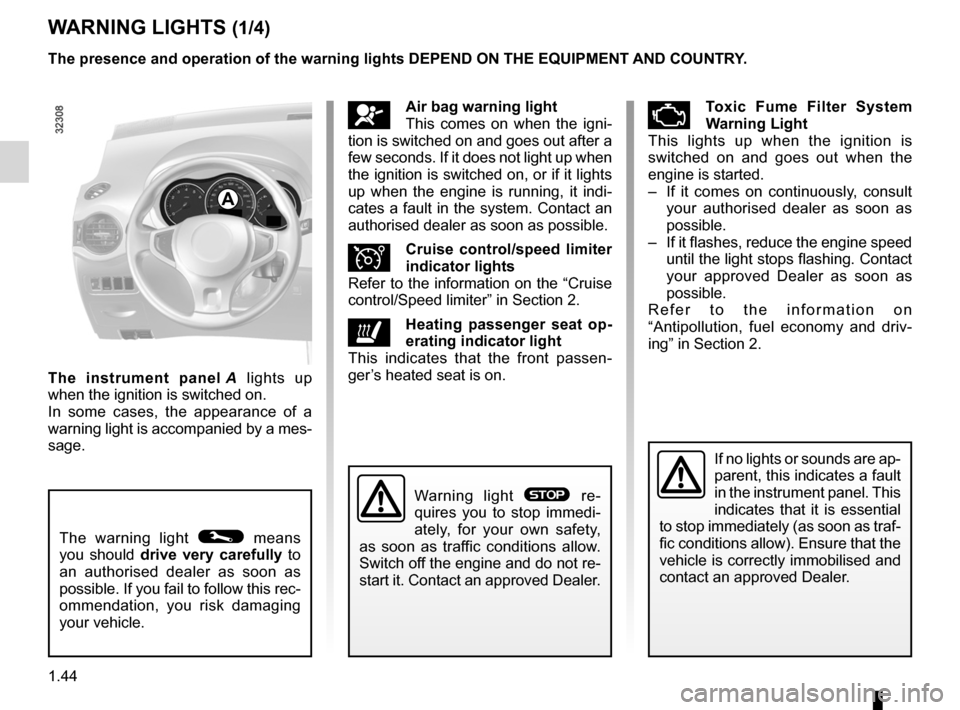
The instrument panel A lights up
when the ignition is switched on.
In some cases, the appearance of a
warning light is accompanied by a mes-
sage. The presence and operation of the warning lights dEpENd ON ThE EQUIpMENT ANd cOUNTRY.
A
Page 63 of 233
JauneNoirNoir texte
1.57
ENG_UD27277_8
Ordinateur de bord (X45 - H45 - Renault)
ENG_NU_977-2_H45_Ph2_Renault_1
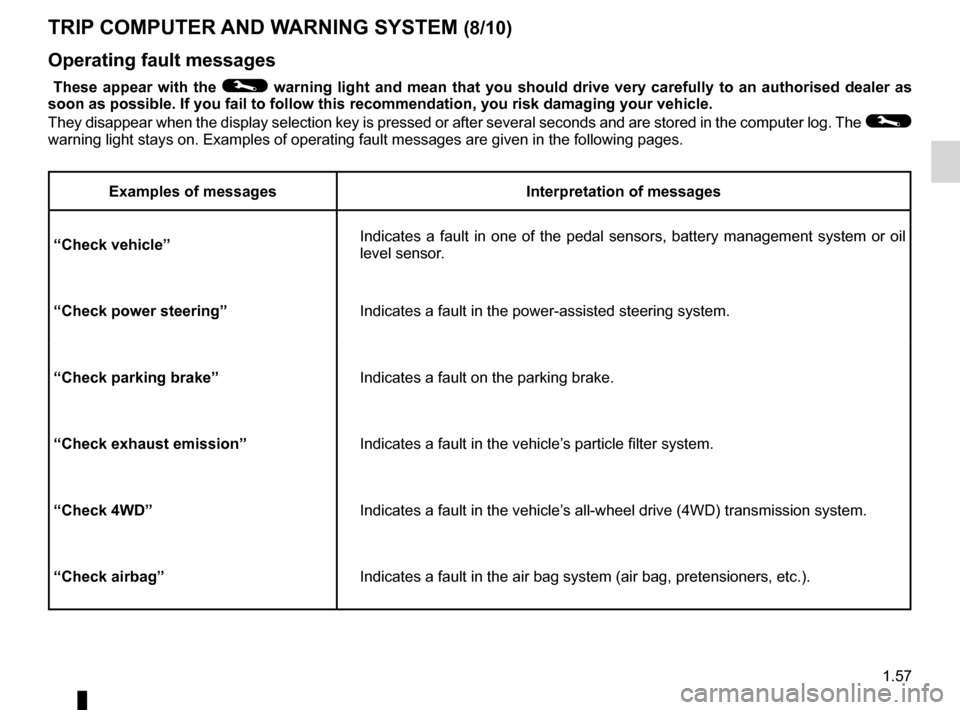
Operating fault messages
These appear with the © warning light and mean that you should drive very carefully to an authorised dealer as
soon as possible. If you fail to follow this recommendation, you risk damaging your vehicle.
They disappear when the display selection key is pressed or after several seconds and are stored in the computer log. The
©
warning light stays on. Examples of operating fault messages are given in the following pages.
Examples of messages Interpretation of messages
“check vehicle” Indicates a fault in one of the pedal sensors, battery management system or oil
level sensor.
“check power steering” Indicates a fault in the power-assisted steering system.
“check parking brake” Indicates a fault on the parking brake.
“check exhaust emission” Indicates a fault in the vehicle’s particle filter system.
“check 4Wd” Indicates a fault in the vehicle’s all-wheel drive (4WD) transmission system.
“check airbag” Indicates a fault in the air bag system (air bag, pretensioners, etc.).
TRIp cOMpUTER ANd WARNINg sYsTEM (8/10)
Page 69 of 233
lighting:exterior ............................................ (up to the end of the DU)
instrument panel ................................... (up to the end of the DU)
lights: side lights ........................................ (up to the end of the DU)
lights: dipped beam headlights .................. (up to the end of the DU)
hazard warning lights signal ................. (up to the end of the DU)
signals and lights .................................. (up to the end of the DU)
lighting: instrument panel ............................. (up to the end of the DU)
1.63
ENG_UD23490_3
Eclairages et signalisations extérieures (X45 - H45 - Renault)
ENG_NU_977-2_H45_Ph2_Renault_1
Exterior lighting and signals
EXTERIOR LIghTINg ANd sIgNALs (1/3)
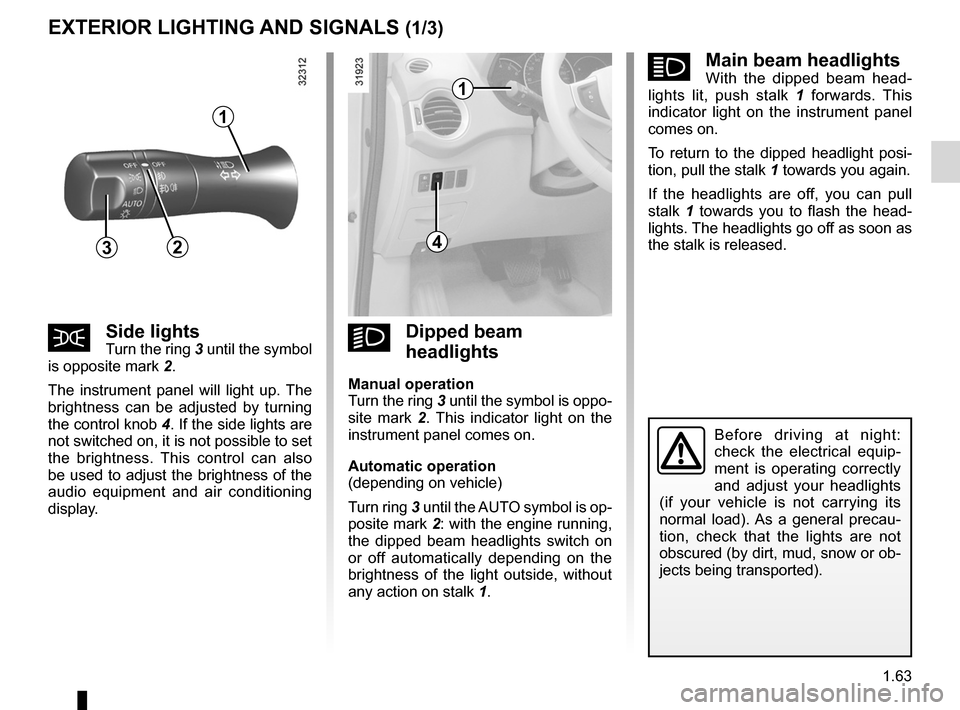
kdipped beam
headlights
Manual operation
Turn the ring 3 until the symbol is oppo -
site mark 2 . This indicator light on the
instrument panel comes on.
Automatic operation
(depending on vehicle)
Turn ring 3 until the AUTO symbol is op-
posite mark 2: with the engine running,
the dipped beam headlights switch on
or off automatically depending on the
brightness of the light outside, without
any action on stalk 1.
šside lightsTurn the ring 3 until the symbol
is opposite mark 2.
The instrument panel will light up. The
brightness can be adjusted by turning
the control knob 4. If the side lights are
not switched on, it is not possible to set
the brightness. This control can also
be used to adjust the brightness of the
audio equipment and air conditioning
display.
áMain beam headlightsWith the dipped beam head -
lights lit, push stalk 1 forwards. This
indicator light on the instrument panel
comes on.
To return to the dipped headlight posi-
tion, pull the stalk 1 towards you again.
If the headlights are off, you can pull
stalk 1 towards you to flash the head -
lights. The headlights go off as soon as
the stalk is released.
Before driving at night:
check the electrical equip -
ment is operating correctly
and adjust your headlights
(if your vehicle is not carrying its
normal load). As a general precau -
tion, check that the lights are not
obscured (by dirt, mud, snow or ob-
jects being transported).
1
432
1
Page 70 of 233
lightsmobile directional ............................................. (current page)
see-me-home lighting ............................................ (current page)
lights-on warning buzzer ........................................ (current page)
1.64
ENG_UD23490_3
Eclairages et signalisations extérieures (X45 - H45 - Renault)
ENG_NU_977-2_H45_Ph2_Renault_1
Jaune NoirNoir texte
EXTERIOR LIghTINg ANd sIgNALs (2/3)
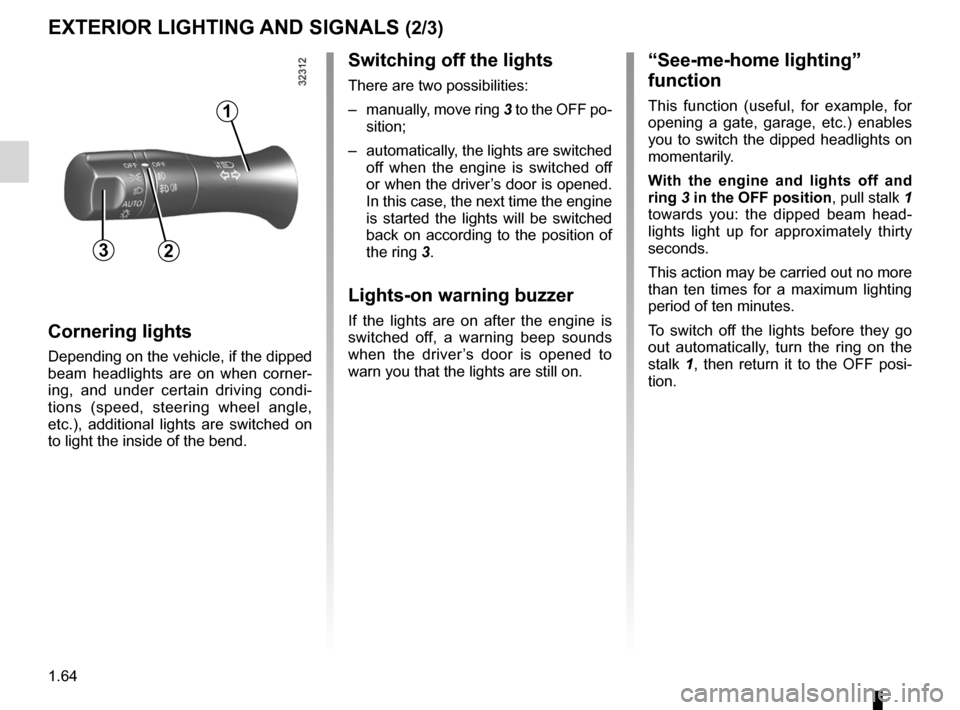
cornering lights
Depending on the vehicle, if the dipped
beam headlights are on when corner -
ing, and under certain driving condi -
tions (speed, steering wheel angle,
etc.), additional lights are switched on
to light the inside of the bend.
switching off the lights
There are two possibilities:
– manually, move ring 3 to the OFF po-
sition;
– automatically, the lights are switched
off when the engine is switched off
or when the driver’s door is opened.
In this case, the next time the engine
is started the lights will be switched
back on according to the position of
the ring 3.
Lights-on warning buzzer
If the lights are on after the engine is
switched off, a warning beep sounds
when the driver ’s door is opened to
warn you that the lights are still on.
“see-me-home lighting”
function
This function (useful, for example, for
opening a gate, garage, etc.) enables
you to switch the dipped headlights on
momentarily.
With the engine and lights off and
ring 3 in the Off position , pull stalk 1
towards you: the dipped beam head -
lights light up for approximately thirty
seconds.
This action may be carried out no more
than ten times for a maximum lighting
period of ten minutes.
To switch off the lights before they go
out automatically, turn the ring on the
stalk 1 , then return it to the OFF posi -
tion.
32
1
Page 71 of 233
lights:fog lights .......................................................... (current page)
JauneNoirNoir texte
1.65
ENG_UD23490_3
Eclairages et signalisations extérieures (X45 - H45 - Renault)
ENG_NU_977-2_H45_Ph2_Renault_1
EXTERIOR LIghTINg ANd sIgNALs (3/3)
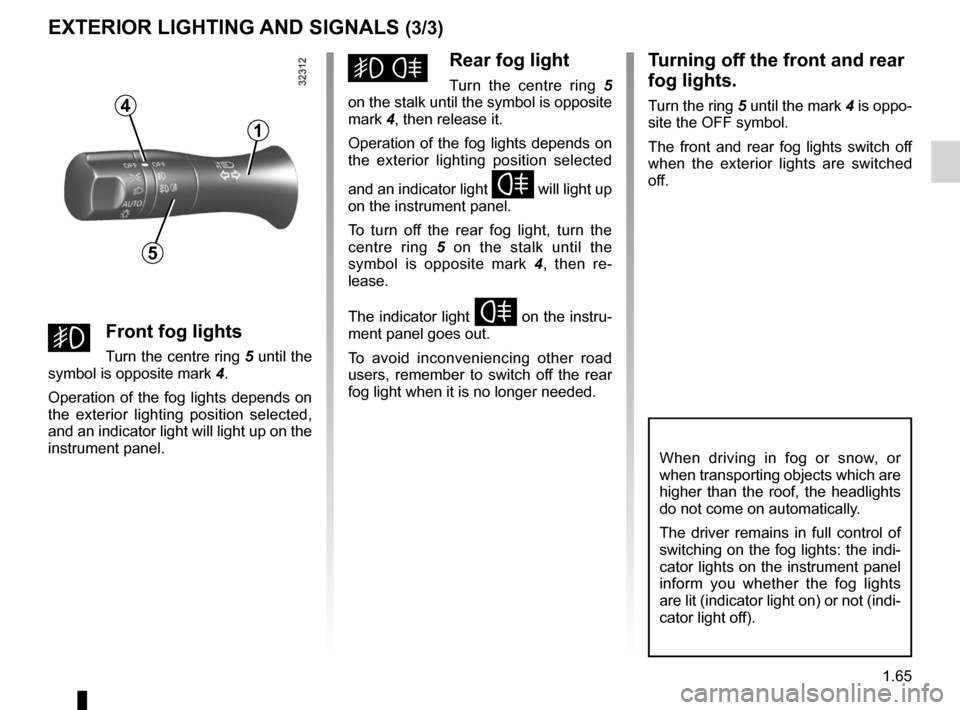
gfront fog lights
Turn the centre ring 5 until the
symbol is opposite mark 4.
Operation of the fog lights depends on
the exterior lighting position selected,
and an indicator light will light up on the
instrument panel.
hRear fog light
Turn the centre ring 5
on the stalk until the symbol is opposite
mark 4, then release it.
Operation of the fog lights depends on
the exterior lighting position selected
and an indicator light
f will light up
on the instrument panel.
To turn off the rear fog light, turn the
centre ring 5 on the stalk until the
symbol is opposite mark 4 , then re -
lease.
The indicator light
f on the instru-
ment panel goes out.
To avoid inconveniencing other road
users, remember to switch off the rear
fog light when it is no longer needed.
Turning off the front and rear
fog lights.
Turn the ring 5 until the mark 4 is oppo-
site the OFF symbol.
The front and rear fog lights switch off
when the exterior lights are switched
off.
When driving in fog or snow, or
when transporting objects which are
higher than the roof, the headlights
do not come on automatically.
The driver remains in full control of
switching on the fog lights: the indi-
cator lights on the instrument panel
inform you whether the fog lights
are lit (indicator light on) or not (indi-
cator light off).
4
1
5
Page 82 of 233
2.4
ENG_UD27279_4
D marrage du moteur (X45 - H45 - obsol te - Renault)
ENG_NU_977-2_H45_Ph2_Renault_2
STARTING THE ENGINE (2/2)
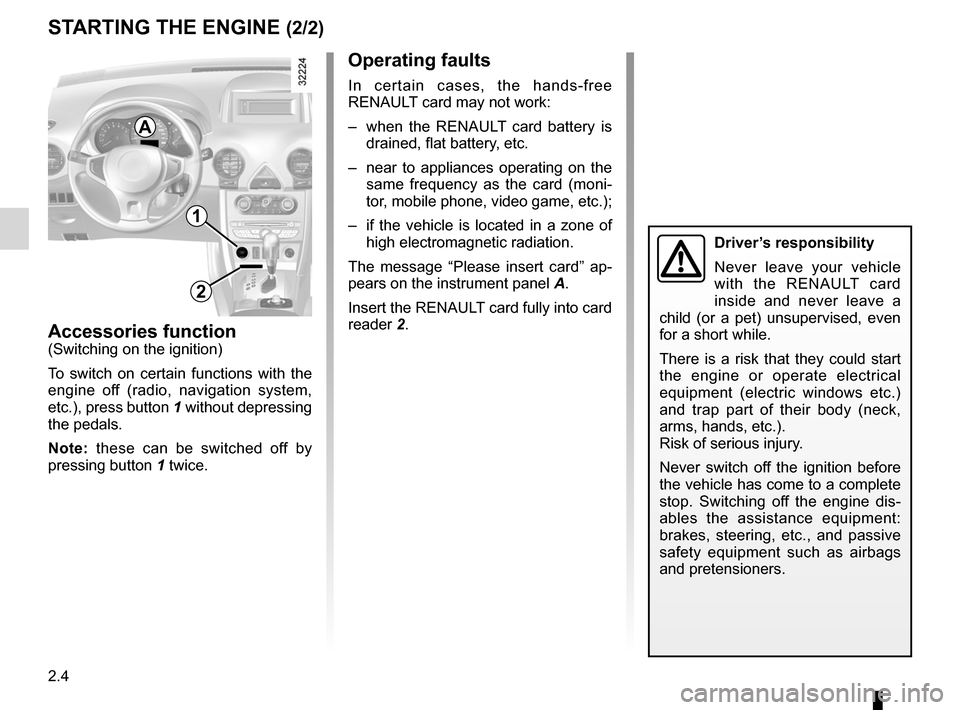
Accessories function(Switching on the ignition)
To switch on certain functions with the
engine off (radio, navigation system,
etc.), press button 1 without depressing
the pedals.
Note: these can be switched off by
pressing button 1 twice.
1
2
Operating faults
In certain cases, the hands-free
RENAULT card may not work:
– when the RENAULT card battery is
drained, flat battery, etc.
– near to appliances operating on the
same frequency as the card (moni -
tor, mobile phone, video game, etc.);
– if the vehicle is located in a zone of
high electromagnetic radiation.
The message “ Please insert card ” ap-
pears on the instrument panel A.
Insert the RENAULT card fully into card
reader 2.
A
Driver’s responsibility
Never leave your vehicle
with the RENAULT card
inside and never leave a
child (or a pet) unsupervised, even
for a short while.
There is a risk that they could start
the engine or operate electrical
equipment (electric windows etc.)
and trap part of their body (neck,
arms, hands, etc.).
Risk of serious injury.
Never switch off the ignition before
the vehicle has come to a complete
stop. Switching off the engine dis -
ables the assistance equipment:
brakes, steering, etc., and passive
safety equipment such as airbags
and pretensioners.
Page 83 of 233
stopping the engine .............................. (up to the end of the DU)
driving ................................................... (up to the end of the DU)
2.5
ENG_UD27287_4
Arr t du moteur (X45 - H45 - Renault)
ENG_NU_977-2_H45_Ph2_Renault_2
Stopping the engine
STOPPING THE ENGINE
Special note
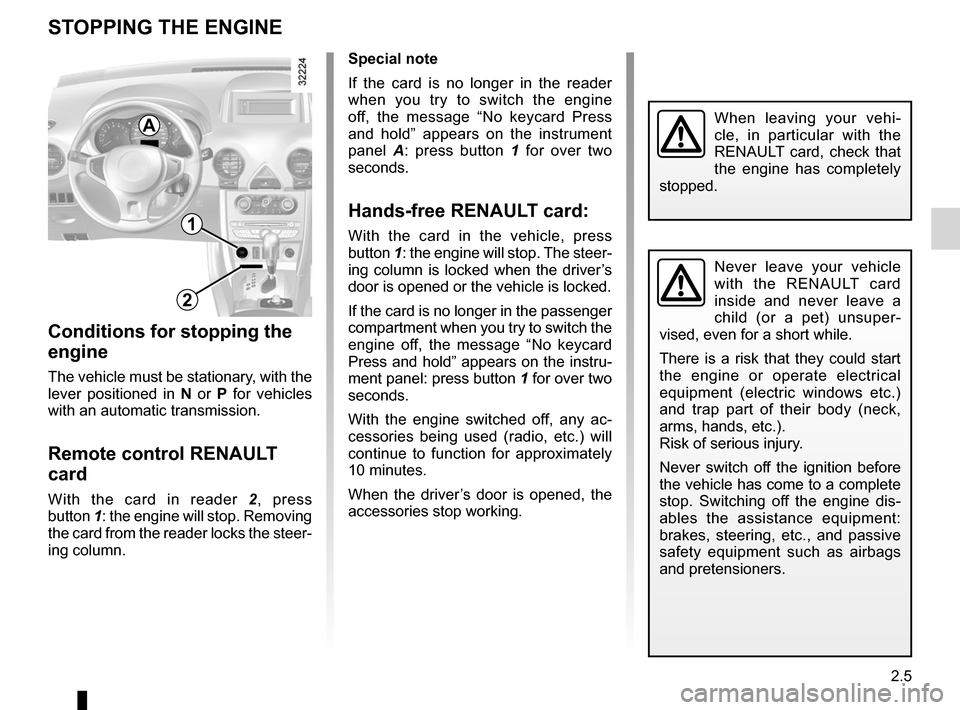
If the card is no longer in the reader
when you try to switch the engine
off, the message “ No keycard Press
and hold ” appears on the instrument
panel A : press button 1 for over two
seconds.
Hands-free RENAULT card:
With the card in the vehicle, press
button 1: the engine will stop. The steer-
ing column is locked when the driver’s
door is opened or the vehicle is locked.
If the card is no longer in the passenger
compartment when you try to switch the
engine off, the message “ No keycard
Press and hold ” appears on the instru-
ment panel: press button 1 for over two
seconds.
With the engine switched off, any ac -
cessories being used (radio, etc.) will
continue to function for approximately
10 minutes.
When the driver’s door is opened, the
accessories stop working.
Conditions for stopping the
engine
The vehicle must be stationary, with the
lever positioned in N or P for vehicles
with an automatic transmission.
Remote control RENAULT
card
With the card in reader 2, press
button 1: the engine will stop. Removing
the card from the reader locks the steer-
ing column.
Never leave your vehicle
with the RENAULT card
inside and never leave a
child (or a pet) unsuper -
vised, even for a short while.
There is a risk that they could start
the engine or operate electrical
equipment (electric windows etc.)
and trap part of their body (neck,
arms, hands, etc.).
Risk of serious injury.
Never switch off the ignition before
the vehicle has come to a complete
stop. Switching off the engine dis -
ables the assistance equipment:
brakes, steering, etc., and passive
safety equipment such as airbags
and pretensioners.
When leaving your vehi -
cle, in particular with the
RENAULT card, check that
the engine has completely
stopped.
1
2
A
Page 84 of 233
special features of petrol vehicles ........ (up to the end of the DU)
driving ................................................... (up to the end of the DU)
catalytic converter ................................. (up to the end of the DU)
2.6
ENG_UD20970_4
Particularit s des versions essence (X45 - H45 - X81 - X95 - B95 - D95 - Renault)
ENG_NU_977-2_H45_Ph2_Renault_2
Special features of petrol versions
SPECIAL FEATURES OF PETROL vERSIONS
Do not park the vehicle or
run the engine in locations
where combustible sub -
stances or materials such
as grass or leaves can come into
contact with the hot exhaust system.
The following operating conditions
should be avoided:
– driving for long periods when the low
fuel level warning light is lit up,
– using leaded petrol,
– using fuel or lubrication additives
which are not approved.
Or operating faults such as:
– faulty ignition system, running out of
fuel or disconnected spark plugs re-
sulting in the engine misfiring or cut-
ting out when driving;
– loss of power,
may cause the catalytic converter to
overheat, reducing its efficiency which
may irreparably damage it and cause
heat damage to the vehicle. If you notice any of the above operating
faults, have the necessary repairs car-
ried out as soon as possible by an ap-
proved dealer.
These faults may be avoided by regu
-
larly taking your vehicle to an approved
Dealer at the intervals specified in the
Maintenance Service Booklet.
Starting problems
To avoid damaging the catalytic con -
verter, do not keep trying to start the
engine (using the start button, or by
pushing or towing the vehicle) without
having identified and corrected the
cause of the fault.
If the fault cannot be identified, do not
continue to try and start the engine, but
contact an approved dealer.
Page 92 of 233
driving ................................................... (up to the end of the DU)
fuel economy ........................................ (up to the end of the DU)
advice on antipollution .......................... (up to the end of the DU)
antipollution advice .............................................................. (current page)
fuel advice on fuel economy ................................... (current page)
2.14
ENG_UD27288_2
Conseils : antipollution, conomies de carburant, conduite (X45 - H45 - Renault)
ENG_NU_977-2_H45_Ph2_Renault_2
Jaune NoirNoir texte
Advice: antipollution and fuel economy
ADvICE: antipollution, fuel economy and driving (1/3)
Your vehicle complies with criteria for
recycling and recovering vehicles at the
end of their service life which will come
into force in 2015.
Some parts of your vehicle have there-
fore been designed to facilitate future
recycling.
These parts are easy to remove so
that they can be recovered and reproc-
essed by recycling companies.
By virtue of its design, moderate fuel
consumption and initial settings, your
vehicle also conforms to current anti-
pollution regulations. The manufac -
turer is actively striving to reduce pol -
lutant exhaust gas emissions and to
save energy. But the fuel consumption
of your vehicle and the level of pollutant
exhaust gas emissions are also your
responsibility. Ensure that it is main -
tained and used correctly.Aiding fuel economyDepending on the vehicle, in order to
optimise consumption, an indicator light
on the instrument panel will inform you
of the best moment to upshift or down -
shift gears:
\ shift up a gear;
[ shift down a gear.
MaintenanceIt is important to remember that failure to
respect antipollution regulations could
lead to legal action being taken against
the vehicle owner. In addition, replacing
engine, fuel supply system and exhaust
components with parts other than those
originally recommended by the manu -
facturer may alter your vehicle so that
it no longer complies with antipollution
regulations. Have your vehicle adjusted and
checked by an approved Dealer, in ac-
cordance with the instructions given in
your maintenance schedule: they will
have all the equipment necessary for
ensuring that your vehicle is maintained
to its original standard.
Engine adjustments
–
ignition: this does not require ad -
justment.
– spark plugs: for optimum fuel econ-
omy, efficiency and performance
the specifications laid down by our
Design Department must be strictly
applied.
If the spark plugs have to be
changed, use the make, type and
gap specified for your vehicle’s
engine. Contact an approved dealer
for this.
– idle: this does not require adjust -
ment.
– air filter, diesel filter: a clogged ele-
ment reduces performance. It must
be replaced.
Page 94 of 233
2.16
ENG_UD27288_2
Conseils : antipollution, conomies de carburant, conduite (X45 - H45 - Renault)
ENG_NU_977-2_H45_Ph2_Renault_2
ADvICE: antipollution, fuel economy and driving (3/3)
Advice on use
– Electricity is fuel; switch off all the
electrical components which are
not really needed. However (safety
first), keep your lights on when the
visibility is bad (“see and be seen”).
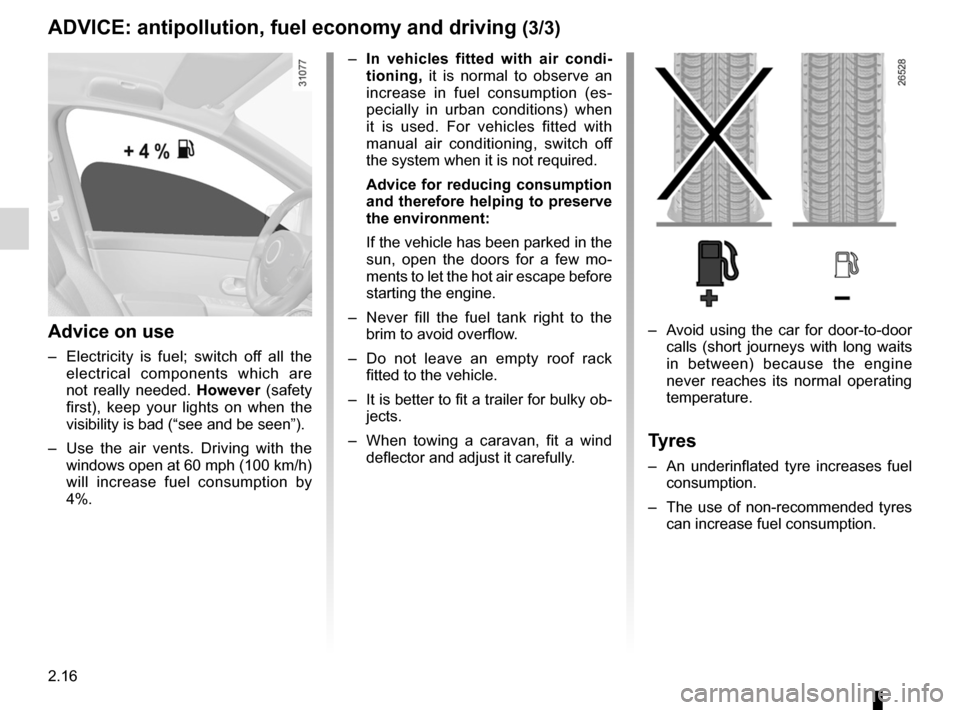
– Use the air vents. Driving with the
windows open at 60 mph (100 km/h)
will increase fuel consumption by
4%.
– Avoid using the car for door-to-door
calls (short journeys with long waits
in between) because the engine
never reaches its normal operating
temperature.
Tyres
– An underinflated tyre increases fuel
consumption.
– The use of non-recommended tyres
can increase fuel consumption.
–
In vehicles fitted with air condi -
tioning, it is normal to observe an
increase in fuel consumption (es -
pecially in urban conditions) when
it is used. For vehicles fitted with
manual air conditioning, switch off
the system when it is not required.
Advice for reducing consumption
and therefore helping to preserve
the environment:
If the vehicle has been parked in the
sun, open the doors for a few mo -
ments to let the hot air escape before
starting the engine.
– Never fill the fuel tank right to the
brim to avoid overflow.
– Do not leave an empty roof rack
fitted to the vehicle.
– It is better to fit a trailer for bulky ob-
jects.
– When towing a caravan, fit a wind
deflector and adjust it carefully.