weight RENAULT KOLEOS 2015 1.G Owners Manual
[x] Cancel search | Manufacturer: RENAULT, Model Year: 2015, Model line: KOLEOS, Model: RENAULT KOLEOS 2015 1.GPages: 232, PDF Size: 18.18 MB
Page 39 of 232
JauneNoir Noir texte
39
ENG_UD23487_5
Sécurité enfants : installation du siège enfant (X45 - H45 - Renault) ENG_NU_1057-1_H45_Ph3_Renault_1
CHILD SAFETY: fitting a child seat (3/3)
(5) RISK OF DEATH OR SERIOUS INJURY: before fitting a rear-facing child seat in the front passenger seat, check
that the air bag has been deactivated (refer to the information on “Child safety: deactivating/activating the front pas-
senger air bag” at the end of the paragraph).
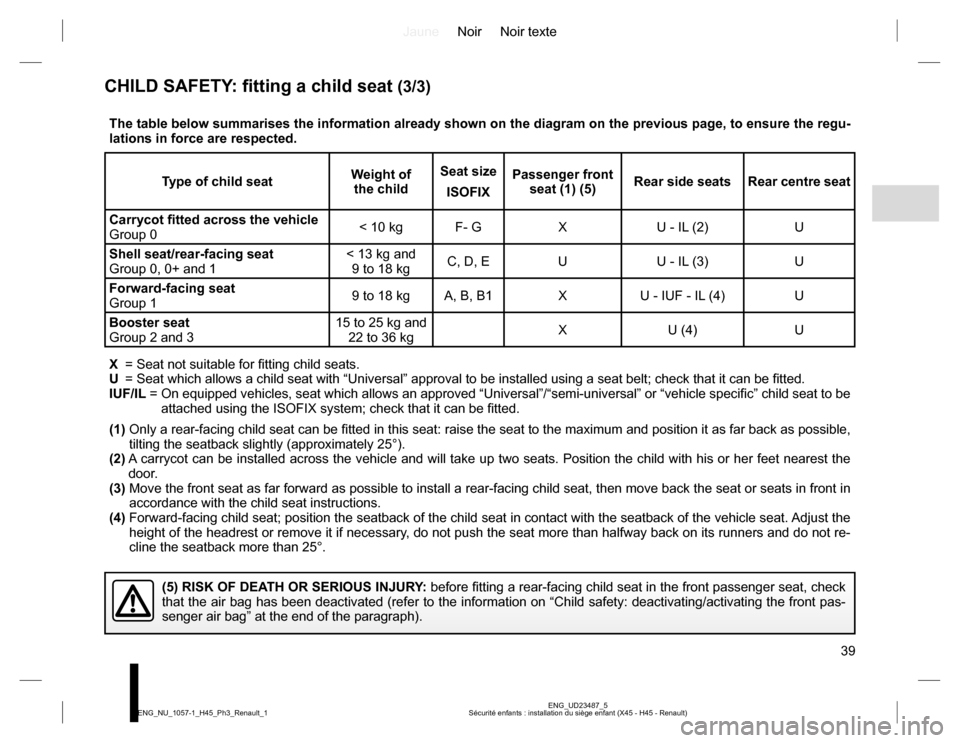
The table below summarises the information already shown on the diagram on the previous page, to ensure the regu-
lations in force are respected.
Type of child seatWeight of
the childSeat size
ISOFIXPassenger front
seat (1) (5)Rear side seats Rear centre seat
Carrycot fitted across the vehicle
Group 0< 10 kg F- G X U - IL (2) U
Shell seat/rear-facing seat
Group 0, 0+ and 1< 13 kg and
9 to 18 kgC, D, E U U - IL (3) U
Forward-facing seat
Group 19 to 18 kg A, B, B1 X U - IUF - IL (4) U
Booster seat
Group 2 and 315 to 25 kg and
22 to 36 kgX U (4) U
X = Seat not suitable for fitting child seats.
U = Seat which allows a child seat with “Universal” approval to be installed using a seat belt; check that it can be fitted.
IUF/IL =
On equipped vehicles, seat which allows an approved “Universal”/“semi-universal” or “vehicle specific” child seat to be
attached using the ISOFIX system; check that it can be fitted.
(1) Only a rear-facing child seat can be fitted in this seat: raise the seat to the maximum and position it as far back as possible,
tilting the seatback slightly (approximately 25°).
(2) A carrycot can be installed across the vehicle and will take up two seats. Position the child with his or her feet nearest the
door.
(3) Move the front seat as far forward as possible to install a rear-facing child seat, then move back the seat or seats in front in
accordance with the child seat instructions.
(4) Forward-facing child seat; position the seatback of the child seat in contact with the seatback of the vehicle seat. Adjust the
height of the headrest or remove it if necessary, do not push the seat more than halfway back on its runners and do not re-
cline the seatback more than 25°.
Page 151 of 232
JauneNoir Noir texte
151
ENG_UD23903_4
Coffre à bagages (X45 - H45 - Renault) ENG_NU_1057-1_H45_Ph3_Renault_3
LUGGAGE COMPARTMENT (1/2)
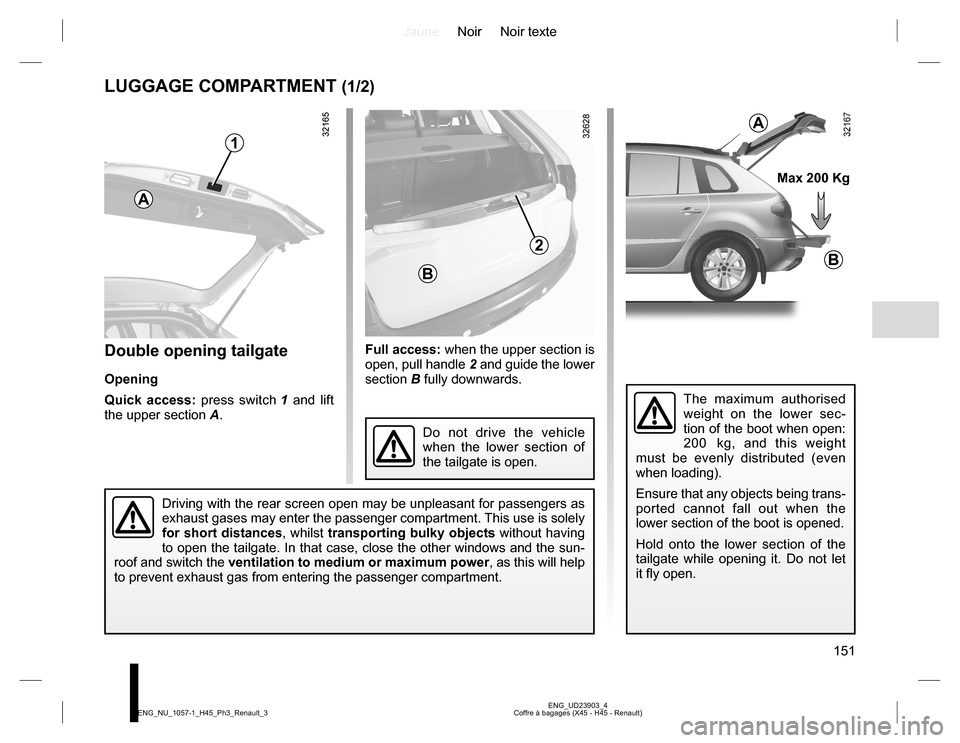
Double opening tailgate
Opening
Quick access: press switch 1 and lift
the upper section A.
1
Max 200 Kg
2
Full access: when the upper section is
open, pull handle 2 and guide the lower
section B fully downwards.
Driving with the rear screen open may be unpleasant for passengers as
exhaust gases may enter the passenger compartment. This use is solely
for short distances, whilst transporting bulky objects without having
to open the tailgate. In that case, close the other windows and the sun-
roof and switch the ventilation to medium or maximum power, as this will help
to prevent exhaust gas from entering the passenger compartment.
Do not drive the vehicle
when the lower section of
the tailgate is open.
The maximum authorised
weight on the lower sec-
tion of the boot when open:
200 kg, and this weight
must be evenly distributed (even
when loading).
Ensure that any objects being trans-
ported cannot fall out when the
lower section of the boot is opened.
Hold onto the lower section of the
tailgate while opening it. Do not let
it fly open.
A
B
A
B
Page 154 of 232
JauneNoir Noir texte
154
ENG_UD23502_5 Transport d’objets dans le coffre, remorquage (attelage) (X45 - H45 - Renault) ENG_NU_1057-1_H45_Ph3_Renault_3
32323
TRANSPORTING OBJECTS IN THE LUGGAGE COMPARTMENT/TOWING (towing equipment)
B
C
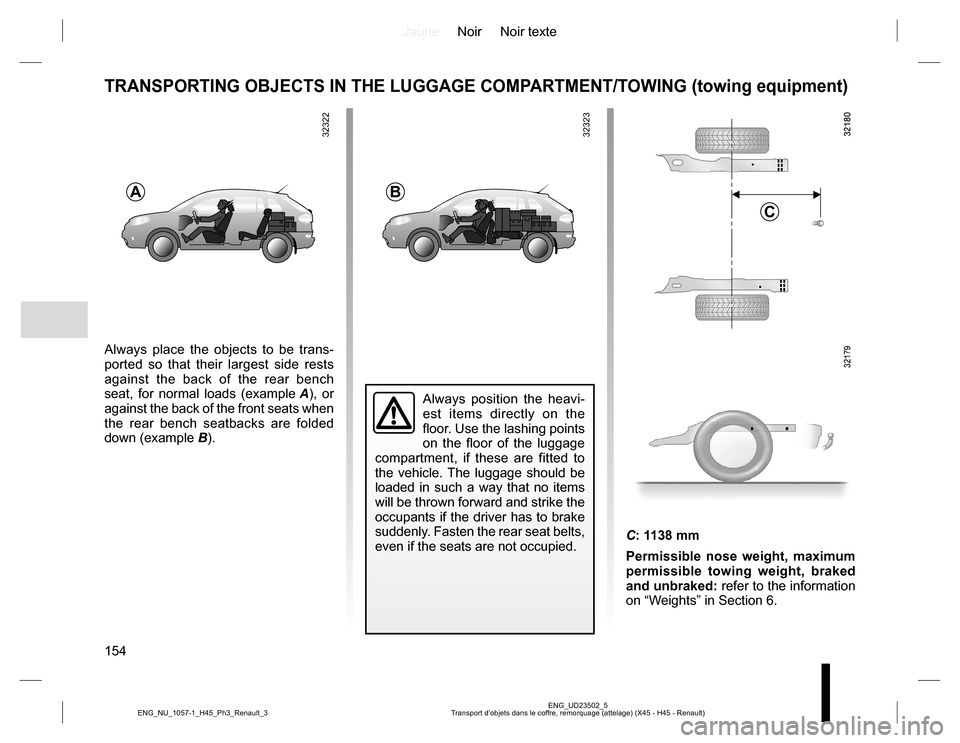
Always place the objects to be trans- ported so that their largest side rests against the back of the rear bench seat, for normal loads (example A), or against the back of the front seats when the rear bench seatbacks are folded down (example B).
A
Always position the heavi- est items directly on the floor. Use the lashing points on the floor of the luggage compartment, if these are fitted to the vehicle. The luggage should be loaded in such a way that no items will be thrown forward and strike the occupants if the driver has to brake suddenly. Fasten the rear seat belts, even if the seats are not occupied.C : 1138 mm
Permissible nose weight, maximum permissible towing weight, braked and unbraked: refer to the information on “Weights” in Section 6.
32322
Page 156 of 232
JauneNoir Noir texte
156
ENG_UD28707_5
Barres de toit (X45 - H45 - Renault) ENG_NU_1057-1_H45_Ph3_Renault_3
ROOF BARS
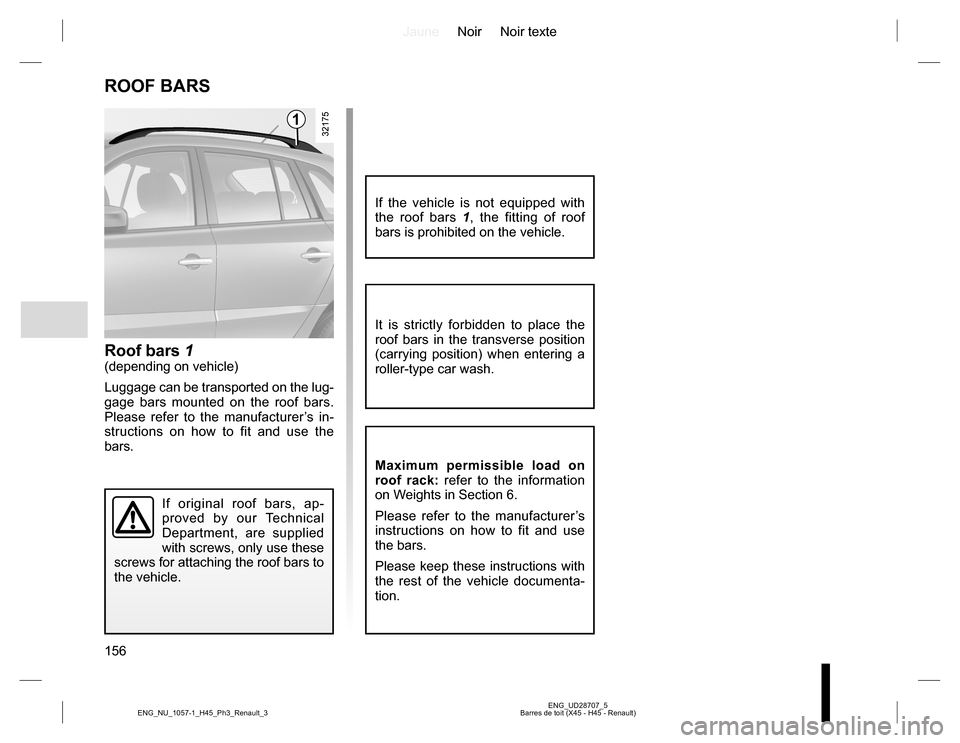
Roof bars 1(depending on vehicle)
Luggage can be transported on the lug-
gage bars mounted on the roof bars.
Please refer to the manufacturer’s in-
structions on how to fit and use the
bars.
1
Maximum permissible load on
roof rack: refer to the information
on Weights in Section 6.
Please refer to the manufacturer’s
instructions on how to fit and use
the bars.
Please keep these instructions with
the rest of the vehicle documenta-
tion.
It is strictly forbidden to place the
roof bars in the transverse position
(carrying position) when entering a
roller-type car wash.
If original roof bars, ap-
proved by our Technical
Department, are supplied
with screws, only use these
screws for attaching the roof bars to
the vehicle.
If the vehicle is not equipped with
the roof bars 1, the fitting of roof
bars is prohibited on the vehicle.
Page 160 of 232
JauneNoir Noir texte
160
ENG_UD23503_5
Capot moteur (X45 - H45 - Renault) ENG_NU_1057-1_H45_Ph3_Renault_4
Opening the bonnet
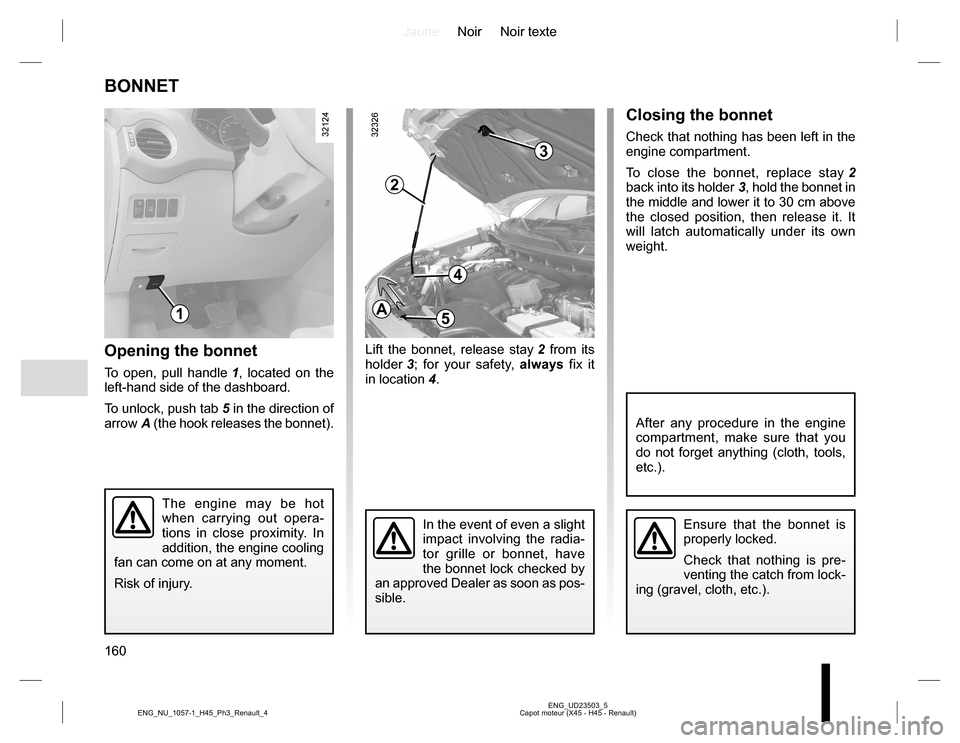
To open, pull handle 1, located on the
left-hand side of the dashboard.
To unlock, push tab 5 in the direction of
arrow A (the hook releases the bonnet).
BONNET
The engine may be hot
when carrying out opera-
tions in close proximity. In
addition, the engine cooling
fan can come on at any moment.
Risk of injury.
In the event of even a slight
impact involving the radia-
tor grille or bonnet, have
the bonnet lock checked by
an approved Dealer as soon as pos-
sible.
15A
Closing the bonnet
Check that nothing has been left in the
engine compartment.
To close the bonnet, replace stay 2
back into its holder 3, hold the bonnet in
the middle and lower it to 30 cm above
the closed position, then release it. It
will latch automatically under its own
weight.
Ensure that the bonnet is
properly locked.
Check that nothing is pre-
venting the catch from lock-
ing (gravel, cloth, etc.).
After any procedure in the engine
compartment, make sure that you
do not forget anything (cloth, tools,
etc.).
Lift the bonnet, release stay 2 from its
holder 3; for your safety, always fix it
in location 4.
2
3
4
Page 168 of 232
JauneNoir Noir texte
168
ENG_UD31480_3
Pressions de gonflage des pneumatiques (X45 - H45 - Renault) ENG_NU_1057-1_H45_Ph3_Renault_4
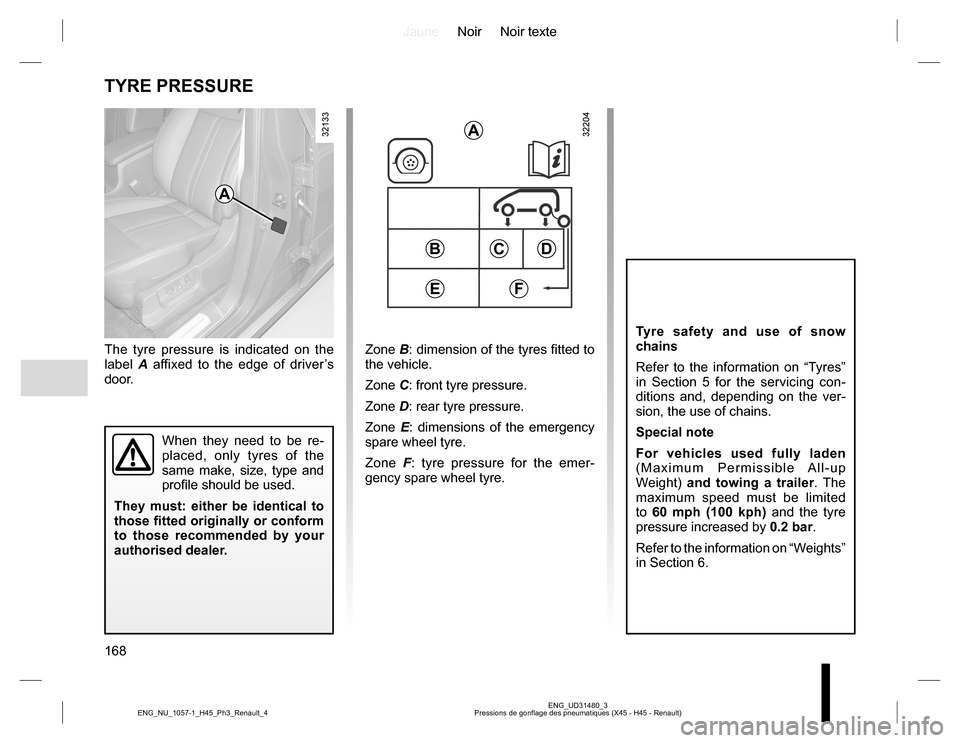
The tyre pressure is indicated on the
label A affixed to the edge of driver’s
door.Zone B: dimension of the tyres fitted to
the vehicle.
Zone C: front tyre pressure.
Zone D: rear tyre pressure.
Zone E: dimensions of the emergency
spare wheel tyre.
Zone F: tyre pressure for the emer-
gency spare wheel tyre.
A
A
BCD
EF
TYRE PRESSURE
Tyre safety and use of snow
chains
Refer to the information on “Tyres”
in Section 5 for the servicing con-
ditions and, depending on the ver-
sion, the use of chains.
Special note
For vehicles used fully laden
(Maximum Permissible All-up
Weight) and towing a trailer. The
maximum speed must be limited
to 60 mph (100 kph) and the tyre
pressure increased by 0.2 bar.
Refer to the information on “Weights”
in Section 6.
When they need to be re-
placed, only tyres of the
same make, size, type and
profile should be used.
They must: either be identical to
those fitted originally or conform
to those recommended by your
authorised dealer.
Page 199 of 232
JauneNoir Noir texte
199
ENG_UD31483_4
Remorquage : d pannage (X45 - H45 - Renault) ENG_NU_1057-1_H45_Ph3_Renault_5
TOWING: breakdown (1/4)
Towing procedure
Before any towing, check that the steer-
ing column is not locked.
If it is locked, insert the RENAULT card
into the reader and press the Start/Stop
button twice without pressing on the
pedals. The steering column unlocks,
the vehicle accessory functions are
supplied with power and you can use
the lights (stop lights, directional indica-
tor lights, etc.): the vehicle must have
its lights on at night.
Do not remove the RENAULT card from
the reader when the vehicle is being
towed.
Press the Start/Stop button twice in
succession to switch off the ignition
once towing is finished (risk of running
down the battery).
Furthermore, it is essential to respect
the towing regulations set out in the leg-
islation of the country concerned and, if
your vehicle is the towing vehicle, not to
exceed the towing weight of your vehi-
cle. Contact your approved Dealer.
Page 209 of 232
JauneNoir Noir texte
209
ENG_UD31513_3
Contents 6 (X45 - H45 - Renault) ENG_NU_1057-1_H45_Ph3_Renault_6
Section 6: Technical specifications
Vehicle identification plates . . . . . . . . . . . . . . . . . . . . . . . . . . . . . . . . . . . . . . . . . . . . . . . . . . . . . . . . 210
Dimensions . . . . . . . . . . . . . . . . . . . . . . . . . . . . . . . . . . . . . . . . . . . . . . . . . . . . . . . . . . . . . . . . . . . . 212
Engine specifications . . . . . . . . . . . . . . . . . . . . . . . . . . . . . . . . . . . . . . . . . . . . . . . . . . . . . . . . . . . . . 213
Weights . . . . . . . . . . . . . . . . . . . . . . . . . . . . . . . . . . . . . . . . . . . . . . . . . . . . . . . . . . . . . . . . . . . . . . . 214
Towing weights . . . . . . . . . . . . . . . . . . . . . . . . . . . . . . . . . . . . . . . . . . . . . . . . . . . . . . . . . . . . . . . . . 214
Replacement parts and repairs . . . . . . . . . . . . . . . . . . . . . . . . . . . . . . . . . . . . . . . . . . . . . . . . . . . . . 215
Service sheets . . . . . . . . . . . . . . . . . . . . . . . . . . . . . . . . . . . . . . . . . . . . . . . . . . . . . . . . . . . . . . . . . . 216
Anti-corrosion check . . . . . . . . . . . . . . . . . . . . . . . . . . . . . . . . . . . . . . . . . . . . . . . . . . . . . . . . . . . . . 222
Page 210 of 232
JauneNoir Noir texte
210
ENG_UD31484_6
Plaques d’identification v hicule (X45 - H45 - Renault) ENG_NU_1057-1_H45_Ph3_Renault_6
VEHICLE IDENTIFICATION PLATES
A
B
A
1
2
34
5
678
9
10
11
12
13
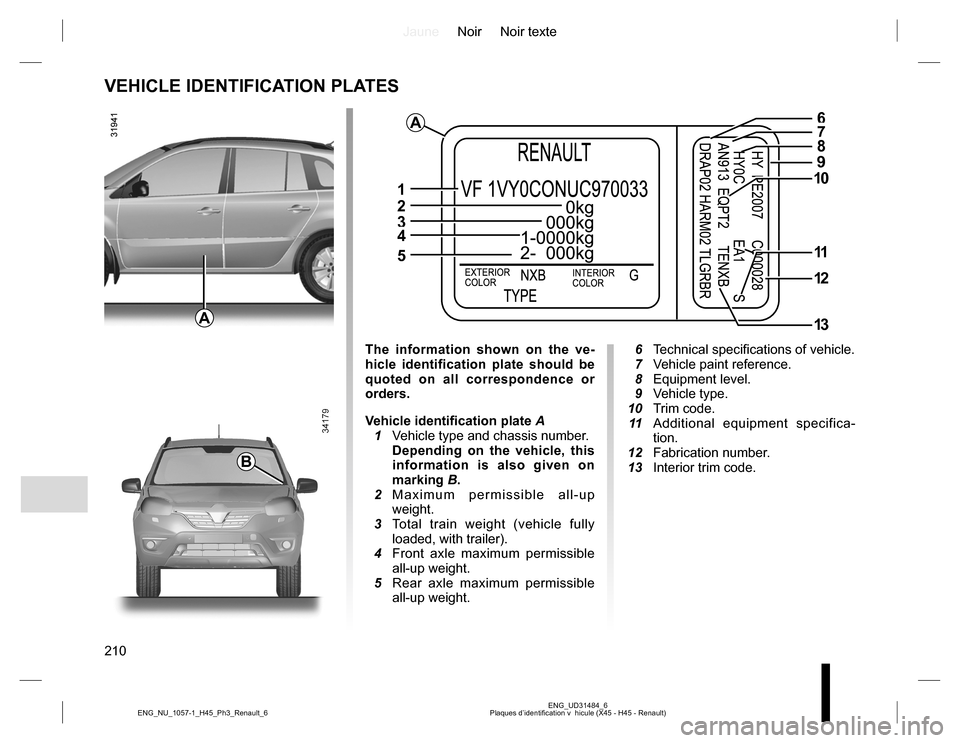
The information shown on the ve-
hicle identification plate should be
quoted on all correspondence or
orders.
Vehicle identification plate A
1 Vehicle type and chassis number.
Depending on the vehicle, this
information is also given on
marking B.
2 Maximum permissible all-up
weight.
3 Total train weight (vehicle fully
loaded, with trailer).
4 Front axle maximum permissible
all-up weight.
5 Rear axle maximum permissible
all-up weight. 6 Technical specifications of vehicle.
7 Vehicle paint reference.
8 Equipment level.
9 Vehicle type.
10 Trim code.
11 Additional equipment specifica-
tion.
12 Fabrication number.
13 Interior trim code.
Page 214 of 232
JauneNoir Noir texte
214
ENG_UD13158_4
Masses (enKg) (X45 - H45 - Renault) ENG_NU_1057-1_H45_Ph3_Renault_6
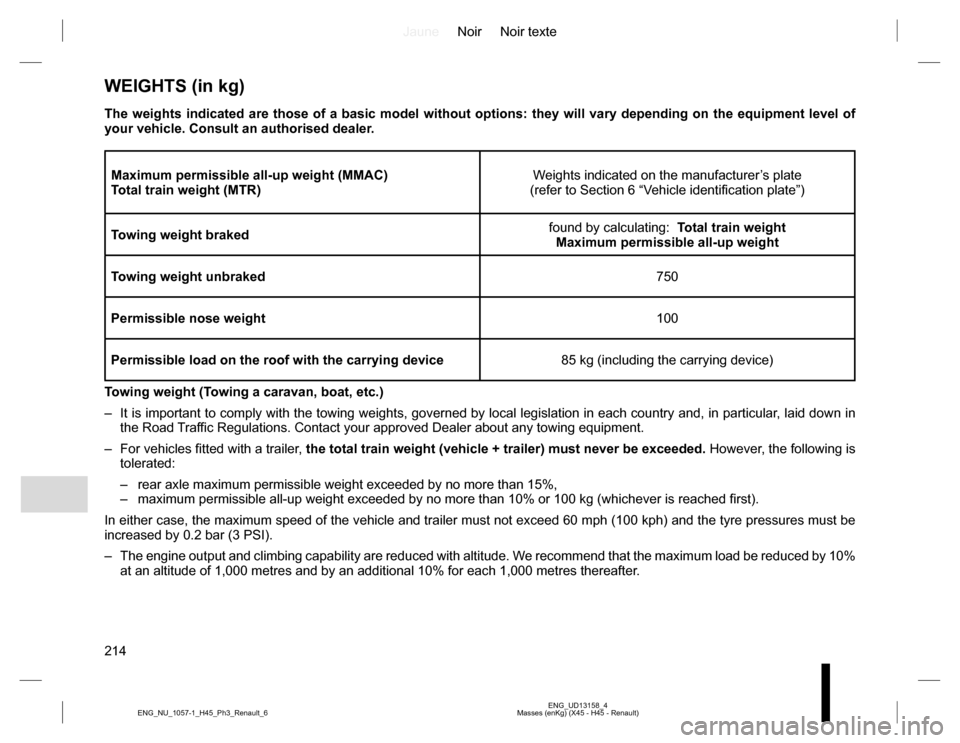
WEIGHTS (in kg)
Maximum permissible all-up weight (MMAC)
Total train weight (MTR)Weights indicated on the manufacturer’s plate
(refer to Section 6 “Vehicle identification plate”)
Towing weight brakedfound by calculating: Total train weight
Maximum permissible all-up weight
Towing weight unbraked750
Permissible nose weight100
Permissible load on the roof with the carrying device85 kg (including the carrying device)
Towing weight (Towing a caravan, boat, etc.)
– It is important to comply with the towing weights, governed by local legislation in each country and, in particular, laid down in
the Road Traffic Regulations. Contact your approved Dealer about any towing equipment.
– For vehicles fitted with a trailer, the total train weight (vehicle + trailer) must never be exceeded. However, the following is
tolerated:
– rear axle maximum permissible weight exceeded by no more than 15%,
– maximum permissible all-up weight exceeded by no more than 10% or 100 kg (whichever is reached first).
In either case, the maximum speed of the vehicle and trailer must not exceed 60 mph (100 kph) and the tyre pressures must be
increased by 0.2 bar (3 PSI).
– The engine output and climbing capability are reduced with altitude. We recommend that the maximum load be reduced by 10%
at an altitude of 1,000 metres and by an additional 10% for each 1,000 metres thereafter. The weights indicated are those of a basic model without options: they will vary depending on the equipment level of
your vehicle. Consult an authorised dealer.