engine RENAULT MASTER 2016 X62 / 2.G User Guide
[x] Cancel search | Manufacturer: RENAULT, Model Year: 2016, Model line: MASTER, Model: RENAULT MASTER 2016 X62 / 2.GPages: 284, PDF Size: 6.69 MB
Page 29 of 284
1.23
SEAT BELTS (2/3)
5
34
5
1
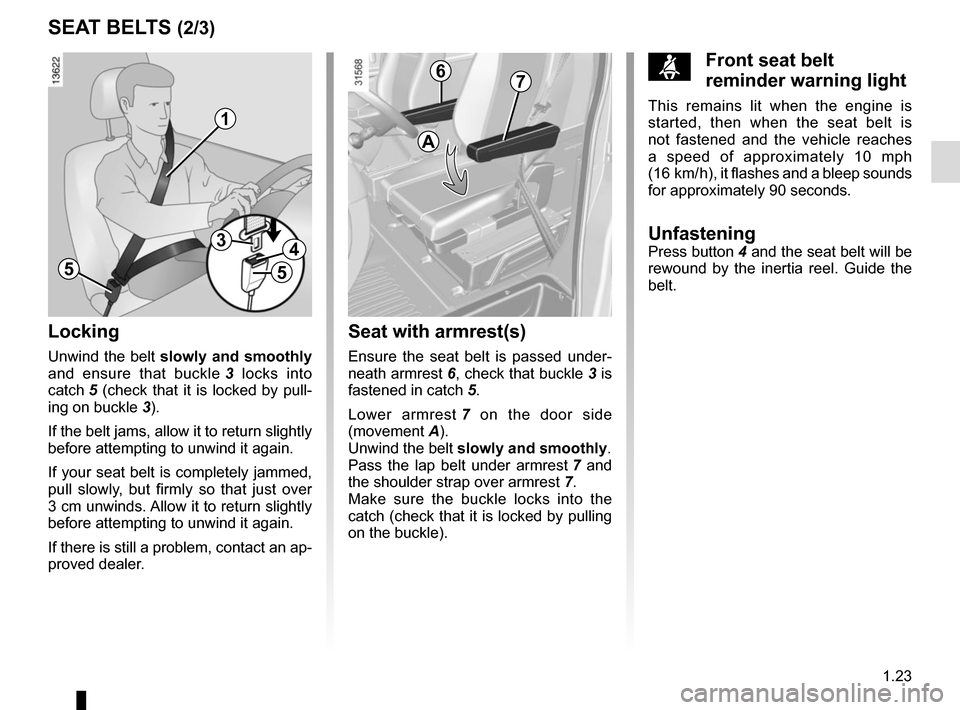
Locking
Unwind the belt slowly and smoothly
and ensure that buckle 3 locks into
catch 5 (check that it is locked by pull- ing on buckle 3).
If the belt jams, allow it to return slightly
before attempting to unwind it again.
If your seat belt is completely jammed,
pull slowly, but firmly so that just over
3 cm unwinds. Allow it to return slightly
before attempting to unwind it again.
If there is still a problem, contact an ap-
proved dealer.
Seat with armrest(s)
Ensure the seat belt is passed under-
neath armrest 6, check that buckle 3 is
fastened in catch 5.
Lower armrest 7 on the door side
(movement A).
Unwind the belt slowly and smoothly .
Pass the lap belt under armrest 7 and
the shoulder strap over armrest 7.
Make sure the buckle locks into the
catch (check that it is locked by pulling
on the buckle).
ßFront seat belt
reminder warning light
This remains lit when the engine is
started, then when the seat belt is
not fastened and the vehicle reaches
a speed of approximately 10 mph
(16 km/ h), it flashes and a bleep sounds
for approximately 90 seconds.
UnfasteningPress button 4 and the seat belt will be
rewound by the inertia reel. Guide the
belt.
A
76
Page 36 of 284
1.30
ADDITIONAL METHODS OF RESTRAINT
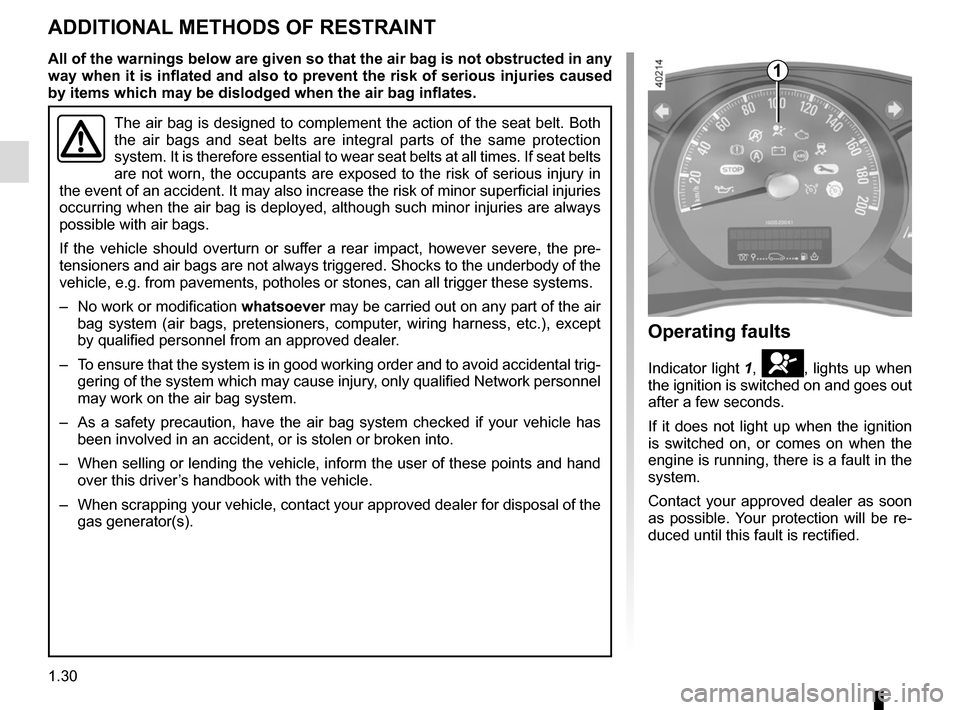
Operating faults
Indicator light 1, å, lights up when
the ignition is switched on and goes out
after a few seconds.
If it does not light up when the ignition
is switched on, or comes on when the
engine is running, there is a fault in the
system.
Contact your approved dealer as soon
as possible. Your protection will be re-
duced until this fault is rectified.
1
The air bag is designed to complement the action of the seat belt. Both \
the air bags and seat belts are integral parts of the same protection
system. It is therefore essential to wear seat belts at all times. If se\
at belts
are not worn, the occupants are exposed to the risk of serious injury in\
the event of an accident. It may also increase the risk of minor superfi\
cial injuries
occurring when the air bag is deployed, although such minor injuries are\
always
possible with air bags.
If the vehicle should overturn or suffer a rear impact, however severe, the pre-
tensioners and air bags are not always triggered. Shocks to the underbod\
y of the
vehicle, e.g. from pavements, potholes or stones, can all trigger these \
systems.
– No work or modification whatsoever may be carried out on any part of the air
bag system (air bags, pretensioners, computer, wiring harness, etc.), except
by qualified personnel from an approved dealer.
– To ensure that the system is in good working order and to avoid accidenta\
l trig- gering of the system which may cause injury, only qualified Network personnel
may work on the air bag system.
– As a safety precaution, have the air bag system checked if your vehicle \
has been involved in an accident, or is stolen or broken into.
– When selling or lending the vehicle, inform the user of these points and\
hand over this driver’s handbook with the vehicle.
– When scrapping your vehicle, contact your approved dealer for disposal o\
f the gas generator(s).
All of the warnings below are given so that the air bag is not obstructed in any
way when it is inflated and also to prevent the risk of serious injuries caused
by items which may be dislodged when the air bag inflates.
Page 37 of 284
1.31
CHILD SAFETY: General information (1/2)
Carrying children
Children, and adults, must be correctly
seated and strapped in for all journeys.
The children being carried in your vehi-
cle are your responsibility.
A child is not a miniature adult. Children
are at risk of specific injuries as their
muscles and bones have not yet fin-
ished growing. The seat belt alone
would not provide suitable protection.
Use an approved child seat and ensure
you use it correctly.
A collision at 30 mph
(50 km/ h) is the same
as falling a distance of
10 metres. Transporting a
child without a restraint is the equiv-
alent of allowing him or her to play
on a fourth-floor balcony without
railings.
Never travel with a child held in your
arms. In the event of an accident,
you will not be able to keep hold of
the child, even if you yourself are
wearing a seat belt.
If your vehicle has been involved
in a road accident, replace the
child seat and have the seat belts
checked.
To prevent the doors being
opened, use the childproof
locks (please refer to the in-
formation on “Locking/un-
locking the doors” in Section 1).
Driver’s responsibility
when parking or stopping
the vehicle
Never leave an animal,
child or adult who is not self-suffi-
cient alone on your vehicle, even for
a short time.
They may pose a risk to themselves
or to others by starting the engine,
activating equipment such as the
electric windows or by locking the
doors.
Also, in hot and/or sunny weather,
please remember that the tempera-
ture inside the passenger compart-
ment increases very quickly.
RISK OF DEATH OR SERIOUS
INJURY.
Page 82 of 284
1.76
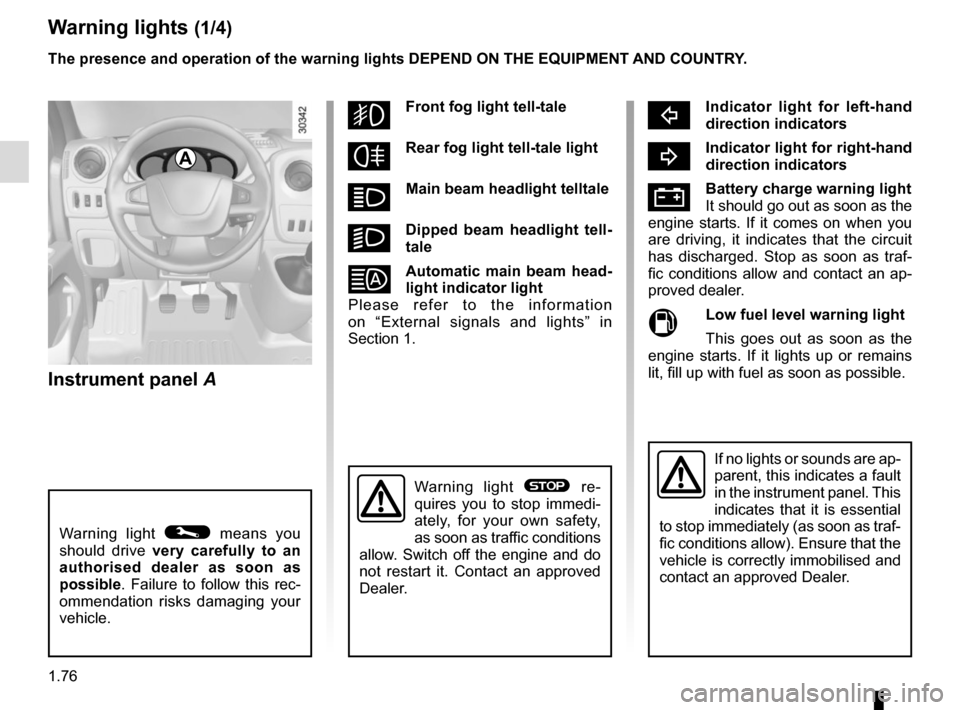
Instrument panel A
Warning lights (1/4)
cIndicator light for left-hand
direction indicators
bIndicator light for right-hand
direction indicators
ÚBattery charge warning light
It should go out as soon as the
engine starts. If it comes on when you
are driving, it indicates that the circuit
has discharged. Stop as soon as traf-
fic conditions allow and contact an ap-
proved dealer.
MLow fuel level warning light
This goes out as soon as the
engine starts. If it lights up or remains
lit, fill up with fuel as soon as possible.
The presence and operation of the warning lights DEPEND ON THE EQUIPMENT\
AND COUNTRY.
If no lights or sounds are ap-
parent, this indicates a fault
in the instrument panel. This
indicates that it is essential
to stop immediately (as soon as traf-
fic conditions allow). Ensure that the
vehicle is correctly immobilised and
contact an approved Dealer.
Warning light © means you
should drive very carefully to an
authorised dealer as soon as
possible. Failure to follow this rec-
ommendation risks damaging your
vehicle.
Warning light ® re-
quires you to stop immedi-
ately, for your own safety,
as soon as traffic conditions
allow. Switch off the engine and do
not restart it. Contact an approved
Dealer.
A
gFront fog light tell-tale
fRear fog light tell-tale light
áMain beam headlight telltale
kDipped beam headlight tell-
tale
Automatic main beam head-
light indicator light
Please refer to the information
on “External signals and lights” in
Section 1.
Page 83 of 284

The presence and operation of the warning lights DEPEND ON THE EQUIPMENT\
AND COUNTRY.
DHandbrake on and brake cir-
cuit incident warning light
This comes on when the igniti")
1.77
Warning lights (2/4)
The presence and operation of the warning lights DEPEND ON THE EQUIPMENT\
AND COUNTRY.
DHandbrake on and brake cir-
cuit incident warning light
This comes on when the ignition is
switched on. If it lights up while braking
or driving, accompanied by the
®
warning light, this indicates a low level
in one of the circuits; it may be danger-
ous to continue driving - please contact
an authorised dealer.
©Warning light
This comes on when the igni-
tion is switched on and goes out after
about 3 seconds.
If it comes on, possibly accompanied
by other warning lights, you should visit
an approved dealer as soon as possi-
ble.
Depending on the vehicle, this warning
light is accompanied by a message on
the instrument panel.
ÄToxic fume filter system
warning light
On equipped vehicles, the light comes
on when the ignition is switched on then
goes out.
– If it lights up continuously accom-
panied by the
© warning light,
please consult an authorised dealer
as soon as possible;
– If it flashes, reduce the engine speed until the light stops flashing. Contact
your approved dealer as soon as
possible.
Please refer to the information on
«Maintenance and anti-pollution
advice» in Section 2.
åAir bag warning light
This light comes on when the
ignition is switched on and goes out
within about 3 seconds. If it comes on,
there is a fault in the system. Contact
an approved dealer as soon as possi-
ble.
ÜNot used
®STOP light
This comes on when the igni-
tion is switched on and goes out after
3 seconds.
If it comes on, possibly accompanied
by other warning lights, stop soon as
traffic conditions allow. Contact an ap-
proved dealer as soon as possible.
Depending on the vehicle, this warning
light is accompanied by a message on
the instrument panel.
ÔCoolant temperature warn-
ing light
If this remains lit while driving accom-
panied by the
® indicator light, it
indicates engine overheating. Stop and
allow the engine to run at idle speed for
about a minute or two. The tempera-
ture should drop. Otherwise, stop the
engine. Let the engine cool down, then
check the coolant level. Contact an ap-
proved Dealer if necessary.
Page 84 of 284

The presence and operation of the warning lights DEPEND ON THE EQUIPMENT\
AND COUNTRY.
xAnti-lock braking warning
light
This light comes on when the ignition is
switched o")
1.78
Warning lights (3/4)
The presence and operation of the warning lights DEPEND ON THE EQUIPMENT\
AND COUNTRY.
xAnti-lock braking warning
light
This light comes on when the ignition is
switched on and goes out within 3 sec-
onds. If it comes on when you are driv-
ing, it indicates a fault in the anti-lock
braking system. Braking will then occur
normally, without the anti-lock system.
Contact an approved dealer as soon as
possible.
^Water in the diesel filter
warning light
If it comes on when you are driving, it
indicates the presence of water in the
diesel. Contact your approved dealer
as soon as possible.
ÀOil pressure warning light
This light comes on when the
ignition is switched on and goes out
within 3 seconds. If it comes on while
you are driving, stop at once and switch
off the ignition. Check the oil level. If
the level is correct, the light has come
on for another reason; contact an ap-
proved dealer.
2
Door status warning light
If it lights up when the ignition
is switched on, it indicates that
a door is not properly closed.
Traction control warning
light
Refer to the information on “Driving cor-
rection devices and aids” in Section 2.
Tyre pressure loss warning
Please refer to the information
on the “Tyre pressure loss warning” in
Section 2.
ÉPreheating warning light
This should come on when
the ignition is switched on. It indicates
that the heater plugs are in operation.
It goes out after preheating is sufficient
and the engine can be started.
T Digital tacograph warning light
If it comes on, there is a fault in the
system. Refer to the handbook for the
equipment.
Engine standby warning
light
Please refer to the information on the
“Stop and Start Function” in Section 2.
Unavailability of engine
standby warning light
Please see information in the para-
graph on “Stop and Start Function” in
Section 2.
A
Page 85 of 284
1.79
WARNING LIGHTS (4/4)
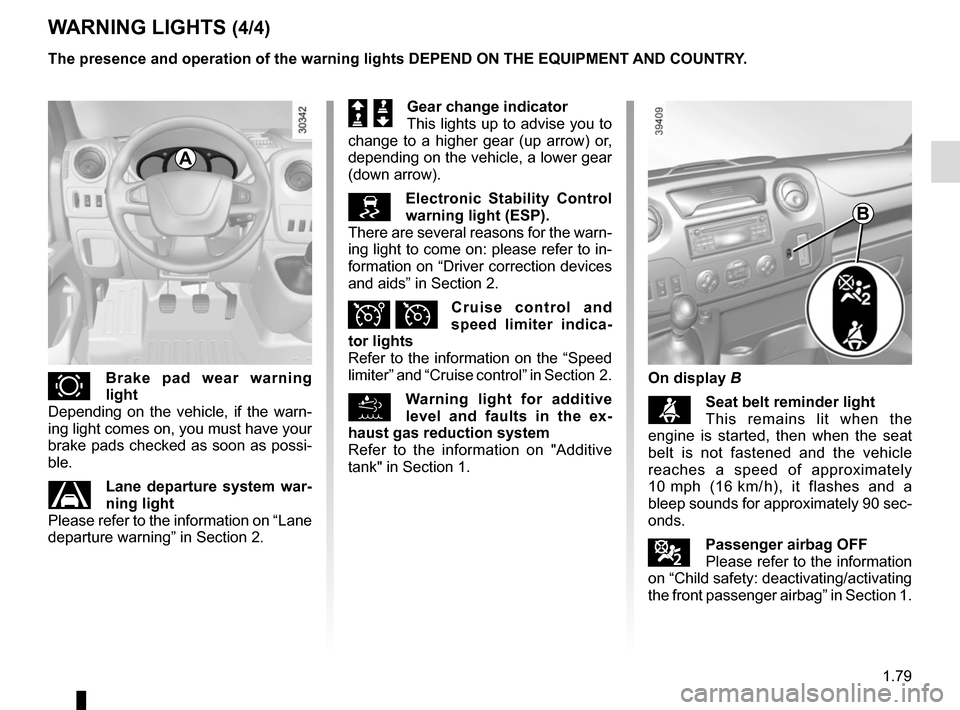
Š ‰Gear change indicator
This lights up to advise you to
change to a higher gear (up arrow) or,
depending on the vehicle, a lower gear
(down arrow).
\bElectronic Stability Control
warning light (ESP).
There are several reasons for the warn-
ing light to come on: please refer to in-
formation on “Driver correction devices
and aids” in Section 2.
Î ÏCruise control and
speed limiter indica-
tor lights
Refer to the information on the “Speed
limiter” and “Cruise control” in Section 2.
Warning light for additive
level and faults in the ex-
haust gas reduction system
Refer to the information on "Additive
tank" in Section 1.zBrake pad wear warning
light
Depending on the vehicle, if the warn-
ing light comes on, you must have your
brake pads checked as soon as possi-
ble.
Lane departure system war-
ning light
Please refer to the information on “Lane
departure warning” in Section 2.
A
The presence and operation of the warning lights DEPEND ON THE EQUIPMENT\
AND COUNTRY.
On display B
ßSeat belt reminder light
This remains lit when the
engine is started, then when the seat
belt is not fastened and the vehicle
reaches a speed of approximately
10 mph (16 km/ h), it flashes and a
bleep sounds for approximately 90 sec-
onds.
¹Passenger airbag OFF
Please refer to the information
on “Child safety: deactivating/activating
the front passenger airbag” in Section 1.
B
Page 86 of 284
1.80
Displays and indicators (1/2)
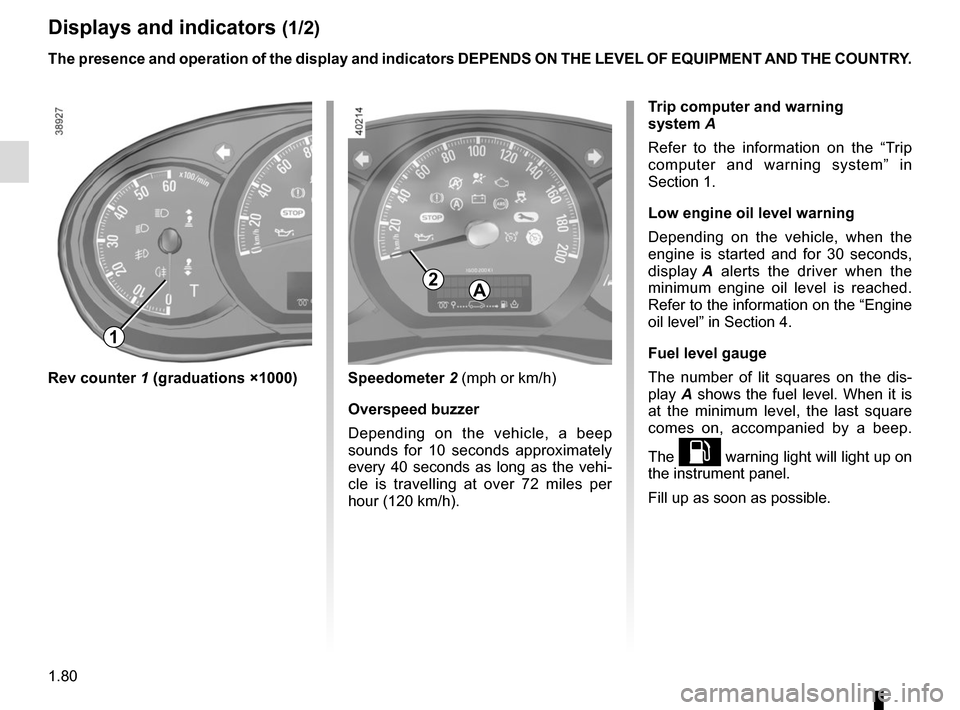
Rev counter 1 (graduations ×1000) Speedometer 2 (mph or km/h)
Overspeed buzzer
Depending on the vehicle, a beep
sounds for 10 seconds approximately
every 40 seconds as long as the vehi-
cle is travelling at over 72 miles per
hour (120 km/h).
2
1
The presence and operation of the display and indicators DEPENDS ON THE \
LEVEL OF EQUIPMENT AND THE COUNTRY.
Trip computer and warning
system A
Refer to the information on the “Trip
computer and warning system” in
Section 1.
Low engine oil level warning
Depending on the vehicle, when the
engine is started and for 30 seconds,
display A alerts the driver when the
minimum engine oil level is reached.
Refer to the information on the “Engine
oil level” in Section 4.
Fuel level gauge
The number of lit squares on the dis-
play A shows the fuel level. When it is
at the minimum level, the last square
comes on, accompanied by a beep.
The
L warning light will light up on
the instrument panel.
Fill up as soon as possible.
A
Page 87 of 284
1.81
Displays and indicators (2/2)
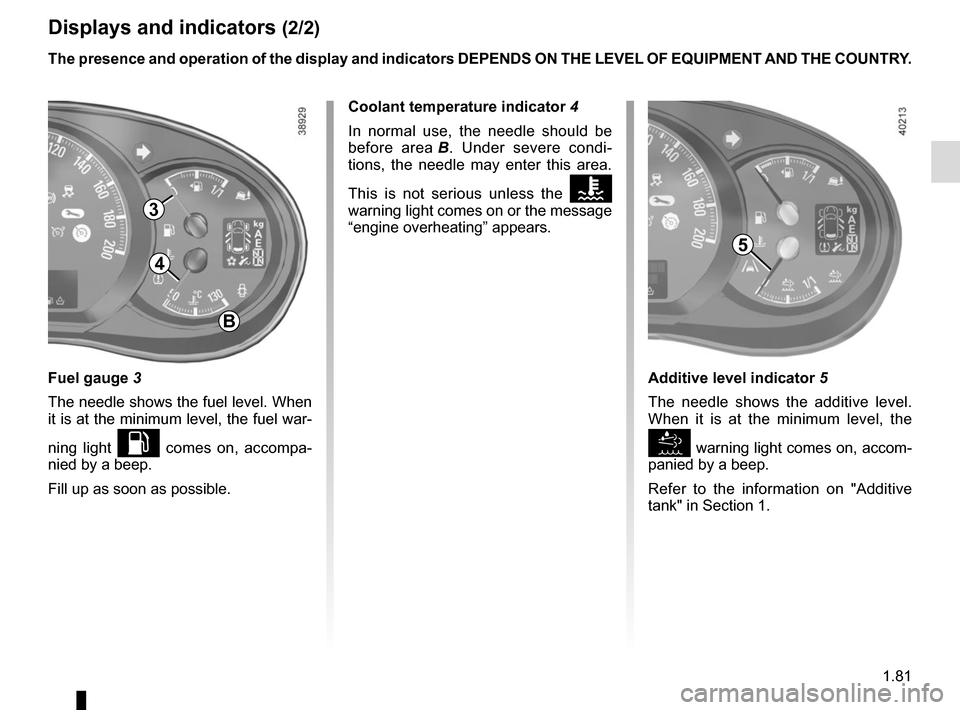
Fuel gauge 3
The needle shows the fuel level. When
it is at the minimum level, the fuel war-
ning light
L comes on, accompa-
nied by a beep.
Fill up as soon as possible. The presence and operation of the display and indicators DEPENDS ON THE \
LEVEL OF EQUIPMENT AND THE COUNTRY.
3
4
B
Coolant temperature indicator 4
In normal use, the needle should be
before area B. Under severe condi-
tions, the needle may enter this area.
This is not serious unless the
Ô
warning light comes on or the message
“engine overheating” appears.
Additive level indicator 5
The needle shows the additive level.
When it is at the minimum level, the
warning light comes on, accom-
panied by a beep.
Refer to the information on "Additive
tank" in Section 1.
5
Page 89 of 284
1.83
TRIP COMPUTER: general information (2/2)
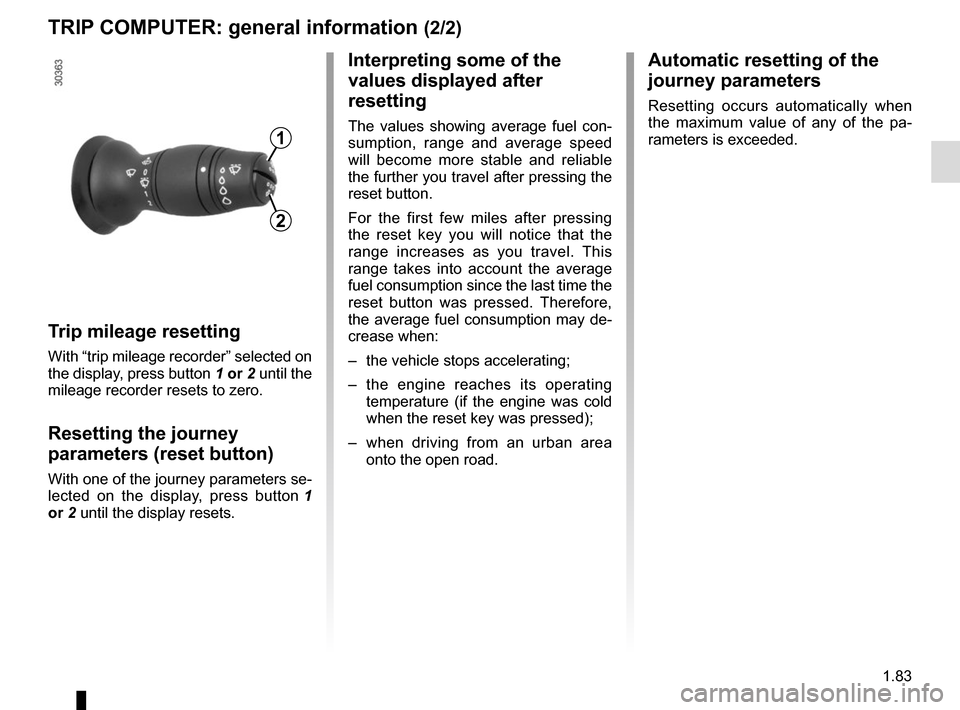
Trip mileage resetting
With “trip mileage recorder” selected on
the display, press button 1 or 2 until the
mileage recorder resets to zero.
Resetting the journey
parameters (reset button)
With one of the journey parameters se-
lected on the display, press button 1
or 2 until the display resets.
Interpreting some of the
values displayed after
resetting
The values showing average fuel con-
sumption, range and average speed
will become more stable and reliable
the further you travel after pressing the
reset button.
For the first few miles after pressing
the reset key you will notice that the
range increases as you travel. This
range takes into account the average
fuel consumption since the last time the
reset button was pressed. Therefore,
the average fuel consumption may de-
crease when:
– the vehicle stops accelerating;
– the engine reaches its operating
temperature (if the engine was cold
when the reset key was pressed);
– when driving from an urban area
onto the open road.
Automatic resetting of the
journey parameters
Resetting occurs automatically when
the maximum value of any of the pa-
rameters is exceeded.
1
2