fuel RENAULT MASTER 2016 X62 / 2.G User Guide
[x] Cancel search | Manufacturer: RENAULT, Model Year: 2016, Model line: MASTER, Model: RENAULT MASTER 2016 X62 / 2.GPages: 284, PDF Size: 6.69 MB
Page 107 of 284
1.101
FUEL TANK (1/2)
Filling the tank
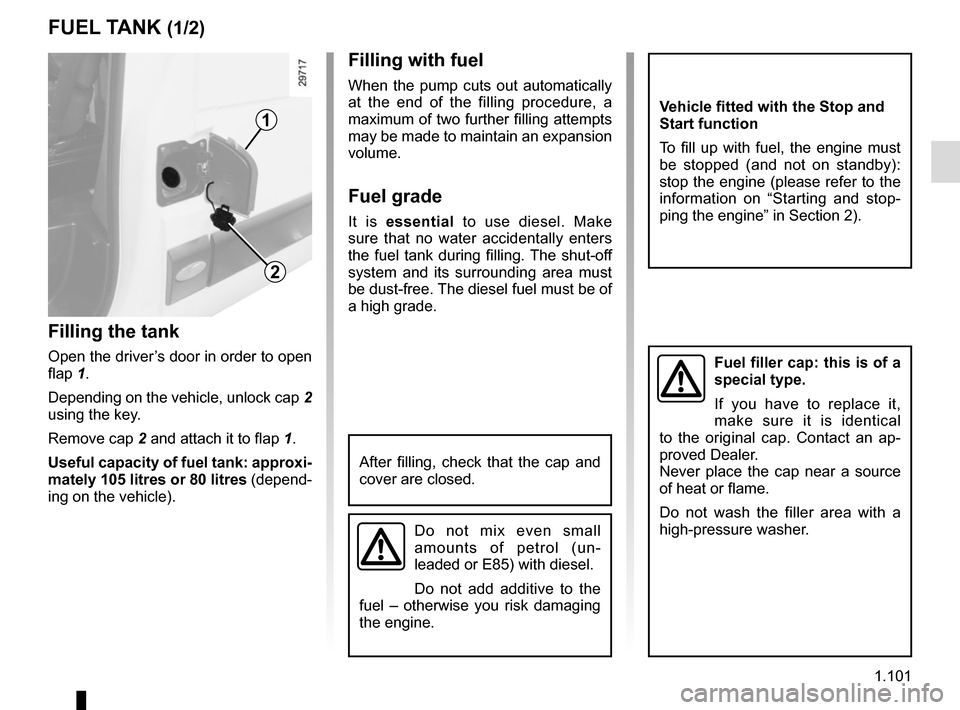
Open the driver’s door in order to open
flap 1.
Depending on the vehicle, unlock cap 2
using the key.
Remove cap 2 and attach it to flap 1.
Useful capacity of fuel tank: approxi-
mately 105 litres or 80 litres (depend-
ing on the vehicle).
Filling with fuel
When the pump cuts out automatically
at the end of the filling procedure, a
maximum of two further filling attempts
may be made to maintain an expansion
volume.
Fuel grade
It is essential to use diesel. Make
sure that no water accidentally enters
the fuel tank during filling. The shut-off
system and its surrounding area must
be dust-free. The diesel fuel must be of
a high grade.
2
1
After filling, check that the cap and
cover are closed.
Fuel filler cap: this is of a
special type.
If you have to replace it,
make sure it is identical
to the original cap. Contact an ap-
proved Dealer.
Never place the cap near a source
of heat or flame.
Do not wash the filler area with a
high-pressure washer.
Do not mix even small
amounts of petrol (un-
leaded or E85) with diesel.
Do not add additive to the
fuel – otherwise you risk damaging
the engine.
Vehicle fitted with the Stop and
Start function
To fill up with fuel, the engine must
be stopped (and not on standby):
stop the engine (please refer to the
information on “Starting and stop-
ping the engine” in Section 2).
Page 108 of 284
1.102
FUEL TANK (2/2)
No modifications what-
soever are permitted on
any part of the fuel supply
system (computers, wiring,
fuel circuit, injector, protection
covers, etc.) as this may be danger-
ous (such work must be undertaken
by qualified Network personnel).
Persistent smell of
fuel
If you notice a persistent
smell of fuel you should:
– stop the vehicle as soon as traf-
fic conditions allow and switch off
the ignition;
– switch on the hazard warning lights and ask your passengers
to leave the vehicle and to keep
away from traffic;
– contact an approved Dealer.
Running out of fuel on diesel
versions
After a breakdown caused by com-
pletely running out of fuel, the system
must be reprimed before the engine is
restarted:
Fill the tank on level ground with a mini-
mum of 5 litres of diesel.
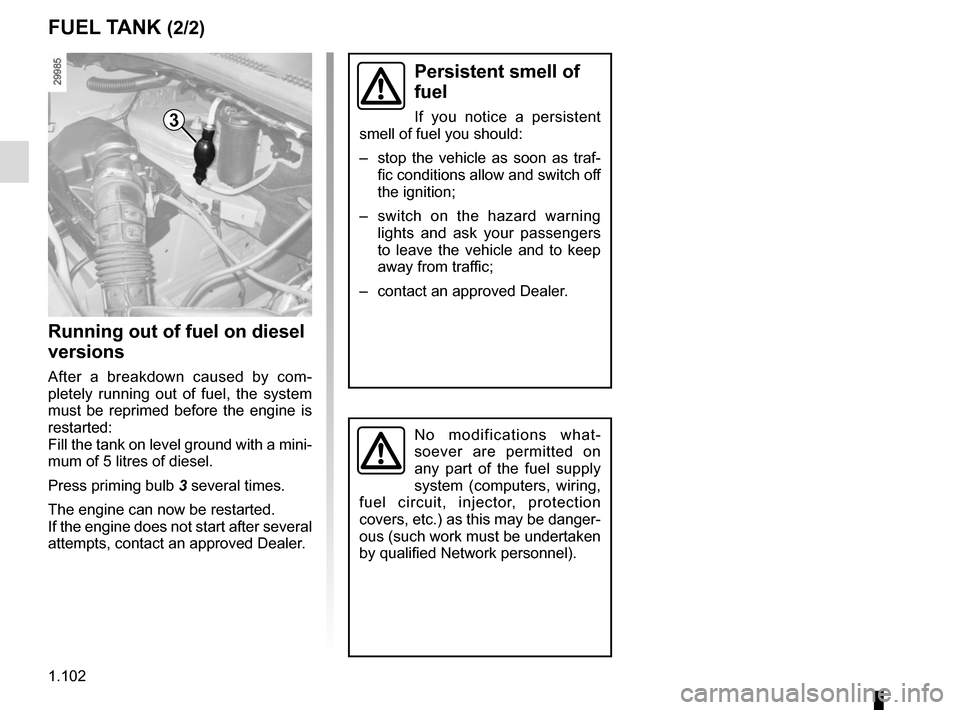
Press priming bulb 3 several times.
The engine can now be restarted.
If the engine does not start after several
attempts, contact an approved Dealer.
3
Page 109 of 284
1.103
Please ensure that you comply with the
legislation of your country.
It is important to remember that failure
to respect regulations in force could
lead to legal action being taken against
the vehicle owner.
Operating principleThe use of additives reduces exhaust
emissions by transforming the pollu-
tants into water vapour and nitrogen.
Topping upCapacity of the fuel tank: 20 litres ap-
proximately.
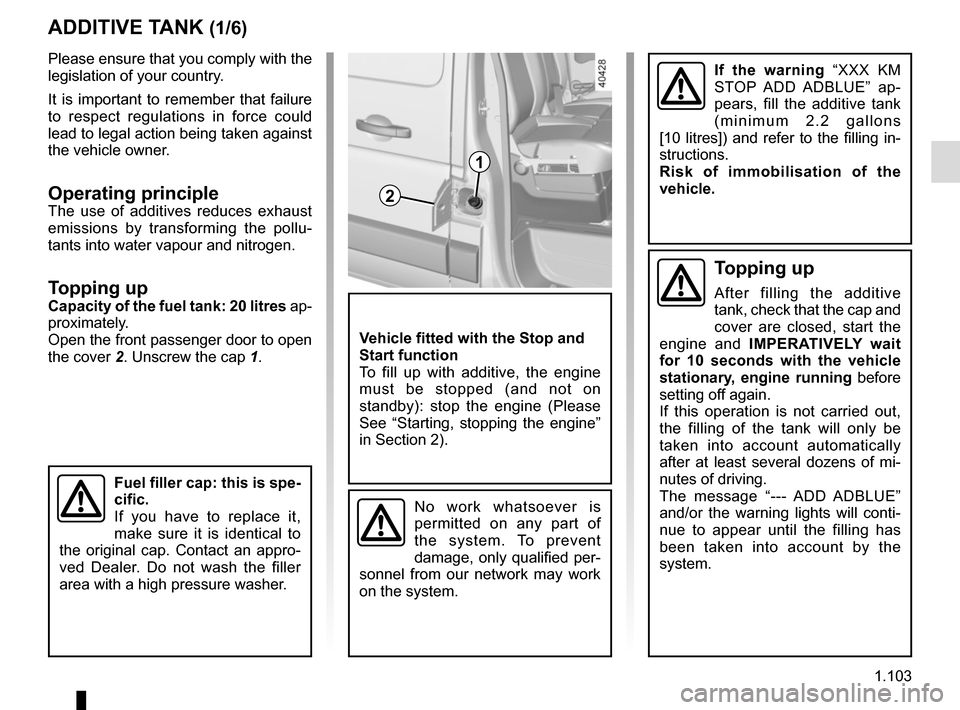
Open the front passenger door to open
the cover 2. Unscrew the cap 1.
ADDITIVE TANK (1/6)
Fuel filler cap: this is spe-
cific.
If you have to replace it,
make sure it is identical to
the original cap. Contact an appro-
ved Dealer. Do not wash the filler
area with a high pressure washer.
2
1
Vehicle fitted with the Stop and
Start function
To fill up with additive, the engine
must be stopped (and not on
standby): stop the engine (Please
See “Starting, stopping the engine”
in Section 2).
No work whatsoever is
permitted on any part of
the system. To prevent
damage, only qualified per-
sonnel from our network may work
on the system.
If the warning “XXX KM
STOP ADD ADBLUE” ap-
pears, fill the additive tank
(minimum 2.2 gallons
[10 litres]) and refer to the filling in-
structions.
Risk of immobilisation of the
vehicle.
Topping up
After filling the additive
tank, check that the cap and
cover are closed, start the
engine and IMPERATIVELY wait
for 10 seconds with the vehicle
stationary, engine running before
setting off again.
If this operation is not carried out,
the filling of the tank will only be
taken into account automatically
after at least several dozens of mi-
nutes of driving.
The message “--- ADD ADBLUE”
and/or the warning lights will conti-
nue to appear until the filling has
been taken into account by the
system.
Page 110 of 284
1.104
ADDITIVE TANK (2/6)Precautions for use
Always read the information on the ad-
ditive can.
Handle additives with care. They can
damage clothes, shoes, bodywork
components etc.
If the additive overflows, or contami-
nates any paintwork, clean the affected
area quickly with a damp cloth.
In extreme cold weather conditions
The vehicle is fitted with a system for
reheating the additive fluid that enables
you to drive in extreme cold weather
conditions.
Precautions when filling the tank
The additive fluid freezes below about
-10°C.
In this case, do not attempt filling when
the fluid is frozen.
It is therefore advisable to top up the
additive fluid or have it topped up by a
qualified professional as soon as the
warning light on the instrument
panel first comes on.
The additive must not come
into contact with eyes or
skin. If it does, wash the af-
fected area with plenty of
cold water. If necessary, consult a
doctor.
Additive quality
Use only additives which conform
to standard ISO 22241 and in accor-
dance with the label on the fuel filler
flap.
Average fuel consumption
Approximately 810 mpg
(3.5 L/1,000 km) depending on the ve-
hicle and the driving style.
Page 115 of 284

Running in, ignition switch . . . . . . . . . . . . . . . . . . . . . . . . . . . . . . . . . . . . \
. . . . . . .")
2.1
Section 2: Driving
(advice on use relating to fuel economy and the environment)
Running in, ignition switch . . . . . . . . . . . . . . . . . . . . . . . . . . . . . . . . . . . . \
. . . . . . . . . . . . . . . . . . . . . 2.2
Starting, stopping the engine . . . . . . . . . . . . . . . . . . . . . . . . . . . . . . . . . . . . \
. . . . . . . . . . . . . . . . . . . 2.3
Stop and Start Function . . . . . . . . . . . . . . . . . . . . . . . . . . . . . . . . . . . . \
. . . . . . . . . . . . . . . . . . . . . . . 2.4
Special features of diesel versions . . . . . . . . . . . . . . . . . . . . . . . . . . . . . . . . . . . .\
. . . . . . . . . . . . . . 2.7
Driving advice, Eco-driving . . . . . . . . . . . . . . . . . . . . . . . . . . . . . . . . . . . .\
. . . . . . . . . . . . . . . . . . . . 2.8
Maintenance and antipollution advice . . . . . . . . . . . . . . . . . . . . . . . . . . . . . . . . . . . . \
. . . . . . . . . . . . 2.12
Environment . . . . . . . . . . . . . . . . . . . . . . . . . . . . . . . . . . . .\
. . . . . . . . . . . . . . . . . . . . . . . . . . . . . . . 2.13
Gear lever . . . . . . . . . . . . . . . . . . . . . . . . . . . . . . . . . . . .\
. . . . . . . . . . . . . . . . . . . . . . . . . . . . . . . . . 2.14
Handbrake . . . . . . . . . . . . . . . . . . . . . . . . . . . . . . . . . . . . \
. . . . . . . . . . . . . . . . . . . . . . . . . . . . . . . . . 2.15
Driver correction devices/aids . . . . . . . . . . . . . . . . . . . . . . . . . . . . . . . . . . . . \
. . . . . . . . . . . . . . . . . . 2.16
Tyre pressure loss warning . . . . . . . . . . . . . . . . . . . . . . . \
. . . . . . . . . . . . . . . . . . . . . . . . . . . . . . . . . 2.21
Lane departure warning. . . . . . . . . . . . . . . . . . . . . . . . . . . . . . . . . . . . \
. . . . . . . . . . . . . . . . . . . . . . . 2.24
Speed limiter . . . . . . . . . . . . . . . . . . . . . . . . . . . . . \
. . . . . . . . . . . . . . . . . . . . . . . . . . . . . . . . . . . . . . 2.26
Cruise control . . . . . . . . . . . . . . . . . . . . . . . . . . . . . . . . . . . .\
. . . . . . . . . . . . . . . . . . . . . . . . . . . . . . 2.29
Overspeed function . . . . . . . . . . . . . . . . . . . . . . . . . . . . . . . . . . . . \
. . . . . . . . . . . . . . . . . . . . . . . . . . 2.33
Parking distance control . . . . . . . . . . . . . . . . . . . . . . . . . . . . . . . . . . . .\
. . . . . . . . . . . . . . . . . . . . . . 2.34
Reversing camera . . . . . . . . . . . . . . . . . . . . . . . . . . . . . . . . . . . . \
. . . . . . . . . . . . . . . . . . . . . . . . . . . 2.36
Power take-off . . . . . . . . . . . . . . . . . . . . . . . . . . . . . . . . . . . . \
. . . . . . . . . . . . . . . . . . . . . . . . . . . . . . 2.38
Fast idle speed . . . . . . . . . . . . . . . . . . . . . . . . . . . . . . . . . . . .\
. . . . . . . . . . . . . . . . . . . . . . . . . . . . . 2.39
Self-locking differential . . . . . . . . . . . . . . . . . . . . . . . . . . . . . . . . . . . .\
. . . . . . . . . . . . . . . . . . . . . . . 2.40
Sequential gearbox . . . . . . . . . . . . . . . . . . . . . . . . . . .\
. . . . . . . . . . . . . . . . . . . . . . . . . . . . . . . . . . . 2.41
Page 118 of 284
2.4
For manual gearboxes:
– the gearbox is in neutral;
and
– the clutch pedal is released.
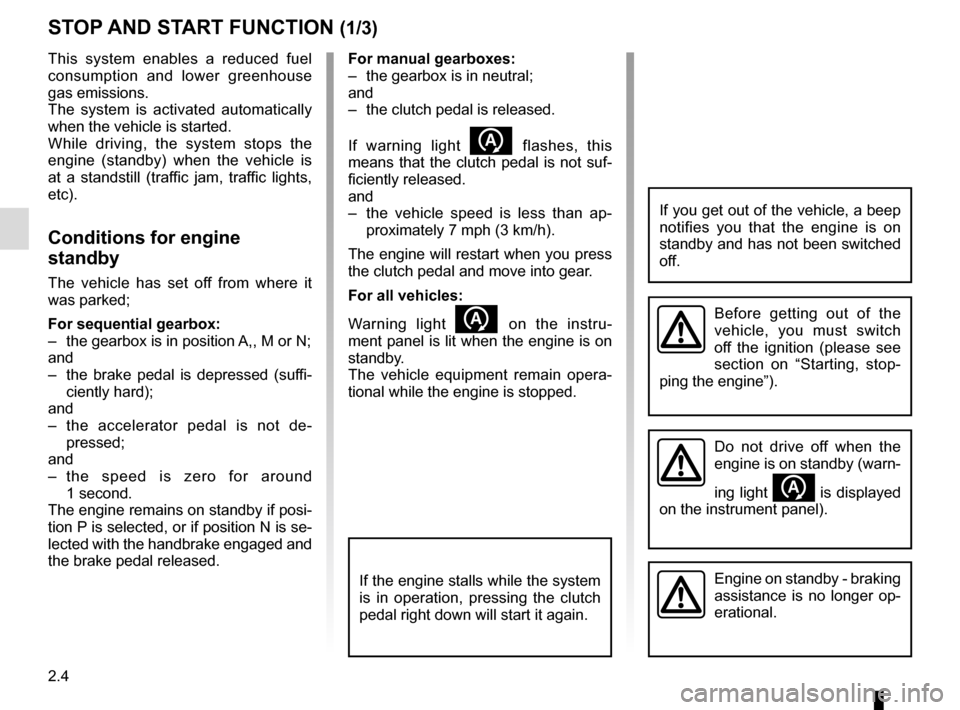
If warning light
flashes, this
means that the clutch pedal is not suf-
ficiently released.
and
– the vehicle speed is less than ap- proximately 7 mph (3 km/h).
The engine will restart when you press
the clutch pedal and move into gear.
For all vehicles:
Warning light
on the instru-
ment panel is lit when the engine is on
standby.
The vehicle equipment remain opera-
tional while the engine is stopped.
STOP AND START FUNCTION (1/3)
Do not drive off when the
engine is on standby (warn-
ing light
is displayed
on the instrument panel).
Engine on standby - braking
assistance is no longer op-
erational.
Before getting out of the
vehicle, you must switch
off the ignition (please see
section on “Starting, stop-
ping the engine”).
If you get out of the vehicle, a beep
notifies you that the engine is on
standby and has not been switched
off.
This system enables a reduced fuel
consumption and lower greenhouse
gas emissions.
The system is activated automatically
when the vehicle is started.
While driving, the system stops the
engine (standby) when the vehicle is
at a standstill (traffic jam, traffic lights,
etc).
Conditions for engine
standby
The vehicle has set off from where it
was parked;
For sequential gearbox:
– the gearbox is in position A,, M or N;
and
– the brake pedal is depressed (suffi- ciently hard);
and
– the accelerator pedal is not de- pressed;
and
– the speed is zero for around 1 second.
The engine remains on standby if posi-
tion P is selected, or if position N is se-
lected with the handbrake engaged and
the brake pedal released.
If the engine stalls while the system
is in operation, pressing the clutch
pedal right down will start it again.
Page 119 of 284
2.5
STOP AND START FUNCTION (2/3)Conditions for coming out of
engine standby
For sequential gearbox:
– the brake pedal is released, position A or M engaged or,
– the brake pedal is released, position N engaged and the handbrake off, or
– the brake pedal is pressed again, with position P engaged or position
N engaged with the handbrake ap-
plied, or
– position R is engaged or,
– the accelerator pedal is pressed.
For manual gearboxes:
– the gearbox is in neutral and the clutch pedal is slightly depressed, or
– the engine is in gear and the clutch pedal is pressed right down.
Conditions preventing the
standby of the engine
Certain conditions prevent the system
from using the engine standby function,
including when:
– reverse gear is engaged;
– the bonnet is not locked; – the outdoor temperature is too low or
too high (less than around 0 °C or
higher than around 30 °C);
– the battery is not sufficiently charged;
– the difference between the vehicle interior temperature and the auto-
matic climate control instruction is
too high;
– the “Clear View” function is activated (please see “Automatic Climate
Control” in Section 3);
– the engine coolant temperature is too low;
– automatic particle filter cleaning is underway;
or
– ...
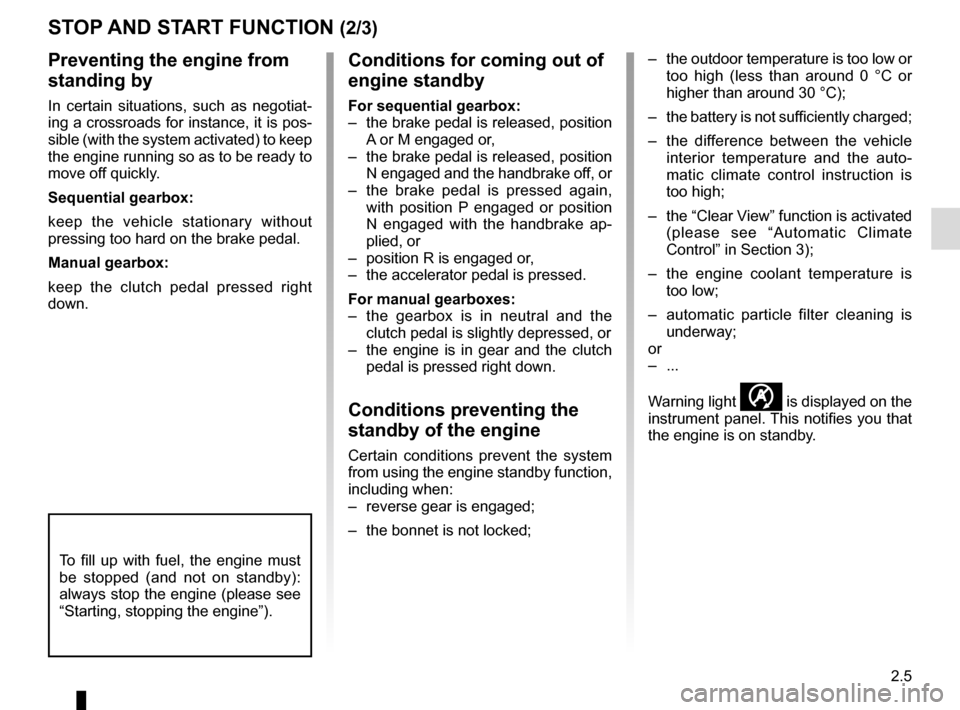
Warning light
is displayed on the
instrument panel. This notifies you that
the engine is on standby.
To fill up with fuel, the engine must
be stopped (and not on standby):
always stop the engine (please see
“Starting, stopping the engine”).
Preventing the engine from
standing by
In certain situations, such as negotiat-
ing a crossroads for instance, it is pos-
sible (with the system activated) to keep
the engine running so as to be ready to
move off quickly.
Sequential gearbox:
keep the vehicle stationary without
pressing too hard on the brake pedal.
Manual gearbox:
keep the clutch pedal pressed right
down.
Page 121 of 284
2.7
SPECIAL FEATURES OF DIESEL VERSIONS
Precautions to be taken in
winter
To avoid any faults in icy weather:
– make sure that the battery is always fully charged;
– always keep the diesel tank rela- tively full to prevent water vapour
condensing in it and accumulating at
the bottom of the tank.
Diesel engine speed
Diesel engines are fitted with an injec-
tion pump with an electronic regulator
which prevents overrevving of the
engine irrespective of the gear en-
gaged.
If the
Ä and © warning lights
come on, consult an approved dealer
as soon as possible.
When driving, depending on the fuel
grade used, it is possible that white
smoke may be emitted.
This is due to the exhaust particle filter
being cleaned automatically, and does
not affect the way the vehicle runs.
Running out of fuel
You may start the engine normally after
refilling the fuel tank even if you have
completely run out of fuel, provided
that the battery is fully charged.
However, if the engine does not start
after a few seconds and several at-
tempts, refer to the information on the
“Fuel tank” in Section 1.
Do not park the vehicle or
run the engine in locations
where combustible sub-
stances or materials such
as grass or leaves can come into
contact with the hot exhaust system.
Page 122 of 284
2.8
DRIVING ADVICE, ECO-DRIVING (1/4)
Fuel consumption is accredited in ac-
cordance with a standard regulatory
method. Identical for all manufactu-
rers, this enables vehicles to be com-
pared with one another. Consumption
in real time depends on vehicle usage
conditions, the equipment fitted and the
user’s driving style. To optimise fuel
consumption, please refer to the fol-
lowing advice.
Depending on the vehicle, you will have
various functions which enable you to
lower your fuel consumption:
– the rev counter;
– gear change indicator;
– the journey record and eco-driving advice via the multimedia display;
– ECO mode – activated by the ECO button.
If fitted on the vehicle, the navigation
system provides additional information.
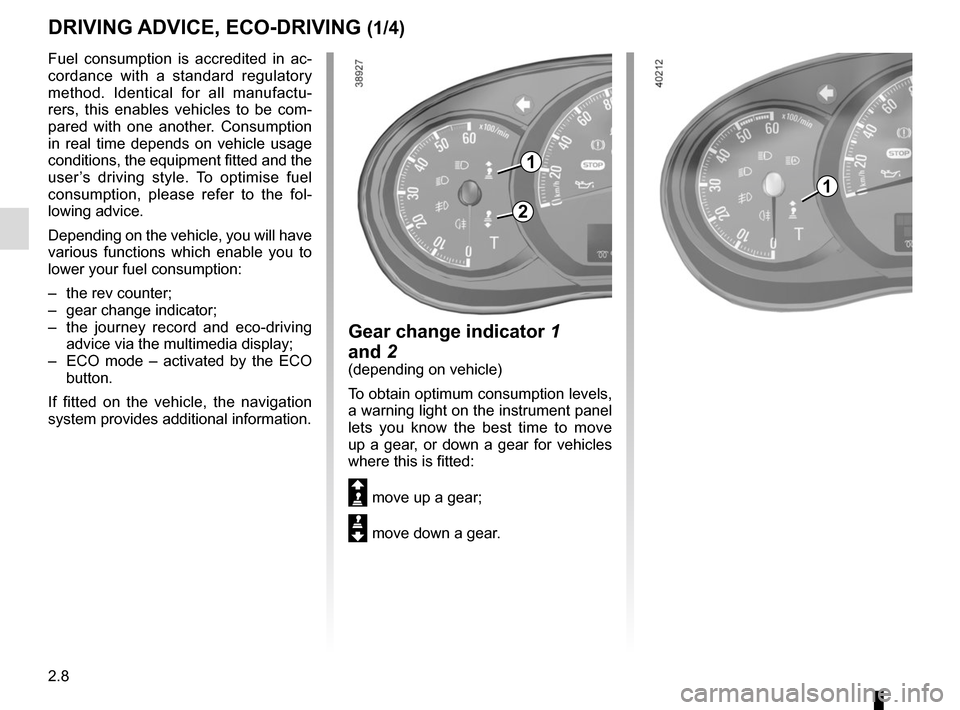
Gear change indicator 1
and 2
(depending on vehicle)
To obtain optimum consumption levels,
a warning light on the instrument panel
lets you know the best time to move
up a gear, or down a gear for vehicles
where this is fitted:
Š move up a gear;
‰ move down a gear.
1
2
1
Page 123 of 284
2.9
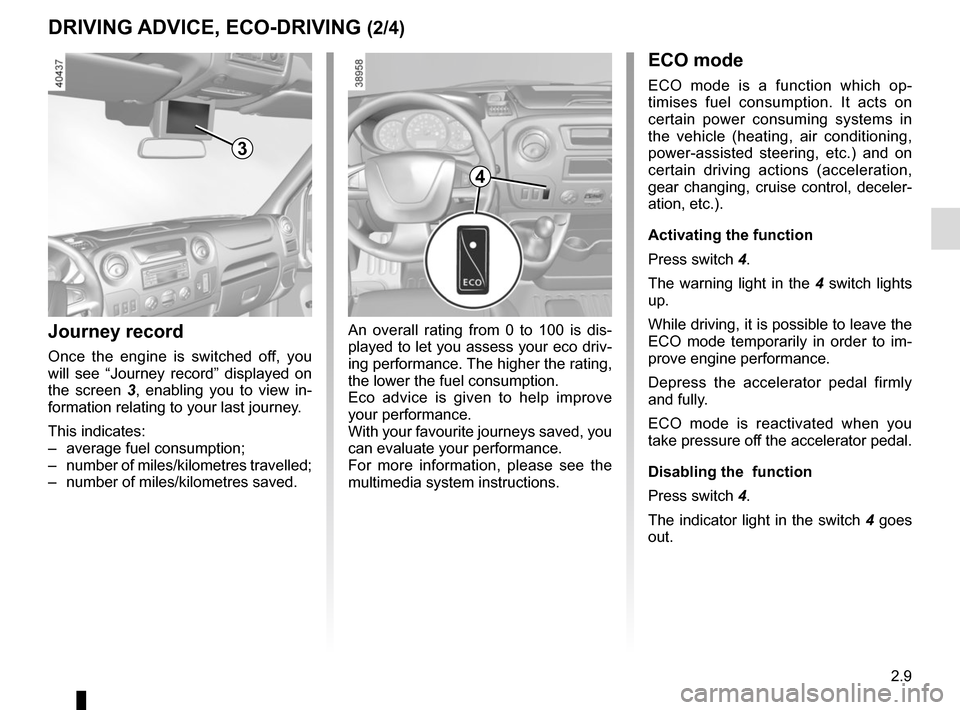
DRIVING ADVICE, ECO-DRIVING (2/4)ECO mode
ECO mode is a function which op-
timises fuel consumption. It acts on
certain power consuming systems in
the vehicle (heating, air conditioning,
power-assisted steering, etc.) and on
certain driving actions (acceleration,
gear changing, cruise control, deceler-
ation, etc.).
Activating the function
Press switch 4.
The warning light in the 4 switch lights
up.
While driving, it is possible to leave the
ECO mode temporarily in order to im-
prove engine performance.
Depress the accelerator pedal firmly
and fully.
ECO mode is reactivated when you
take pressure off the accelerator pedal.
Disabling the function
Press switch 4.
The indicator light in the switch 4 goes
out.
4
An overall rating from 0 to 100 is dis-
played to let you assess your eco driv-
ing performance. The higher the rating,
the lower the fuel consumption.
Eco advice is given to help improve
your performance.
With your favourite journeys saved, you
can evaluate your performance.
For more information, please see the
multimedia system instructions.Journey record
Once the engine is switched off, you
will see “Journey record” displayed on
the screen 3 , enabling you to view in-
formation relating to your last journey.
This indicates:
– average fuel consumption;
– number of miles/kilometres travelled;
– number of miles/kilometres saved.
3