seat RENAULT MASTER 2017 X62 / 2.G Workshop Manual
[x] Cancel search | Manufacturer: RENAULT, Model Year: 2017, Model line: MASTER, Model: RENAULT MASTER 2017 X62 / 2.GPages: 286, PDF Size: 6.97 MB
Page 74 of 286
1.68
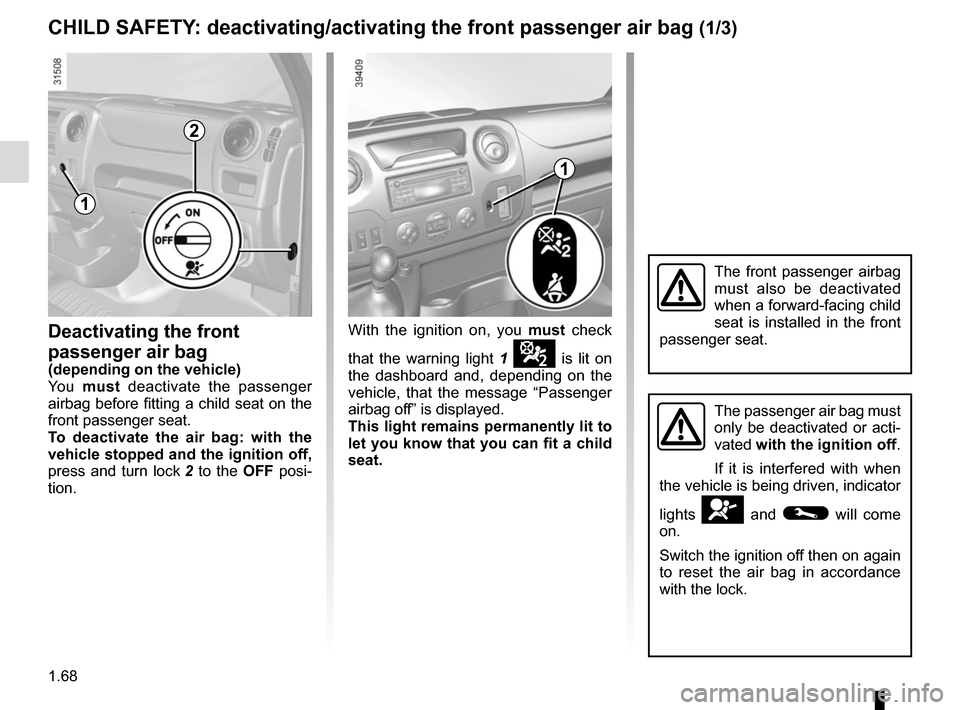
Deactivating the front
passenger air bag
(depending on the vehicle)
Yo u must deactivate the passenger
airbag before fitting a child seat on the
front passenger seat.
To deactivate the air bag: with the
vehicle stopped and the ignition off,
press and turn lock 2 to the OFF posi-
tion. With the ignition on, you
must check
that the warning light 1 ¹ is lit on
the dashboard and, depending on the
vehicle, that the message “Passenger
airbag off” is displayed.
This light remains permanently lit to
let you know that you can fit a child
seat.
CHILD SAFETY: deactivating/activating the front passenger air bag (1/3)
1
2
The front passenger airbag
must also be deactivated
when a forward-facing child
seat is installed in the front
passenger seat.
The passenger air bag must
only be deactivated or acti-
vated with the ignition off.
If it is interfered with when
the vehicle is being driven, indicator
lights
å and © will come
on.
Switch the ignition off then on again
to reset the air bag in accordance
with the lock.
1
Page 75 of 286
1.69
3
A
A
CHILD SAFETY: deactivating/activating the front passenger air bag (2/3)
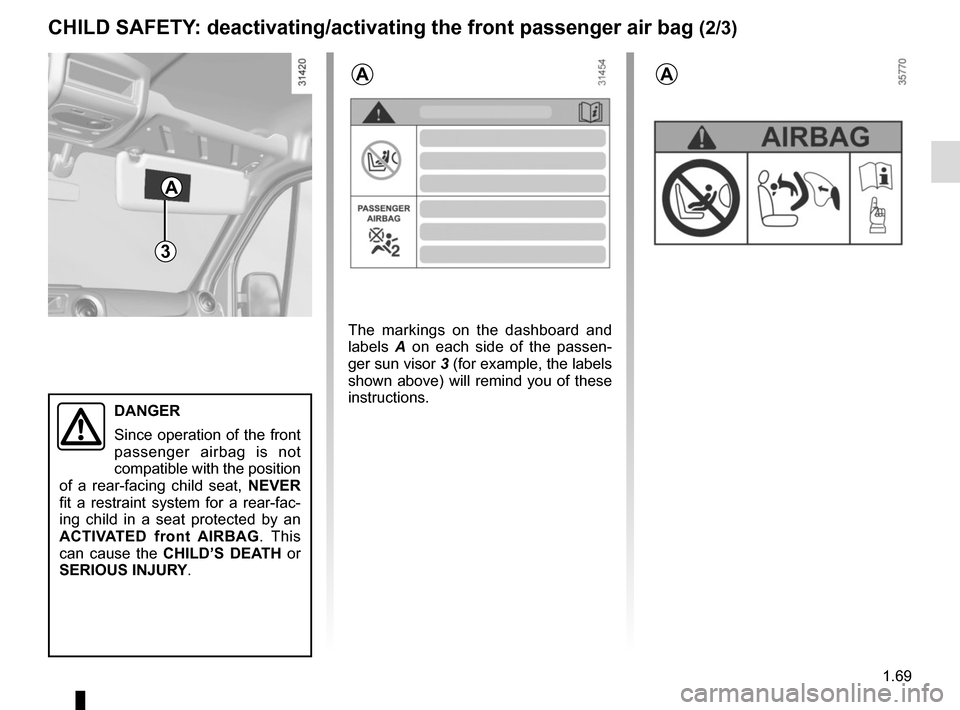
The markings on the dashboard and
labels A on each side of the passen-
ger sun visor 3 (for example, the labels
shown above) will remind you of these
instructions.
A
DANGER
Since operation of the front
passenger airbag is not
compatible with the position
of a rear-facing child seat, NEVER
fit a restraint system for a rear-fac-
ing child in a seat protected by an
ACTIVATED front AIRBAG . This
can cause the CHILD’S DEATH or
SERIOUS INJURY.
Page 76 of 286
1.70
Operating faultsIn the event that the front passenger air
bag activation/deactivation system is
faulty, child seats must not be fitted to
the front seat.
Allowing any other passenger to sit in
that seat is not recommended.
Contact your approved Dealer as soon
as possible.Activation of the front
passenger air bag
You should reactivate the air bag as
soon as you remove the child seat from
the front passenger seat to ensure the
protection of the front passenger in the
event of an impact.
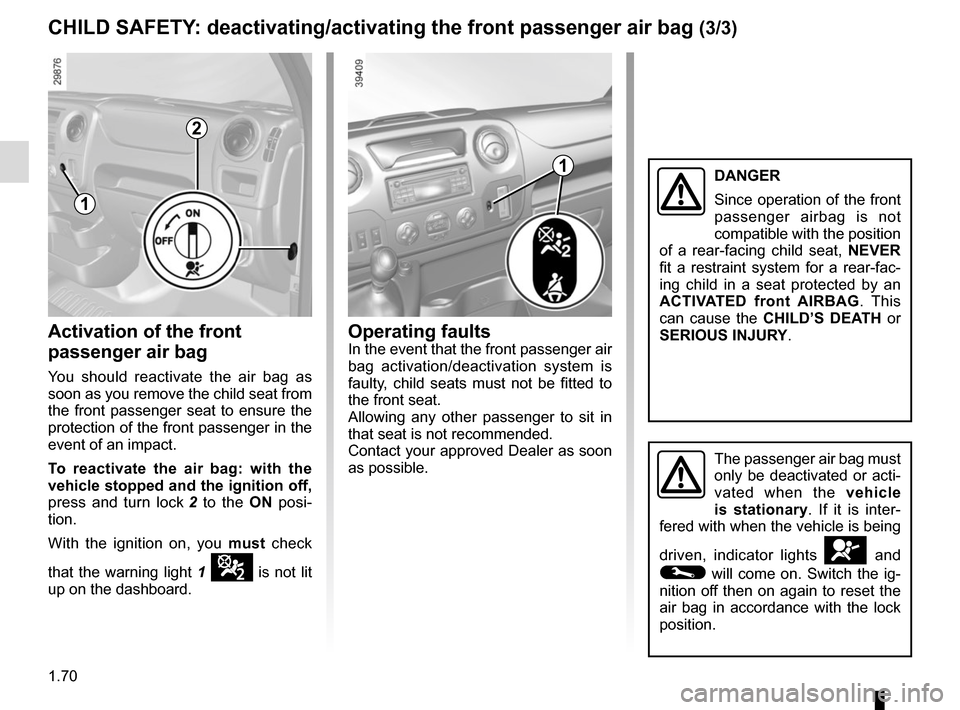
To reactivate the air bag: with the
vehicle stopped and the ignition off,
press and turn lock 2 to the ON posi-
tion.
With the ignition on, you must check
that the warning light 1
¹ is not lit
up on the dashboard.
CHILD SAFETY: deactivating/activating the front passenger air bag (3/3)
1
2
The passenger air bag must
only be deactivated or acti-
vated when the vehicle
is stationary. If it is inter-
fered with when the vehicle is being
driven, indicator lights
å and
© will come on. Switch the ig-
nition off then on again to reset the
air bag in accordance with the lock
position.
1DANGER
Since operation of the front
passenger airbag is not
compatible with the position
of a rear-facing child seat, NEVER
fit a restraint system for a rear-fac-
ing child in a seat protected by an
ACTIVATED front AIRBAG . This
can cause the CHILD’S DEATH or
SERIOUS INJURY.
Page 85 of 286
1.79
WARNING LIGHTS (4/4)
Š ‰Gear change indicator
This lights up to advise you to
change to a higher gear (up arrow) or,
depending on the vehicle, a lower gear
(down arrow).
Electronic Stability Control
warning light (ESP).
There are several reasons for the warn-
ing light to come on: please refer to in-
formation on “Driver correction devices
and aids” in Section 2.
Î ÏCruise control and
speed limiter indica-
tor lights
Refer to the information on the “Speed
limiter” and “Cruise control” in Section 2.
Warning light for additive
level and faults in the ex-
haust gas reduction system
Refer to the information on "Additive
tank" in Section 1.
The presence and operation of the warning lights DEPEND ON THE EQUIPMENT\
AND COUNTRY.
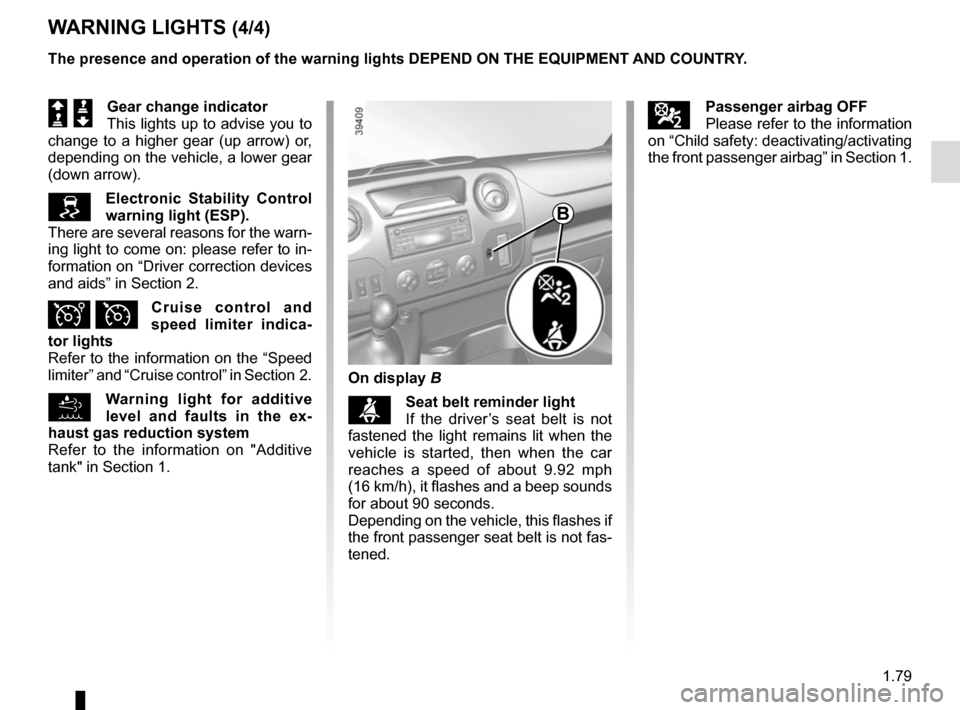
On display B
ßSeat belt reminder light
If the driver’s seat belt is not
fastened the light remains lit when the
vehicle is started, then when the car
reaches a speed of about 9.92 mph
(16 km/h), it flashes and a beep sounds
for about 90 seconds.
Depending on the vehicle, this flashes if
the front passenger seat belt is not fas-
tened.
B
¹Passenger airbag OFF
Please refer to the information
on “Child safety: deactivating/activating
the front passenger airbag” in Section 1.
Page 163 of 286

3.1
Section 3: Your comfort
Air Vents . . . . . . . . . . . . . . . . . . . . . . . . . . . . . . . . . . . .\
. . . . . . . . . . . . . . . . . . . . . . . . . . . . . . . . . . 3.2
Manual air conditioning/heating system . . . . . . . . . . . . . . . . . . . . . . . . . . . . . . . . . . . .\
. . . . . . . . . . 3.4
Automatic climate control . . . . . . . . . . . . . . . . . . . . . . . . . . . . . . . . . . . .\
. . . . . . . . . . . . . . . . . . . . . 3.7
Air conditioning: information and advice on use . . . . . . . . . . . . . . . . . . . . . . . . . . . . . . . . . . . .\
. . . . 3.13
Windows . . . . . . . . . . . . . . . . . . . . . . . . . . . . . . . . . . . .\
. . . . . . . . . . . . . . . . . . . . . . . . . . . . . . . . . . 3.15
Interior lighting . . . . . . . . . . . . . . . . . . . . . . . . . . . . . . . . . . . . \
. . . . . . . . . . . . . . . . . . . . . . . . . . . . . . 3.17
Sun visor, grab handle . . . . . . . . . . . . . . . . . . . . . . . . . . . . . . . . . . . . \
. . . . . . . . . . . . . . . . . . . . . . . . 3.18
Ashtrays, Cigarette lighter, Accessories socket . . . . . . . . . . . . . . . . . . . . . . . . . . . . . . . . . . . . \
. . . . . 3.19
Passenger compartment storage, fittings . . . . . . . . . . . . . . . . . . . . . . . . . . . . . . . . . . . .\
. . . . . . . . . 3.20
Rear bench seats . . . . . . . . . . . . . . . . . . . . . . . . . . . . . . . . . . . .\
. . . . . . . . . . . . . . . . . . . . . . . . . . . 3.26
Multimedia equipment . . . . . . . . . . . . . . . . . . . . . . . . . . . . . . . . . . . . \
. . . . . . . . . . . . . . . . . . . . . . . . 3.28
Transporting objects . . . . . . . . . . . . . . . . . . . . . . . . . . . . . . . . . . . .\
. . . . . . . . . . . . . . . . . . . . . . . . . 3.29
Page 177 of 286
3.15
WINDOWS (1/2)
Avoid resting any objects against a
half-open window: there is a risk that
the electric window winder could be
damaged.
1
2
3
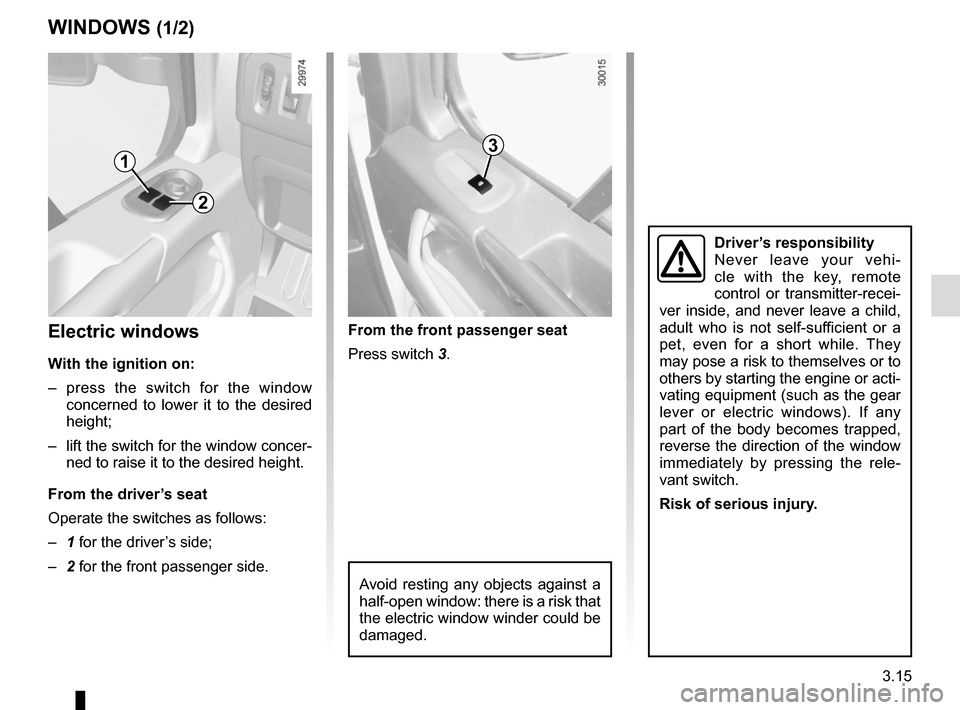
Electric windows
With the ignition on:
– press the switch for the window concerned to lower it to the desired
height;
– lift the switch for the window concer- ned to raise it to the desired height.
From the driver’s seat
Operate the switches as follows:
– 1 for the driver’s side;
– 2 for the front passenger side. From the front passenger seat
Press switch 3.
Driver’s responsibility
Never leave your vehi-
cle with the key, remote
control or transmitter-recei-
ver inside, and never leave a child,
adult who is not self-sufficient or a
pet, even for a short while. They
may pose a risk to themselves or to
others by starting the engine or acti-
vating equipment (such as the gear
lever or electric windows). If any
part of the body becomes trapped,
reverse the direction of the window
immediately by pressing the rele-
vant switch.
Risk of serious injury.
Page 186 of 286
3.24
Note: make sure the tray is put back in
place correctly before lifting the back of
the centre seat. Check that the back of
the centre seat is properly locked.
PASSENGER COMPARTMENT STORAGE/FITTINGS (5/6)
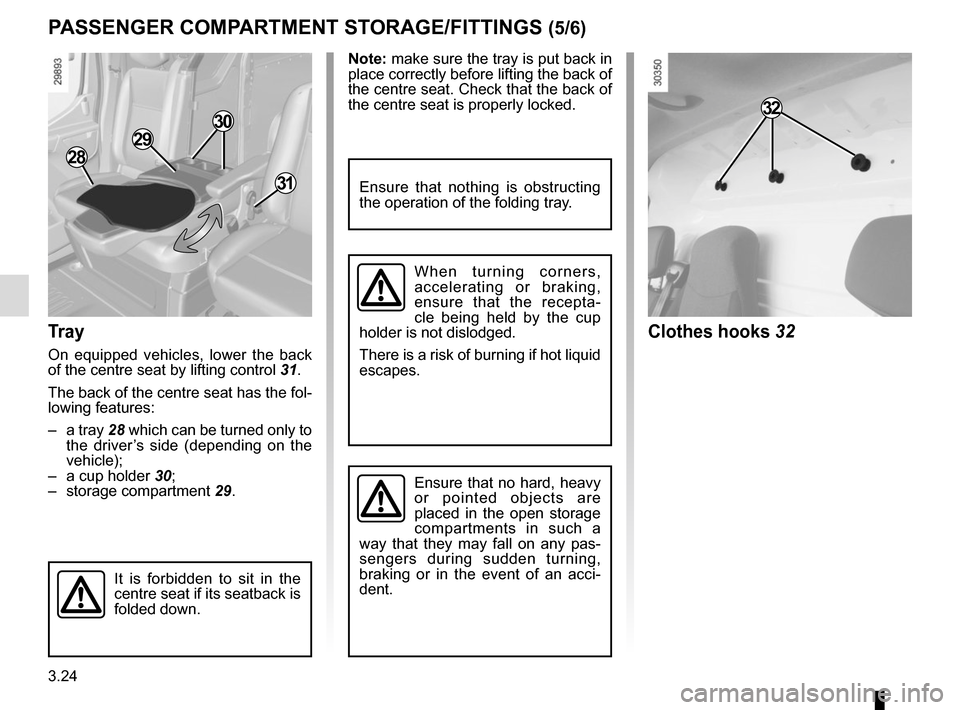
Tray
On equipped vehicles, lower the back
of the centre seat by lifting control 31.
The back of the centre seat has the fol-
lowing features:
– a tray 28 which can be turned only to
the driver’s side (depending on the
vehicle);
– a cup holder 30;
– storage compartment 29.
When turning corners,
accelerating or braking,
ensure that the recepta-
cle being held by the cup
holder is not dislodged.
There is a risk of burning if hot liquid
escapes.
It is forbidden to sit in the
centre seat if its seatback is
folded down.
Ensure that no hard, heavy
or pointed objects are
placed in the open storage
compartments in such a
way that they may fall on any pas-
sengers during sudden turning,
braking or in the event of an acci-
dent.
Ensure that nothing is obstructing
the operation of the folding tray.
28
29
30
31
Clothes hooks 32
32
Page 187 of 286

3.25
Storage compartment 34
underneath front bench seat
To access, pull tabs 33.
Rear load area storage
compartment 36
Reserved for the transport of objects
only.
The total weight of rear load area upper
storage compartment must not exceed
35 kg.
PASSENGER COMPARTMENT STORAGE/FITTINGS (6/6)
Do not hang any heavy and/
or sharp objects which may
fall while you are driving.
Risk of injury.
36
Storage compartment
underneath rear bench seat
Seat base 35 lifts up to give access to
a storage compartment underneath the
bench seat.
35
Check that the rear seat
belts are positioned and op-
erating correctly each time
the rear seats are moved.
Always close the seat base
when driving:
– there is a risk of injury
when braking suddenly or
in the event of an accident;
– there is a risk of objects being hurled through the passenger
compartment.
33
34
Page 188 of 286
3.26
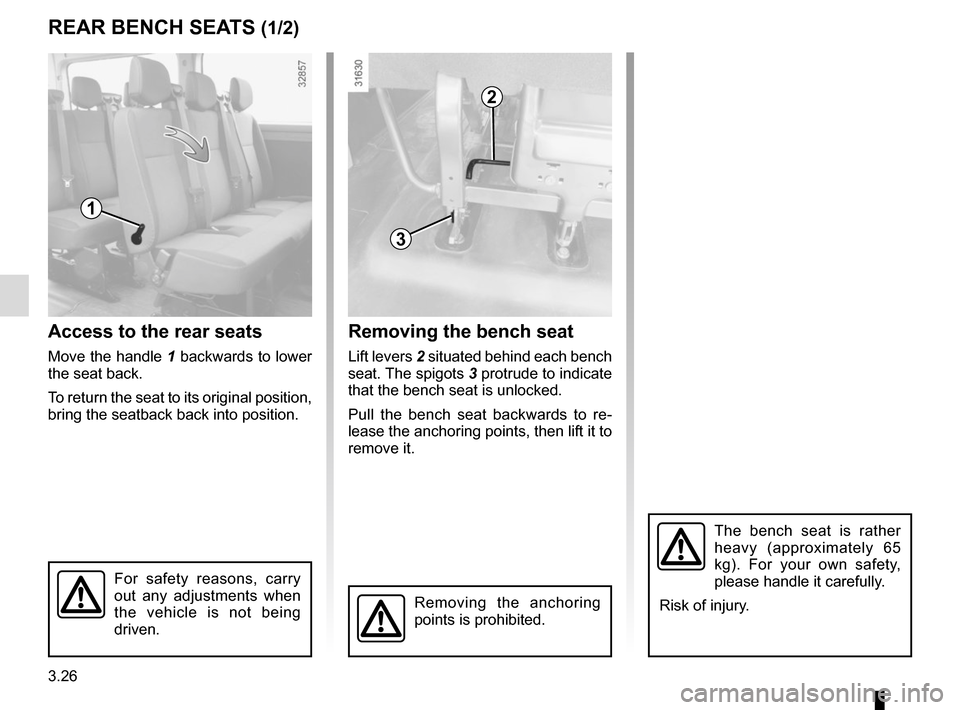
Access to the rear seats
Move the handle 1 backwards to lower
the seat back.
To return the seat to its original position,
bring the seatback back into position.
REAR BENCH SEATS (1/2)
Removing the bench seat
Lift levers 2 situated behind each bench
seat. The spigots 3 protrude to indicate
that the bench seat is unlocked.
Pull the bench seat backwards to re-
lease the anchoring points, then lift it to
remove it.
For safety reasons, carry
out any adjustments when
the vehicle is not being
driven.
Removing the anchoring
points is prohibited.
1
2
The bench seat is rather
heavy (approximately 65
kg). For your own safety,
please handle it carefully.
Risk of injury.
3
Page 189 of 286
3.27
REAR BENCH SEATS (2/2)
When moving the rear
bench seat, check that
the bench seat anchor-
age points are clean (they
should be free from grit, cloths or
any other item which may prevent
the bench seat from locking se-
curely).
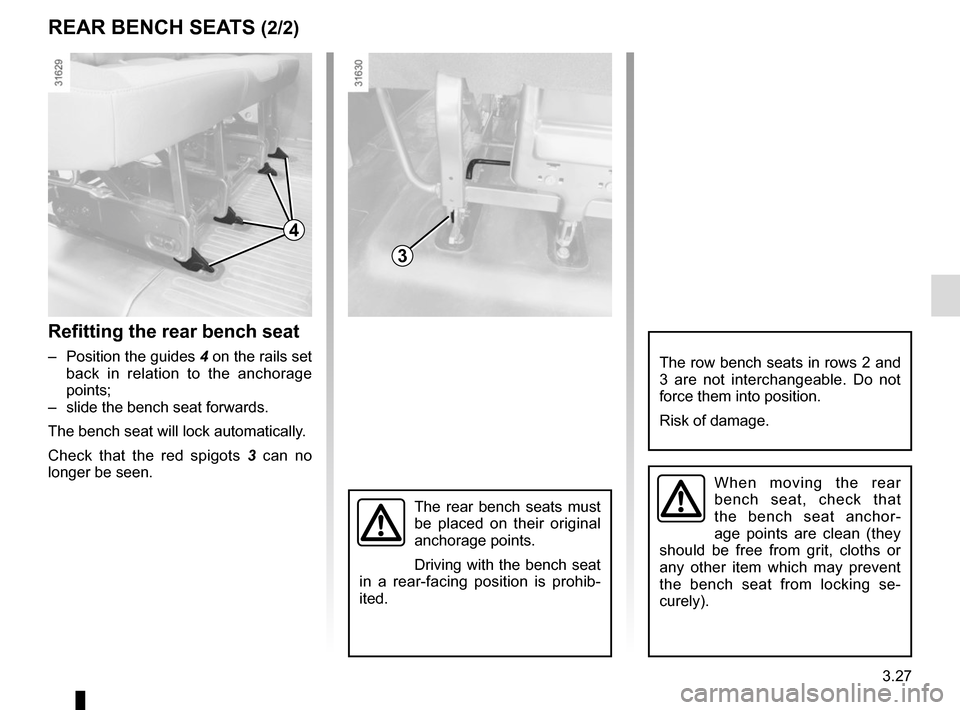
Refitting the rear bench seat
– Position the guides 4 on the rails set
back in relation to the anchorage
points;
– slide the bench seat forwards.
The bench seat will lock automatically.
Check that the red spigots 3 can no
longer be seen.
The rear bench seats must
be placed on their original
anchorage points.
Driving with the bench seat
in a rear-facing position is prohib-
ited.
4
3
The row bench seats in rows 2 and
3 are not interchangeable. Do not
force them into position.
Risk of damage.