seat RENAULT MASTER 2017 X62 / 2.G Repair Manual
[x] Cancel search | Manufacturer: RENAULT, Model Year: 2017, Model line: MASTER, Model: RENAULT MASTER 2017 X62 / 2.GPages: 286, PDF Size: 6.97 MB
Page 191 of 286
3.29
TRANSPORTING OBJECTS (1/2)
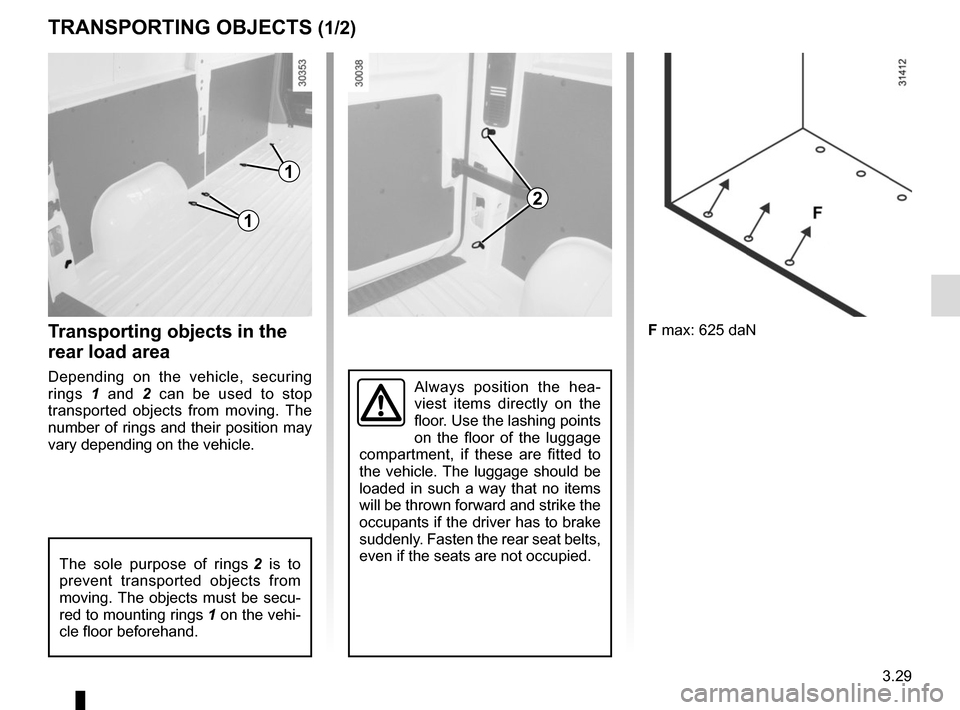
F max: 625 daN
Always position the hea-
viest items directly on the
floor. Use the lashing points
on the floor of the luggage
compartment, if these are fitted to
the vehicle. The luggage should be
loaded in such a way that no items
will be thrown forward and strike the
occupants if the driver has to brake
suddenly. Fasten the rear seat belts,
even if the seats are not occupied.
Transporting objects in the
rear load area
Depending on the vehicle, securing
rings 1 and 2 can be used to stop
transported objects from moving. The
number of rings and their position may
vary depending on the vehicle.
2
1
1
The sole purpose of rings 2 is to
prevent transported objects from
moving. The objects must be secu-
red to mounting rings 1 on the vehi-
cle floor beforehand.
Page 208 of 286
4.16
Glass instrument panel(e.g.: instrument panel, clock, exterior
temperature display, radio display, mul-
timedia or multifunction display etc.)
Use a soft cloth (or cotton wool).
If this does not clean them properly,
use a soft cloth (or cotton wool) slightly
moistened with soapy water and then
wipe clean with another soft damp cloth
or cotton wool.
Finally, carefully dry off with a soft dry
cloth.
Do not use products containing alco-
hol and/or spray fluids on the area.
Seat belts
These must be kept clean.
Use products selected by our Technical
Department (Approved outlets) or
warm, soapy water and a sponge and
wipe with a dry cloth.
Detergents or dyes must not be used
under any circumstances.
INTERIOR TRIM MAINTENANCE (1/2)
Textiles (seats, door trim, etc)
Vacuum-clean the textiles regularly.
Liquid stain
Use soapy water.
Dab lightly (never rub) with a soft cloth,
rinse and remove the excess.
Solid or pasty stain
Carefully remove the excess solid or
pasty material immediately with a
spatula (working from the edges to the
centre to avoid spreading the stain).
Clean as for a liquid stain.
Special instructions for sweets or
chewing gum
Put an ice cube on the stain to solidify
it, then proceed as for a solid stain.
A well-maintained vehicle will last
longer. It is therefore recommended to
maintain the interior of the vehicle regu-
larly.
A stain should always be dealt with
swiftly.
Whatever type of stain is on the trim,
use
cold (or warm) soapy water with
natural soap.
Detergents (washing-up liquid, pow-
dered products, alcohol-based prod-
ucts) should not be used.
Use a soft cloth.
Rinse and soak up the excess.
For further recommendations for
maintaining the interior, and/or for
any unsatisfactory results, please
see an authorised dealer.
Page 214 of 286
5.4
TOOL KIT
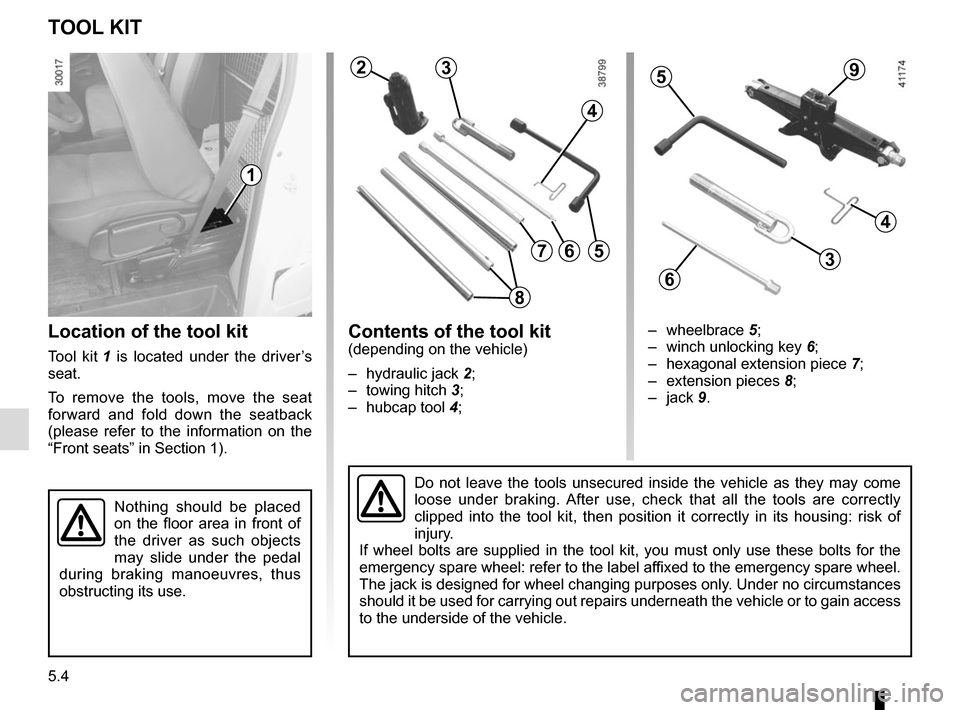
Location of the tool kit
Tool kit 1 is located under the driver’s
seat.
To remove the tools, move the seat
forward and fold down the seatback
(please refer to the information on the
“Front seats” in Section 1).
Contents of the tool kit(depending on the vehicle)
– hydraulic jack 2;
– towing hitch 3;
– hubcap tool 4;
1
Do not leave the tools unsecured inside the vehicle as they may come
loose under braking. After use, check that all the tools are correctly
clipped into the tool kit, then position it correctly in its housing: ri\
sk of
injury.
If wheel bolts are supplied in the tool kit, you must only use these bol\
ts for the
emergency spare wheel: refer to the label affixed to the emergency spare wheel.
The jack is designed for wheel changing purposes only. Under no circumstances
should it be used for carrying out repairs underneath the vehicle or to \
gain access
to the underside of the vehicle.
Nothing should be placed
on the floor area in front of
the driver as such objects
may slide under the pedal
during braking manoeuvres, thus
obstructing its use.
23
4
56
– wheelbrace 5;
– winch unlocking key 6;
– hexagonal extension piece 7;
– extension pieces 8;
– jack 9.
59
4
3
6
7
8
Page 216 of 286
5.6
TYRE INFLATION KIT (2/6)
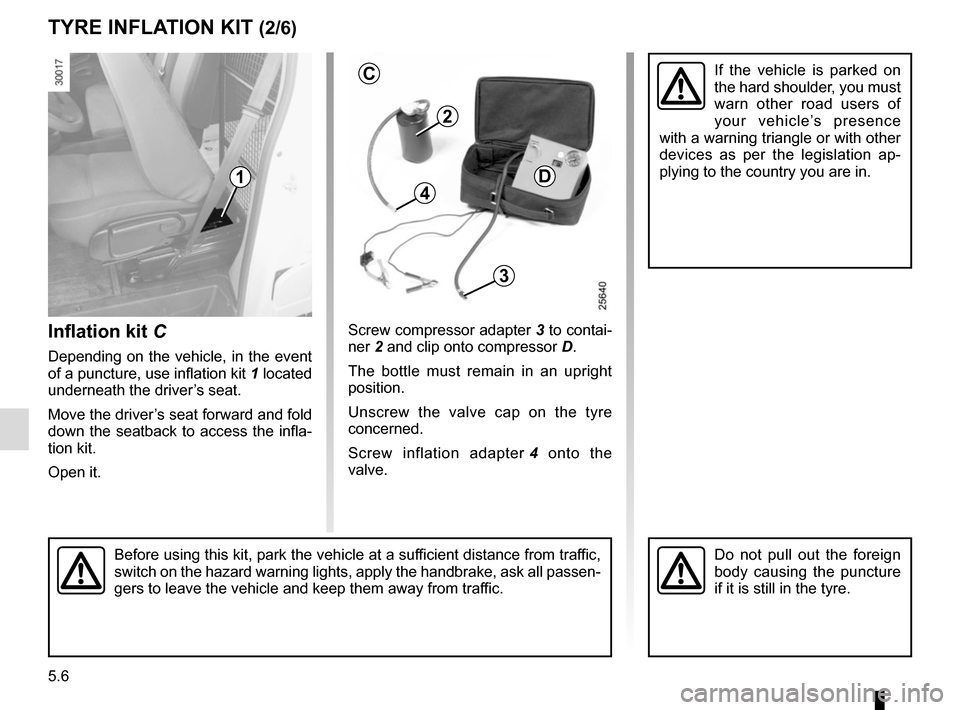
Inflation kit C
Depending on the vehicle, in the event
of a puncture, use inflation kit 1 located
underneath the driver’s seat.
Move the driver’s seat forward and fold
down the seatback to access the infla-
tion kit.
Open it. Screw compressor adapter
3 to contai-
ner 2 and clip onto compressor D.
The bottle must remain in an upright
position.
Unscrew the valve cap on the tyre
concerned.
Screw inflation adapter 4 onto the
valve.
Before using this kit, park the vehicle at a sufficient distance from traffic,
switch on the hazard warning lights, apply the handbrake, ask all passen\
-
gers to leave the vehicle and keep them away from traffic.Do not pull out the foreign
body causing the puncture
if it is still in the tyre.
2
D
3
41
If the vehicle is parked on
the hard shoulder, you must
warn other road users of
your vehicle’s presence
with a warning triangle or with other
devices as per the legislation ap-
plying to the country you are in.C
Page 218 of 286
5.8
TYRE INFLATION KIT (4/6)
Affix the driving recommendation label
to the dashboard where it can easily be
seen by the driver;
Store the kit underneath the driver’s
seat.
Start the vehicle immediately in order
to the distribute the product in the tyre
and, after 6 miles (10 km) or 10 mi-
nutes driving, stop to check the pres-
sure. To do this, fit adapter 3 onto the
tyre valve. If the pressure is less than
the recommended pressure, adjust it
(refer to the information on “Tyre pres-
sures”), otherwise contact an approved
dealer: repair is not possible.Precautions when using the
kit
– the kit should not be operated for more than 15 consecutive minutes;
– when driving, vibration may be felt due to the presence of the repair pro-
duct injected into the tyre.
Following repair with the kit,
do not travel further than
120 miles (200 km). In addi-
tion, reduce your speed and
under no circumstances exceed
48 mph (80 km/h). The sticker,
which you must affix in a prominent
position on the dashboard, reminds
you of this.
Depending on the country or local
legislation, a tyre repaired with the
inflation kit may need to be replaced.
3
Please be aware that a poorly tightened or missing valve cap can make
the tyres less airtight and lead to pressure loss.
Always use valve caps identical to those fitted originally and tighten t\
hem
fully.
Nothing should be placed
around the driver’s feet
as such objects may slide
under the pedals during
sudden braking manoeuvres and
obstruct their use.
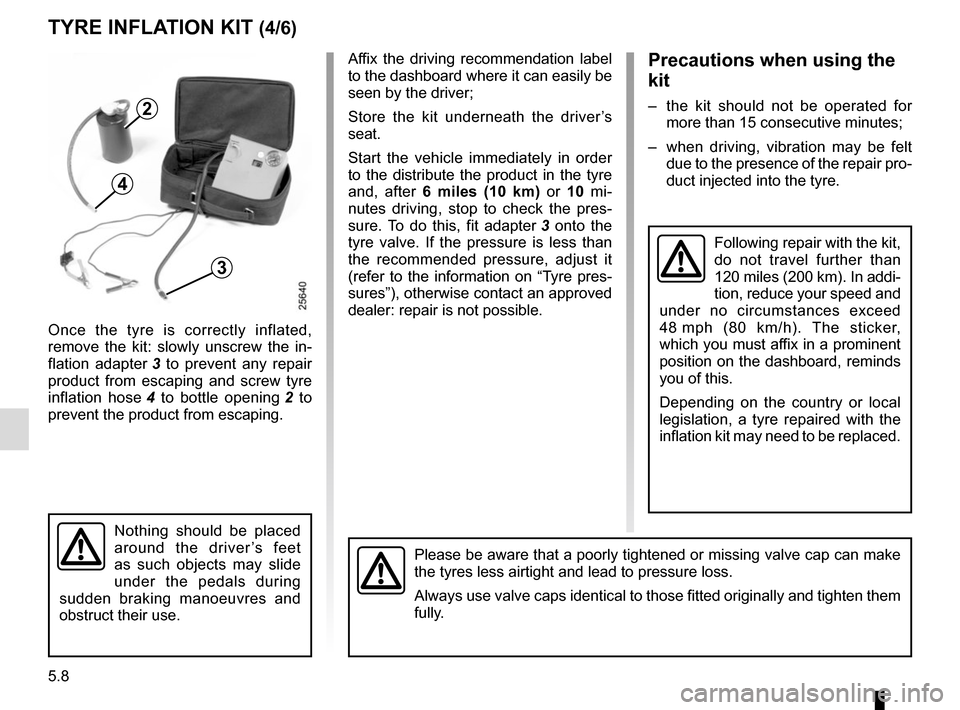
Once the tyre is correctly inflated,
remove the kit: slowly unscrew the in-
flation adapter 3 to prevent any repair
product from escaping and screw tyre
inflation hose 4 to bottle opening 2 to
prevent the product from escaping.
4
2
Page 219 of 286
5.9
TYRE INFLATION KIT (5/6)
Inflation kit E
Depending on the vehicle, in the event
of a puncture, use the inflation kit loca-
ted underneath the driver’s seat.
Before using this kit, park
the vehicle at a sufficient
distance from traffic, switch
on the hazard warning
lights, apply the handbrake, ask all
passengers to leave the vehicle and
keep them away from traffic.
If the vehicle is parked on
the hard shoulder, you must
warn other road users of
your vehicle’s presence
with a warning triangle or with other
devices as per the legislation ap-
plying to the country you are in.
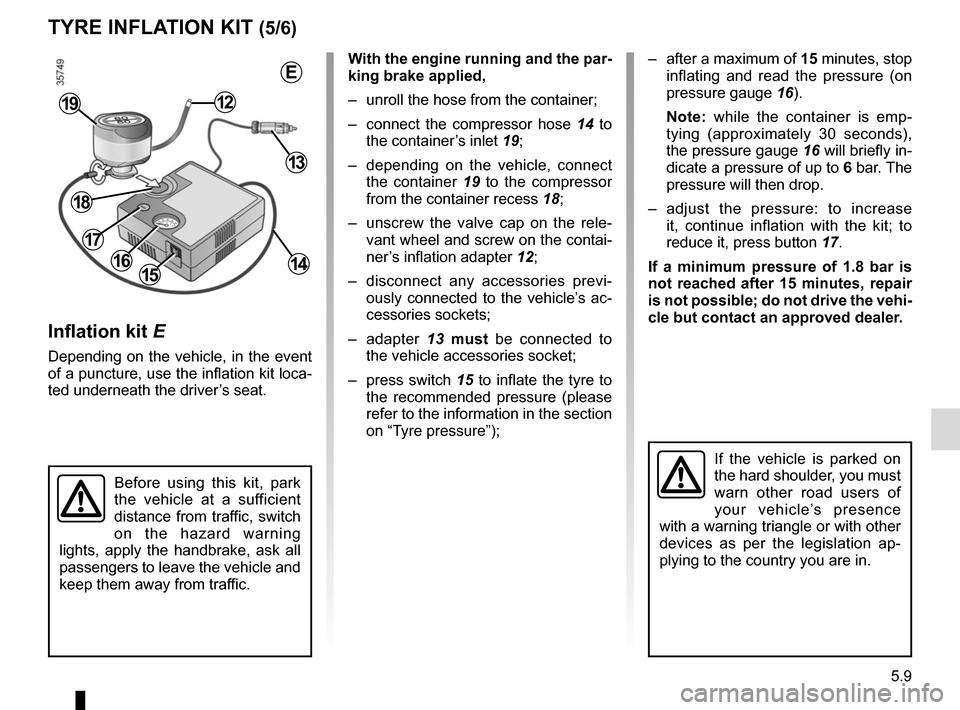
With the engine running and the par-
king brake applied,
– unroll the hose from the container;
– connect the compressor hose 14 to the container’s inlet 19;
– depending on the vehicle, connect the container 19 to the compressor
from the container recess 18;
– unscrew the valve cap on the rele- vant wheel and screw on the contai-
ner’s inflation adapter 12;
– disconnect any accessories previ- ously connected to the vehicle’s ac-
cessories sockets;
– adapter 13 must be connected to
the vehicle accessories socket;
– press switch 15 to inflate the tyre to
the recommended pressure (please
refer to the information in the section
on “Tyre pressure”);
1516
1219
– after a maximum of 15 minutes, stop inflating and read the pressure (on
pressure gauge 16).
Note: while the container is emp-
tying (approximately 30 seconds),
the pressure gauge 16 will briefly in-
dicate a pressure of up to 6 bar. The
pressure will then drop.
– adjust the pressure: to increase it, continue inflation with the kit; to
reduce it, press button 17.
If a minimum pressure of 1.8 bar is
not reached after 15 minutes, repair
is not possible; do not drive the vehi-
cle but contact an approved dealer.
13
14
18
17
E
Page 239 of 286
5.29
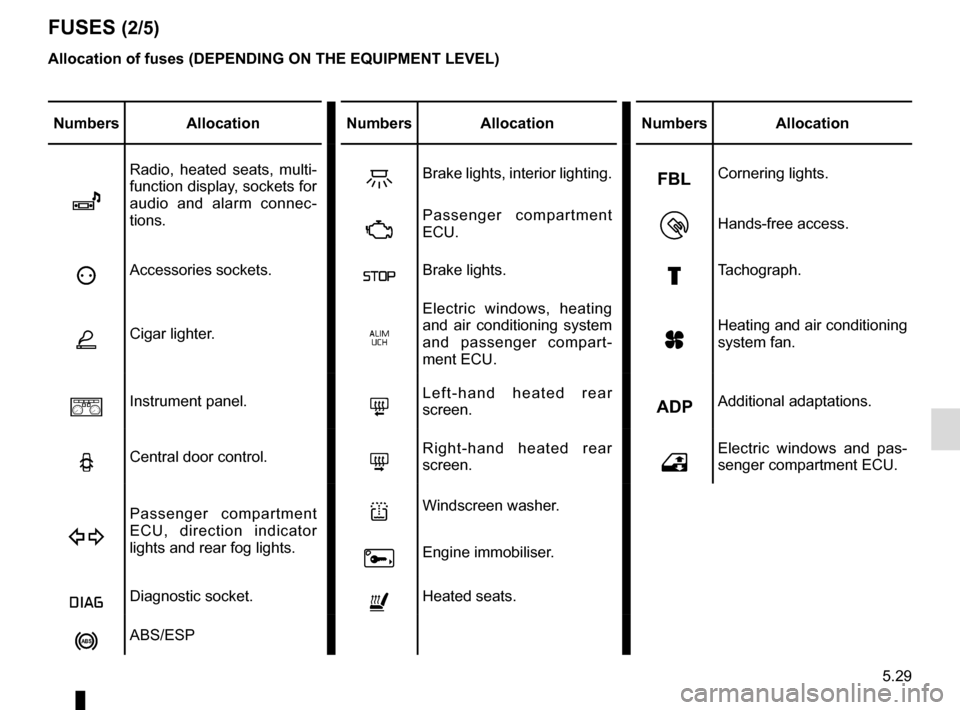
FUSES (2/5)
Allocation of fuses (DEPENDING ON THE EQUIPMENT LEVEL)
Numbers AllocationNumbers Allocation Numbers Allocation
î
Radio, heated seats, multi-
function display, sockets for
audio and alarm connec-
tions.ZBrake lights, interior lighting.Cornering lights.
ÄPassenger compartment
ECU.Hands-free access.
ëAccessories sockets.ßBrake lights.£Tachograph.
ÆCigar lighter.‚
Electric windows, heating
and air conditioning system
and passenger compart-
ment ECU.
yHeating and air conditioning
system fan.
aInstrument panel.8Left-hand heated rear
screen.Additional adaptations.
NCentral door control.7Right-hand heated rear
screen.hElectric windows and pas-
senger compartment ECU.
D
Passenger compartment
ECU, direction indicator
lights and rear fog lights.lWindscreen washer.
0Engine immobiliser.
ÎDiagnostic socket.ñHeated seats.
nABS/ESP
Page 249 of 286
5.39
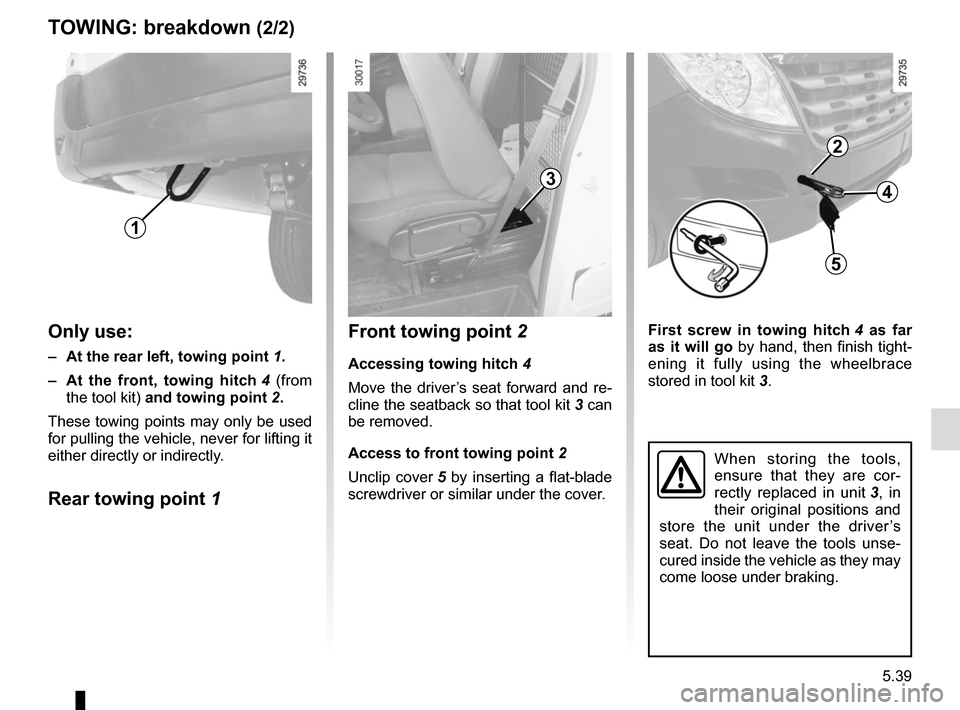
First screw in towing hitch 4 as far
as it will go by hand, then finish tight-
ening it fully using the wheelbrace
stored in tool kit 3.
TOWING: breakdown (2/2)
When storing the tools,
ensure that they are cor-
rectly replaced in unit 3, in
their original positions and
store the unit under the driver’s
seat. Do not leave the tools unse-
cured inside the vehicle as they may
come loose under braking.
Front towing point 2
Accessing towing hitch 4
Move the driver’s seat forward and re-
cline the seatback so that tool kit 3 can
be removed.
Access to front towing point 2
Unclip cover 5 by inserting a flat-blade
screwdriver or similar under the cover.
3
2
5
4
1
Only use:
– At the rear left, towing point 1.
– At the front, towing hitch 4 (from
the tool kit) and towing point 2.
These towing points may only be used
for pulling the vehicle, never for lifting it
either directly or indirectly.
Rear towing point 1
Page 279 of 286

A
ABS ....................................................................\
...2.16 → 2.20
accessories...................................................................")
7.1
ALPHABETICAL INDEX (1/4)
A
ABS ....................................................................\
...2.16 → 2.20
accessories........................................................................\
5.41
accessories socket ............................................................ 3.19
AdBlue ...............................................................1.103 → 1.108
AdBlue additive..................................................1.103 → 1.108
additional systems to the seat belts................................... 1.29
additive (tank) ....................................................1.103 → 1.108
additive tank ......................................................1.103 → 1.108
adjusting the seats............................................................. 1.22
adjusting your driving position ........................................... 1.22
advice on antipollution ....................................................... 2.12
air bag....................................................................1.26 → 1.29
activating the front passenger air bags ............1.68 → 1.70
deactivating the front passenger air bags ........1.68 → 1.70
air conditioning ........................................................3.2 → 3.14
air vents ...................................................................... 3.2 – 3.3
anti-corrosion check ..............................................6.16 → 6.21
anti-corrosion protection .................................................... 4.14
anti-lock braking system: ABS ...............................2.16 → 2.20
antipollution advice .................................................................\
......... 2.12
ashtrays ...............................................................\
.............. 3.19
audible and visual signals................................................ 1.100
B
battery........................................................................\
........ 4.13 troubleshooting ................................................. 5.33 – 5.34
bonnet........................................................................\
.......... 4.2
brake fluid ........................................................................\
.... 4.8
bulbs changing ......................................5.21 – 5.22, 5.25 → 5.27
C
capacity of mechanical components........................4.8 → 4.10
central door locking ........................... 1.2 → 1.11, 1.14 → 1.17changing a bulb .................................5.21 – 5.22, 5.25
→ 5.27
changing a wheel........................ 5.2 → 5.4, 5.11 → 5.15, 5.17
changing gear .................................................................... 2.14
child restraint/seat 1.28, 1.31 – 1.32, 1.36 → 1.55, 1.68 → 1.70
child safety............ 1.2, 1.31 – 1.32, 1.36 → 1.55, 1.68 → 1.70
child seats..........................................1.31 – 1.32, 1.36 → 1.55
children ............................................................ 1.2, 1.31 – 1.32
cigar lighter ........................................................................\
3.19
cleaning: inside the vehicle .............................................. 4.16 – 4.17
clock ..................................................................\
................ 1.92
control instruments ................................................1.76 → 1.83
coolant ................................................................\
............... 1.81
courtesy light ............................................................ 3.17, 5.27
cruise control .........................................................2.30 → 2.33
cruise control-speed limiter....................................2.27 → 2.33
D
demisting windscreen ..................................................3.4, 3.7 → 3.12
dimensions ................................................................. 6.6 – 6.7
dipstick................................................................\
........ 4.4 – 4.5
display .................................................................... 1.82 – 1.83
doors................................................... 1.12 – 1.13, 1.16 – 1.17
driver’s position .....................................................1.72 → 1.75
driving ...........................................2.2, 2.10, 2.16 → 2.23, 2.34
driving recommendations ........................................ 2.8 → 2.11
E
ECO driving ............................................................. 2.8 →
2.11
ECO mode ........................................................................\
... 2.9
electric beam height adjustment ........................................ 1.99
electric windows ..................................................... 3.15 – 3.16
electronic stability control: ESC .............................2.16 → 2.20
emergency brake assist.........................................2.16 → 2.20
emergency braking ................................................2.16 → 2.20
Page 280 of 286
7.2
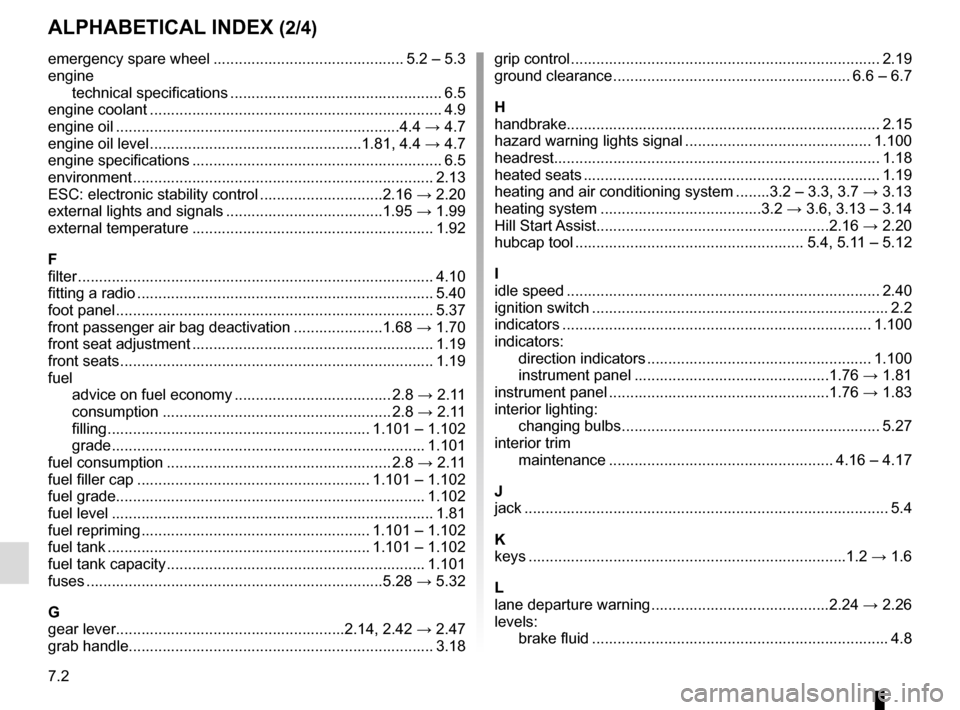
ALPHABETICAL INDEX (2/4)
emergency spare wheel ............................................. 5.2 – 5.3
enginetechnical specifications .................................................. 6.5
engine coolant ..................................................................... 4.9
engine oil ...................................................................4.4 → 4.7
engine oil level ..................................................1.81, 4.4 → 4.7
engine specifications ........................................................... 6.5
environment ............................................................\
........... 2.13
ESC: electronic stability control .............................2.16 → 2.20
external lights and signals .....................................1.95 → 1.99
external temperature ......................................................... 1.92
F
filter .................................................................\
................... 4.10
fitting a radio ...................................................................... 5.40
foot panel ........................................................................\
... 5.37
front passenger air bag deactivation .....................1.68 → 1.70
front seat adjustment ......................................................... 1.19
front seats ........................................................................\
.. 1.19
fuel advice on fuel economy ..................................... 2.8 → 2.11
consumption ...................................................... 2.8 → 2.11
filling .............................................................. 1.101 – 1.102
grade ..................................................................\
........ 1.101
fuel consumption ..................................................... 2.8 → 2.11
fuel filler cap ....................................................... 1.101 – 1.102
fuel grade........................................................................\
. 1.102
fuel level ........................................................................\
.... 1.81
fuel repriming ...................................................... 1.101 – 1.102
fuel tank .............................................................. 1.101 – 1.102
fuel tank capacity ............................................................. 1.101
fuses ..................................................................\
....5.28 → 5.32
G
gear lever......................................................2.14, 2.42 → 2.47
grab handle........................................................................\
3.18 grip control ........................................................................\
. 2.19
ground clearance ........................................................ 6.6 – 6.7
H
handbrake........................................................................\
.. 2.15
hazard warning lights signal ............................................ 1.100
headrest........................................................................\
..... 1.18
heated seats ...................................................................... 1.19
heating and air conditioning system ........3.2 – 3.3, 3.7 → 3.13
heating system ......................................3.2 → 3.6, 3.13 – 3.14
Hill Start Assist.......................................................2.16 → 2.20
hubcap tool ...................................................... 5.4, 5.11 – 5.12
I
idle speed ........................................................................\
.. 2.40
ignition switch ...................................................................... 2.2
indicators .............................................................\
............ 1.100
indicators: direction indicators ..................................................... 1.100
instrument panel ..............................................1.76 → 1.81
instrument panel ....................................................1.76 → 1.83
interior lighting: changing bulbs ............................................................. 5.27
interior trim maintenance ..................................................... 4.16 – 4.17
J
jack ...................................................................\
................... 5.4
K
keys ...................................................................\
........1.2 → 1.6
L
lane departure warning ..........................................2.24 → 2.26
levels: brake fluid ...................................................................... 4.8