belts RENAULT MASTER 2018 User Guide
[x] Cancel search | Manufacturer: RENAULT, Model Year: 2018, Model line: MASTER, Model: RENAULT MASTER 2018Pages: 290, PDF Size: 7.1 MB
Page 39 of 290
1.33
CHILD SAFETY: General information (1/2)
Carrying children
Children, and adults, must be correctly
seated and strapped in for all journeys.
The children being carried in your vehi-
cle are your responsibility.
A child is not a miniature adult. Children
are at risk of specific injuries as their
muscles and bones have not yet fin-
ished growing. The seat belt alone
would not provide suitable protection.
Use an approved child seat and ensure
you use it correctly.
A collision at 30 mph
(50 km/ h) is the same
as falling a distance of
10 metres. Transporting a
child without a restraint is the equiv-
alent of allowing him or her to play
on a fourth-floor balcony without
railings.
Never travel with a child held in your
arms. In the event of an accident,
you will not be able to keep hold of
the child, even if you yourself are
wearing a seat belt.
If your vehicle has been involved
in a road accident, replace the
child seat and have the seat belts
checked.
To prevent the doors being
opened, use the childproof
locks (please refer to the in-
formation on “Locking/un-
locking the doors” in Section 1).
Driver’s responsibility
when parking or stopping
the vehicle
Never leave an animal,
child or adult who is not self-suffi-
cient alone on your vehicle, even for
a short time.
They may pose a risk to themselves
or to others by starting the engine,
activating equipment such as the
electric windows or by locking the
doors.
Also, in hot and/or sunny weather,
please remember that the tempera-
ture inside the passenger compart-
ment increases very quickly.
RISK OF DEATH OR SERIOUS
INJURY.
Page 40 of 290
1.34
CHILD SAFETY: General information (2/2)
Using a child seat
The level of protection offered by the
child seat depends on its ability to re-
strain your child and on its installation.
Incorrect installation compromises the
protection it offers the child in the event
of harsh braking or an impact.
Before purchasing a child seat, check
that it complies with the regulations for
the country you are in and that it can
be fitted in your vehicle. Consult an ap-
proved dealer to find out which seats
are recommended for your vehicle.
Before fitting a child seat, read the
manual and respect its instructions. If
you experience any difficulties during
installation, contact the manufacturer
of the equipment. Keep the instructions
with the seat.
Never leave a child unat-
tended in the vehicle.
Check that your child is
always strapped in and that
the belt or safety harness used is
correctly set and adjusted. Avoid
wearing bulky clothing which could
cause the belts to slacken.
Never let your child put their head or
arms out of the window.
Check that the child is in the correct
position for the entire journey, espe-
cially if asleep.
Set a good example by always fas-
tening your seat belt and teaching
your child:
– to strap themselves in correctly.
– to always get in and out of the car at the kerb, away from busy traf-
fic.
Do not use a second-hand child
seat or one without an instruction
manual.
Check that there are no objects in
the vicinity of the child seat which
could impede its operation.
Page 42 of 290
1.36
CHILD SAFETY: choosing a child, baby seat mounting (1/2)
There are two ways of attaching child
seats: via the seat belt or using the
ISOFIX system.
Attachment via the seat belt
The seat belt must be adjusted to
ensure that it is effective in the event of
harsh braking or an impact.
Ensure that the strap paths indicated
by the child seat manufacturer are re-
spected.
Always check that the seat belt is cor-
rectly fastened by pulling it up, then
pulling it out fully whilst pressing on the
child seat.
Check that the seat is correctly held by
moving it from side to side and back
to front: the seat should remain firmly
fixed.Attachment using the ISOFIX
system
Authorised ISOFIX child seats are ap-
proved in accordance with regulation
ECE-R44 in one of the three following
scenarios:
– universal ISOFIX 3-point forward-
facing seat;
– semi-universal ISOFIX 2-point seat;
– specific.
For the latter two, check that your child
seat can be installed by consulting the
list of compatible vehicles.
Attach the child seat with the ISOFIX
locks, if these are provided. The ISOFIX
system allows quick, easy, safe fitting.
The ISOFIX system consists of 2 rings
and, in some cases, a third ring.
Before using an ISOFIX
child seat that you pur-
chased for another vehicle,
check that its installation is
authorised. Consult the list of ve-
hicles which can be fitted with the
seat from the equipment manufac-
turer.
No modifications may be
made to the component
parts of the restraint system
(ISOFIX seat belts, seats
and their mountings) originally fitted.
The seat belt must never
be twisted or the tension
relieved. Never pass the
shoulder strap under the
arm or behind the back.
Check that the seat belt has not
been damaged by sharp edges.
If the seat belt does not operate nor-
mally, it will not protect the child.
Consult an approved dealer. Do not
use this seat until the seat belt has
been repaired.
Do not use the child seat
if it may unfasten the seat
belt restraining it: the base
of the seat must not rest on
the buckle and/or catch of the seat
belt.
Check that the child seat has not been
installed at an angle and that it is not
resting against a window.
Page 191 of 290
3.25
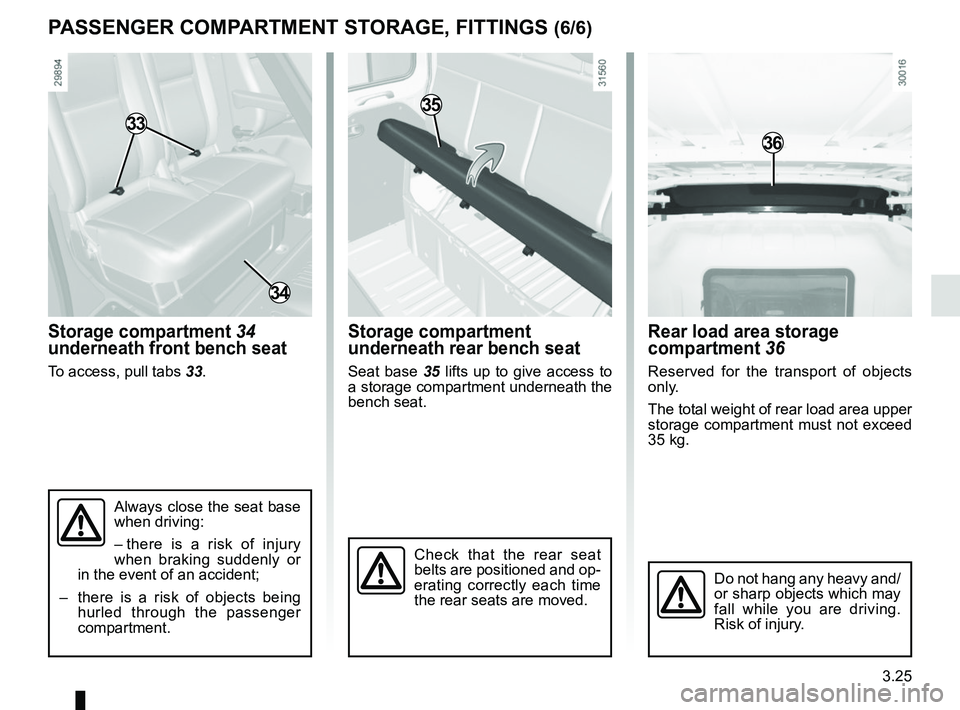
Storage compartment 34
underneath front bench seat
To access, pull tabs 33.
Rear load area storage
compartment 36
Reserved for the transport of objects
only.
The total weight of rear load area upper
storage compartment must not exceed
35 kg.
PASSENGER COMPARTMENT STORAGE, FITTINGS (6/6)
Do not hang any heavy and/
or sharp objects which may
fall while you are driving.
Risk of injury.
36
Storage compartment
underneath rear bench seat
Seat base 35 lifts up to give access to
a storage compartment underneath the
bench seat.
35
Check that the rear seat
belts are positioned and op-
erating correctly each time
the rear seats are moved.
Always close the seat base
when driving:
– there is a risk of injury
when braking suddenly or
in the event of an accident;
– there is a risk of objects being hurled through the passenger
compartment.
33
34
Page 195 of 290
3.29
TRANSPORTING OBJECTS (1/2)
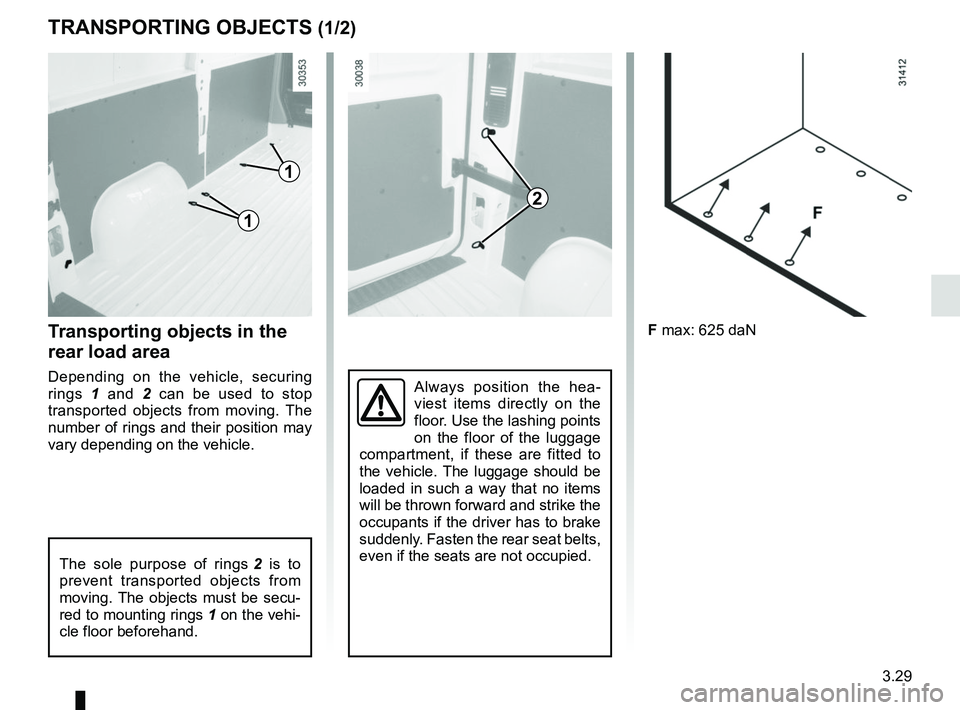
F max: 625 daN
Always position the hea-
viest items directly on the
floor. Use the lashing points
on the floor of the luggage
compartment, if these are fitted to
the vehicle. The luggage should be
loaded in such a way that no items
will be thrown forward and strike the
occupants if the driver has to brake
suddenly. Fasten the rear seat belts,
even if the seats are not occupied.
Transporting objects in the
rear load area
Depending on the vehicle, securing
rings 1 and 2 can be used to stop
transported objects from moving. The
number of rings and their position may
vary depending on the vehicle.
2
1
1
The sole purpose of rings 2 is to
prevent transported objects from
moving. The objects must be secu-
red to mounting rings 1 on the vehi-
cle floor beforehand.
Page 213 of 290
4.17
Glass instrument panel(e.g. instrument panel, clock, exterior
temperature display, radio display, etc.)
Use a soft cloth (or cotton wool).
If this does not clean them properly,
use a soft cloth (or cotton wool) slightly
moistened with soapy water and then
wipe clean with another soft damp cloth
or cotton wool.
Finally, carefully dry off with a soft dry
cloth.
Do not use products containing alco-
hol and/or spray fluids on the area.
Seat belts
These must be kept clean.
Use products selected by our Technical
Department (Approved outlets) or
warm, soapy water and a sponge and
wipe with a dry cloth.
Detergents or dyes must not be used
under any circumstances.
INTERIOR TRIM MAINTENANCE (1/2)
Textiles (seats, door trim, etc)
Vacuum-clean the textiles regularly.
Liquid stain
Use soapy water.
Dab lightly (never rub) with a soft cloth,
rinse and remove the excess.
Solid or pasty stain
Carefully remove the excess solid or
pasty material immediately with a
spatula (working from the edges to the
centre to avoid spreading the stain).
Clean as for a liquid stain.
Special instructions for sweets or
chewing gum
Put an ice cube on the stain to solidify
it, then proceed as for a solid stain.
A well-maintained vehicle will last
longer. It is therefore recommended to
maintain the interior of the vehicle regu-
larly.
A stain should always be dealt with
swiftly.
Whatever type of stain is on the trim,
use
cold (or warm) soapy water with
natural soap.
Detergents (washing-up liquid, pow-
dered products, alcohol-based prod-
ucts) should not be used.
Use a soft cloth.
Rinse and soak up the excess.
For further recommendations for
maintaining the interior, and/or for
any unsatisfactory results, please
see an authorised dealer.
Page 283 of 290

A
ABS ....................................................................\
...2.16 → 2.23
accessories...................................................................")
7.1
ALPHABETICAL INDEX (1/4)
A
ABS ....................................................................\
...2.16 → 2.23
accessories........................................................................\
5.41
accessories socket ............................................................ 3.19
AdBlue ...............................................................1.104 → 1.109
AdBlue additive..................................................1.104 → 1.109
additional systems to the seat belts................................... 1.31
additive (tank) ....................................................1.104 → 1.109
additive tank ......................................................1.104 → 1.109
adjusting the seats............................................................. 1.24
adjusting your driving position ........................................... 1.24
advice on antipollution ....................................................... 2.12
air bag....................................................................1.28 → 1.31
activating the front passenger air bags ............1.70 → 1.72
deactivating the front passenger air bags ........1.70 → 1.72
air conditioning ........................................................3.2 → 3.14
air vents ...................................................................... 3.2 – 3.3
anti-corrosion check ..............................................6.16 → 6.21
anti-corrosion protection .................................................... 4.14
anti-lock braking system: ABS ...............................2.16 → 2.23
antipollution advice .................................................................\
......... 2.12
ashtrays ...............................................................\
.............. 3.19
audible and visual signals................................................ 1.101
automatic gearbox selector lever...........................2.45 → 2.49
B
battery........................................................................\
........ 4.13 troubleshooting ................................................. 5.33 – 5.34
bonnet........................................................................\
.......... 4.2
brake fluid ........................................................................\
.... 4.8
bulbs changing ......................................5.21 – 5.22, 5.25 → 5.27
C
capacity of mechanical components........................4.8 → 4.10central door locking ........................... 1.2
→ 1.12, 1.15 → 1.18
changing a bulb .................................5.21 – 5.22, 5.25 → 5.27
changing a wheel........................ 5.2 → 5.4, 5.11 → 5.15, 5.17
changing gear .................................................................... 2.14
child restraint/seat 1.30, 1.33 – 1.34, 1.38 → 1.57, 1.70 → 1.72
child safety................... 1.33 – 1.34, 1.38 → 1.57, 1.70 → 1.72
child seats..........................................1.33 – 1.34, 1.38 → 1.57
children ................................................................... 1.33 – 1.34
cigar lighter ........................................................................\
3.19
cleaning: inside the vehicle .............................................. 4.17 – 4.18
clock ..................................................................\
................ 1.93
control instruments ................................................1.78 → 1.85
coolant ................................................................\
............... 1.83
courtesy light ............................................................ 3.17, 5.27
cruise control .........................................................2.33 → 2.36
cruise control-speed limiter....................................2.30 → 2.36
D
deadlocking the doors ......................................................... 1.7
demisting windscreen ..................................................3.4, 3.7 → 3.12
dimensions ................................................................. 6.6 – 6.7
dipstick................................................................\
........ 4.4 – 4.5
display .................................................................... 1.84 – 1.85
doors................................................... 1.13 – 1.14, 1.17 – 1.18
driver’s position .....................................................1.74 → 1.77
driving ...........................................2.2, 2.10, 2.16 → 2.26, 2.37
driving recommendations ........................................ 2.8 → 2.11
E
ECO driving .............................................................
2.8 → 2.11
ECO mode ........................................................................\
... 2.9
electric beam height adjustment ...................................... 1.100
electric windows ..................................................... 3.15 – 3.16
electronic stability control: ESC .............................2.16 → 2.23
Page 285 of 290

7.3
ALPHABETICAL INDEX (3/4)
L
lane departure warning ..........................................2.27 → 2.29
levels: brake fluid ...................................................................... 4.8
coolant ................................................................\
........... 4.9
power-assisted steering pump ..................................... 4.10
lifting the vehicle changing a wheel .............................5.4, 5.13 → 5.15, 5.17
lighting: interior ...............................................................\
........... 3.17
lights: adjustment of headlight beam height ......................... 1.100
brake lights ....................................................... 5.25 – 5.26
daytime running lights ....................................... 5.21 – 5.22
dipped beam headlights .................. 1.96, 5.21 – 5.22, 5.25
direction indicators ............................................ 5.21 – 5.22
fog lights ............................................................. 1.99, 5.25
hazard warning ............................................................ 5.25
main beam headlights .............................. 1.97, 5.21 – 5.22
reversing lights ............................................................. 5.25
side lights ................................................. 1.96, 5.21 – 5.22
lights-on warning buzzer.................................................... 1.97
locking the doors ..........................1.2 → 1.9, 1.12, 1.15 – 1.16
M
maintenance ............................................................\
.......... 2.12
maintenance: bodywork .........................................................4.14 → 4.16
interior trim ........................................................ 4.17 – 4.18
mechanical .......................................................6.10 → 6.15
manufacturer’s plates .......................................................... 6.2
methods of restraint in addition to the front seat belts ..............
1.28 → 1.30
N
navigation system ..................................................... 1.93, 3.28 O
oil change ................................................................... 4.6 – 4.7
operating faults ......................................................5.42
→ 5.46
P
paintwork maintenance ....................................................4.14 → 4.16
reference ..............................................................\
.......... 6.2
parking distance control.......................................... 2.38 – 2.39
power-assisted steering..................................................... 1.19
puncture.................................... 5.2 → 5.10, 5.13 → 5.15, 5.17
R
radio fitting a radio ................................................................ 5.40
radio frequency remote control/key use ........................................................................\
1.5 – 1.6
rear bench seat....................................................... 3.26 – 3.27
rear view camera .................................................... 2.40 – 2.41
rear view mirrors ................................................................ 1.73
remote control door locking batteries ..............................................................\
......... 5.35
remote control door locking unit ................................1.2 → 1.6
RENAULT ANTI-INTRUDER DEVICE (RAID) ................... 1.12
replacement parts ................................................................ 6.9
reverse gear selecting ..............................................................\
2.14, 2.46
running in ........................................................................\
..... 2.2
S
screen wash/wipe ................................................... 1.94 – 1.95
seat belt pretensioners front seat belt ...................................................1.28 → 1.30
seat belts ......................................................1.24 → 1.26, 1.31
see-me-home lighting ........................................................ 1.97
sequential gearbox ................................................2.45 → 2.49