child lock RENAULT MASTER 2018 User Guide
[x] Cancel search | Manufacturer: RENAULT, Model Year: 2018, Model line: MASTER, Model: RENAULT MASTER 2018Pages: 290, PDF Size: 7.1 MB
Page 39 of 290
1.33
CHILD SAFETY: General information (1/2)
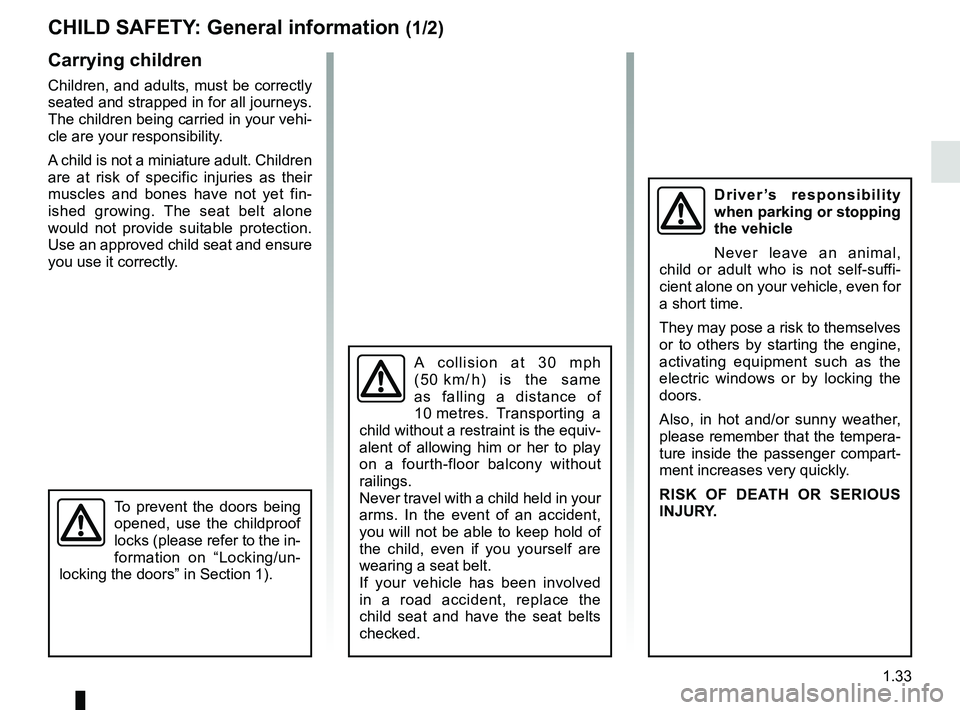
Carrying children
Children, and adults, must be correctly
seated and strapped in for all journeys.
The children being carried in your vehi-
cle are your responsibility.
A child is not a miniature adult. Children
are at risk of specific injuries as their
muscles and bones have not yet fin-
ished growing. The seat belt alone
would not provide suitable protection.
Use an approved child seat and ensure
you use it correctly.
A collision at 30 mph
(50 km/ h) is the same
as falling a distance of
10 metres. Transporting a
child without a restraint is the equiv-
alent of allowing him or her to play
on a fourth-floor balcony without
railings.
Never travel with a child held in your
arms. In the event of an accident,
you will not be able to keep hold of
the child, even if you yourself are
wearing a seat belt.
If your vehicle has been involved
in a road accident, replace the
child seat and have the seat belts
checked.
To prevent the doors being
opened, use the childproof
locks (please refer to the in-
formation on “Locking/un-
locking the doors” in Section 1).
Driver’s responsibility
when parking or stopping
the vehicle
Never leave an animal,
child or adult who is not self-suffi-
cient alone on your vehicle, even for
a short time.
They may pose a risk to themselves
or to others by starting the engine,
activating equipment such as the
electric windows or by locking the
doors.
Also, in hot and/or sunny weather,
please remember that the tempera-
ture inside the passenger compart-
ment increases very quickly.
RISK OF DEATH OR SERIOUS
INJURY.
Page 42 of 290
1.36
CHILD SAFETY: choosing a child, baby seat mounting (1/2)
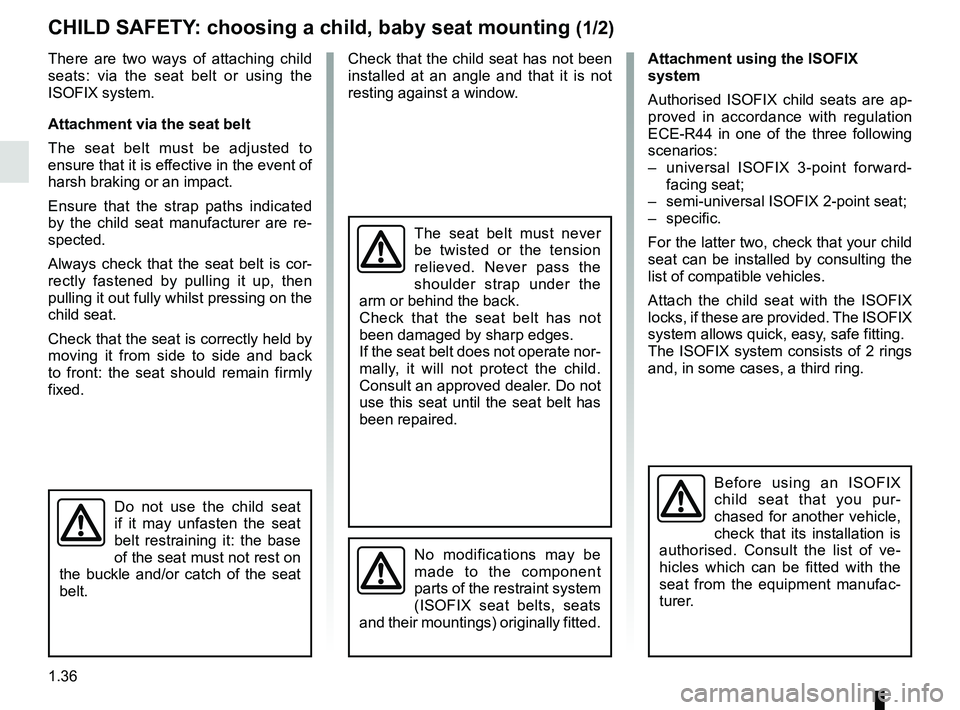
There are two ways of attaching child
seats: via the seat belt or using the
ISOFIX system.
Attachment via the seat belt
The seat belt must be adjusted to
ensure that it is effective in the event of
harsh braking or an impact.
Ensure that the strap paths indicated
by the child seat manufacturer are re-
spected.
Always check that the seat belt is cor-
rectly fastened by pulling it up, then
pulling it out fully whilst pressing on the
child seat.
Check that the seat is correctly held by
moving it from side to side and back
to front: the seat should remain firmly
fixed.Attachment using the ISOFIX
system
Authorised ISOFIX child seats are ap-
proved in accordance with regulation
ECE-R44 in one of the three following
scenarios:
– universal ISOFIX 3-point forward-
facing seat;
– semi-universal ISOFIX 2-point seat;
– specific.
For the latter two, check that your child
seat can be installed by consulting the
list of compatible vehicles.
Attach the child seat with the ISOFIX
locks, if these are provided. The ISOFIX
system allows quick, easy, safe fitting.
The ISOFIX system consists of 2 rings
and, in some cases, a third ring.
Before using an ISOFIX
child seat that you pur-
chased for another vehicle,
check that its installation is
authorised. Consult the list of ve-
hicles which can be fitted with the
seat from the equipment manufac-
turer.
No modifications may be
made to the component
parts of the restraint system
(ISOFIX seat belts, seats
and their mountings) originally fitted.
The seat belt must never
be twisted or the tension
relieved. Never pass the
shoulder strap under the
arm or behind the back.
Check that the seat belt has not
been damaged by sharp edges.
If the seat belt does not operate nor-
mally, it will not protect the child.
Consult an approved dealer. Do not
use this seat until the seat belt has
been repaired.
Do not use the child seat
if it may unfasten the seat
belt restraining it: the base
of the seat must not rest on
the buckle and/or catch of the seat
belt.
Check that the child seat has not been
installed at an angle and that it is not
resting against a window.
Page 76 of 290
1.70
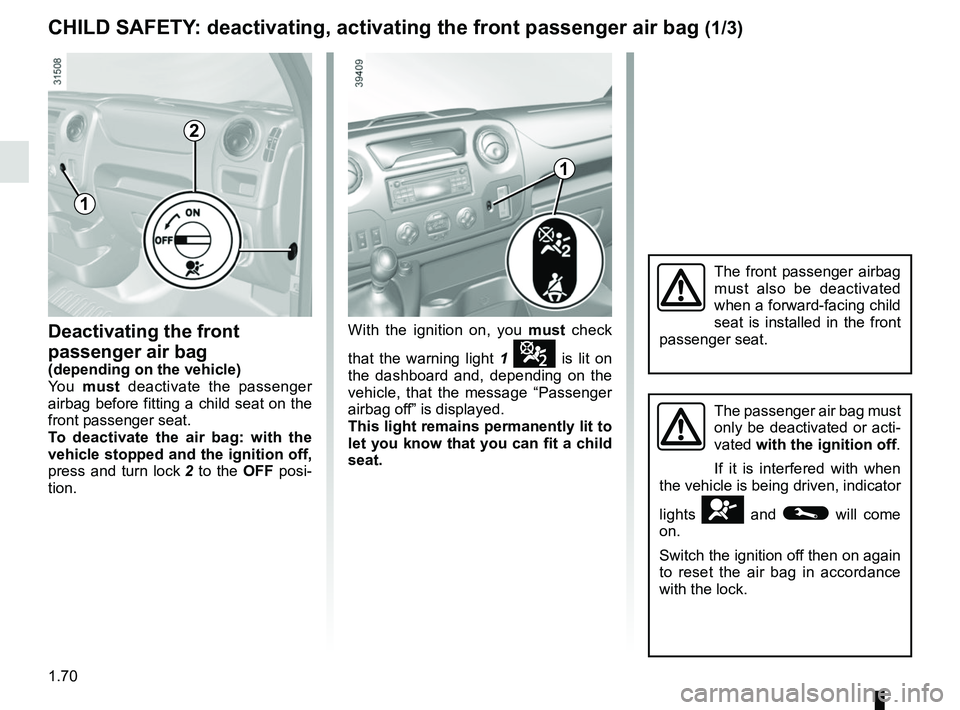
Deactivating the front
passenger air bag
(depending on the vehicle)
Yo u must deactivate the passenger
airbag before fitting a child seat on the
front passenger seat.
To deactivate the air bag: with the
vehicle stopped and the ignition off,
press and turn lock 2 to the OFF posi-
tion. With the ignition on, you
must check
that the warning light 1 ¹ is lit on
the dashboard and, depending on the
vehicle, that the message “Passenger
airbag off” is displayed.
This light remains permanently lit to
let you know that you can fit a child
seat.
CHILD SAFETY: deactivating, activating the front passenger air bag (1/3)
1
2
The front passenger airbag
must also be deactivated
when a forward-facing child
seat is installed in the front
passenger seat.
The passenger air bag must
only be deactivated or acti-
vated with the ignition off.
If it is interfered with when
the vehicle is being driven, indicator
lights
å and © will come
on.
Switch the ignition off then on again
to reset the air bag in accordance
with the lock.
1
Page 78 of 290
1.72
Operating faultsIn the event that the front passenger air
bag activation/deactivation system is
faulty, child seats must not be fitted to
the front seat.
Allowing any other passenger to sit in
that seat is not recommended.
Contact your approved Dealer as soon
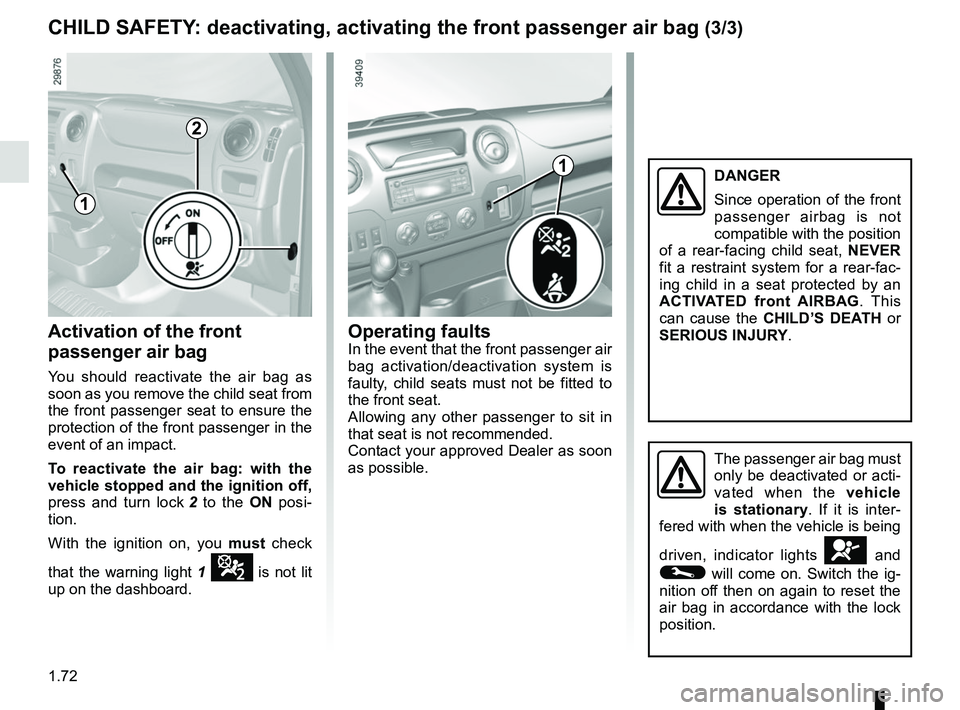
as possible.Activation of the front
passenger air bag
You should reactivate the air bag as
soon as you remove the child seat from
the front passenger seat to ensure the
protection of the front passenger in the
event of an impact.
To reactivate the air bag: with the
vehicle stopped and the ignition off,
press and turn lock 2 to the ON posi-
tion.
With the ignition on, you must check
that the warning light 1
¹ is not lit
up on the dashboard.
CHILD SAFETY: deactivating, activating the front passenger air bag (3/3)
1
2
The passenger air bag must
only be deactivated or acti-
vated when the vehicle
is stationary. If it is inter-
fered with when the vehicle is being
driven, indicator lights
å and
© will come on. Switch the ig-
nition off then on again to reset the
air bag in accordance with the lock
position.
1DANGER
Since operation of the front
passenger airbag is not
compatible with the position
of a rear-facing child seat, NEVER
fit a restraint system for a rear-fac-
ing child in a seat protected by an
ACTIVATED front AIRBAG . This
can cause the CHILD’S DEATH or
SERIOUS INJURY.
Page 119 of 290
2.3
STARTING, STOPPING THE ENGINE
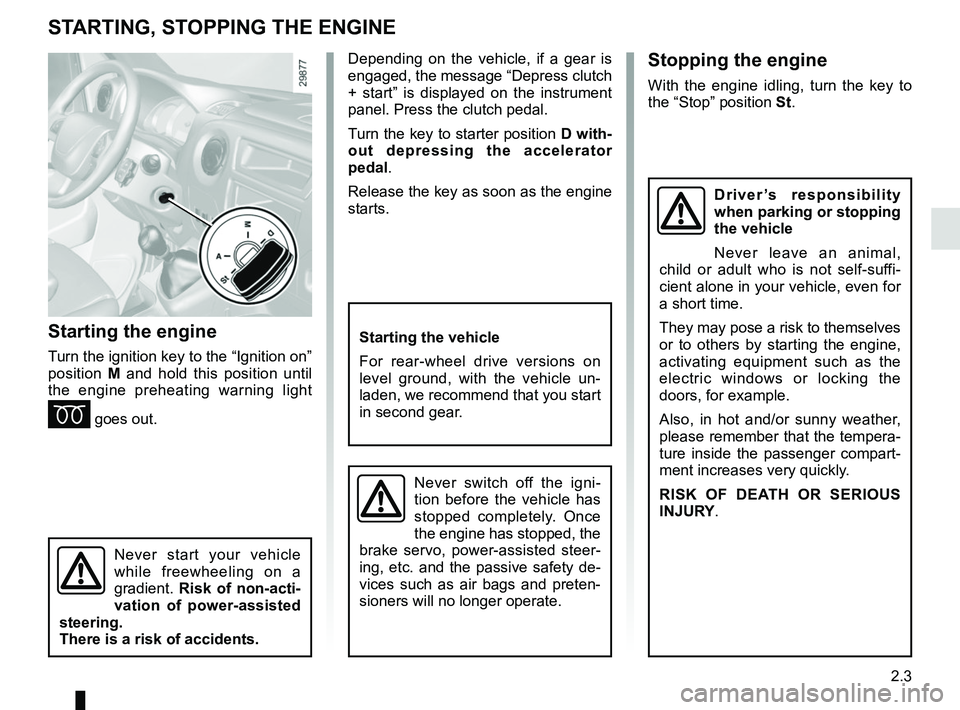
Starting the engine
Turn the ignition key to the “Ignition on”
position M and hold this position until
the engine preheating warning light
É goes out.
Stopping the engine
With the engine idling, turn the key to
the “Stop” position St.
Starting the vehicle
For rear-wheel drive versions on
level ground, with the vehicle un-
laden, we recommend that you start
in second gear.
Never switch off the igni-
tion before the vehicle has
stopped completely. Once
the engine has stopped, the
brake servo, power-assisted steer-
ing, etc. and the passive safety de-
vices such as air bags and preten-
sioners will no longer operate.
Driver’s responsibility
when parking or stopping
the vehicle
Never leave an animal,
child or adult who is not self-suffi-
cient alone in your vehicle, even for
a short time.
They may pose a risk to themselves
or to others by starting the engine,
activating equipment such as the
electric windows or locking the
doors, for example.
Also, in hot and/or sunny weather,
please remember that the tempera-
ture inside the passenger compart-
ment increases very quickly.
RISK OF DEATH OR SERIOUS
INJURY.
Never start your vehicle
while freewheeling on a
gradient. Risk of non-acti-
vation of power-assisted
steering.
There is a risk of accidents.
Depending on the vehicle, if a gear is
engaged, the message “Depress clutch
+ start” is displayed on the instrument
panel. Press the clutch pedal.
Turn the key to starter position D with-
out depressing the accelerator
pedal.
Release the key as soon as the engine
starts.
Page 283 of 290

A
ABS ....................................................................\
...2.16 → 2.23
accessories...................................................................")
7.1
ALPHABETICAL INDEX (1/4)
A
ABS ....................................................................\
...2.16 → 2.23
accessories........................................................................\
5.41
accessories socket ............................................................ 3.19
AdBlue ...............................................................1.104 → 1.109
AdBlue additive..................................................1.104 → 1.109
additional systems to the seat belts................................... 1.31
additive (tank) ....................................................1.104 → 1.109
additive tank ......................................................1.104 → 1.109
adjusting the seats............................................................. 1.24
adjusting your driving position ........................................... 1.24
advice on antipollution ....................................................... 2.12
air bag....................................................................1.28 → 1.31
activating the front passenger air bags ............1.70 → 1.72
deactivating the front passenger air bags ........1.70 → 1.72
air conditioning ........................................................3.2 → 3.14
air vents ...................................................................... 3.2 – 3.3
anti-corrosion check ..............................................6.16 → 6.21
anti-corrosion protection .................................................... 4.14
anti-lock braking system: ABS ...............................2.16 → 2.23
antipollution advice .................................................................\
......... 2.12
ashtrays ...............................................................\
.............. 3.19
audible and visual signals................................................ 1.101
automatic gearbox selector lever...........................2.45 → 2.49
B
battery........................................................................\
........ 4.13 troubleshooting ................................................. 5.33 – 5.34
bonnet........................................................................\
.......... 4.2
brake fluid ........................................................................\
.... 4.8
bulbs changing ......................................5.21 – 5.22, 5.25 → 5.27
C
capacity of mechanical components........................4.8 → 4.10central door locking ........................... 1.2
→ 1.12, 1.15 → 1.18
changing a bulb .................................5.21 – 5.22, 5.25 → 5.27
changing a wheel........................ 5.2 → 5.4, 5.11 → 5.15, 5.17
changing gear .................................................................... 2.14
child restraint/seat 1.30, 1.33 – 1.34, 1.38 → 1.57, 1.70 → 1.72
child safety................... 1.33 – 1.34, 1.38 → 1.57, 1.70 → 1.72
child seats..........................................1.33 – 1.34, 1.38 → 1.57
children ................................................................... 1.33 – 1.34
cigar lighter ........................................................................\
3.19
cleaning: inside the vehicle .............................................. 4.17 – 4.18
clock ..................................................................\
................ 1.93
control instruments ................................................1.78 → 1.85
coolant ................................................................\
............... 1.83
courtesy light ............................................................ 3.17, 5.27
cruise control .........................................................2.33 → 2.36
cruise control-speed limiter....................................2.30 → 2.36
D
deadlocking the doors ......................................................... 1.7
demisting windscreen ..................................................3.4, 3.7 → 3.12
dimensions ................................................................. 6.6 – 6.7
dipstick................................................................\
........ 4.4 – 4.5
display .................................................................... 1.84 – 1.85
doors................................................... 1.13 – 1.14, 1.17 – 1.18
driver’s position .....................................................1.74 → 1.77
driving ...........................................2.2, 2.10, 2.16 → 2.26, 2.37
driving recommendations ........................................ 2.8 → 2.11
E
ECO driving .............................................................
2.8 → 2.11
ECO mode ........................................................................\
... 2.9
electric beam height adjustment ...................................... 1.100
electric windows ..................................................... 3.15 – 3.16
electronic stability control: ESC .............................2.16 → 2.23
Page 286 of 290
7.4
ALPHABETICAL INDEX (4/4)
service sheets........................................................6.10 → 6.15
signals and lights .................................................1.96 → 1.100
speakers location ...............................................................\
......... 5.40
special features of diesel versions....................................... 2.7
speed limiter ..........................................................2.30 → 2.32
starting the engine ............................................................... 2.3
steering wheel adjustment .............................................................\
...... 1.19
Stop & Start ...............................................................2.4 → 2.6
Stop & Start function..................................................2.4 → 2.6
stopping the engine ............................................................. 2.3
storage compartment.............................................3.20 → 3.25
storage compartments ...........................................3.20 → 3.25
sun visor ........................................................................\
.... 3.18
T
tailgate ...............................................................\
................ 3.29
tank AdBlue .........................................................1.104 → 1.109
tanks and reservoirs: windscreen washer ...................................................... 4.10
technical specifications ..............................6.2 – 6.3, 6.6 → 6.9
temperature regulation ........................................... 3.13 – 3.14
tool kit ........................................................................\
.......... 5.4
towing .................................................................\
............... 3.29 driving ................................................................\
.......... 2.18
breakdown ........................................................ 5.38 – 5.39
towing a caravan ............................................................ 6.8
towing hitch........................................................................\
.. 5.4
towing rings ............................................................ 3.29 – 3.30
towing weights ..................................................................... 6.8
traction control .......................................................2.16 → 2.23
transporting children .... 1.33 – 1.34, 1.38 → 1.57, 1.70 → 1.72
transporting objects in the luggage compartment ............................. 3.29 – 3.30 trims ........................................................................\
5.11 – 5.12
trip computer and warning system.......................... 1.84 – 1.85
turning circle ............................................................... 6.6 – 6.7
tyre inflation kit.........................................................5.5
→ 5.10
tyre pressure...................................... 2.24 → 2.26, 4.11 – 4.12
tyre pressure loss warning.....................................2.24 → 2.26
tyre pressures ......................................................... 4.11 – 4.12
tyres ............................. 2.24 → 2.26, 4.11 – 4.12, 5.18 → 5.20
U
unlocking the doors ................................................. 1.8 → 1.11
use in winter ...................................................................... 5.20
V
vehicle identification ................................................... 6.2 – 6.3
vehicle identification plates ......................................... 6.2 – 6.3
ventilation ............................................................... 3.13 – 3.14 air conditioning ...................................................... 3.2 – 3.3
W
warning buzzer ....................................................... 1.13 – 1.14
warning lights.........................................................1.78 → 1.83
washing ................................................................\
.4.14 → 4.16
weights ................................................................\
................ 6.8
wheelbrace .............................................................\
............. 5.4
wheels (safety) ......................................................5.18 → 5.20
windows .................................................................. 3.15 – 3.16
wiper blades ...................................................................... 5.37