weight RENAULT MASTER 2018 User Guide
[x] Cancel search | Manufacturer: RENAULT, Model Year: 2018, Model line: MASTER, Model: RENAULT MASTER 2018Pages: 290, PDF Size: 7.1 MB
Page 74 of 290

The table below summarises the information already shown on the diagram \
on the previous page, to ensure the applica-
ble regulations are")
1.68
CHILD SEATS: attachment using the ISOFIX system (11/12)
The table below summarises the information already shown on the diagram \
on the previous page, to ensure the applica-
ble regulations are respected.
9-seater Combi versionFront seatsRear seats
Child seat group Weight of
the child Size of
Isofix seat central side 2nd row side seats
2nd row centre seat 3rd row
Behind
driver Behind front
passenger
Carrycot fitted
across the vehicle
Group 0 < 10 kg F, G X X X
XX X
Rear-facing shell
seat
Group 0 or 0 + < 13 kg E X X IL (1)
XX X
Rear-facing seat
Group 0+ and 1 < 13 kg and
9 to 18 kg C, D X X IL (1) X
X X
Forward-facing seat
Group 1 9 to 18 kg A, B, B1 X X IUF - IL (2) X IUF - IL (2) X
Booster seat
Group 2 and 3 15 kg to
25 kg and
22 to 36 kg XX X X X X
Page 106 of 290
1.100
Load statusControl position
Empty, driver only 0
Driver with passenger(s) and luggage compartment full (1) 2
Other cases According to driver’s judgement
EXTERIOR LIGHTING AND SIGNALS (5/5)
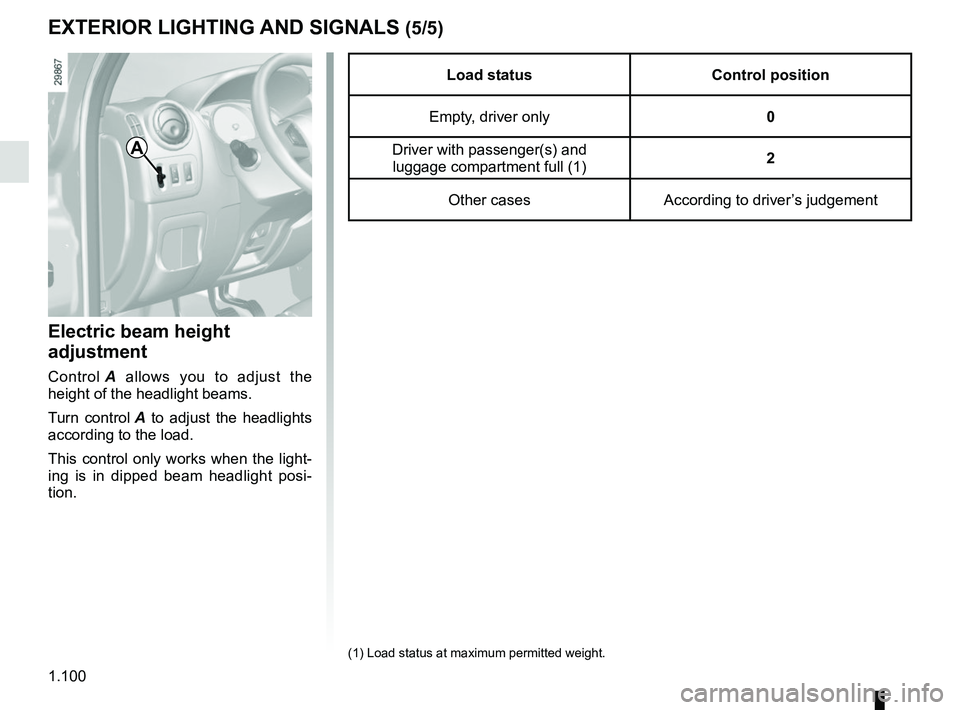
Electric beam height
adjustment
Control A allows you to adjust the
height of the headlight beams.
Turn control A to adjust the headlights
according to the load.
This control only works when the light-
ing is in dipped beam headlight posi-
tion.
(1) Load status at maximum permitted weight.
A
Page 180 of 290
3.14
AIR CONDITIONING: information and operating instructions (2/2)
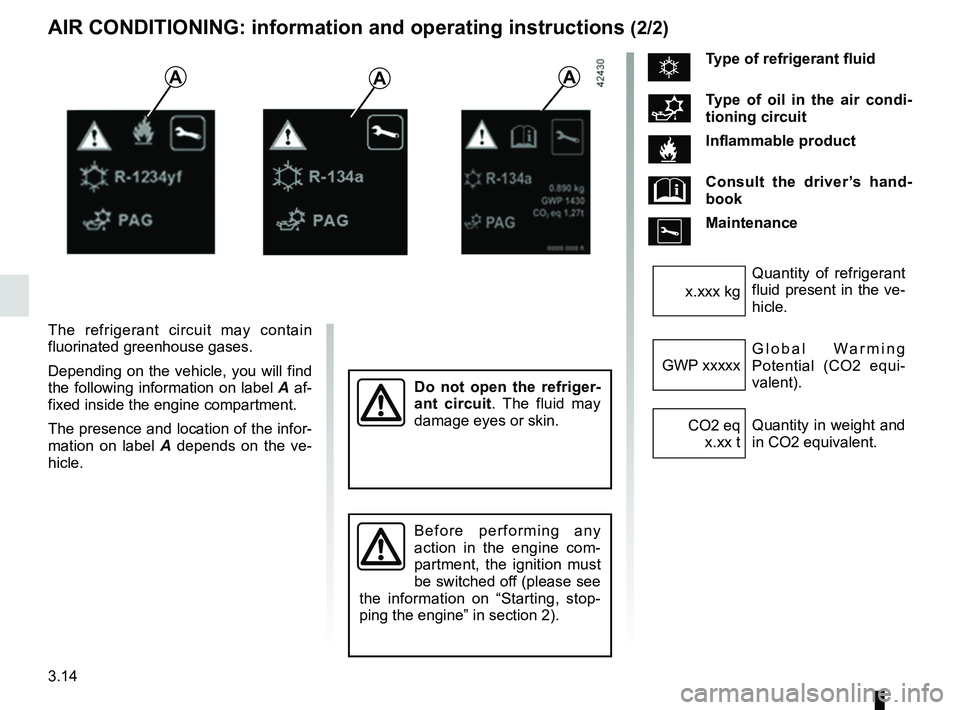
The refrigerant circuit may contain
fluorinated greenhouse gases.
Depending on the vehicle, you will find
the following information on label A af-
fixed inside the engine compartment.
The presence and location of the infor-
mation on label A depends on the ve-
hicle.
AAA
Do not open the refriger-
ant circuit . The fluid may
damage eyes or skin.
Before performing any
action in the engine com-
partment, the ignition must
be switched off (please see
the information on “Starting, stop-
ping the engine” in section 2).
ÑType of refrigerant fluid
Type of oil in the air condi-
tioning circuit
Inflammable product
Consult the driver’s hand-
book
Maintenance
Quantity of refrigerant
fluid present in the ve-
hicle.
x.xxx kg
Global Warming
Potential (CO2 equi-
valent).
GWP xxxxx
Quantity in weight and
in CO2 equivalent.
CO2 eq
x.xx t
Page 189 of 290

3.23
24
25
PASSENGER COMPARTMENT STORAGE, FITTINGS (4/6)
Tray 25
Pull tray 25 fully towards you.
Turn it and push it fully.
You can use clip 24 to attach A5 format
documents.
To refit it, pull the table tray fully to-
wards you, lift it up until it is horizontal
and push it in fully.
Upper cab storage
compartment 26 and 27
Reserved for the transport of objects
only.
The total weight of upper cab storage
compartment 27 must not exceed 5 kg.
Do not hang any heavy and/
or sharp objects which may
fall whilst driving. Risk of
injury.
Nothing should be placed
on the floor area in front of
the driver as such objects
may slide under the pedal
during braking manoeuvres, thus
obstructing its use.
26
27
Page 191 of 290
3.25
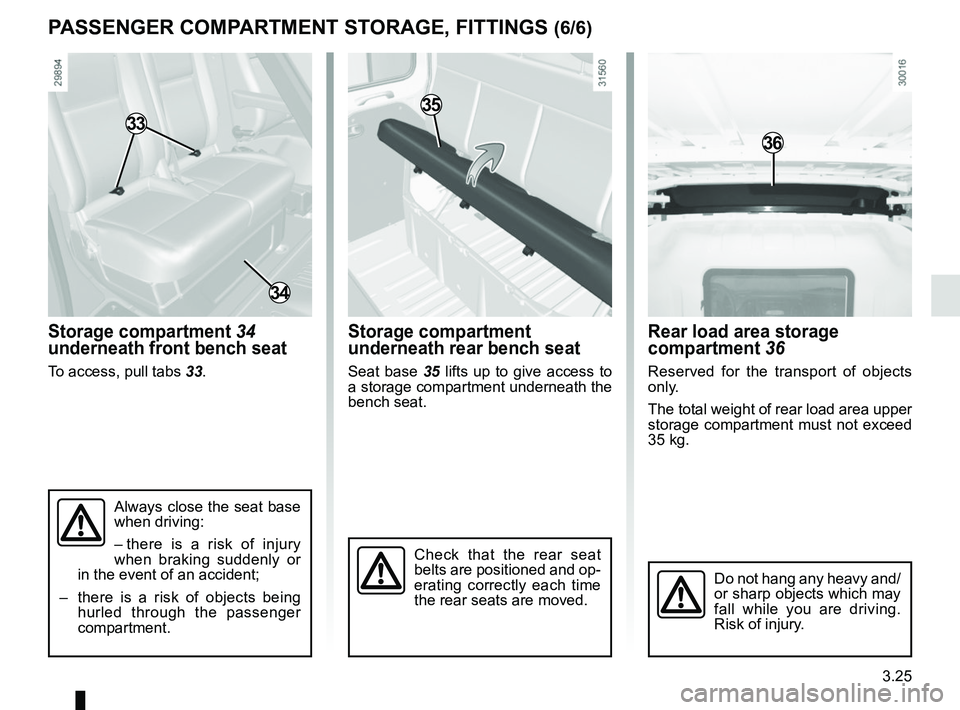
Storage compartment 34
underneath front bench seat
To access, pull tabs 33.
Rear load area storage
compartment 36
Reserved for the transport of objects
only.
The total weight of rear load area upper
storage compartment must not exceed
35 kg.
PASSENGER COMPARTMENT STORAGE, FITTINGS (6/6)
Do not hang any heavy and/
or sharp objects which may
fall while you are driving.
Risk of injury.
36
Storage compartment
underneath rear bench seat
Seat base 35 lifts up to give access to
a storage compartment underneath the
bench seat.
35
Check that the rear seat
belts are positioned and op-
erating correctly each time
the rear seats are moved.
Always close the seat base
when driving:
– there is a risk of injury
when braking suddenly or
in the event of an accident;
– there is a risk of objects being hurled through the passenger
compartment.
33
34
Page 196 of 290
3.30
TRANSPORTING OBJECTS (2/2)
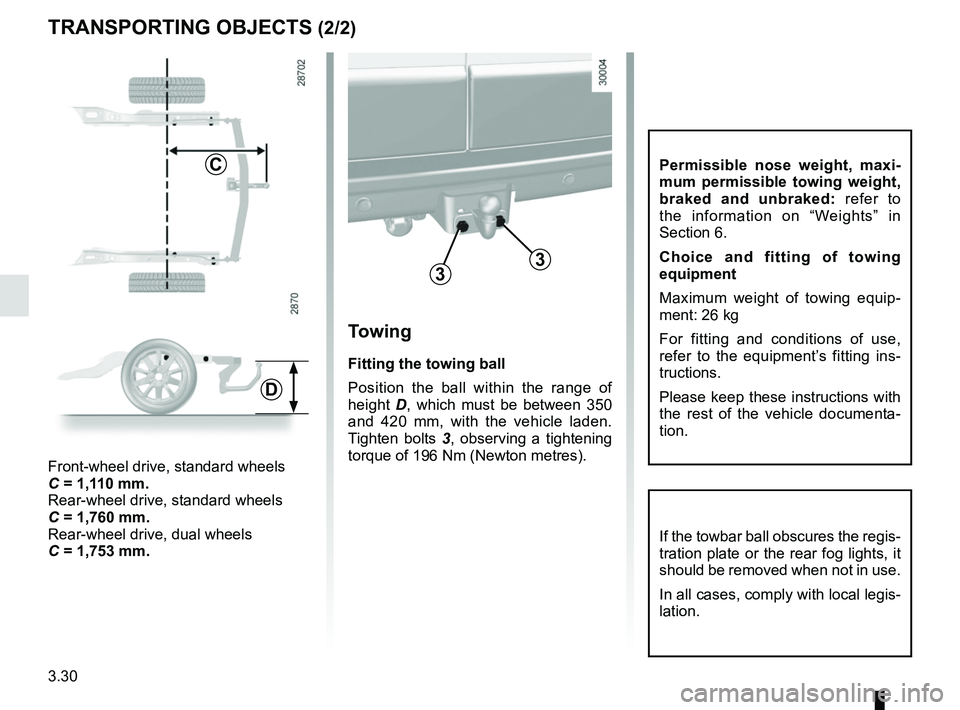
Towing
Fitting the towing ball
Position the ball within the range of
height D, which must be between 350
and 420 mm, with the vehicle laden.
Tighten bolts 3, observing a tightening
torque of 196 Nm (Newton metres).
33
C
Front-wheel drive, standard wheels
C = 1,110 mm.
Rear-wheel drive, standard wheels
C = 1,760 mm.
Rear-wheel drive, dual wheels
C = 1,753 mm.
D
If the towbar ball obscures the regis-
tration plate or the rear fog lights, it
should be removed when not in use.
In all cases, comply with local legis-
lation.
Permissible nose weight, maxi-
mum permissible towing weight,
braked and unbraked: refer to
the information on “Weights” in
Section 6.
Choice and fitting of towing
equipment
Maximum weight of towing equip-
ment: 26 kg
For fitting and conditions of use,
refer to the equipment’s fitting ins-
tructions.
Please keep these instructions with
the rest of the vehicle documenta-
tion.
Page 199 of 290
4.3
BONNET (2/2)
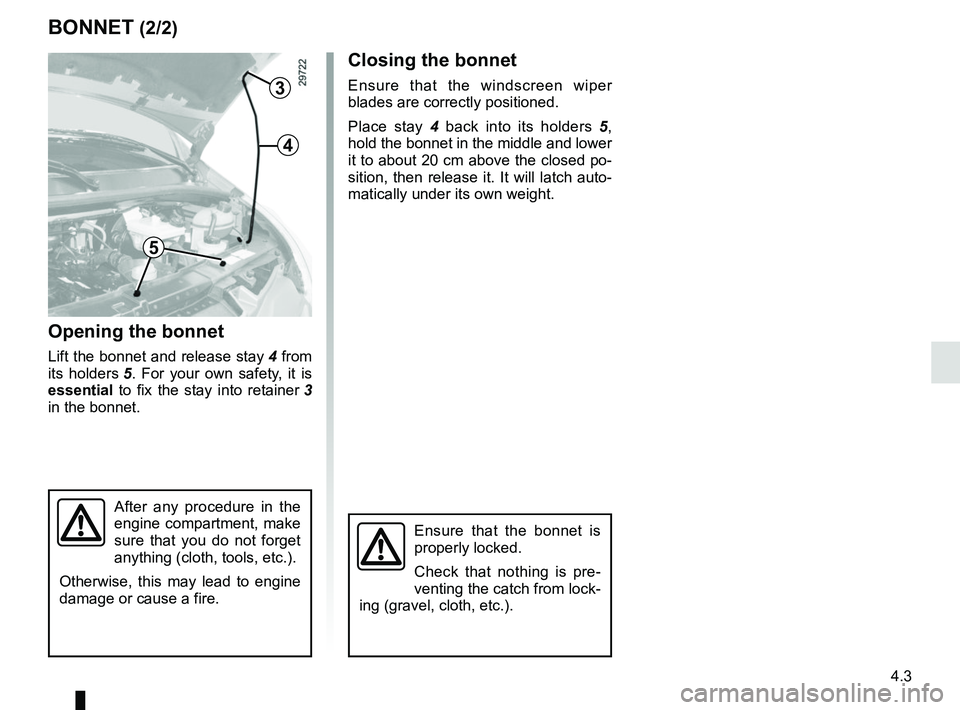
3
4
5
Closing the bonnet
Ensure that the windscreen wiper
blades are correctly positioned.
Place stay 4 back into its holders 5 ,
hold the bonnet in the middle and lower
it to about 20 cm above the closed po-
sition, then release it. It will latch auto-
matically under its own weight.
Ensure that the bonnet is
properly locked.
Check that nothing is pre-
venting the catch from lock-
ing (gravel, cloth, etc.).
Opening the bonnet
Lift the bonnet and release stay 4 from
its holders 5. For your own safety, it is
essential to fix the stay into retainer 3
in the bonnet.
After any procedure in the
engine compartment, make
sure that you do not forget
anything (cloth, tools, etc.).
Otherwise, this may lead to engine
damage or cause a fire.
Page 208 of 290
4.12
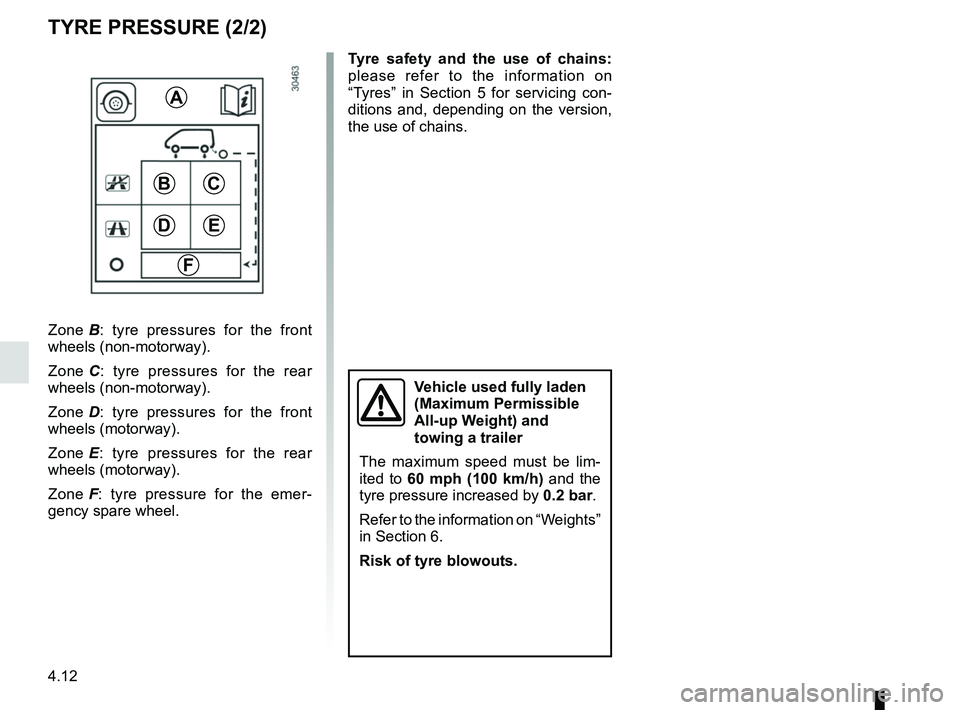
BC
ED
F
A
Zone B: tyre pressures for the front
wheels (non-motorway).
Zone C : tyre pressures for the rear
wheels (non-motorway).
Zone D : tyre pressures for the front
wheels (motorway).
Zone E : tyre pressures for the rear
wheels (motorway).
Zone F : tyre pressure for the emer-
gency spare wheel.
TYRE PRESSURE (2/2)
Tyre safety and the use of chains:
please refer to the information on
“Tyres” in Section 5 for servicing con-
ditions and, depending on the version,
the use of chains.
Vehicle used fully laden
(Maximum Permissible
All-up Weight) and
towing a trailer
The maximum speed must be lim-
ited to 60 mph (100 km/h) and the
tyre pressure increased by 0.2 bar.
Refer to the information on “Weights”
in Section 6.
Risk of tyre blowouts.
Page 252 of 290
5.38
TOWING: breakdown (1/2)
The steering wheel must be un-
locked and the ignition key must be
in position M (ignition on) to provide
brake lights and hazard warning
lights on the towed vehicle. At night
the vehicle must have its lights on.
Unhitch the trailer, etc., if one is
being towed.
You must observe the towing regu-
lations which apply in the country in
which you are driving: do not exceed
the towing weight for your vehicle.
Contact an approved dealer.
– Use a rigid towing bar.
If a rope or cable is used
(where the law allows this),
the vehicle being towed
must be able to brake.
– A vehicle must not be towed if it is not fit to be driven.
– Avoid accelerating or braking suddenly when towing, as this
may result in damage being
caused to the vehicle.
– When towing a vehicle, it is ad- visable not to exceed 15 mph
(25 km/h).
When the engine is
stopped, steering and brak-
ing assistance are not op-
erational.
Do not remove the key from
the ignition when the vehi-
cle is being towed.
Towing a vehicle with a
sequential gearbox
If the gearbox is stuck in a gear:
– switch on the ignition;
– select neutral with the brake pedal depressed;
– check that the gearbox is in neutral (by pushing the vehicle for example).
If you cannot find neutral you must tow
the vehicle with the front wheels raised.
The vehicle should always be towed
with the ignition switched off.
Page 261 of 290

6.1
Section 6: Technical specifications
Vehicle identification plates . . . . . . . . . . . . . . . . . . . . . . . . . . . . . . . . . . . . \
. . . . . . . . . . . . . . . . . . . . 6.2
Engine specifications . . . . . . . . . . . . . . . . . . . . . . . . . . . . . . . . . . . . \
. . . . . . . . . . . . . . . . . . . . . . . . . 6.5
Dimensions . . . . . . . . . . . . . . . . . . . . . . . . . . . . . . . . . . . .\
. . . . . . . . . . . . . . . . . . . . . . . . . . . . . . . . 6.6
Weights . . . . . . . . . . . . . . . . . . . . . . . . . . . . . . . . . . . .\
. . . . . . . . . . . . . . . . . . . . . . . . . . . . . . . . . . . 6.8
Replacement parts and repairs . . . . . . . . . . . . . . . . . . . . . . . . . . . . . . . . . . . . \
. . . . . . . . . . . . . . . . . 6.9
Service sheets . . . . . . . . . . . . . . . . . . . . . . . . . . . . . . . . . . . . \
. . . . . . . . . . . . . . . . . . . . . . . . . . . . . . 6.10
Anticorrosion check . . . . . . . . . . . . . . . . . . . . . . . . . . . . . . . . . . . . \
. . . . . . . . . . . . . . . . . . . . . . . . . . 6.16