brake light RENAULT MASTER 2018 Owner's Manual
[x] Cancel search | Manufacturer: RENAULT, Model Year: 2018, Model line: MASTER, Model: RENAULT MASTER 2018Pages: 290, PDF Size: 7.1 MB
Page 204 of 290
4.8
LEVELS (1/3)
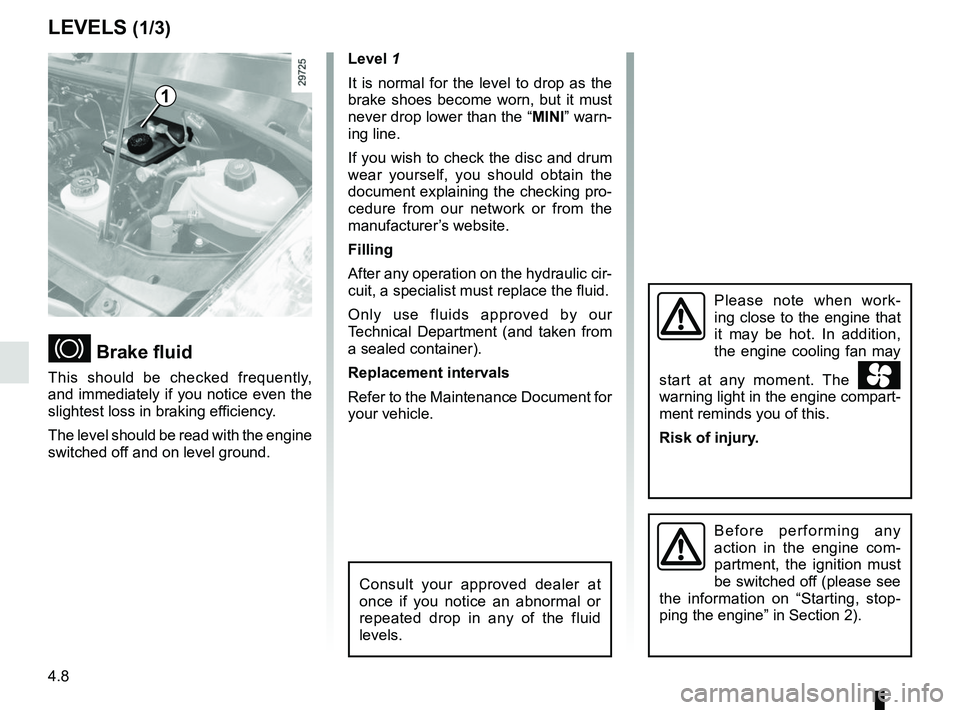
Brake fluid
This should be checked frequently,
and immediately if you notice even the
slightest loss in braking efficiency.
The level should be read with the engine
switched off and on level ground.Level 1
It is normal for the level to drop as the
brake shoes become worn, but it must
never drop lower than the “
MINI” warn-
ing line.
If you wish to check the disc and drum
wear yourself, you should obtain the
document explaining the checking pro-
cedure from our network or from the
manufacturer’s website.
Filling
After any operation on the hydraulic cir-
cuit, a specialist must replace the fluid.
Only use fluids approved by our
Technical Department (and taken from
a sealed container).
Replacement intervals
Refer to the Maintenance Document for
your vehicle.
Consult your approved dealer at
once if you notice an abnormal or
repeated drop in any of the fluid
levels.
1
Please note when work-
ing close to the engine that
it may be hot. In addition,
the engine cooling fan may
start at any moment. The
warning light in the engine compart-
ment reminds you of this.
Risk of injury.
Before performing any
action in the engine com-
partment, the ignition must
be switched off (please see
the information on “Starting, stop-
ping the engine” in Section 2).
Page 220 of 290
5.6
TYRE INFLATION KIT (2/6)
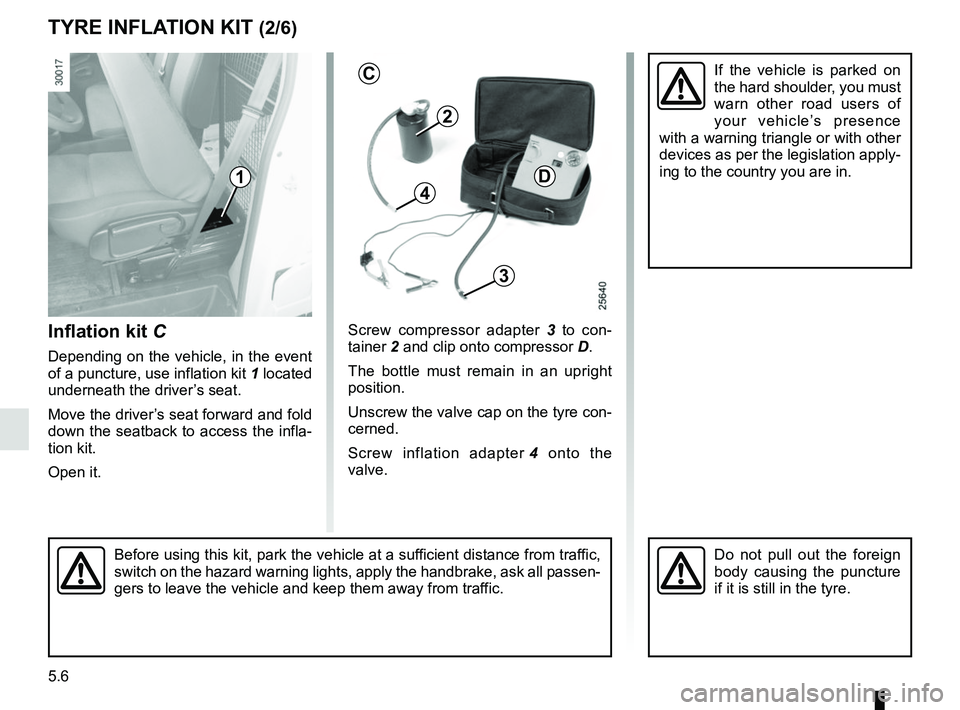
Inflation kit C
Depending on the vehicle, in the event
of a puncture, use inflation kit 1 located
underneath the driver’s seat.
Move the driver’s seat forward and fold
down the seatback to access the infla-
tion kit.
Open it. Screw compressor adapter
3 to con-
tainer 2 and clip onto compressor D.
The bottle must remain in an upright
position.
Unscrew the valve cap on the tyre con-
cerned.
Screw inflation adapter 4 onto the
valve.
Before using this kit, park the vehicle at a sufficient distance from traffic,
switch on the hazard warning lights, apply the handbrake, ask all passen\
-
gers to leave the vehicle and keep them away from traffic.Do not pull out the foreign
body causing the puncture
if it is still in the tyre.
2
D
3
41
If the vehicle is parked on
the hard shoulder, you must
warn other road users of
your vehicle’s presence
with a warning triangle or with other
devices as per the legislation apply-
ing to the country you are in.C
Page 223 of 290
5.9
TYRE INFLATION KIT (5/6)
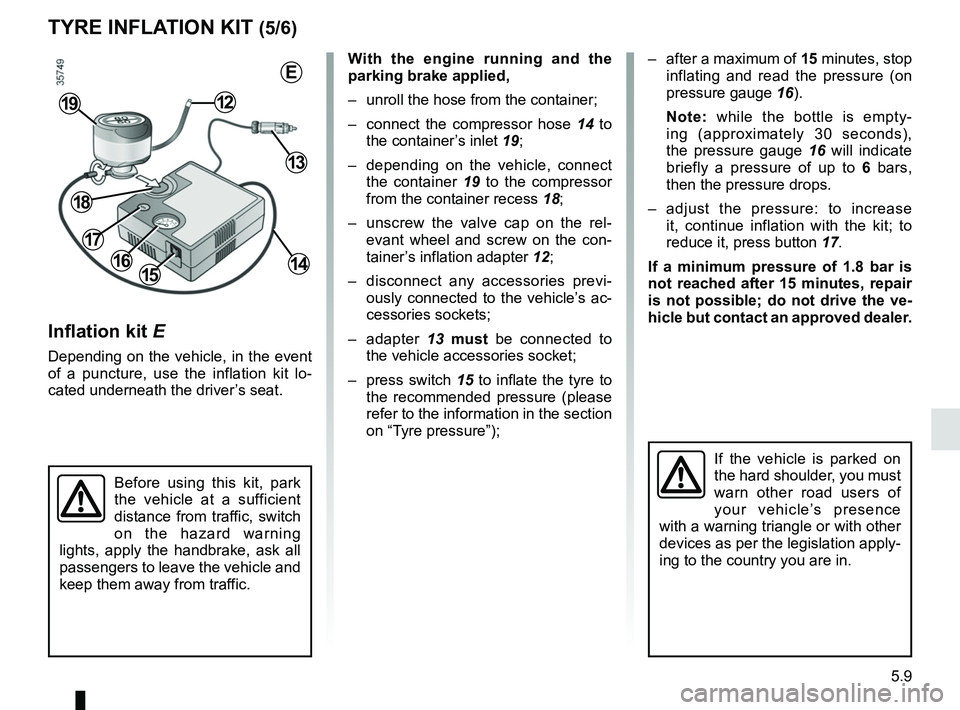
Inflation kit E
Depending on the vehicle, in the event
of a puncture, use the inflation kit lo-
cated underneath the driver’s seat.
Before using this kit, park
the vehicle at a sufficient
distance from traffic, switch
on the hazard warning
lights, apply the handbrake, ask all
passengers to leave the vehicle and
keep them away from traffic.
If the vehicle is parked on
the hard shoulder, you must
warn other road users of
your vehicle’s presence
with a warning triangle or with other
devices as per the legislation apply-
ing to the country you are in.
With the engine running and the
parking brake applied,
– unroll the hose from the container;
– connect the compressor hose 14 to the container’s inlet 19;
– depending on the vehicle, connect the container 19 to the compressor
from the container recess 18;
– unscrew the valve cap on the rel- evant wheel and screw on the con-
tainer’s inflation adapter 12;
– disconnect any accessories previ- ously connected to the vehicle’s ac-
cessories sockets;
– adapter 13 must be connected to
the vehicle accessories socket;
– press switch 15 to inflate the tyre to
the recommended pressure (please
refer to the information in the section
on “Tyre pressure”);
1516
1219
– after a maximum of 15 minutes, stop inflating and read the pressure (on
pressure gauge 16).
Note: while the bottle is empty-
ing (approximately 30 seconds),
the pressure gauge 16 will indicate
briefly a pressure of up to 6 bars,
then the pressure drops.
– adjust the pressure: to increase it, continue inflation with the kit; to
reduce it, press button 17.
If a minimum pressure of 1.8 bar is
not reached after 15 minutes, repair
is not possible; do not drive the ve-
hicle but contact an approved dealer.
13
14
18
17
E
Page 227 of 290
5.13
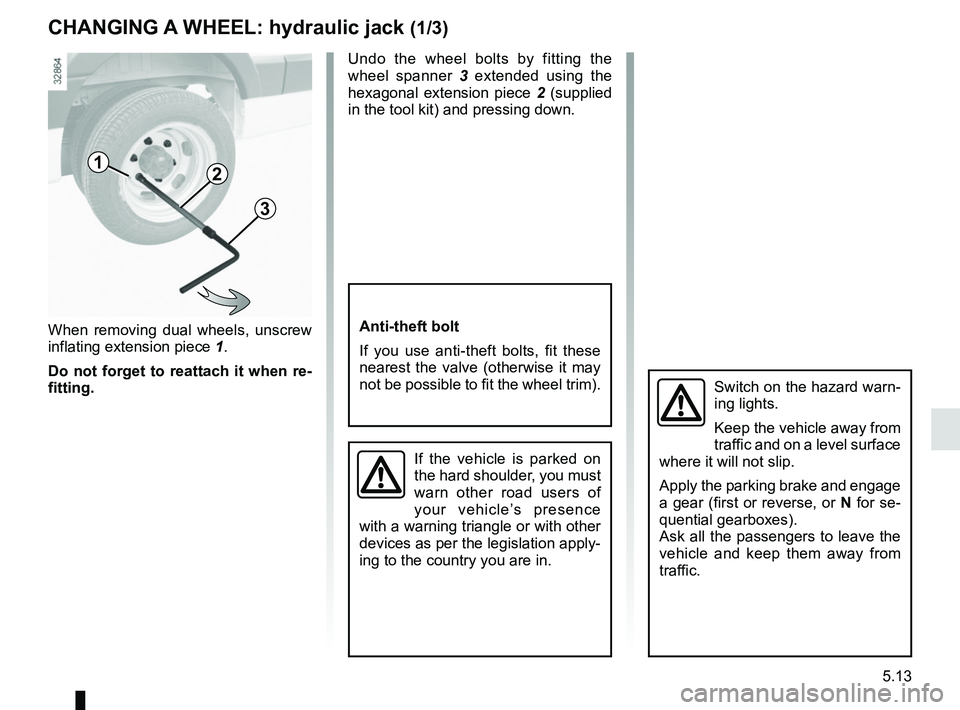
When removing dual wheels, unscrew
inflating extension piece 1.
Do not forget to reattach it when re-
fitting. Undo the wheel bolts by fitting the
wheel spanner
3 extended using the
hexagonal extension piece 2 (supplied
in the tool kit) and pressing down.
1
CHANGING A WHEEL: hydraulic jack (1/3)
Switch on the hazard warn-
ing lights.
Keep the vehicle away from
traffic and on a level surface
where it will not slip.
Apply the parking brake and engage
a gear (first or reverse, or N for se-
quential gearboxes).
Ask all the passengers to leave the
vehicle and keep them away from
traffic.
If the vehicle is parked on
the hard shoulder, you must
warn other road users of
your vehicle’s presence
with a warning triangle or with other
devices as per the legislation apply-
ing to the country you are in.
Anti-theft bolt
If you use anti-theft bolts, fit these
nearest the valve (otherwise it may
not be possible to fit the wheel trim).
2
3
Page 230 of 290
5.16
CHANGING A WHEEL: jack (1/2)
2
If the vehicle is parked on
the hard shoulder, you must
warn other road users of
your vehicle’s presence
with a warning triangle or with other
devices as per the legislation ap-
plying to the country you are in.
Switch on the hazard war-
ning lights.
Keep the vehicle away from
traffic and on a level surface
where it will not slip.
Apply the parking brake and engage
a gear (first or reverse, or N for se-
quential gearboxes).
Ask all the passengers to leave the
vehicle and keep them away from
traffic.
To prevent any risk of injury
or damage to the vehi-
cle, raise the jack until the
wheel you are replacing is
a maximum of 3 centimetres off the
ground.
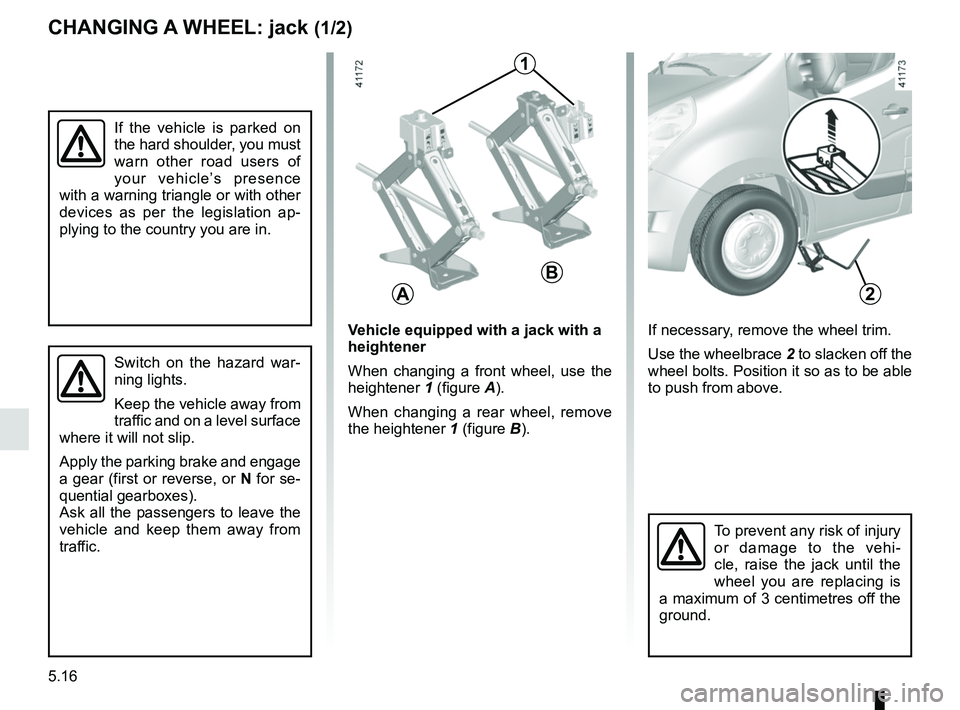
If necessary, remove the wheel trim.
Use the wheelbrace 2 to slacken off the
wheel bolts. Position it so as to be able
to push from above.Vehicle equipped with a jack with a
heightener
When changing a front wheel, use the
heightener 1 (figure A).
When changing a rear wheel, remove
the heightener 1 (figure B).
A
B
1
Page 239 of 290
5.25
REAR LIGHTS: changing bulbs (1/2)
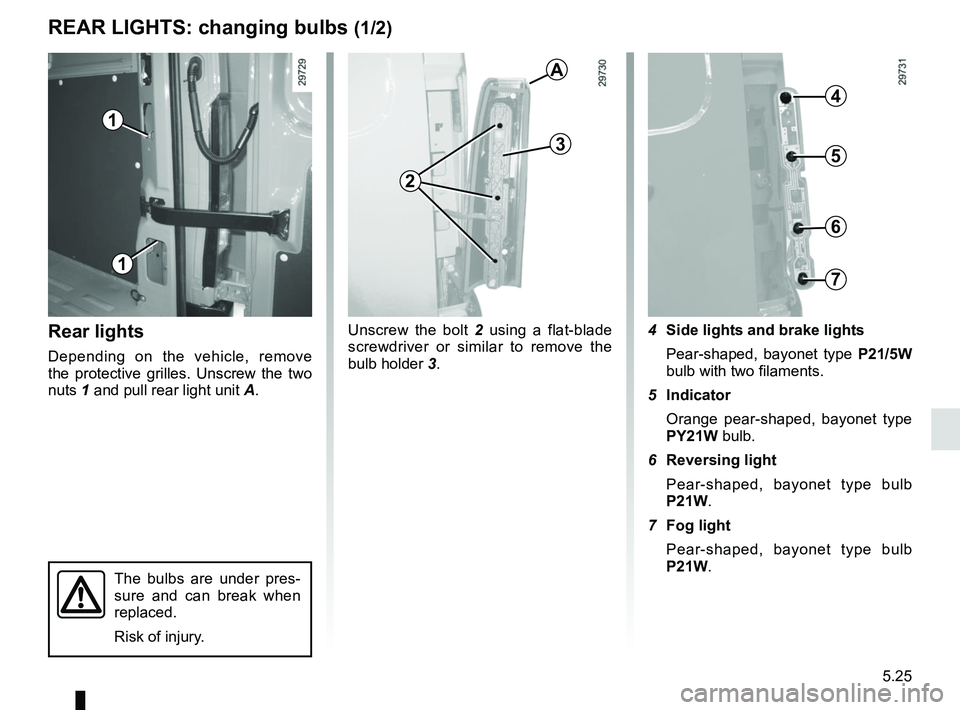
Rear lights
Depending on the vehicle, remove
the protective grilles. Unscrew the two
nuts 1 and pull rear light unit A.Unscrew the bolt
2 using a flat-blade
screwdriver or similar to remove the
bulb holder 3. 4 Side lights and brake lights
Pear-shaped, bayonet type P21/5W
bulb with two filaments.
5 Indicator Orange pear-shaped, bayonet type
PY21W bulb.
6 Reversing light
Pear-shaped, bayonet type bulb
P21W.
7 Fog light Pear-shaped, bayonet type bulb
P21W.
The bulbs are under pres-
sure and can break when
replaced.
Risk of injury.
1
1
A
2
3
4
5
6
7
Page 240 of 290
5.26
REAR LIGHTS: changing bulbs (2/2)
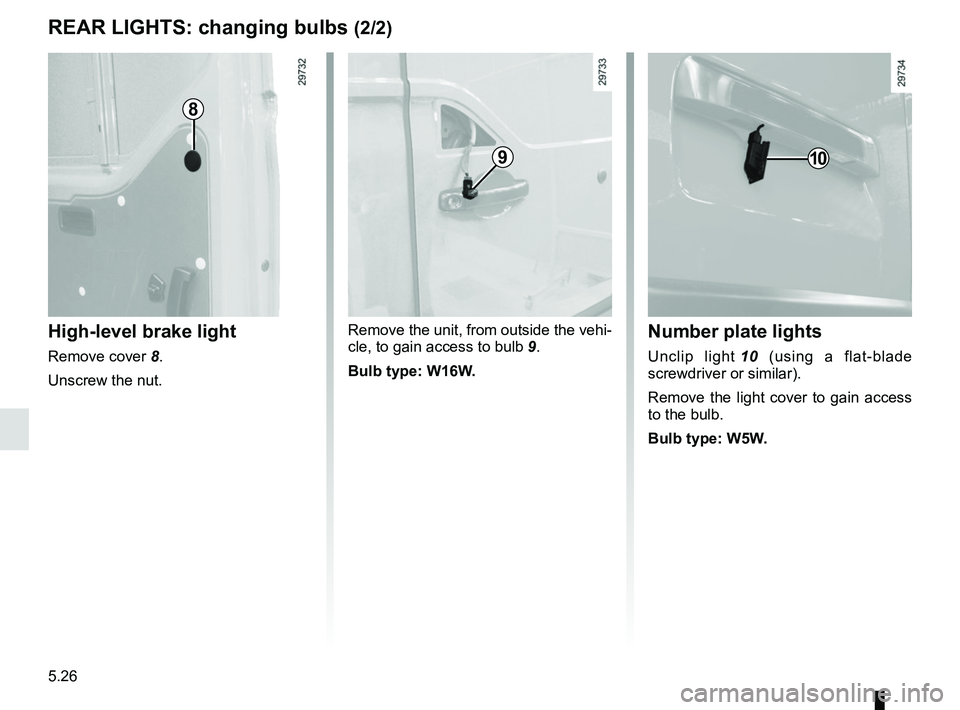
High-level brake light
Remove cover 8.
Unscrew the nut. Remove the unit, from outside the vehi-
cle, to gain access to bulb
9.
Bulb type: W16W.
Number plate lights
Unclip light 10 (using a flat-blade
screwdriver or similar).
Remove the light cover to gain access
to the bulb.
Bulb type: W5W.
8
910
Page 243 of 290
5.29
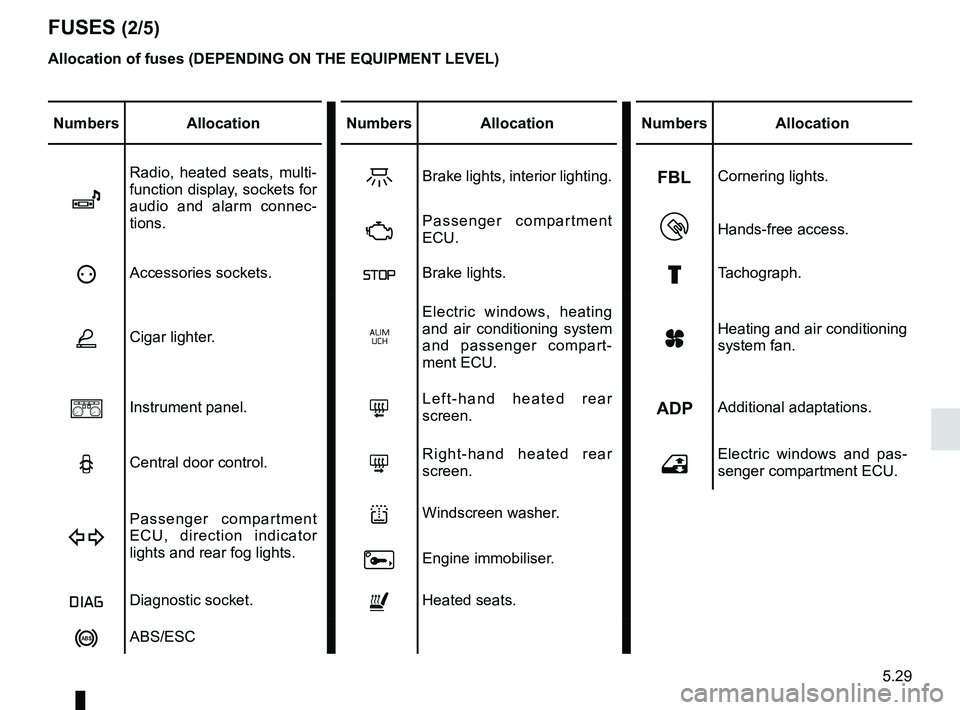
FUSES (2/5)
Allocation of fuses (DEPENDING ON THE EQUIPMENT LEVEL)
Numbers AllocationNumbers Allocation Numbers Allocation
î
Radio, heated seats, multi-
function display, sockets for
audio and alarm connec-
tions.ZBrake lights, interior lighting.Cornering lights.
ÄPassenger compartment
ECU.Hands-free access.
ëAccessories sockets.ßBrake lights.£Tachograph.
ÆCigar lighter.‚
Electric windows, heating
and air conditioning system
and passenger compart-
ment ECU.
yHeating and air conditioning
system fan.
aInstrument panel.8Left-hand heated rear
screen.Additional adaptations.
NCentral door control.7Right-hand heated rear
screen.hElectric windows and pas-
senger compartment ECU.
D
Passenger compartment
ECU, direction indicator
lights and rear fog lights.lWindscreen washer.
0Engine immobiliser.
ÎDiagnostic socket.ñHeated seats.
nABS/ESC
Page 252 of 290
5.38
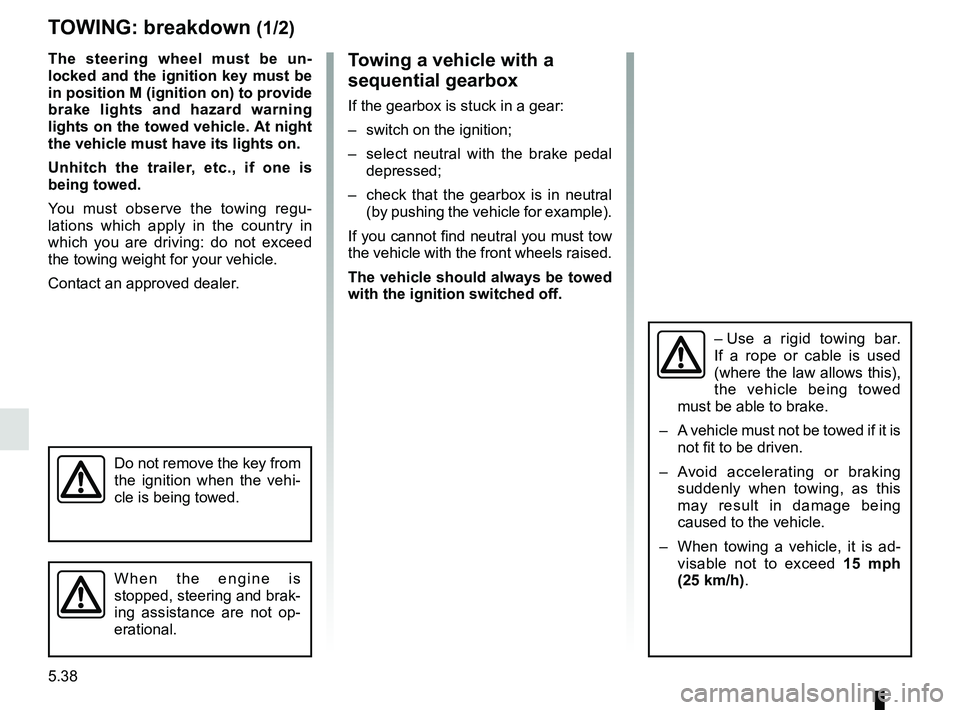
TOWING: breakdown (1/2)
The steering wheel must be un-
locked and the ignition key must be
in position M (ignition on) to provide
brake lights and hazard warning
lights on the towed vehicle. At night
the vehicle must have its lights on.
Unhitch the trailer, etc., if one is
being towed.
You must observe the towing regu-
lations which apply in the country in
which you are driving: do not exceed
the towing weight for your vehicle.
Contact an approved dealer.
– Use a rigid towing bar.
If a rope or cable is used
(where the law allows this),
the vehicle being towed
must be able to brake.
– A vehicle must not be towed if it is not fit to be driven.
– Avoid accelerating or braking suddenly when towing, as this
may result in damage being
caused to the vehicle.
– When towing a vehicle, it is ad- visable not to exceed 15 mph
(25 km/h).
When the engine is
stopped, steering and brak-
ing assistance are not op-
erational.
Do not remove the key from
the ignition when the vehi-
cle is being towed.
Towing a vehicle with a
sequential gearbox
If the gearbox is stuck in a gear:
– switch on the ignition;
– select neutral with the brake pedal depressed;
– check that the gearbox is in neutral (by pushing the vehicle for example).
If you cannot find neutral you must tow
the vehicle with the front wheels raised.
The vehicle should always be towed
with the ignition switched off.
Page 283 of 290

A
ABS ....................................................................\
...2.16 → 2.23
accessories...................................................................")
7.1
ALPHABETICAL INDEX (1/4)
A
ABS ....................................................................\
...2.16 → 2.23
accessories........................................................................\
5.41
accessories socket ............................................................ 3.19
AdBlue ...............................................................1.104 → 1.109
AdBlue additive..................................................1.104 → 1.109
additional systems to the seat belts................................... 1.31
additive (tank) ....................................................1.104 → 1.109
additive tank ......................................................1.104 → 1.109
adjusting the seats............................................................. 1.24
adjusting your driving position ........................................... 1.24
advice on antipollution ....................................................... 2.12
air bag....................................................................1.28 → 1.31
activating the front passenger air bags ............1.70 → 1.72
deactivating the front passenger air bags ........1.70 → 1.72
air conditioning ........................................................3.2 → 3.14
air vents ...................................................................... 3.2 – 3.3
anti-corrosion check ..............................................6.16 → 6.21
anti-corrosion protection .................................................... 4.14
anti-lock braking system: ABS ...............................2.16 → 2.23
antipollution advice .................................................................\
......... 2.12
ashtrays ...............................................................\
.............. 3.19
audible and visual signals................................................ 1.101
automatic gearbox selector lever...........................2.45 → 2.49
B
battery........................................................................\
........ 4.13 troubleshooting ................................................. 5.33 – 5.34
bonnet........................................................................\
.......... 4.2
brake fluid ........................................................................\
.... 4.8
bulbs changing ......................................5.21 – 5.22, 5.25 → 5.27
C
capacity of mechanical components........................4.8 → 4.10central door locking ........................... 1.2
→ 1.12, 1.15 → 1.18
changing a bulb .................................5.21 – 5.22, 5.25 → 5.27
changing a wheel........................ 5.2 → 5.4, 5.11 → 5.15, 5.17
changing gear .................................................................... 2.14
child restraint/seat 1.30, 1.33 – 1.34, 1.38 → 1.57, 1.70 → 1.72
child safety................... 1.33 – 1.34, 1.38 → 1.57, 1.70 → 1.72
child seats..........................................1.33 – 1.34, 1.38 → 1.57
children ................................................................... 1.33 – 1.34
cigar lighter ........................................................................\
3.19
cleaning: inside the vehicle .............................................. 4.17 – 4.18
clock ..................................................................\
................ 1.93
control instruments ................................................1.78 → 1.85
coolant ................................................................\
............... 1.83
courtesy light ............................................................ 3.17, 5.27
cruise control .........................................................2.33 → 2.36
cruise control-speed limiter....................................2.30 → 2.36
D
deadlocking the doors ......................................................... 1.7
demisting windscreen ..................................................3.4, 3.7 → 3.12
dimensions ................................................................. 6.6 – 6.7
dipstick................................................................\
........ 4.4 – 4.5
display .................................................................... 1.84 – 1.85
doors................................................... 1.13 – 1.14, 1.17 – 1.18
driver’s position .....................................................1.74 → 1.77
driving ...........................................2.2, 2.10, 2.16 → 2.26, 2.37
driving recommendations ........................................ 2.8 → 2.11
E
ECO driving .............................................................
2.8 → 2.11
ECO mode ........................................................................\
... 2.9
electric beam height adjustment ...................................... 1.100
electric windows ..................................................... 3.15 – 3.16
electronic stability control: ESC .............................2.16 → 2.23