diesel RENAULT MEGANE 2017 4.G User Guide
[x] Cancel search | Manufacturer: RENAULT, Model Year: 2017, Model line: MEGANE, Model: RENAULT MEGANE 2017 4.GPages: 346, PDF Size: 7.04 MB
Page 138 of 346
2.26
ENVIRONMENT
Emissions
Your vehicle has been designed to
emit fewer greenhouse gases (CO2)
while in use, and therefore to consume
less fuel (e.g. 140 g/km, equivalent to
1494.6 mpg (5.3 l/100 km) for a diesel
vehicle).
Our vehicles are also equipped with a
particle filter system including a cata-
lytic converter, an oxygen sensor and
an active carbon filter (the latter pre-
vents vapour from the fuel tank being
released into the open air).
For certain diesel vehicles, this system
also has a particle filter to reduce the
volume of soot particles emitted.
Please make your own
contribution towards
protecting the environment
too
– Worn parts replaced in the course of routine vehicle maintenance (vehi-
cle battery, oil filter, air filter, batter-
ies, etc.) and oil containers (empty or
filled with used oil) must be disposed
of through specialist organisations. – At the end of the vehicle’s service
life, it should be sent to approved
centres to ensure that it is recycled.
– In all cases, comply with local legis- lation.
Recycling
Your vehicle is 85% recyclable and
95% recoverable.
To achieve these objectives, many of
the vehicle components have been de-
signed to enable them to be recycled.
The materials and structures have
been carefully designed to allow these
components to be easily removed and
reprocessed by specialist companies.
In order to preserve raw material re-
sources, this vehicle incorporates nu-
merous parts made from recycled plas-
tics or renewable materials (vegetable
or animal-derived materials such as
cotton or wool).
Your vehicle has been designed with
respect for the environment in mind for
its entire service life: during production,
use and at the end of its life.
This commitment is illustrated by the
Renault eco² signature.Manufacture
Your vehicle has been manufactured at
a factory which complies with a policy
to reduce the environmental impact
on the surrounding areas (reduction of
water and energy consumption, visual
and noise pollution, atmospheric emis-
sions and waste water; sorting and re-
using waste).
Page 262 of 346
4.10
LEVELS (3/3)/FILTERS
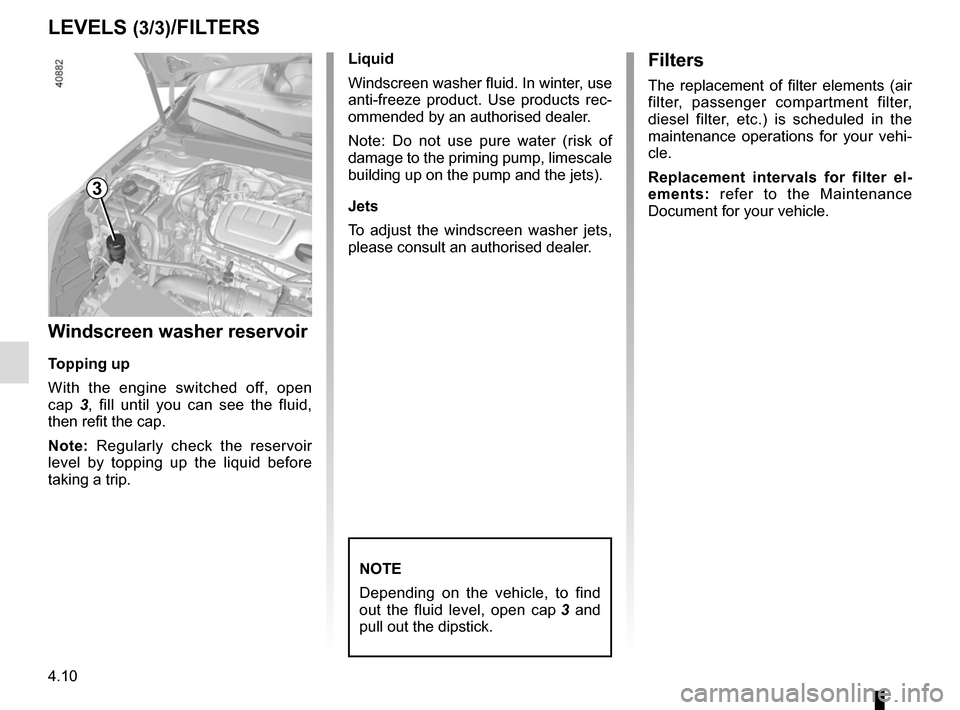
Windscreen washer reservoir
Topping up
With the engine switched off, open
cap 3, fill until you can see the fluid,
then refit the cap.
Note: Regularly check the reservoir
level by topping up the liquid before
taking a trip. Liquid
Windscreen washer fluid. In winter, use
anti-freeze product. Use products rec-
ommended by an authorised dealer.
Note: Do not use pure water (risk of
damage to the priming pump, limescale
building up on the pump and the jets).
Jets
To adjust the windscreen washer jets,
please consult an authorised dealer.
NOTE
Depending on the vehicle, to find
out the fluid level, open cap
3 and
pull out the dipstick.
Filters
The replacement of filter elements (air
filter, passenger compartment filter,
diesel filter, etc.) is scheduled in the
maintenance operations for your vehi-
cle.
Replacement intervals for filter el-
ements: refer to the Maintenance
Document for your vehicle.
3
Page 312 of 346
5.42
OPERATING FAULTS (4/7)
On the roadPOSSIBLE CAUSESWHAT TO DO
Vibrations. Tyres not inflated to correct pres-
sures, incorrectly balanced or dam-
aged. Check the tyre pressures: if this is not the
problem, have them checked by an ap-
proved Dealer.
White smoke from the exhaust. In the diesel version, this is necessar-
ily a fault. Smoke may be caused by
particle filter regeneration. Refer to the information on “Special fea-
tures of diesel versions” in Section 2.
Smoke under the bonnet. Short-circuit or cooling system leak. Stop, switch off the ignition, stand away
from the vehicle and contact an approved
dealer.
The oil pressure warning light comes
on: while cornering or braking The level is too low. Top up the engine oil level (refer to the in-
formation on “Engine oil level: topping up,
filling” in Section 4).
is slow to go out or remains lit
under acceleration Loss of oil pressure.
Stop the vehicle and contact an approved
Dealer.
Page 318 of 346
6.2
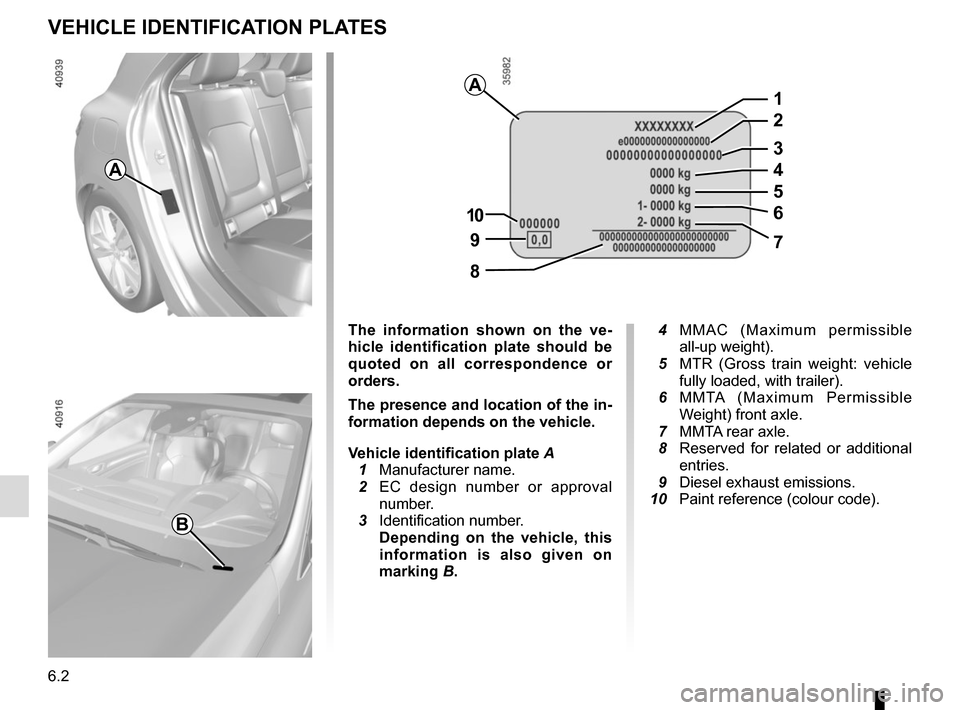
VEHICLE IDENTIFICATION PLATES
A
B
A
97
8
10
5
1
2
3
4
6
The information shown on the ve-
hicle identification plate should be
quoted on all correspondence or
orders.
The presence and location of the in-
formation depends on the vehicle.
Vehicle identification plate A
1 Manufacturer name.
2 EC design number or approval
number.
3 Identification number.
Depending on the vehicle, this
information is also given on
marking B.
4 MMAC (Maximum permissible
all-up weight).
5 MTR (Gross train weight: vehicle
fully loaded, with trailer).
6 MMTA (Maximum Permissible
Weight) front axle.
7 MMTA rear axle.
8 Reserved for related or additional
entries.
9 Diesel exhaust emissions.
10 Paint reference (colour code).
Page 324 of 346
6.8
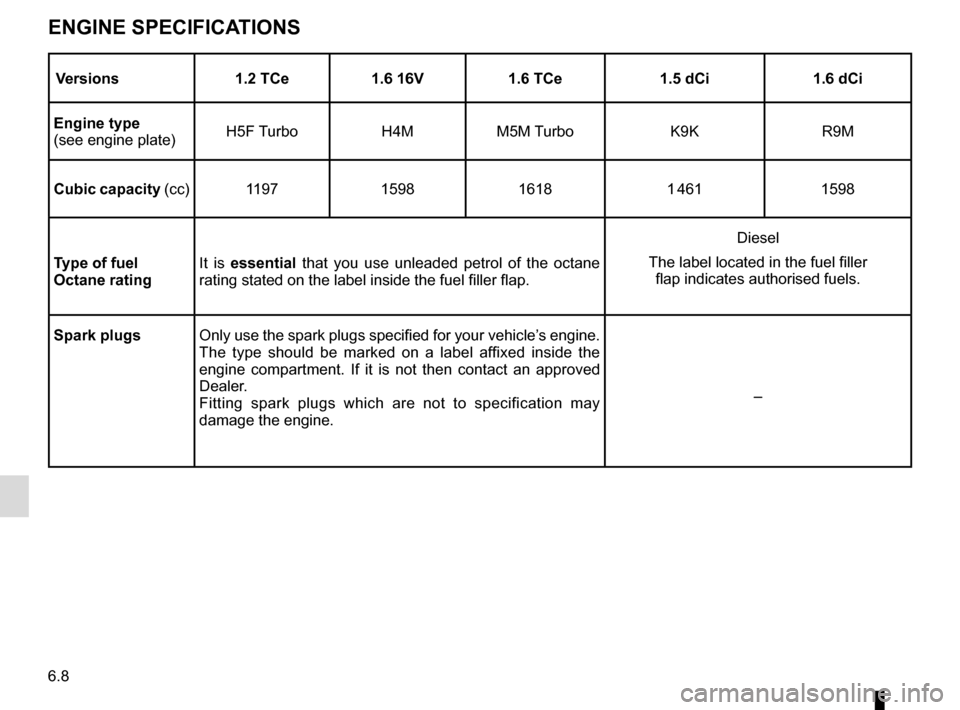
ENGINE SPECIFICATIONS
Versions1.2 TCe1.6 16V 1.6 TCe 1.5 dCi 1.6 dCi
Engine type
(see engine plate) H5F Turbo
H4MM5M Turbo K9KR9M
Cubic capacity (cc) 1197 15981618 1 461 1598
Type of fuel
Octane rating It is
essential that you use unleaded petrol of the octane
rating stated on the label inside the fuel filler flap. Diesel
The label located in the fuel filler flap indicates authorised fuels.
Spark plugs Only use the spark plugs specified for your vehicle’s engine.
The type should be marked on a label affixed inside the
engine compartment. If it is not then contact an approved
Dealer.
Fitting spark plugs which are not to specification may
damage the engine. –
Page 340 of 346
7.2
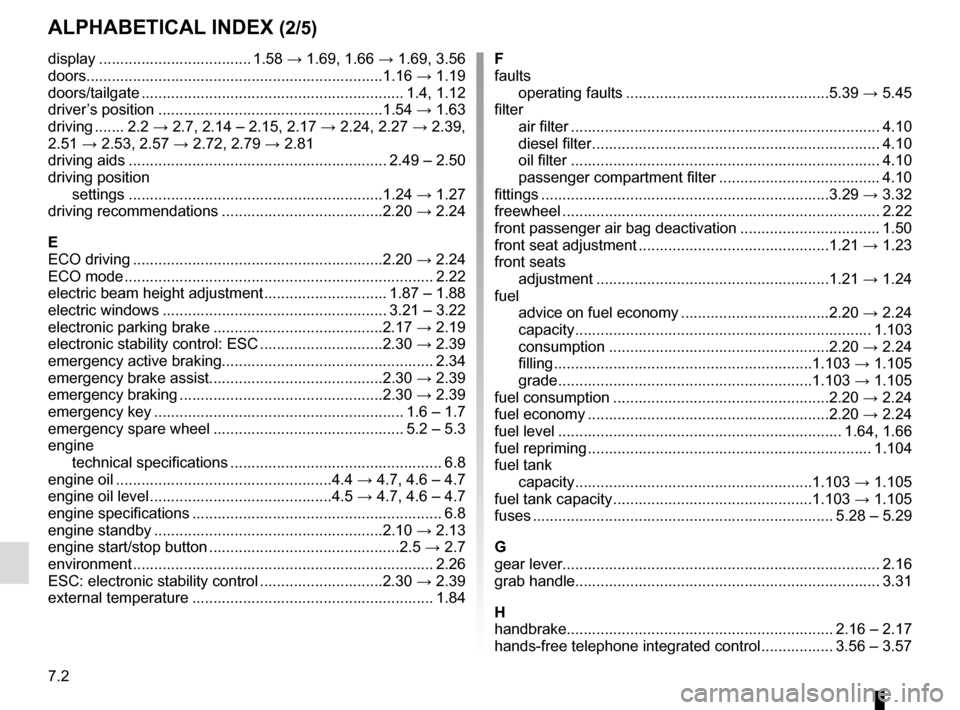
ALPHABETICAL INDEX (2/5)
display .................................... 1.58 → 1.69, 1.66 → 1.69, 3.56
doors......................................................................1.16 → 1.19
doors/tailgate .........................................................\
..... 1.4, 1.12
driver’s position .....................................................1.54 → 1.63
driving ....... 2.2 → 2.7, 2.14 – 2.15, 2.17 → 2.24, 2.27 → 2.39,
2.51 → 2.53, 2.57 → 2.72, 2.79 → 2.81
driving aids ............................................................. 2.49 – 2.50
driving position settings ............................................................1.24 → 1.27
driving recommendations ......................................2.20 → 2.24
E
ECO driving ...........................................................2.20 → 2.24
ECO mode ........................................................................\
. 2.22
electric beam height adjustment ............................. 1.87 – 1.88
electric windows ..................................................... 3.21 – 3.22
electronic parking brake ........................................2.17 → 2.19
electronic stability control: ESC .............................2.30 → 2.39
emergency active braking.................................................. 2.34
emergency brake assist.........................................2.30 → 2.39
emergency braking ................................................2.30 → 2.39
emergency key ........................................................... 1.6 – 1.7
emergency spare wheel ............................................. 5.2 – 5.3
engine technical specifications .................................................. 6.8
engine oil ...................................................4.4 → 4.7, 4.6 – 4.7
engine oil level ...........................................4.5 → 4.7, 4.6 – 4.7
engine specifications ........................................................... 6.8
engine standby ......................................................2.10 → 2.13
engine start/stop button .............................................2.5 → 2.7
environment ............................................................\
........... 2.26
ESC: electronic stability control .............................2.30 → 2.39
external temperature ......................................................... 1.84 F
faults
operating faults ................................................5.39 → 5.45
filter air filter ........................................................................\
. 4.10
diesel filter .................................................................... 4.10
oil filter ........................................................................\
. 4.10
passenger compartment filter ...................................... 4.10
fittings ...............................................................\
.....3.29 → 3.32
freewheel ..............................................................\
............. 2.22
front passenger air bag deactivation ................................. 1.50
front seat adjustment .............................................1.21 → 1.23
front seats adjustment .......................................................1.21 → 1.24
fuel advice on fuel economy ...................................2.20 → 2.24
capacity ...............................................................\
....... 1.103
consumption ....................................................2.20 → 2.24
filling .............................................................1.103 → 1.105
grade ............................................................1.103 → 1.105
fuel consumption ...................................................2.20 → 2.24
fuel economy .........................................................2.20 → 2.24
fuel level ................................................................... 1.64, 1.66
fuel repriming
................................................................... 1.104
fuel tank capacity ........................................................1.103 → 1.105
fuel tank capacity ...............................................1.103 → 1.105
fuses ....................................................................... 5.28 – 5.29
G
gear lever........................................................................\
... 2.16
grab handle........................................................................\
3.31
H
handbrake............................................................... 2.16 – 2.17
hands-free telephone integrated control ................. 3.56 – 3.57
Page 342 of 346
7.4
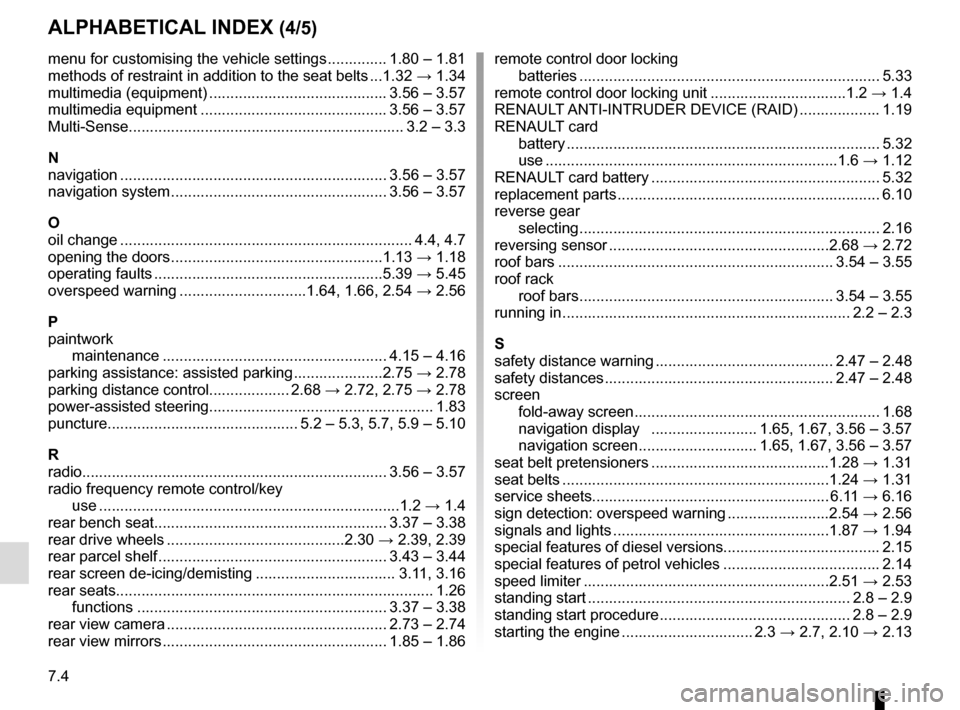
ALPHABETICAL INDEX (4/5)
menu for customising the vehicle settings .............. 1.80 – 1.81
methods of restraint in addition to the seat belts ...1.32 → 1.34
multimedia (equipment) .......................................... 3.56 – 3.57
multimedia equipment ............................................ 3.56 – 3.57
Multi-Sense................................................................. 3.2 – 3.3
N
navigation ............................................................... 3.56 – 3.57
navigation system ................................................... 3.56 – 3.57
O
oil change ..................................................................... 4.4, 4.7
opening the doors ..................................................1.13 → 1.18
operating faults ......................................................5.39 → 5.45
overspeed warning ..............................1.64, 1.66, 2.54 → 2.56
P
paintwork maintenance ..................................................... 4.15 – 4.16
parking assistance: assisted parking .....................2.75 → 2.78
parking distance control................... 2.68 → 2.72, 2.75 → 2.78
power-assisted steering..................................................... 1.83
puncture............................................. 5.2 – 5.3, 5.7, 5.9 – 5.10
R
radio........................................................................\
3.56 – 3.57
radio frequency remote control/key use ....................................................................\
...1.2 → 1.4
rear bench seat....................................................... 3.37 – 3.38
rear drive wheels ..........................................2.30 → 2.39, 2.39
rear parcel shelf ...................................................... 3.43 – 3.44
rear screen de-icing/demisting ................................. 3.11, 3.16
rear seats........................................................................\
... 1.26 functions ........................................................... 3.37 – 3.38
rear view camera .................................................... 2.73 – 2.74
rear view mirrors ..................................................... 1.85 – 1.86 remote control door locking
batteries ..............................................................\
......... 5.33
remote control door locking unit ................................1.2 → 1.4
RENAULT ANTI-INTRUDER DEVICE (RAID) ................... 1.19
RENAULT card battery ................................................................\
.......... 5.32
use ....................................................................\
.1.6 → 1.12
RENAULT card battery ...................................................... 5.32
replacement parts .............................................................. 6.10
reverse gear selecting ..............................................................\
......... 2.16
reversing sensor ....................................................2.68 → 2.72
roof bars ................................................................. 3.54 – 3.55
roof rack roof bars ............................................................ 3.54 – 3.55
running in .................................................................... 2.2 – 2.3
S
safety distance warning .......................................... 2.47 – 2.48
safety distances ...................................................... 2.47 – 2.48
screen fold-away screen .......................................................... 1.68
navigation display ......................... 1.65, 1.67, 3.56 – 3.57
navigation screen ............................ 1.65, 1.67, 3.56 – 3.57
seat belt pretensioners ..........................................1.28 → 1.31
seat belts ...............................................................1.24 → 1.31
service sheets........................................................ 6.11 → 6.16
sign detection: overspeed warning ........................2.54 → 2.56
signals and lights ...................................................1.87 → 1.94
special features of diesel versions..................................... 2.15
special features of petrol vehicles ..................................... 2.14
speed limiter ..........................................................2.51 → 2.53
standing start .............................................................. 2.8 – 2.9
standing start procedure ............................................. 2.8 – 2.9
starting the engine ............................... 2.3 → 2.7, 2.10 → 2.13