rim RENAULT MEGANE 2017 4.G User Guide
[x] Cancel search | Manufacturer: RENAULT, Model Year: 2017, Model line: MEGANE, Model: RENAULT MEGANE 2017 4.GPages: 346, PDF Size: 7.04 MB
Page 270 of 346
4.18
You are strongly recom-
mended not to use high-
pressure or spray cleaning
equipment inside the pas-
senger compartment: use of such
equipment could impair the correct
functioning of the electrical or elec-
tronic components in the vehicle, or
have other detrimental effects.
INTERIOR TRIM MAINTENANCE (2/2)
You should not:
You are strongly advised not to po-
sition objects such as deodorants,
scents, etc. near air vents, as this could
damage your dashboard trim.
Removal/replacing removable
equipment originally fitted in
the vehicle
If you need to remove equipment in
order to clean the passenger com-
partment (for example, mats), always
ensure that they are correctly refitted
and are the right way around (the driv-
er’s mat should be fitted on the driver’s
side, etc.) and fit them with the compo-
nents supplied with the equipment (for
example, the driver mat should always
be fixed using the pre-fitted mounting
components).
With the vehicle stationary, always
ensure that nothing will impede driving
(anything obstructing the pedals, heel
wedged by the mat etc.).
Page 271 of 346

5.1
Section 5: Practical advice
Puncture/emergency spare wheel . . . . . . . . . . . . . . . . . . . . . . . . . . . . . . . . . . . . \
. . . . . . . . . . . . . . . 5.2
Tyre inflation kit . . . . . . . . . . . . . . . . . . . . . . . . . . . . . . . . . . . .\
. . . . . . . . . . . . . . . . . . . . . . . . . . . . . 5.4
Tools . . . . . . . . . . . . . . . . . . . . . . . . . . . . . . . . . . . .\
. . . . . . . . . . . . . . . . . . . . . . . . . . . . . . . . . . . . . 5.7
Wheel trim . . . . . . . . . . . . . . . . . . . . . . . . . . . . . . . . . . . . \
. . . . . . . . . . . . . . . . . . . . . . . . . . . . . . . . . 5.8
Changing a wheel . . . . . . . . . . . . . . . . . . . . . . . . . . . . . . . . . . . .\
. . . . . . . . . . . . . . . . . . . . . . . . . . . 5.9
Tyres (tyre and wheel safety, use in winter) . . . . . . . . . . . . . . . . . . . . . . . . . . . . . . . . . . . .\
. . . . . . . 5.11
Headlights (changing bulbs) . . . . . . . . . . . . . . . . . . . . . . . . . . . . . . . . . . . .\
. . . . . . . . . . . . . . . . . . . 5.14
Rear lights and side lights (changing bulbs) . . . . . . . . . . . . . . . . . . . . . . . . . . . . . . . . . . . .\
. . . . . . . 5.16
interior lighting:
Fuses . . . . . . . . . . . . . . . . . . . . . . . . . . . . . . . . . . . . \
. . . . . . . . . . . . . . . . . . . . . . . . . . . . . . . . . . . . . 5.28
Battery . . . . . . . . . . . . . . . . . . . . . . . . . . . . . . . . . . . . \
. . . . . . . . . . . . . . . . . . . . . . . . . . . . . . . . . . . . 5.30
RENAULT card: battery . . . . . . . . . . . . . . . . . . . . . . . . . . . . . . . . . . . . \
. . . . . . . . . . . . . . . . . . . . . . . 5.32
Radio frequency remote control: batteries. . . . . . . . . . . . . . . . . . . . . . . . . . . . . . . . . . . . \
. . . . . . . . . 5.33
Accessories . . . . . . . . . . . . . . . . . . . . . . . . . . . . . . . . . . . . \
. . . . . . . . . . . . . . . . . . . . . . . . . . . . . . . . 5.34
Wipers (replacing blades) . . . . . . . . . . . . . . . . . . . . . . . . . . . . . . . . . . . .\
. . . . . . . . . . . . . . . . . . . . . 5.35
Towing . . . . . . . . . . . . . . . . . . . . . . . . . . . . . . . . . . . . \
. . . . . . . . . . . . . . . . . . . . . . . . . . . . . . . . . . . . 5.37
Operating faults . . . . . . . . . . . . . . . . . . . . . . . . . . . . . . . . . . . . \
. . . . . . . . . . . . . . . . . . . . . . . . . . . . . 5.39
Page 274 of 346
5.4
TYRE PRESSURE KIT (1/3)
The kit is only approved for
inflating the tyres of the ve-
hicle originally equipped
with the kit.
It must never be used to inflate
the tyres of another vehicle, or any
other inflatable object (rubber ring,
rubber boat, etc.).
Avoid spillage on skin when hand-
ling the repair liquid bottle. If drop-
lets do leak out, rinse them off with
plenty of water.
Keep the repair kit away from chil-
dren.
Do not dispose of the empty bottle
in the countryside. Return it to your
approved dealer or to a recycling or-
ganisation.
The bottle has a limited service
life which is indicated on its label.
Check the expiry date.
Contact an approved dealer to re-
place the inflation tube and repair
product bottle.
A
B
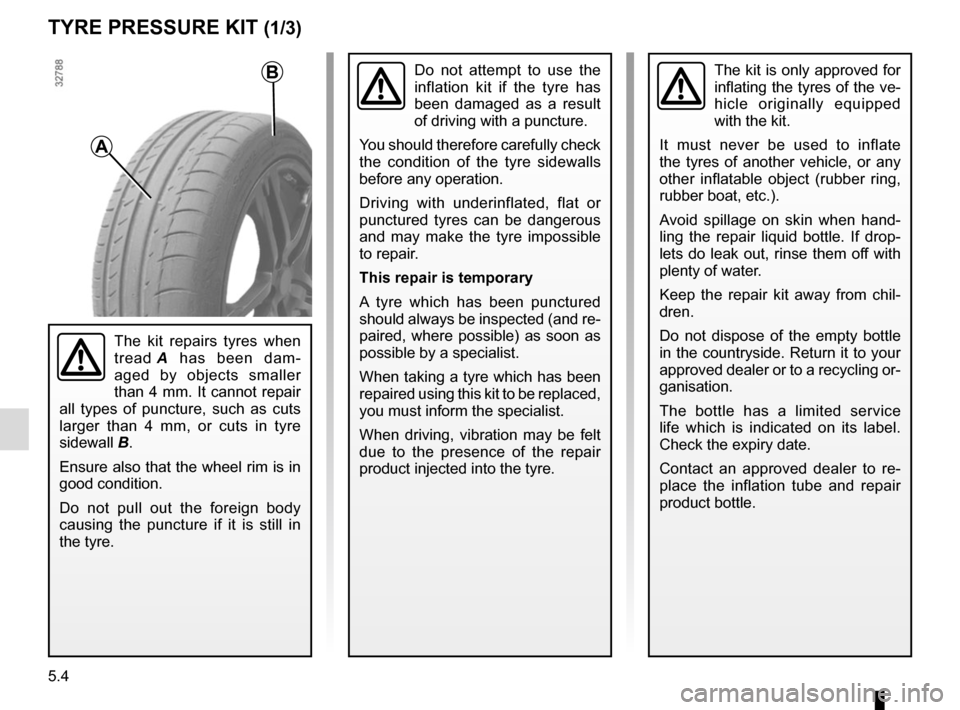
The kit repairs tyres when
tread A has been dam-
aged by objects smaller
than 4 mm. It cannot repair
all types of puncture, such as cuts
larger than 4 mm, or cuts in tyre
sidewall B.
Ensure also that the wheel rim is in
good condition.
Do not pull out the foreign body
causing the puncture if it is still in
the tyre.
Do not attempt to use the
inflation kit if the tyre has
been damaged as a result
of driving with a puncture.
You should therefore carefully check
the condition of the tyre sidewalls
before any operation.
Driving with underinflated, flat or
punctured tyres can be dangerous
and may make the tyre impossible
to repair.
This repair is temporary
A tyre which has been punctured
should always be inspected (and re-
paired, where possible) as soon as
possible by a specialist.
When taking a tyre which has been
repaired using this kit to be replaced,
you must inform the specialist.
When driving, vibration may be felt
due to the presence of the repair
product injected into the tyre.
Page 277 of 346
5.7
TOOLS
Tool kit storage
The presence of the tools depends on
the vehicle.
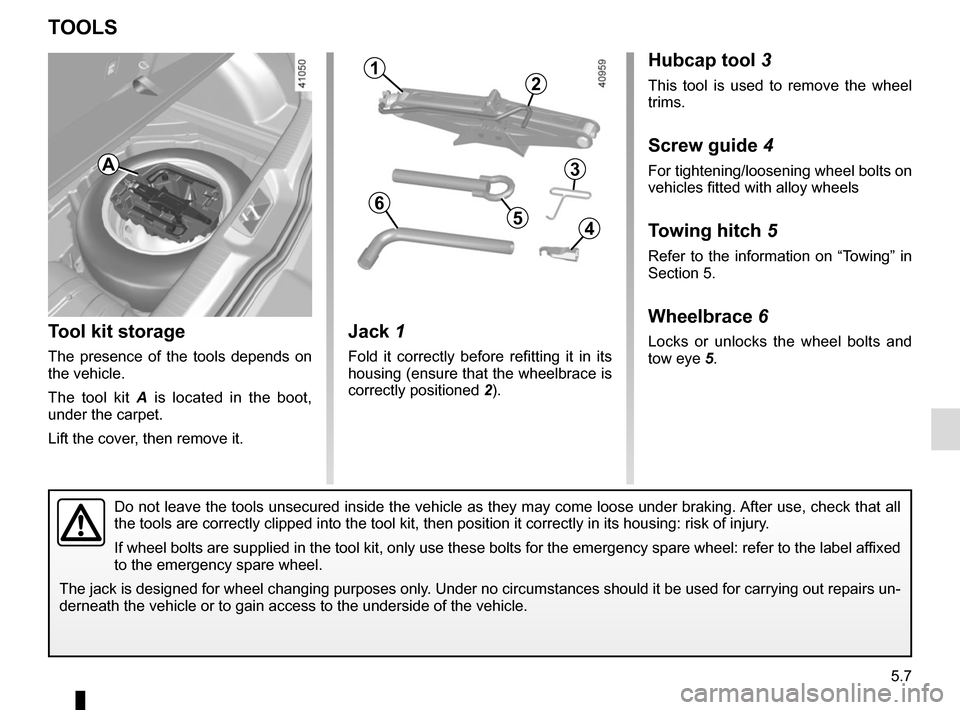
The tool kit A is located in the boot,
under the carpet.
Lift the cover, then remove it.
Jack 1
Fold it correctly before refitting it in its
housing (ensure that the wheelbrace is
correctly positioned 2).
Hubcap tool 3
This tool is used to remove the wheel
trims.
Screw guide 4
For tightening/loosening wheel bolts on
vehicles fitted with alloy wheels
Towing hitch 5
Refer to the information on “Towing” in
Section 5.
Wheelbrace 6
Locks or unlocks the wheel bolts and
tow eye 5.
1
6
3
5
2
4
Do not leave the tools unsecured inside the vehicle as they may come loo\
se under braking. After use, check that all
the tools are correctly clipped into the tool kit, then position it corr\
ectly in its housing: risk of injury.
If wheel bolts are supplied in the tool kit, only use these bolts for th\
e emergency spare wheel: refer to the label affixed
to the emergency spare wheel.
The jack is designed for wheel changing purposes only. Under no circumstances should it be used for carrying out repairs un-
derneath the vehicle or to gain access to the underside of the vehicle.
A
Page 279 of 346
5.9
CHANGING A WHEEL (1/2)
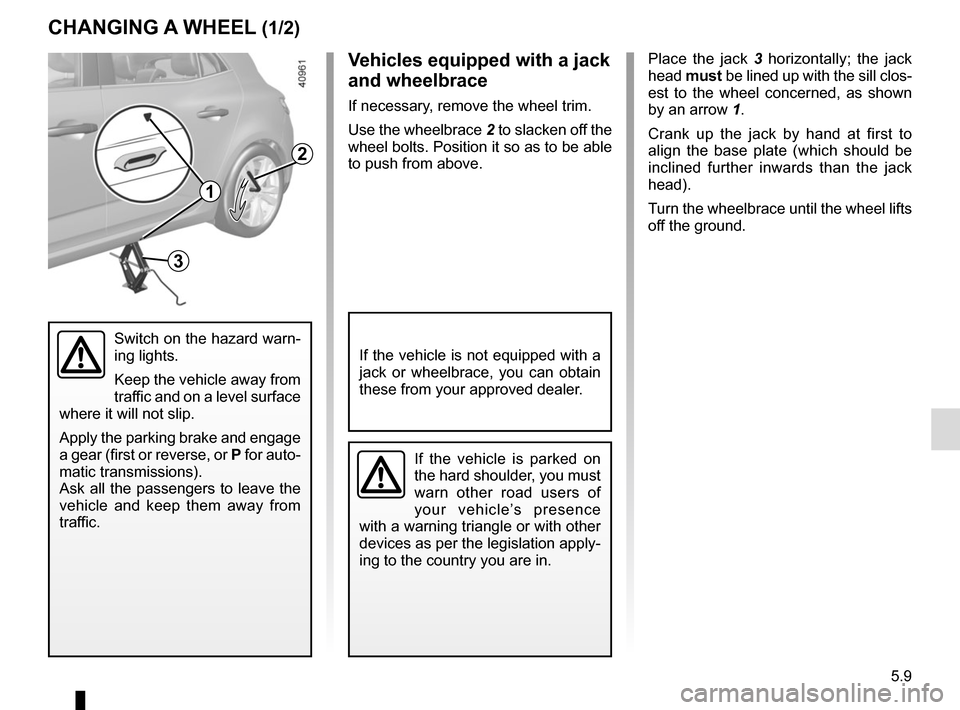
Place the jack 3 horizontally; the jack
head must be lined up with the sill clos-
est to the wheel concerned, as shown
by an arrow 1.
Crank up the jack by hand at first to
align the base plate (which should be
inclined further inwards than the jack
head).
Turn the wheelbrace until the wheel lifts
off the ground.
Switch on the hazard warn-
ing lights.
Keep the vehicle away from
traffic and on a level surface
where it will not slip.
Apply the parking brake and engage
a gear (first or reverse, or P for auto-
matic transmissions).
Ask all the passengers to leave the
vehicle and keep them away from
traffic.
If the vehicle is parked on
the hard shoulder, you must
warn other road users of
your vehicle’s presence
with a warning triangle or with other
devices as per the legislation apply-
ing to the country you are in.
If the vehicle is not equipped with a
jack or wheelbrace, you can obtain
these from your approved dealer.
Vehicles equipped with a jack
and wheelbrace
If necessary, remove the wheel trim.
Use the wheelbrace 2 to slacken off the
wheel bolts. Position it so as to be able
to push from above.
3
2
1
Page 281 of 346
5.11
TYRES (1/3)
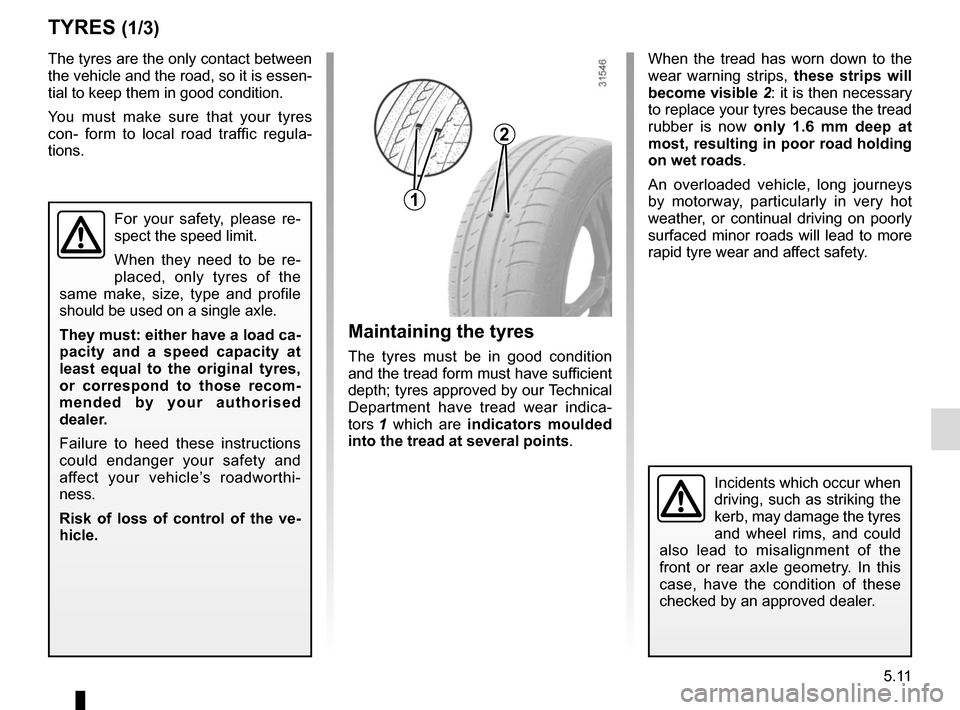
Maintaining the tyres
The tyres must be in good condition
and the tread form must have sufficient
depth; tyres approved by our Technical
Department have tread wear indica-
tors 1 which are indicators moulded
into the tread at several points .
The tyres are the only contact between
the vehicle and the road, so it is essen-
tial to keep them in good condition.
You must make sure that your tyres
con- form to local road traffic regula-
tions.
When the tread has worn down to the
wear warning strips,
these strips will
become visible 2: it is then necessary
to replace your tyres because the tread
rubber is now only 1.6 mm deep at
most, resulting in poor road holding
on wet roads.
An overloaded vehicle, long journeys
by motorway, particularly in very hot
weather, or continual driving on poorly
surfaced minor roads will lead to more
rapid tyre wear and affect safety.
Incidents which occur when
driving, such as striking the
kerb, may damage the tyres
and wheel rims, and could
also lead to misalignment of the
front or rear axle geometry. In this
case, have the condition of these
checked by an approved dealer.
2
1
For your safety, please re-
spect the speed limit.
When they need to be re-
placed, only tyres of the
same make, size, type and profile
should be used on a single axle.
They must: either have a load ca-
pacity and a speed capacity at
least equal to the original tyres,
or correspond to those recom-
mended by your authorised
dealer.
Failure to heed these instructions
could endanger your safety and
affect your vehicle’s roadworthi-
ness.
Risk of loss of control of the ve-
hicle.
Page 287 of 346
5.17
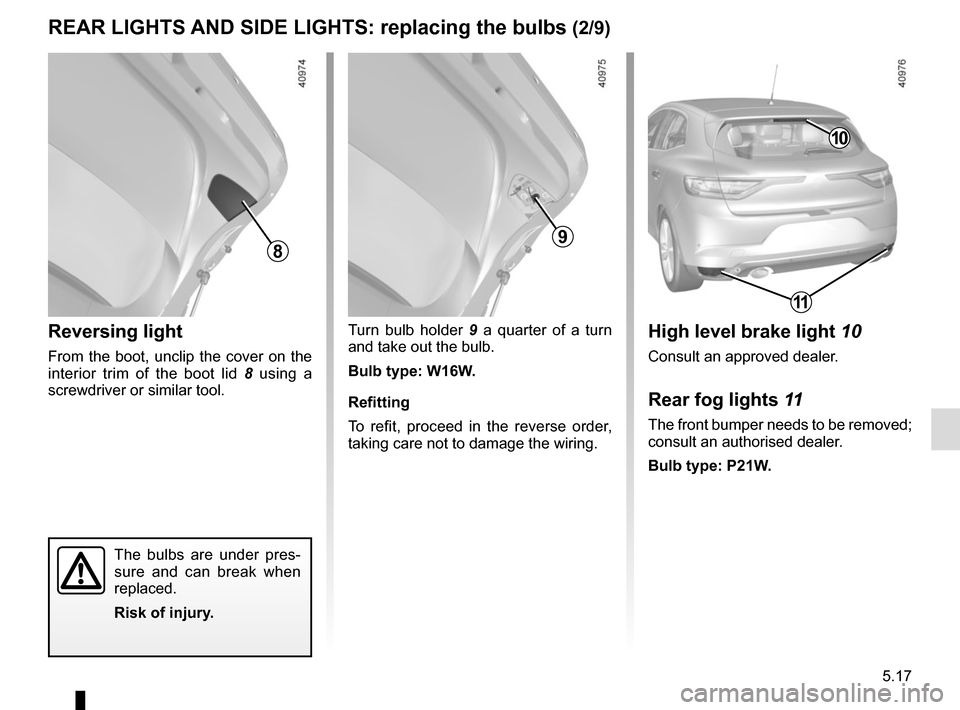
Reversing light
From the boot, unclip the cover on the
interior trim of the boot lid 8 using a
screwdriver or similar tool.
Turn bulb holder 9 a quarter of a turn
and take out the bulb.
Bulb type: W16W.
Refitting
To refit, proceed in the reverse order,
taking care not to damage the wiring.
The bulbs are under pres-
sure and can break when
replaced.
Risk of injury.
REAR LIGHTS AND SIDE LIGHTS: replacing the bulbs (2/9)
98
High level brake light 10
Consult an approved dealer.
Rear fog lights 11
The front bumper needs to be removed;
consult an authorised dealer.
Bulb type: P21W.
11
10
Page 290 of 346
5.20
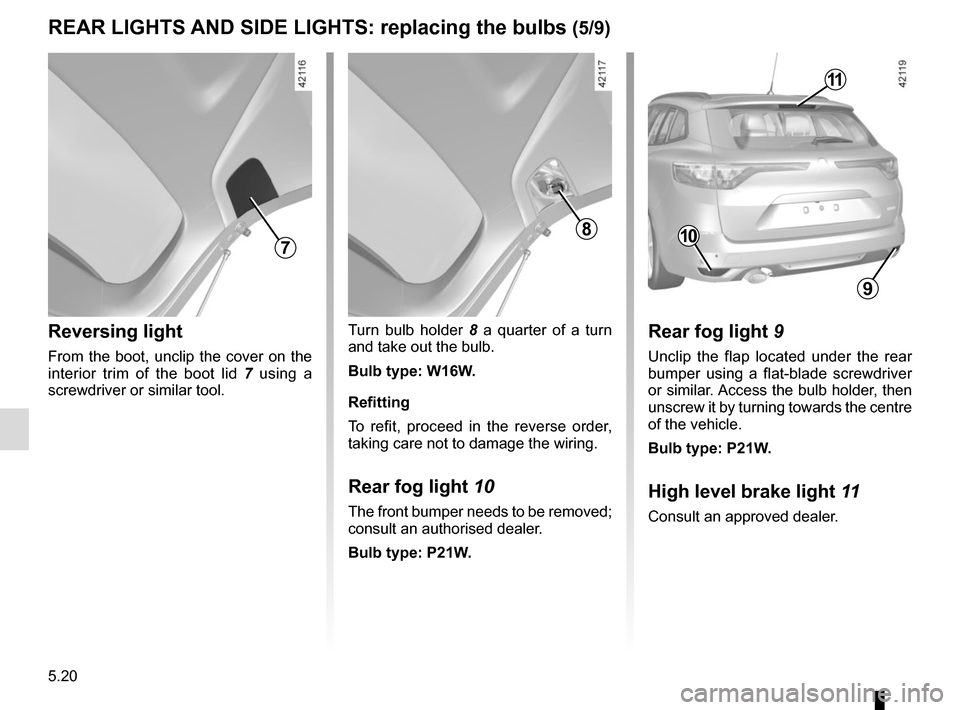
Reversing light
From the boot, unclip the cover on the
interior trim of the boot lid 7 using a
screwdriver or similar tool.
Turn bulb holder 8 a quarter of a turn
and take out the bulb.
Bulb type: W16W.
Refitting
To refit, proceed in the reverse order,
taking care not to damage the wiring.
Rear fog light 10
The front bumper needs to be removed;
consult an authorised dealer.
Bulb type: P21W.
REAR LIGHTS AND SIDE LIGHTS: replacing the bulbs (5/9)
8
7
Rear fog light 9
Unclip the flap located under the rear
bumper using a flat-blade screwdriver
or similar. Access the bulb holder, then
unscrew it by turning towards the centre
of the vehicle.
Bulb type: P21W.
High level brake light 11
Consult an approved dealer.
9
10
11
Page 293 of 346
5.23
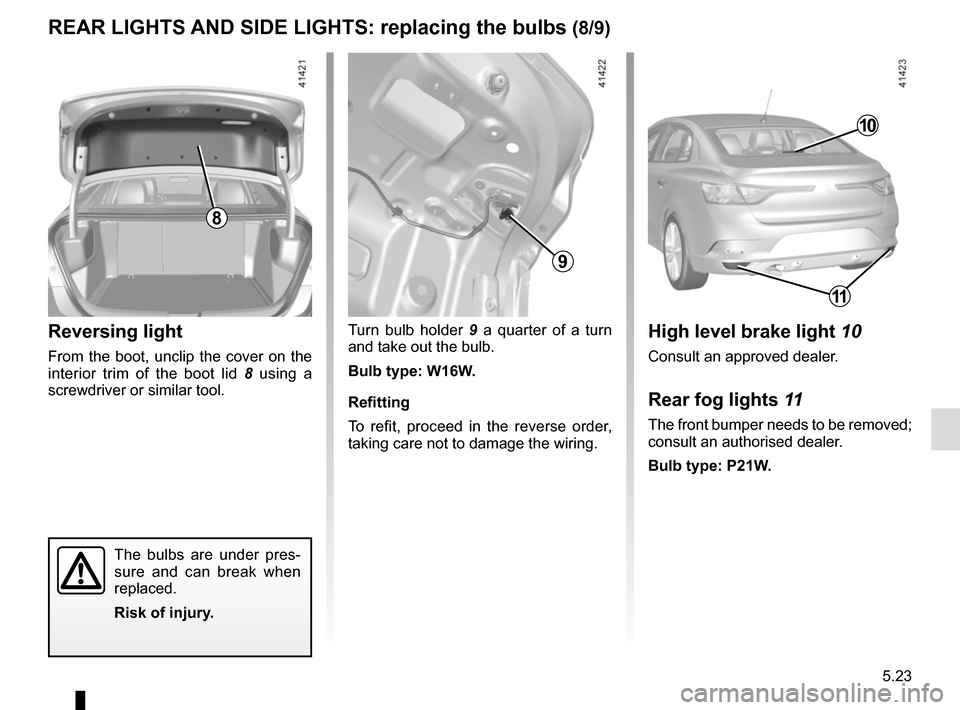
Turn bulb holder 9 a quarter of a turn
and take out the bulb.
Bulb type: W16W.
Refitting
To refit, proceed in the reverse order,
taking care not to damage the wiring.Reversing light
From the boot, unclip the cover on the
interior trim of the boot lid 8 using a
screwdriver or similar tool.
REAR LIGHTS AND SIDE LIGHTS: replacing the bulbs (8/9)
9
8
High level brake light 10
Consult an approved dealer.
Rear fog lights 11
The front bumper needs to be removed;
consult an authorised dealer.
Bulb type: P21W.
11
10
The bulbs are under pres-
sure and can break when
replaced.
Risk of injury.
Page 340 of 346
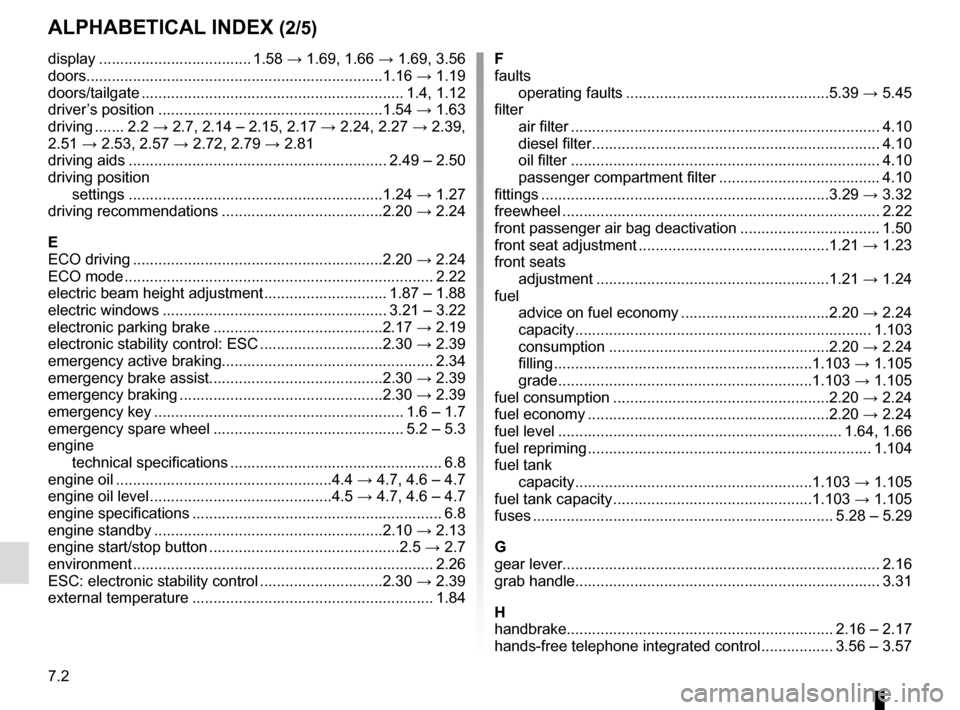
7.2
ALPHABETICAL INDEX (2/5)
display .................................... 1.58 → 1.69, 1.66 → 1.69, 3.56
doors......................................................................1.16 → 1.19
doors/tailgate .........................................................\
..... 1.4, 1.12
driver’s position .....................................................1.54 → 1.63
driving ....... 2.2 → 2.7, 2.14 – 2.15, 2.17 → 2.24, 2.27 → 2.39,
2.51 → 2.53, 2.57 → 2.72, 2.79 → 2.81
driving aids ............................................................. 2.49 – 2.50
driving position settings ............................................................1.24 → 1.27
driving recommendations ......................................2.20 → 2.24
E
ECO driving ...........................................................2.20 → 2.24
ECO mode ........................................................................\
. 2.22
electric beam height adjustment ............................. 1.87 – 1.88
electric windows ..................................................... 3.21 – 3.22
electronic parking brake ........................................2.17 → 2.19
electronic stability control: ESC .............................2.30 → 2.39
emergency active braking.................................................. 2.34
emergency brake assist.........................................2.30 → 2.39
emergency braking ................................................2.30 → 2.39
emergency key ........................................................... 1.6 – 1.7
emergency spare wheel ............................................. 5.2 – 5.3
engine technical specifications .................................................. 6.8
engine oil ...................................................4.4 → 4.7, 4.6 – 4.7
engine oil level ...........................................4.5 → 4.7, 4.6 – 4.7
engine specifications ........................................................... 6.8
engine standby ......................................................2.10 → 2.13
engine start/stop button .............................................2.5 → 2.7
environment ............................................................\
........... 2.26
ESC: electronic stability control .............................2.30 → 2.39
external temperature ......................................................... 1.84 F
faults
operating faults ................................................5.39 → 5.45
filter air filter ........................................................................\
. 4.10
diesel filter .................................................................... 4.10
oil filter ........................................................................\
. 4.10
passenger compartment filter ...................................... 4.10
fittings ...............................................................\
.....3.29 → 3.32
freewheel ..............................................................\
............. 2.22
front passenger air bag deactivation ................................. 1.50
front seat adjustment .............................................1.21 → 1.23
front seats adjustment .......................................................1.21 → 1.24
fuel advice on fuel economy ...................................2.20 → 2.24
capacity ...............................................................\
....... 1.103
consumption ....................................................2.20 → 2.24
filling .............................................................1.103 → 1.105
grade ............................................................1.103 → 1.105
fuel consumption ...................................................2.20 → 2.24
fuel economy .........................................................2.20 → 2.24
fuel level ................................................................... 1.64, 1.66
fuel repriming
................................................................... 1.104
fuel tank capacity ........................................................1.103 → 1.105
fuel tank capacity ...............................................1.103 → 1.105
fuses ....................................................................... 5.28 – 5.29
G
gear lever........................................................................\
... 2.16
grab handle........................................................................\
3.31
H
handbrake............................................................... 2.16 – 2.17
hands-free telephone integrated control ................. 3.56 – 3.57