fuel RENAULT MEGANE ESTATE 2016 X95 / 3.G Owner's Manual
[x] Cancel search | Manufacturer: RENAULT, Model Year: 2016, Model line: MEGANE ESTATE, Model: RENAULT MEGANE ESTATE 2016 X95 / 3.GPages: 274, PDF Size: 2.62 MB
Page 115 of 274

2.17
DRIVING ADVICE, ECO-DRIVING (3/3)
Tyres
– An underinflated tyre increases fuel consumption.
– The use of non-recommended tyres can increase fuel consumption.Advice on use
– Electricity is fuel; switch off all the electrical components which are
not really needed. However (safety
first), keep your lights on when the
visibility is bad (“see and be seen”).
– Use the air vents. Driving with the windows open at 60 mph (100 km/h)
will increase fuel consumption by
4%.
– Never fill the fuel tank right to the brim to avoid overflow. –
In vehicles fitted with air condi-
tioning, it is normal to observe an
increase in fuel consumption (espe-
cially in urban conditions) when it is
used. For vehicles fitted with manual
air conditioning, switch off the system
when it is not required.
Advice for reducing consumption
and therefore helping to preserve
the environment:
If the vehicle has been parked in the
sun, open the doors for a few mo-
ments to let the hot air escape before
starting the engine.
– Do not leave an empty roof rack fitted to the vehicle.
– It is better to fit a trailer for bulky ob- jects.
– When towing a caravan, fit a wind deflector and adjust it carefully.
– Avoid using the car for door-to-door calls (short journeys with long waits
in between) because the engine
never reaches its normal operating
temperature.
Page 116 of 274

2.18
MAINTENANCE AND ANTI-POLLUTION ADVICE
Your vehicle complies with criteria for
recycling and recovering vehicles at the
end of their service life, which will come
into force in 2015.
Some of the parts on your vehicle have
been designed to be recycled later.
These parts are easily removable in
order to be collected and reprocessed
in recycling networks.
Furthermore, by virtue of its design,
moderate fuel consumption and initial
settings, your vehicle also conforms
to current anti-pollution regulations.
The manufacturer is actively striving
to reduce pollutant exhaust gas emis-
sions and to save energy. However,
the fuel consumption of your vehicle
and the level of pollutant exhaust gas
emissions are also your responsibility.
Ensure that it is maintained and used
correctly.Maintenance
It is important to remember that fail-
ure to respect anti-pollution regulations
could lead to legal action being taken
against the vehicle owner.
In addition, replacing engine, fuel
supply system and exhaust compo-
nents with parts other than those origi-
nally recommended by the manufac-
turer may alter your vehicle so that it
no longer complies with anti-pollution
regulations.
Have your vehicle adjusted and
checked by an authorised dealer, in ac-
cordance with the instructions given in
your maintenance schedule: they will
have all the equipment necessary for
ensuring that your vehicle is maintained
to its original standard.
Engine adjustments
– Air filter, fuel filter: a choked ele-
ment will reduce efficiency. It must
be replaced.
– Idle speed: no adjustment is
needed.
Exhaust gas monitoring
system
The exhaust gas monitoring system will
detect any operating faults in the vehi-
cle’s antipollution system.
If this system malfunctions, toxic sub-
stances may be released into the at-
mosphere or damage may occur.
ÄThis warning light on the in-
strument panel will indicate if
there are any faults in the system:
This lights up when the ignition is
switched on and goes out when the
engine is started.
– If it lights up continuously, consult an approved Dealer as soon as possi-
ble;
– if it flashes, reduce the engine speed until the light stops flashing. Contact
an authorised dealer as soon as pos-
sible.
Page 117 of 274
2.19
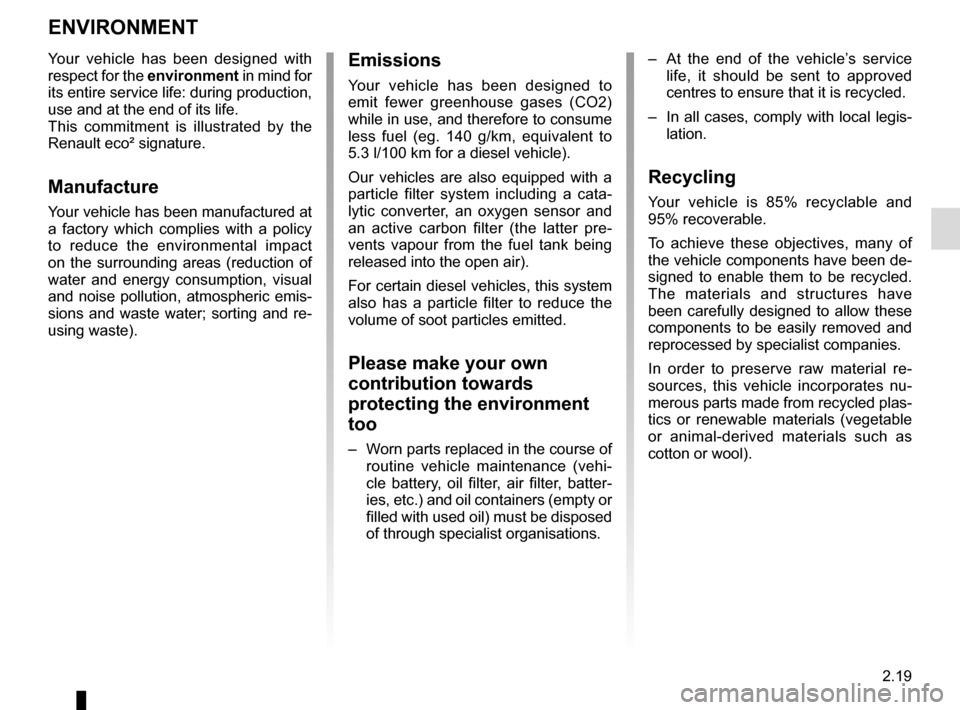
ENVIRONMENT
Emissions
Your vehicle has been designed to
emit fewer greenhouse gases (CO2)
while in use, and therefore to consume
less fuel (eg. 140 g/km, equivalent to
5.3 l/100 km for a diesel vehicle).
Our vehicles are also equipped with a
particle filter system including a cata-
lytic converter, an oxygen sensor and
an active carbon filter (the latter pre-
vents vapour from the fuel tank being
released into the open air).
For certain diesel vehicles, this system
also has a particle filter to reduce the
volume of soot particles emitted.
Please make your own
contribution towards
protecting the environment
too
– Worn parts replaced in the course of routine vehicle maintenance (vehi-
cle battery, oil filter, air filter, batter-
ies, etc.) and oil containers (empty or
filled with used oil) must be disposed
of through specialist organisations. – At the end of the vehicle’s service
life, it should be sent to approved
centres to ensure that it is recycled.
– In all cases, comply with local legis- lation.
Recycling
Your vehicle is 85% recyclable and
95% recoverable.
To achieve these objectives, many of
the vehicle components have been de-
signed to enable them to be recycled.
The materials and structures have
been carefully designed to allow these
components to be easily removed and
reprocessed by specialist companies.
In order to preserve raw material re-
sources, this vehicle incorporates nu-
merous parts made from recycled plas-
tics or renewable materials (vegetable
or animal-derived materials such as
cotton or wool).
Your vehicle has been designed with
respect for the environment in mind for
its entire service life: during production,
use and at the end of its life.
This commitment is illustrated by the
Renault eco² signature.Manufacture
Your vehicle has been manufactured at
a factory which complies with a policy
to reduce the environmental impact
on the surrounding areas (reduction of
water and energy consumption, visual
and noise pollution, atmospheric emis-
sions and waste water; sorting and re-
using waste).
Page 155 of 274
3.11
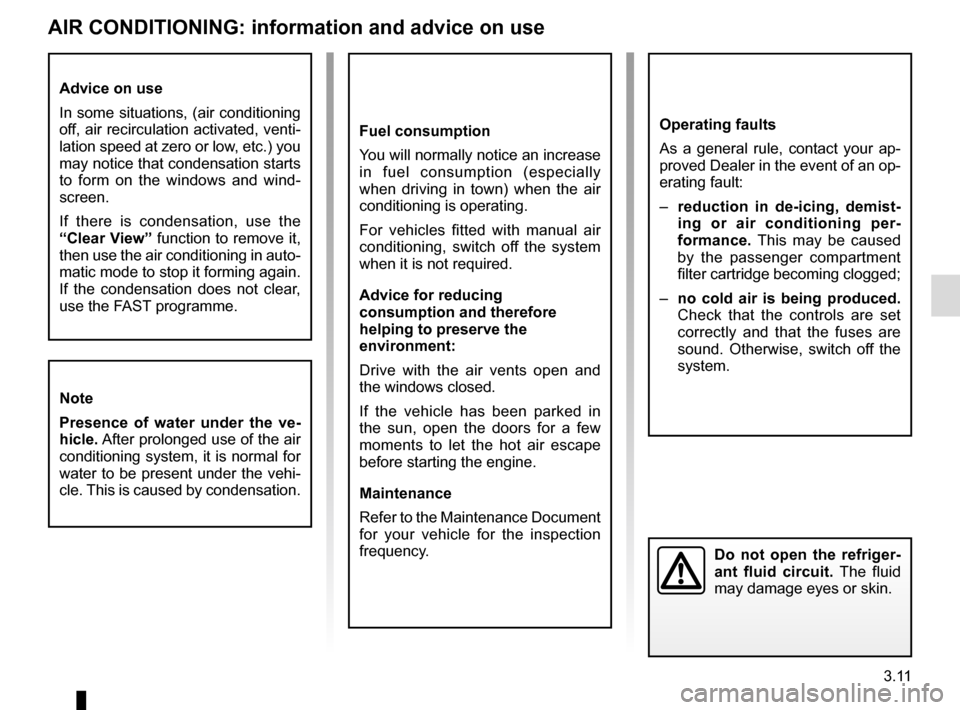
AIR CONDITIONING: information and advice on use
Fuel consumption
You will normally notice an increase
in fuel consumption (especially
when driving in town) when the air
conditioning is operating.
For vehicles fitted with manual air
conditioning, switch off the system
when it is not required.
Advice for reducing
consumption and therefore
helping to preserve the
environment:
Drive with the air vents open and
the windows closed.
If the vehicle has been parked in
the sun, open the doors for a few
moments to let the hot air escape
before starting the engine.
Maintenance
Refer to the Maintenance Document
for your vehicle for the inspection
frequency.Operating faults
As a general rule, contact your ap-
proved Dealer in the event of an op-
erating fault:
– reduction in de-icing, demist-
ing or air conditioning per-
formance. This may be caused
by the passenger compartment
filter cartridge becoming clogged;
– no cold air is being produced.
Check that the controls are set
correctly and that the fuses are
sound. Otherwise, switch off the
system.
Advice on use
In some situations, (air conditioning
off, air recirculation activated, venti-
lation speed at zero or low, etc.) you
may notice that condensation starts
to form on the windows and wind-
screen.
If there is condensation, use the
“Clear View” function to remove it,
then use the air conditioning in auto-
matic mode to stop it forming again.
If the condensation does not clear,
use the FAST programme.
Do not open the refriger-
ant fluid circuit. The fluid
may damage eyes or skin.
Note
Presence of water under the ve-
hicle. After prolonged use of the air
conditioning system, it is normal for
water to be present under the vehi-
cle. This is caused by condensation.
Page 252 of 274
6.8
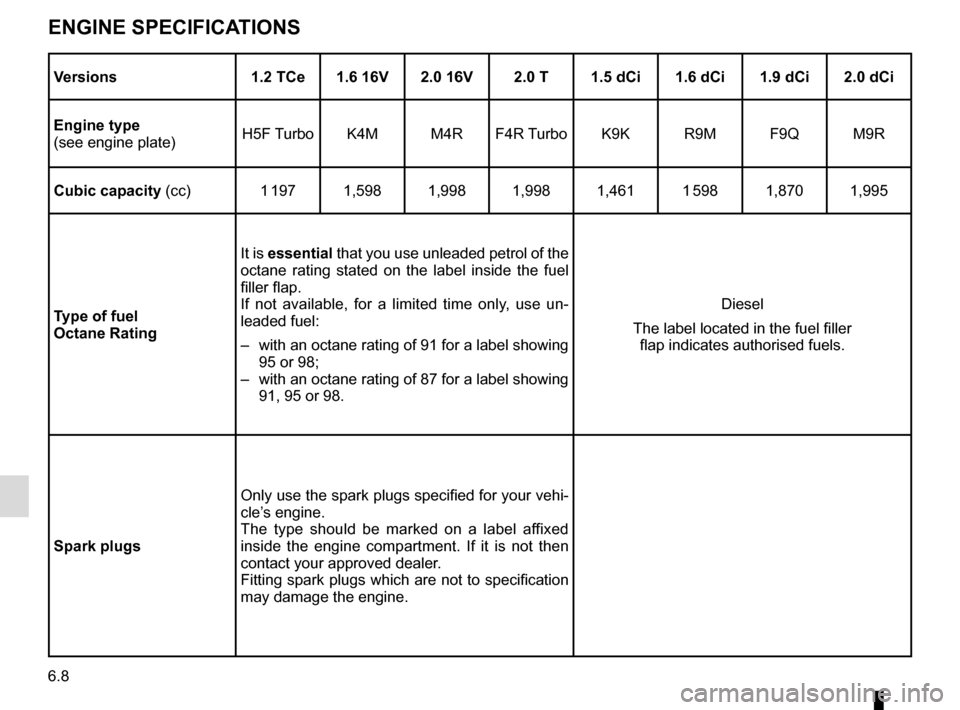
Versions1.2 TCe 1.6 16V 2.0 16V 2.0 T 1.5 dCi 1.6 dCi 1.9 dCi 2.0 dCi
Engine type
(see engine plate) H5F Turbo K4M M4R F4R Turbo K9K R9M F9Q M9R
Cubic capacity (cc) 1 197 1,598 1,998 1,998 1,461 1 598 1,870 1,995
Type of fuel
Octane Rating It is essential that you use unleaded petrol of the
octane rating stated on the label inside the fuel
filler flap.
If not available, for a limited time only, use un-
leaded fuel:
– with an octane rating of 91 for a label showing
95 or 98;
– with an octane rating of 87 for a label showing 91, 95 or 98. Diesel
The label located in the fuel filler flap indicates authorised fuels.
Spark plugs Only use the spark plugs specified for your vehi-
cle’s engine.
The type should be marked on a label affixed
inside the engine compartment. If it is not then
contact your approved dealer.
Fitting spark plugs which are not to specification
may damage the engine.
ENGINE SPECIFICATIONS
Page 268 of 274
7.2
ALPHABETICAL INDEX (2/5)
driving ........ 2.2 → 2.5, 2.9 → 2.17, 2.20 → 2.27, 2.30 → 2.40,
2.43 → 2.45
driving position settings ............................................................1.2\
2 → 1.24
driving recommendations ......................................2.15 → 2.17
E
electric beam height adjustment ........................................ 1.82
electric windows ....................................................3.12 → 3.15
electronic parking brake ........................................2.12 → 2.14
electronic stability control: ESC .............................2.24 → 2.27
emergency brake assist.........................................2.24 → 2.27
emergency braking ................................................2.24 → 2.27
emergency key ........................................................... 1.2 – 1.3
emergency spare wheel ...................................................... 5.2
engine coolant ..................................................................... 4.9
engine oil ..........................................................1.60, 4.4 → 4.8
engine oil capacity .....................................................4.6 → 4.8
engine oil level ...........................................................4.4 → 4.8
engine standby ..........................................................2.6 → 2.8
engine start/stop button .............................................2.3 → 2.5
environment ............................................................\
........... 2.19
ESC: electronic stability control .............................2.24 → 2.27
external temperature ......................................................... 1.76
F
faults operating faults ................................................5.36 → 5.41
filter air filter ........................................................................\
. 4.11
diesel filter .................................................................... 4.11
oil filter ........................................................ 4.6 → 4.8, 4.11
passenger compartment filter ...................................... 4.11
fitting a radio ...................................................................... 5.31
fittings ...............................................................\
.....3.19 → 3.22
fog lights ................................................................5.15 → 5.17front passenger air bag deactivation ................................. 1.50
front seat driver’s position memory .............................................. 1.20
front seat adjustment .............................................. 1.17 – 1.18
front seats adjustment ..........................1.15, 1.17 – 1.18, 1.22 → 1.24
with electric controls .................................................... 1.19
with manual controls .................................................... 1.17
fuel advice on fuel economy ...................................2.15 → 2.17
capacity ...............................................................\
......... 1.89
consumption .......................1.61, 1.66 – 1.67, 2.15 → 2.17
filling ........................................................1.61, 1.89 → 1.91
grade ................................................................1.\
89 → 1.91
fuel consumption ......................1.61, 1.66 – 1.67, 2.15 → 2.17
fuel economy .........................................................2.15 → 2.17
fuel filler cap ..........................................................1.89 → 1.91
fuel level ........................................................................\
.... 1.62
fuel tank capacity ............................................................1.8\
9 → 1.91
fuel tank capacity ...................................................1.89 → 1.91
fuses .......................................................................
5.26 – 5.27
G
gear lever..............................................................\
............. 2.11
glove box ........................................................................\
... 3.21
H
handbrake...............................................................\
.. 1.58, 2.11
hands-free telephone integrated control ............................ 3.37
hazard warning lights signal ................................... 1.77 – 1.78
headlight beam adjustment ............................................... 1.82
headlight flashers .............................................................. 1.77
headlight washer ............................................................... 1.87
headrest................................................................\
.. 1.15 – 1.16
heating and air conditioning system .................................. 3.11
Page 269 of 274
7.3
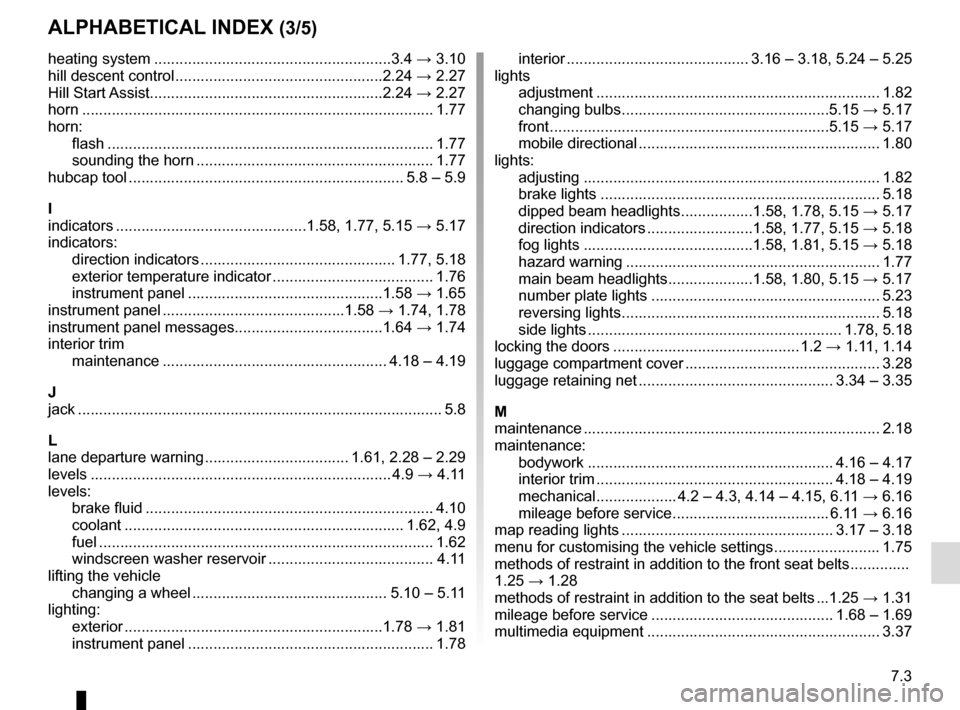
ALPHABETICAL INDEX (3/5)
heating system ........................................................3.4 → 3.10
hill descent control .................................................2.24 → 2.27
Hill Start Assist.......................................................2.24 → 2.27
horn ...................................................................\
................ 1.77
horn: flash ..................................................................\
........... 1.77
sounding the horn ........................................................ 1.77
hubcap tool ................................................................. 5.8 – 5.9
I
indicators .............................................1.58, 1.77, 5.15 → 5.17
indicators: direction indicators .............................................. 1.77, 5.18
exterior temperature indicator ...................................... 1.76
instrument panel ..............................................1.58 → 1.65
instrument panel ...........................................1.58 → 1.74, 1.78
instrument panel messages...................................1.64 → 1.74
interior trim maintenance ..................................................... 4.18 – 4.19
J
jack ...................................................................\
................... 5.8
L
lane departure warning .................................. 1.61, 2.28 – 2.29
levels .................................................................\
...... 4.9 → 4.11
levels: brake fluid .................................................................... 4.10
coolant ................................................................\
.. 1.62, 4.9
fuel ...................................................................\
............ 1.62
windscreen washer reservoir ....................................... 4.11
lifting the vehicle changing a wheel .............................................. 5.10 – 5.11
lighting: exterior .............................................................1.\
78 → 1.81
instrument panel .......................................................... 1.78 interior ........................................... 3.16 – 3.18, 5.24 – 5.25
lights adjustment .............................................................\
...... 1.82
changing bulbs .................................................5.15 → 5.17
front ..................................................................\
5.15 → 5.17
mobile directional ......................................................... 1.80
lights: adjusting ..............................................................\
........ 1.82
brake lights .................................................................. 5.18
dipped beam headlights .................1.58, 1.78, 5.15 → 5.17
direction indicators .........................1.58, 1.77, 5.15 → 5.18
fog lights ........................................1.58, 1.81, 5.15 → 5.18
hazard warning ............................................................ 1.77
main beam headlights ....................1.58, 1.80, 5.15 → 5.17
number plate lights ...................................................... 5.23
reversing lights ............................................................. 5.18
side lights ............................................................ 1.78, 5.18
locking the doors ............................................ 1.2 → 1.11, 1.14
luggage compartment cover .............................................. 3.28
luggage retaining net .............................................. 3.34 – 3.35
M
maintenance ............................................................\
.......... 2.18
maintenance: bodywork .......................................................... 4.16 – 4.17
interior trim ........................................................ 4.18 – 4.19
mechanical ................... 4.2 – 4.3, 4.14 – 4.15, 6.11 → 6.16
mileage before service ..................................... 6.11 → 6.16
map reading lights .................................................. 3.17 – 3.18
menu for customising the vehicle settings ......................... 1.75
methods of restraint in addition to the front seat belts ..............
1.25 → 1.28
methods of restraint in addition to the seat belts ...1.25 → 1.31
mileage before service ........................................... 1.68 – 1.69
multimedia equipment ....................................................... 3.37
Page 270 of 274

N
navigation .............................................................\
............. 3.37
navigation system ..........................................................")
7.4
ALPHABETICAL INDEX (4/5)
N
navigation .............................................................\
............. 3.37
navigation system .............................................................. 3.37
O
oil change ..................................................................4.4 → 4.8
opening the doors ..................................................1.10 → 1.13
operating faults ................................ 1.58 → 1.61, 5.36 → 5.41
P
paintwork maintenance ..................................................... 4.16 – 4.17
parking distance control.........................................2.37 → 2.42
power-assisted steering.................................................\
.... 1.53
pretensioners ..........................................................\
........... 1.25
puncture.................................................... 5.2, 5.8, 5.10 – 5.11
R
radio...................................................................\
................ 3.37 fitting a radio ................................................................ 5.31
range with fuel ................................................................... 1.67
rear bench seat....................................................... 3.24 – 3.25
rear parcel shelf ...................................................... 3.27 – 3.28
rear screen de-icing/demisting ..................................... 3.5, 3.9
rear seats functions ........................................................... 3.24 – 3.25
rear view camera .................................................... 2.41 – 2.42
rear view mirrors ................................................................ 1.32
RENAULT ANTI-INTRUDER DEVICE (RAID) ................... 1.14
RENAULT card battery ................................................................\
.......... 5.30
use ....................................................................\
...1.2 → 1.9
RENAULT card battery ...................................................... 5.30
replacement parts .............................................................. 6.10
reverse gear selecting .................................................. 2.11, 2.43 → 2.45reversing sensor ....................................................2.37
→ 2.40
roof bars ........................................................................\
.... 3.36
roof rack roof bars ....................................................................... 3.36
running in ........................................................................\
..... 2.2
S
screen wash/wipe .............................................................. 1.88
seat belt pretensioners ..........................................1.25 → 1.28
front seat belt ...................................................1.25 → 1.28
seat belts ..................................1.22 → 1.28, 1.30 – 1.31, 1.61
see-me-home lighting ............................................... 1.80, 1.82
service sheets........................................................ 6.11 → 6.16
side indicator lights changing bulbs ............................................................. 5.23
side protection devices ...................................................... 1.30
signals and lights ...................................................1.78 → 1.82
speakers location ...............................................................\
......... 5.31
special features of diesel versions.....................................\
2.10
special features of petrol vehicles ....................................... 2.9
speed limiter .................................................1.59, 2.30 → 2.32
starting the engine .....................................................2.3 → 2.8
steering wheel adjustment .............................................................\
...... 1.53
Stop & Start ...............................................................2.6 → 2.8
Stop & Start function..................................................2.6 → 2.8
stopping the engine ...................................................2.3 → 2.5
storage compartment.............................................3.19 → 3.22
storage compartments ..................... 3.19 → 3.22, 3.29 → 3.31
storing the driver’s seat position ........................................ 1.20
sun visor ................................................................... 3.13, 3.16
sunroof.................................................................\
... 3.14 – 3.15
switching on the vehicle ignition .......................................... 2.4