ignition RENAULT SANDERO 2012 Owner's Manual
[x] Cancel search | Manufacturer: RENAULT, Model Year: 2012, Model line: SANDERO, Model: RENAULT SANDERO 2012Pages: 183, PDF Size: 6.95 MB
Page 67 of 183
driving ................................................... (up to the end of the DU)
starting .................................................. (up to the end of the DU)
starting the engine ................................ (up to the end of the DU)
2.3
ENG_UD18206_6
Démarrage, Arrêt du moteur (B90 - L90 Ph2 - F90 Ph2 - R90 Ph2 - Dacia)
ENG_NU_817-9_B90_Dacia_2
Vehicle equipped with an automatic
gearbox
Before starting, move the lever to posi-
tion N or P.
Refer to the information on the
“Automatic gearbox” in Section 2.
Petrol injection
Engine warm or cold
– Activate the starter without de-
pressing the accelerator.
– Release the key as soon as the
engine starts.ÉDiesel injection
Turn the ignition key to ignition “On” po-
sition M, and hold this position until the
preheating warning light goes out.
Move the key to “Start” position D with-
out accelerating. Release the key as
soon as the engine starts.
Stopping the engine
With the engine idling, turn the key
back to “Stop” position St.
Starting the engine
In very cold conditions (temperatures
below –20°C): so that it is easier to
start the engine, switch on the ignition
for several seconds before starting the
engine.
Make sure the engine immobiliser is not
activated. Refer to the information on
the “Engine immobiliser” in Section 1.
Starting/stopping the engine
STARTING/STOPPING THE ENGINE
Never leave your vehicle with the key or remote control inside and never leave a child (or a pet) unsupervised, even
for a short while.
The reason for this is that the child may endanger himself or others by starting the engine, activating equipment such
as the window winders for example, or locking the doors.
Risk of serious injury.
Never switch off the ignition before the vehicle has stopped completely. Once the engine has stopped, the brake servo,
power assisted steering and passive safety equipment such as air bags wi\
ll no longer operate.
The steering is locked when the key is removed.
Page 68 of 183
driving ................................................... (up to the end of the DU)
catalytic converter ................................. (up to the end of the DU)
catalytic converter ................................. (up to the end of the DU)
special features of petrol vehicles ........ (up to the end of the DU)
2.4
ENG_UD18237_9
Particularités des versions essence (B90 - U90 - L90 Ph2 - F90 Ph2 -\
R90 Ph2 - H79 - Dacia)
ENG_NU_817-9_B90_Dacia_2
Special features of petrol versions
SPECIAL FEATURES OF PETROL VERSIONS
The following operating conditions:
– driving for long periods when the low
fuel level warning light is lit;
– using leaded petrol;
– using oil or fuel additives which are
not approved by the manufacturer.
Or operating faults such as:
– faulty ignition system, running out of
fuel or disconnected spark plugs re-
sulting in the engine misfiring or cut-
ting out when driving;
– loss of power,
may cause the catalytic converter to
overheat, reducing its efficiency which
may irreparably damage it and cause
heat damage to the vehicle. If you notice any of the above operating
faults, have the necessary repairs car-
ried out as soon as possible by an ap-
proved Dealer.
These faults may be avoided by reg
-
ularly taking your vehicle to your ap -
proved dealer at the intervals speci -
fied in your Maintenance Service
Document.
Starting problems
To avoid damaging the catalytic con -
verter, do not keep trying to start the
engine (using the start button, or by
pushing or towing the vehicle) without
having identified and corrected the
starting fault.
If the fault cannot be identified, do not
continue to try and start the engine, but
contact an approved dealer.
Do not park the vehicle or
run the engine in locations
where combustible sub -
stances or materials such
as grass or leaves can come into
contact with a hot exhaust system.
Page 70 of 183
antipollutionadvice ............................................. (up to the end of the DU)
fuel advice on fuel economy .................. (up to the end of the DU)
driving ................................................... (up to the end of the DU)
fuel economy ........................................ (up to the end of the DU)
2.6
ENG_UD22287_11
Conseils : antipollution, économies de carburant, conduite (B90 - U9\
0 - L90 Ph2 - F90 Ph2 - R90 Ph2 - H79 - Dacia)
ENG_NU_817-9_B90_Dacia_2
Jaune NoirNoir texte
Advice: antipollution, fuel economy and driving
By virtue of its design, moderate fuel
consumption and initial settings, your
vehicle conforms to current antipol -
lution regulations. The manufacturer
is actively striving to reduce pollutant
exhaust gas emissions and to save
energy. But the fuel consumption of
your vehicle and the level of pollutant
exhaust gas emissions are also your
responsibility. Ensure that it is main -
tained and used correctly.Maintenance
It should be noted that failure to respect
antipollution regulations may lead to
legal action being taken against the
vehicle owner. In addition, replacing
engine, fuel supply system and exhaust
components with parts other than those
originally recommended by the manu -
facturer may alter your vehicle so that
it no longer complies with antipollution
regulations.
Have your vehicle adjusted and
checked by an approved Dealer, in ac-
cordance with the instructions given in
your maintenance schedule: they will
have all the equipment necessary for
ensuring that your vehicle is maintained
to its original standard.
Engine adjustments
– ignition: this does not require ad -
justment.
– spark plugs: for optimum fuel econ-
omy, efficiency and performance
the specifications laid down by our
Design Department must be strictly
applied.
If the spark plugs have to be
changed, use the make, type and
gap specified for your vehicle’s
engine. Contact an approved dealer
for this.
– idle speed: this does not require ad-
justment.
– air filter, diesel filter: a choked el-
ement hinders performance. It must
be replaced.
ADVICE: antipollution, fuel economy and driving (1/3)
Page 71 of 183

ENG_NU_817-9_B90_Dacia_2
On versions with")
JauneNoirNoir texte
2.7
ENG_UD22287_11
Conseils : antipollution, économies de carburant, conduite (B90 - U9\
0 - L90 Ph2 - F90 Ph2 - R90 Ph2 - H79 - Dacia)
ENG_NU_817-9_B90_Dacia_2
On versions with an automatic gear-
box, it is preferable to keep the gear
lever in position D.
– Do not try to maintain the same
speed up a hill, accelerate no more
than you would on the level. Keep
your foot in the same position on the
accelerator pedal.
– Double declutching and accelerating
before switching off are unnecessary
in modern vehicles.
– Poor weather conditions, flooded
roads. Do not drive through water if it
is higher than the lower edge of the
wheel rim.Exhaust gas monitoring
system
The exhaust gas monitoring system de-
tects operating faults in the vehicle’s
antipollution system. These faults may
cause mechanical damage or the re -
lease of harmful substances.
ÄThis warning light on the in -
strument panel will indicate if
there are any faults in the system:
This comes on when the ignition is
switched on and goes out after three
seconds.
– If it comes on continuously, consult
an approved dealer as soon as pos-
sible.
– If it flashes, reduce the engine speed
until the light stops flashing. Contact
an approved dealer as soon as pos-
sible.
Driving– Drive carefully for the first few miles
until the engine reaches its normal
operating temperature, rather than
let it warm up while the vehicle is sta-
tionary.
ADVICE: antipollution, fuel economy and driving (2/3)
Driving problems
On the driver ’s side, only
use mats specially adapted
for the vehicle and attached
to prefitted devices. Check regularly
to make sure they are secure. Do
not overlay several mats.
Risk of pedals jamming .
– Speed is expensive.
– Sporty driving uses a lot of fuel: drive
with a light right foot.
– Study the road ahead so that you are
able to brake as little as possible, it
can be sufficient just to lift off the ac-
celerator.
– Avoid sudden acceleration.
– Do not overrev the engine in the in-
termediate gears. Always use the
highest gear possible without labour-
ing the engine.
Page 78 of 183
automatic gearbox (use) ....................... (up to the end of the DU)
changing gear ....................................... (up to the end of the DU)
driving ................................................... (up to the end of the DU)
automatic gearbox selector lever ..........(up to the end of the DU)
2.14
ENG_UD22554_10
Boîte automatique (B90 - L90 Ph2 - F90 Ph2 - R90 Ph2 - Dacia)
ENG_NU_817-9_B90_Dacia_2
Jaune NoirNoir texte
Automatic gearbox
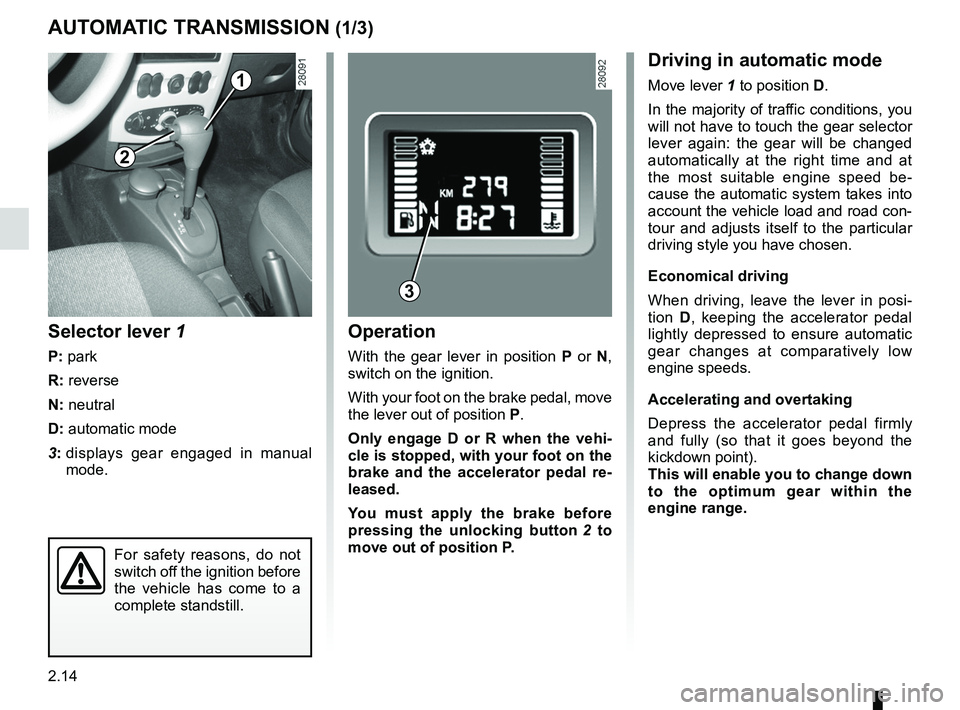
Selector lever 1
P: park
R: reverse
N: neutral
D: automatic mode
3: displays gear engaged in manual
mode.
Operation
With the gear lever in position P or N,
switch on the ignition.
With your foot on the brake pedal, move
the lever out of position P.
Only engage D or R when the vehi -
cle is stopped, with your foot on the
brake and the accelerator pedal re -
leased.
You must apply the brake before
pressing the unlocking button 2 to
move out of position P.
AUTOMATIC TRANSMISSION (1/3)
2
1
Driving in automatic mode
Move lever 1 to position D.
In the majority of traffic conditions, you
will not have to touch the gear selector
lever again: the gear will be changed
automatically at the right time and at
the most suitable engine speed be -
cause the automatic system takes into
account the vehicle load and road con-
tour and adjusts itself to the particular
driving style you have chosen.
Economical driving
When driving, leave the lever in posi -
tion D, keeping the accelerator pedal
lightly depressed to ensure automatic
gear changes at comparatively low
engine speeds.
Accelerating and overtaking
Depress the accelerator pedal firmly
and fully (so that it goes beyond the
kickdown point).
This will enable you to change down
to the optimum gear within the
engine range.
3
For safety reasons, do not
switch off the ignition before
the vehicle has come to a
complete standstill.
Page 80 of 183
2.16
ENG_UD22554_10
Boîte automatique (B90 - L90 Ph2 - F90 Ph2 - R90 Ph2 - Dacia)
ENG_NU_817-9_B90_Dacia_2
Parking the vehicleWhen the vehicle is stopped, move the
lever to position P while keeping your
foot on the brake pedal: the gearbox is
in neutral and the drive wheels are me-
chanically locked by the driveshaft.
Apply the handbrake.
AUTOMATIC TRANSMISSION (3/3)
An impact to the under -
side of the vehicle while
manoeuvring (e.g.: strik -
ing a post, raised kerb or
other street furniture) may result in
damage to the vehicle (e.g.: defor -
mation of an axle).
To avoid any risk of accident, have
your vehicle checked by an ap -
proved Dealer.
2
6
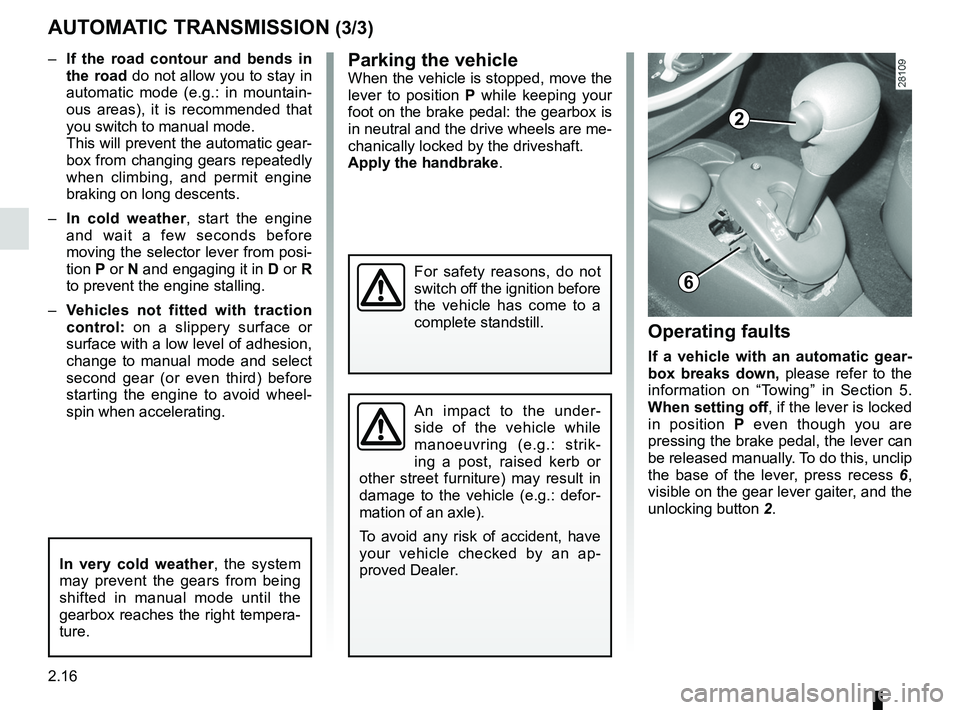
Operating faults
If a vehicle with an automatic gear -
box breaks down, please refer to the
information on “Towing” in Section 5.
When setting off, if the lever is locked
in position P even though you are
pressing the brake pedal, the lever can
be released manually. To do this, unclip
the base of the lever, press recess 6 ,
visible on the gear lever gaiter, and the
unlocking button 2.
–
If the road contour and bends in
the road do not allow you to stay in
automatic mode (e.g.: in mountain -
ous areas), it is recommended that
you switch to manual mode.
This will prevent the automatic gear-
box from changing gears repeatedly
when climbing, and permit engine
braking on long descents.
– In cold weather , start the engine
and wait a few seconds before
moving the selector lever from posi-
tion P or N and engaging it in D or R
to prevent the engine stalling.
– Vehicles not fitted with traction
control: on a slippery surface or
surface with a low level of adhesion,
change to manual mode and select
second gear (or even third) before
starting the engine to avoid wheel -
spin when accelerating.
In very cold weather , the system
may prevent the gears from being
shifted in manual mode until the
gearbox reaches the right tempera-
ture.
For safety reasons, do not
switch off the ignition before
the vehicle has come to a
complete standstill.
Page 91 of 183
electric windows ................................... (up to the end of the DU)
3.11
ENG_UD17904_3
Lève-vitres (B90 - Dacia)
ENG_NU_817-9_B90_Dacia_3
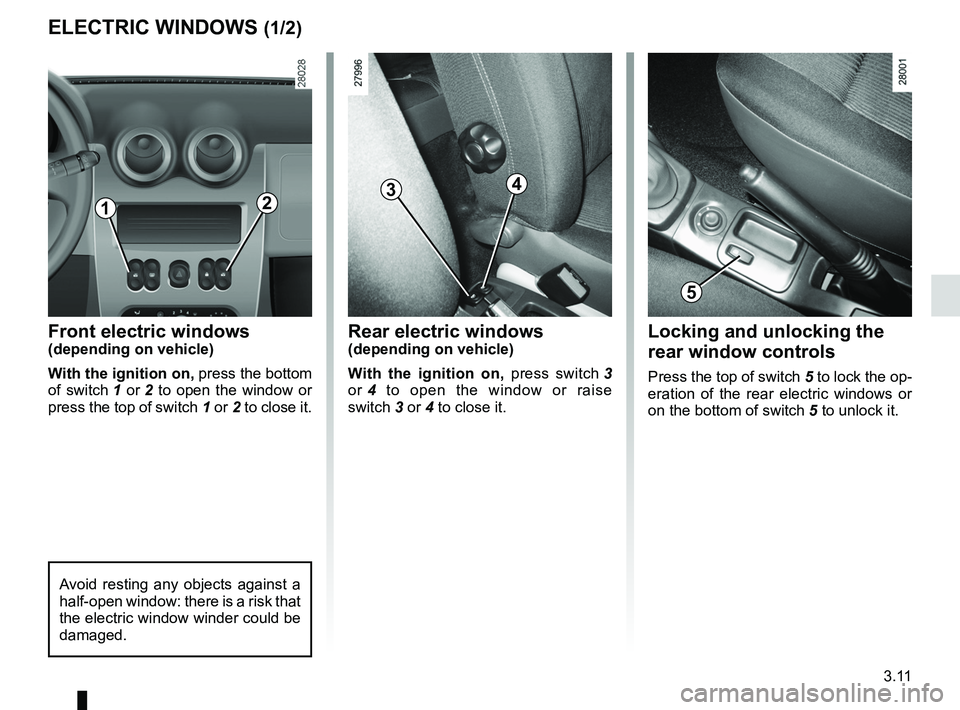
Electric windows
ELECTRIC WINDOWS (1/2)
Front electric windows
(depending on vehicle)
With the ignition on, press the bottom
of switch 1 or 2 to open the window or
press the top of switch 1 or 2 to close it.Rear electric windows(depending on vehicle)
With the ignition on, press switch 3
or 4 to open the window or raise
switch 3 or 4 to close it.Locking and unlocking the
rear window controls
Press the top of switch 5 to lock the op-
eration of the rear electric windows or
on the bottom of switch 5 to unlock it.
1234
5
Avoid resting any objects against a
half-open window: there is a risk that
the electric window winder could be
damaged.
Page 94 of 183
cigar lighter ........................................... (up to the end of the DU)
ashtrays ................................................ (up to the end of the DU)
accessories socket ............................... (up to the end of the DU)
3.14
ENG_UD17918_3
Cendriers - Allume-cigares (B90 - Dacia)
ENG_NU_817-9_B90_Dacia_3
Ashtrays, Cigar lighter, Accessories socket
ASHTRAYS/CIGAR LIGHTER/ACCESSORIES SOCKET
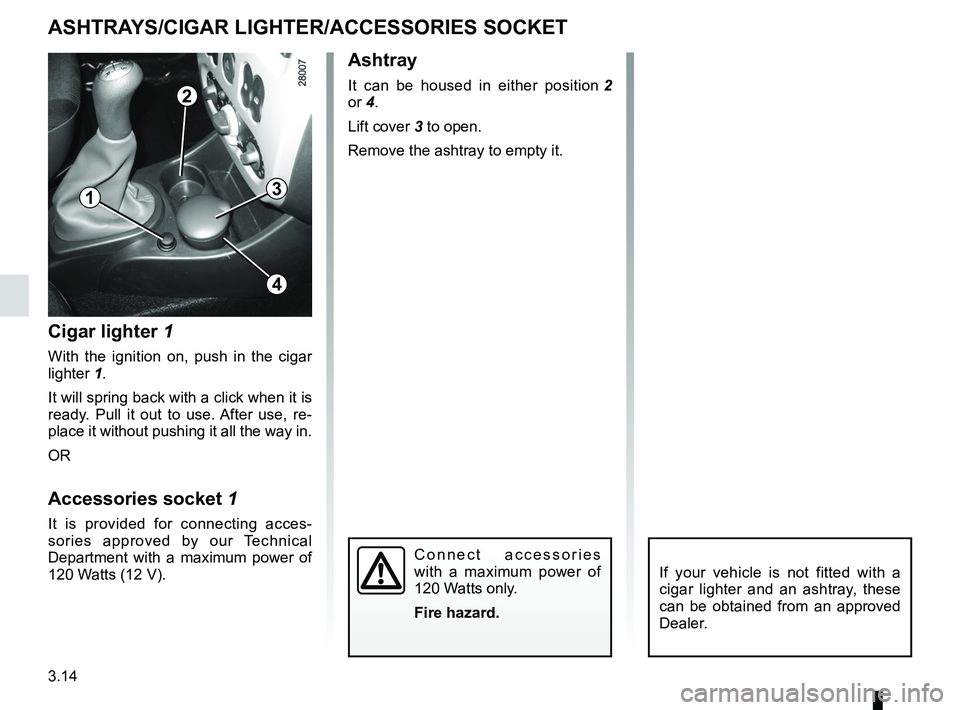
Ashtray
It can be housed in either position 2
or 4.
Lift cover 3 to open.
Remove the ashtray to empty it.
13
4
2
Cigar lighter 1
With the ignition on, push in the cigar
lighter 1.
It will spring back with a click when it is
ready. Pull it out to use. After use, re -
place it without pushing it all the way in.
OR
Accessories socket 1
It is provided for connecting acces -
sories approved by our Technical
Department with a maximum power of
120 Watts (12 V).
If your vehicle is not fitted with a
cigar lighter and an ashtray, these
can be obtained from an approved
Dealer.
C o n n e c t a c c e s s o r i e s
with a maximum power of
120 Watts only.
Fire hazard.
Page 99 of 183
tailgate ................................................................... (current page)
transporting objects in the luggage compartment ............................ (current page)
3.19
ENG_UD20455_4
Coffre à bagage / transport d’objets dans le coffre (B90 - Dacia)
ENG_NU_817-9_B90_Dacia_3
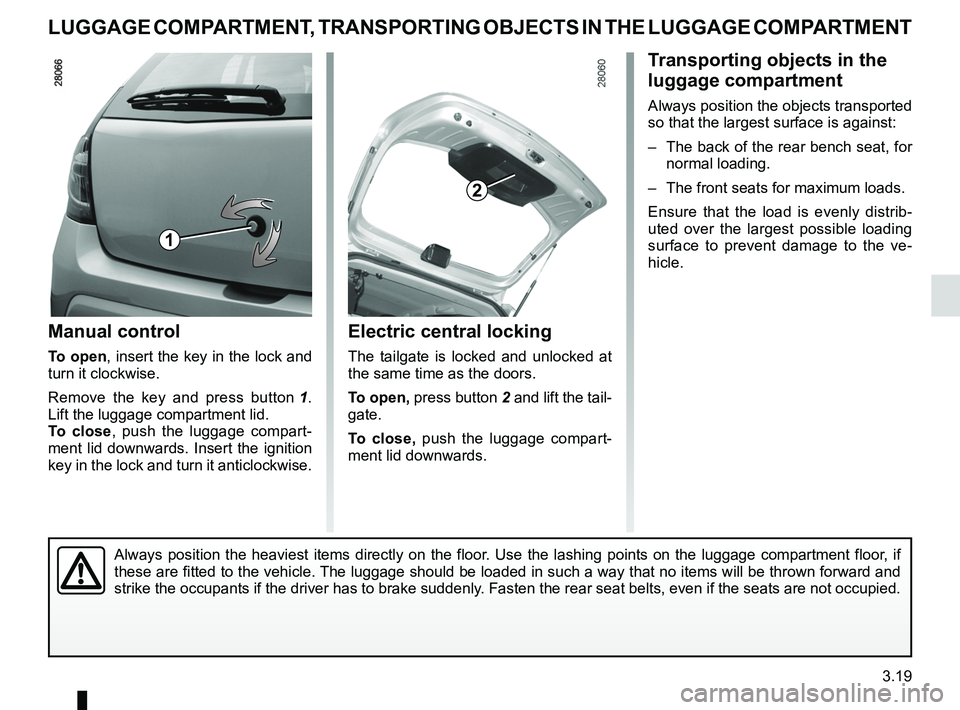
Electric central locking
The tailgate is locked and unlocked at
the same time as the doors.
To open, press button 2 and lift the tail-
gate.
To close, push the luggage compart -
ment lid downwards.
Luggage compartment/Transporting objects in the luggage compartment
LuGGAGE COMPARTMENT, TRANSPORTING OBJECTS IN THE LuGGAGE COMPARTMENT
Manual control
To open, insert the key in the lock and
turn it clockwise.
Remove the key and press button 1 .
Lift the luggage compartment lid.
To close , push the luggage compart -
ment lid downwards. Insert the ignition
key in the lock and turn it anticlockwise.
Always position the heaviest items directly on the floor. Use the lashing points on the luggage compartment floor, if
these are fitted to the vehicle. The luggage should be loaded in such a way that no items will be thrown forward and
strike the occupants if the driver has to brake suddenly. Fasten the rear seat belts, even if the seats are not occupied.
Transporting objects in the
luggage compartment
Always position the objects transported
so that the largest surface is against:
– The back of the rear bench seat, for
normal loading.
– The front seats for maximum loads.
Ensure that the load is evenly distrib -
uted over the largest possible loading
surface to prevent damage to the ve -
hicle.
1
2
Page 145 of 183
batterytroubleshooting ............................... (up to the end of the DU)
practical advice ..................................... (up to the end of the DU)
5.25
ENG_UD17938_1
Batterie : dépannage (B90 - Dacia)
ENG_NU_817-9_B90_Dacia_5
Battery
BATTERY: troubleshooting (1/2)
To avoid all risk of sparks:
– Ensure that any consumers (cour -
tesy lights, etc.) are switched off
before disconnecting or reconnect -
ing the battery;
– when charging, stop the charger
before connecting or disconnecting
the battery;
– to avoid creating a short circuit be -
tween the terminals, do not place
metal objects on the battery;
– always wait at least one minute after
the engine has been switched off
before disconnecting a battery;
– make sure that you reconnect the
battery terminals after refitting.
Handle the battery with care
as it contains sulphuric acid,
which must not come into
contact with eyes or skin. If
it does, wash the affected area with
plenty of cold water and consult a
doctor, if necessary.
Ensure that naked flames, red hot
objects and sparks do not come into
contact with the battery as there is a
risk of explosion.
The engine may be hot when car -
rying out operations in close prox -
imity. In addition, the engine cooling
fan can come on at any moment.
Risk of injury.
Connecting a battery charger
The battery charger must be com -
patible with a battery with nominal
voltage of 12 volts.
Do not disconnect the battery when the
engine is running. Follow the instruc-
tions given by the manufacturer of
the battery charger you are using.
When many accessories are fitted to
the vehicle, have them connected to
the + after ignition feed.
Some batteries may have
specific conditions for re -
charging. Consult your ap -
proved dealer. Avoid the
risk of sparks, as this could cause
a sudden explosion, and always
charge the battery in a well-venti -
lated area.
Risk of serious injury.