ignition RENAULT SANDERO 2012 Owner's Guide
[x] Cancel search | Manufacturer: RENAULT, Model Year: 2012, Model line: SANDERO, Model: RENAULT SANDERO 2012Pages: 183, PDF Size: 6.95 MB
Page 146 of 183
5.26
ENG_UD17938_1
Batterie : dépannage (B90 - Dacia)
ENG_NU_817-9_B90_Dacia_5
BATTERY: troubleshooting (2/2)
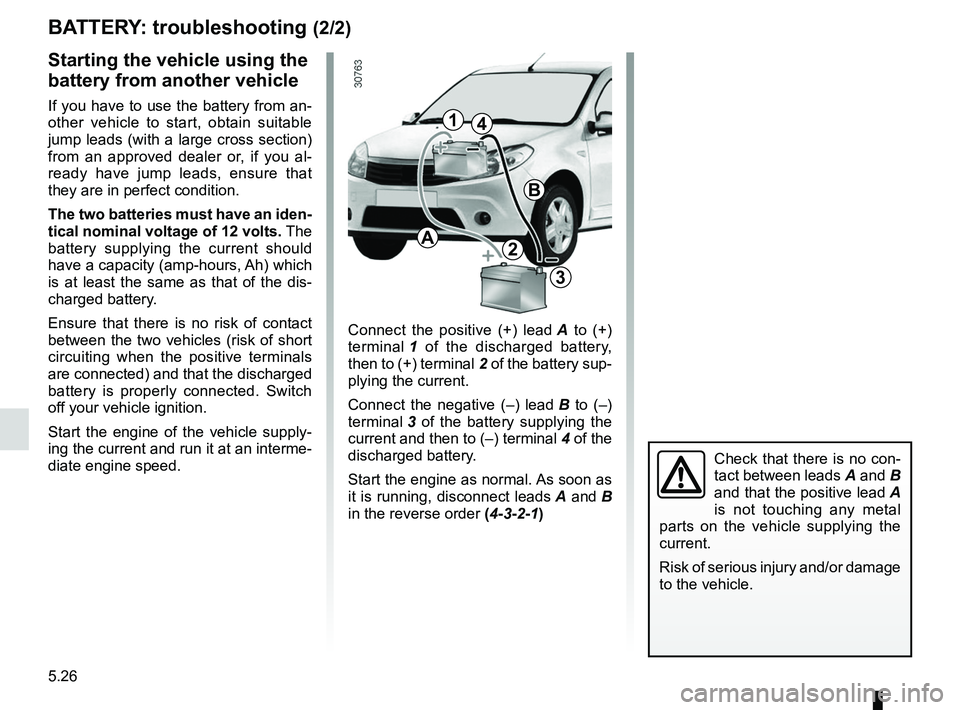
Connect the positive (+) lead A to (+)
terminal 1 of the discharged battery,
then to (+) terminal 2 of the battery sup-
plying the current.
Connect the negative (–) lead B to (–)
terminal 3 of the battery supplying the
current and then to (–) terminal 4 of the
discharged battery.
Start the engine as normal. As soon as
it is running, disconnect leads A and B
in the reverse order (4-3-2-1)
Starting the vehicle using the
battery from another vehicle
If you have to use the battery from an-
other vehicle to start, obtain suitable
jump leads (with a large cross section)
from an approved dealer or, if you al -
ready have jump leads, ensure that
they are in perfect condition.
The two batteries must have an iden-
tical nominal voltage of 12 volts. The
battery supplying the current should
have a capacity (amp-hours, Ah) which
is at least the same as that of the dis-
charged battery.
Ensure that there is no risk of contact
between the two vehicles (risk of short
circuiting when the positive terminals
are connected) and that the discharged
battery is properly connected. Switch
off your vehicle ignition.
Start the engine of the vehicle supply -
ing the current and run it at an interme-
diate engine speed.
Check that there is no con-
tact between leads A and B
and that the positive lead A
is not touching any metal
parts on the vehicle supplying the
current.
Risk of serious injury and/or damage
to the vehicle.
14
B
A2
3
Page 148 of 183
wiper blades ......................................... (up to the end of the DU)
practical advice ..................................... (up to the end of the DU)
wipers blades ............................................. (up to the end of the DU)
5.28
ENG_UD20464_6
Balais d’essuie-vitre (B90 - Dacia)
ENG_NU_817-9_B90_Dacia_5
Wiper blades
WIPER BLADES
12
3
4
Check the condition of the wiper
blades. You are responsible for their
service life:
– clean the blades, windscreen and
rear screen regularly with soapy
water;
– do not use them when the wind-
screen or rear screen are dry;
– free them from the windscreen or
rear screen when they have not
been used for a long time.
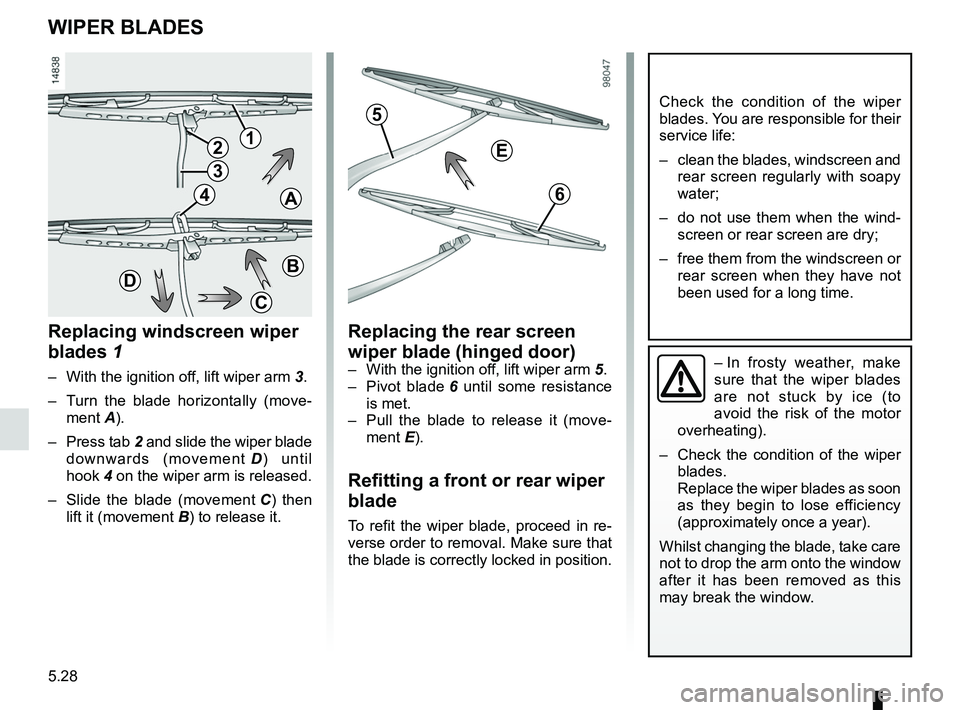
Replacing windscreen wiper
blades 1
– With the ignition off, lift wiper arm 3.
– Turn the blade horizontally (move -
ment A).
– Press tab 2 and slide the wiper blade
downwards (movement D ) until
hook 4 on the wiper arm is released.
– Slide the blade (movement C ) then
lift it (movement B) to release it.
Replacing the rear screen
wiper blade (hinged door)
– With the ignition off, lift wiper arm 5.
– Pivot blade 6 until some resistance
is met.
– Pull the blade to release it (move -
ment E).
Refitting a front or rear wiper
blade
To refit the wiper blade, proceed in re-
verse order to removal. Make sure that
the blade is correctly locked in position.
A
C
BD
6
5
E
– In frosty weather, make
sure that the wiper blades
are not stuck by ice (to
avoid the risk of the motor
overheating).
– Check the condition of the wiper
blades.
Replace the wiper blades as soon
as they begin to lose efficiency
(approximately once a year).
Whilst changing the blade, take care
not to drop the arm onto the window
after it has been removed as this
may break the window.
Page 149 of 183
towing hitch........................................... (up to the end of the DU)
practical advice ..................................... (up to the end of the DU)
towing breakdown ...................................... (up to the end of the DU)
5.29
ENG_UD17944_4
Remorquage : dépannage (B90 - Dacia)
ENG_NU_817-9_B90_Dacia_5
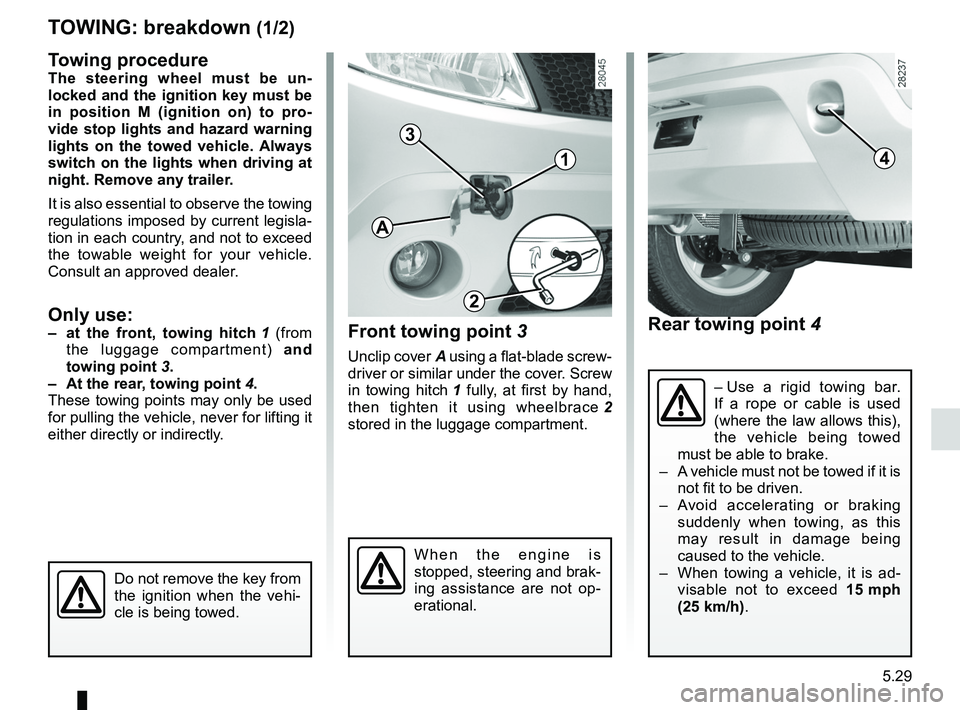
Rear towing point 4
Front towing point 3
Unclip cover A using a flat-blade screw-
driver or similar under the cover. Screw
in towing hitch 1 fully, at first by hand,
then tighten it using wheelbrace 2
stored in the luggage compartment.
Towing: breakdown
W h e n t h e e n g i n e i s
stopped, steering and brak-
ing assistance are not op -
erational.
41
3
Towing procedureThe steering wheel must be un -
locked and the ignition key must be
in position M (ignition on) to pro -
vide stop lights and hazard warning
lights on the towed vehicle. Always
switch on the lights when driving at
night. Remove any trailer.
It is also essential to observe the towing
regulations imposed by current legisla -
tion in each country, and not to exceed
the towable weight for your vehicle.
Consult an approved dealer.
Only use:– at the front, towing hitch 1 (from
the luggage compartment) and
towing point 3.
– At the rear, towing point 4.
These towing points may only be used
for pulling the vehicle, never for lifting it
either directly or indirectly.
Do not remove the key from
the ignition when the vehi -
cle is being towed.
– Use a rigid towing bar.
If a rope or cable is used
(where the law allows this),
the vehicle being towed
must be able to brake.
– A vehicle must not be towed if it is
not fit to be driven.
– Avoid accelerating or braking
suddenly when towing, as this
may result in damage being
caused to the vehicle.
– When towing a vehicle, it is ad -
visable not to exceed 15 mph
(25 km/h).
T OWING : breakdown (1/2)
A
2
Page 154 of 183
operating faults ..................................... (up to the end of the DU)
practical advice ..................................... (up to the end of the DU)
faults operating faults ............................... (up to the end of the DU)
5.34
ENG_UD19739_7
Anomalies de fonctionnement (B90 - U90 - L90 Ph2 - F90 Ph2 - R90 Ph2 - \
Dacia)
ENG_NU_817-9_B90_Dacia_5
Jaune NoirNoir texte
Operating faults
OPERATING FAULTS (1/5)
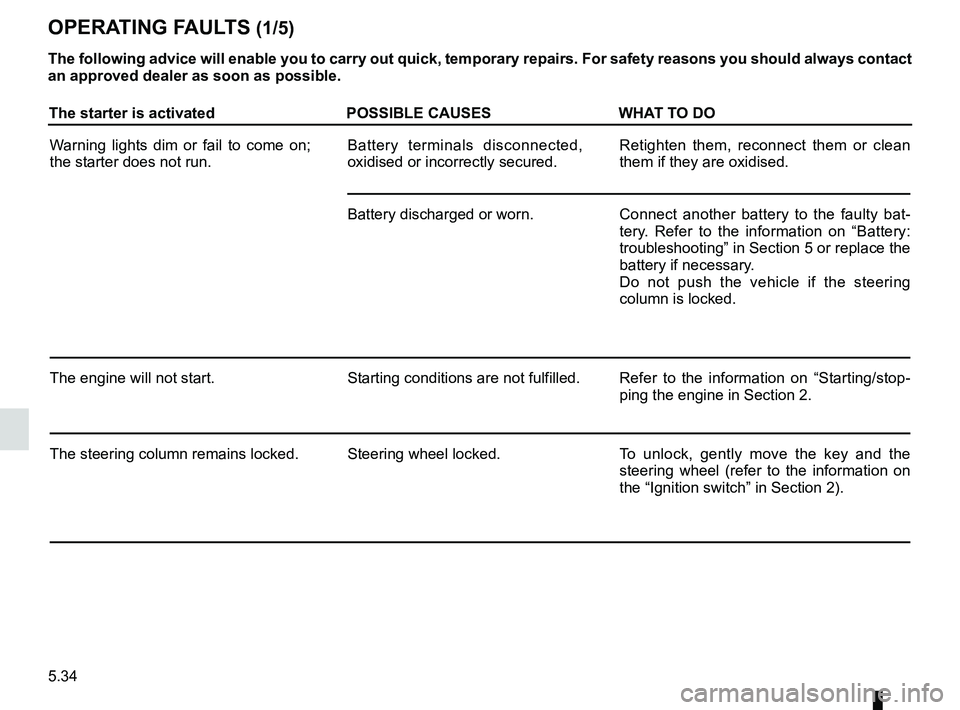
The following advice will enable you to carry out quick, temporary repairs. For safety reasons you should always contact
an approved dealer as soon as possible.
The starter is activated POSSIBLE CAUSESWHAT TO DO
Warning lights dim or fail to come on;
the starter does not run. Battery terminals disconnected,
oxidised or incorrectly secured.Retighten them, reconnect them or clean
them if they are oxidised.
Battery discharged or worn. Connect another battery to the faulty bat -
tery. Refer to the information on “Battery:
troubleshooting” in Section 5 or replace the
battery if necessary.
Do not push the vehicle if the steering
column is locked.
The engine will not start. Starting conditions are not fulfilled.Refer to the information on “Starting/stop -
ping the engine in Section 2.
The steering column remains locked. Steering wheel locked.To unlock, gently move the key and the
steering wheel (refer to the information on
the “Ignition switch” in Section 2).
Page 155 of 183

ENG_NU_817-9_B90_Dacia_5
OPERATING FAULTS (2/5)
On the road POSSIBLE CAUSES WHAT")
JauneNoirNoir texte
5.35
ENG_UD19739_7
Anomalies de fonctionnement (B90 - U90 - L90 Ph2 - F90 Ph2 - R90 Ph2 - \
Dacia)
ENG_NU_817-9_B90_Dacia_5
OPERATING FAULTS (2/5)
On the road POSSIBLE CAUSES WHAT TO DO
Vibrations. Tyres not inflated to correct pres-
sures, incorrectly balanced or
damaged. Check the tyre pressures; if this is not the cause, have
their condition checked by an approved dealer.
Coolant boiling in the coolant
reservoir. Mechanical fault: cylinder head
gasket damaged, faulty coolant
pump. Stop the engine.
Contact an approved dealer.
Engine cooling fan not working. Contact an approved dealer.
Smoke under the bonnet. Short circuit or cooling system
leak. Stop, switch off the ignition, stand away from the vehi-
cle and contact an approved Dealer.
The oil pressure warning light
comes on: on a bend or under braking The engine oil level is too low. Top up the engine oil (refer to the information on
“Engine oil level, topping up/refilling” in Section 4).
at idle speed Low oil pressure. Go to your nearest approved dealer.
The oil pressure warning
light takes a long time to
go out or remains lit during
acceleration. Loss of oil pressure.
Stop the vehicle: contact an approved dealer.
Page 178 of 183

7.2
FRA_UD25177_11
Index (B90 - Dacia)
ENG_NU_817-9_B90_Dacia_7
Jaune NoirNoir texte
AlphAbeticAl index (2/4)
engine oil grade .......................................................... 4.5 – 4.6
engine specifications ........................................................... 6.4
environment ........................................................................\
. 2.9
F
faults operating faults ................................................ 5.34 → 5.38
filter ........................................................................\
............ 4.10
air filter ......................................................................... 4.10
diesel filter ........................................................... 1.58, 4.10
oil filter ........................................................................... 4.6
particle filter ................................................................... 2.5
passenger compartment filter ...................................... 4.10
fitting a radio ...................................................................... 5.32
fittings ..................................................................... 3.15 – 3.16
fog lights ........................................................................\
.... 1.50
front passenger air bag deactivation ................................. 1.32
front seat adjustment ........................................................... 1.9
front seats adjustment ..................................................................... 1.9
fuel advice on fuel economy ....................................... 2.6 → 2.8
grade ..................................................................... 1.56, 6.4
fuel economy ............................................................. 2.6 → 2.8
fuel filler cap ...................................................................... 1.56
fuel grade ........................................................................\
... 1.56
fuel level ........................................................................\
.... 1.44
fuel priming bulb ................................................................ 1.58
fuel tank ................................................................. 1.56 → 1.58
fuel tank capacity ............................................................... 1.56
fuses ...................................................................... 5.22 → 5.24
G
gear lever ........................................................................\
... 2.10
glove box ........................................................................\
... 3.15
grab handle ........................................................................\
3.13h
handbrake
........................................................................\
.. 2.11
hazard warning lights signal .............................................. 1.52
headlight beam adjustment ............................................... 1.51
headlight flashers .............................................................. 1.52
headrest ...................................................................... 1.8, 3.17
heating and air conditioning system ................... 3.2 → 3.5, 3.9
heating system .......................................................... 3.2 → 3.9
horn ........................................................................\
........... 1.52
i
ignition switch ...................................................................... 2.2
indicator lights .................................................................... 5.18
indicators .................................................................. 1.52, 5.14
indicators: direction indicators ....................................................... 1.52
instrument panel .................................................... 1.40 → 1.44
interior trim maintenance ..................................................... 4.16 – 4.17
J
jack .................................................................... 5.2, 5.9 – 5.10
K
keys ........................................................................\
.... 1.2 – 1.3
replacing the battery .................................................... 5.27
l
levels .................................................................. 4.4, 4.7 → 4.9
levels: engine oil ....................................................................... 4.5
lifting the vehicle changing a wheel ............................... 5.2 – 5.3, 5.7 → 5.10
lighting: exterior ......................................... 1.49 – 1.50, 5.14 → 5.18
interior ..................................................... 3.10, 5.19 → 5.21