cooler RENAULT SCENIC 2011 J95 / 3.G Engine And Peripherals Siemens Injection Workshop Manual
[x] Cancel search | Manufacturer: RENAULT, Model Year: 2011, Model line: SCENIC, Model: RENAULT SCENIC 2011 J95 / 3.GPages: 329, PDF Size: 1.71 MB
Page 22 of 329
13B-22
MR-372-J84-13B050$195.mif
V17
Siemens Injection
SID301 and 304
Vdiag No.: 44-45-48-49-4D-4C
Program No.: B1 and B2DIESEL INJECTION
Fault finding – Function13B
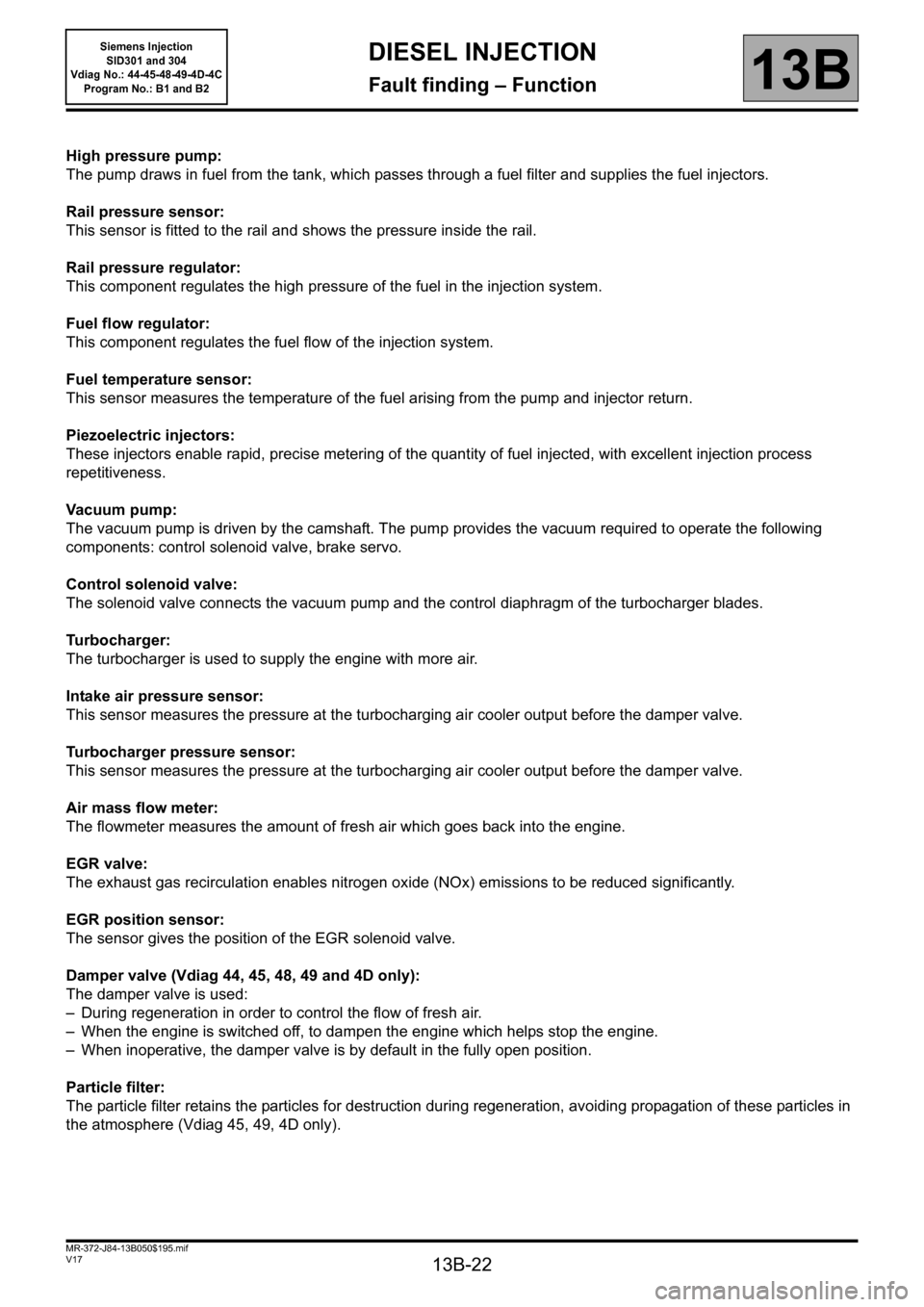
High pressure pump:
The pump draws in fuel from the tank, which passes through a fuel filter and supplies the fuel injectors.
Rail pressure sensor:
This sensor is fitted to the rail and shows the pressure inside the rail.
Rail pressure regulator:
This component regulates the high pressure of the fuel in the injection system.
Fuel flow regulator:
This component regulates the fuel flow of the injection system.
Fuel temperature sensor:
This sensor measures the temperature of the fuel arising from the pump and injector return.
Piezoelectric injectors:
These injectors enable rapid, precise metering of the quantity of fuel injected, with excellent injection process
repetitiveness.
Vacuum pump:
The vacuum pump is driven by the camshaft. The pump provides the vacuum required to operate the following
components: control solenoid valve, brake servo.
Control solenoid valve:
The solenoid valve connects the vacuum pump and the control diaphragm of the turbocharger blades.
Turbocharger:
The turbocharger is used to supply the engine with more air.
Intake air pressure sensor:
This sensor measures the pressure at the turbocharging air cooler output before the damper valve.
Turbocharger pressure sensor:
This sensor measures the pressure at the turbocharging air cooler output before the damper valve.
Air mass flow meter:
The flowmeter measures the amount of fresh air which goes back into the engine.
EGR valve:
The exhaust gas recirculation enables nitrogen oxide (NOx) emissions to be reduced significantly.
EGR position sensor:
The sensor gives the position of the EGR solenoid valve.
Damper valve (Vdiag 44, 45, 48, 49 and 4D only):
The damper valve is used:
– During regeneration in order to control the flow of fresh air.
– When the engine is switched off, to dampen the engine which helps stop the engine.
– When inoperative, the damper valve is by default in the fully open position.
Particle filter:
The particle filter retains the particles for destruction during regeneration, avoiding propagation of these particles in
the atmosphere (Vdiag 45, 49, 4D only).
Page 326 of 329
13B-326
MR-372-J84-13B050$936.mif
V17
DIESEL INJECTION
Fault finding – Tests13B
Siemens Injection
SID301 and 304
Vdiag No.: 44-45-48-49-4D-4C
Program No.: B1 and B2
TEST 10
CONTINUED
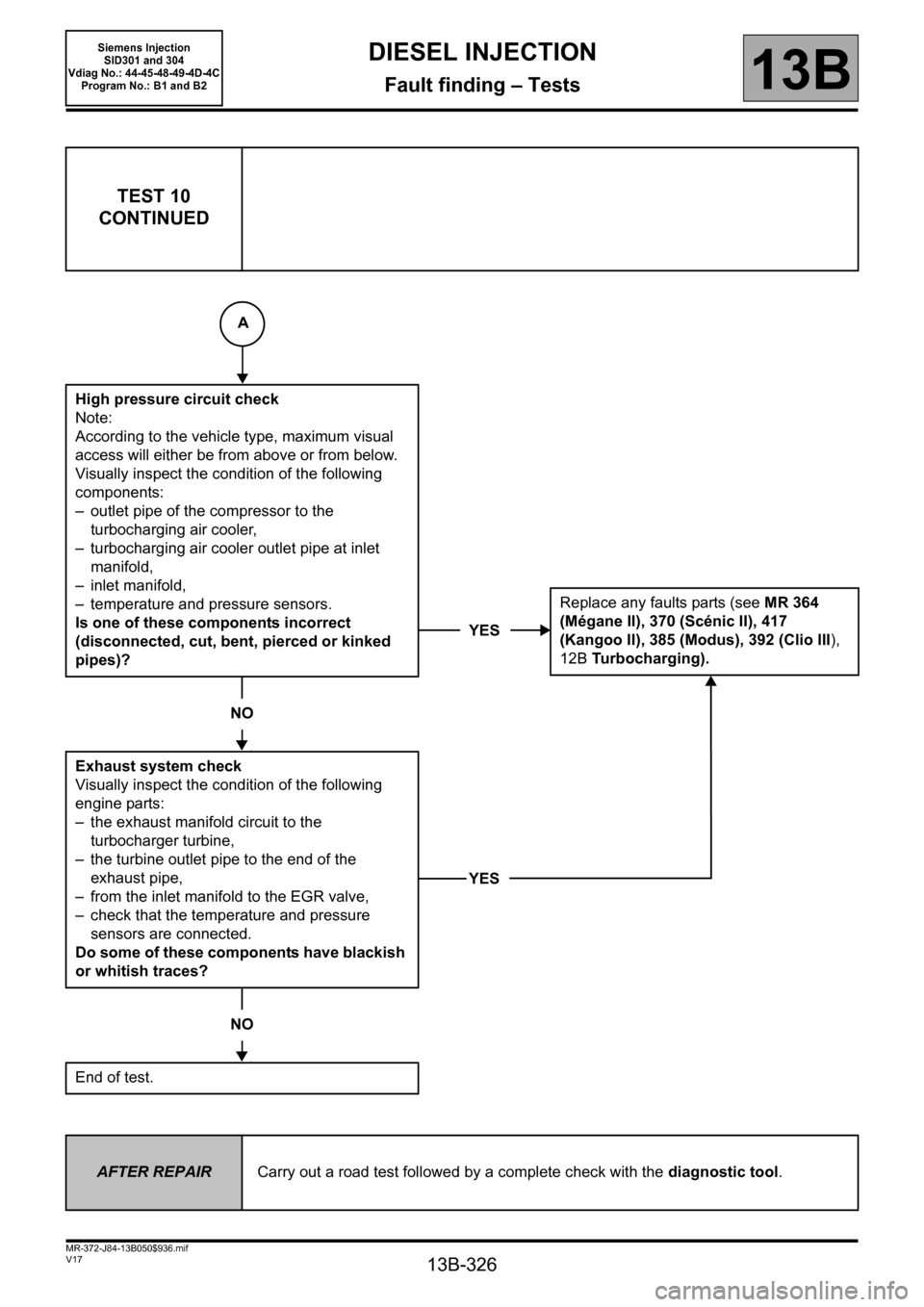
High pressure circuit check
Note:
According to the vehicle type, maximum visual
access will either be from above or from below.
Visually inspect the condition of the following
components:
– outlet pipe of the compressor to the
turbocharging air cooler,
– turbocharging air cooler outlet pipe at inlet
manifold,
– inlet manifold,
– temperature and pressure sensors.
Is one of these components incorrect
(disconnected, cut, bent, pierced or kinked
pipes)?
NO
Exhaust system check
Visually inspect the condition of the following
engine parts:
– the exhaust manifold circuit to the
turbocharger turbine,
– the turbine outlet pipe to the end of the
exhaust pipe,
– from the inlet manifold to the EGR valve,
– check that the temperature and pressure
sensors are connected.
Do some of these components have blackish
or whitish traces?
NO
End of test.
YESReplace any faults parts (see MR 364
(Mégane II), 370 (Scénic II), 417
(Kangoo II), 385 (Modus), 392 (Clio III),
12B Turbocharging).
YES
AFTER REPAIRCarry out a road test followed by a complete check with the diagnostic tool.
A