exhaust RENAULT SCENIC 2012 J95 / 3.G Engine And Peripherals EDC16CP33 Owner's Manual
[x] Cancel search | Manufacturer: RENAULT, Model Year: 2012, Model line: SCENIC, Model: RENAULT SCENIC 2012 J95 / 3.GPages: 510, PDF Size: 2.98 MB
Page 322 of 510
13B-322V12 MR-372-J84-13B300$102.mif
DIESEL INJECTION
Fault finding – Interpretation of statuses13B
COOL*: Cooling
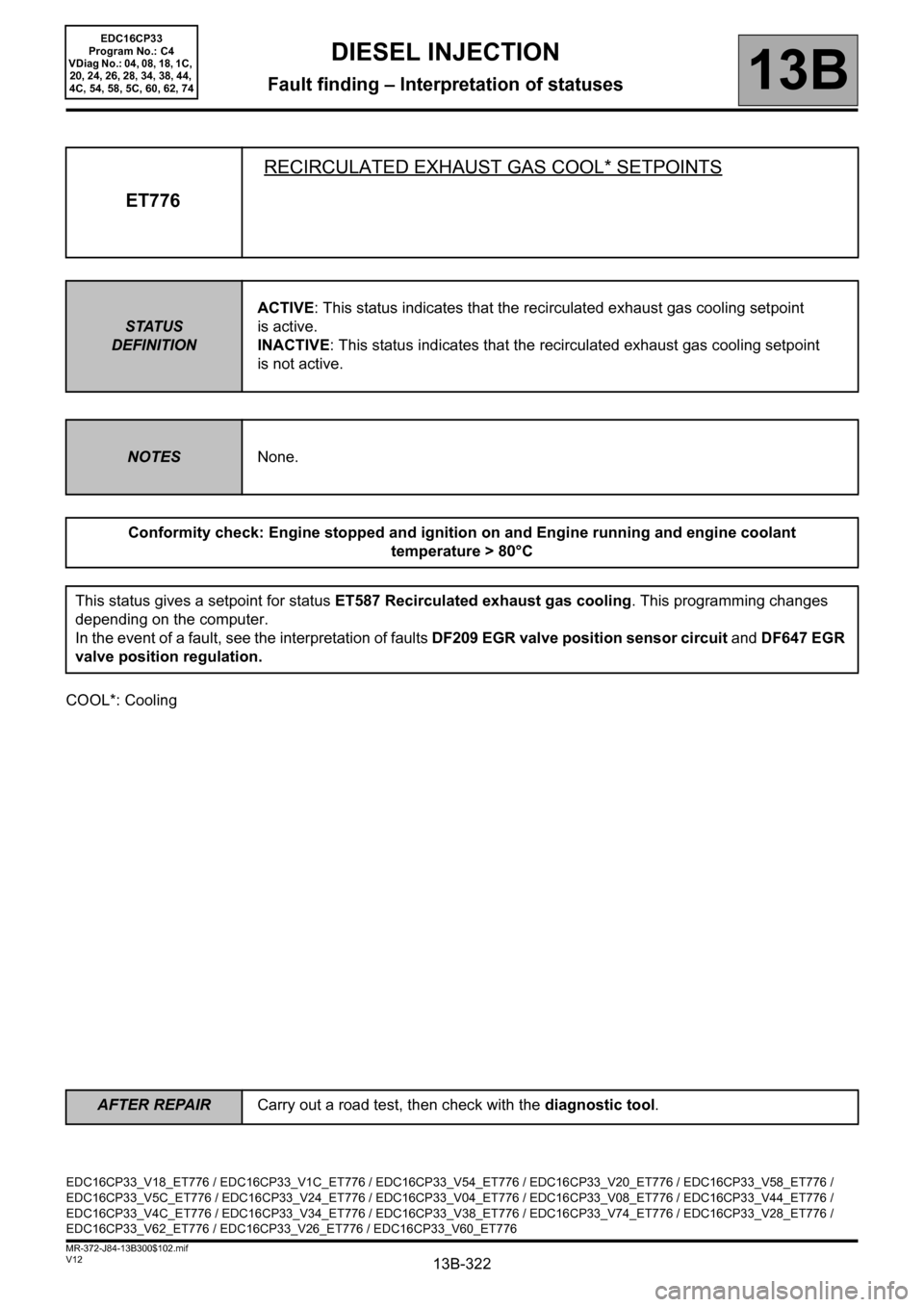
ET776RECIRCULATED EXHAUST GAS COOL* SETPOINTS
STATUS
DEFINITION
ACTIVE: This status indicates that the recirculated exhaust gas cooling setpoint
is active.
INACTIVE: This status indicates that the recirculated exhaust gas cooling setpoint
is not active.
NOTESNone.
Conformity check: Engine stopped and ignition on and Engine running and engine coolant
temperature > 80°C
This status gives a setpoint for status ET587 Recirculated exhaust gas cooling. This programming changes
depending on the computer.
In the event of a fault, see the interpretation of faults DF209 EGR valve position sensor circuit and DF647 EGR
valve position regulation.
EDC16CP33_V18_ET776 / EDC16CP33_V1C_ET776 / EDC16CP33_V54_ET776 / EDC16CP33_V20_ET776 / EDC16CP33_V58_ET776 /
EDC16CP33_V5C_ET776 / EDC16CP33_V24_ET776 / EDC16CP33_V04_ET776 / EDC16CP33_V08_ET776 / EDC16CP33_V44_ET776 /
EDC16CP33_V4C_ET776 / EDC16CP33_V34_ET776 / EDC16CP33_V38_ET776 / EDC16CP33_V74_ET776 / EDC16CP33_V28_ET776 /
EDC16CP33_V62_ET776 / EDC16CP33_V26_ET776 / EDC16CP33_V60_ET776
EDC16CP33
Program No.: C4
VDiag No.: 04, 08, 18, 1C,
20, 24, 26, 28, 34, 38, 44,
4C, 54, 58, 5C, 60, 62, 74
AFTER REPAIRCarry out a road test, then check with the diagnostic tool.
Page 327 of 510
13B-327V12 MR-372-J84-13B300$110.mif
DIESEL INJECTION
Fault finding – Parameter summary table13B
EDC16CP33
Program No.: C4
VDiag No.: 04, 08, 18, 1C,
20, 24, 26, 28, 34, 38, 44,
4C, 54, 58, 5C, 60, 62, 74
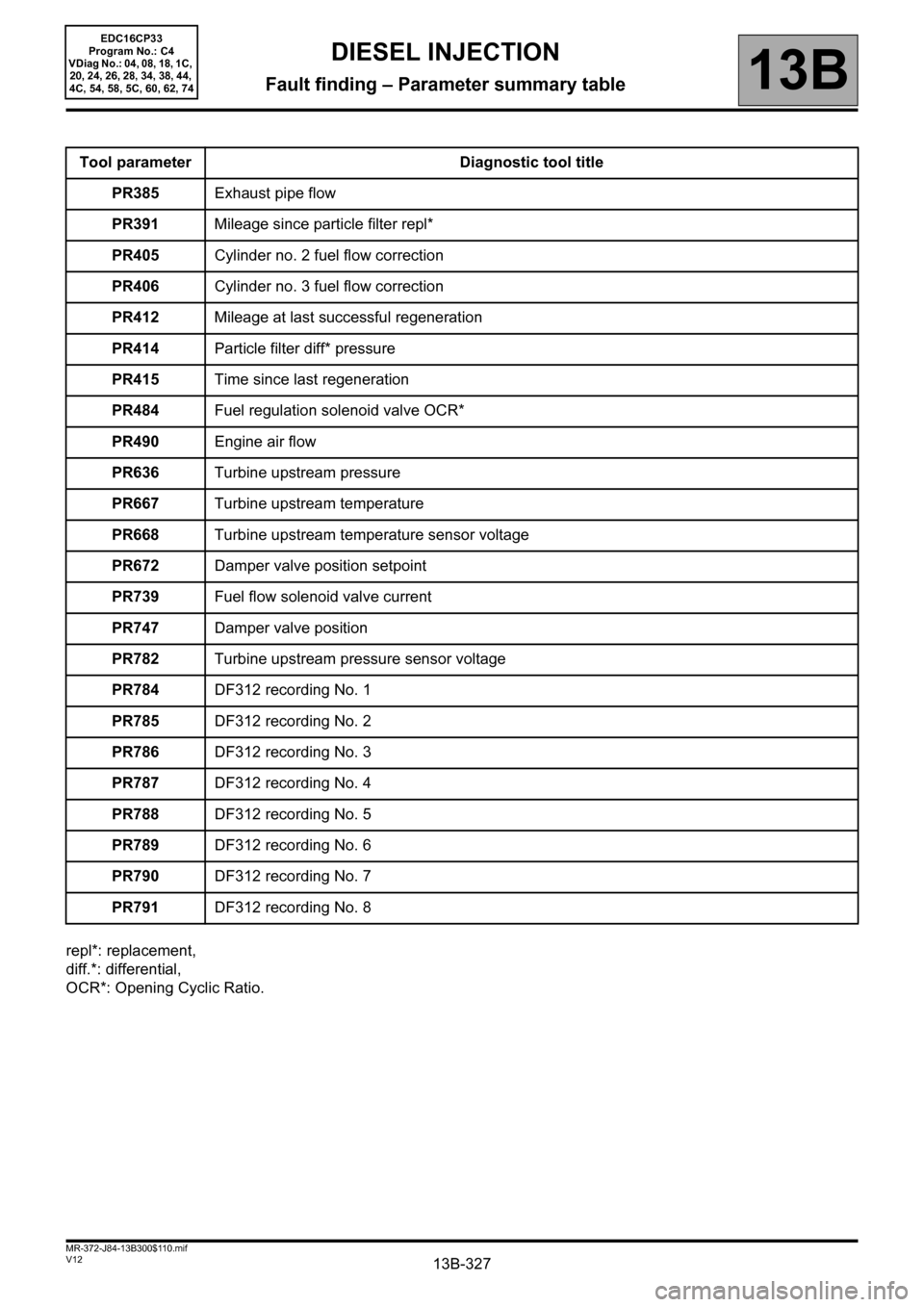
repl*: replacement,
diff.*: differential,
OCR*: Opening Cyclic Ratio.Tool parameter Diagnostic tool title
PR385Exhaust pipe flow
PR391Mileage since particle filter repl*
PR405Cylinder no. 2 fuel flow correction
PR406Cylinder no. 3 fuel flow correction
PR412Mileage at last successful regeneration
PR414Particle filter diff* pressure
PR415Time since last regeneration
PR484Fuel regulation solenoid valve OCR*
PR490Engine air flow
PR636Turbine upstream pressure
PR667Turbine upstream temperature
PR668Turbine upstream temperature sensor voltage
PR672Damper valve position setpoint
PR739Fuel flow solenoid valve current
PR747Damper valve position
PR782Turbine upstream pressure sensor voltage
PR784DF312 recording No. 1
PR785DF312 recording No. 2
PR786DF312 recording No. 3
PR787DF312 recording No. 4
PR788DF312 recording No. 5
PR789DF312 recording No. 6
PR790DF312 recording No. 7
PR791DF312 recording No. 8
Page 387 of 510

13B-387V12 MR-372-J84-13B300$122.mif
DIESEL INJECTION
Fault finding – Interpretation of parameters13B
PR382PARTICLE FILTER UPSTREAM TEMPERATURE
PARAMETER
DEFINITIONThis parameter indicates the air temperature of the exhaust gas upstream of the particle
filter in °C.
NOTESNone.
Conformity check with engine stopped and ignition on, or engine running, and engine coolant
temperature > 80°C
The value of the air temperature of the exhaust gas upstream of the particle filter must be:
PR382 ≈ 200°C
In the event of a fault, consult the interpretation of faults DF309 Particle filter downstream temperature sensor
and DF310 Particle filter upstream temperature sensor.
EDC16CP33_V18_PR382 / EDC16CP33_V1C_PR382 / EDC16CP33_V54_PR382 / EDC16CP33_V20_PR382 / EDC16CP33_V58_PR382 /
EDC16CP33_V5C_PR382 / EDC16CP33_V24_PR382 / EDC16CP33_V28_PR382 / EDC16CP33_V62_PR382 / EDC16CP33_V26_PR382 /
EDC16CP33_V60_PR382
EDC16CP33
Program No.: C4
Vdiag No.: 18, 1C, 20, 24,
26, 28, 54, 58, 5C, 60, 62
AFTER REPAIRCarry out a road test, then check with the diagnostic tool.
Page 389 of 510
13B-389V12 MR-372-J84-13B300$122.mif
DIESEL INJECTION
Fault finding – Interpretation of parameters13B
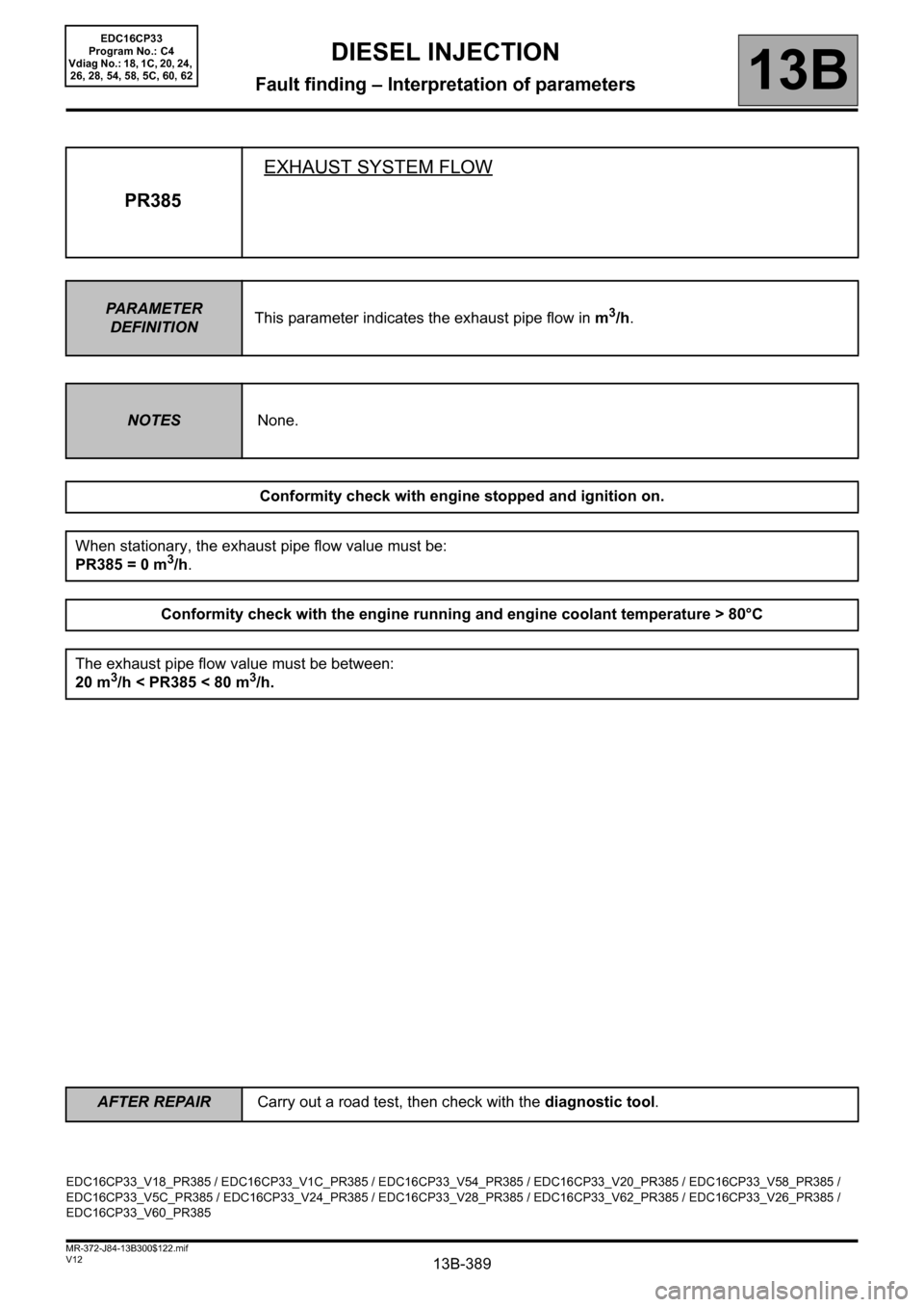
PR385EXHAUST SYSTEM FLOW
PARAMETER
DEFINITIONThis parameter indicates the exhaust pipe flow in m3/h.
NOTESNone.
Conformity check with engine stopped and ignition on.
When stationary, the exhaust pipe flow value must be:
PR385 = 0 m
3/h.
Conformity check with the engine running and engine coolant temperature > 80°C
The exhaust pipe flow value must be between:
20 m
3/h < PR385 < 80 m3/h.
EDC16CP33_V18_PR385 / EDC16CP33_V1C_PR385 / EDC16CP33_V54_PR385 / EDC16CP33_V20_PR385 / EDC16CP33_V58_PR385 /
EDC16CP33_V5C_PR385 / EDC16CP33_V24_PR385 / EDC16CP33_V28_PR385 / EDC16CP33_V62_PR385 / EDC16CP33_V26_PR385 /
EDC16CP33_V60_PR385
EDC16CP33
Program No.: C4
Vdiag No.: 18, 1C, 20, 24,
26, 28, 54, 58, 5C, 60, 62
AFTER REPAIRCarry out a road test, then check with the diagnostic tool.
Page 427 of 510
13B-427V12 MR-372-J84-13B300$150.mif
DIESEL INJECTION
Fault finding – Interpretation of commands13B
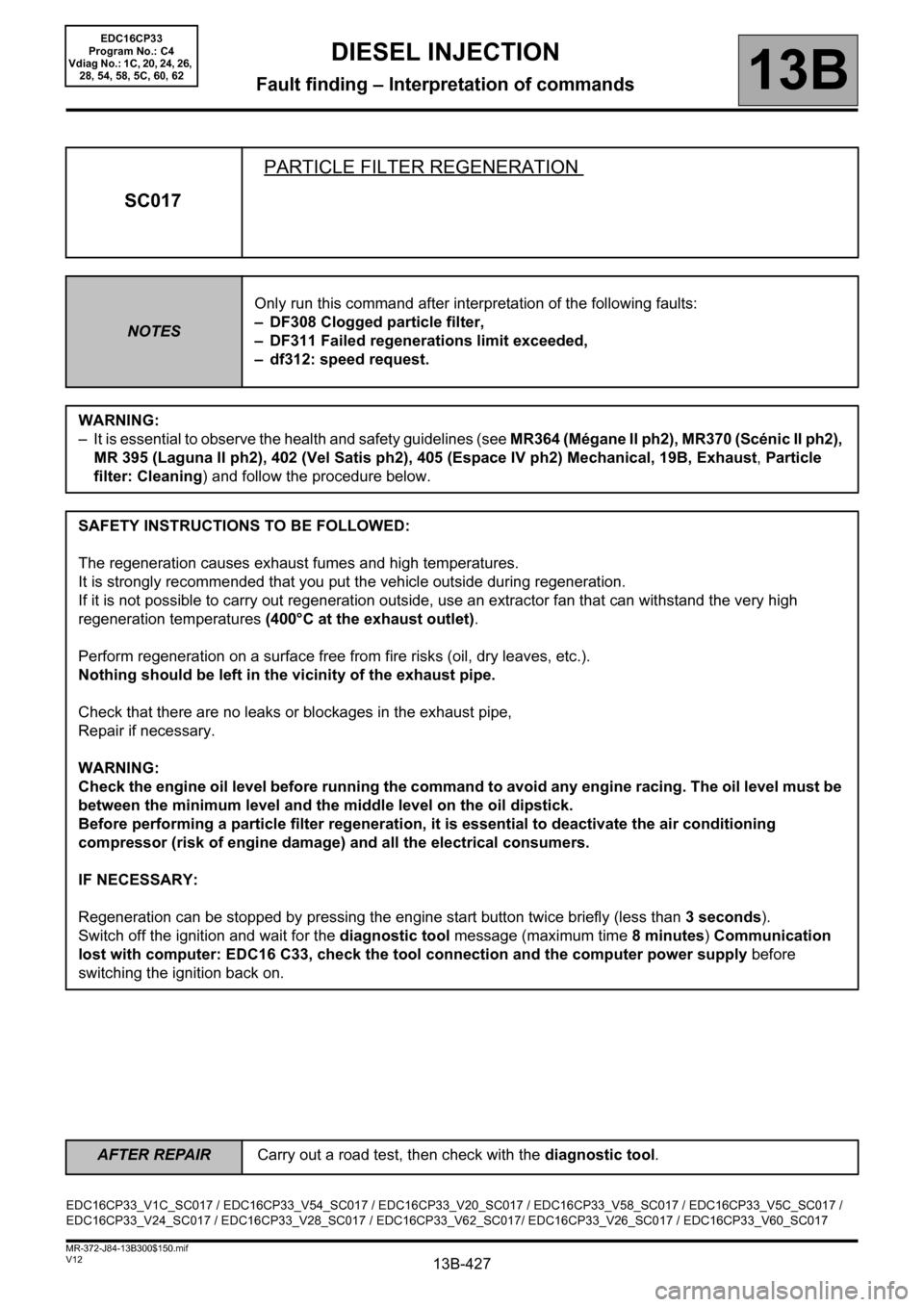
SC017PARTICLE FILTER REGENERATION
NOTESOnly run this command after interpretation of the following faults:
– DF308 Clogged particle filter,
– DF311 Failed regenerations limit exceeded,
– df312: speed request.
WARNING:
– It is essential to observe the health and safety guidelines (see MR364 (Mégane II ph2), MR370 (Scénic II ph2),
MR 395 (Laguna II ph2), 402 (Vel Satis ph2), 405 (Espace IV ph2) Mechanical, 19B, Exhaust, Particle
filter: Cleaning) and follow the procedure below.
SAFETY INSTRUCTIONS TO BE FOLLOWED:
The regeneration causes exhaust fumes and high temperatures.
It is strongly recommended that you put the vehicle outside during regeneration.
If it is not possible to carry out regeneration outside, use an extractor fan that can withstand the very high
regeneration temperatures (400°C at the exhaust outlet).
Perform regeneration on a surface free from fire risks (oil, dry leaves, etc.).
Nothing should be left in the vicinity of the exhaust pipe.
Check that there are no leaks or blockages in the exhaust pipe,
Repair if necessary.
WARNING:
Check the engine oil level before running the command to avoid any engine racing. The oil level must be
between the minimum level and the middle level on the oil dipstick.
Before performing a particle filter regeneration, it is essential to deactivate the air conditioning
compressor (risk of engine damage) and all the electrical consumers.
IF NECESSARY:
Regeneration can be stopped by pressing the engine start button twice briefly (less than 3 seconds).
Switch off the ignition and wait for the diagnostic tool message (maximum time 8 minutes) Communication
lost with computer: EDC16 C33, check the tool connection and the computer power supply before
switching the ignition back on.
EDC16CP33_V1C_SC017 / EDC16CP33_V54_SC017 / EDC16CP33_V20_SC017 / EDC16CP33_V58_SC017 / EDC16CP33_V5C_SC017 /
EDC16CP33_V24_SC017 / EDC16CP33_V28_SC017 / EDC16CP33_V62_SC017/ EDC16CP33_V26_SC017 / EDC16CP33_V60_SC017
EDC16CP33
Program No.: C4
Vdiag No.: 1C, 20, 24, 26,
28, 54, 58, 5C, 60, 62
AFTER REPAIRCarry out a road test, then check with the diagnostic tool.
Page 428 of 510
13B-428V12 MR-372-J84-13B300$150.mif
DIESEL INJECTION
Fault finding – Interpretation of commands13B
SC017
CONTINUED 1
PROCEDURE TO BE FOLLOWED:
To run this command, select the command mode on the diagnostic tool and run command SC017.
When regeneration is complete, a message will indicate whether regeneration was successful, and what
operations need to be carried out (filter replacement, whether an oil service is required, etc.).
DESCRIPTION OF THE PROCESS
particle filter regeneration takes place in 3 stages (values given as a guide only):
Heating phase: the speed is fixed or fluctuating around 3000 rpm.
– This phase lasts at least 6minutes, until the coolant temperature is above 80°C.
–Regeneration phase: the speed is fixed or varies around 2000 rpm. Engine injection is retarded. The exhaust
fumes rise in temperature and burn the soot retained in the particle filter. The particle filter downstream
temperature starts to rise after the particle filter upstream temperature due to the volume of the particle filter.
Then the combustion of the soot stored in the particle filter causes the particle filter downstream temperature
to increase, possibly reaching more than 700°C depending on the amount of soot in the filter (with a particle
filter upstream temperature of around 600°C). This phase lasts about 30 minutes.
–Cooling phase: the engine speed is fixed or varies around 2000 rpm.
– Engine injection returns to normal and the exhaust gases cool the particle filter.
– This phase lasts 3 minutes. At the end of this period, the engine speed returns to idle speed or remains fixed
at 2000 rpm.
The process lasts at least 40 minutes (the regeneration time will be increased depending on how long it takes
for the coolant to heat up to 80°C).
EDC16CP33
Program No.: C4
Vdiag No.: 1C, 20, 24, 26,
28, 54, 58, 5C, 60, 62
AFTER REPAIRCarry out a road test, then check with the diagnostic tool.
Page 459 of 510
13B-459V12 MR-372-J84-13B300$150.mif
DIESEL INJECTION
Fault finding – Interpretation of commands13B
MT001TURBOCHARGING FUNCTION
NOTESPerform this fault finding procedure:
– following the interpretation of a fault concerning the air line which cannot be rectified,
– following an inconsistency found in the parameters concerning the air line
(turbocharging pressure or inlet air flow),
– following a customer complaint (starting faults, engine speed instability, lack of
power).
NOTESThis fault finding mode allows you to check dynamically certain mechanical components
on the engine.
To do this, the engine will run a 4-phase cycle which will enable the entire air line to be
checked: air filter, air flowmeter, duct (hoses), air refrigerant, turbocharging pressure
sensor, turbocharger, inlet manifold, exhaust manifold and exhaust pipe.
This test lasts for approximately 50 seconds.
Interpretation of test results:
The data recorded during this test is displayed in the DATA section.
- Identify any data which is outside the tolerance range and apply the different Monitool fault finding procedures
if necessary.
Introduction:
Engine parameters used during this test:
– PR055 Engine speed
– PR035 Atmospheric pressure
– PR059 Inlet air temperature
– PR064 Coolant temperature
–PR132 Air flow
– PR041 Turbocharging pressure
– PR051 EGR valve position feedback
EDC16CP33_V04_MT001 / EDC16CP33_V44_MT001
EDC16CP33
Program No.: C4
Vdiag No.: 04, 44
AFTER REPAIRCarry out a road test, then check with the diagnostic tool.
Page 462 of 510
13B-462V12 MR-372-J84-13B300$150.mif
DIESEL INJECTION
Fault finding – Interpretation of commands13B
MT001
CONTINUED 3
Fault finding procedure Monitool no. 1:
– Check the fitting of the air flowmeter (direction of fitting to be observed).
– Check the tightness of the different air flowmeter clips.
– Check the + 5 V supply of connection 3KJ of component 799.
If the connection is faulty and there is a repair procedure (see Technical Note 6015A, Electrical wiring repair,
Wiring: Precautions for repair), repair the wiring, otherwise replace it.
– Check that there are no air leaks between the air flowmeter and the turbocharger.
– Run Test 5 Air flowmeter: check that there is no dust on the sensors.
If the checks do not reveal any non-conformity and the fault is still present, change the air flowmeter. Attach a
screen copy of the Monitool results.
Monitool no. 2 fault finding procedure:
– Measure the internal resistance of the turbocharger control solenoid valve by applying the interpretation of
DF054 Turbocharging solenoid valve control circuit.
– Check the connection of all the air hoses and the tightness of the clips.
– Check the condition of the air filter and replace it if necessary.
– Check that the exhaust pipe is not clogged, run Test 1 Exhaust pipe check.
–Apply Test 7 Variable geometry turbocharger control.
– Check that there are no leaks around the exhaust manifold.
– Check that there is no clogging obstructing the air refrigerant.
– Check that there are no air leaks on the engine (compression test).
If the checks do not reveal any non-conformity and the fault is still present, replace the turbocharger. Attach a
screen copy of the Monitool results.
EDC16CP33
Program No.: C4
Vdiag No.: 04, 44
AFTER REPAIRCarry out a road test, then check with the diagnostic tool.
Page 474 of 510
13B-474
AFTER REPAIRCarry out a road test, then check with the diagnostic tool.
V12 MR-372-J84-13B300$170.mif
DIESEL INJECTION
Fault finding – Fault Finding Chart13B
ALP2
CONTINUED 2
Check that the exhaust is not blocked: run Test 1 Exhaust pipe check, and follow the related fault finding
procedure (see Test 4).
Check the consistency of the signal from the engine coolant temperature sensor.
Check the operation of the rail pressure regulator (DRV) using command AC225 Rail pressure regulator and then
the operation of the pump pressure regulator (MPROP) using command AC226 Pump pressure regulator.
Check the timing setting.
Apply part B of Test 10 Poor injector operation.
End of part A.
EDC16CP33
Program No.: C4
Vdiag No.: 04, 08, 18, 1C,
20, 24, 26, 28, 34, 38, 44,
4C, 54, 58, 5C, 60, 62, 74
Page 478 of 510
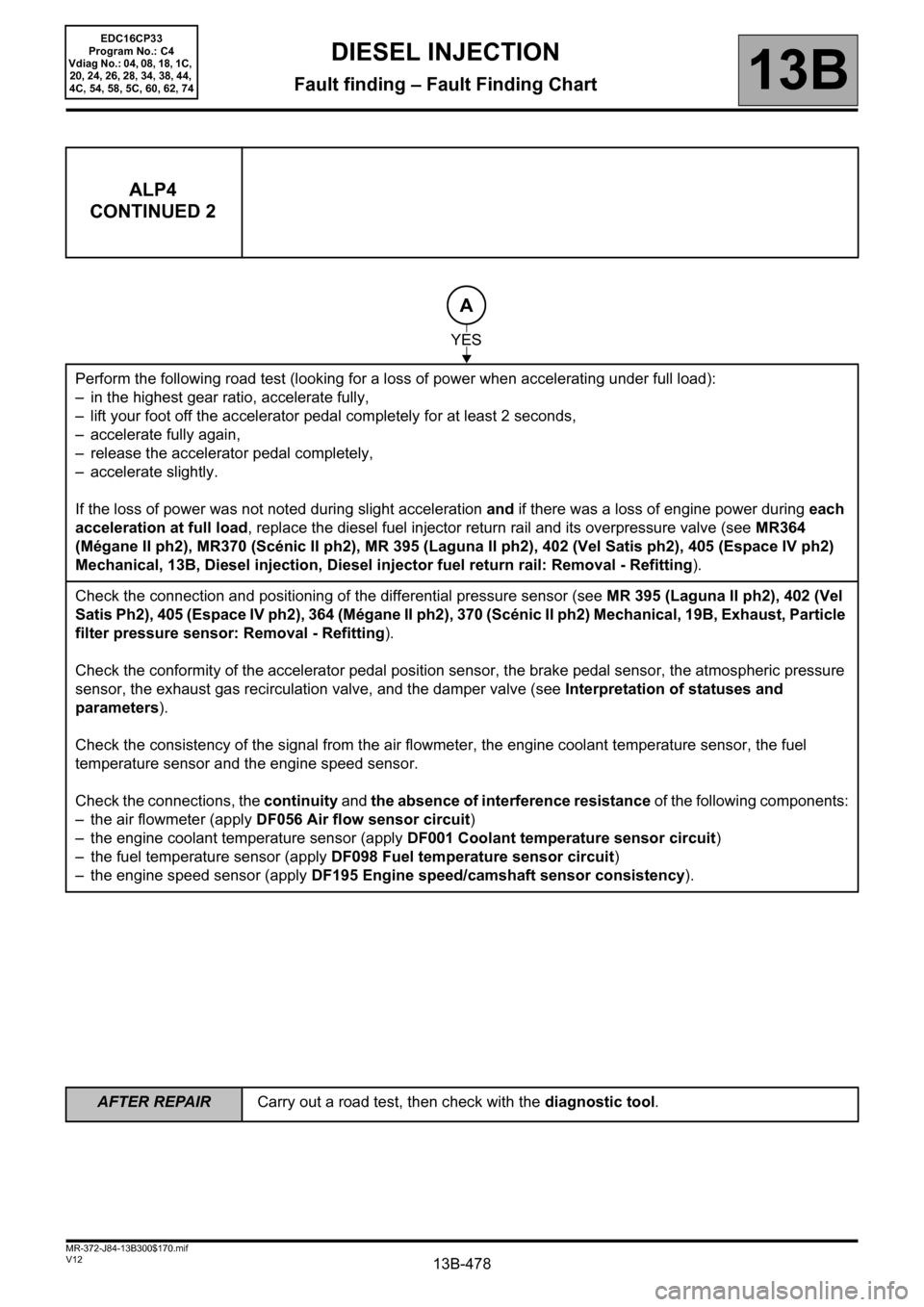
13B-478
AFTER REPAIRCarry out a road test, then check with the diagnostic tool.
V12 MR-372-J84-13B300$170.mif
DIESEL INJECTION
Fault finding – Fault Finding Chart13B
ALP4
CONTINUED 2
Perform the following road test (looking for a loss of power when accelerating under full load):
– in the highest gear ratio, accelerate fully,
– lift your foot off the accelerator pedal completely for at least 2 seconds,
– accelerate fully again,
– release the accelerator pedal completely,
– accelerate slightly.
If the loss of power was not noted during slight acceleration and if there was a loss of engine power during each
acceleration at full load, replace the diesel fuel injector return rail and its overpressure valve (see MR364
(Mégane II ph2), MR370 (Scénic II ph2), MR 395 (Laguna II ph2), 402 (Vel Satis ph2), 405 (Espace IV ph2)
Mechanical, 13B, Diesel injection, Diesel injector fuel return rail: Removal - Refitting).
Check the connection and positioning of the differential pressure sensor (see MR 395 (Laguna II ph2), 402 (Vel
Satis Ph2), 405 (Espace IV ph2), 364 (Mégane II ph2), 370 (Scénic II ph2) Mechanical, 19B, Exhaust, Particle
filter pressure sensor: Removal - Refitting).
Check the conformity of the accelerator pedal position sensor, the brake pedal sensor, the atmospheric pressure
sensor, the exhaust gas recirculation valve, and the damper valve (see Interpretation of statuses and
parameters).
Check the consistency of the signal from the air flowmeter, the engine coolant temperature sensor, the fuel
temperature sensor and the engine speed sensor.
Check the connections, the continuity and the absence of interference resistance of the following components:
– the air flowmeter (apply DF056 Air flow sensor circuit)
– the engine coolant temperature sensor (apply DF001 Coolant temperature sensor circuit)
– the fuel temperature sensor (apply DF098 Fuel temperature sensor circuit)
– the engine speed sensor (apply DF195 Engine speed/camshaft sensor consistency).
A
YES
EDC16CP33
Program No.: C4
Vdiag No.: 04, 08, 18, 1C,
20, 24, 26, 28, 34, 38, 44,
4C, 54, 58, 5C, 60, 62, 74