change time RENAULT SCENIC 2018 Owner's Manual
[x] Cancel search | Manufacturer: RENAULT, Model Year: 2018, Model line: SCENIC, Model: RENAULT SCENIC 2018Pages: 364, PDF Size: 10.43 MB
Page 213 of 364
2.93
AUTOMATIC GEARBOX (1/3)
2
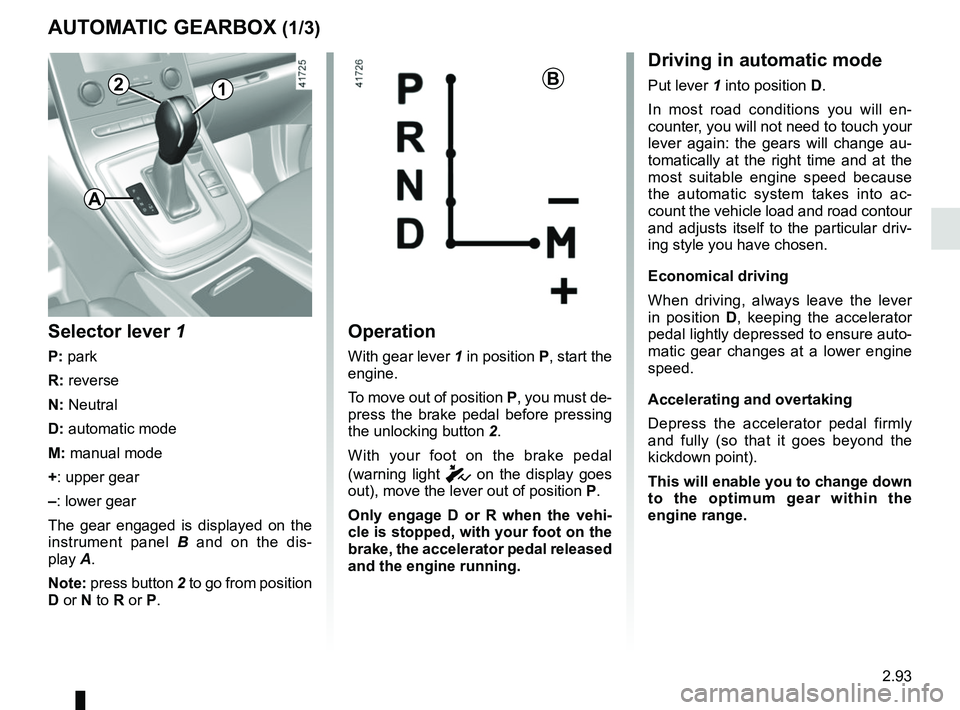
Operation
With gear lever 1 in position P, start the
engine.
To move out of position P, you must de-
press the brake pedal before pressing
the unlocking button 2.
With your foot on the brake pedal
(warning light
c on the display goes
out), move the lever out of position P.
Only engage D or R when the vehi-
cle is stopped, with your foot on the
brake, the accelerator pedal released
and the engine running.
1B
Selector lever 1
P: park
R: reverse
N: Neutral
D: automatic mode
M: manual mode
+: upper gear
–: lower gear
The gear engaged is displayed on the
instrument panel B and on the dis-
play A.
Note: press button 2 to go from position
D or N to R or P.
Driving in automatic mode
Put lever 1 into position D.
In most road conditions you will en-
counter, you will not need to touch your
lever again: the gears will change au-
tomatically at the right time and at the
most suitable engine speed because
the automatic system takes into ac-
count the vehicle load and road contour
and adjusts itself to the particular driv-
ing style you have chosen.
Economical driving
When driving, always leave the lever
in position D, keeping the accelerator
pedal lightly depressed to ensure auto-
matic gear changes at a lower engine
speed.
Accelerating and overtaking
Depress the accelerator pedal firmly
and fully (so that it goes beyond the
kickdown point).
This will enable you to change down
to the optimum gear within the
engine range.
A
Page 218 of 364
3.2
MULTI-SENSE (1/2)
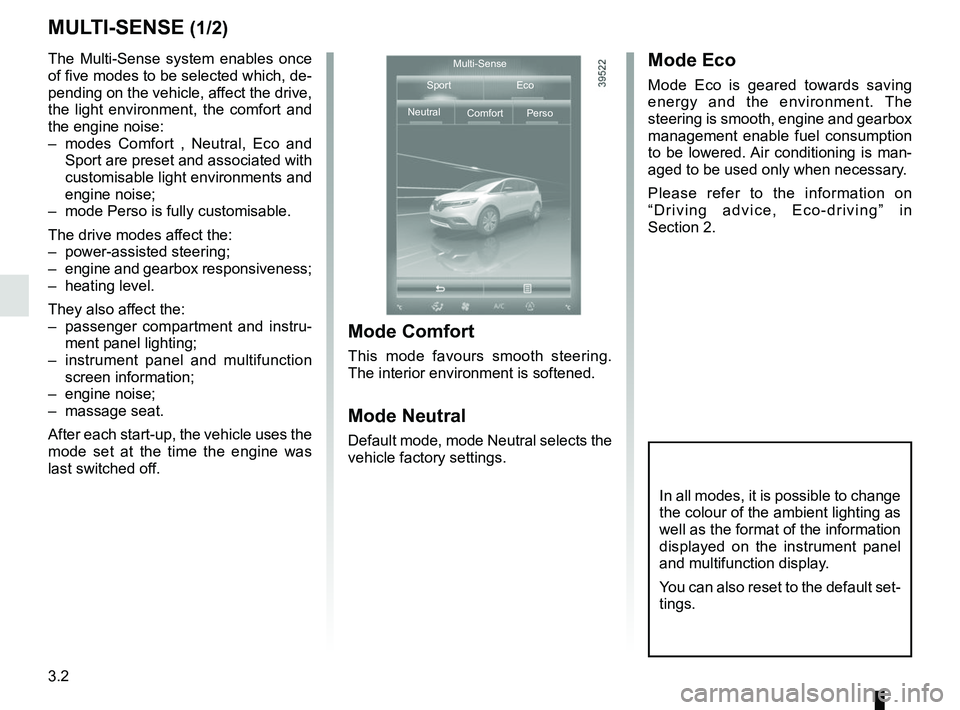
The Multi-Sense system enables once
of five modes to be selected which, de-
pending on the vehicle, affect the drive,
the light environment, the comfort and
the engine noise:
– modes Comfort , Neutral, Eco and Sport are preset and associated with
customisable light environments and
engine noise;
– mode Perso is fully customisable.
The drive modes affect the:
– power-assisted steering;
– engine and gearbox responsiveness;
– heating level.
They also affect the:
– passenger compartment and instru- ment panel lighting;
– instrument panel and multifunction screen information;
– engine noise;
– massage seat.
After each start-up, the vehicle uses the
mode set at the time the engine was
last switched off.
Mode Comfort
This mode favours smooth steering.
The interior environment is softened.
Mode Neutral
Default mode, mode Neutral selects the
vehicle factory settings.
Mode Eco
Mode Eco is geared towards saving
energy and the environment. The
steering is smooth, engine and gearbox
management enable fuel consumption
to be lowered. Air conditioning is man-
aged to be used only when necessary.
Please refer to the information on
“Driving advice, Eco-driving” in
Section 2.
Multi-Sense
Sport Eco
Neutral Comfort Perso
In all modes, it is possible to change
the colour of the ambient lighting as
well as the format of the information
displayed on the instrument panel
and multifunction display.
You can also reset to the default set-
tings.
Page 276 of 364
4.4
ENGINE OIL LEVEL: general information
It is normal for an engine to use oil for
lubrication and cooling of moving parts
and it is normal to top up the level be-
tween oil changes.
However, contact your approved
Dealer if more than 0.5 litres is being
consumed every 600 miles (1,000 km)
after the running in period.
Oil change frequency: check the oil
level from time to time and certainly
before any long journey to avoid the
risk of damaging your engine.
Reading the oil level
The oil level should be read with the ve-
hicle on level ground, after the engine
has been switched off for some time.
The dipstick must be used to read
the exact oil level and make sure
that the maximum level has not been
exceeded (risk of engine damage).
Refer to the following pages.
The instrument panel display only
alerts the driver when the oil level is at
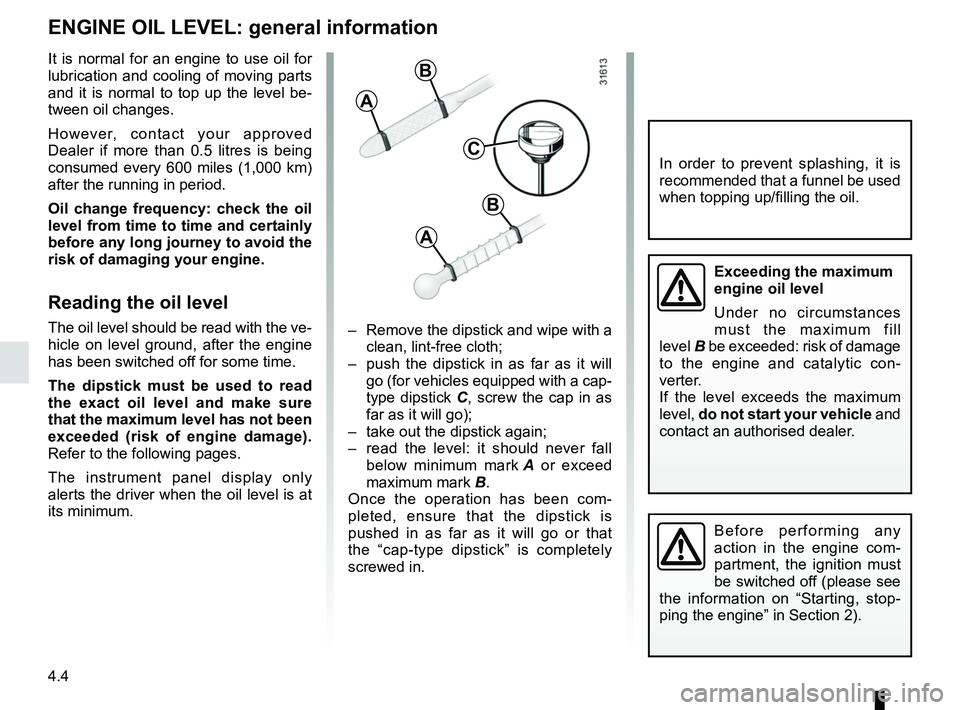
its minimum. – Remove the dipstick and wipe with a
clean, lint-free cloth;
– push the dipstick in as far as it will go (for vehicles equipped with a cap-
type dipstick C, screw the cap in as
far as it will go);
– take out the dipstick again;
– read the level: it should never fall below minimum mark A or exceed
maximum mark B.
Once the operation has been com-
pleted, ensure that the dipstick is
pushed in as far as it will go or that
the “cap-type dipstick” is completely
screwed in.
C
A
B
A
B
In order to prevent splashing, it is
recommended that a funnel be used
when topping up/filling the oil.
Before performing any
action in the engine com-
partment, the ignition must
be switched off (please see
the information on “Starting, stop-
ping the engine” in Section 2).
Exceeding the maximum
engine oil level
Under no circumstances
must the maximum fill
level B be exceeded: risk of damage
to the engine and catalytic con-
verter.
If the level exceeds the maximum
level, do not start your vehicle and
contact an authorised dealer.
Page 360 of 364
7.4
ALPHABETICAL INDEX (4/6)
lighting:exterior ....................................................1.7, 1.95 → 1.102
instrument panel .......................................................... 1.95
interior ..........................................3.27 – 3.28, 5.24 → 5.26
lights adjustment .................................................... 1.101 – 1.102
changing bulbs .................................................. 5.17 – 5.18
front ................................................................... 5.17 – 5.18
lights: adjusting ....................................................... 1.101 – 1.102
adjustment of headlight beam height ............ 1.101 – 1.102
brake lights .................................................................. 5.19
dipped beam headlights ........................... 1.95, 5.17 – 5.18
direction indicators ..................................1.94, 5.17 → 5.19
electric beam height adjustment ................... 1.101 – 1.102
fog lights ........................................................... 1.100, 5.19
hazard warning ............................................................ 1.94
main beam headlights ..................... 1.96, 1.98, 5.17 – 5.18
number plate lights ...................................................... 5.23
reversing lights ............................................................. 5.19
side lights ............................................................ 1.95, 5.19
locking the doors ........................ 1.4, 1.6 → 1.12, 1.16 → 1.18
luggage compartment cover .............................................. 3.48
luggage retaining net .............................................3.53 → 3.55
M
maintenance ............................................................\
.......... 2.30
maintenance: bodywork .........................................................4.15 → 4.17
interior trim ........................................................ 4.18 – 4.19
mechanical .........................................4.2 – 4.3, 6.9 → 6.14
manual air conditioning..............................................3.6 → 3.8
map reading lights .................................................. 3.27 – 3.28
menu for customising the vehicle settings .............. 1.88 – 1.89
methods of restraint in addition to the seat belts ...1.36 → 1.38
mulitfunction display ..............................................1.72 → 1.77multifunction screen...............................................1.72
→ 1.77
multimedia (equipment) .......................................... 3.22 – 3.23
multimedia equipment ............................................ 3.22 – 3.23
Multi-Sense................................................................. 3.2 – 3.3
N
navigation ............................................................... 3.22 – 3.23
navigation system ................................................... 3.22 – 3.23
O
oil change ..................................................................... 4.4, 4.7
opening the doors ..................................................1.13 → 1.17
operating faults ......................................................5.38 → 5.44
overspeed warning .......................................1.72, 2.64 → 2.66
P
paintwork maintenance ....................................................4.15 → 4.17
parking assistance: assisted parking 2.82 → 2.86, 2.89 → 2.92
parking distance control.........................................2.82 → 2.86
P
pedestrian detection ..............................................2.40 → 2.46
P
power-assisted steering..................................................... 1.91
puncture................................................. 5.2 → 5.4, 5.9 → 5.13
R
radio........................................................................\
3.22 – 3.23
radio frequency remote control/key use ....................................................................\
...1.2 → 1.4
rear parcel shelf ............................................. 3.37, 3.47 – 3.48
rear screen de-icing/demisting .......................................... 3.13
rear seats functions ..........................................................3.40 → 3.45