light RENAULT SCENIC 2018 Repair Manual
[x] Cancel search | Manufacturer: RENAULT, Model Year: 2018, Model line: SCENIC, Model: RENAULT SCENIC 2018Pages: 364, PDF Size: 10.43 MB
Page 129 of 364
2.9
To fill up with fuel, the engine must
be stopped (and not on standby):
switch the ignition off (please see
the information on “Starting, stop-
ping the engine” in Section 2).
FUNCTION STOP AND START (2/4)
Preventing the engine from
standing by
In certain situations, such as negotiat-
ing a crossroads for instance, it is pos-
sible (with the system activated) to keep
the engine running so as to be ready to
move off quickly.
For vehicles equipped with auto-
matic gearboxes:
Keep the vehicle stationary without
pressing too hard on the brake pedal.
For vehicles equipped with manual
gearboxes:
Keep the clutch pedal pressed right
down.
Conditions for coming out of
engine standby
For automatic gearboxes:
– the brake pedal is released, posi-tion D or M engaged;
or
– the brake pedal is released in gear position N with the handbrake off;
or
– the brake pedal is pressed again in gear position P or N engaged with
the handbrake applied;
or
– the vehicle is in gear position R;
or
– the accelerator pedal is depressed;
or
– in manual mode, the gear lever is moved to + or -.
For manual gearboxes:
– the gearbox is in neutral and the clutch pedal is slightly depressed;
or
– the engine is in gear and the clutch pedal is pressed right down. Special note:
depending on the vehi-
cle, if you switch off the ignition when
the engine is on standby, the warning
light Ä is displayed for a few sec-
onds on the instrument panel.
If the engine stalls while the system
is in operation, pressing the clutch
pedal right down will start it again.
Page 130 of 364
2.10
FUNCTION STOP AND START (3/4)
Conditions preventing the
standby of the engine
Certain conditions prevent the system
from using the engine standby function,
including when:
for vehicles equipped with a
RENAULT card:
– the driver’s door is not closed;
– the driver’s seatbelt is not fastened.
for all vehicles:
– reverse gear is engaged;
– the bonnet is not locked;
– the outdoor temperature is too low or too high (less than around 5°C or
higher than around 35°C);
– one of the two batteries is not suffi- ciently charged;
– the difference between the vehicle interior temperature and the auto-
matic climate control instruction is
too high;
– parking distance control is in opera- tion; – for vehicles with automatic gear-
boxes, the gradient is steeper than
approximately 12%;
– the “Clear View” function is activated (please see “Automatic climate con-
trol” in Section 3);
– the engine temperature is too low;
– the emission control system is being regenerated;
– ...
Warning light
is displayed on the
instrument panel. This notifies you that
engine standby is not available.
Deactivate the Stop and
Start function for any opera-
tion performed in the engine
compartment.
Special case for vehicles with
a RENAULT card
With the engine on standby (traffic jam,
traffic lights, etc.), if the driver unfas-
tens the seat belt and opens the driv-
er’s door, or gets out of the seat, the
ignition is switched off.
The assisted parking brake is applied
automatically.
To restart and reactivate the Stop and
Start system, start the engine (please
refer to the information on “Starting,
stopping the engine” in Section 2).
Special case of vehicles with
a key
With the engine on standby (traffic
jam, traffic lights, etc.), if you get out of
the vehicle, a beep warns you that the
engine is on standby and has not been
stopped.
Page 131 of 364
2.11
FUNCTION STOP AND START (4/4)
Special feature of the automatic
engine re-start
Under certain conditions, the engine
can restart on its own in order to guar-
antee your safety and comfort.
This can occur especially when:
– the outdoor temperature is too low or too high (less than around 5°C or
higher than around 35°C);
– the “Clear View” function is activated (please see “Automatic climate con-
trol” in Section 3);
– one of the two batteries is not suffi- ciently charged;
– the vehicle speed is above 3 mph (5 km/h) (downhill slope, etc.);
– repeated pressing on the brake pedal or braking system require-
ment;
– on vehicles fitted with a manual gearbox, restarting may be inter-
rupted if the clutch pedal is released
too quickly while a gear is engaged;
– ...
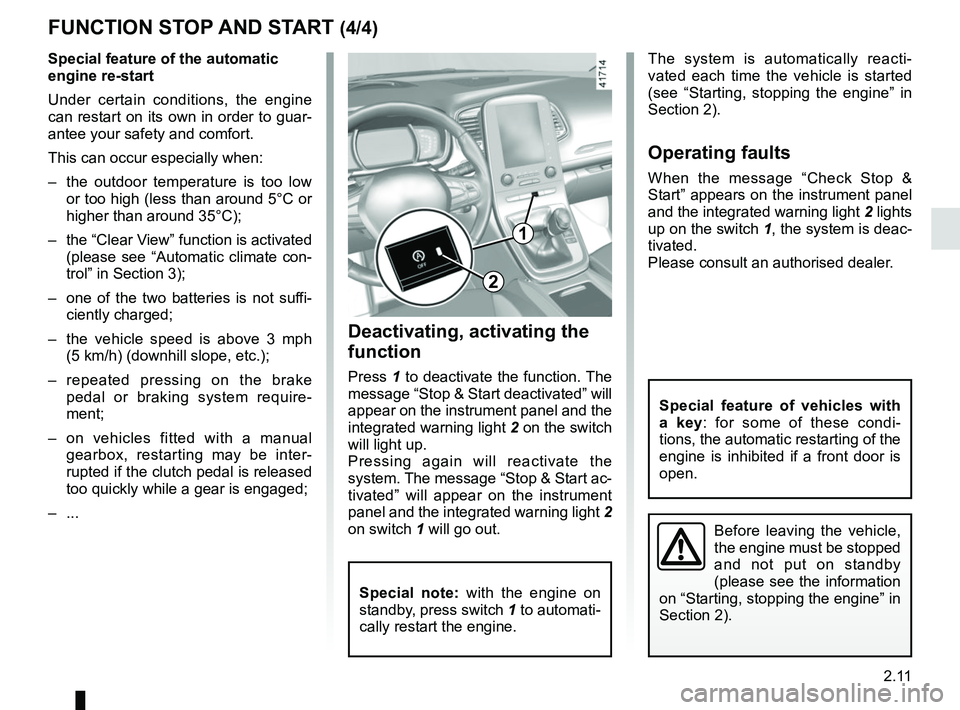
1
2
Deactivating, activating the
function
Press 1 to deactivate the function. The
message “Stop & Start deactivated” will
appear on the instrument panel and the
integrated warning light 2 on the switch
will light up.
Pressing again will reactivate the
system. The message “Stop & Start ac-
tivated” will appear on the instrument
panel and the integrated warning light 2
on switch 1 will go out.
Special note: with the engine on
standby, press switch 1 to automati-
cally restart the engine.
The system is automatically reacti-
vated each time the vehicle is started
(see “Starting, stopping the engine” in
Section 2).
Operating faults
When the message “Check Stop &
Start” appears on the instrument panel
and the integrated warning light 2 lights
up on the switch 1, the system is deac-
tivated.
Please consult an authorised dealer.
Special feature of vehicles with
a key: for some of these condi-
tions, the automatic restarting of the
engine is inhibited if a front door is
open.
Before leaving the vehicle,
the engine must be stopped
and not put on standby
(please see the information
on “Starting, stopping the engine” in
Section 2).
Page 132 of 364
2.12
SPECIAL FEATURES OF PETROL VERSIONS
Do not park the vehicle or
run the engine in locations
where combustible sub-
stances or materials such
as grass or leaves can come into
contact with the hot exhaust system.
The following operating conditions
should be avoided:
– driving for long periods when the low fuel level warning light is lit;
– using leaded petrol;
– using fuel or lubrication additives which are not approved.
Or operating faults such as:
– faulty ignition, running out of fuel or disconnected spark plugs resulting
in the engine misfiring or cutting out
when driving;
– loss of power,
may cause the catalytic converter to
overheat, reducing its efficiency which
may irreparably damage it and cause
heat damage to the vehicle. If you notice any of the above operating
faults, have the necessary repairs car-
ried out as soon as possible by an ap-
proved dealer.
These faults may be avoided by regu-
larly taking your vehicle to an approved
Dealer at the intervals specified in the
Maintenance Document.
Starting problems
To avoid damaging the catalytic con-
verter,
do not keep trying to start the
engine (using the start button, or by
pushing or towing the vehicle) without
having identified and corrected the
cause of the fault.
Page 133 of 364
2.13
SPECIAL FEATURES OF DIESEL VERSIONS
Diesel engine speed
Diesel engines are fitted with injection
equipment which prevents the engine
speed being exceeded irrespective of
the gear selected.
If the message “Check anti- pollution
system” is displayed along with warn-
ing lights
Ä and ©, consult an
authorised dealer immediately.
When driving, depending on the fuel
grade used, it is possible that white
smoke may be emitted.
This is due to the exhaust particle filter
being cleaned automatically, and does
not affect the way the vehicle runs.
Do not park the vehicle or
run the engine in locations
where combustible sub-
stances or materials such
as grass or leaves can come into
contact with the hot exhaust system.
Precautions to be taken in
winter
To avoid any faults in icy weather:
– ensure that the battery is always fully charged,
– always keep the diesel tank rela- tively full to avoid water vapour con-
densing in it and accumulating at the
bottom of the tank.
Page 136 of 364
2.16
The “Hybrid Assist” system uses an
electric motor to improve performance
of the combustion engine (acceleration,
starting on a slope etc.). The vehicle
has more acceleration torque available
while consuming less fuel.
BatteriesYour electric vehicle has two types of
battery:
– a 48 V traction battery;
– secondary 12 V battery.
“48 volt” traction battery
Located under the rear floor, this bat-
tery stores the energy recovered during
phases of deceleration. This energy is
used by the hybrid system to provide
additional torque to the combustion
engine.
“HYBRID ASSIST" SYSTEM: introduction (3/5)
Secondary 12V battery
The 12 V battery supplies the energy
required to operate vehicle equipment
(lights, windscreen wipers, ABS etc).
Please see the information under
“12 volt battery” in Section 4.
“48 volt” electrical circuit
The 48 V electrical circuit is denoted
by orange cables and parts bearing the
symbol
ṑ.
All interventions or modi-
fications to the vehicle’s
48 volt electrical system
(components, cables, con-
nectors, traction battery) are strictly
prohibited due to the risks this may
present to your safety. Call an ap-
proved Dealer.
Risk of electric shock.
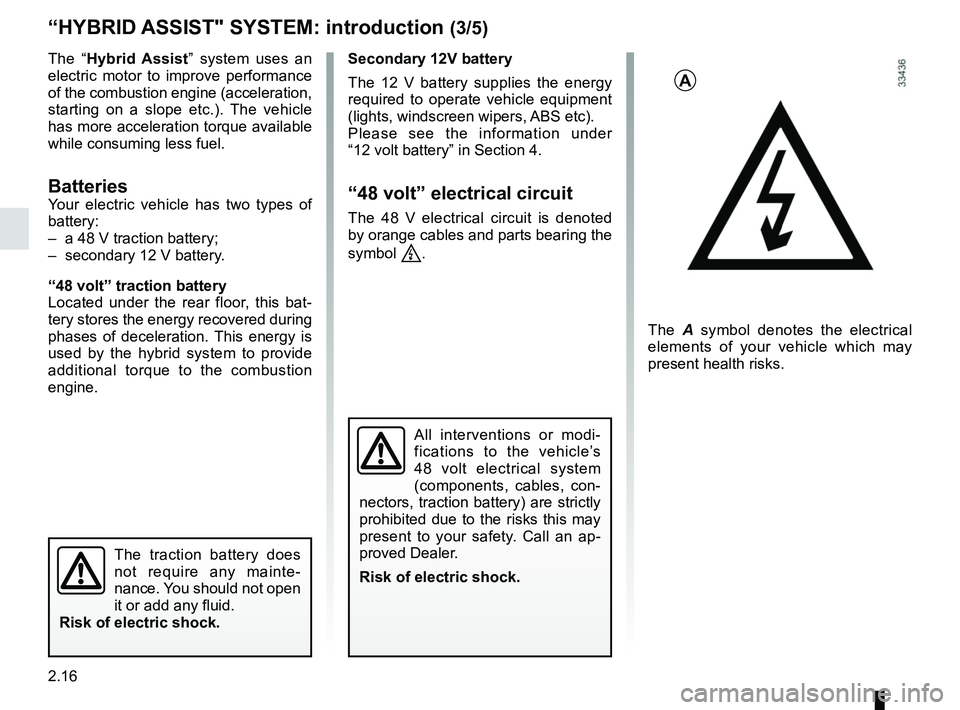
A
The A symbol denotes the electrical
elements of your vehicle which may
present health risks.
The traction battery does
not require any mainte-
nance. You should not open
it or add any fluid.
Risk of electric shock.
Page 138 of 364
2.18
Operating faults
– If the warning light on the in-
strument panel comes on, this indi-
cates that an operating fault has oc-
curred in the system. The operation
of the vehicle is still maintained ;
–
Ú and ® lit up on the in-
strument panel accompanied by the
message “Electric failure DANGER”
indicates a system fault.
For approximately 30 seconds,
the
Ú warning light lights up
on the instrument panel accompa-
nied by the message “Electric failure
DANGER”.
Over the following 30 seconds, the vehicle progressively loses power
from its combustion engine.
Approximately two minutes after the first time the warning appears, the
vehicle speed is limited to 4.34 mph
(7 km/h) approximately.
In all cases, please consult an
Authorised Dealer.
Warning light ® re-
quires you to stop immedi-
ately, for your own safety,
as soon as traffic conditions
allow. Switch off the engine and do
not restart it. Contact an approved
Dealer.
“HYBRID ASSIST" SYSTEM: introduction (5/5)
Page 140 of 364
2.20
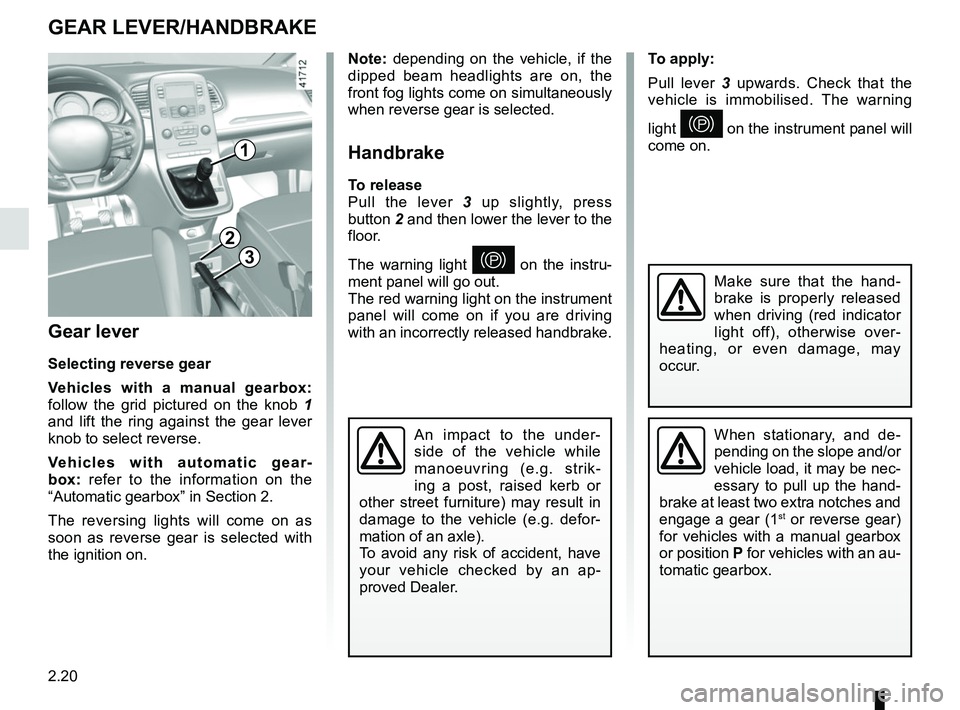
To apply:
Pull lever 3 upwards. Check that the
vehicle is immobilised. The warning
light
} on the instrument panel will
come on.
Gear lever
Selecting reverse gear
Vehicles with a manual gearbox:
follow the grid pictured on the knob 1
and lift the ring against the gear lever
knob to select reverse.
Vehicles with automatic gear-
box: refer to the information on the
“Automatic gearbox” in Section 2.
The reversing lights will come on as
soon as reverse gear is selected with
the ignition on.
1
GEAR LEVER/HANDBRAKE
Note: depending on the vehicle, if the
dipped beam headlights are on, the
front fog lights come on simultaneously
when reverse gear is selected.
Handbrake
To release
Pull the lever 3 up slightly, press
button 2 and then lower the lever to the
floor.
The warning light
} on the instru-
ment panel will go out.
The red warning light on the instrument
panel will come on if you are driving
with an incorrectly released handbrake.3
2
When stationary, and de-
pending on the slope and/or
vehicle load, it may be nec-
essary to pull up the hand-
brake at least two extra notches and
engage a gear (1
st or reverse gear)
for vehicles with a manual gearbox
or position P for vehicles with an au-
tomatic gearbox.
An impact to the under-
side of the vehicle while
manoeuvring (e.g. strik-
ing a post, raised kerb or
other street furniture) may result in
damage to the vehicle (e.g. defor-
mation of an axle).
To avoid any risk of accident, have
your vehicle checked by an ap-
proved Dealer.
Make sure that the hand-
brake is properly released
when driving (red indicator
light off), otherwise over-
heating, or even damage, may
occur.
Page 141 of 364
2.21
ELECTRONIC PARKING BRAKE (1/3)
Note:
To indicate that the electronic parking
brake is released, a beep sounds and
the message “Apply parking brake” ap-
pears on the instrument panel:
– with the engine running: when the driver’s door is opened;
– for vehicles not fitted with Stop and Start, with the engine switched off
(e.g when the engine stalls): when a
front door is opened.
In this case, pull and release switch 3 to
apply the assisted parking brake.
Assisted release of the parking
brake
The brake will be released as soon as
the vehicle starts and accelerates.
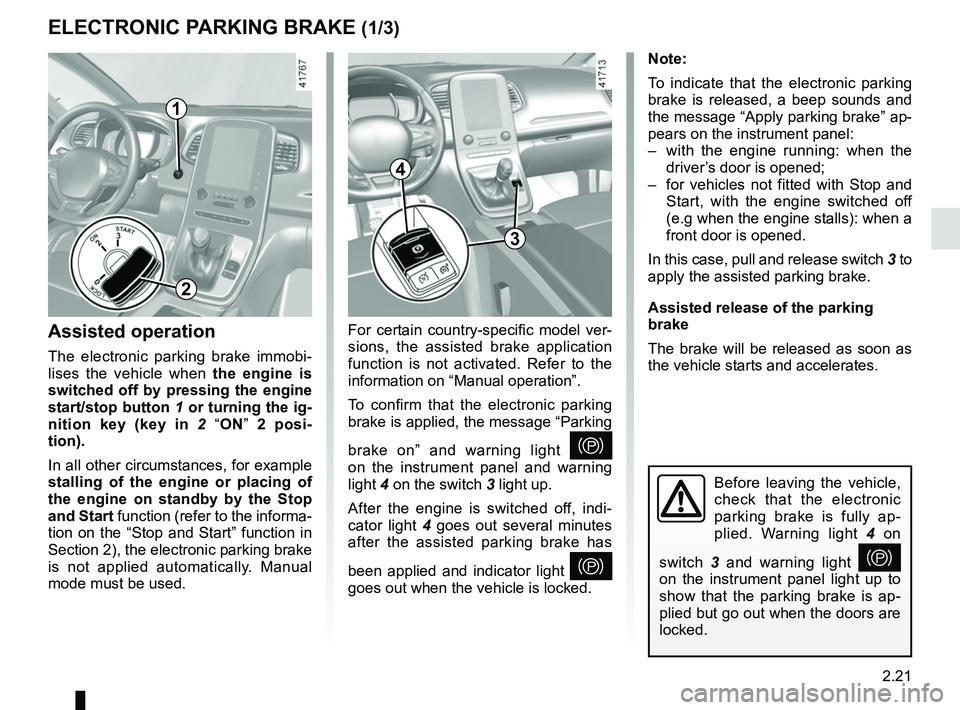
Assisted operation
The electronic parking brake immobi-
lises the vehicle when the engine is
switched off by pressing the engine
start/stop button 1 or turning the ig-
nition key (key in 2 “ ON” 2 posi-
tion).
In all other circumstances, for example
stalling of the engine or placing of
the engine on standby by the Stop
and Start function (refer to the informa-
tion on the “Stop and Start” function in
Section 2), the electronic parking brake
is not applied automatically. Manual
mode must be used. For certain country-specific model ver-
sions, the assisted brake application
function is not activated. Refer to the
information on “Manual operation”.
To confirm that the electronic parking
brake is applied, the message “Parking
brake on” and warning light
}
on the instrument panel and warning
light 4 on the switch 3 light up.
After the engine is switched off, indi-
cator light 4 goes out several minutes
after the assisted parking brake has
been applied and indicator light
}
goes out when the vehicle is locked.
Before leaving the vehicle,
check that the electronic
parking brake is fully ap-
plied. Warning light 4 on
switch 3 and warning light
}
on the instrument panel light up to
show that the parking brake is ap-
plied but go out when the doors are
locked.
1
4
3
2
Page 142 of 364
2.22
ELECTRONIC PARKING BRAKE (2/3)
For vehicles fitted with the Stop and
Start function, with the engine on
standby, the electronic parking brake is
automatically activated if the driver un-
fastens their seat belt or opens the driv-
er's door or gets out of their seat.Brief stop
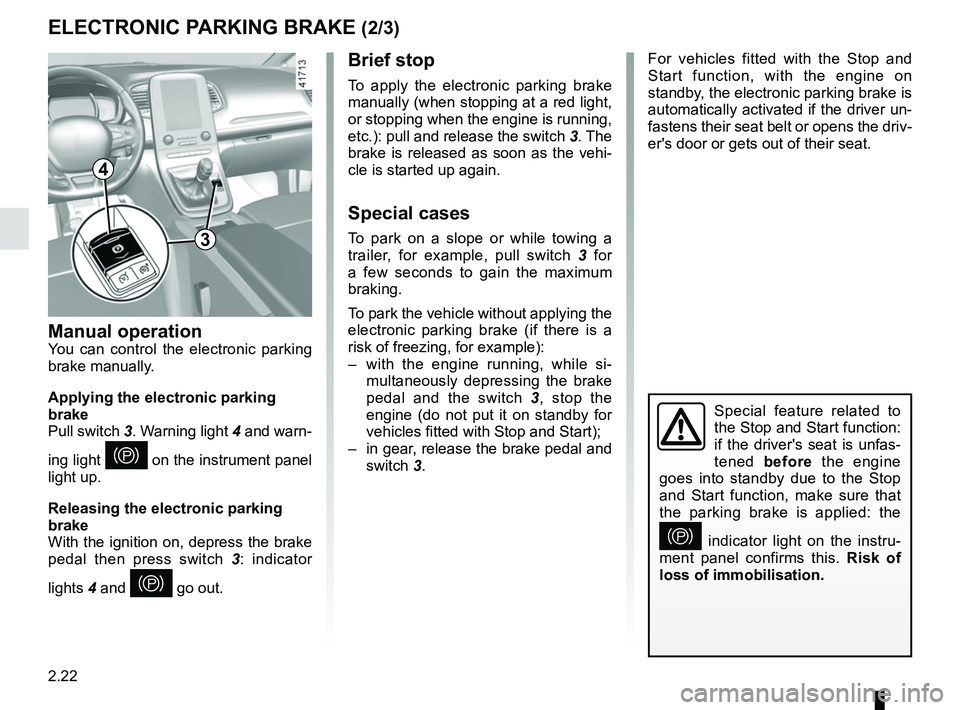
To apply the electronic parking brake
manually (when stopping at a red light,
or stopping when the engine is running,
etc.): pull and release the switch 3. The
brake is released as soon as the vehi-
cle is started up again.
Special cases
To park on a slope or while towing a
trailer, for example, pull switch 3 for
a few seconds to gain the maximum
braking.
To park the vehicle without applying the
electronic parking brake (if there is a
risk of freezing, for example):
– with the engine running, while si- multaneously depressing the brake
pedal and the switch 3, stop the
engine (do not put it on standby for
vehicles fitted with Stop and Start);
– in gear, release the brake pedal and switch 3.
Manual operationYou can control the electronic parking
brake manually.
Applying the electronic parking
brake
Pull switch 3. Warning light 4 and warn-
ing light
} on the instrument panel
light up.
Releasing the electronic parking
brake
With the ignition on, depress the brake
pedal then press switch 3: indicator
lights 4 and
} go out.
Special feature related to
the Stop and Start function:
if the driver's seat is unfas-
tened before the engine
goes into standby due to the Stop
and Start function, make sure that
the parking brake is applied: the
} indicator light on the instru-
ment panel confirms this. Risk of
loss of immobilisation.
4
3