change RENAULT TRAFIC 2016 X82 / 3.G User Guide
[x] Cancel search | Manufacturer: RENAULT, Model Year: 2016, Model line: TRAFIC, Model: RENAULT TRAFIC 2016 X82 / 3.GPages: 292, PDF Size: 3.35 MB
Page 151 of 292
2.27
Exceeding the limit speed
It is possible to exceed the limit speed
at any time. To do this: press the accel-
erator pedal firmly and fully (beyond
the resistance point).
If the speed is exceeded, the limited
speed flashes on the instrument panel
accompanied by a beep.
Then, release the accelerator: the
speed limiter function will return as
soon as you reach a speed lower than
the stored speed.
Limited speed cannot be maintained
If driving up or down a steep gradient,
the system is unable to maintain the
limited speed: the memorised speed
flashes on the instrument panel and
a beep sounds at regular intervals to
inform you.
Varying the limit speed
The limit speed may be changed by re-
peatedly pressing:
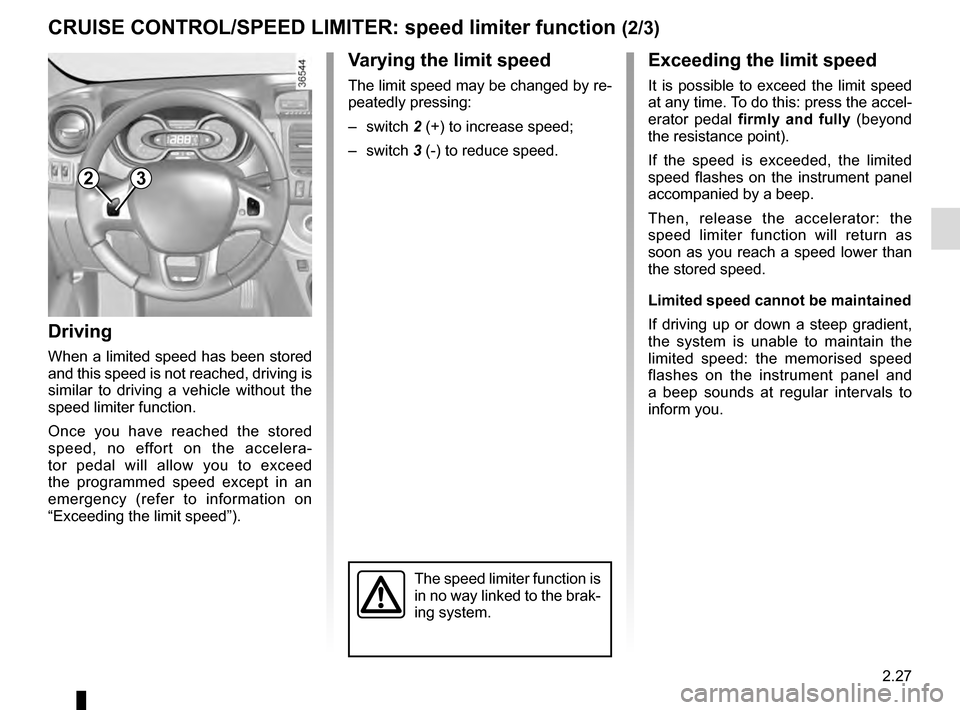
– switch 2 (+) to increase speed;
– switch 3 (-) to reduce speed.
Driving
When a limited speed has been stored
and this speed is not reached, driving is
similar to driving a vehicle without the
speed limiter function.
Once you have reached the stored
speed, no effort on the accelera-
tor pedal will allow you to exceed
the programmed speed except in an
emergency (refer to information on
“Exceeding the limit speed”).
CRUISE CONTROL/SPEED LIMITER: speed limiter function (2/3)
The speed limiter function is
in no way linked to the brak-
ing system.
23
Page 155 of 292
2.31
CRUISE CONTROL/SPEED LIMITER: cruise control function (3/4)
Exceeding the cruising speed
The cruising speed may be exceeded
at any time by depressing the accelera-
tor pedal. While it is being exceeded,
the cruising speed flashes on the in-
strument panel.
Then, release the accelerator: after a
few seconds, the vehicle will automati-
cally return to its set cruising speed.
Cruising speed cannot be
maintained
When driving down a steep gradient,
the system is unable to maintain the
cruising speed: the stored speed will
flash on the instrument panel informa-
tion display to inform you of this situ-
ation.
Adjusting the cruising speed
The cruising speed may be changed by
pressing the following repeatedly:
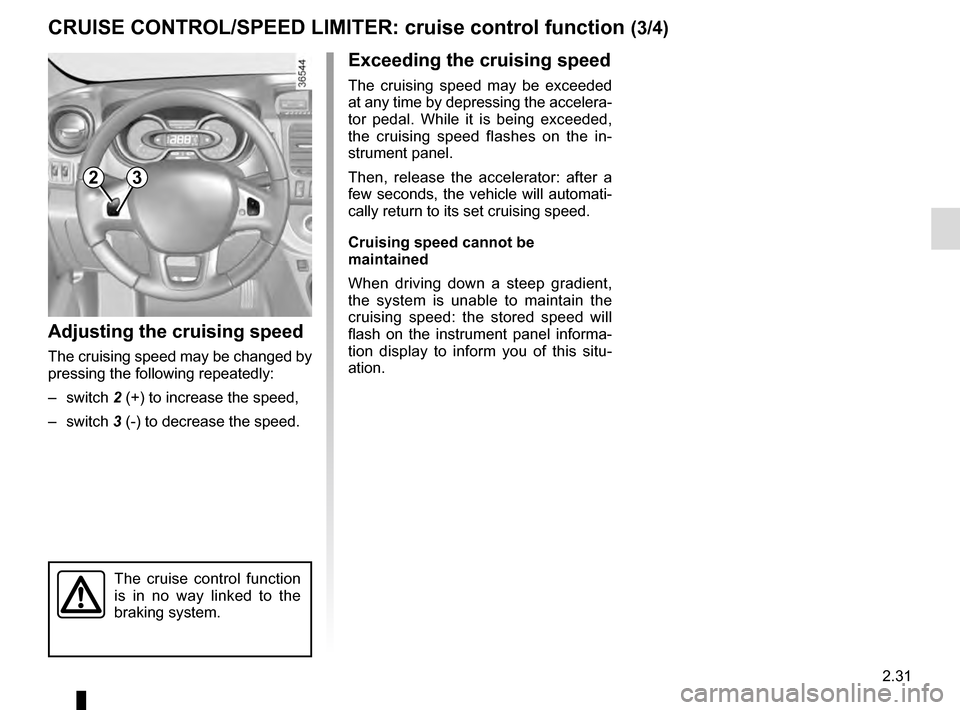
– switch 2 (+) to increase the speed,
– switch 3 (-) to decrease the speed.
The cruise control function
is in no way linked to the
braking system.
23
Page 182 of 292
3.20
PASSENGER COMPARTMENT STORAGE/FITTINGS (2/9)
5
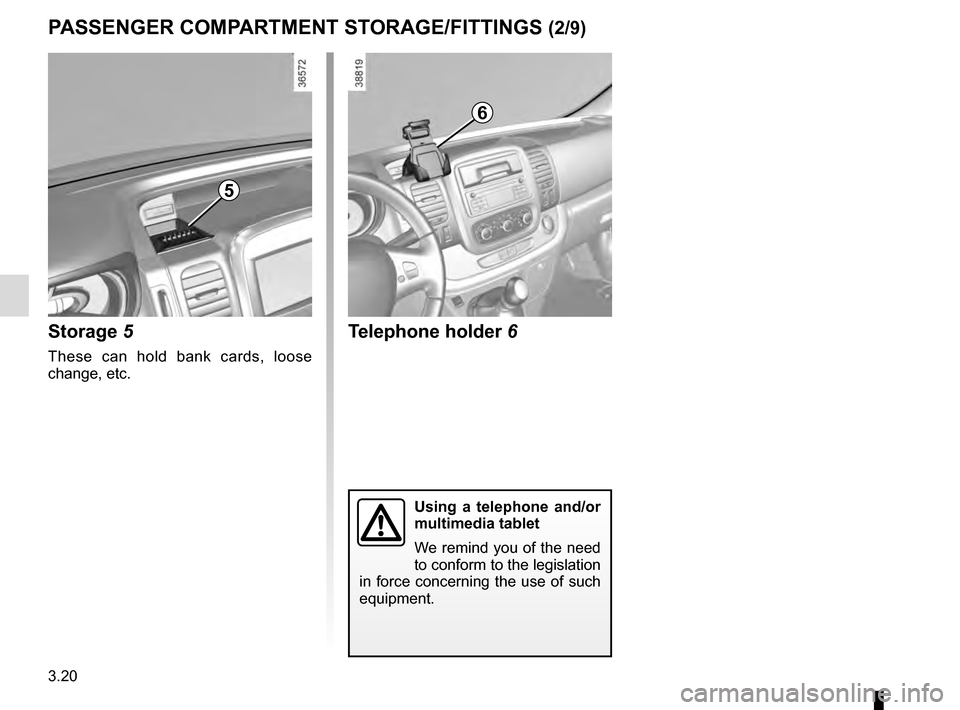
Storage 5
These can hold bank cards, loose
change, etc.
Telephone holder 6
Using a telephone and/or
multimedia tablet
We remind you of the need
to conform to the legislation
in force concerning the use of such
equipment.
6
Page 205 of 292

4.1
Section 4: Maintenance
Bonnet . . . . . . . . . . . . . . . . . . . . . . . . . . . . . . . . . . . . \
. . . . . . . . . . . . . . . . . . . . . . . . . . . . . . . . . . . . 4.2
Engine oil level: general information . . . . . . . . . . . . . . . . . . . . . . . . . . . . . . . . . . . .\
. . . . . . . . . . . . . 4.4
Engine oil level: topping up/filling . . . . . . . . . . . . . . . . . . . . . . . . . . . . . . . . . . . .\
. . . . . . . . . . . . . . . 4.5
Oil change . . . . . . . . . . . . . . . . . . . . . . . . . . . . . . . . . . . . \
. . . . . . . . . . . . . . . . . . . . . . . . . . . . . . . . . 4.6
Levels . . . . . . . . . . . . . . . . . . . . . . . . . . . . . . . . . . . .\
. . . . . . . . . . . . . . . . . . . . . . . . . . . . . . . . . . . . 4.7engine coolant . . . . . . . . . . . . . . . . . . . . . . . . . . . . . . . . . . . .\
. . . . . . . . . . . . . . . . . . . . . . . . 4.7
Brake fluid . . . . . . . . . . . . . . . . . . . . . . . . . . . . . . . . . . . .\
. . . . . . . . . . . . . . . . . . . . . . . . . . . 4.8
windscreen washer reservoir . . . . . . . . . . . . . . . . . . . . . . . . . . . . . . . . . . . . \
. . . . . . . . . . . . . 4.9
Filters . . . . . . . . . . . . . . . . . . . . . . . . . . . . . . . . . . . . \
. . . . . . . . . . . . . . . . . . . . . . . . . . . . . . . . . . . . . 4.9
Tyre pressure. . . . . . . . . . . . . . . . . . . . . . . . . . . . . . \
. . . . . . . . . . . . . . . . . . . . . . . . . . . . . . . . . . . . . 4.10
Battery . . . . . . . . . . . . . . . . . . . . . . . . . . . . . . . . . . . . \
. . . . . . . . . . . . . . . . . . . . . . . . . . . . . . . . . . . . 4.12
Bodywork maintenance . . . . . . . . . . . . . . . . . . . . . . . . . . . . . . . . . . . . \
. . . . . . . . . . . . . . . . . . . . . . . 4.13
Interior trim maintenance . . . . . . . . . . . . . . . . . . . . . . . . . . . . . . . . . . . . \
. . . . . . . . . . . . . . . . . . . . . . 4.15
Page 208 of 292
4.4
It is normal for an engine to use oil for
lubrication and cooling of moving parts
and it is normal to top up the level be-
tween oil changes.
However, contact your approved
Dealer if more than 0.5 litres is being
consumed every 600 miles (1,000 km)
after the running in period.
Oil change frequency: check the oil
level from time to time and certainly
before any long journey to avoid the
risk of damaging your engine.
ENGINE OIL LEVEL: general information
Exceeding the maximum
engine oil level
Under no circumstances
should maximum filling
level B be exceeded: this could
damage the engine and the cata-
lytic converter.
If the oil level exceeds the maximum
level, do not start your vehicle and
contact an approved Dealer.
In order to prevent splashback, it is
recommended that a funnel be used
when topping up/filling with oil.
Reading the oil level
The oil level should be read with the ve-
hicle on level ground, after the engine
has been switched off for some time.
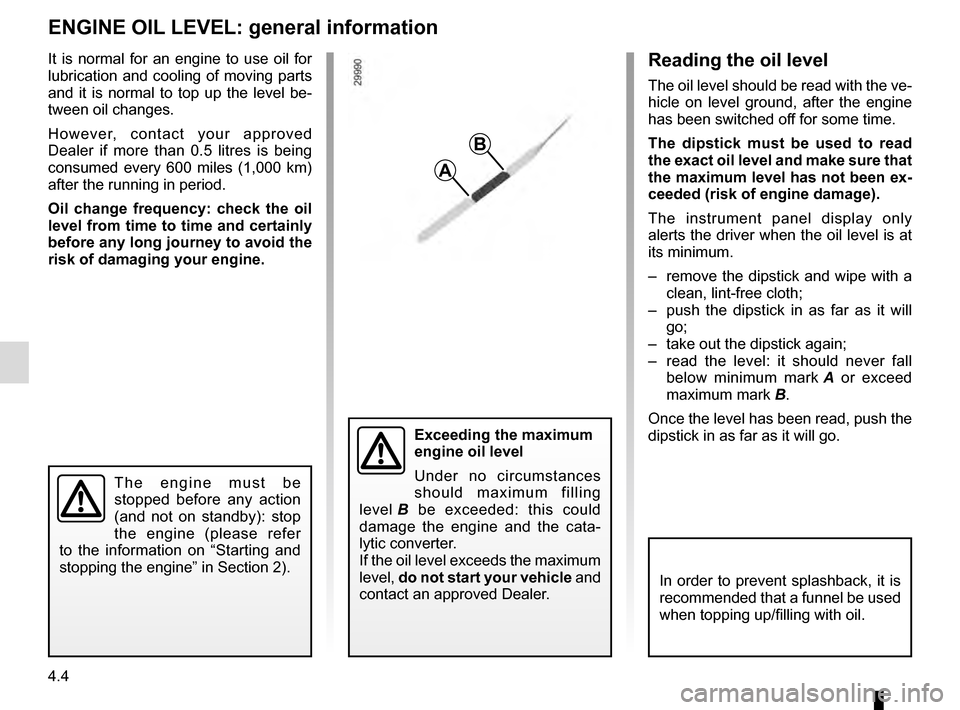
The dipstick must be used to read
the exact oil level and make sure that
the maximum level has not been ex-
ceeded (risk of engine damage).
The instrument panel display only
alerts the driver when the oil level is at
its minimum.
– remove the dipstick and wipe with a clean, lint-free cloth;
– push the dipstick in as far as it will go;
– take out the dipstick again;
– read the level: it should never fall below minimum mark A or exceed
maximum mark B.
Once the level has been read, push the
dipstick in as far as it will go.
A
B
The engine must be
stopped before any action
(and not on standby): stop
the engine (please refer
to the information on “Starting and
stopping the engine” in Section 2).
Page 209 of 292
4.5
ENGINE OIL LEVEL: topping up/filling (1/2)
The engine must be
stopped before any action
(and not on standby): stop
the engine (please refer
to the information on “Starting and
stopping the engine” in Section 2).
Never run the engine in an
enclosed space as exhaust
gases are poisonous.
Engine oil change : if you
are changing the oil when
the engine is hot, be careful
not to scald yourself if the
oil overflows.
When working in the engine
compartment, ensure that
the windscreen wiper stalk
is in the park position.
Risk of injury.
The engine may be hot
when carrying out opera-
tions in close proximity. In
addition, the engine cooling
fan can come on at any moment.
Risk of injury.
Filling: take care when
topping up the oil that
no oil drips onto engine
components - risk of fire.
Remember to refit the cap securely
as there is a risk of fire if oil splashes
onto hot engine components.
Exceeding the maximum
engine oil level
Under no circumstances
must the maximum fill level
be exceeded: risk of damage to the
engine and catalytic converter.
If the oil level exceeds the maximum
level, do not start your vehicle and
contact an approved Dealer.
Page 210 of 292
4.6
ENGINE OIL LEVEL: topping up, filling (2/2)OIL CHANGE
Oil change
Service interval: refer to the
Maintenance Service Booklet for your
vehicle.
Oil change capacity
Please refer to the maintenance docu-
ment for your vehicle, or contact an au-
thorised dealer.
Always check the engine oil level using
the dipstick, as explained previously (it
should never fall below the minimum
level, or be over the maximum level on
the dipstick).
Engine oil grade
Refer to the Maintenance Service
Booklet for your vehicle.
Consult your approved dealer at
once if you notice an abnormal or
repeated drop in any of the fluid
levels.
1
2
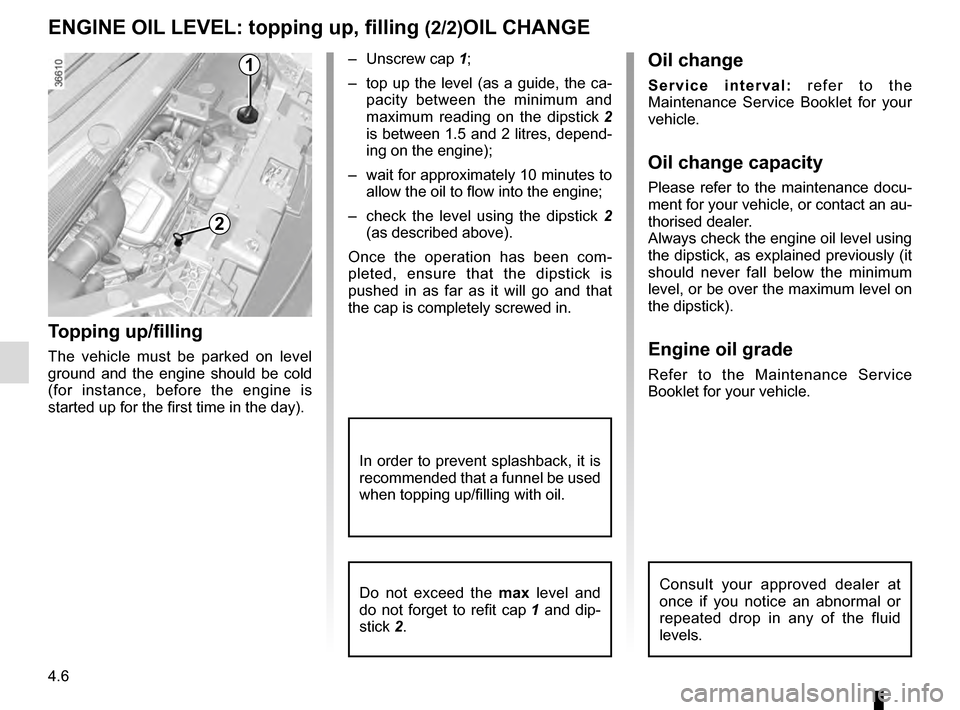
Topping up/filling
The vehicle must be parked on level
ground and the engine should be cold
(for instance, before the engine is
started up for the first time in the day).– Unscrew cap
1;
– top up the level (as a guide, the ca- pacity between the minimum and
maximum reading on the dipstick 2
is between 1.5 and 2 litres, depend-
ing on the engine);
– wait for approximately 10 minutes to allow the oil to flow into the engine;
– check the level using the dipstick 2
(as described above).
Once the operation has been com-
pleted, ensure that the dipstick is
pushed in as far as it will go and that
the cap is completely screwed in.
In order to prevent splashback, it is
recommended that a funnel be used
when topping up/filling with oil.
Do not exceed the max level and
do not forget to refit cap 1 and dip-
stick 2.
Page 231 of 292
5.11
TYRES (1/3)
For your safety, please re-
spect the speed limit.
When they need to be re-
placed, only tyres of the
same make, size, type and profile
should be used on a single axle.
They must: either have a load ca-
pacity and speed rating at least
equal to those of the original
tyres, or conform to those recom-
mended by an authorised dealer.
Failure to heed these instructions
could endanger your safety and
affect your vehicle’s roadworthi-
ness.
Risk of loss of control of the ve-
hicle.
Incidents which occur when
driving, such as striking the
kerb, may damage the tyres
and wheel rims, and could
also lead to misalignment of the
front or rear axle geometry. In this
case, have the condition of these
checked by an approved dealer.
Incorrect tyre pressures
lead to abnormal tyre wear
and unusually hot running.
These are factors which
may seriously affect safety and lead
to:
– poor road holding,
– risk of bursting or tread separa- tion.
The pressure depends on the load
and the speed of use. Adjust the
pressure according to the condi-
tions of use (refer to the label affixed
to the edge of the driver’s door).
Please be aware that a
poorly tightened or miss-
ing valve cap can make the
tyres less airtight and lead
to pressure loss.
Always use valve caps identical to
those fitted originally and tighten
them fully.
Fitting new tyres
For safety reasons, this op-
eration must be carried out
by a specialist.
Fitting different tyres may change
your vehicle as follows:
– it may mean that your vehicle no longer conforms to current regu-
lations;
– it may change the way it handles when cornering;
– it may cause the steering to be heavy;
– it may affect the use of snow chains.
Page 234 of 292
5.14
FRONT HEADLIGHTS: changing bulbs (1/2)
Take care when working in
the engine compartment
as the engine cooling fan
may start to operate at any
moment without warning.
Risk of injury.
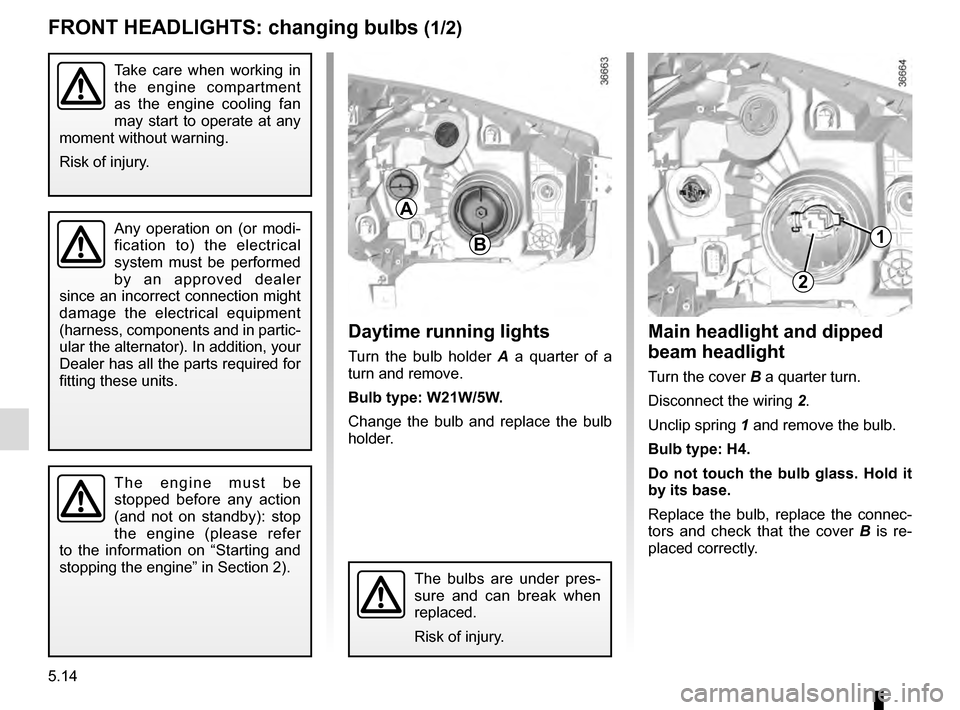
Main headlight and dipped
beam headlight
Turn the cover B a quarter turn.
Disconnect the wiring 2.
Unclip spring 1 and remove the bulb.
Bulb type: H4.
Do not touch the bulb glass. Hold it
by its base.
Replace the bulb, replace the connec-
tors and check that the cover B is re-
placed correctly.
B
A
2
1Any operation on (or modi-
fication to) the electrical
system must be performed
by an approved dealer
since an incorrect connection might
damage the electrical equipment
(harness, components and in partic-
ular the alternator). In addition, your
Dealer has all the parts required for
fitting these units.
The bulbs are under pres-
sure and can break when
replaced.
Risk of injury.
The engine must be
stopped before any action
(and not on standby): stop
the engine (please refer
to the information on “Starting and
stopping the engine” in Section 2).
Daytime running lights
Turn the bulb holder A a quarter of a
turn and remove.
Bulb type: W21W/5W.
Change the bulb and replace the bulb
holder.
Page 287 of 292

I
idle speed ........................................................................\
.. 2.34
ignition switch ............................................................")
7.3
ALPHABETICAL INDEX (3/5)
I
idle speed ........................................................................\
.. 2.34
ignition switch ...................................................................... 2.2
indicator lights........................................................\
............ 5.19
indicators ....................................................1.108, 5.14 → 5.19
indicators: direction indicators ..................................................... 1.108
instrument panel ..............................................1.84 → 1.91
instrument panel ....................................................1.84 → 1.98
instrument panel messages...................................1.90 → 1.98
interior trim maintenance ..................................................... 4.15 – 4.16
Isofix ....................................................................... 1.47 – 1.48
J
jack ........................................................................\
..... 5.7 – 5.8
K
keys ...................................................................\
........1.2 → 1.5
L
levels .................................................................\
........4.7 → 4.9
levels: brake fluid ...................................................................... 4.8
coolant ................................................................\
........... 4.7
windscreen washer reservoir ......................................... 4.9
lifting the vehicle changing a wheel ................................................ 5.9 – 5.10
lighting: exterior .........................................................1.103 \
→ 1.108
instrument panel ........................................................ 1.103
interior ........................................... 3.17 – 3.18, 5.20 – 5.21
lights adjustment .................................................... 1.106 – 1.107
changing bulbs .................................................. 5.14 – 5.15
front ................................................................... 5.14 – 5.15 lights:
adjusting ....................................................... 1.106 – 1.107
brake lights ......................................................5.16 → 5.19
dipped beam headlights ................ 1.84, 1.103, 5.14 – 5.15
direction indicators .......................1.84, 1.108, 5.14 → 5.16
fog lights .................................................. 1.84, 1.105, 5.16
hazard warning .......................................................... 1.108
main beam headlights .............................. 1.84, 1.103, 5.14
number plate lights ...................................................... 5.19
reversing lights ............................................................. 5.16
side lights ..............................................1.103, 5.14 → 5.16
load permitted on the roof......................................... 6.9 – 6.10
locking the doors ........... 1.2 → 1.8, 1.13 → 1.17, 1.23 → 1.27
luggage compartment cover .............................................. 3.35
luggage retaining net .............................................. 3.36 – 3.37
M
maintenance ............................................................\
.......... 2.16
maintenance: bodywork .......................................................... 4.13 – 4.14
interior trim ........................................................ 4.15 – 4.16
mechanical .......................................4.4, 4.12, 6.12 → 6.17
map reading lights .................................................. 3.17 – 3.18
methods of restraint in addition to the seat belts ...1.37 → 1.43
multimedia equipment .............................................. 3.41, 5.26
N
navigation system .............................................................. 3.41
O
oil change ................................................................... 4.5 – 4.6
opening the doors ................................................... 1.14 – 1.15
operating faults ................................ 1.84 → 1.87, 5.35 → 5.41