Child RENAULT TRAFIC 2016 X82 / 3.G Owner's Manual
[x] Cancel search | Manufacturer: RENAULT, Model Year: 2016, Model line: TRAFIC, Model: RENAULT TRAFIC 2016 X82 / 3.GPages: 292, PDF Size: 3.35 MB
Page 56 of 292
1.50
Rear centre seat
Check that the belt is suitable for secu-
ring your child seat. Consult an appro-
ved dealer.
Fit the child seat in a rear
seat wherever possible.
In the rear side seat
A carrycot can be installed across the
vehicle and will take up at least two
seats.
Position the child with their feet nearest
the door.
Move the front seat as far forward as
possible to install a rear-facing child
seat, then move back the seat in front
as far as it will go, although without al-
lowing it to come into contact with the
child seat.
For the safety of the child in the for-
ward-facing seat, do not move the seat
in front back past the middle of the
runner, do not tilt the seatback too far
(maximum of 25°) and raise the seat as
much as possible.
In all situations, remove the rear head-
rests (refer to the information on the
“Rear headrests” in Section 3). This
must be done before fitting the child
seat.
Check that the forward-facing child seat
is resting against the back of the vehi-
cle seat.
CHILD SAFETY: fitting a child seat, general information (2/2)
Page 57 of 292
1.51
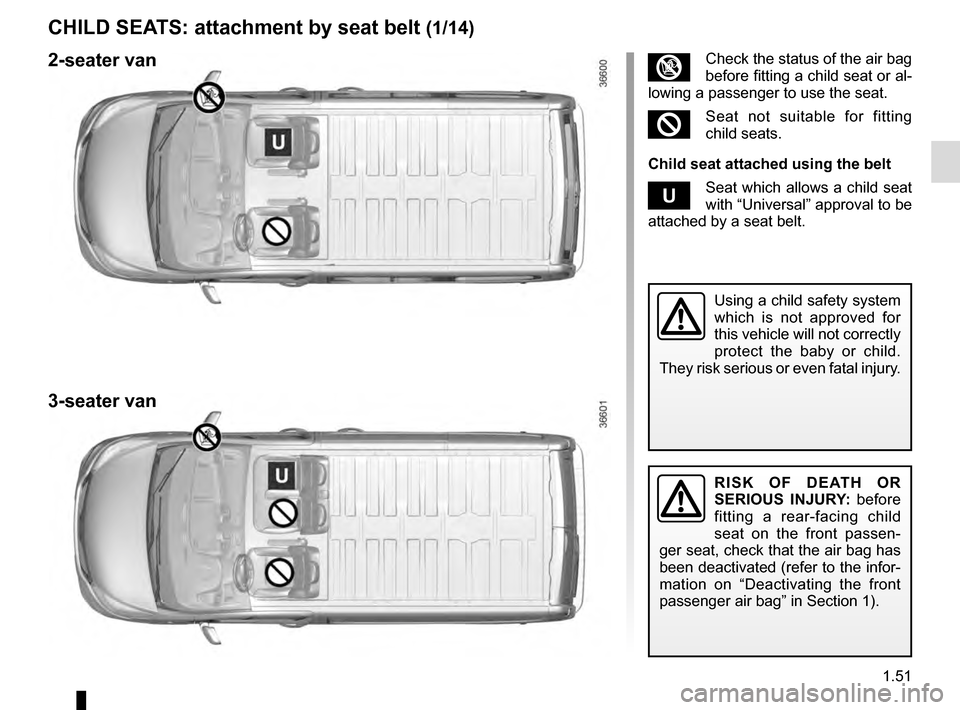
CHILD SEATS: attachment by seat belt (1/14)
³Check the status of the air bag
before fitting a child seat or al-
lowing a passenger to use the seat.
²Seat not suitable for fitting
child seats.
Child seat attached using the belt
¬Seat which allows a child seat
with “Universal” approval to be
attached by a seat belt.
RISK OF DEATH OR
SERIOUS INJURY: before
fitting a rear-facing child
seat on the front passen-
ger seat, check that the air bag has
been deactivated (refer to the infor-
mation on “Deactivating the front
passenger air bag” in Section 1).
Using a child safety system
which is not approved for
this vehicle will not correctly
protect the baby or child.
They risk serious or even fatal injury.
3-seater van 2-seater van
Page 58 of 292
1.52
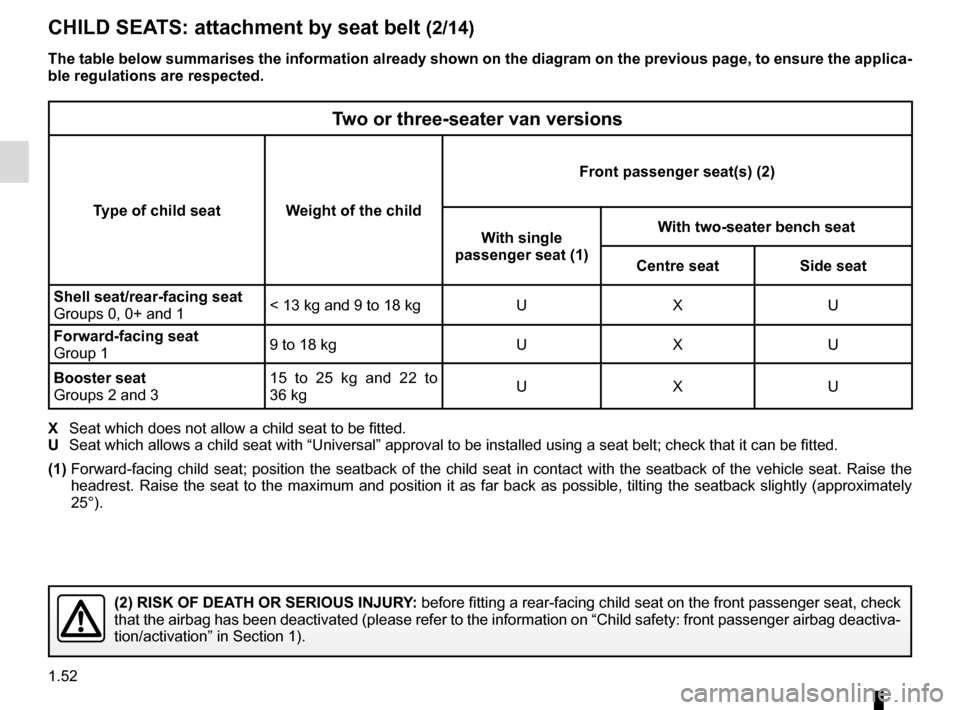
CHILD SEATS: attachment by seat belt (2/14)
Two or three-seater van versions
Type of child seat Weight of the childFront passenger seat(s) (2)
With single
passenger seat (1) With two-seater bench seat
Centre seat Side seat
Shell seat/rear-facing seat
Groups 0, 0+ and 1 < 13 kg and 9 to 18 kg U X U
Forward-facing seat
Group 1 9 to 18 kg U X U
Booster seat
Groups 2 and 3 15 to 25 kg and 22 to
36 kg
UXU
X Seat which does not allow a child seat to be fitted.
U Seat which allows a child seat with “Universal” approval to be ins\
talled using a seat belt; check that it can be fitted.
(1) Forward-facing child seat; position the seatback of the child seat in co\
ntact with the seatback of the vehicle seat. Raise the
headrest. Raise the seat to the maximum and position it as far back as p\
ossible, tilting the seatback slightly (approximately
25°).
(2) RISK OF DEATH OR SERIOUS INJURY: before fitting a rear-facing child seat on the front passenger seat, ch\
eck
that the airbag has been deactivated (please refer to the information o\
n “Child safety: front passenger airbag deactiva-
tion/activation” in Section 1).
The table below summarises the information already shown on the diagram \
on the previous page, to ensure the applica-
ble regulations are respected.
Page 59 of 292
1.53
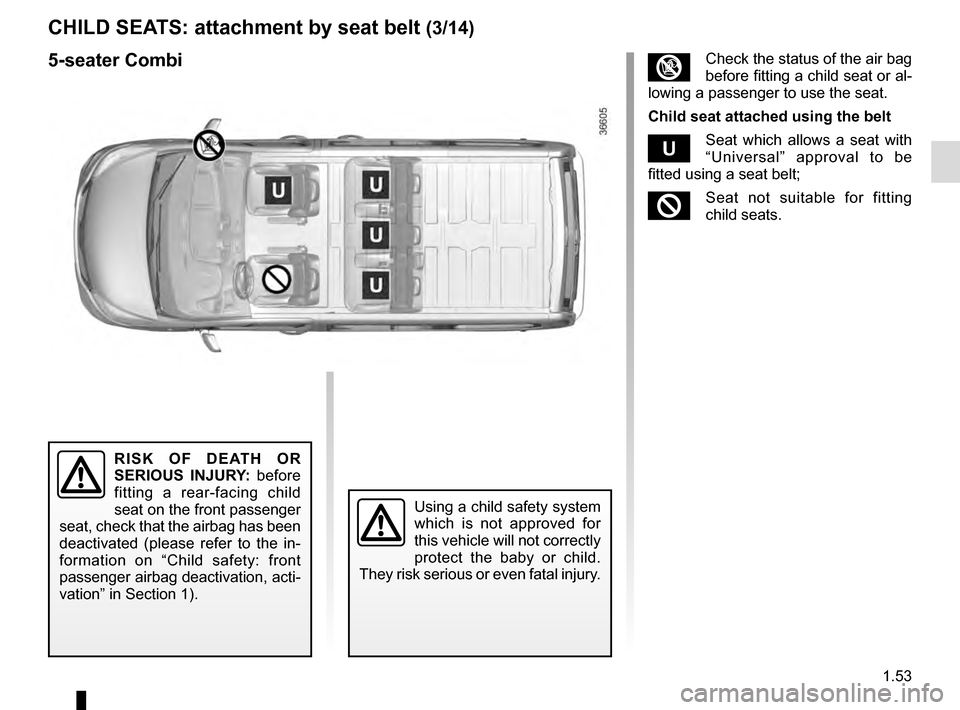
CHILD SEATS: attachment by seat belt (3/14)
Using a child safety system
which is not approved for
this vehicle will not correctly
protect the baby or child.
They risk serious or even fatal injury.
RISK OF DEATH OR
SERIOUS INJURY: before
fitting a rear-facing child
seat on the front passenger
seat, check that the airbag has been
deactivated (please refer to the in-
formation on “Child safety: front
passenger airbag deactivation, acti-
vation” in Section 1).
³Check the status of the air bag
before fitting a child seat or al-
lowing a passenger to use the seat.
Child seat attached using the belt
¬Seat which allows a seat with
“Universal” approval to be
fitted using a seat belt;
²Seat not suitable for fitting
child seats.
5-seater Combi
Page 60 of 292
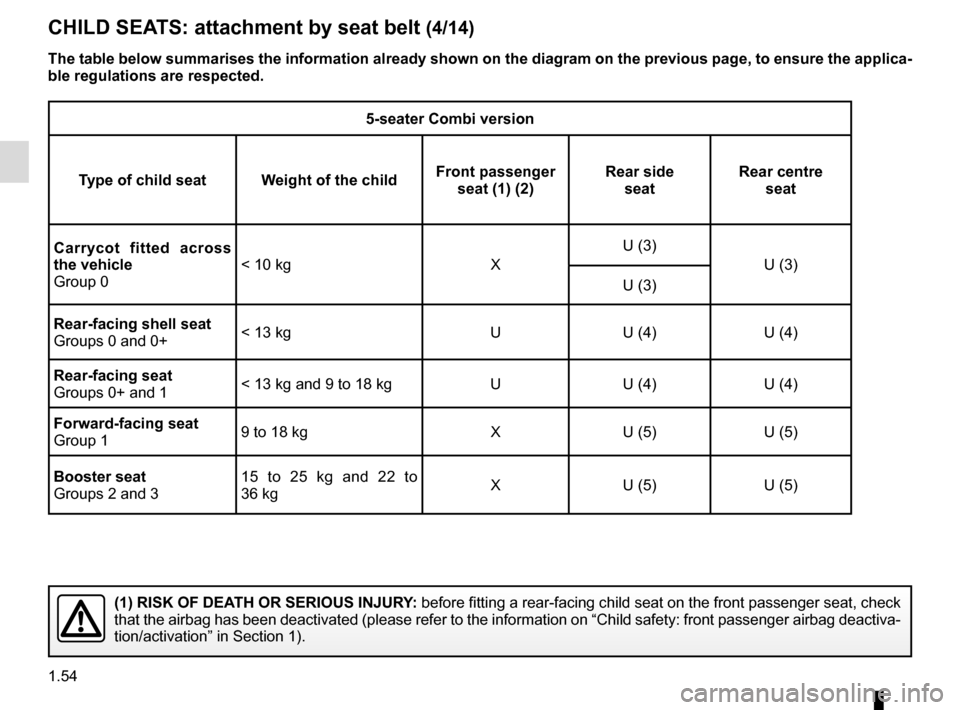
1.54
CHILD SEATS: attachment by seat belt (4/14)
5-seater Combi version
Type of child seat Weight of the child Front passenger
seat (1) (2) Rear side
seat Rear centre
seat
Carrycot fitted across
the vehicle
Group 0 < 10 kg X U (3)
U (3)
U (3)
Rear-facing shell seat
Groups 0 and 0+ < 13 kg U U (4) U (4)
Rear-facing seat
Groups 0+ and 1 < 13 kg and 9 to 18 kg U U (4) U (4)
Forward-facing seat
Group 1 9 to 18 kg X U (5) U (5)
Booster seat
Groups 2 and 3 15 to 25 kg and 22 to
36 kg
X U (5) U (5)
(1) RISK OF DEATH OR SERIOUS INJURY:
before fitting a rear-facing child seat on the front passenger seat, ch\
eck
that the airbag has been deactivated (please refer to the information o\
n “Child safety: front passenger airbag deactiva-
tion/activation” in Section 1).
The table below summarises the information already shown on the diagram \
on the previous page, to ensure the applica-
ble regulations are respected.
Page 61 of 292

X = Seat not suitable for fitting child seats of this type.
U = Seat which allows a child seat with “Universal” approval to be ins\
talled using")
1.55
CHILD SEATS: attachment by seat belt (5/14)
X = Seat not suitable for fitting child seats of this type.
U = Seat which allows a child seat with “Universal” approval to be ins\
talled using a seat belt; check that it can be fitted.
(2) Raise the seat to the maximum and position it as far back as possible, \
tilting the seatback slightly (approximately 25°).
(3) A carrycot can be installed across the vehicle and will take up at least \
two seats. Position the child with his or her feet nea rest
the door.
(4) Move the front seat as far forward as possible to install a rear-facing \
child seat, then move back the seat in front as far as it will
go, although without allowing it to come into contact with the child sea\
t.
(5) Forward-facing child seat; position the seatback of the child seat in co\
ntact with the seatback of the vehicle seat. In all sit ua-
tions, remove the rear headrest of the seat on which the child seat is p\
ositioned. This must be done before fitting the child s eat
(please refer to the section entitled “Rear headrests” in Section\
3). Do not push the seat in front of the child more than half way
back on its runners and do not recline the seatback more than 25°.
Page 62 of 292
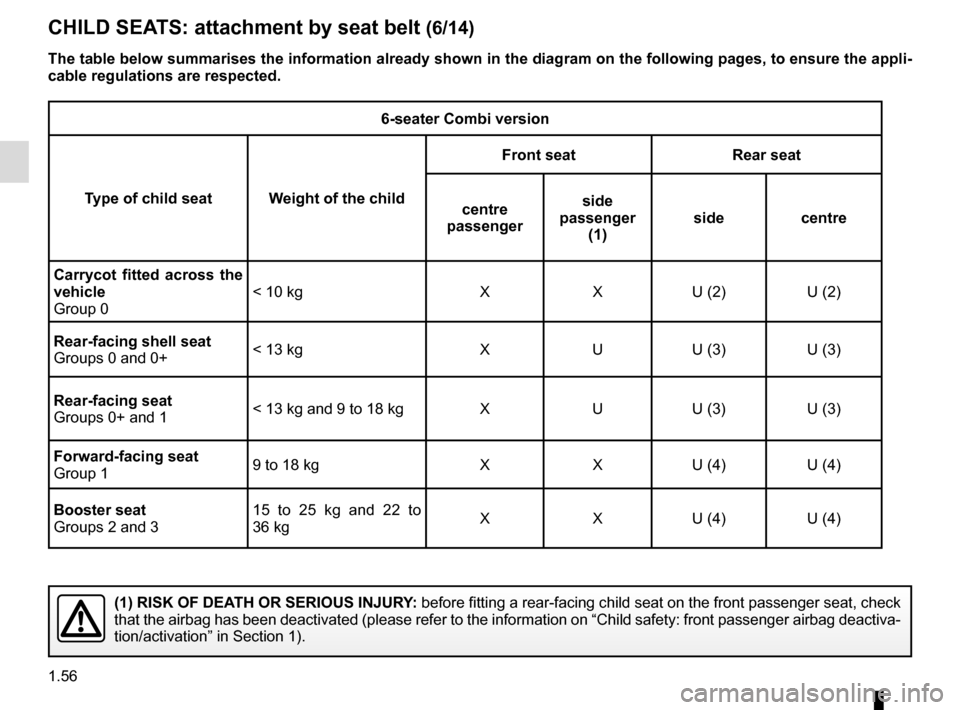
1.56
6-seater Combi version
Type of child seat Weight of the child Front seat Rear seat
centre
passenger side
passenger (1) side centre
Carrycot fitted across the
vehicle
Group 0 < 10 kg X X U (2) U (2)
Rear-facing shell seat
Groups 0 and 0+ < 13 kg X U U (3) U (3)
Rear-facing seat
Groups 0+ and 1 < 13 kg and 9 to 18 kg X U U (3) U (3)
Forward-facing seat
Group 1 9 to 18 kg X X U (4) U (4)
Booster seat
Groups 2 and 3 15 to 25 kg and 22 to
36 kg
X X U (4) U (4)
CHILD SEATS: attachment by seat belt (6/14)
(1) RISK OF DEATH OR SERIOUS INJURY:
before fitting a rear-facing child seat on the front passenger seat, ch\
eck
that the airbag has been deactivated (please refer to the information o\
n “Child safety: front passenger airbag deactiva-
tion/activation” in Section 1).
The table below summarises the information already shown in the diagram \
on the following pages, to ensure the appli-
cable regulations are respected.
Page 63 of 292

X = Seat not suitable for fitting child seats of this type.
U = Seat which allows a child seat with “Universal” approval to be ins\
talled using")
1.57
CHILD SEATS: attachment by seat belt (7/14)
X = Seat not suitable for fitting child seats of this type.
U = Seat which allows a child seat with “Universal” approval to be ins\
talled using a seat belt; check that it can be fitted.
(2) A carrycot can be installed across the vehicle and will take up at least \
two seats. Position the child with his or her feet nea rest
the door.
(3) Move the front seat as far forward as possible to install a rear-facing \
child seat, then move back the seat in front as far as it will
go, although without allowing it to come into contact with the child sea\
t.
(4) Forward-facing child seat; position the seatback of the child seat in co\
ntact with the seatback of the vehicle seat. In all sit ua-
tions, remove the rear headrest of the seat on which the child seat is p\
ositioned. This must be done before fitting the child s eat
(please refer to the section entitled “Rear headrests” in Section\
3). Do not push the seat in front of the child more than half way
back on its runners and do not recline the seatback more than 25°.
Page 64 of 292
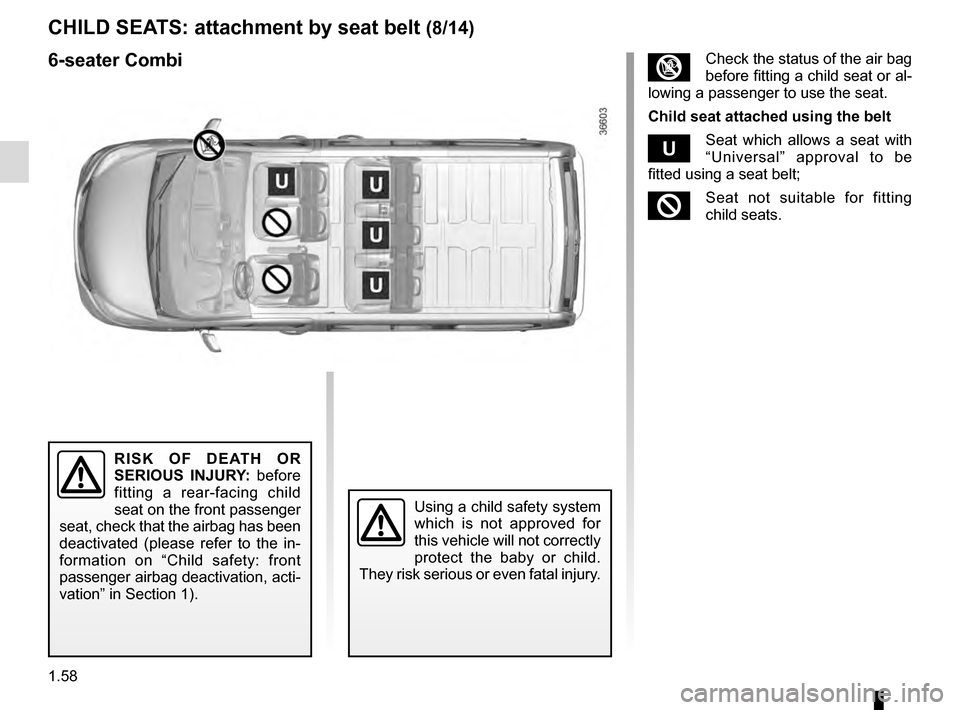
1.58
CHILD SEATS: attachment by seat belt (8/14)
³Check the status of the air bag
before fitting a child seat or al-
lowing a passenger to use the seat.
Child seat attached using the belt
¬Seat which allows a seat with
“Universal” approval to be
fitted using a seat belt;
²Seat not suitable for fitting
child seats.
Using a child safety system
which is not approved for
this vehicle will not correctly
protect the baby or child.
They risk serious or even fatal injury.
RISK OF DEATH OR
SERIOUS INJURY: before
fitting a rear-facing child
seat on the front passenger
seat, check that the airbag has been
deactivated (please refer to the in-
formation on “Child safety: front
passenger airbag deactivation, acti-
vation” in Section 1).
6-seater Combi
Page 65 of 292
1.59
RISK OF DEATH OR
SERIOUS INJURY: before
fitting a rear-facing child
seat on the front passenger
seat, check that the airbag has been
deactivated (please refer to the in-
formation on “Child safety: front
passenger airbag deactivation, acti-
vation” in Section 1).
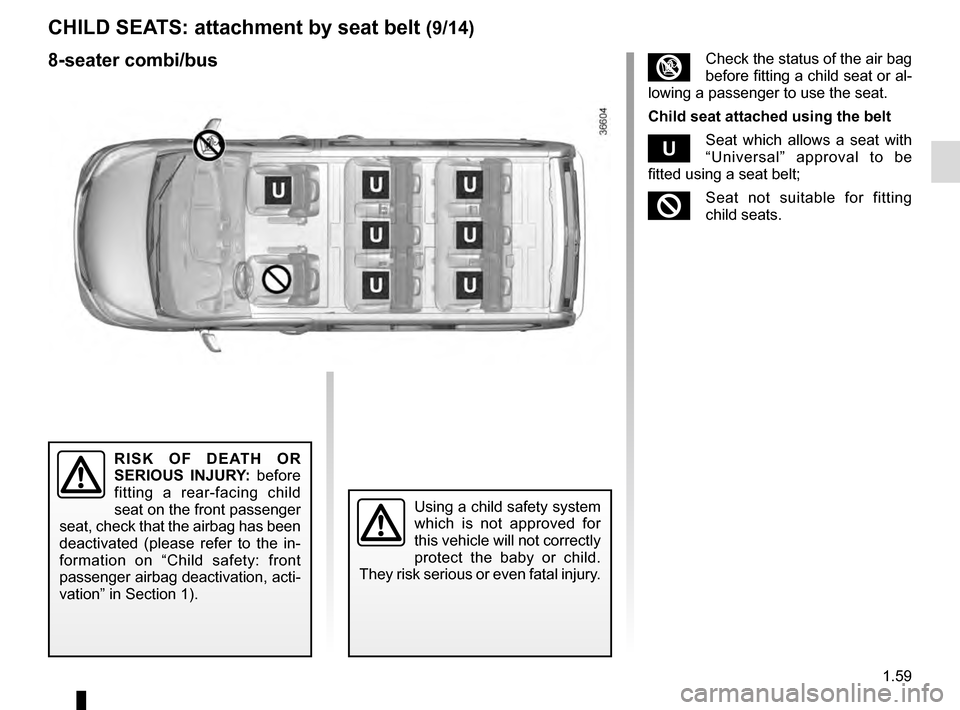
³Check the status of the air bag
before fitting a child seat or al-
lowing a passenger to use the seat.
Child seat attached using the belt
¬Seat which allows a seat with
“Universal” approval to be
fitted using a seat belt;
²Seat not suitable for fitting
child seats.
Using a child safety system
which is not approved for
this vehicle will not correctly
protect the baby or child.
They risk serious or even fatal injury.
CHILD SEATS: attachment by seat belt (9/14)
8-seater combi/bus