Child RENAULT TRAFIC 2016 X82 / 3.G Workshop Manual
[x] Cancel search | Manufacturer: RENAULT, Model Year: 2016, Model line: TRAFIC, Model: RENAULT TRAFIC 2016 X82 / 3.GPages: 292, PDF Size: 3.35 MB
Page 127 of 292
2.3
STARTING, STOPPING THE ENGINE: vehicle with key
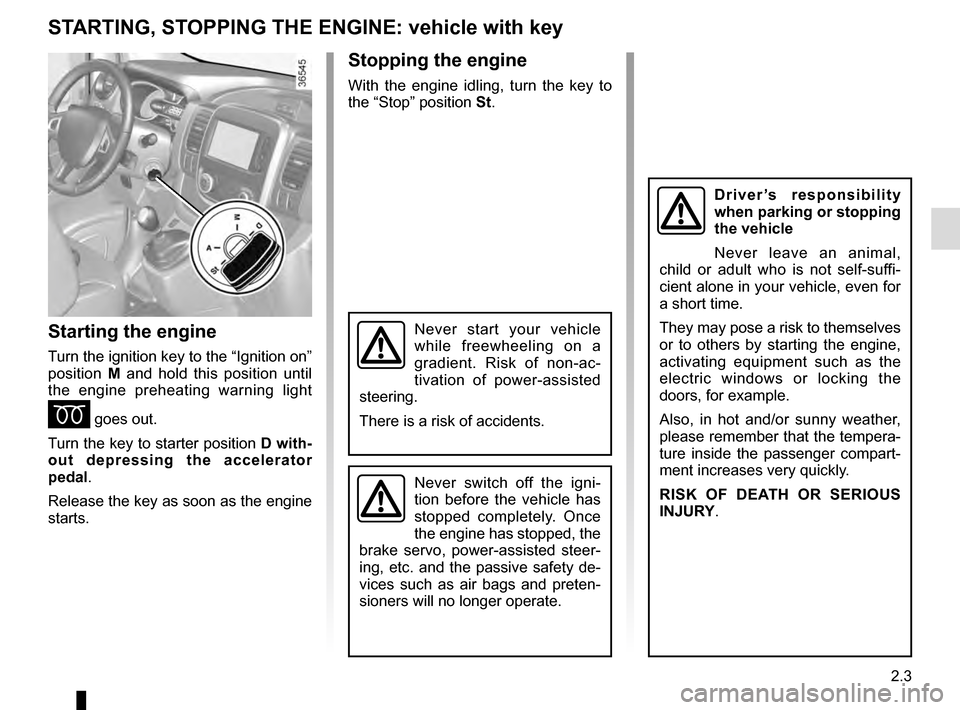
Starting the engine
Turn the ignition key to the “Ignition on”
position M and hold this position until
the engine preheating warning light
É goes out.
Turn the key to starter position D with-
out depressing the accelerator
pedal.
Release the key as soon as the engine
starts.
Stopping the engine
With the engine idling, turn the key to
the “Stop” position St.
Driver’s responsibility
when parking or stopping
the vehicle
Never leave an animal,
child or adult who is not self-suffi-
cient alone in your vehicle, even for
a short time.
They may pose a risk to themselves
or to others by starting the engine,
activating equipment such as the
electric windows or locking the
doors, for example.
Also, in hot and/or sunny weather,
please remember that the tempera-
ture inside the passenger compart-
ment increases very quickly.
RISK OF DEATH OR SERIOUS
INJURY.
Never start your vehicle
while freewheeling on a
gradient. Risk of non-ac-
tivation of power-assisted
steering.
There is a risk of accidents.
Never switch off the igni-
tion before the vehicle has
stopped completely. Once
the engine has stopped, the
brake servo, power-assisted steer-
ing, etc. and the passive safety de-
vices such as air bags and preten-
sioners will no longer operate.
Page 128 of 292
2.4
STARTING, STOPPING THE ENGINE: vehicle with RENAULT CARD (1/3)
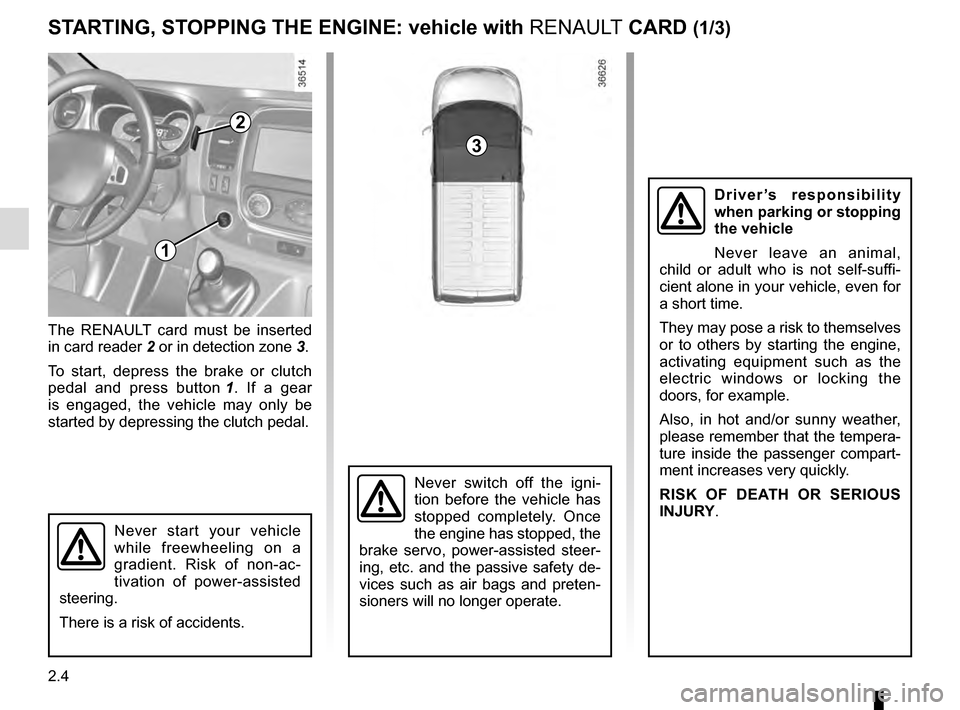
The RENAULT card must be inserted
in card reader 2 or in detection zone 3.
To start, depress the brake or clutch
pedal and press button 1. If a gear
is engaged, the vehicle may only be
started by depressing the clutch pedal.
3
Driver’s responsibility
when parking or stopping
the vehicle
Never leave an animal,
child or adult who is not self-suffi-
cient alone in your vehicle, even for
a short time.
They may pose a risk to themselves
or to others by starting the engine,
activating equipment such as the
electric windows or locking the
doors, for example.
Also, in hot and/or sunny weather,
please remember that the tempera-
ture inside the passenger compart-
ment increases very quickly.
RISK OF DEATH OR SERIOUS
INJURY.
1
2
Never start your vehicle
while freewheeling on a
gradient. Risk of non-ac-
tivation of power-assisted
steering.
There is a risk of accidents.
Never switch off the igni-
tion before the vehicle has
stopped completely. Once
the engine has stopped, the
brake servo, power-assisted steer-
ing, etc. and the passive safety de-
vices such as air bags and preten-
sioners will no longer operate.
Page 130 of 292
2.6
When you leave your vehi-
cle, especially if you have
your RENAULT card with
you, check that the engine
is completely switched off.
With the engine switched off, any ac-
cessories being used (radio, etc.) will
continue to function for approximately
10 minutes.
When the driver’s door is opened, the
accessories stop working.Conditions for stopping the
engine
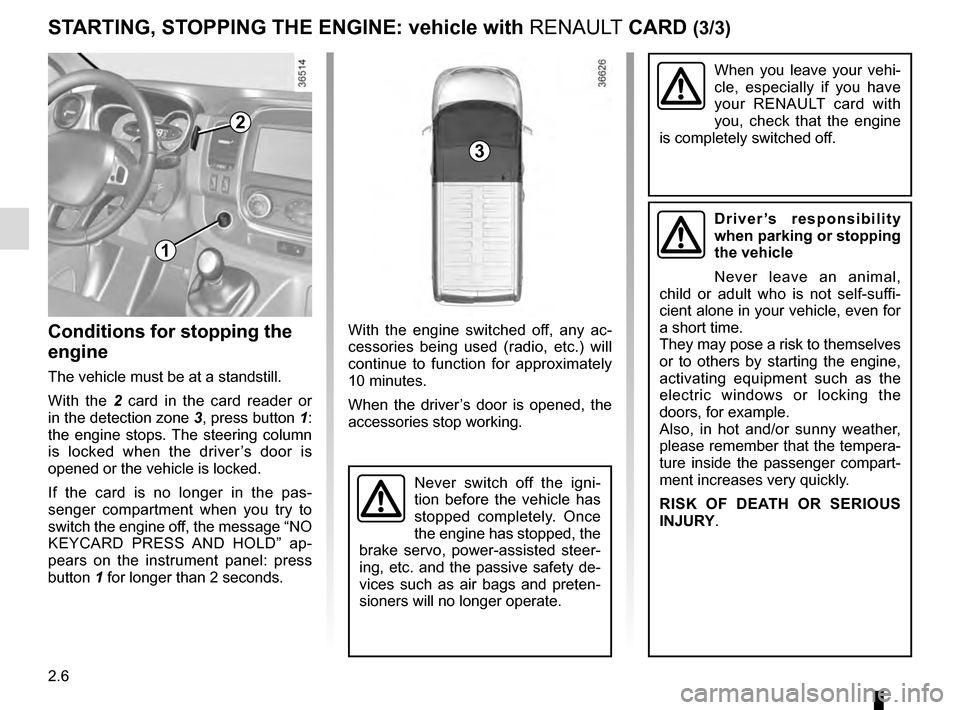
The vehicle must be at a standstill.
With the 2 card in the card reader or
in the detection zone 3, press button 1:
the engine stops. The steering column
is locked when the driver’s door is
opened or the vehicle is locked.
If the card is no longer in the pas-
senger compartment when you try to
switch the engine off, the message “NO
KEYCARD PRESS AND HOLD” ap-
pears on the instrument panel: press
button 1 for longer than 2 seconds.
STARTING, STOPPING THE ENGINE: vehicle with RENAULT CARD (3/3)
3
1
2
Driver’s responsibility
when parking or stopping
the vehicle
Never leave an animal,
child or adult who is not self-suffi-
cient alone in your vehicle, even for
a short time.
They may pose a risk to themselves
or to others by starting the engine,
activating equipment such as the
electric windows or locking the
doors, for example.
Also, in hot and/or sunny weather,
please remember that the tempera-
ture inside the passenger compart-
ment increases very quickly.
RISK OF DEATH OR SERIOUS
INJURY.
Never switch off the igni-
tion before the vehicle has
stopped completely. Once
the engine has stopped, the
brake servo, power-assisted steer-
ing, etc. and the passive safety de-
vices such as air bags and preten-
sioners will no longer operate.
Page 159 of 292
2.35
Operating principle
Ultrasonic detectors, installed in the
rear bumper (depending on the vehi-
cle), measure the distance between the
vehicle and an obstacle whilst revers-
ing.
This measurement is indicated by
beeps which become more frequent the
closer you come to the obstacle, until
they become a continuous beep when
the vehicle is approximately 30 centi-
metres from the obstacle.
NB: make sure that the ultrasonic sen-
sors are not obscured (by dirt, mud,
snow, etc.).
PARKING DISTANCE CONTROL (1/2)Operation
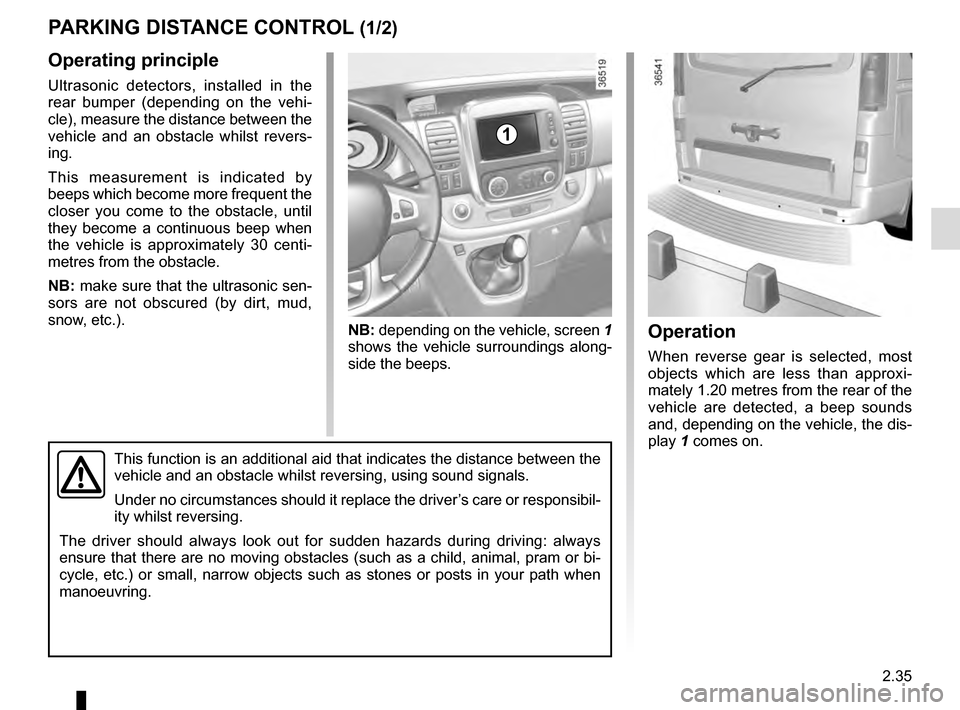
When reverse gear is selected, most
objects which are less than approxi-
mately 1.20 metres from the rear of the
vehicle are detected, a beep sounds
and, depending on the vehicle, the dis-
play 1 comes on.
1
NB: depending on the vehicle, screen 1
shows the vehicle surroundings along-
side the beeps.
This function is an additional aid that indicates the distance between t\
he
vehicle and an obstacle whilst reversing, using sound signals.
Under no circumstances should it replace the driver’s care or responsibil-
ity whilst reversing.
The driver should always look out for sudden hazards during driving: alw\
ays
ensure that there are no moving obstacles (such as a child, animal, pra\
m or bi-
cycle, etc.) or small, narrow objects such as stones or posts in your p\
ath when
manoeuvring.
Page 161 of 292
2.37
REVERSING CAMERA (1/2)
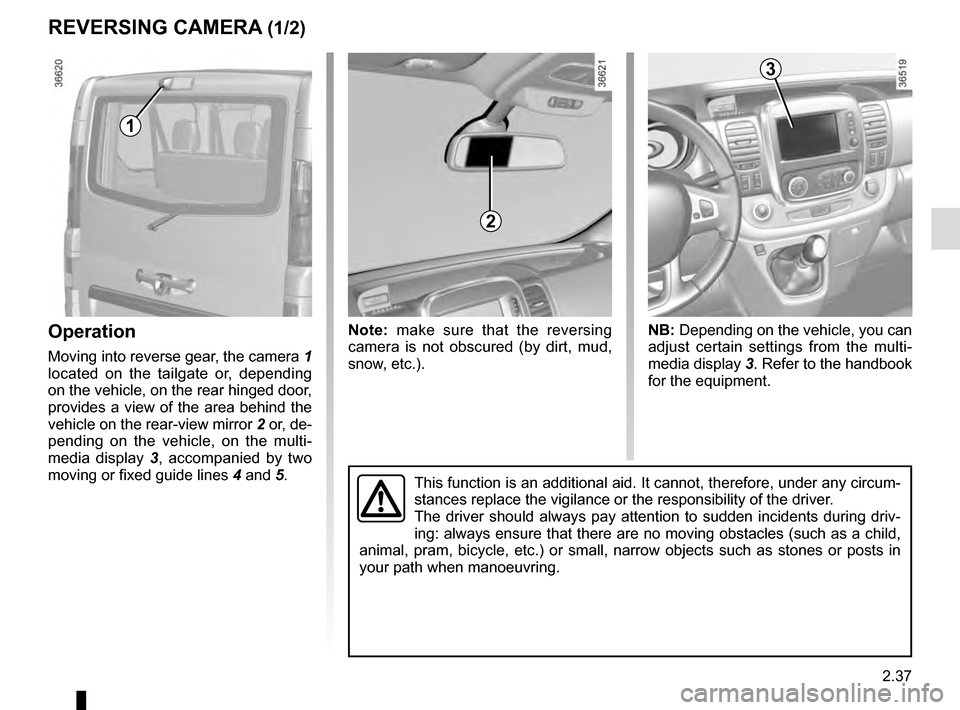
Operation
Moving into reverse gear, the camera 1
located on the tailgate or, depending
on the vehicle, on the rear hinged door,
provides a view of the area behind the
vehicle on the rear-view mirror 2 or, de-
pending on the vehicle, on the multi-
media display 3, accompanied by two
moving or fixed guide lines 4 and 5.
1
Note: make sure that the reversing
camera is not obscured (by dirt, mud,
snow, etc.).
3
NB: Depending on the vehicle, you can
adjust certain settings from the multi-
media display 3. Refer to the handbook
for the equipment.
This function is an additional aid. It cannot, therefore, under any circ\
um-
stances replace the vigilance or the responsibility of the driver.
The driver should always pay attention to sudden incidents during driv-
ing: always ensure that there are no moving obstacles (such as a child,\
animal, pram, bicycle, etc.) or small, narrow objects such as stones or\
posts in
your path when manoeuvring.
2
Page 176 of 292
3.14
WINDOWS (1/2)
Avoid resting any objects against a
half-open window: there is a risk that
the electric window winder could be
damaged.
1
2
3
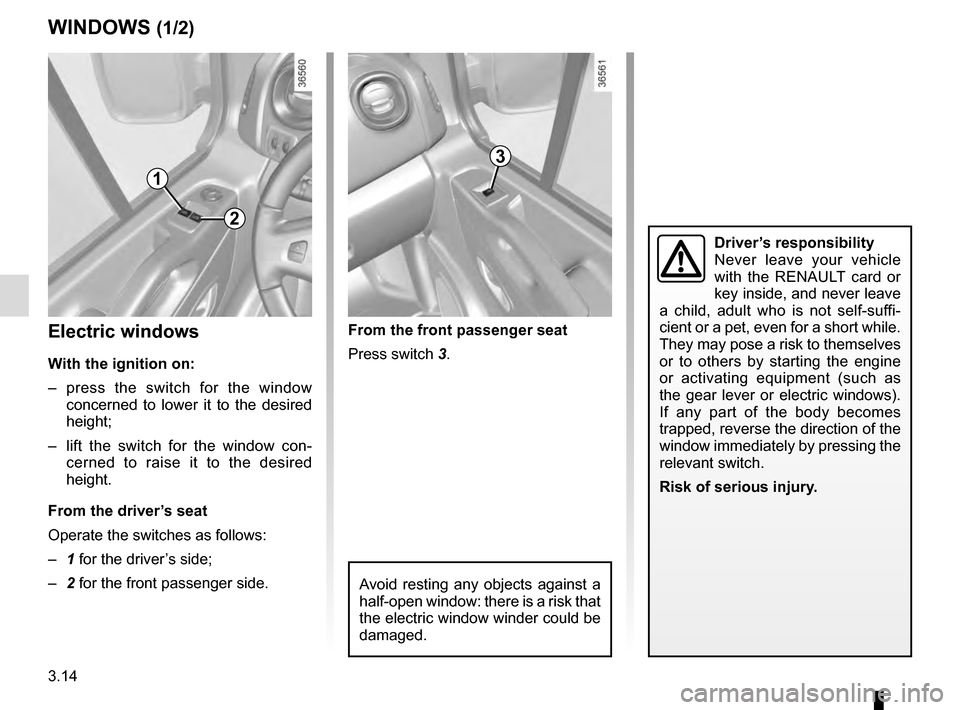
Electric windows
With the ignition on:
– press the switch for the window concerned to lower it to the desired
height;
– lift the switch for the window con- cerned to raise it to the desired
height.
From the driver’s seat
Operate the switches as follows:
– 1 for the driver’s side;
– 2 for the front passenger side. From the front passenger seat
Press switch 3.
Driver’s responsibility
Never leave your vehicle
with the RENAULT card or
key inside, and never leave
a child, adult who is not self-suffi-
cient or a pet, even for a short while.
They may pose a risk to themselves
or to others by starting the engine
or activating equipment (such as
the gear lever or electric windows).
If any part of the body becomes
trapped, reverse the direction of the
window immediately by pressing the
relevant switch.
Risk of serious injury.
Page 216 of 292
4.12
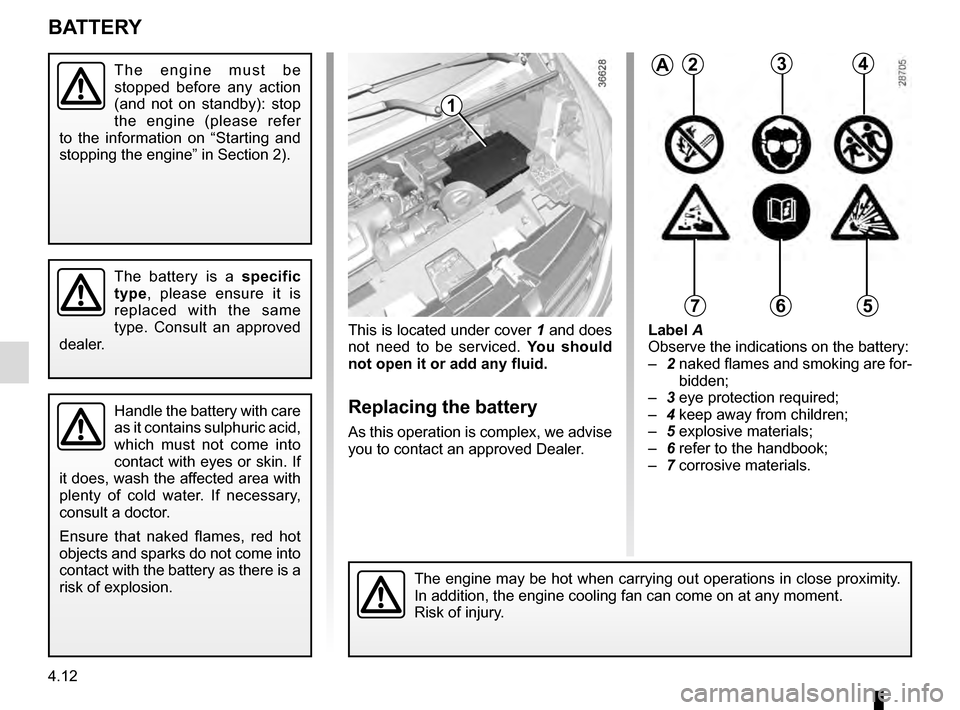
This is located under cover 1 and does
not need to be serviced. You should
not open it or add any fluid.
Replacing the battery
As this operation is complex, we advise
you to contact an approved Dealer.
Label A
Observe the indications on the battery:
– 2 naked flames and smoking are for-
bidden;
– 3 eye protection required;
– 4 keep away from children;
– 5 explosive materials;
– 6 refer to the handbook;
– 7 corrosive materials.
BATTERY
1
2
Handle the battery with care
as it contains sulphuric acid,
which must not come into
contact with eyes or skin. If
it does, wash the affected area with
plenty of cold water. If necessary,
consult a doctor.
Ensure that naked flames, red hot
objects and sparks do not come into
contact with the battery as there is a
risk of explosion.
The battery is a specific
type, please ensure it is
replaced with the same
type. Consult an approved
dealer.
A234
567
The engine may be hot when carrying out operations in close proximity.
In addition, the engine cooling fan can come on at any moment.
Risk of injury.
The engine must be
stopped before any action
(and not on standby): stop
the engine (please refer
to the information on “Starting and
stopping the engine” in Section 2).
Page 285 of 292

A
ABS ..............................................................1.86, \
2.21 → 2.25
accessories.............................................................\
......")
7.1
ALPHABETICAL INDEX (1/5)
A
ABS ..............................................................1.86, \
2.21 → 2.25
accessories.............................................................\
........... 5.30
accessories socket ................................................. 3.28 – 3.29
AdBlue ............................................................... 1.115 → 1.118
AdBlue additive.................................................. 1.115 → 1.118
additional methods of restraint .......................................... 1.43 side protection ............................................................. 1.42
to the front seat belts .......................................1.37 → 1.40
to the rear seat belts .................................................... 1.41
additive (tank) .................................................... 1.115 → 1.118
additive tank ...................................................... 1.115 → 1.118
adjusting your driving position ..1.28 – 1.30, 1.32 → 1.36, 3.30
advice on antipollution ....................................................... 2.16
air bag.......................................1.37 → 1.40, 1.42 – 1.43, 1.84
activating the front passenger air bags ........................ 1.79
deactivating the front passenger air bags .................... 1.77
air conditioning ........................................................3.4 → 3.13
air vents ...................................................................... 3.2 – 3.3
anti-corrosion check ..............................................6.18 → 6.22
anti-corrosion protection .................................................... 4.13
anti-lock braking system: ABS ...............................2.21 → 2.25
antipollution advice .................................................................\
......... 2.16
armrest: front ..................................................................\
............ 3.23
ashtray .................................................................... 3.28 – 3.29
audible and visual signals................................................ 1.108
B
battery............................................................ 4.12, 5.24 – 5.25 troubleshooting ................................................. 5.24 – 5.25
bonnet..................................................................\
....... 4.2 – 4.3
brake fluid ........................................................................\
.... 4.8
bulbs changing ..........................................................5.14 \
→ 5.21C
catalytic converter.....................................................\
......... 2.10
central door locking 1.4 → 1.6, 1.13, 1.16 → 1.21, 1.23 → 1.27
changing a bulb .....................................................5.14 → 5.21
changing a wheel...................................................... 5.9 – 5.10
changing gear .................................................................... 2.11
child restraint/seat ....................1.44 – 1.45, 1.47 → 1.64, 1.77
child safety......1.15, 1.40, 1.44 – 1.45, 1.47 → 1.64, 1.77, 2.4,
3.14 – 3.15
child seats..........................................1.44 – 1.45, 1.4\
7 → 1.64
children ................................. 1.2, 1.7, 1.44 – 1.45, 3.14 – 3.15
children (safety) ................................................... 1.2, 1.7, 1.15
cigar lighter ............................................................. 3.28 – 3.29
cleaning: inside the vehicle .............................................. 4.15 – 4.16
clock ..................................................................... 1.99 – 1.100
closing the doors ........................................... 1.14 – 1.15, 1.27
control instruments ..........................1.84 → 1.91, 1.99 – 1.100
controls ...............................................................\
...1.80 → 1.83
courtesy light ................................................. 3.17 – 3.18, 5.20
cruise control ................................................1.87, 2.29 → 2.32
cruise control-speed limiter....................................2.26 → 2.32
D
dashboard..............................................................1\
.80 → 1.83
deadlocking the doors ................................................ 1.6, 1.13
demisting rear screen ......................................................... 3.8 → 3.11
windscreen .................................................. 3.5, 3.8 → 3.11
dimensions .............................................................\
...6.4 → 6.7
dipstick................................................................\
................. 4.4
display ................................................................\
...1.84 →
1.89
doors...................................................................\
...1.18 → 1.21
doors/tailgate .......................1.2 → 1.8, 1.13, 1.23 – 1.24, 1.27
driver’s position .....................................................1.80 →
1.87
driving ............ 2.2 → 2.6, 2.10, 2.14, 2.18 → 2.33, 2.35 – 2.36
Page 289 of 292
7.5
ALPHABETICAL INDEX (5/5)
towing hitch............................................. 5.7 – 5.8, 5.33 – 5.34
towing rings ...........................................................3.36 → 3.39
towing weights .......................................................... 6.9 – 6.10
traction control .......................................................2.21 → 2.25
transporting children .................1.44 – 1.45, 1.47 → 1.64, 1.77
transporting objects in the luggage compartment ............................3.36 → 3.39
on the roof ........................................................... 6.9 – 6.10
trip computer and warning system... 1.84 → 1.87, 1.90 → 1.98
tyre inflation kit......................................................\
.....5.4 → 5.6
tyre pressure............................. 2.18 → 2.20, 4.10 – 4.11, 5.12
tyre pressure loss warning.....................................2.18 → 2.20
tyre pressures ......................................................... 4.10 – 4.11
tyres ............................. 2.18 → 2.20, 4.10 – 4.11, 5.11 → 5.13
U
unlocking the doors ...............................................1.23 → 1.26
V
variable power-assisted steering ....................................... 1.31
vehicle identification plates .................................................. 6.3
ventilation ............................................................\
....3.2 → 3.13
W
warning lights.........................................................1\
.84 → 1.98
washing .................................................................. 4.13 – 4.14
weights ..................................................................... 6.9 – 6.10
wheel trim ........................................................................\
.... 5.8
wheelbrace ................................................................. 5.7 – 5.8
wheels (safety) ...................................................... 5.11 → 5.13
windscreen de-icing/demisting ................................ 3.8 → 3.11
windscreen washer ............................................ 1.109 → 1.111
wiper blades ........................................................... 5.31 – 5.32
wipers ................................................................ 1.109 → 1.111
blades ............................................................... 5.31 – 5.32