warning light RENAULT TRAFIC 2018 User Guide
[x] Cancel search | Manufacturer: RENAULT, Model Year: 2018, Model line: TRAFIC, Model: RENAULT TRAFIC 2018Pages: 298, PDF Size: 8.05 MB
Page 44 of 298
1.38
Load limiter
Above a certain severity of impact, this
mechanism is used to limit the force of
the belt against the body so that it is at
an acceptable level.
Airbags driver and passenger
front
Fitted to the driver and passenger
sides.
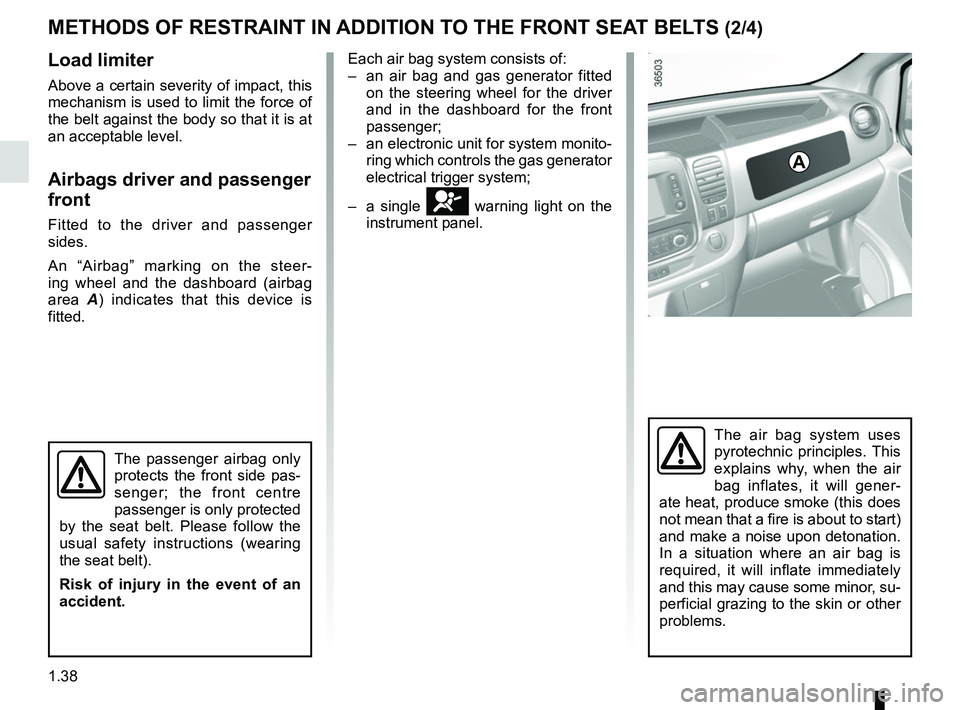
An “Airbag” marking on the steer-
ing wheel and the dashboard (airbag
area A) indicates that this device is
fitted.
Each air bag system consists of:
– an air bag and gas generator fitted on the steering wheel for the driver
and in the dashboard for the front
passenger;
– an electronic unit for system monito- ring which controls the gas generator
electrical trigger system;
– a single
å warning light on the
instrument panel.
METHODS OF RESTRAINT IN ADDITION TO THE FRONT SEAT BELTS (2/4)
The air bag system uses
pyrotechnic principles. This
explains why, when the air
bag inflates, it will gener-
ate heat, produce smoke (this does
not mean that a fire is about to start)
and make a noise upon detonation.
In a situation where an air bag is
required, it will inflate immediately
and this may cause some minor, su-
perficial grazing to the skin or other
problems.
A
The passenger airbag only
protects the front side pas-
senger; the front centre
passenger is only protected
by the seat belt. Please follow the
usual safety instructions (wearing
the seat belt).
Risk of injury in the event of an
accident.
Page 45 of 298
1.39
METHODS OF RESTRAINT IN ADDITION TO THE FRONT SEAT BELTS (3/4)
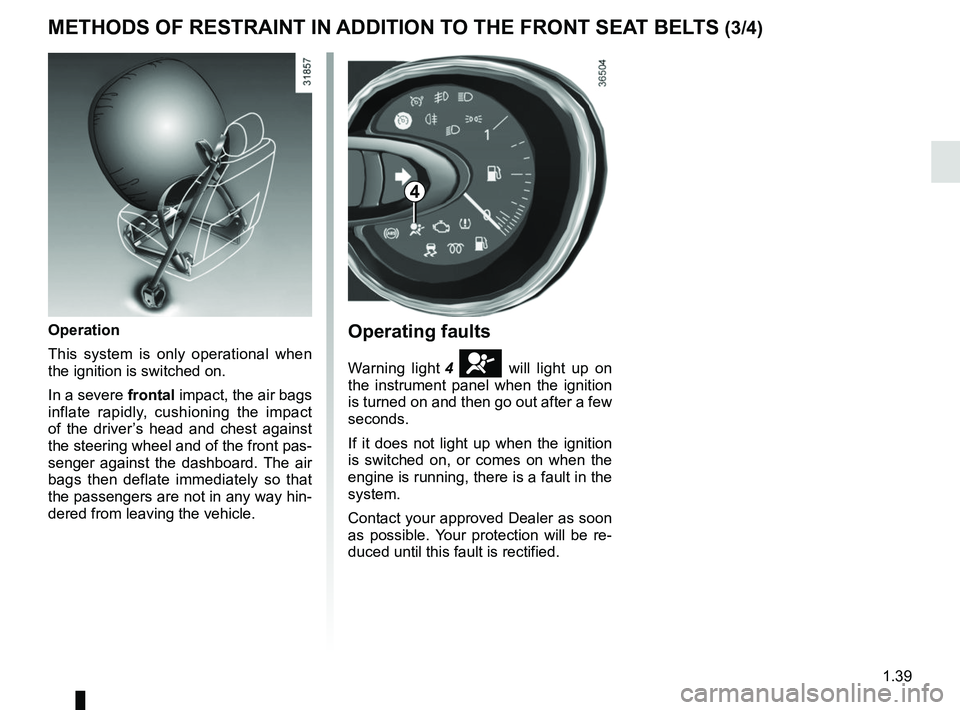
Operating faults
Warning light 4 å will light up on
the instrument panel when the ignition
is turned on and then go out after a few
seconds.
If it does not light up when the ignition
is switched on, or comes on when the
engine is running, there is a fault in the
system.
Contact your approved Dealer as soon
as possible. Your protection will be re-
duced until this fault is rectified.
4
Operation
This system is only operational when
the ignition is switched on.
In a severe frontal impact, the air bags
inflate rapidly, cushioning the impact
of the driver’s head and chest against
the steering wheel and of the front pas-
senger against the dashboard. The air
bags then deflate immediately so that
the passengers are not in any way hin-
dered from leaving the vehicle.
Page 46 of 298
1.40
METHODS OF RESTRAINT IN ADDITION TO THE FRONT SEAT BELTS (4/4)
Warnings concerning the driver’s air bag
– Do not modify the steering wheel or the steering wheel boss.
– Do not cover the steering wheel boss under any circumstances.
– Do not attach any objects (badge, logo, clock, telephone holder, etc.) to the steering wheel boss.
– The steering wheel must not be removed (except by qualified personnel f\
rom our Network).
– When driving, do not sit too close to the steering wheel. Sit with your \
arms slightly bent (see the information on “Adjusting
your driving position” in Section 1). This will allow sufficient space for the air bag to deploy correctly and be fully effective.
Warnings concerning the passenger air bag
– Do not attach or glue any objects (badge, logo, clock, telephone holder\
, etc.) to the dashboard on or near the air bag.
– Do not place anything between the dashboard and the passenger (pet, umb\
rella, walking stick, parcels, etc.).
– The passenger must not put his or her feet on the dashboard or seat as t\
here is a risk that serious injuries may occur. In general, parts of the body should be kept away from the dashboard (knee\
s, hands, head, etc.).
– The devices in addition to the front passenger seat belt should be react\
ivated as soon as a child seat is removed, to ensure the protection of the passenger in the event of an impact.
A REAR-FACING CHILD SEAT MUST NOT BE FITTED TO THE FRONT PASSENGER SEAT UNLESS THE ADDITIONAL RESTRAINT SYSTEMS, I.E. THE PASSENGER AIR BAG, ARE DEACTIVATED.
(refer to the information on “Child safety: deactivating/activating \
the front passenger air bag” in Section 1)
All of the warnings below are given so that the air bag is not obstructe\
d in any way when it is inflated and also to prevent
the risk of serious injuries caused by items which may be dislodged when\
the air bag inflates.
Page 83 of 298
1.77
CHILD SAFETY: deactivating, activating the front passenger air bag (1/3)
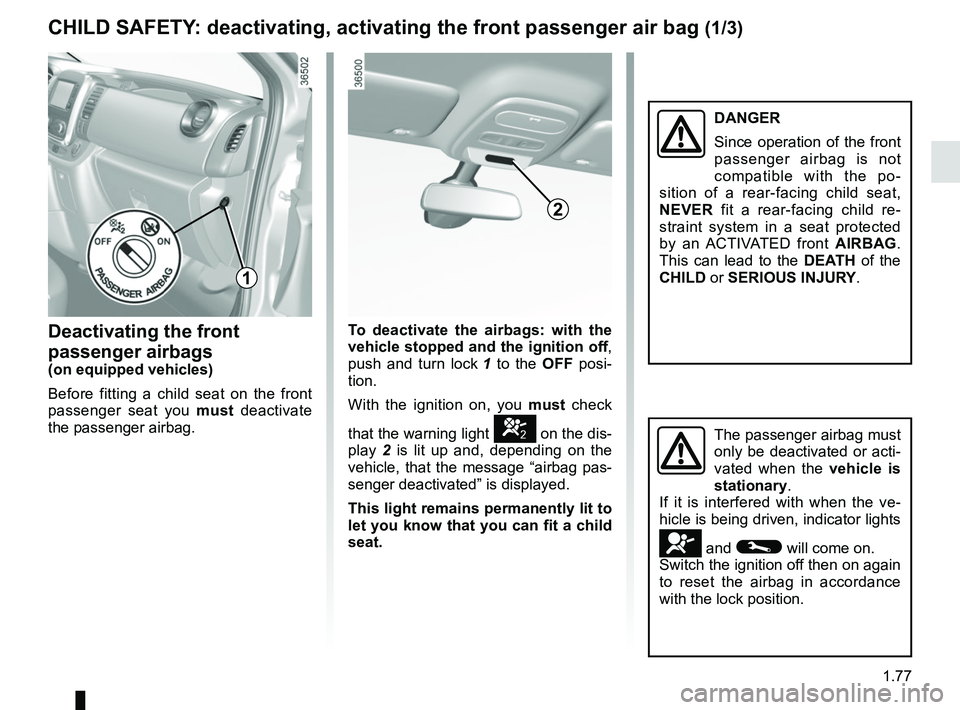
Deactivating the front
passenger airbags
(on equipped vehicles)
Before fitting a child seat on the front
passenger seat you must deactivate
the passenger airbag.To deactivate the
airbags: with the
vehicle stopped and the ignition off ,
push and turn lock 1 to the OFF posi-
tion.
With the ignition on, you must check
that the warning light
] on the dis-
play 2 is lit up and, depending on the
vehicle, that the message “airbag pas-
senger deactivated” is displayed.
This light remains permanently lit to
let you know that you can fit a child
seat.
2
The passenger airbag must
only be deactivated or acti-
vated when the vehicle is
stationary.
If it is interfered with when the ve-
hicle is being driven, indicator lights
å and © will come on.
Switch the ignition off then on again
to reset the airbag in accordance
with the lock position.
DANGER
Since operation of the front
passenger airbag is not
compatible with the po-
sition of a rear-facing child seat,
NEVER fit a rear-facing child re-
straint system in a seat protected
by an ACTIVATED front AIRBAG. This can lead to the DEATH of the
CHILD or SERIOUS INJURY.
1
Page 85 of 298
1.79
CHILD SAFETY: deactivating, activating the front passenger air bag (3/3)
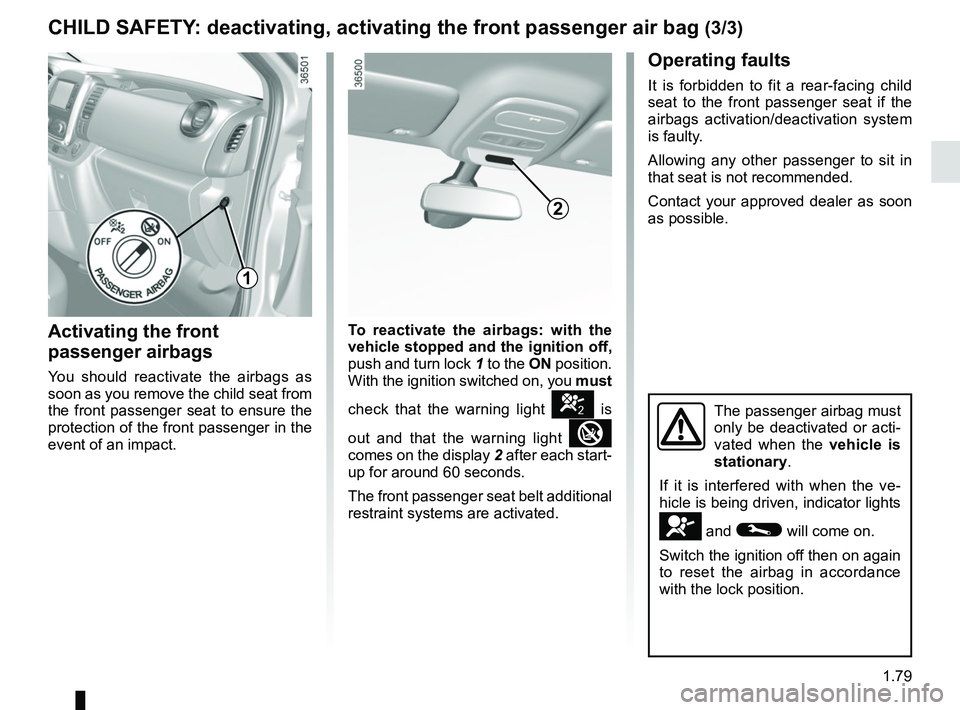
Activating the front
passenger airbags
You should reactivate the airbags as
soon as you remove the child seat from
the front passenger seat to ensure the
protection of the front passenger in the
event of an impact.
The passenger airbag must
only be deactivated or acti-
vated when the vehicle is
stationary.
If it is interfered with when the ve-
hicle is being driven, indicator lights
å and © will come on.
Switch the ignition off then on again
to reset the airbag in accordance
with the lock position.
2
Operating faults
It is forbidden to fit a rear-facing child
seat to the front passenger seat if the
airbags activation/deactivation system
is faulty.
Allowing any other passenger to sit in
that seat is not recommended.
Contact your approved dealer as soon
as possible.
To reactivate the airbags: with the
vehicle stopped and the ignition off,
push and turn lock 1 to the ON position.
With the ignition switched on, you must
check that the warning light
] is
out and that the warning light
comes on the display 2 after each start-
up for around 60 seconds.
The front passenger seat belt additional
restraint systems are activated.
1
Page 87 of 298
1.81
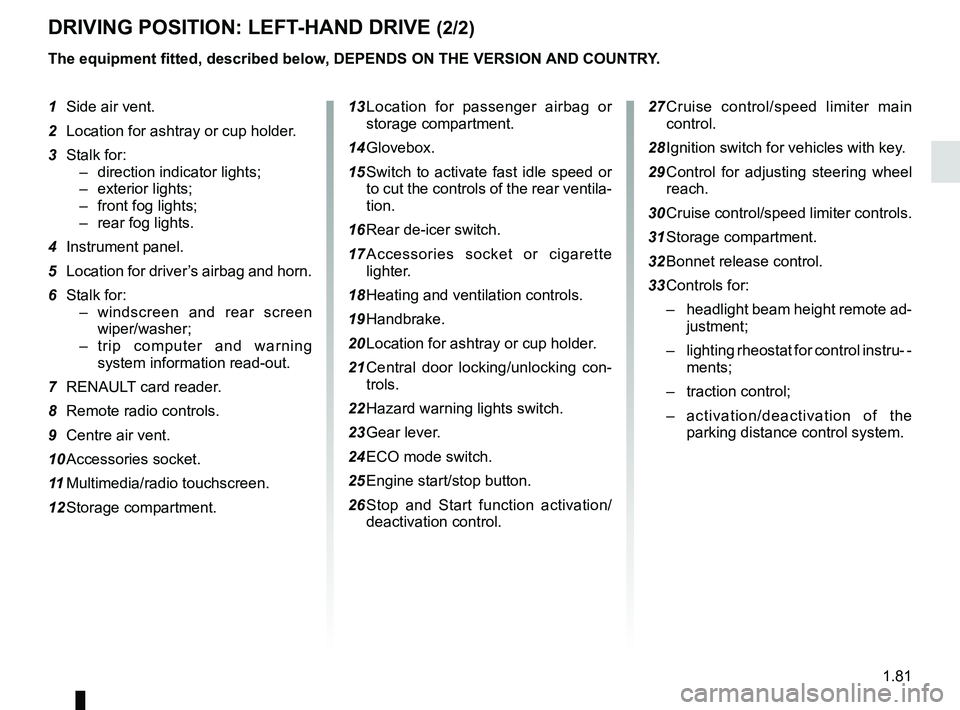
DRIVING POSITION: LEFT-HAND DRIVE (2/2)
The equipment fitted, described below, DEPENDS ON THE VERSION AND COUNTRY.
1 Side air vent.
2 Location for ashtray or cup holder.
3 Stalk for:– direction indicator lights;
– exterior lights;
– front fog lights;
– rear fog lights.
4 Instrument panel.
5 Location for driver’s airbag and horn.
6 Stalk for: – windscreen and rear screen wiper/washer;
– trip computer and warning system information read-out.
7 RENAULT card reader.
8 Remote radio controls.
9 Centre air vent.
10 Accessories socket.
11 Multimedia/radio touchscreen.
12 Storage compartment. 13 Location for passenger airbag or
storage compartment.
14 Glovebox.
15 Switch to activate fast idle speed or to cut the controls of the rear ventila-
tion.
16 Rear de-icer switch.
17 Accessories socket or cigarette lighter.
18 Heating and ventilation controls.
19 Handbrake.
20 Location for ashtray or cup holder.
21 Central door locking/unlocking con- trols.
22 Hazard warning lights switch.
23 Gear lever.
24 ECO mode switch.
25 Engine start/stop button.
26 Stop and Start function activation/ deactivation control.
27 Cruise control/speed limiter main control.
28 Ignition switch for vehicles with key.
29 Control for adjusting steering wheel reach.
30 Cruise control/speed limiter controls.
31 Storage compartment.
32 Bonnet release control.
33 Controls for: – headlight beam height remote ad-
justment;
– lighting rheostat for control instru- -
ments;
– traction control;
– activation/deactivation of the
parking distance control system.
Page 89 of 298
1.83
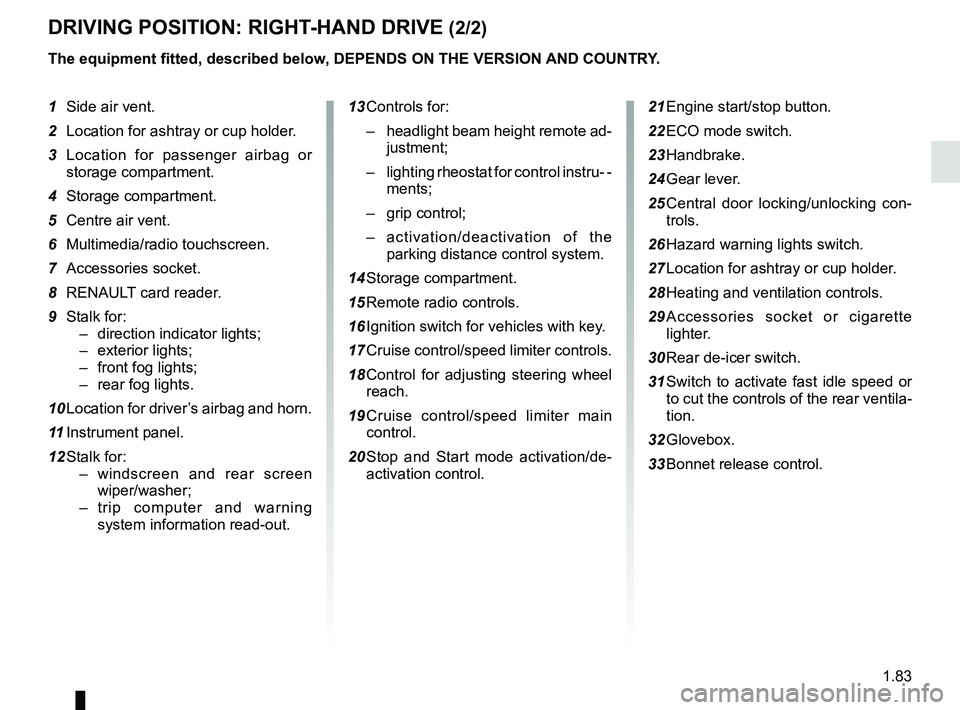
DRIVING POSITION: RIGHT-HAND DRIVE (2/2)
The equipment fitted, described below, DEPENDS ON THE VERSION AND COUNTRY.
1 Side air vent.
2 Location for ashtray or cup holder.
3 Location for passenger airbag or storage compartment.
4 Storage compartment.
5 Centre air vent.
6 Multimedia/radio touchscreen.
7 Accessories socket.
8 RENAULT card reader.
9 Stalk for: – direction indicator lights;
– exterior lights;
– front fog lights;
– rear fog lights.
10 Location for driver’s airbag and horn.
11 Instrument panel.
12 Stalk for: – windscreen and rear screen wiper/washer;
– trip computer and warning system information read-out. 13 Controls for:
– headlight beam height remote ad-
justment;
– lighting rheostat for control instru- -
ments;
– grip control;
– activation/deactivation of the
parking distance control system.
14 Storage compartment.
15 Remote radio controls.
16 Ignition switch for vehicles with key.
17 Cruise control/speed limiter controls.
18 Control for adjusting steering wheel reach.
19 Cruise control/speed limiter main control.
20 Stop and Start mode activation/de- activation control. 21 Engine start/stop button.
22 ECO mode switch.
23 Handbrake.
24 Gear lever.
25 Central door locking/unlocking con-
trols.
26 Hazard warning lights switch.
27 Location for ashtray or cup holder.
28 Heating and ventilation controls.
29 Accessories socket or cigarette lighter.
30 Rear de-icer switch.
31 Switch to activate fast idle speed or to cut the controls of the rear ventila-
tion.
32 Glovebox.
33 Bonnet release control.
Page 90 of 298
1.84
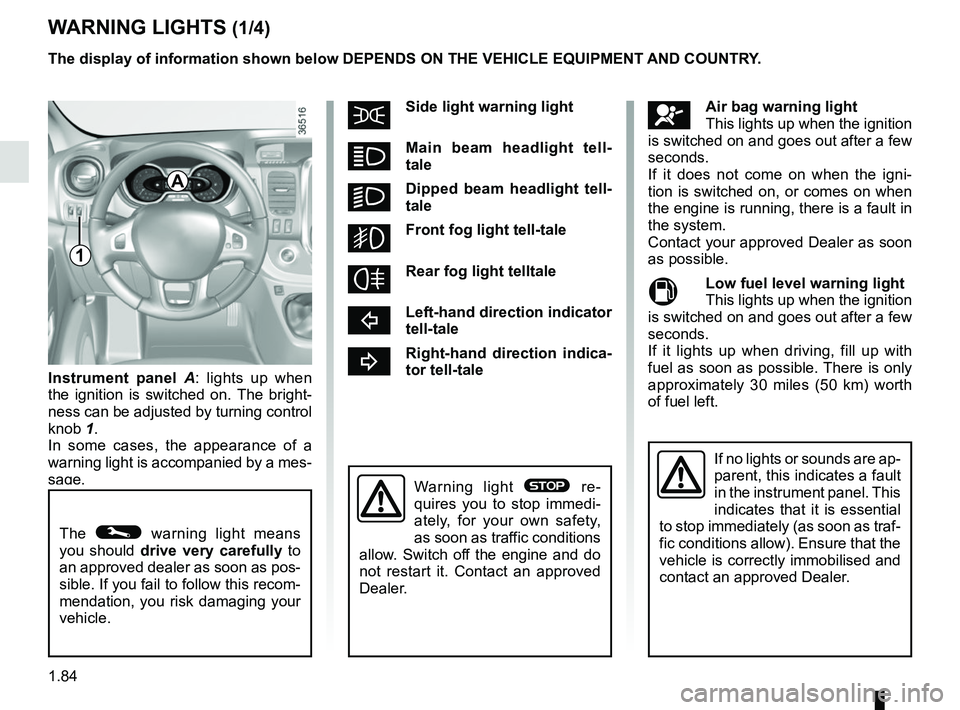
WARNING LIGHTS (1/4)
šSide light warning light
áMain beam headlight tell-
tale
kDipped beam headlight tell-
tale
gFront fog light tell-tale
fRear fog light telltale
cLeft-hand direction indicator
tell-tale
bRight-hand direction indica-
tor tell-tale
åAir bag warning light
This lights up when the ignition
is switched on and goes out after a few
seconds.
If it does not come on when the igni-
tion is switched on, or comes on when
the engine is running, there is a fault in
the system.
Contact your approved Dealer as soon
as possible.
MLow fuel level warning light
This lights up when the ignition
is switched on and goes out after a few
seconds.
If it lights up when driving, fill up with
fuel as soon as possible. There is only
approximately 30 miles (50 km) worth
of fuel left.
A
If no lights or sounds are ap-
parent, this indicates a fault
in the instrument panel. This
indicates that it is essential
to stop immediately (as soon as traf-
fic conditions allow). Ensure that the
vehicle is correctly immobilised and
contact an approved Dealer.
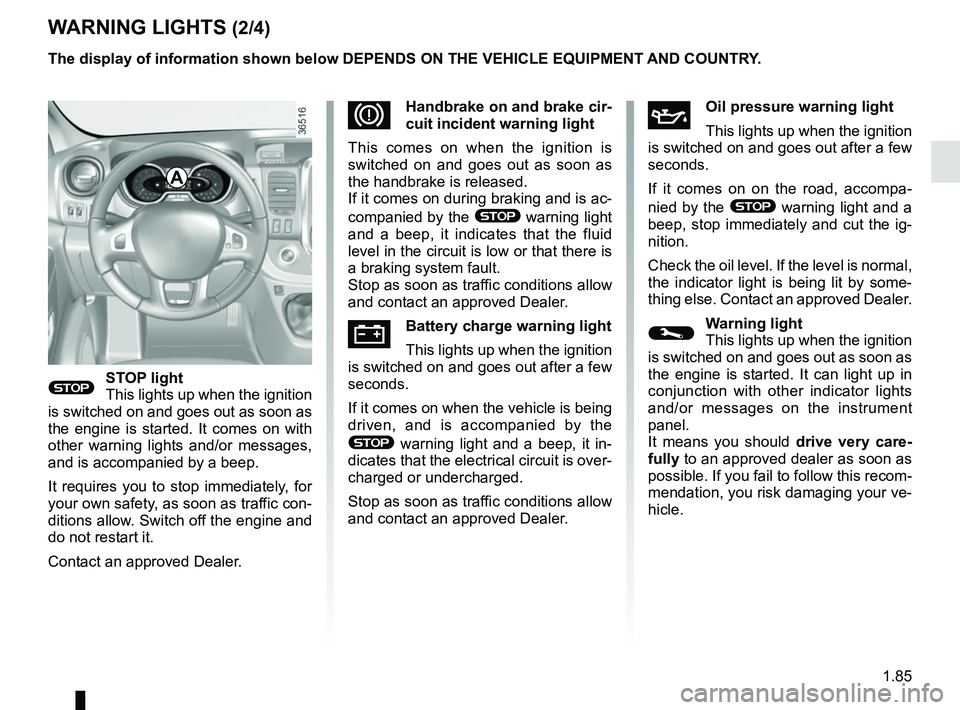
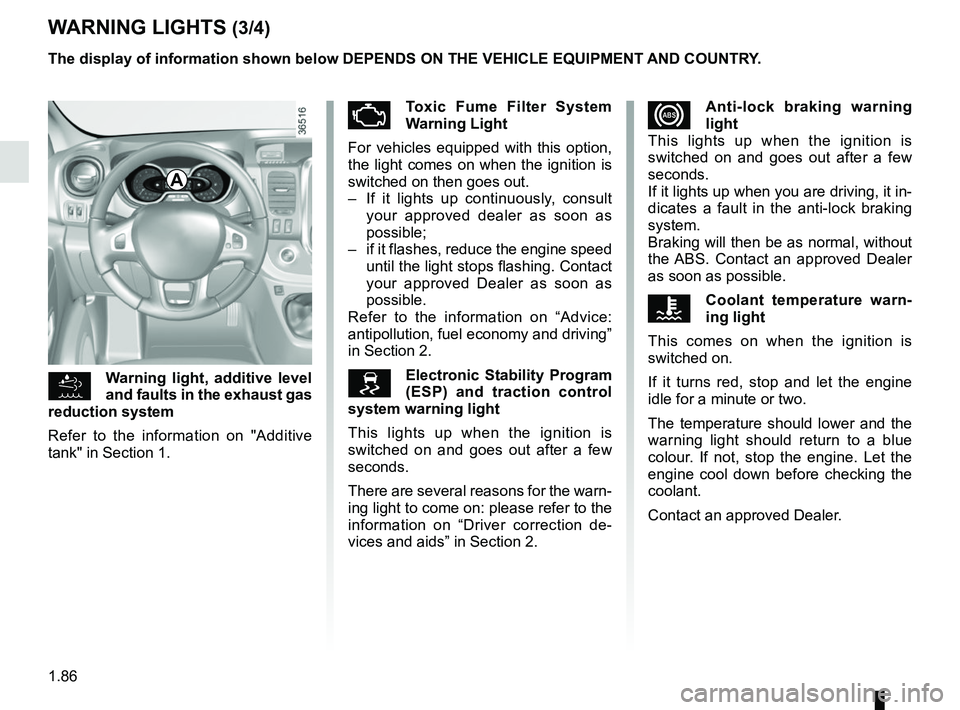
Instrument panel A: lights up when
the ignition is switched on. The bright-
ness can be adjusted by turning control
knob 1.
In some cases, the appearance of a
warning light is accompanied by a mes-
sage.
The © warning light means
you should drive very carefully to
an approved dealer as soon as pos-
sible. If you fail to follow this recom-
mendation, you risk damaging your
vehicle.
Warning light ® re-
quires you to stop immedi-
ately, for your own safety,
as soon as traffic conditions
allow. Switch off the engine and do
not restart it. Contact an approved
Dealer.
The display of information shown below DEPENDS ON THE VEHICLE EQUIPMENT \
AND COUNTRY.
1
Page 91 of 298
1.85
WARNING LIGHTS (2/4)
®STOP light
This lights up when the ignition
is switched on and goes out as soon as
the engine is started. It comes on with
other warning lights and/or messages,
and is accompanied by a beep.
It requires you to stop immediately, for
your own safety, as soon as traffic con-
ditions allow. Switch off the engine and
do not restart it.
Contact an approved Dealer.
ÀOil pressure warning light
This lights up when the ignition
is switched on and goes out after a few
seconds.
If it comes on on the road, accompa-
nied by the
® warning light and a
beep, stop immediately and cut the ig-
nition.
Check the oil level. If the level is normal,
the indicator light is being lit by some-
thing else. Contact an approved Dealer.
©Warning light
This lights up when the ignition
is switched on and goes out as soon as
the engine is started. It can light up in
conjunction with other indicator lights
and/or messages on the instrument
panel.
It means you should drive very care-
fully to an approved dealer as soon as
possible. If you fail to follow this recom-
mendation, you risk damaging your ve-
hicle.
DHandbrake on and brake cir-
cuit incident warning light
This comes on when the ignition is
switched on and goes out as soon as
the handbrake is released.
If it comes on during braking and is ac-
companied by the
® warning light
and a beep, it indicates that the fluid
level in the circuit is low or that there is
a braking system fault.
Stop as soon as traffic conditions allow
and contact an approved Dealer.
ÚBattery charge warning light
This lights up when the ignition
is switched on and goes out after a few
seconds.
If it comes on when the vehicle is being
driven, and is accompanied by the
® warning light and a beep, it in-
dicates that the electrical circuit is over-
charged or undercharged.
Stop as soon as traffic conditions allow
and contact an approved Dealer.
A
The display of information shown below DEPENDS ON THE VEHICLE EQUIPMENT \
AND COUNTRY.
Page 92 of 298
1.86
xAnti-lock braking warning
light
This lights up when the ignition is
switched on and goes out after a few
seconds.
If it lights up when you are driving, it in-
dicates a fault in the anti-lock braking
system.
Braking will then be as normal, without
the ABS. Contact an approved Dealer
as soon as possible.
ÔCoolant temperature warn-
ing light
This comes on when the ignition is
switched on.
If it turns red, stop and let the engine
idle for a minute or two.
The temperature should lower and the
warning light should return to a blue
colour. If not, stop the engine. Let the
engine cool down before checking the
coolant.
Contact an approved Dealer.
WARNING LIGHTS (3/4)
Warning light, additive level
and faults in the exhaust gas
reduction system
Refer to the information on "Additive
tank" in Section 1.
ÄToxic Fume Filter System
Warning Light
For vehicles equipped with this option,
the light comes on when the ignition is
switched on then goes out.
– If it lights up continuously, consult your approved dealer as soon as
possible;
– if it flashes, reduce the engine speed until the light stops flashing. Contact
your approved Dealer as soon as
possible.
Refer to the information on “Advice:
antipollution, fuel economy and driving”
in Section 2.
Electronic Stability Program
(ESP) and traction control
system warning light
This lights up when the ignition is
switched on and goes out after a few
seconds.
There are several reasons for the warn-
ing light to come on: please refer to the
information on “Driver correction de-
vices and aids” in Section 2.
A
The display of information shown below DEPENDS ON THE VEHICLE EQUIPMENT \
AND COUNTRY.