warning light RENAULT TRAFIC 2018 Owner's Guide
[x] Cancel search | Manufacturer: RENAULT, Model Year: 2018, Model line: TRAFIC, Model: RENAULT TRAFIC 2018Pages: 298, PDF Size: 8.05 MB
Page 122 of 298
1.116
Please ensure that you comply with the
legislation of your country.
It is important to remember that failure
to respect regulations in force could
lead to legal action being taken against
the vehicle owner.
Operating principleThe use of additives reduces exhaust
emissions by transforming the pollut-
ants into water vapour and nitrogen.
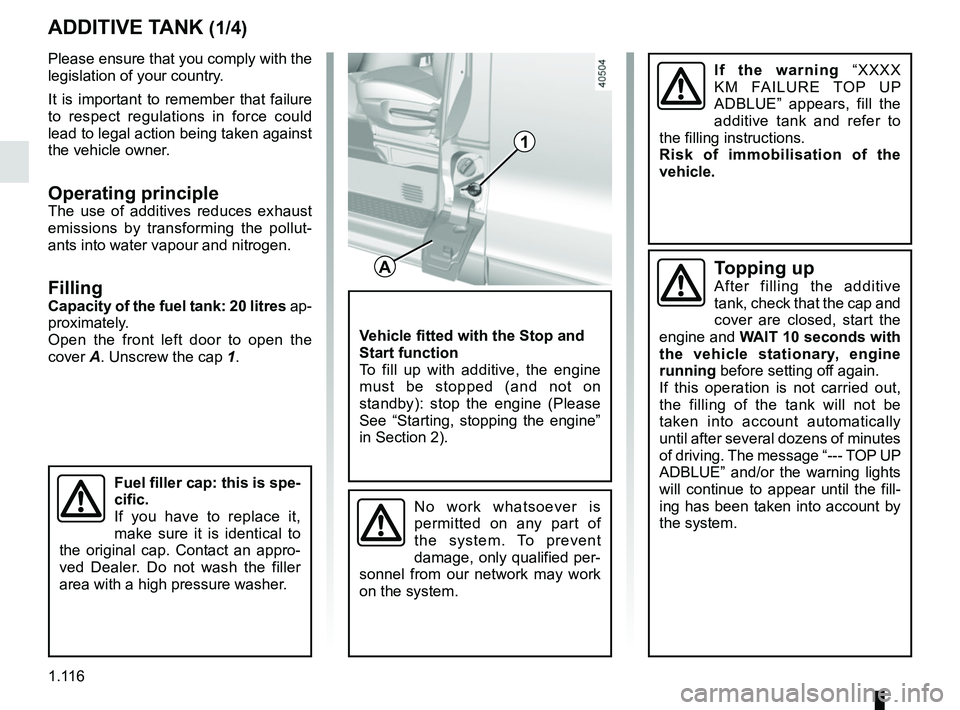
FillingCapacity of the fuel tank: 20 litres ap-
proximately.
Open the front left door to open the
cover A. Unscrew the cap 1.
ADDITIVE TANK (1/4)
A
1
Fuel filler cap: this is spe-
cific.
If you have to replace it,
make sure it is identical to
the original cap. Contact an appro-
ved Dealer. Do not wash the filler
area with a high pressure washer.
Vehicle fitted with the Stop and
Start function
To fill up with additive, the engine
must be stopped (and not on
standby): stop the engine (Please
See “Starting, stopping the engine”
in Section 2).
No work whatsoever is
permitted on any part of
the system. To prevent
damage, only qualified per-
sonnel from our network may work
on the system.
Topping upAfter filling the additive
tank, check that the cap and
cover are closed, start the
engine and WAIT 10 seconds with
the vehicle stationary, engine
running before setting off again.
If this operation is not carried out,
the filling of the tank will not be
taken into account automatically
until after several dozens of minutes
of driving. The message “--- TOP UP
ADBLUE” and/or the warning lights
will continue to appear until the fill-
ing has been taken into account by the system.
If the warning “XXXX
KM FAILURE TOP UP
ADBLUE” appears, fill the
additive tank and refer to
the filling instructions.
Risk of immobilisation of the
vehicle.
Page 123 of 298
1.117
Additive quality
Use only additives which conform
to standard ISO 22241 and in accor-
dance with the label on the fuel filler
flap.
Average fuel consumption
Approximately 807 mpg
(3.5 l/1,000 km) depending on the vehi-
cle and the driving style.
The additive must not come
into contact with eyes or
skin. If it does, wash the af-
fected area with plenty of
cold water. If necessary, consult a
doctor.
ADDITIVE TANK (2/4)
Precautions for use
Always read the information on the ad-
ditive can.
Handle additives with care. They can
damage clothes, shoes, bodywork
components etc.
If the additive overflows, or contami-
nates any paintwork, clean the affected
area quickly with a damp cloth.
In extreme cold weather conditions
The vehicle is fitted with a system for
reheating the additive fluid that enables
you to drive in extreme cold weather
conditions.
Precautions when filling the tank
The additive fluid freezes below about
-10°C.
In this case, do not attempt filling when
the fluid is frozen.
It is therefore advisable to top up the
additive fluid or have it topped up by a
qualified professional as soon as the
warning light on the instrument
panel first comes on.
Page 124 of 298

Maintenance/Range
Warning lights and messages on the instrument panel
When the indicator lights described light up, this may be accompanied by\
a beep.
Indicator lights Mess")
1.118
ADDITIVE TANK (3/4)
Maintenance/Range
Warning lights and messages on the instrument panel
When the indicator lights described light up, this may be accompanied by\
a beep.
Indicator lights Message What to do?
comes on each
time the vehicle is started. « ADBLUE LEVEL
LOW »
Fill or have an Approved Dealer fill or top up the additive tank.
comes on.« ADBLUE TO FILL »
comes on.« XXXX KM FAILURE
TOP UP ADBLUE »
Fill or have an Approved Dealer fill the additive tank as soon as possible.
comes on.« 0KM FAILURE TOP
UP ADBLUE »
The engine will not start.
To restart, you must fill the additive tank yourself.
Page 125 of 298

System fault
The integrated indicator lights described below are accompanied by a bee\
p.
Indicator lights Message Readings
and © come
on. « CHECK ANTI- -
POLLUTION SY")
1.119
ADDITIVE TANK (4/4)
System fault
The integrated indicator lights described below are accompanied by a bee\
p.
Indicator lights Message Readings
and © come
on. « CHECK ANTI- -
POLLUTION SYSTEM »
Indicates a fault in the system. Contact your approved dealer as soon
as possible.
and © come
on. « XXXX KM FAILURE
ANTIPOLLUTION »Indicates that in less than 682 miles (1100 km) it will become im-
possible to restart the vehicle
. These warnings will be repeated
every 60 miles (100 km). Contact your approved dealer as soon as
possible.
and © come
on. « 0KM FAILURE TOP
UP ADBLUE »
Indicates that after the ignition is switched off
the vehicle will not re-
start . Call an approved Dealer.
Page 129 of 298
2.3
STARTING, STOPPING THE ENGINE: vehicle with key
Starting the engine
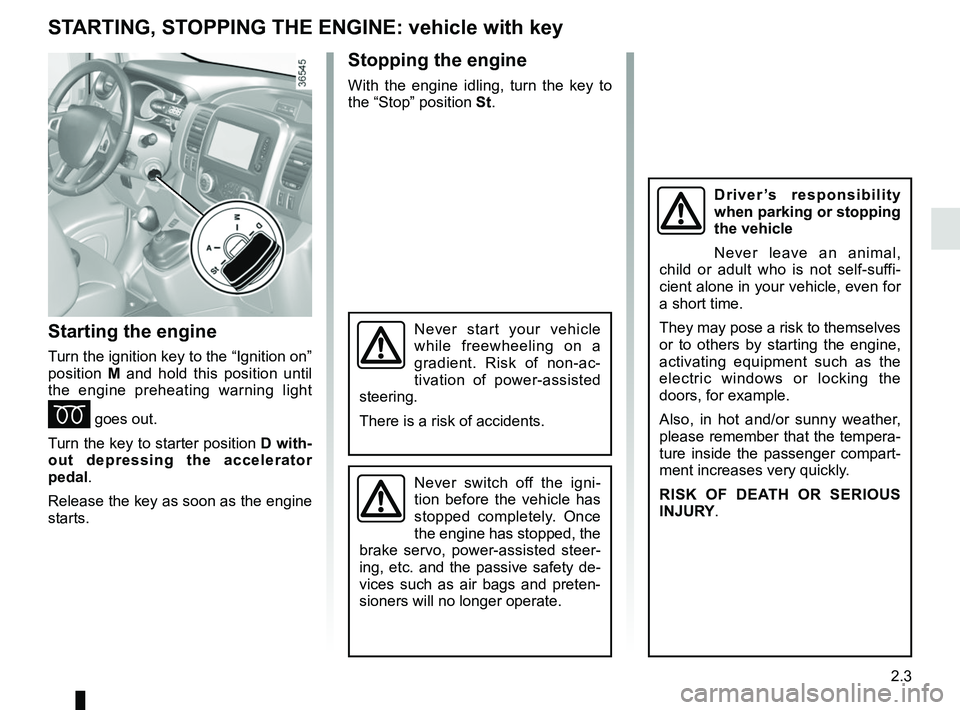
Turn the ignition key to the “Ignition on”
position M and hold this position until
the engine preheating warning light
É goes out.
Turn the key to starter position D with-
out depressing the accelerator
pedal.
Release the key as soon as the engine
starts.
Stopping the engine
With the engine idling, turn the key to
the “Stop” position St.
Driver’s responsibility
when parking or stopping
the vehicle
Never leave an animal,
child or adult who is not self-suffi-
cient alone in your vehicle, even for
a short time.
They may pose a risk to themselves
or to others by starting the engine,
activating equipment such as the
electric windows or locking the
doors, for example.
Also, in hot and/or sunny weather,
please remember that the tempera-
ture inside the passenger compart-
ment increases very quickly.
RISK OF DEATH OR SERIOUS
INJURY.
Never start your vehicle
while freewheeling on a
gradient. Risk of non-ac-
tivation of power-assisted
steering.
There is a risk of accidents.
Never switch off the igni-
tion before the vehicle has
stopped completely. Once
the engine has stopped, the
brake servo, power-assisted steer-
ing, etc. and the passive safety de-
vices such as air bags and preten-
sioners will no longer operate.
Page 133 of 298

2.7
The warning light is displayed on
the instrument panel to notify you that
the engine is on standby.
The vehicle equipment remain opera-
tional while the engine is stopped.
The engine will restart when you press
the clutch pedal and move into gear.
Special feature of the automatic
engine re-start
Under certain conditions, the engine
can restart on its own in order to guar-
antee your safety and comfort.
STOP AND START function (1/3)
This system enables a reduced fuel
consumption and lower greenhouse
gas emissions.
The system is activated automatically
when the vehicle is started.
While driving, the system stops the
engine (standby) when the vehicle is
at a standstill (traffic jam, traffic lights,
etc).
System operating conditionsEngine standby is activated if:
– the vehicle has been driven since its last stop;
– the gearbox is in neutral;
– the clutch pedal is released;
and
– the vehicle speed is less than ap- proximately 1.86 mph (3 km/h). This can occur especially when:
– the outdoor temperature is too low or
too high (less than around 0 °C or
higher than around 35 °C);
– the “Clear View” function is activated (please see the information on “Air
conditioning” in Section 3);
– the battery is not sufficiently charged;
– the vehicle speed is above 3 mph (5 km/h) (downhill slope etc.);
– repeated pressing on the brake pedal or braking system require-
ment;
– the engine restart may be interrupted if the clutch pedal is released too
quickly while a gear is engaged.
– ...
Before leaving the vehicle,
the engine must be stopped
and not put on standby
(please see the information
on “Starting, stopping the engine” in
Section 2).
Do not drive off when the
engine is on standby (warn-
ing light
is displayed
on the instrument panel).
If you get out of the vehicle, a beep
and the message “IGNITION OFF”
notifies you that the engine is on
standby and has not been switched
off.
Page 134 of 298
2.8
STOP AND START function (2/3)
Special cases
– For vehicles using a RENAULT card, while the system is operating and
the engine is in standby (traffic jam,
traffic lights, etc.), if the driver gets
out of their seat or unfastens their
seatbelt and opens the driver's door,
the ignition will be switched off. To
restart and reactivate the Stop and
Start system, press the start button
(please refer to "Starting, stopping
the engine" in Section 2).
– In the event of the engine stalling, if the system is operational, press
down the clutch pedal as far as it will
go to restart.
– the outdoor temperature is too low or
too high (less than around 0 °C or
higher than around 35 °C);
– the battery is not sufficiently charged;
– the difference between the vehicle interior temperature and the auto-
matic climate control instruction is
too high;
– the “Clear View” function is activated (please see the information on “Air
conditioning” in Section 3);
– the engine coolant temperature is too low;
– automatic particle filter cleaning is underway;
– the “Fast Idle Speed” function is acti- vated (please refer to the information
on “Fast Idle Speed” in section 2);
– ...
Warning light
is displayed on the
instrument panel. This notifies you that
engine standby is not available.
To fill up with fuel, the engine must
be stopped (and not on standby):
stop the engine (please refer to the
information on “Starting and stop-
ping the engine” in Section 2).
Special features of vehicles with
remote control
Some of these conditions prevent the
engine from automatically restarting
upon opening:
– one of the doors for vehicles using a key;
– the passenger side door for vehicles using a RENAULT card.
Conditions preventing the
standby of the engine
Depending on the vehicle, certain con-
ditions prevent the system from using
the engine standby function, including
when:
– reverse gear is engaged;
– the bonnet is not locked;
– for vehicles using a RENAULT card, the driver’s side door is not closed;
– for vehicles using a RENAULT card, the driver’s seat belt is not buckled;
Page 135 of 298

2.9
Operating faults
When the message “CHECK STOP
AND START” appears on the instru-
ment panel and the integrated warn-
ing light 2 lights up on the switch 1, the
system is deactivated.
Please consult an authorised dealer.
Deactivating, activating the
function
Press switch 1 to deactivate the func-
tion. The message “STOP AND START
DEACTIVATED” will appear on the in-
strument panel and the integrated
warning light 2 on the switch will light
up.
Pressing again will reactivate the
system. The message “STOP AND
START ACTIVATED” will appear on the
instrument panel and the integrated
warning light 2 on the switch 1 will go
out.
STOP AND START function (3/3)
The system is automatically reacti-
vated each time the vehicle is started
(see “Starting, stopping the engine” in
Section 2).
Special note: engine on standby,
press switch 1 to automatically restart
the engine.
1
2
In the event of an emer-
gency, the engine can be
restarted by pressing on the
clutch pedal if the Stop and
Start function is activated.
Before leaving the vehicle,
the engine must be stopped
and not put on standby
(please see the information
on “Starting, stopping the engine” in
Section 2).
Page 137 of 298

2.11
GEAR LEVER/HANDBRAKE
Gear lever
To select reverse gear
(vehicle stationary)
Move the lever to neutral, then position
the lever in reverse.
Ring 1 has to be lifted up to the gear
lever knob to select reverse gear.
The reversing lights will come on as
soon as reverse gear is selected (with
the ignition on).
Vehicles fitted with parking distance
control: refer to the information on the
“Parking distance control” in Section 2
for details of the special features.
An impact to the underside
of the vehicle when revers-
ing (e.g. striking a raised
kerb) may result in damage
to the vehicle (eg. deformation of
the rear axle).
To avoid any risk of accident, have
your vehicle checked by an ap-
proved Dealer.
Handbrake
To release
Pull the lever up slightly, press button 2
and then lower the lever to the floor.
The red warning light on the instrument
panel will light up if you are driving with
an incorrectly released handbrake.
To apply
Pull the lever upwards and make sure
the vehicle is immobilised.
When stationary and de-
pending on the slope and/or
vehicle load, it may be nec-
essary to pull up the hand-
brake at least two extra notches and
engage a gear (1
st or reverse gear)
for vehicles with a manual gearbox
or position P for vehicles with an au-
tomatic transmission.
1
Make sure that the hand-
brake is properly released
when driving (red indicator
light off), otherwise over-
heating may occur.
2
Page 138 of 298

2.12
DRIVING ADVICE, ECO-DRIVING (1/4)
Driving style indicator 2
Informs you about the driving style
adopted in real time. You will be notified
by the colour of warning light 2.
– Green: measured, economical driv- ing;
– Yellow: opt for a calmer driving style;
– Orange: driving too fast.
To activate/deactivate the driving style
indicator, please see the multimedia
system instructions.
1
2
Gear change indicator 1
Depending on the vehicle, to obtain op-
timum consumption levels, a warning
light on the instrument panel lets you
know the best time to move up or down
a gear:
Š move up a gear;
‰ move down a gear.
Fuel consumption is accredited in ac-
cordance with a standard regulatory
method. Identical for all manufactu-
rers, this enables vehicles to be com-
pared with one another. Consumption
in real time depends on vehicle usage
conditions, the equipment fitted and the
user’s driving style. To optimise fuel
consumption, please refer to the fol-
lowing advice.
Depending on the vehicle, you will have
various functions which enable you to
lower your fuel consumption:
– the rev counter;
– gear change indicator;
– the driving style indicator;
– the journey record and eco-driving
advice via the multimedia display;
– ECO mode – activated by the ECO button.
If fitted on the vehicle, the navigation
system provides additional information.