battery RENAULT TWINGO 2012 2.G User Guide
[x] Cancel search | Manufacturer: RENAULT, Model Year: 2012, Model line: TWINGO, Model: RENAULT TWINGO 2012 2.GPages: 220, PDF Size: 6.73 MB
Page 78 of 220
power-assisted steering........................(up to the end of the DU)
power-assisted steering ........................(up to the end of the DU)
gear lever .............................................. (up to the end of the DU)
reverse gear selecting .......................................... (up to the end of the DU)
changing gear ....................................... (up to the end of the DU)
2.6
ENG_UD24713_4
Levier de vitesses / Direction assistée (X44 - Renault)
ENG_NU_952-4_X44_Renault_2
Gear lever - Power-assisted steering
GeAR leveR/PoweR-ASSISteD SteeRING
Gear lever
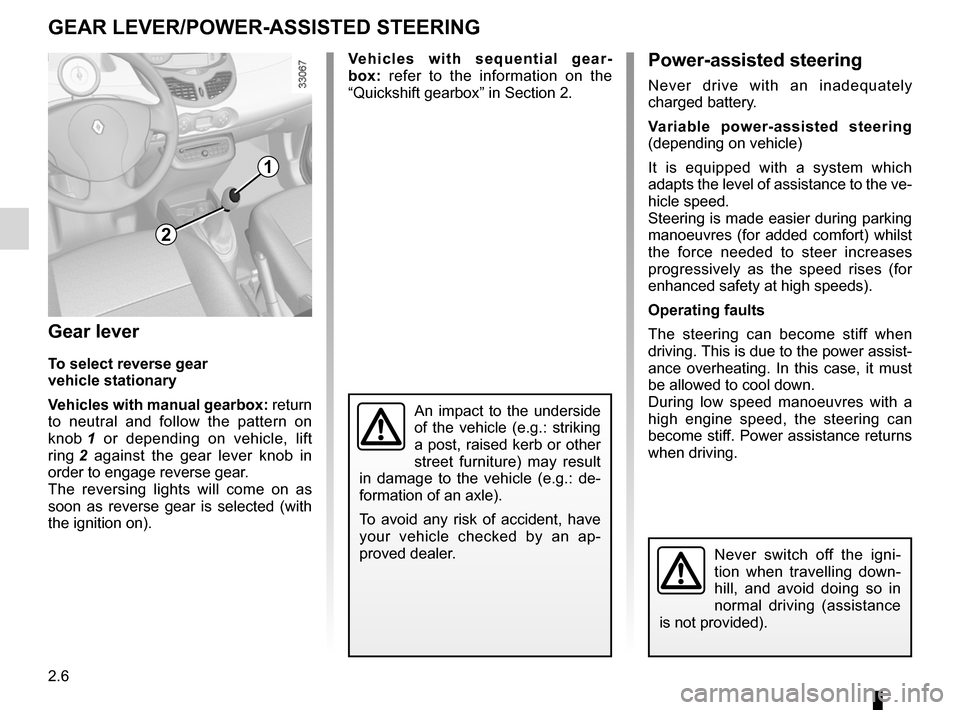
t o select reverse gear
vehicle stationary
v ehicles with manual gearbox: return
to neutral and follow the pattern on
knob 1 or depending on vehicle, lift
ring 2 against the gear lever knob in
order to engage reverse gear.
The reversing lights will come on as
soon as reverse gear is selected (with
the ignition on).
2
1
Power-assisted steering
Never drive with an inadequately
charged battery.
v ariable power-assisted steering
(depending on vehicle)
It is equipped with a system which
adapts the level of assistance to the ve-
hicle speed.
Steering is made easier during parking
manoeuvres (for added comfort) whilst
the force needed to steer increases
progressively as the speed rises (for
enhanced safety at high speeds).
operating faults
The steering can become stiff when
driving. This is due to the power assist-
ance overheating. In this case, it must
be allowed to cool down.
During low speed manoeuvres with a
high engine speed, the steering can
become stiff. Power assistance returns
when driving.
Never switch off the igni -
tion when travelling down -
hill, and avoid doing so in
normal driving (assistance
is not provided).
v ehicles with sequential gear -
box: refer to the information on the
“Quickshift gearbox” in Section 2.
An impact to the underside
of the vehicle (e.g.: striking
a post, raised kerb or other
street furniture) may result
in damage to the vehicle (e.g.: de -
formation of an axle).
To avoid any risk of accident, have
your vehicle checked by an ap -
proved dealer.
Page 83 of 220
environment .......................................... (up to the end of the DU)
2.11
ENG_UD25716_1
Environnement (sans marque) (X44 - X45 - X77 - X81 - X85 - X90 - X91 - X83 - X61 - TEST - X95 - J95 - R95 - F90 Ph2 - X33 - X47 - X43 - X38 - H79 - X62 - X32 - X09 -
ENG_NU_952-4_X44_Renault_2
Environment
eNvIRoNMeNt
emissions
Your vehicle has been designed to
emit fewer greenhouse gases (CO2)
while in use, and therefore to consume
less fuel (eg. 140 g/km, equivalent to
5.3 l/100 km for a diesel vehicle).
Our vehicles are also equipped with a
particle filter system including a cata -
lytic converter, an oxygen sensor and
an active carbon filter (the latter pre -
vents vapour from the fuel tank being
released into the open air).
For certain diesel vehicles, this system
also has a particle filter to reduce the
volume of soot particles emitted.
Please make your own
contribution towards
protecting the environment
too
– Worn parts replaced in the course of
routine vehicle maintenance (vehi -
cle battery, oil filter, air filter, batter -
ies, etc.) and oil containers (empty or
filled with used oil) must be disposed
of through specialist organisations. –
At the end of the vehicle’s service
life, it should be sent to approved
centres to ensure that it is recycled.
– In all cases, comply with local legis -
lation.
Recycling
Your vehicle is 85% recyclable and
95% recoverable.
To achieve these objectives, many of
the vehicle components have been de-
signed to enable them to be recycled.
The materials and structures have
been carefully designed to allow these
components to be easily removed and
reprocessed by specialist companies.
In order to preserve raw material re -
sources, this vehicle incorporates nu -
merous parts made from recycled plas-
tics or renewable materials (vegetable
or animal-derived materials such as
cotton or wool).
Your vehicle has been designed with
respect for the
environment in mind for
its entire service life: during production,
use and at the end of its life.
This commitment is illustrated by the of
the manufacturer eco² signature.Manufacture
Your vehicle has been manufactured at
a factory which complies with a policy
to reduce the environmental impact
on the surrounding areas (reduction of
water and energy consumption, visual
and noise pollution, atmospheric emis-
sions and waste water; sorting and re-
using waste).
Page 95 of 220
automatic gearbox (use) ........................................ (current page)
JauneNoirNoir texte
2.23
ENG_UD24716_6
Boîte de vitesses Quickshift (X44 - Renault)
ENG_NU_952-4_X44_Renault_2
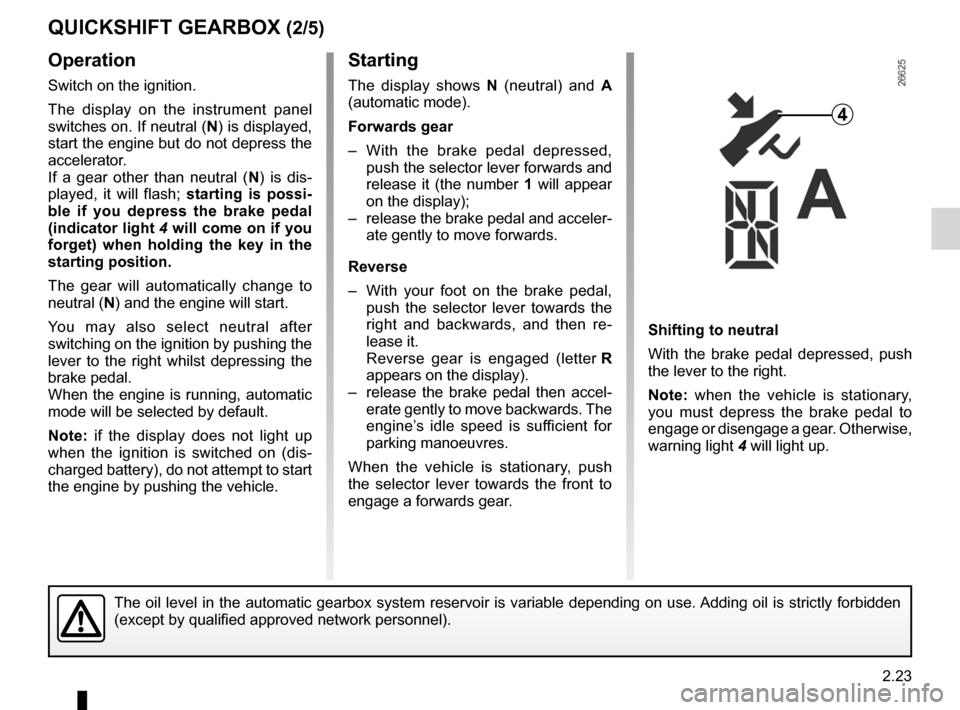
Starting
The display shows N (neutral) and A
(automatic mode).
Forwards gear
– With the brake pedal depressed,
push the selector lever forwards and
release it (the number 1 will appear
on the display);
– release the brake pedal and acceler-
ate gently to move forwards.
Reverse
– With your foot on the brake pedal,
push the selector lever towards the
right and backwards, and then re -
lease it.
Reverse gear is engaged (letter R
appears on the display).
– release the brake pedal then accel -
erate gently to move backwards. The
engine’s idle speed is sufficient for
parking manoeuvres.
When the vehicle is stationary, push
the selector lever towards the front to
engage a forwards gear.
operation
Switch on the ignition.
The display on the instrument panel
switches on. If neutral (N) is displayed,
start the engine but do not depress the
accelerator.
If a gear other than neutral ( N) is dis -
played, it will flash; starting is possi-
ble if you depress the brake pedal
(indicator light 4 will come on if you
forget) when holding the key in the
starting position.
The gear will automatically change to
neutral (N) and the engine will start.
You may also select neutral after
switching on the ignition by pushing the
lever to the right whilst depressing the
brake pedal.
When the engine is running, automatic
mode will be selected by default.
Note: if the display does not light up
when the ignition is switched on (dis -
charged battery), do not attempt to start
the engine by pushing the vehicle. Shifting to neutral
With the brake pedal depressed, push
the lever to the right.
Note:
when the vehicle is stationary,
you must depress the brake pedal to
engage or disengage a gear. Otherwise,
warning light 4 will light up.
QUIcKShIFt GeARBoX (2/5)
4
The oil level in the automatic gearbox system reservoir is variable depending on use. Adding oil is strictly forbidden
(except by qualified approved network personnel).
Page 98 of 220
2.26
ENG_UD24716_6
Boîte de vitesses Quickshift (X44 - Renault)
ENG_NU_952-4_X44_Renault_2
QUIcKShIFt GeARBoX (5/5)
t owing the vehicle
If the gearbox is stuck in a gear:
– Switch on the ignition;
– select neutral with the brake pedal
depressed;
– check that the gearbox is in neutral
(by pushing the vehicle, for exam -
ple).
If you cannot find neutral you must tow
the vehicle with the front wheels raised.
the vehicle should always be towed
with the ignition switched off.operating faults
ÒWhen driving, if this warning
light comes on together with
warning light
©, this indicates a
system fault. In most cases, you may
still drive the vehicle, although it will not
function perfectly. Contact an approved
dealer as soon as possible.
the vehicle will not start
If you cannot start the engine and if the
battery is not discharged (display lit up):
– Switch on the ignition;
– select neutral;
– push the vehicle or roll it down a suf-
ficiently steep slope. Then push the
selector lever forwards.
The optimum gear for starting the
engine will then be automatically se -
lected.
Note: never attempt this manoeuvre in
reverse.
Page 139 of 220
4.1
ENG_UD30796_17
Sommaire 4 (X44 - Renault)
ENG_NU_952-4_X44_Renault_4
Section 4: Maintenance
Bonnet . . . . . . . . . . . . . . . . . . . . . . . . . . . . . . . . . . . . . . . . . . . . . . . . . . . . . . . . . . . . . . . . . . . . . . . . 4.2
Engine oil level: . . . . . . . . . . . . . . . . . . . . . . . . . . . . . . . . . . . . . . . . . . . . . . . . . . . . . . . . . . . . . . . . . 4.4
general information . . . . . . . . . . . . . . . . . . . . . . . . . . . . . . . . . . . . . . . . . . . . . . . . . . . . . . . . 4.4
topping up/filling . . . . . . . . . . . . . . . . . . . . . . . . . . . . . . . . . . . . . . . . . . . . . . . . . . . . . . . . . . . 4.5
Engine oil change . . . . . . . . . . . . . . . . . . . . . . . . . . . . . . . . . . . . . . . . . . . . . . . . . . . . . . . . . . . . . . . 4.6
Levels: . . . . . . . . . . . . . . . . . . . . . . . . . . . . . . . . . . . . . . . . . . . . . . . . . . . . . . . . . . . . . . . . . . . . . . . . 4.7
Brake fluid . . . . . . . . . . . . . . . . . . . . . . . . . . . . . . . . . . . . . . . . . . . . . . . . . . . . . . . . . . . . . . . 4.7
Coolant level . . . . . . . . . . . . . . . . . . . . . . . . . . . . . . . . . . . . . . . . . . . . . . . . . . . . . . . . . . . . . 4.8
Windscreen washer reservoir . . . . . . . . . . . . . . . . . . . . . . . . . . . . . . . . . . . . . . . . . . . . . . . . . 4.9
Filters . . . . . . . . . . . . . . . . . . . . . . . . . . . . . . . . . . . . . . . . . . . . . . . . . . . . . . . . . . . . . . . . . . . . . . . . . 4.9
Tyre pressure. . . . . . . . . . . . . . . . . . . . . . . . . . . . . . . . . . . . \
. . . . . . . . . . . . . . . . . . . . . . . . . . . . . . . 4.10
Battery . . . . . . . . . . . . . . . . . . . . . . . . . . . . . . . . . . . . . . . . . . . . . . . . . . . . . . . . . . . . . . . . . . . . . . . . 4.12
Bodywork maintenance . . . . . . . . . . . . . . . . . . . . . . . . . . . . . . . . . . . . . . . . . . . . . . . . . . . . . . . . . . . 4.13
Interior trim maintenance . . . . . . . . . . . . . . . . . . . . . . . . . . . . . . . . . . . . . . . . . . . . . . . . . . . . . . . . . . 4.15
Page 150 of 220

battery................................................... (up to the end of the DU)
4.12
ENG_UD24730_3
Batterie (X44 - C44 - G44 - Renault)
ENG_NU_952-4_X44_Renault_4
Battery
Battery
Depending on the vehicle, this is lo -
cated underneath cover 1.
Battery access:
Depending on the vehicle, unclip
cover A.
Replacing the battery
As this operation is complex, we advise
you to contact an approved Dealer.
Take care when working in
the engine compartment
as the engine cooling fan
may start to operate at any
moment without warning.
Risk of injury.When working in the engine
compartment, ensure that
the windscreen wiper stalk
is in the park position.
Risk of injury.
BATTER y
1
A
Label B
Observe the indications on the battery:
– 2 Naked flames and smoking are for-
bidden;
– 3 eye protection required;
– 4 keep children at a safe distance;
– 5 explosive materials;
– 6 refer to the handbook;
– 7 corrosive materials.
Handle the battery with care
as it contains sulphuric acid
which must not come into
contact with the eyes or
skin. If it does, wash the affected
area with plenty of cold water. If
necessary, consult a doctor.
Ensure that naked flames, red hot
objects and sparks do not come into
contact with the battery as there is a
risk of explosion.
B
234
567
Page 155 of 220
5.1
ENG_UD30797_17
Sommaire 5 (X44 - Renault)
ENG_NU_952-4_X44_Renault_5
Section 5: Practical advice
Puncture . . . . . . . . . . . . . . . . . . . . . . . . . . . . . . . . . . . . . . . . . . . . . . . . . . . . . . . . . . . . . . . . . . . . . . 5.2
Tyre inflation kit . . . . . . . . . . . . . . . . . . . . . . . . . . . . . . . . . . . . . . . . . . . . . . . . . . . . . . . . . . . . . . . . . 5.3
Tool kit . . . . . . . . . . . . . . . . . . . . . . . . . . . . . . . . . . . . . . . . . . . . . . . . . . . . . . . . . . . . . . . . . . . . . . . . 5.6
Wheel trim – Wheel rims . . . . . . . . . . . . . . . . . . . . . . . . . . . . . . . . . . . . . . . . . . . . . . . . . . . . . . . . . . 5.7
Changing a wheel . . . . . . . . . . . . . . . . . . . . . . . . . . . . . . . . . . . . . . . . . . . . . . . . . . . . . . . . . . . . . . . 5.8
Tyres (tyre and wheel safety, use in winter) . . . . . . . . . . . . . . . . . . . . . . . . . . . . . . . . . . . . . . . . . . . 5.10
Wiper blades . . . . . . . . . . . . . . . . . . . . . . . . . . . . . . . . . . . . . . . . . . . . . . . . . . . . . . . . . . . . . . . . . . . 5.13
Fog lights, front side lights . . . . . . . . . . . . . . . . . . . . . . . . . . . . . . . . . . . . . . . . . . . . . . . . . . . 5.16
Rear lights . . . . . . . . . . . . . . . . . . . . . . . . . . . . . . . . . . . . . . . . . . . . . . . . . . . . . . . . . . . . . . . 5.17
Side indicator lights . . . . . . . . . . . . . . . . . . . . . . . . . . . . . . . . . . . . . . . . . . . . . . . . . . . . . . . . 5.21
Interior lighting . . . . . . . . . . . . . . . . . . . . . . . . . . . . . . . . . . . . . . . . . . . . . . . . . . . . . . . . . . . . 5.22
Battery: breakdowns . . . . . . . . . . . . . . . . . . . . . . . . . . . . . . . . . . . . . . . . . . . . . . . . . . . . . . . . . . . . . 5.24
Radio frequency remote control unit: batteries . . . . . . . . . . . . . . . . . . . . . . . . . . . . . . . . . . . . . . . . . 5.26
Fuses . . . . . . . . . . . . . . . . . . . . . . . . . . . . . . . . . . . . . . . . . . . . . . . . . . . . . . . . . . . . . . . . . . . . . . . . . 5.27
Towing (breakdown – attachments) . . . . . . . . . . . . . . . . . . . . . . . . . . . . . . . . . . . . . . . . . . . . . . . . . . 5.30
Fitting a radio/accessories . . . . . . . . . . . . . . . . . . . . . . . . . . . . . . . . . . . . . . . . . . . . . . . . . . . . . . . . . 5.32
Accessories . . . . . . . . . . . . . . . . . . . . . . . . . . . . . . . . . . . . . . . . . . . . . . . . . . . . . . . . . . . . . . . . . . . . 5.34
Operating faults . . . . . . . . . . . . . . . . . . . . . . . . . . . . . . . . . . . . . . . . . . . . . . . . . . . . . . . . . . . . . . . . . 5.35
Page 178 of 220
batterytroubleshooting ............................... (up to the end of the DU)
5.24
ENG_UD24705_3
Batterie : dépannage (X44 - Renault)
ENG_NU_952-4_X44_Renault_5
Jaune NoirNoir texte
Battery: troubleshooting
BAtter Y: troubleshooting
to avoid all risk of sparks:
– Ensure that any consumers are
switched off before disconnecting or
reconnecting the battery;
– When charging, stop the charger
before connecting or disconnecting
the battery.
– Do not place metal objects on the
battery to avoid creating a short cir-
cuit between the terminals.
connecting a battery charger
the battery charger should be com-
patible with a battery with nominal
voltage of 12 Volts.
With the engine off, it is essential to dis-
connect the leads connected to both
battery terminals , starting with the
negative terminal.
Do not disconnect the battery when the
engine is running. Follow the instruc-
tions given by the manufacturer of
the battery charger you are using. Only a fully charged and well
-main -
tained battery will have a long and
useful service life and enable you to
start the vehicle’s engine normally.
The battery must be kept clean and dry.
Have the battery’s charge status
checked regularly:
– especially if you use your vehicle for
short journeys or for frequent driving
in town;
– when the exterior temperature drops
(in winter), the charge decreases .
In winter, only use the electrical
equipment that is really necessary;
– finally, you should understand that
the charge decreases naturally as a
result of certain permanent electrical
consumers such as the clock, after-
sales accessories, etc.
When many accessories are fitted to
the vehicle, have them connected to
the + after ignition feed. In this case,
it is advisable to have your vehicle
fitted with a battery which has an in -
creased nominal capacity. Contact an
approved Dealer. If your vehicle is to
be left stationary for a relatively long
time, disconnect the battery or have it
recharged regularly, particularly during
cold weather. The equipment with a
memory, radio, etc. will then have to
be reprogrammed. The battery must
be stored in a cool dry place, protected
from frost.
Special procedures may be
required to charge some
batteries. Contact an ap -
proved Dealer.
Avoid all risk of sparks which may
cause an immediate explosion, and
charge the battery in a well-venti -
lated area. Risk of serious injury.
Page 179 of 220
JauneNoirNoir texte
5.25
ENG_UD24705_3
Batterie : dépannage (X44 - Renault)
ENG_NU_952-4_X44_Renault_5
BA tter Y: troubleshooting (continued)
Starting the vehicle using the
battery from another vehicle
Proceed as follows when starting your
vehicle from another vehicle’s battery:
Obtain suitable jump leads (large) from
an approved Dealer or, if you already
have jump leads, ensure that they are
in perfect condition.
the two batteries must have an iden-
tical nominal voltage of 12 volts. The
battery supplying the current should
have a capacity (amp-hours, Ah) which
is at least the same as that of the dis-
charged battery.
Ensure that there is no risk of contact
between the two vehicles (risk of short
circuiting when the positive terminals
are connected) and that the discharged
battery is properly connected. Switch
off your vehicle ignition.
Start the engine of the vehicle supply -
ing the current and run it at an interme-
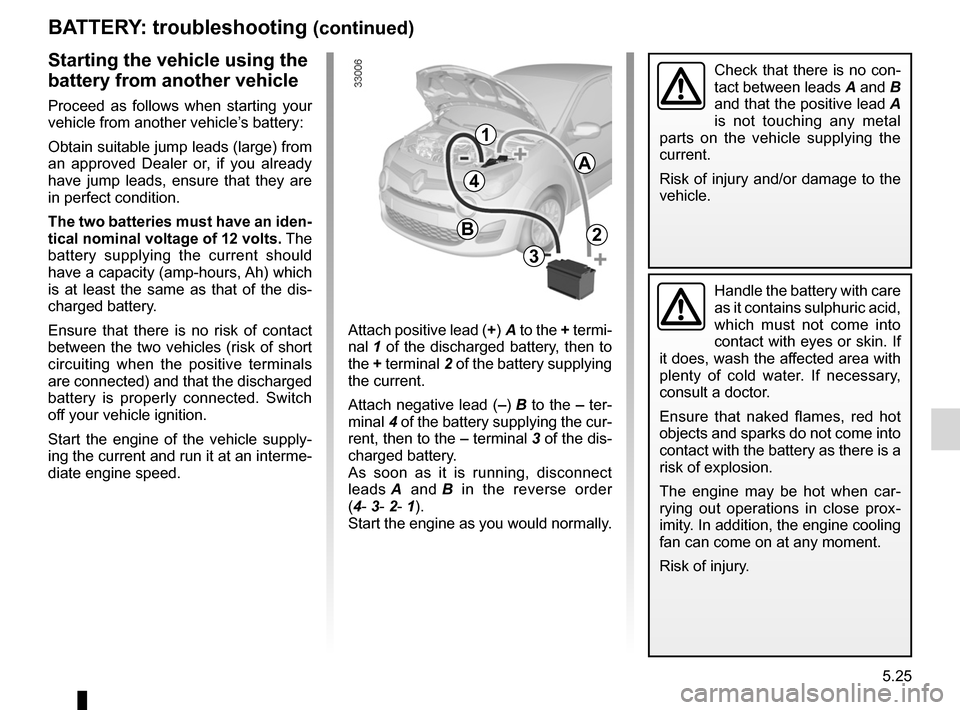
diate engine speed. Attach positive lead (+) A to the
+ termi-
nal 1 of the discharged battery, then to
the + terminal 2 of the battery supplying
the current.
Attach negative lead (–) B to the – ter-
minal 4 of the battery supplying the cur-
rent, then to the – terminal 3 of the dis-
charged battery.
As soon as it is running, disconnect
leads A and B in the reverse order
(4- 3- 2- 1).
Start the engine as you would normally.
A
B
1
4
2
3
Handle the battery with care
as it contains sulphuric acid,
which must not come into
contact with eyes or skin. If
it does, wash the affected area with
plenty of cold water. If necessary,
consult a doctor.
Ensure that naked flames, red hot
objects and sparks do not come into
contact with the battery as there is a
risk of explosion.
The engine may be hot when car -
rying out operations in close prox -
imity. In addition, the engine cooling
fan can come on at any moment.
Risk of injury.
Check that there is no con-
tact between leads A and B
and that the positive lead A
is not touching any metal
parts on the vehicle supplying the
current.
Risk of injury and/or damage to the
vehicle.
Page 180 of 220
remote control electric door lockingbatteries ........................................................... (current page)
battery (remote control) ......................................... (current page)
5.26
ENG_UD14469_2
Télécommande à radiofréquence : piles (X44 - E33 - X33 - Re\
nault)
ENG_NU_952-4_X44_Renault_5
Radio frequency remote control: batteries
rADIO FreQuencY reMOte cOntrOL: BAtterIeS
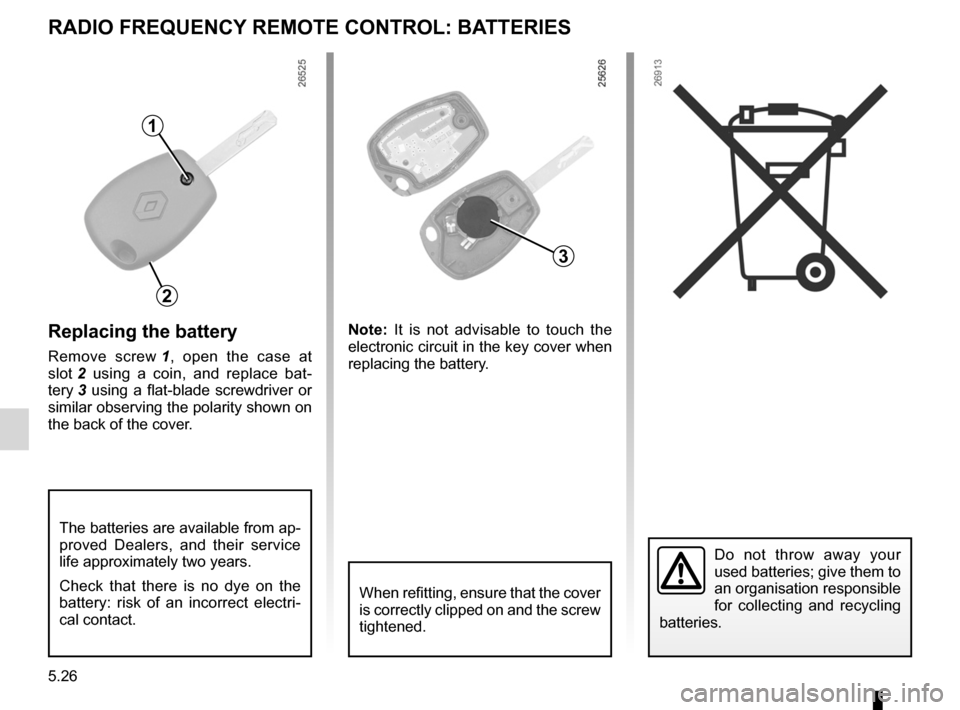
replacing the battery
Remove screw 1 , open the case at
slot 2 using a coin, and replace bat -
tery 3 using a flat-blade screwdriver or
similar observing the polarity shown on
the back of the cover. n
ote: It is not advisable to touch the
electronic circuit in the key cover when
replacing the battery.
Do not throw away your
used batteries; give them to
an organisation responsible
for collecting and recycling
batteries.
1
3
2
When refitting, ensure that the cover
is correctly clipped on and the screw
tightened.
The batteries are available from ap-
proved Dealers, and their service
life approximately two years.
Check that there is no dye on the
battery: risk of an incorrect electri -
cal contact.