lights RENAULT TWINGO 2012 2.G Owner's Manual
[x] Cancel search | Manufacturer: RENAULT, Model Year: 2012, Model line: TWINGO, Model: RENAULT TWINGO 2012 2.GPages: 220, PDF Size: 6.73 MB
Page 78 of 220
power-assisted steering........................(up to the end of the DU)
power-assisted steering ........................(up to the end of the DU)
gear lever .............................................. (up to the end of the DU)
reverse gear selecting .......................................... (up to the end of the DU)
changing gear ....................................... (up to the end of the DU)
2.6
ENG_UD24713_4
Levier de vitesses / Direction assistée (X44 - Renault)
ENG_NU_952-4_X44_Renault_2
Gear lever - Power-assisted steering
GeAR leveR/PoweR-ASSISteD SteeRING
Gear lever
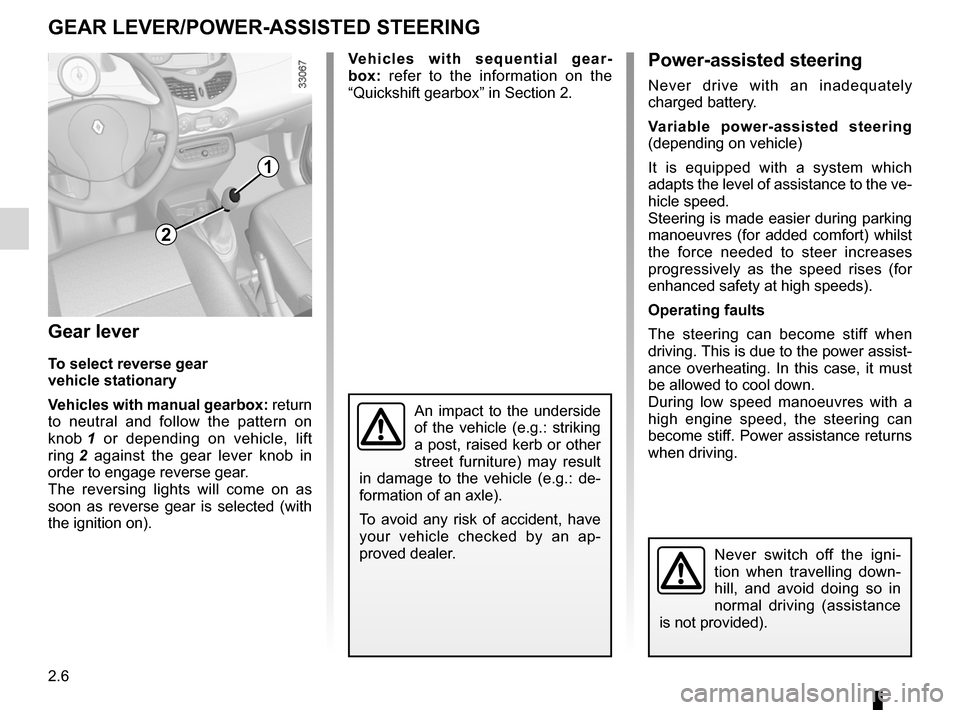
t o select reverse gear
vehicle stationary
v ehicles with manual gearbox: return
to neutral and follow the pattern on
knob 1 or depending on vehicle, lift
ring 2 against the gear lever knob in
order to engage reverse gear.
The reversing lights will come on as
soon as reverse gear is selected (with
the ignition on).
2
1
Power-assisted steering
Never drive with an inadequately
charged battery.
v ariable power-assisted steering
(depending on vehicle)
It is equipped with a system which
adapts the level of assistance to the ve-
hicle speed.
Steering is made easier during parking
manoeuvres (for added comfort) whilst
the force needed to steer increases
progressively as the speed rises (for
enhanced safety at high speeds).
operating faults
The steering can become stiff when
driving. This is due to the power assist-
ance overheating. In this case, it must
be allowed to cool down.
During low speed manoeuvres with a
high engine speed, the steering can
become stiff. Power assistance returns
when driving.
Never switch off the igni -
tion when travelling down -
hill, and avoid doing so in
normal driving (assistance
is not provided).
v ehicles with sequential gear -
box: refer to the information on the
“Quickshift gearbox” in Section 2.
An impact to the underside
of the vehicle (e.g.: striking
a post, raised kerb or other
street furniture) may result
in damage to the vehicle (e.g.: de -
formation of an axle).
To avoid any risk of accident, have
your vehicle checked by an ap -
proved dealer.
Page 81 of 220
JauneNoirNoir texte
2.9
ENG_UD27029_5
Conseils antipollution, économies de carburant, conduite (X44 - E33 - Renault)
ENG_NU_952-4_X44_Renault_2
ADvIce: antipollution, fuel economy and driving (2/3)
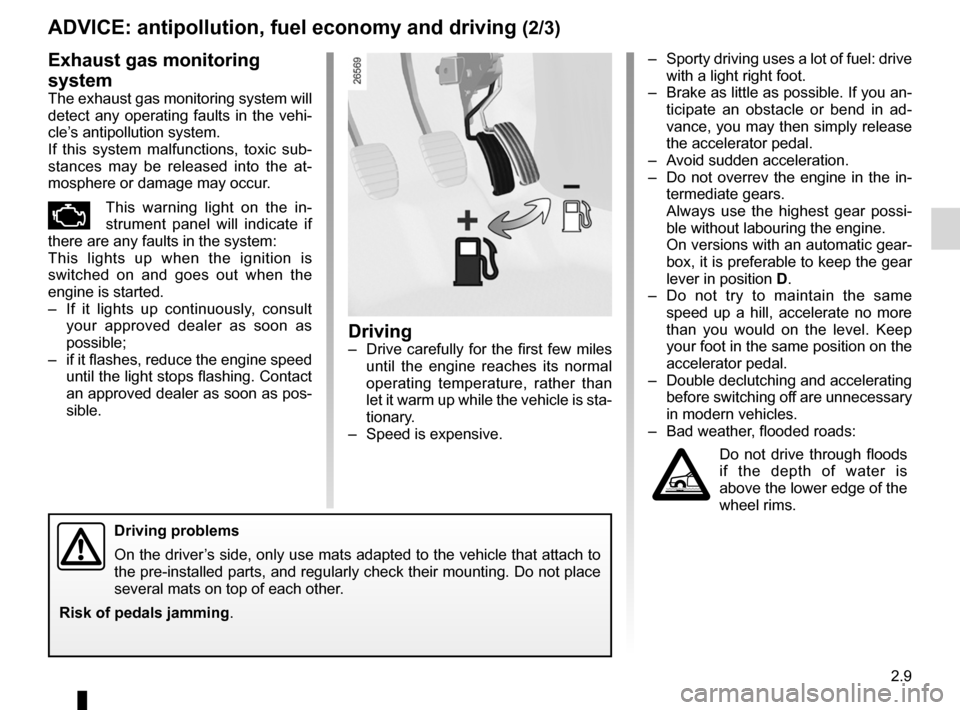
Driving
– Drive carefully for the first few miles
until the engine reaches its normal
operating temperature, rather than
let it warm up while the vehicle is sta-
tionary.
– Speed is expensive.
exhaust gas monitoring
system
The exhaust gas monitoring system will
detect any operating faults in the vehi-
cle’s antipollution system.
If this system malfunctions, toxic sub -
stances may be released into the at -
mosphere or damage may occur.
ÄThis warning light on the in -
strument panel will indicate if
there are any faults in the system:
This lights up when the ignition is
switched on and goes out when the
engine is started.
– If it lights up continuously, consult
your approved dealer as soon as
possible;
– if it flashes, reduce the engine speed
until the light stops flashing. Contact
an approved dealer as soon as pos-
sible. –
Sporty driving uses a lot of fuel: drive
with a light right foot.
– Brake as little as possible. If you an-
ticipate an obstacle or bend in ad -
vance, you may then simply release
the accelerator pedal.
– Avoid sudden acceleration.
– Do not overrev the engine in the in-
termediate gears.
Always use the highest gear possi -
ble without labouring the engine.
On versions with an automatic gear-
box, it is preferable to keep the gear
lever in position D.
– Do not try to maintain the same
speed up a hill, accelerate no more
than you would on the level. Keep
your foot in the same position on the
accelerator pedal.
– Double declutching and accelerating
before switching off are unnecessary
in modern vehicles.
– Bad weather, flooded roads:
Do not drive through floods
if the depth of water is
above the lower edge of the
wheel rims.
Driving problems
On the driver’s side, only use mats adapted to the vehicle that attach to
the pre-installed parts, and regularly check their mounting. Do not place
several mats on top of each other.
Risk of pedals jamming .
Page 82 of 220
tyres ....................................................................... (current page)
2.10
ENG_UD27029_5
Conseils antipollution, économies de carburant, conduite (X44 - E33 - Renault)
ENG_NU_952-4_X44_Renault_2
ADvIce: antipollution, fuel economy and driving (3/3)
Advice on use
– Electricity is fuel; switch off all the
electrical components which are
not really needed. however (safety
first), keep your lights on when the
visibility is bad (“see and be seen”).
– Use the air vents. Driving with the
windows open at 60 mph (100 km/h)
will increase fuel con -sumption by
4%.
– When towing a caravan, fit a wind
deflector and adjust it carefully.
– For vehicles fitted with air condi -
tioning , it is normal to observe an
increase in fuel consumption (es -
pecially in city conditions) when
it is used. For vehicles fitted with
manual air conditioning, switch off
the system when it is not required.
Advice for reducing consumption
and therefore helping to preserve
the environment:
Drive with the air vents open and the
windows closed.
If the vehicle has been parked in the
sun, open the doors for a few mo -
ments to let the hot air escape before
starting the engine.
– Never fill the fuel tank right to the
brim to avoid overflow.
– Do not leave an empty roof rack
fitted to the vehicle.
– It is better to fit a trailer for bulky ob-
jects.
– Avoid using the vehicle for door -
to-door calls (short journeys with
long waits in between) because the
engine never reaches its normal op-
erating temperature.
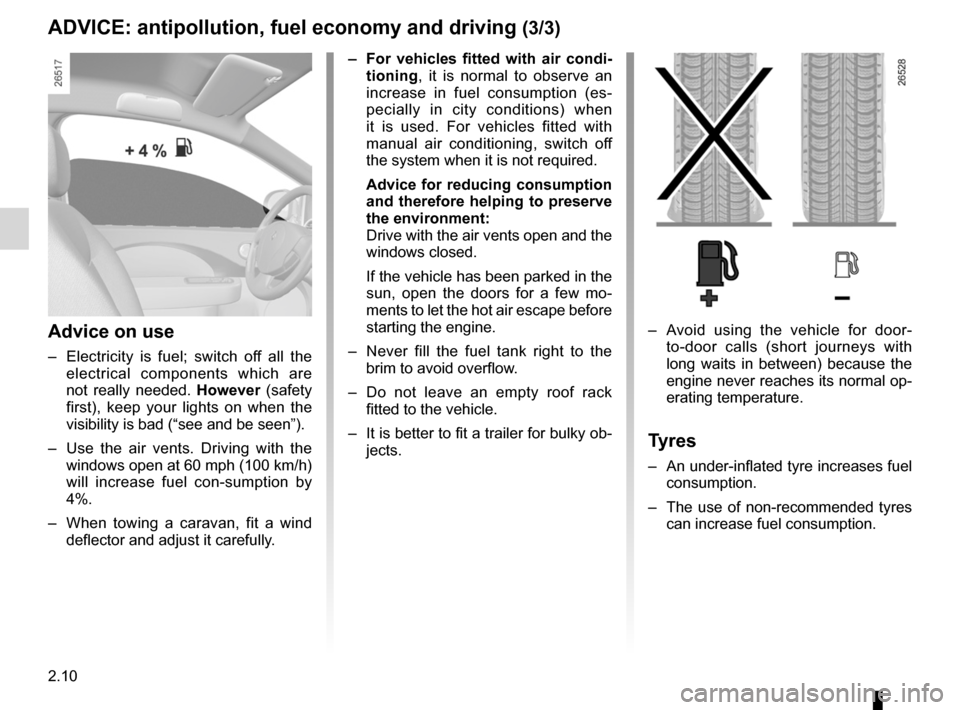
t yres
– An under-inflated tyre increases fuel
consumption.
– The use of non-recommended tyres
can increase fuel consumption.
Page 84 of 220
ABS ...................................................... (up to the end of the DU)
anti-lock braking system: ABS ..............(up to the end of the DU)
ESP: Electronic Stability Program ........ (up to the end of the DU)
ASR (traction control) ........................... (up to the end of the DU)
traction control: ASR .............................(up to the end of the DU)
Electronic Stability Program: ESP ........ (up to the end of the DU)
emergency brake assist ........................(up to the end of the DU)
emergency braking ............................... (up to the end of the DU)
traction control: ASR .............................................. (current page)
driving ................................................... (up to the end of the DU)
2.12
ENG_UD25058_2
Dispositifs de correction de conduite (X44 - Renault)
ENG_NU_952-4_X44_Renault_2
Jaune NoirNoir texte
Driving correction devices
DRIvING coRRectIoN DevIce
Depending on the vehicle, this is com-
posed of:
– ABS (anti-lock braking system);
– electronic stability program (eSP)
with understeer control and trac -
tion control (ASR);
– emergency brake assist.
In an emergency, apply firm and
continuous pressure to the brake
pedal. There is no need to pump
it repeatedly. The ABS will modu -
late the force applied in the braking
system.
These functions are an ad-
ditional aid in the event of
critical driving conditions,
enabling the vehicle behav -
iour to be adapted to suit the driving
conditions.
However, the functions do not take
the place of the driver. they do
not increase the vehicle’s limits
and should not encourage you
to drive more quickly. Therefore,
they can under no circumstances
replace the vigilance or responsibil -
ity of the driver when manoeuvring
the vehicle (the driver must always
be ready for sudden incidents which
may occur when driving).
Yo u r b r a k i n g s y s t e m s
are partially operational.
However, it is dangerous
to brake suddenly and
it is essential to stop immediately,
as soon as traffic conditions allow.
Contact an approved dealer.
operating faults:
– If indicator lights
x and © light up on the instrument panel,
braking is still operational but
without ABS;
– If indicator lights
x, û,
© and D are displayed on
the instrument panel when driving,
this indicates there is a fault with
the braking system and ABS.
In both cases, consult an approved
Dealer.
ABS (Anti-lock Braking
System)
Under heavy braking, the ABS prevents
the wheels from locking, allowing the
stopping distance to be managed and
keeping control of the vehicle.
Under these circumstances, the vehi -
cle can be steered to avoid an obstacle
whilst braking. In addition, this system
can increase stopping distances, par -
ticularly on roads with low surface grip
(wet ground, etc.).
You will feel a pulsation through the
brake pedal each time the system is
activated. The ABS does not in any way
improve the vehicle’s physical perform-
ance relating to the road surface and
roadholding. It is still essential to follow
the rules of good driving practice (such
as driving at a safe distance from the
vehicle in front).
Page 86 of 220
2.14
ENG_UD25058_2
Dispositifs de correction de conduite (X44 - Renault)
ENG_NU_952-4_X44_Renault_2
emergency brake assist
This is an additional system to ABS
which helps reduce vehicle stopping
distances.
operating principle
The system detects an emergency
braking situation. In this case, the brak-
ing assistance immediately develops
maximum power and may trigger ABS
regulation.
ABS braking is maintained as long as
the brake pedal is not released.
hazard warning lights switching on
Depending on the vehicle, these may
light up in the event of sudden decel -
eration.
DRIvING coRRectIoN DevIce (continued)
Special note on vehicles with a
Quickshift gearbox
When driving on some roads with low
surface grip (grass, snow, mud, etc.),
the system may reduce the engine
output to limit wheelspin. If this is not
required, it is recommended to switch
to manual mode on the Quickshift gear-
box (using the gear lever).
operating faults
When the system detects an operat -
ing fault the warning lights
and
© appear on the instrument panel.
In this situation, ESP and ASR are de-
activated.
Consult an approved dealer.
Page 96 of 220
horn ....................................................................... (current page)
2.24
ENG_UD24716_6
Boîte de vitesses Quickshift (X44 - Renault)
ENG_NU_952-4_X44_Renault_2
Jaune NoirNoir texte
changing mode
You can change mode at any time
by pushing the lever to the left. This
switches mode without changing gear.
Driving in manual mode
Using the selector lever
Pushing the lever repeatedly allows
you to change gears manually:
– To change up a gear: push the lever
forwards;
– to change down a gear: push the
lever backwards;
– to change to neutral: with the brake
pedal depressed (indicator light 4
will come on if you forget), push the
lever towards the right.
Note: when the vehicle is stationary
(braking, red light, etc.), the system au-
tomatically switches to first gear.
By pushing the lever forwards twice
you can move up two gears at a time
(unless this causes low engine speeds).
By pushing the lever backwards twice
you can move down two gears at a time
(unless this causes overrevving).
Note: neutral may only be selected
when the vehicle is being driven or is
stationary when the brake pedal is
depressed (if you forget, warning
light 4 will light up).
Accelerating and overtaking
To obtain maximum vehicle perform -
ance, in automatic or manual mode,
quickly depress the accelerator pedal
beyond the kickdown point.
This will activate the kickdown func -
tion allowing you to change down to the
most suitable gear.
QUIcKShIFt GeARBoX (3/5)
Driving in automatic mode
Each time the ignition is switched on,
automatic mode is selected by default
(letter A on the display).
The vehicle is controlled using the ac -
celerator and the brake.
Gears will change automatically at
the correct moment and at a suitable
engine speed because automatic mode
takes into consideration the road sur -
face and the chosen driving style.
You may change the gear selection
made by the automatic system (unless
this risks the engine being overrevved
or underrevved):
– by pushing the lever forwards or
backwards.
You can stop the vehicle at red lights,
with the gear engaged, by pressing the
brake pedal; there is no need to change
to neutral.
If the engine is being overrevved or underevved, the system will select the opti-
mal gear.
Page 107 of 220
heating system ..................................... (up to the end of the DU)
air conditioning ..................................... (up to the end of the DU)
ventilation ............................................. (up to the end of the DU)
controls .................................................................. (current page)
air conditioning ..................................... (up to the end of the DU)
temperature regulation ......................... (up to the end of the DU)
heating and air conditioning system ..... (up to the end of the DU)
3.9
ENG_UD24164_1
Air conditionné automatique (X44 - Renault)
ENG_NU_952-4_X44_Renault_3
Automatic climate control
AuT oMATIC ClIMATE CoNTRol (1/9)
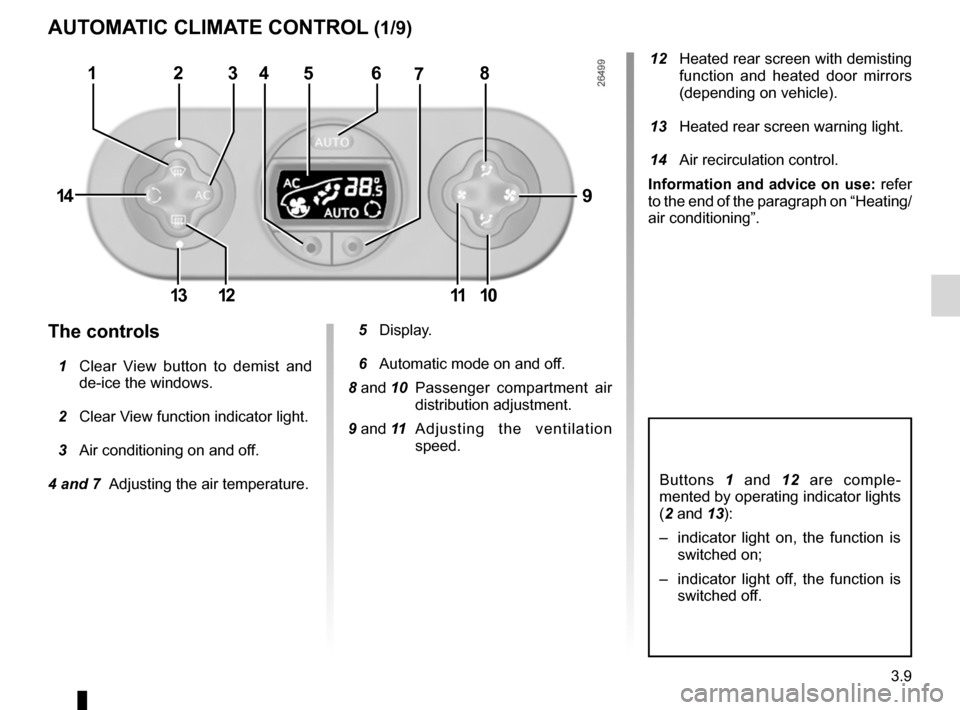
The controls
1 Clear View button to demist and
de-ice the windows.
2 Clear View function indicator light.
3 Air conditioning on and off.
4 and 7 Adjusting the air temperature.
5 Display.
6 Automatic mode on and off.
8 and 10 Passenger compartment air
distribution adjustment.
9 and 11 A d j u s t i n g t h e v e n t i l a t i o n
speed.
12 Heated rear screen with demisting
function and heated door mirrors
(depending on vehicle).
13 Heated rear screen warning light.
14 Air recirculation control.
Information and advice on use: refer
to the end of the paragraph on “Heating/
air conditioning”.
Buttons 1 and 12 are comple -
mented by operating indicator lights
(2 and 13):
– indicator light on, the function is
switched on;
– indicator light off, the function is
switched off.
12345678
9
10111213
14
Page 115 of 220
JauneNoirNoir texte
3.17
ENG_UD24164_1
Air conditionné automatique (X44 - Renault)
ENG_NU_952-4_X44_Renault_3
AuT oMATIC ClIMATE CoNTRol (9/9)
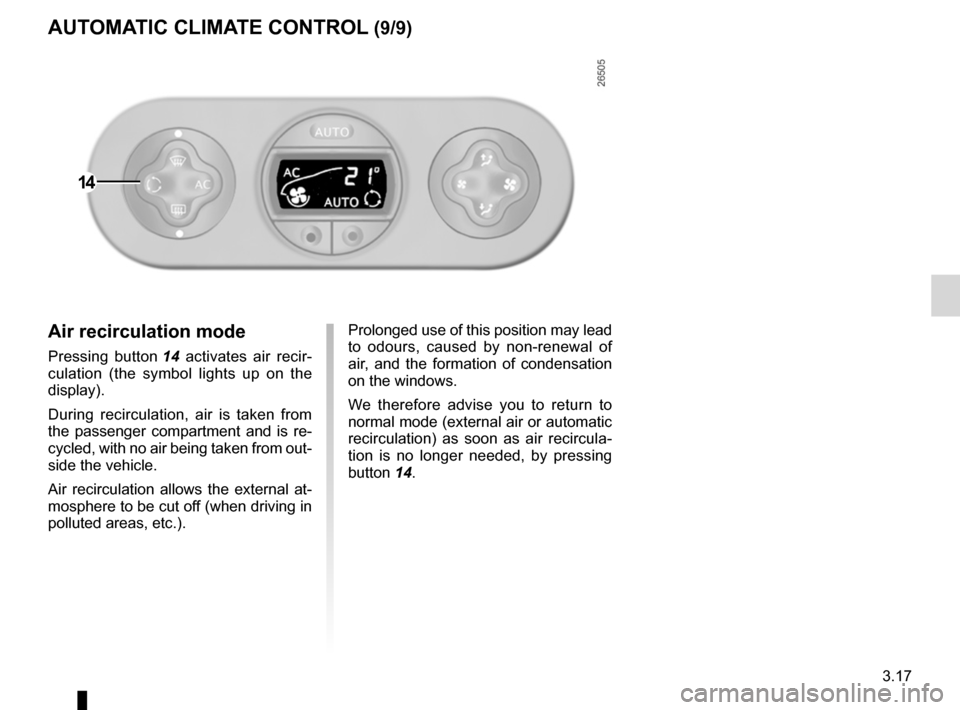
Air recirculation mode
Pressing button 14 activates air recir -
culation (the symbol lights up on the
display).
During recirculation, air is taken from
the passenger compartment and is re-
cycled, with no air being taken from out-
side the vehicle.
Air recirculation allows the external at-
mosphere to be cut off (when driving in
polluted areas, etc.). Prolonged use of this position may lead
to odours, caused by non-renewal of
air, and the formation of condensation
on the windows.
We therefore advise you to return to
normal mode (external air or automatic
recirculation) as soon as air recircula
-
tion is no longer needed, by pressing
button 14.
14
Page 117 of 220
lighting:interior ............................................. (up to the end of the DU)
3.19
ENG_UD24750_2
Eclairage intérieur (X44 - Renault)
ENG_NU_952-4_X44_Renault_3
luggage compartment light
(depending on vehicle)
It comes on when the tailgate or one of
the doors is opened.
Interior lighting
INTERIoR lIghTINg
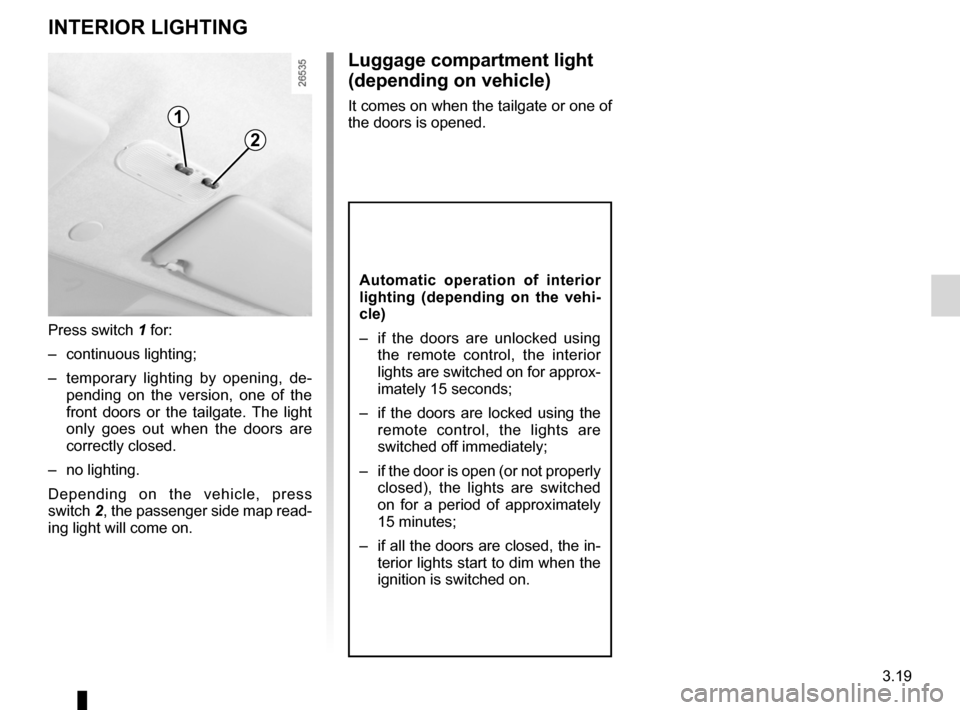
Press switch 1 for:
– continuous lighting;
– temporary lighting by opening, de -
pending on the version, one of the
front doors or the tailgate. The light
only goes out when the doors are
correctly closed.
– no lighting.
Depending on the vehicle, press
switch 2, the passenger side map read-
ing light will come on.
Automatic operation of interior
lighting (depending on the vehi -
cle)
– if the doors are unlocked using
the remote control, the interior
lights are switched on for approx -
imately 15 seconds;
– if the doors are locked using the
remote control, the lights are
switched off immediately;
– if the door is open (or not properly
closed), the lights are switched
on for a period of approximately
15 minutes;
– if all the doors are closed, the in-
terior lights start to dim when the
ignition is switched on.
1
2
Page 136 of 220
towingtowing equipment ............................................. (current page)
3.38
ENG_UD28738_4
Remorquage : attelage (X44 - Renault)
ENG_NU_952-4_X44_Renault_3
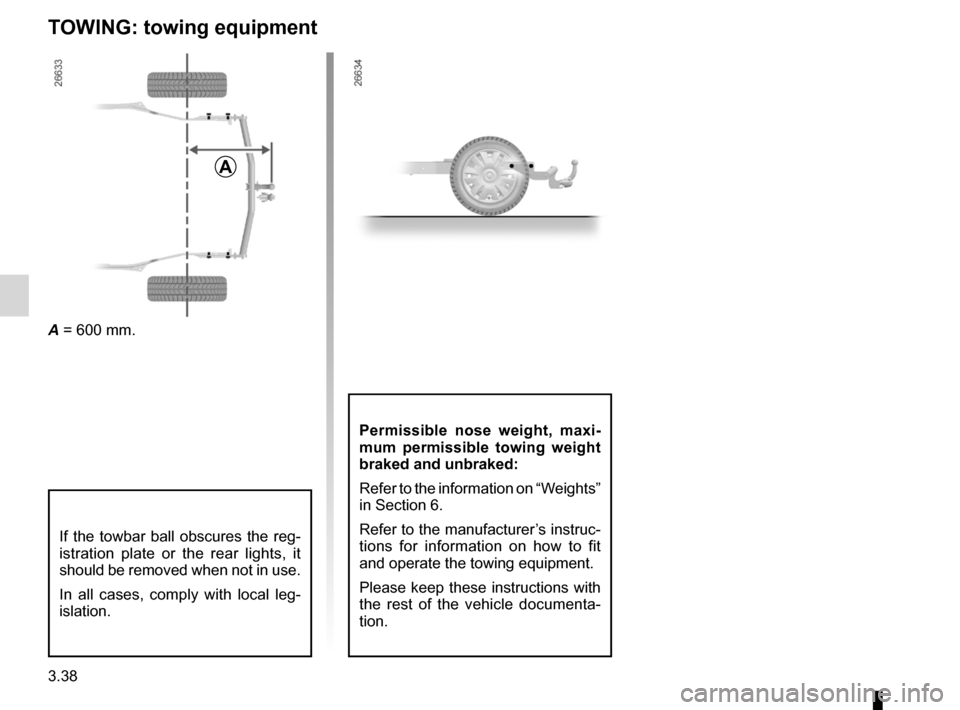
A = 600 mm.
T oWINg: towing equipment
Permissible nose weight, maxi -
mum permissible towing weight
braked and unbraked:
Refer to the information on “Weights”
in Section 6.
Refer to the manufacturer’s instruc-
tions for information on how to fit
and operate the towing equipment.
Please keep these instructions with
the rest of the vehicle documenta -
tion.
A
If the towbar ball obscures the reg-
istration plate or the rear lights, it
should be removed when not in use.
In all cases, comply with local leg -
islation.