start RENAULT TWINGO 2015 3.G Workshop Manual
[x] Cancel search | Manufacturer: RENAULT, Model Year: 2015, Model line: TWINGO, Model: RENAULT TWINGO 2015 3.GPages: 216, PDF Size: 5.06 MB
Page 162 of 216
5.4
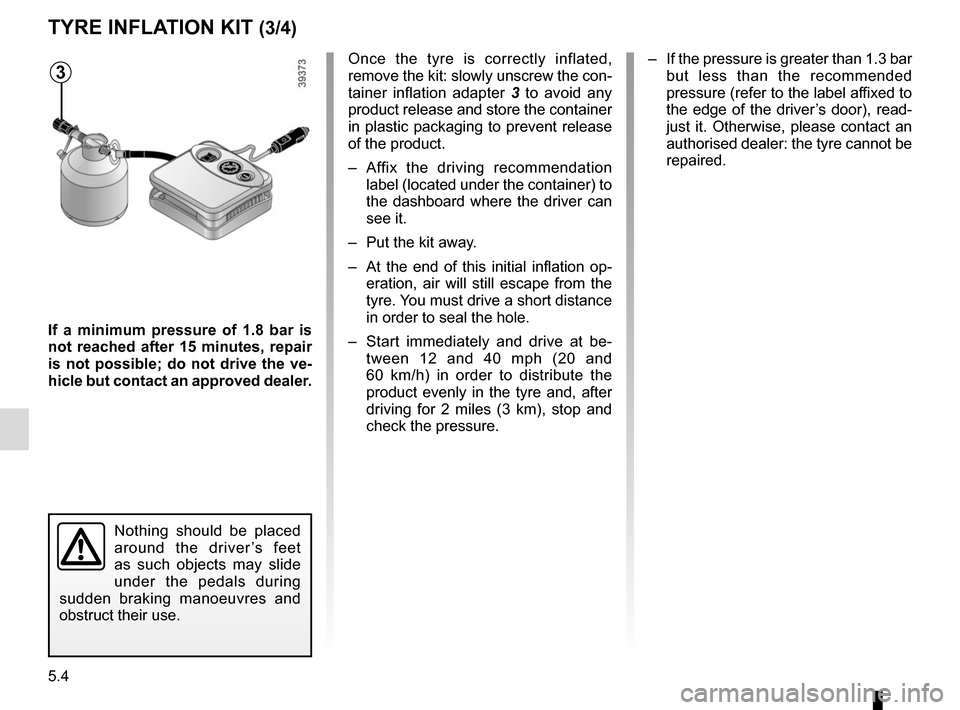
TYRE INFLATION KIT (3/4)
If a minimum pressure of 1.8 bar is
not reached after 15 minutes, repair
is not possible; do not drive the ve-
hicle but contact an approved dealer.
Once the tyre is correctly inflated,
remove the kit: slowly unscrew the con-
tainer inflation adapter 3 to avoid any
product release and store the container
in plastic packaging to prevent release
of the product.
– Affix the driving recommendation label (located under the container) to
the dashboard where the driver can
see it.
– Put the kit away.
– At the end of this initial inflation op- eration, air will still escape from the
tyre. You must drive a short distance
in order to seal the hole.
– Start immediately and drive at be- tween 12 and 40 mph (20 and
60 km/h) in order to distribute the
product evenly in the tyre and, after
driving for 2 miles (3 km), stop and
check the pressure.
Nothing should be placed
around the driver’s feet
as such objects may slide
under the pedals during
sudden braking manoeuvres and
obstruct their use.
3– If the pressure is greater than 1.3 bar but less than the recommended
pressure (refer to the label affixed to
the edge of the driver’s door), read-
just it. Otherwise, please contact an
authorised dealer: the tyre cannot be
repaired.
Page 167 of 216
5.9
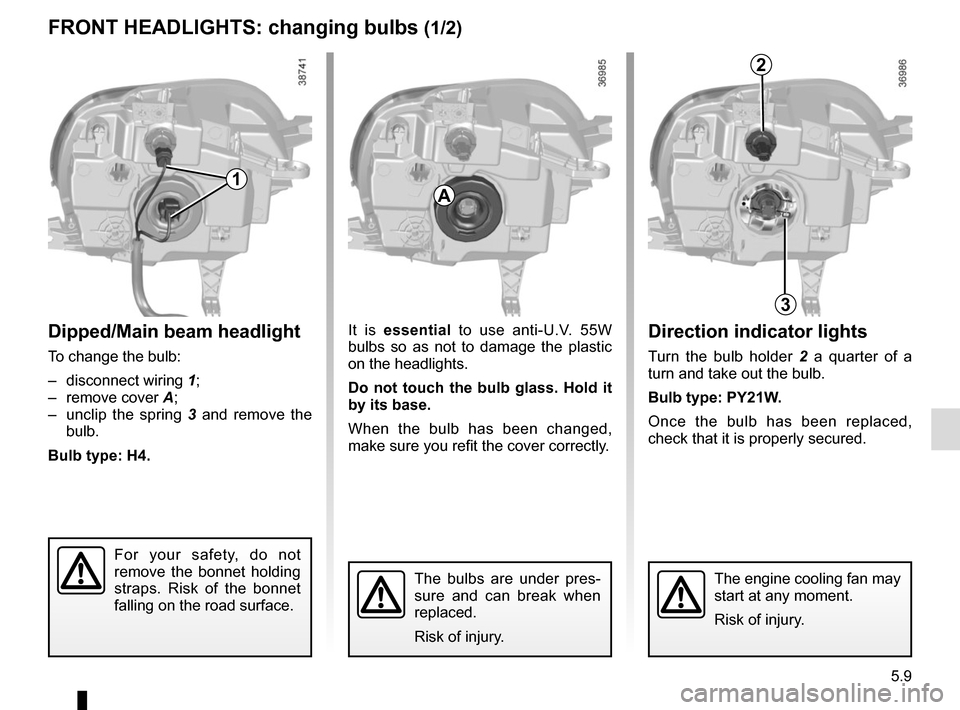
Direction indicator lights
Turn the bulb holder 2 a quarter of a
turn and take out the bulb.
Bulb type: PY21W.
Once the bulb has been replaced,
check that it is properly secured.
Dipped/Main beam headlight
To change the bulb:
– disconnect wiring 1;
– remove cover A;
– unclip the spring 3 and remove the
bulb.
Bulb type: H4.
FRONT HEADLIGHTS: changing bulbs (1/2)
The engine cooling fan may
start at any moment.
Risk of injury.
It is essential to use anti-U.V. 55W
bulbs so as not to damage the plastic
on the headlights.
Do not touch the bulb glass. Hold it
by its base.
When the bulb has been changed,
make sure you refit the cover correctly.
A
3
2
The bulbs are under pres-
sure and can break when
replaced.
Risk of injury.
1
For your safety, do not
remove the bonnet holding
straps. Risk of the bonnet
falling on the road surface.
Page 175 of 216
5.17
Number Allocation
1 “Starting” position on the
ignition-starter switch
2 Power-assisted steering
3 Lighting
4 Airbags
5 Lighting
6 Instrument panel
7 Alarm
8 UCE energy management
9 UCE energy management
10 Passenger compartment
ECU
11 Direction indicator lights
12 Passenger compartment
ECU
13 Passenger compartment
ECU
14 Electric windows
15 ESC/steering wheel angle
sensor/automatic gearbox
16 Courtesy lights/air
conditioning
17 Locking/unlocking the
doors/ESC
18 Rear-view mirrors
19 Brake lights
FUSES (3/3)
Number Allocation
20 Headlight beam height/rear
parking distance control/
front camera adjustment
21 Injection
22 Reversing light/rear
windscreen wiper
23 “Starting” position on the
ignition-starter switch
24 «Accessory» position on the
ignition switch/service relay
25 Front windscreen wiper
26 Radio/energy management
27 Daytime running lights
28 Accessories socket
29 UCE energy management
30 Horn
31 Rear fog light
32 “Accessory” position on the
ignition-starter switch
33 Exterior lights/Rear side
lightsNumber Allocation
34 energy management ECU/
passenger compartment
ECU/headlights/daytime
running lights
35 Right headlight/energy
management ECU
36 Left headlight/passenger
compartment ECU
37 Right-hand main beam
headlight
38 Left headlight/passenger
compartment ECU
39 Bicycle carrier
40 Not used
41 Not used
42 Fog lights
43 Radio amplifier
44 Automatic gearbox
45 Electric windows/one-touch
windows
46 Electric door mirrors
47 Not used
48 Not used
49 Not used
Page 178 of 216

5.20
Start the engine. As soon as it is run-
ning, disconnect the cables A and B in
reverse order ( 1 - 4 - 3 - 2 ) and posi-
tion the red protective cover by press-
ing it down.
BATTERY: breakdown recovery (2/2)
Depending on the vehicle, unclip the
red protective cover to access termi-
nal 2 (+).
Connect the positive cable B to the ter-
minal 2 (+) then to the terminal 3 (+) of
the battery supplying the current.
Connect the negative cable A to the
terminal 4 (–) of the battery supplying
the current, then to the terminal 1 (–) of
the discharged battery.
Starting the vehicle using the
battery from another vehicle
If you have to use the battery from an-
other vehicle to start, obtain suitable
jump leads (with a large cross section)
from an approved dealer or, if you al-
ready have jump leads, ensure that
they are in perfect condition.
The two batteries must have an iden-
tical nominal voltage of 12 volts. The
battery supplying the current should
have a capacity (amp-hours, Ah) which
is at least the same as that of the dis-
charged battery.
Ensure that there is no risk of contact
between the two vehicles (risk of short
circuiting when the positive terminals
are connected) and that the discharged
battery is properly connected. Switch
off your vehicle ignition.
Start the engine of the vehicle supply-
ing the current and run it at an interme-
diate engine speed.
Check that there is no con-
tact between cables A
and B, and that the positive
cable B is not touching any
metal parts of the vehicle supplying
the current.
Risk of injury and/or damage to the
vehicle.
1
2
21
3
B
A
4
For your safety, do not remove the bonnet holding straps. Risk of the
bonnet falling on the road surface.
Page 183 of 216
5.25
TOWING: breakdown recovery (1/2)
Towing a vehicle with an
automatic gearbox
With the engine switched off, the trans-
mission is no longer lubricated. It is
preferable to tow this type of vehicle on
a trailer or tow it with the rear wheels off
the ground.
Under exceptional circumstances, you
may tow the vehicle with all four wheels
on the ground, only going forward, with
the gear lever in the neutral N position,
and for a distance not exceeding
30 miles (50 km).
If the gear lever cannot be put into the
N position, please consult an autho-
rised dealer.
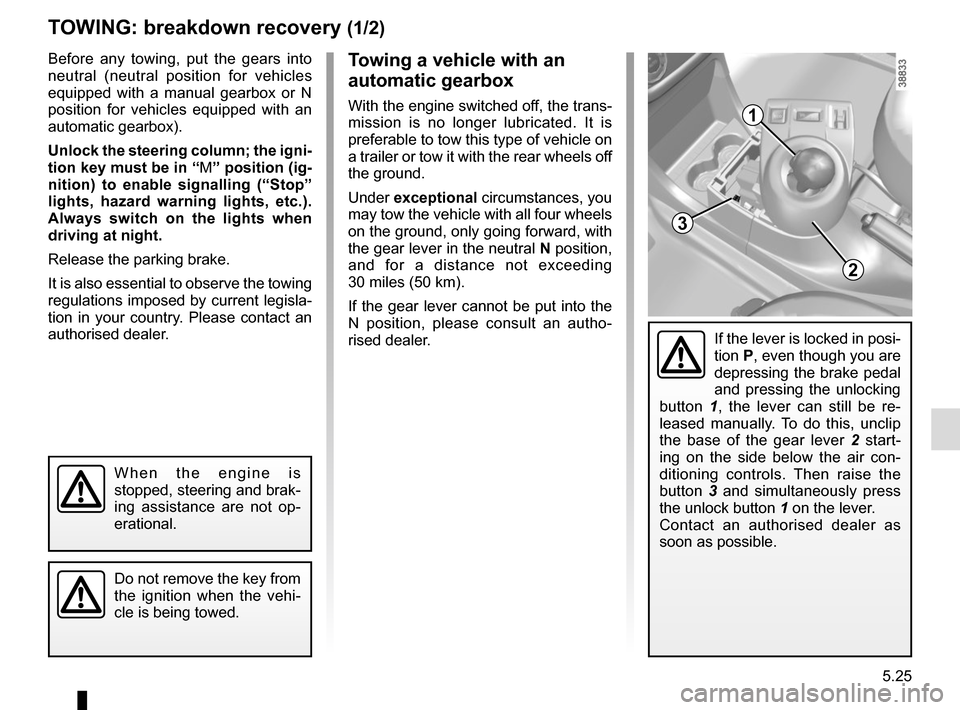
If the lever is locked in posi-
tion P, even though you are
depressing the brake pedal
and pressing the unlocking
button 1, the lever can still be re-
leased manually. To do this, unclip
the base of the gear lever 2 start-
ing on the side below the air con-
ditioning controls. Then raise the
button 3 and simultaneously press
the unlock button 1 on the lever.
Contact an authorised dealer as
soon as possible.
1
2
Before any towing, put the gears into
neutral (neutral position for vehicles
equipped with a manual gearbox or N
position for vehicles equipped with an
automatic gearbox).
Unlock the steering column; the igni-
tion key must be in “ M” position (ig-
nition) to enable signalling (“Stop”
lights, hazard warning lights, etc.).
Always switch on the lights when
driving at night.
Release the parking brake.
It is also essential to observe the towing
regulations imposed by current legisla-
tion in your country. Please contact an
authorised dealer.
When the engine is
stopped, steering and brak-
ing assistance are not op-
erational.
Do not remove the key from
the ignition when the vehi-
cle is being towed.
3
Page 185 of 216
5.27
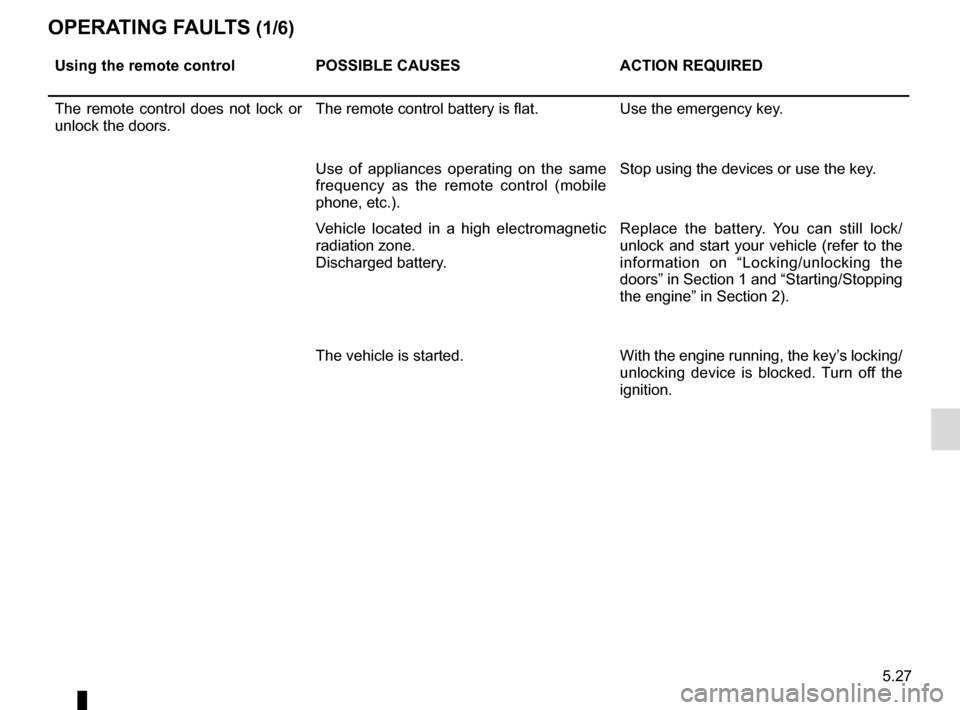
OPERATING FAULTS (1/6)
Using the remote controlPOSSIBLE CAUSES ACTION REQUIRED
The remote control does not lock or
unlock the doors. The remote control battery is flat.
Use the emergency key.
Use of appliances operating on the same
frequency as the remote control (mobile
phone, etc.). Stop using the devices or use the key.
Vehicle located in a high electromagnetic
radiation zone.
Discharged battery. Replace the battery. You can still lock/
unlock and start your vehicle (refer to the
information on “Locking/unlocking the
doors” in Section 1 and “Starting/Stopping
the engine” in Section 2).
The vehicle is started. With the engine running, the key’s locking/
unlocking device is blocked. Turn off the
ignition.
Page 186 of 216
5.28
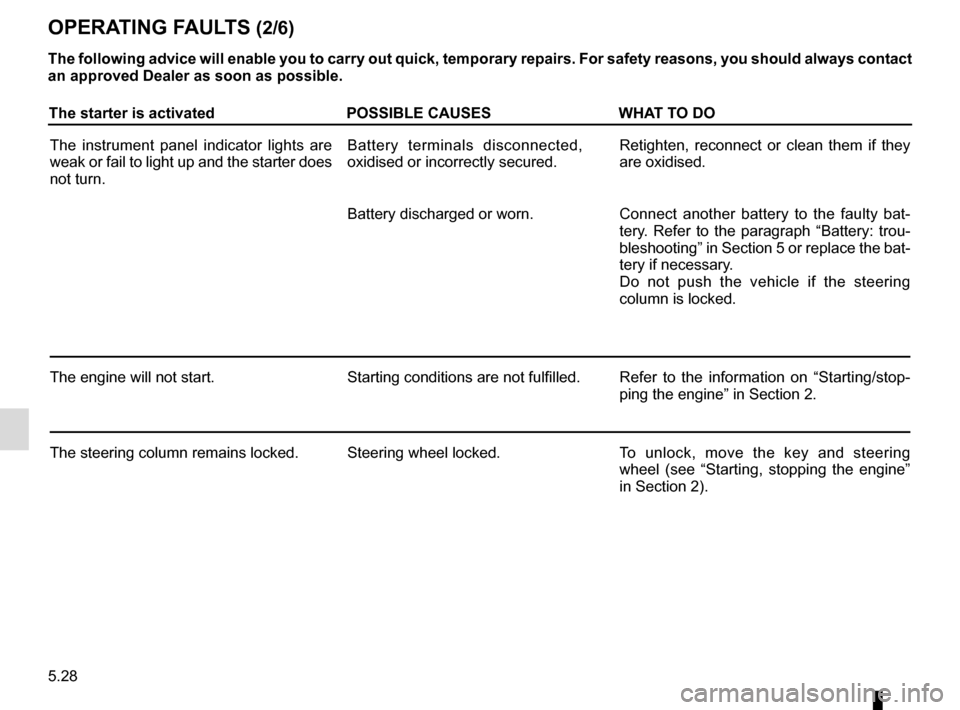
The starter is activatedPOSSIBLE CAUSESWHAT TO DO
The instrument panel indicator lights are
weak or fail to light up and the starter does
not turn. Battery terminals disconnected,
oxidised or incorrectly secured.
Retighten, reconnect or clean them if they
are oxidised.
Battery discharged or worn. Connect another battery to the faulty bat-
tery. Refer to the paragraph “Battery: trou-
bleshooting” in Section 5 or replace the bat-
tery if necessary.
Do not push the vehicle if the steering
column is locked.
The engine will not start. Starting conditions are not fulfilled.Refer to the information on “Starting/stop-
ping the engine” in Section 2.
The steering column remains locked. Steering wheel locked. To unlock, move the key and steering
wheel (see “Starting, stopping the engine”
in Section 2).
OPERATING FAULTS (2/6)
The following advice will enable you to carry out quick, temporary repai\
rs. For safety reasons, you should always contact
an approved Dealer as soon as possible.
Page 210 of 216
7.2
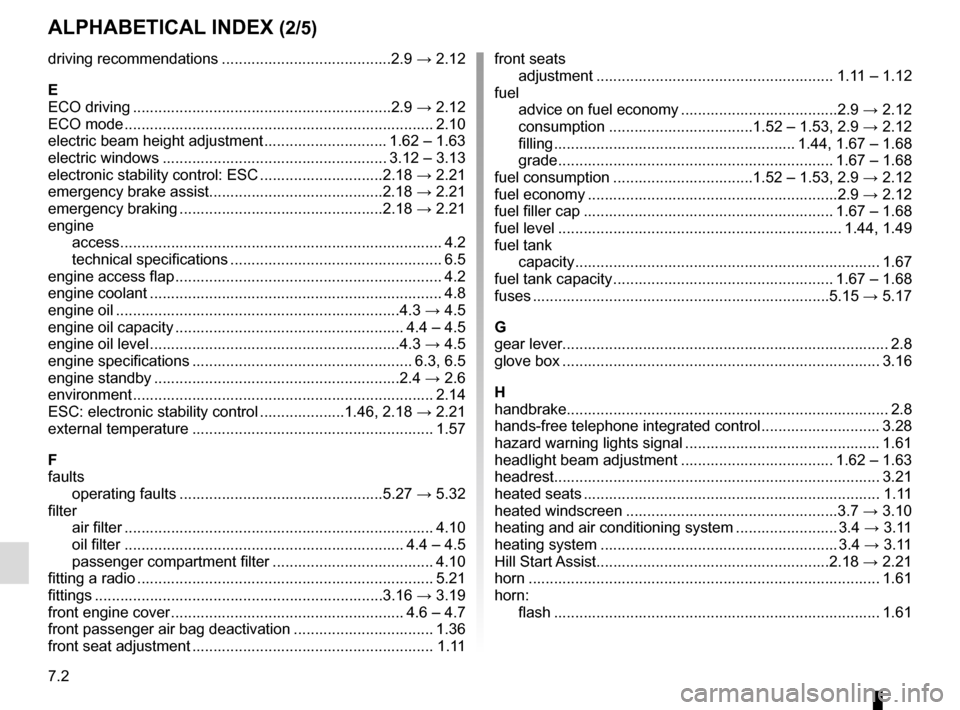
ALPHABETICAL INDEX (2/5)
driving recommendations ........................................2.9 → 2.12
E
ECO driving .............................................................2.9 → 2.12
ECO mode ........................................................................\
. 2.10
electric beam height adjustment ............................. 1.62 – 1.63
electric windows ..................................................... 3.12 – 3.13
electronic stability control: ESC .............................2.18 → 2.21
emergency brake assist.........................................2.18 → 2.21
emergency braking ................................................2.18 → 2.21
engine access .................................................................\
........... 4.2
technical specifications .................................................. 6.5
engine access flap ............................................................... 4.2
engine coolant ..................................................................... 4.8
engine oil ...................................................................4.3 → 4.5
engine oil capacity ...................................................... 4.4 – 4.5
engine oil level ...........................................................4.3 → 4.5
engine specifications .................................................... 6.3, 6.5
engine standby ..........................................................2.4 → 2.6
environment ............................................................\
........... 2.14
ESC: electronic stability control ....................1.46, 2.18 → 2.21
external temperature ......................................................... 1.57
F
faults operating faults ................................................5.27 → 5.32
filter air filter ........................................................................\
. 4.10
oil filter .................................................................. 4.4 – 4.5
passenger compartment filter ...................................... 4.10
fitting a radio ...................................................................... 5.21
fittings ...............................................................\
.....3.16 → 3.19
front engine cover ....................................................... 4.6 – 4.7
front passenger air bag deactivation ................................. 1.36
front seat adjustment ......................................................... 1.11 front seats
adjustment ........................................................ 1.11 – 1.12
fuel advice on fuel economy .....................................2.9 → 2.12
consumption ..................................1.52 – 1.53, 2.9 → 2.12
filling ......................................................... 1.44, 1.67 – 1.68
grade ................................................................. 1.67 – 1.68
fuel consumption .................................1.52 – 1.53, 2.9 → 2.12
fuel economy ...........................................................2.9 → 2.12
fuel filler cap ........................................................... 1.67 – 1.68
fuel level ................................................................... 1.44, 1.49
fuel tank capacity ...............................................................\
......... 1.67
fuel tank capacity .................................................... 1.67 – 1.68
fuses ..................................................................\
....5.15 → 5.17
G
gear lever..............................................................\
............... 2.8
glove box ........................................................................\
... 3.16
H
handbrake...............................................................\
............. 2.8
hands-free telephone integrated control ............................ 3.28
hazard warning lights signal .............................................. 1.61
headlight beam adjustment .................................... 1.62 – 1.63
headrest................................................................\
............. 3.21
heated seats ...................................................................... 1.11
heated windscreen ..................................................3.7 → 3.10
heating and air conditioning system ........................ 3.4 → 3.11
heating system ........................................................ 3.4 → 3.11
Hill Start Assist.......................................................2.18 → 2.21
horn ...................................................................\
................ 1.61
horn: flash ..................................................................\
........... 1.61
Page 212 of 216

rear bench seat.........................................................\
......... 3.22
rear lightsnumber plate lights ...................................................")
7.4
ALPHABETICAL INDEX (4/5)
rear bench seat.........................................................\
......... 3.22
rear lightsnumber plate lights ...................................................... 5.12
rear seats..............................................................\
............. 1.14 functions ..............................................................\
........ 3.22
rear view camera .................................................... 2.33 – 2.34
rear view mirrors ................................................................ 1.39
remote control door locking batteries ..............................................................\
......... 5.18
remote control door locking unit ................................1.2 → 1.4
RENAULT ANTI-INTRUDER DEVICE (RAID) ................... 1.10
replacement parts ................................................................ 6.7
reverse gear selecting ....................................................2.8, 2.35 → 2.37
reversing sensor ..................................................... 2.31 – 2.32
roof bars ........................................................................\
.... 3.27
roof rack roof bars ....................................................................... 3.27
running in ........................................................................\
..... 2.2
S
seat belt pretensioners front seat belt ...................................................1.15 → 1.18
seat belts .............................................1.12 → 1.18, 1.21, 1.48
service sheets..........................................................\
6.8 → 6.13
side indicator lights changing bulbs ............................................................. 5.13
side protection devices ...................................................... 1.20
signals and lights ...................................................1.58 → 1.63
speakers location ...............................................................\
......... 5.21
special features of petrol vehicles ....................................... 2.7
speed limiter .................................................1.47, 2.24 → 2.26
starting the engine .....................................................2.2 → 2.6
steering wheel adjustment .............................................................\
...... 1.22 Stop & Start ......................................................1.47, 2.4
→ 2.6
Stop & Start function..................................................2.4 → 2.6
stopping the engine ............................................................. 2.3
storage compartment.............................................3.16 → 3.19
storage compartments ...........................................3.16 → 3.19
sun visor ........................................................................\
.... 3.19
sunroof.................................................................\
.............. 3.14
switching on the vehicle ignition ................................. 2.2 – 2.3
T
tailgate ........................................................... 3.23, 3.25 – 3.26
tanks and reservoirs brake fluid ...................................................................... 4.9
coolant ................................................................\
........... 4.8
tanks and reservoirs: windscreen washer ...................................................... 4.10
technical specifications ..............................................6.4 → 6.7
telephone ..............................................................\
............. 3.28
temperature regulation ............................................ 3.7 → 3.11
towing breakdown ........................................................ 5.25 – 5.26
towing a caravan ................................................................. 6.6
towing hitch............................................................\
............ 5.26
towing rings ....................................................................... 3.26
towing weights ..................................................................... 6.6
transporting children ..........................1.23 – 1.24, 1.26 → 1.36
transporting objects in the luggage compartment ........................................ 3.26
on the roof ...................................................................... 6.6
trip computer and warning system... 1.44 → 1.48, 1.50 → 1.55
tyre inflation kit......................................................\
.....5.2 → 5.5
tyre pressure...............................2.15 → 2.17, 4.12 – 4.13, 5.7
tyre pressure loss warning.....................................2.15 → 2.17
tyre pressures ......................................................... 4.12 – 4.13
tyres ........................ 2.12, 2.15 → 2.17, 4.12 – 4.13, 5.6 → 5.8