speed limit RENAULT TWINGO 2016 3.G User Guide
[x] Cancel search | Manufacturer: RENAULT, Model Year: 2016, Model line: TWINGO, Model: RENAULT TWINGO 2016 3.GPages: 216, PDF Size: 7.15 MB
Page 102 of 216
2.28
The cruise control function helps you to
maintain your driving speed at a speed
that you choose, called the cruising
speed.
This cruising speed may be set at any
speed above 20 mph (30 km/h).
This function is an addi-
tional driving aid. However,
the function does not take
the place of the driver.
Therefore, it can under no circum-
stances replace the driver’s respon-
sibility to respect speed limits and to
be vigilant (the driver must always
be ready to brake).
Cruise control must not be used in
heavy traffic, on undulating or slip-
pery roads (black ice, aquaplan-
ing, gravel) and during bad weather
(fog, rain, side winds etc.).
There is a risk of accidents.
The cruise control function
is in no way linked to the
braking system.
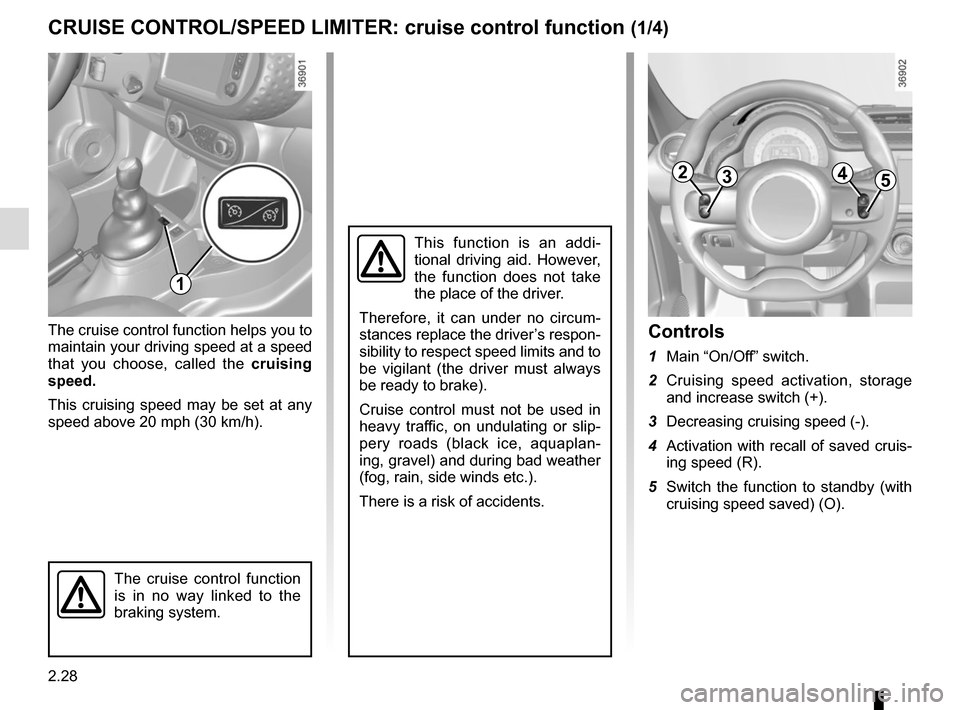
Controls
1 Main “On/Off” switch.
2 Cruising speed activation, storage and increase switch (+).
3 Decreasing cruising speed (-).
4 Activation with recall of saved cruis- ing speed (R).
5 Switch the function to standby (with cruising speed saved) (O).
CRUISE CONTROL/SPEED LIMITER: cruise control function (1/4)
2354
1
Page 103 of 216
2.29
Driving
Once a cruising speed is memorised
and the cruise control function is active,
you may lift your foot off the accelera-
tor pedal.
Important: you are never-
theless advised to keep
your feet close to the pedals
in order to react if neces-
sary.
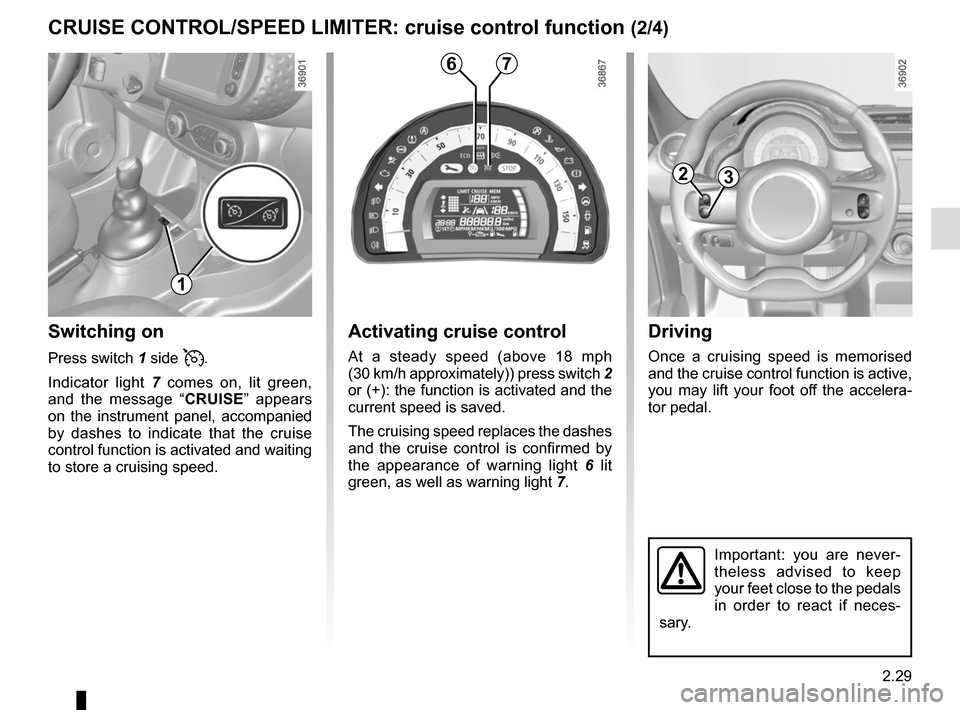
Activating cruise control
At a steady speed (above 18 mph
(30 km/h approximately)) press switch 2
or (+): the function is activated and the
current speed is saved.
The cruising speed replaces the dashes
and the cruise control is confirmed by
the appearance of warning light 6 lit
green, as well as warning light 7.
Switching on
Press switch 1 side .
Indicator light 7 comes on, lit green,
and the message “ CRUISE” appears
on the instrument panel, accompanied
by dashes to indicate that the cruise
control function is activated and waiting
to store a cruising speed.
CRUISE CONTROL/SPEED LIMITER: cruise control function (2/4)
23
67
1
Page 104 of 216
2.30
CRUISE CONTROL/SPEED LIMITER: cruise control function (3/4)
Exceeding the cruising speed
The cruising speed may be exceeded
at any time by depressing the accelera-
tor pedal. While it is being exceeded,
the cruising speed flashes on the in-
strument panel.
Then, release the accelerator: after a
few seconds, the vehicle will automati-
cally return to its set cruising speed.
Cruising speed cannot be
maintained
When driving down a steep gradient,
the system is unable to maintain the
cruising speed: the stored speed will
flash on the instrument panel informa-
tion display to inform you of this situ-
ation.
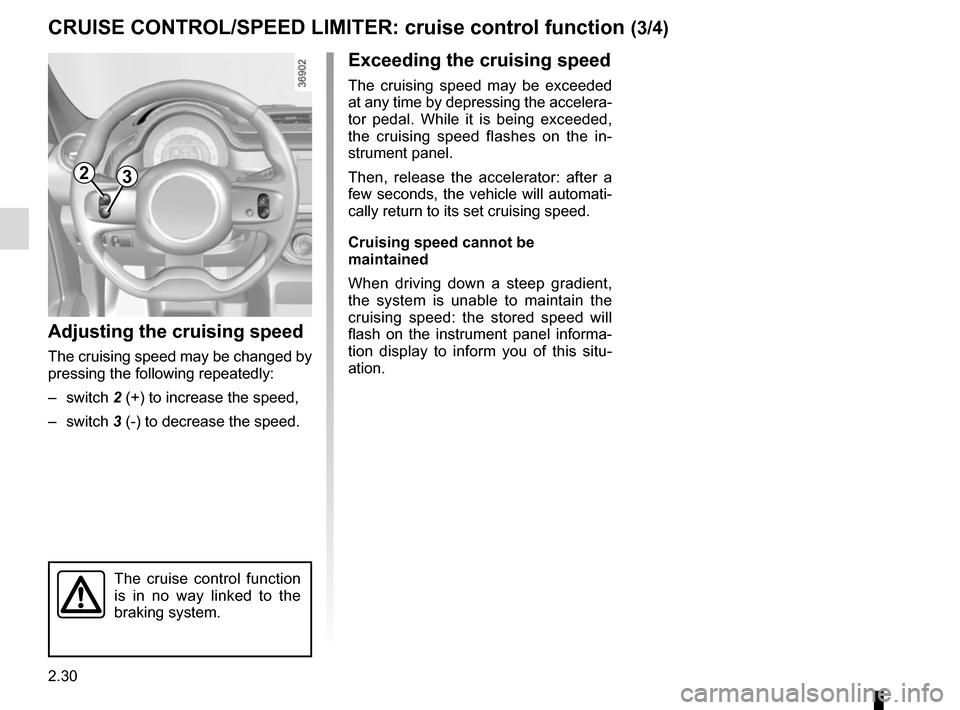
Adjusting the cruising speed
The cruising speed may be changed by
pressing the following repeatedly:
– switch 2 (+) to increase the speed,
– switch 3 (-) to decrease the speed.
The cruise control function
is in no way linked to the
braking system.
23
Page 105 of 216
2.31
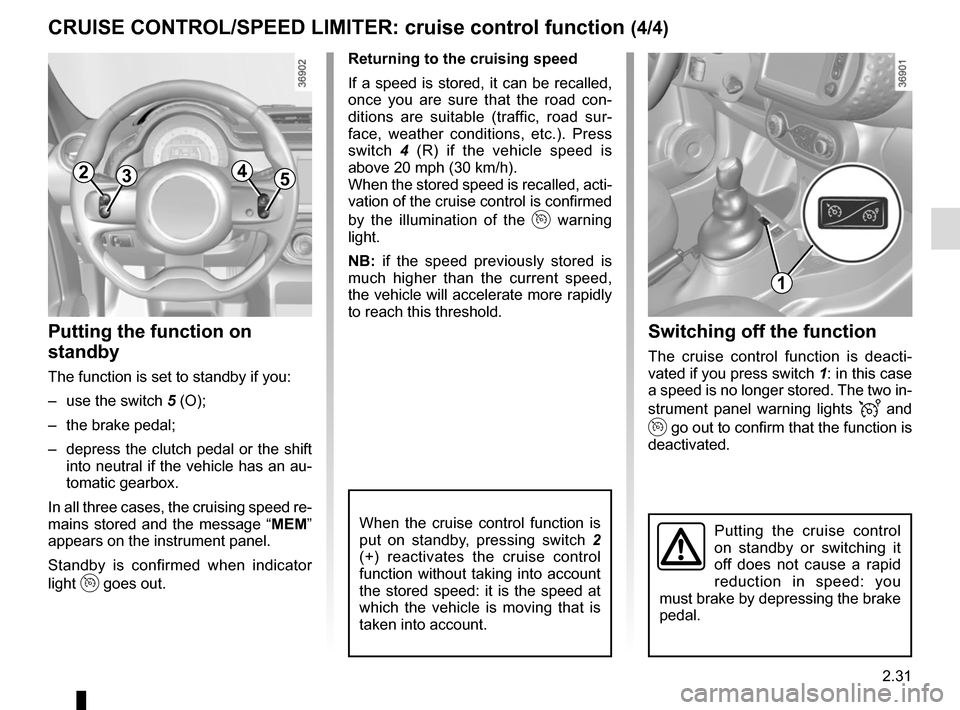
Switching off the function
The cruise control function is deacti-
vated if you press switch 1: in this case
a speed is no longer stored. The two in-
strument panel warning lights
and
go out to confirm that the function is
deactivated.
Returning to the cruising speed
If a speed is stored, it can be recalled,
once you are sure that the road con-
ditions are suitable (traffic, road sur-
face, weather conditions, etc.). Press
switch
4 (R) if the vehicle speed is
above 20 mph (30 km/h).
When the stored speed is recalled, acti-
vation of the cruise control is confirmed
by the illumination of the
warning
light.
NB: if the speed previously stored is
much higher than the current speed,
the vehicle will accelerate more rapidly
to reach this threshold.
When the cruise control function is
put on standby, pressing switch 2
(+) reactivates the cruise control
function without taking into account
the stored speed: it is the speed at
which the vehicle is moving that is
taken into account.
Putting the function on
standby
The function is set to standby if you:
– use the switch 5 (O);
– the brake pedal;
– depress the clutch pedal or the shift into neutral if the vehicle has an au-
tomatic gearbox.
In all three cases, the cruising speed re-
mains stored and the message “ MEM”
appears on the instrument panel.
Standby is confirmed when indicator
light
goes out.
CRUISE CONTROL/SPEED LIMITER: cruise control function (4/4)
Putting the cruise control
on standby or switching it
off does not cause a rapid
reduction in speed: you
must brake by depressing the brake
pedal.
2354
1
Page 153 of 216
4.13
TYRE PRESSURE (2/2)
Tyre safety and use of snow chains:
Refer to the information on “Tyres” in
Section 5 for the servicing conditions
and, depending on the version, the use
of chains.
For your safety, please re-
spect the speed limit.
When they need to be re-
placed, only tyres of the
same make, size, type and profile
should be used on a single axle.
They must: either have a load ca-
pacity and speed rating at least
equal to those of the original
tyres, or conform to those recom-
mended by an authorised dealer.
Failure to heed these instructions
could endanger your safety and
affect your vehicle’s roadworthi-
ness.
Risk of loss of control of the ve-
hicle.
Page 164 of 216
5.6
Tyre and wheel safetyThe tyres are the only contact between
the vehicle and the road, so it is essen-
tial to keep them in good condition. You
must make sure that your tyres conform
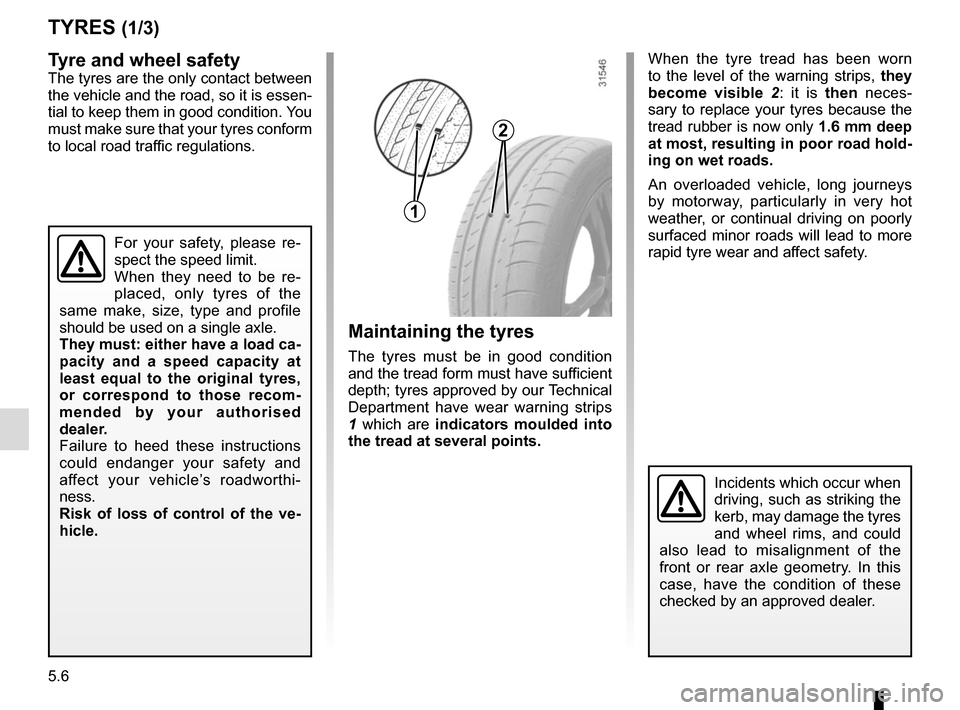
to local road traffic regulations.When the tyre tread has been worn
to the level of the warning strips, they
become visible
2: it is then neces-
sary to replace your tyres because the
tread rubber is now only 1.6 mm deep
at most, resulting in poor road hold-
ing on wet roads.
An overloaded vehicle, long journeys
by motorway, particularly in very hot
weather, or continual driving on poorly
surfaced minor roads will lead to more
rapid tyre wear and affect safety.
TYRES (1/3)
For your safety, please re-
spect the speed limit.
When they need to be re-
placed, only tyres of the
same make, size, type and profile
should be used on a single axle.
They must: either have a load ca-
pacity and a speed capacity at
least equal to the original tyres,
or correspond to those recom-
mended by your authorised
dealer.
Failure to heed these instructions
could endanger your safety and
affect your vehicle’s roadworthi-
ness.
Risk of loss of control of the ve-
hicle.
Incidents which occur when
driving, such as striking the
kerb, may damage the tyres
and wheel rims, and could
also lead to misalignment of the
front or rear axle geometry. In this
case, have the condition of these
checked by an approved dealer.
1
2
Maintaining the tyres
The tyres must be in good condition
and the tread form must have sufficient
depth; tyres approved by our Technical
Department have wear warning strips
1 which are indicators moulded into
the tread at several points.
Page 166 of 216
5.8
TYRES (3/3)
Studded tyres
This type of equipment may only be
used for a limited period and as laid
down by local legislation. It is neces-
sary to observe the speed specified by
current legislation.
These tyres must, at a minimum, be
fitted to the two front wheels.
Chains may only be fitted
to tyres of the same size
as those originally fitted to
your vehicle.
In all cases, we would recommend
that you contact an approved dealer
who will be able to advise you on
the choice of equipment which is
most suitable for your vehicle.
Snow or winter tyres
We would recommend that these be
fitted to all four wheels to ensure that
your vehicle retains maximum adhe-
sion.
Warning: These tyres sometimes have
a specific direction of rotation and a
maximum speed index which may be
lower than the maximum speed of your
vehicle.
16” wheels cannot be
fitted with chains.
If you wish to fit snow
chains, you must use spe-
cial equipment .
Consult an approved Dealer.
Use in winter
Chains
For safety reasons, only fit chains
on the rear axle.
Chains cannot be fitted to tyres which
are larger than those originally fitted to
the vehicle.
Page 209 of 216

A
ABS ..............................................................1.46, \
2.19 → 2.22
accessories.............................................................\
......")
7.1
ALPHABETICAL INDEX (1/5)
A
ABS ..............................................................1.46, \
2.19 → 2.22
accessories.............................................................\
........... 5.22
accessories socket ............................................................ 3.20
additional methods of restraint .......................................... 1.21 side protection ............................................................. 1.20
to the front seat belts .......................................1.15 → 1.18
to the rear seat belts .................................................... 1.19
adjusting your driving position ...................... 1.11 → 1.14, 3.21
advice on antipollution ....................................................... 2.14
air bag...........................................................1.15 → 1.21, 1.44
activating the front passenger air bags ........................ 1.38
deactivating the front passenger air bags .................... 1.36
air conditioning ........................................................ 3.4 → 3.11
air vents ...................................................................... 3.2 – 3.3
anti-corrosion check ..............................................6.14 → 6.18
anti-corrosion protection .................................................... 4.14
anti-lock braking system: ABS ...............................2.19 → 2.22
antipollution advice .................................................................\
......... 2.14
ashtray ................................................................\
............... 3.20
audible and visual signals.................................................. 1.61
automatic gearbox (use) ........................................2.36 → 2.38
automatic gearbox selector lever...........................2.36 → 2.38
B
battery............................................................ 4.11, 5.19 – 5.20 troubleshooting ................................................. 5.19 – 5.20
battery (remote control) ..................................................... 5.18
brake fluid ........................................................................\
.... 4.9
bulbs changing ............................................................5.9 → 5.14
C
catalytic converter.....................................................\
........... 2.8
central door locking .................................1.2 – 1.3, 1.8 → 1.10changing a bulb .......................................................5.9
→ 5.14
changing gear .................................................2.9, 2.36 → 2.38
child restraint/seat .............................1.23 – 1.24, 1.26 → 1.36
child safety.........................1.7, 1.18, 1.23 – 1.24, 1.26 → 1.36
child seats..........................................1.23 – 1.24, 1.2\
6 → 1.35
children .......................................................... 1.23 – 1.24, 1.24
children (safety) ................................................................... 1.7
cigar lighter ........................................................................\
3.20
cleaning: inside the vehicle .............................................. 4.16 – 4.17
clock ....................................................................... 1.56 – 1.57
closing the doors .....................................................1.6 → 1.10
control instruments ............................1.44 → 1.51, 1.56 – 1.57
controls ...............................................................\
...1.40 → 1.43
courtesy light ............................................................ 3.15, 5.14
cruise control ................................................1.47, 2.28 → 2.31
crosswind assist ................................................................ 2.20
cruise control-speed limiter....................................2.25 → 2.31
crosswind assist function ................................................... 2.20
D
dashboard..............................................................1\
.40 → 1.43
demisting rear screen ..................................................3.4, 3.7 → 3.10
windscreen ..................................................3.5, 3.7 → 3.10
dimensions .............................................................\
............. 6.4
dipstick................................................................\
................. 4.3
display ................................................................\
...1.44 → 1.49
doors/tailgate ....................................................1.4, \
1.6 → 1.10
driver assistance....................................................2.1\
9 → 2.35
driver’s position .....................................................1.40 → 1.48
driving ......... 2.3, 2.8, 2.10 → 2.13, 2.19 → 2.22, 2.25 → 2.33,
2.36 → 2.38
driving aids ............................................................2.19 → 2.35
driving position settings ............................................................1.1\
2 →
1.14
Page 212 of 216

rear bench seat.........................................................\
......... 3.22
rear lightsnumber plate lights ...................................................")
7.4
ALPHABETICAL INDEX (4/5)
rear bench seat.........................................................\
......... 3.22
rear lightsnumber plate lights ...................................................... 5.12
rear seats..............................................................\
............. 1.14 functions ..............................................................\
........ 3.22
rear view camera .................................................... 2.34 – 2.35
rear view mirrors ................................................................ 1.39
remote control door locking batteries ..............................................................\
......... 5.18
remote control door locking unit ................................1.2 → 1.4
RENAULT ANTI-INTRUDER DEVICE (RAID) ................... 1.10
replacement parts ................................................................ 6.7
reverse gear selecting ....................................................2.9, 2.36 → 2.38
reversing sensor ..................................................... 2.32 – 2.33
roof bars ........................................................................\
.... 3.27
roof rack roof bars ....................................................................... 3.27
running in ........................................................................\
..... 2.2
S
seat belt pretensioners front seat belt ...................................................1.15 → 1.18
seat belts .............................................1.12 → 1.18, 1.21, 1.48
service sheets..........................................................\
6.8 → 6.13
side indicator lights changing bulbs ............................................................. 5.13
side protection devices ...................................................... 1.20
signals and lights ...................................................1.58 → 1.63
speakers location ...............................................................\
......... 5.21
special features of petrol vehicles ....................................... 2.8
speed limiter .................................................1.47, 2.25 → 2.27
starting the engine .....................................................2.2 → 2.7
steering wheel adjustment .............................................................\
...... 1.22 Stop & Start ......................................................1.47, 2.4
→ 2.7
Stop & Start function..................................................2.4 → 2.7
stopping the engine ............................................................. 2.3
storage compartment.............................................3.16 → 3.19
storage compartments ...........................................3.16 → 3.19
sun visor ........................................................................\
.... 3.19
sunroof.................................................................\
.............. 3.14
switching on the vehicle ignition ................................. 2.2 – 2.3
T
tailgate ........................................................... 3.23, 3.25 – 3.26
tanks and reservoirs brake fluid ...................................................................... 4.9
coolant ................................................................\
........... 4.8
tanks and reservoirs: windscreen washer ...................................................... 4.10
technical specifications ..............................................6.4 → 6.7
telephone ..............................................................\
............. 3.28
temperature regulation ............................................ 3.7 → 3.11
towing breakdown ........................................................ 5.25 – 5.26
towing a caravan ................................................................. 6.6
towing hitch............................................................\
............ 5.26
towing rings ....................................................................... 3.26
towing weights ..................................................................... 6.6
transporting children ..........................1.23 – 1.24, 1.26 → 1.36
transporting objects in the luggage compartment ........................................ 3.26
on the roof ...................................................................... 6.6
trip computer and warning system... 1.44 → 1.48, 1.50 → 1.55
tyre inflation kit......................................................\
.....5.2 → 5.5
tyre pressure...............................2.16 → 2.18, 4.12 – 4.13, 5.7
tyre pressure loss warning.....................................2.16 → 2.18
tyre pressures ......................................................... 4.12 – 4.13
tyres ........................ 2.13, 2.16 → 2.18, 4.12 – 4.13, 5.6 → 5.8