lights RENAULT TWIZY 2017 1.G User Guide
[x] Cancel search | Manufacturer: RENAULT, Model Year: 2017, Model line: TWIZY, Model: RENAULT TWIZY 2017 1.GPages: 118, PDF Size: 2.48 MB
Page 68 of 118
4.4
12V BATTERY (1/2)
The secondary battery is a 12 V battery:
this supplies the energy required to op-
erate vehicle equipment (lights, wind-
screen wipers, audio system, etc) and
certain safety systems, such as ABS.
For your safety and the
proper operation of the
vehicle’s electrical equip-
ment (lights, windscreen
wipers, etc.), any work on the se-
condary 12V battery (removal, dis-
connection, etc.) must be carried
out by a specialist.
Risk of serious burns or electric
shocks.
Respect categorically the replace-
ment intervals (without exceeding
them) as stated in the maintenance
document.
The battery is a specific type.
Please ensure it is replaced with the
same type.
Contact an Authorised Dealer.
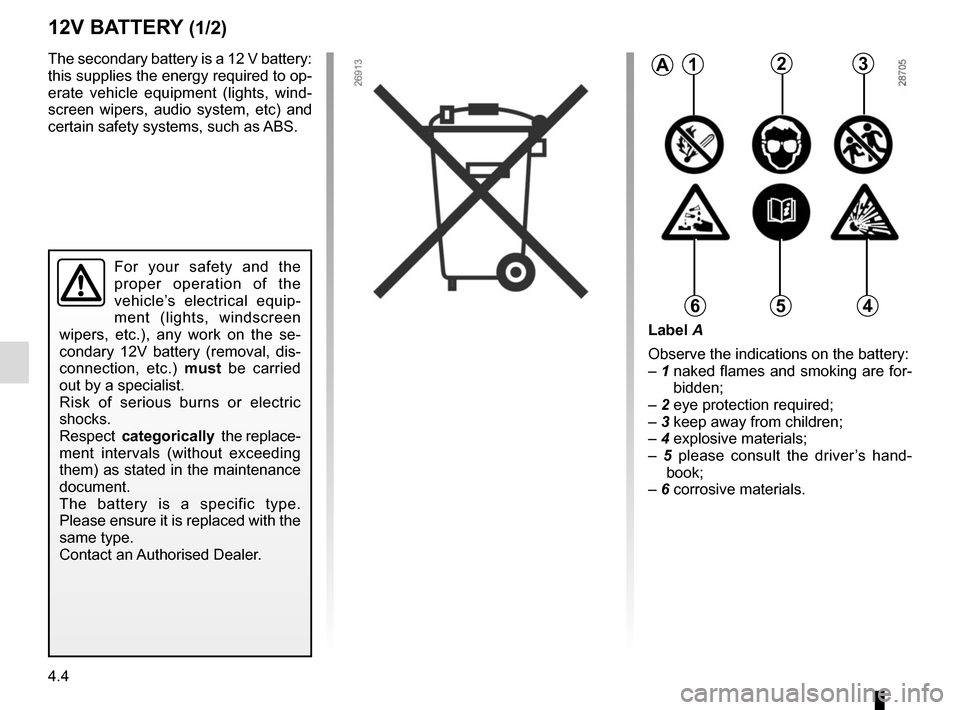
A123
456
Label A
Observe the indications on the battery:
– 1 naked flames and smoking are for-
bidden;
– 2 eye protection required;
– 3 keep away from children;
– 4 explosive materials;
– 5 please consult the driver’s hand-
book;
– 6 corrosive materials.
Page 69 of 118
4.5
12 VOLT BATTERY (2/2)Connecting a charger to the
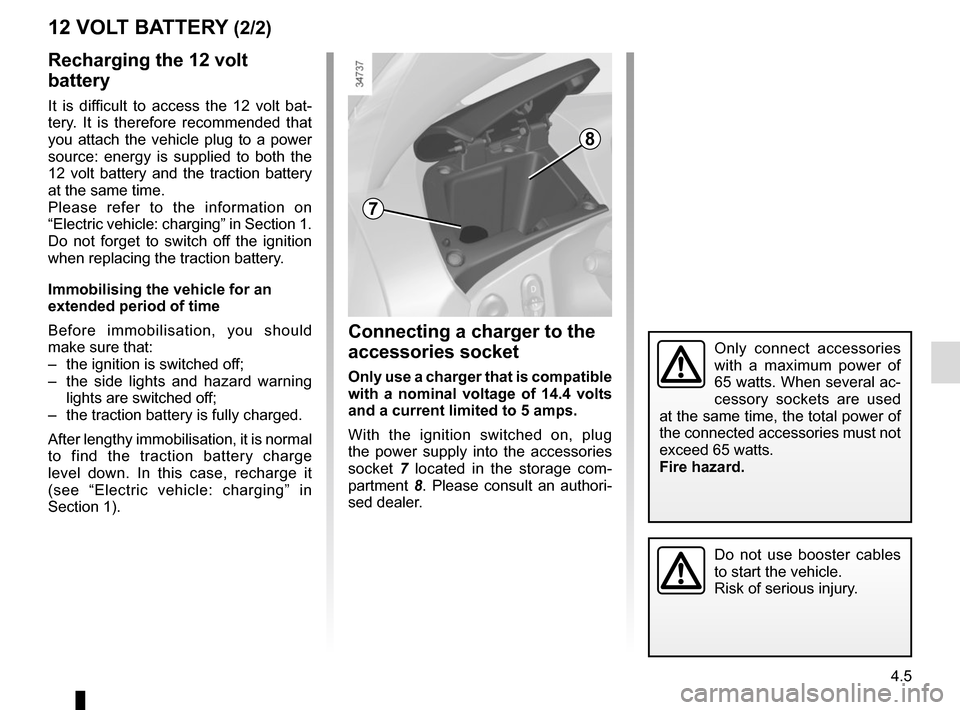
accessories socket
Only use a charger that is compatible
with a nominal voltage of 14.4 volts
and a current limited to 5 amps.
With the ignition switched on, plug
the power supply into the accessories
socket 7 located in the storage com-
partment 8. Please consult an authori-
sed dealer.
Recharging the 12 volt
battery
It is difficult to access the 12 volt bat-
tery. It is therefore recommended that
you attach the vehicle plug to a power
source: energy is supplied to both the
12 volt battery and the traction battery
at the same time.
Please refer to the information on
“Electric vehicle: charging” in Section 1.
Do not forget to switch off the ignition
when replacing the traction battery.
Immobilising the vehicle for an
extended period of time
Before immobilisation, you should
make sure that:
– the ignition is switched off;
– the side lights and hazard warning lights are switched off;
– the traction battery is fully charged.
After lengthy immobilisation, it is normal
to find the traction battery charge
level down. In this case, recharge it
(see “Electric vehicle: charging” in
Section 1).
Do not use booster cables
to start the vehicle.
Risk of serious injury.
8
7
Only connect accessories
with a maximum power of
65 watts. When several ac-
cessory sockets are used
at the same time, the total power of
the connected accessories must not
exceed 65 watts.
Fire hazard.
Page 75 of 118
 . . . . . . . . . . . . . . . . . . . . . . . . . . . . . . . . . . . .\
. . . . . . . 5.2
Headlights (changing bulbs)")
5.1
Section 5: Practical advice
Tyres (tyre and wheel safety, use in winter) . . . . . . . . . . . . . . . . . . . . . . . . . . . . . . . . . . . .\
. . . . . . . 5.2
Headlights (changing bulbs) . . . . . . . . . . . . . . . . . . . . . . . . . . . . . . . . . . . .\
. . . . . . . . . . . . . . . . . . . 5.6
Rear lights (changing bulbs) . . . . . . . . . . . . . . . . . . . . . . . . . . . . . . . . . . . .\
. . . . . . . . . . . . . . . . . . . 5.8
Fuses . . . . . . . . . . . . . . . . . . . . . . . . . . . . . . . . . . . . \
. . . . . . . . . . . . . . . . . . . . . . . . . . . . . . . . . . . . . 5.10
Accessories . . . . . . . . . . . . . . . . . . . . . . . . . . . . . . . . . . . . \
. . . . . . . . . . . . . . . . . . . . . . . . . . . . . . . . 5.12
Wipers (replacing blades) . . . . . . . . . . . . . . . . . . . . . . . . . . . . . . . . . . . .\
. . . . . . . . . . . . . . . . . . . . . 5.13
Towing/breakdown . . . . . . . . . . . . . . . . . . . . . . . . . . . . . . . . . . . . \
. . . . . . . . . . . . . . . . . . . . . . . . . . . 5.14
Operating faults . . . . . . . . . . . . . . . . . . . . . . . . . . . . . . . . . . . . \
. . . . . . . . . . . . . . . . . . . . . . . . . . . . . 5.17
Page 80 of 118
5.6
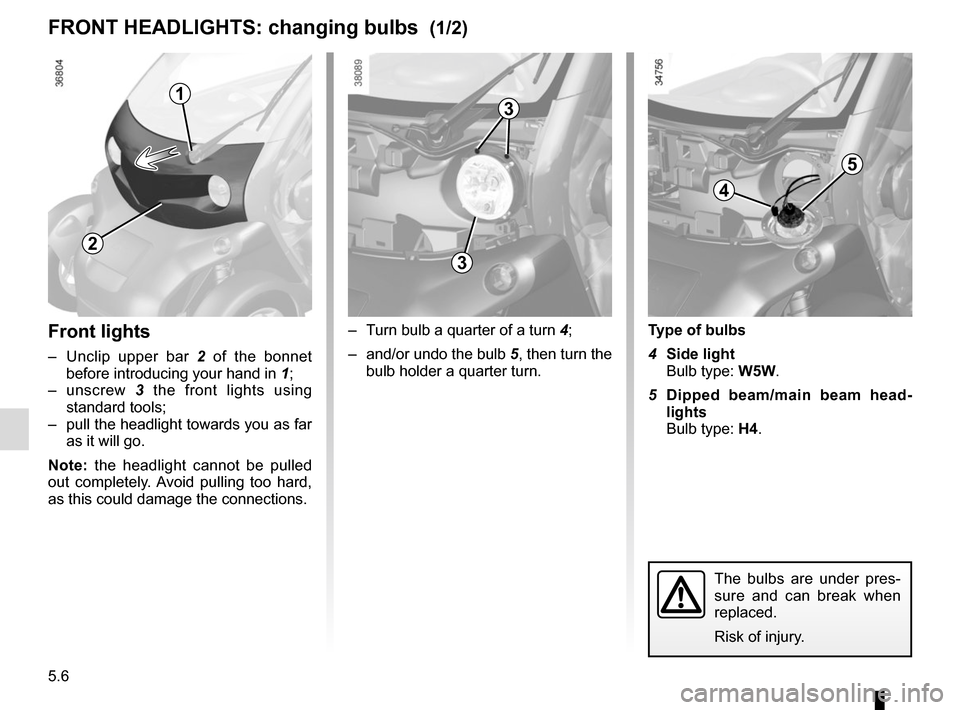
Front lights
– Unclip upper bar 2 of the bonnet
before introducing your hand in 1;
– unscrew 3 the front lights using
standard tools;
– pull the headlight towards you as far as it will go.
Note: the headlight cannot be pulled
out completely. Avoid pulling too hard,
as this could damage the connections.
FRONT HEADLIGHTS: changing bulbs (1/2)
– Turn bulb a quarter of a turn 4;
– and/or undo the bulb 5, then turn the
bulb holder a quarter turn.
2
13
3
5
4
Type of bulbs
4 Side light
Bulb type: W5W.
5 Dipped beam/main beam head-
lights
Bulb type: H4.
The bulbs are under pres-
sure and can break when
replaced.
Risk of injury.
Page 81 of 118
5.7
FRONT HEADLIGHTS: replacing bulbs (2/2)
Any operation on (or modi-
fication to) the electrical
system must be performed
by an authorised dealer
since incorrect connections could
damage the electrical equipment
(wiring, components). In addition,
your dealer has available all the
parts necessary for fitting electrical
components.
Cleaning the headlights
Use a soft cloth. If this does not clean
it properly, moisten the cloth with soapy
water then rinse off.
Finally, carefully dry off with a soft dry
cloth.
Cleaning products containing alco-
hol must not be used under any cir-
cumstances.
To comply with local legislation, or
as a precaution, you can obtain an
emergency kit containing a set of
spare bulbs and fuses from an ap-
proved dealer.
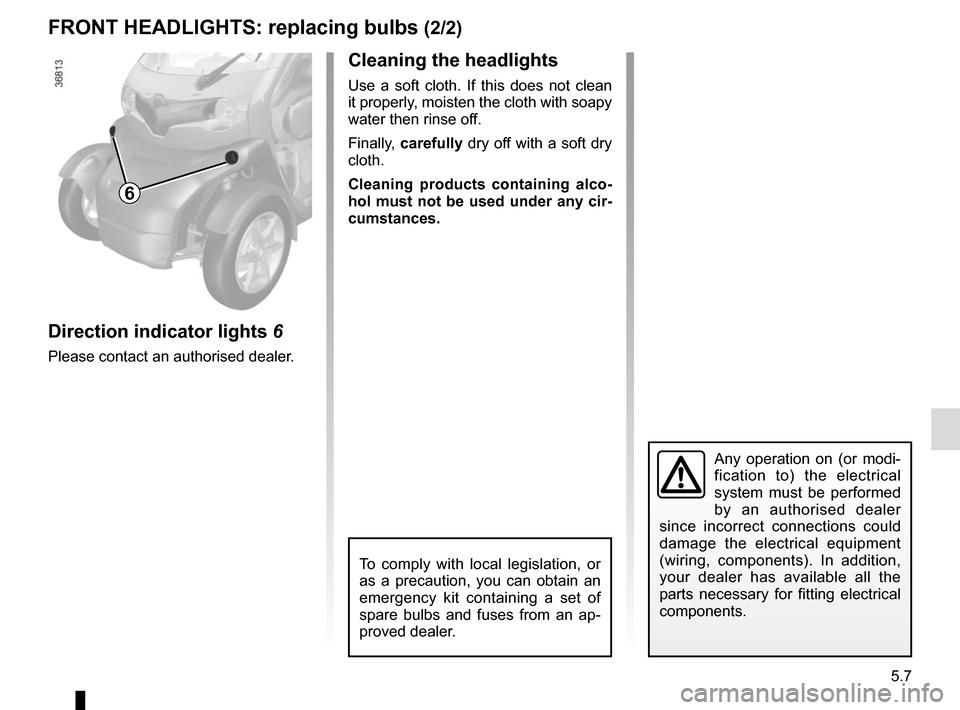
Direction indicator lights 6
Please contact an authorised dealer.
6
Page 82 of 118
5.8
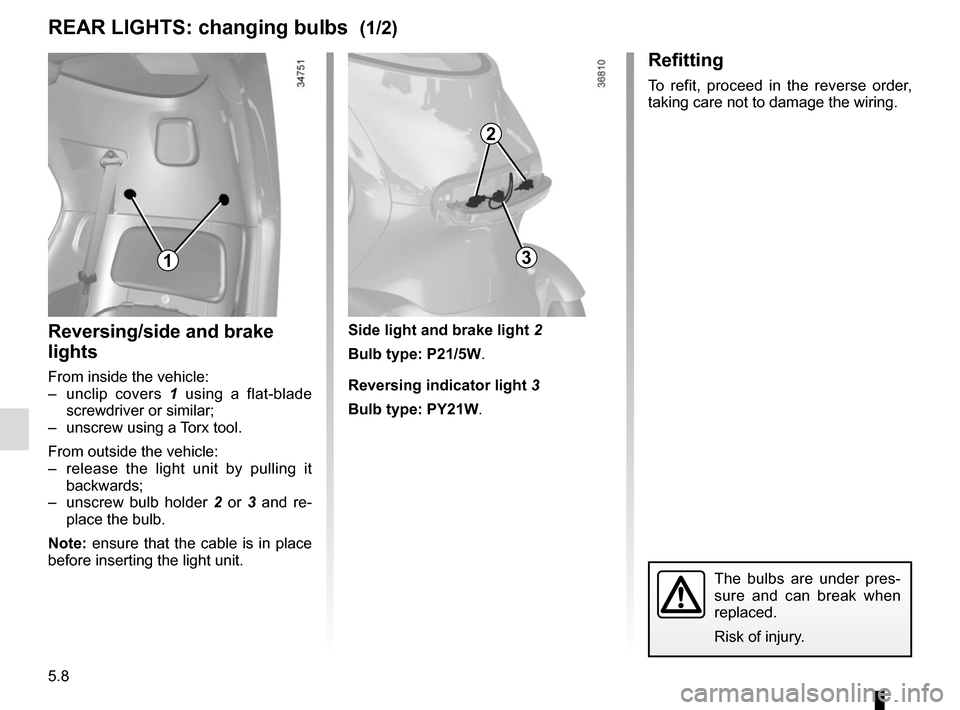
Side light and brake light 2
Bulb type: P21/5W.
Reversing indicator light 3
Bulb type: PY21W.Reversing/side and brake
lights
From inside the vehicle:
– unclip covers 1 using a flat-blade
screwdriver or similar;
– unscrew using a Torx tool.
From outside the vehicle:
– release the light unit by pulling it backwards;
– unscrew bulb holder 2 or 3 and re-
place the bulb.
Note: ensure that the cable is in place
before inserting the light unit.
REAR LIGHTS: changing bulbs (1/2)
Refitting
To refit, proceed in the reverse order,
taking care not to damage the wiring.
The bulbs are under pres-
sure and can break when
replaced.
Risk of injury.
1
2
3
Page 83 of 118
5.9
REAR LIGHTS: changing bulbs (2/2)
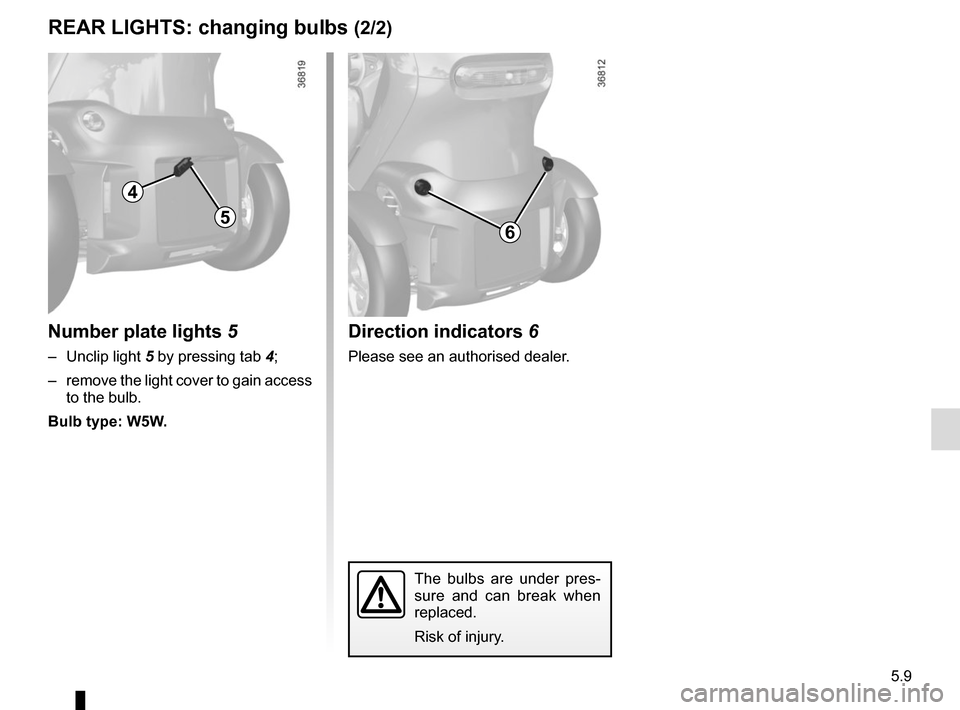
Direction indicators 6
Please see an authorised dealer.
Number plate lights 5
– Unclip light 5 by pressing tab 4;
– remove the light cover to gain access to the bulb.
Bulb type: W5W.
The bulbs are under pres-
sure and can break when
replaced.
Risk of injury.
4
56
Page 85 of 118
5.11
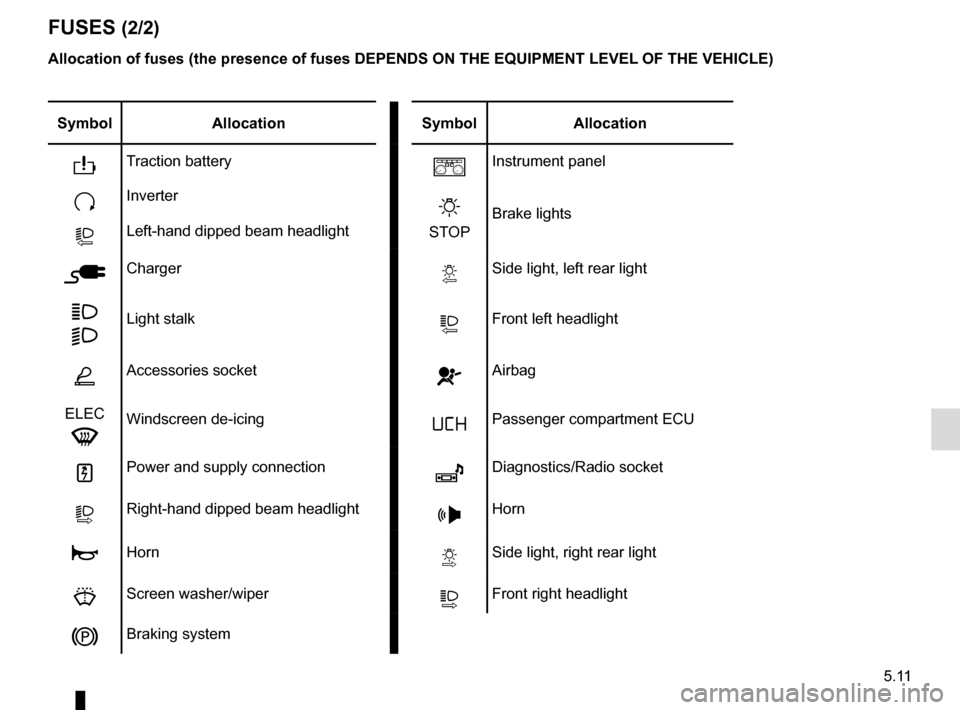
FUSES (2/2)
SymbolAllocation SymbolAllocation
ṌTraction batteryaInstrument panel
ṞInverterU
STOPBrake lightsLLeft-hand dipped beam headlight
ChargerYSide light, left rear light
Á
KLight stalkQFront left headlight
ÆAccessories socketÅAirbag
ELEC
d
Windscreen de-icingôPassenger compartment ECU
ṡPower and supply connectionîDiagnostics/Radio socket
TRight-hand dipped beam headlightṠHorn
ÌHornVSide light, right rear light
HScreen washer/wiperPFront right headlight
Braking system
Allocation of fuses (the presence of fuses DEPENDS ON THE EQUIPMENT LEV\
EL OF THE VEHICLE)
Page 89 of 118
5.15
TOWING, BREAKDOWN (2/3)
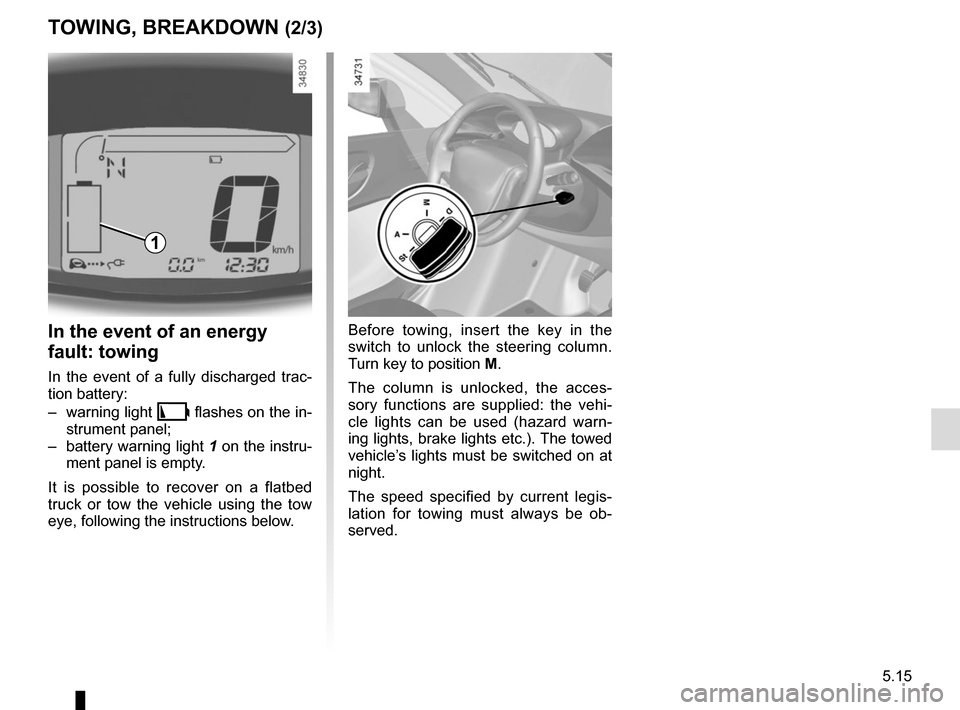
In the event of an energy
fault: towing
In the event of a fully discharged trac-
tion battery:
– warning light
\b flashes on the in-
strument panel;
– battery warning light 1 on the instru-
ment panel is empty.
It is possible to recover on a flatbed
truck or tow the vehicle using the tow
eye, following the instructions below.
1
Before towing, insert the key in the
switch to unlock the steering column.
Turn key to position M.
The column is unlocked, the acces-
sory functions are supplied: the vehi-
cle lights can be used (hazard warn-
ing lights, brake lights etc.). The towed
vehicle’s lights must be switched on at
night.
The speed specified by current legis-
lation for towing must always be ob-
served.
Page 93 of 118
5.19
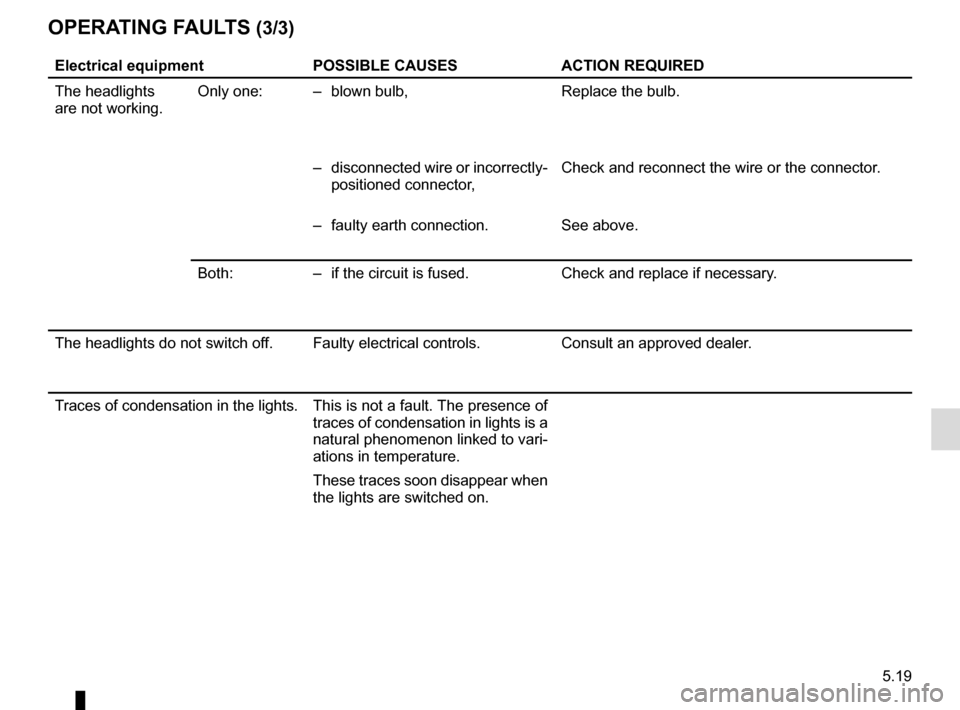
OPERATING FAULTS (3/3)
Electrical equipmentPOSSIBLE CAUSESACTION REQUIRED
The headlights
are not working. Only one: – blown bulb,
Replace the bulb.
– disconnected wire or incorrectly- positioned connector, Check and reconnect the wire or the connector.
– faulty earth connection. See above.
Both: – if the circuit is fused. Check and replace if necessary.
The headlights do not switch off. Faulty electrical controls. Consult an approved dealer.
Traces of condensation in the lights. This is not a fault. The presence of traces of condensation in lights is a
natural phenomenon linked to vari-
ations in temperature.
These traces soon disappear when
the lights are switched on.