ESP RENAULT WIND ROADSTER 2012 User Guide
[x] Cancel search | Manufacturer: RENAULT, Model Year: 2012, Model line: WIND ROADSTER, Model: RENAULT WIND ROADSTER 2012Pages: 185, PDF Size: 5.52 MB
Page 52 of 185
1.46
ENG_UD24362_1
Ordinateur de bord : messages d’anomalies de fonctionnement (E33 - X33 - Renault)
ENG_NU_865-6_E33_Renault_1
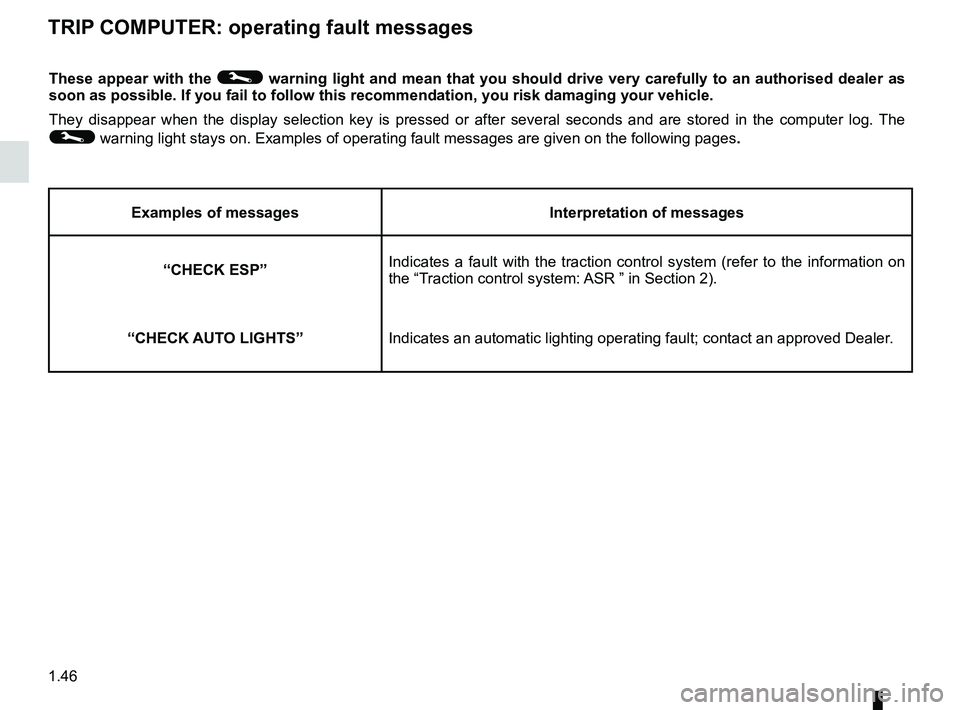
TRIp COMpUTER: operating fault messages
These appear with the © warning light and mean that you should drive very carefully to an authorised dealer as
soon as possible. If you fail to follow this recommendation, you risk damaging your vehicle.
They disappear when the display selection key is pressed or after several seconds and are stored in the computer log. The
© warning light stays on. Examples of operating fault messages are given on the following pages .
Examples of messages Interpretation of messages
“CHECK ESp” Indicates a fault with the traction control system (refer to the information on
the “Traction control system: ASR ” in Section 2).
“CHECK AUTO LIGHTS ”Indicates an automatic lighting operating fault; contact an approved Dealer .
Page 59 of 185
lights:main beam headlights ...................................... (current page)
warning buzzer ...................................................... (current page)
see-me-home lighting ............................................ (current page)
lights mobile directional ............................................. (current page)
JauneNoirNoir texte
1.53
ENG_UD21753_2
Éclairages et signalisations extérieurs (E33 - X33 - Renault)
ENG_NU_865-6_E33_Renault_1
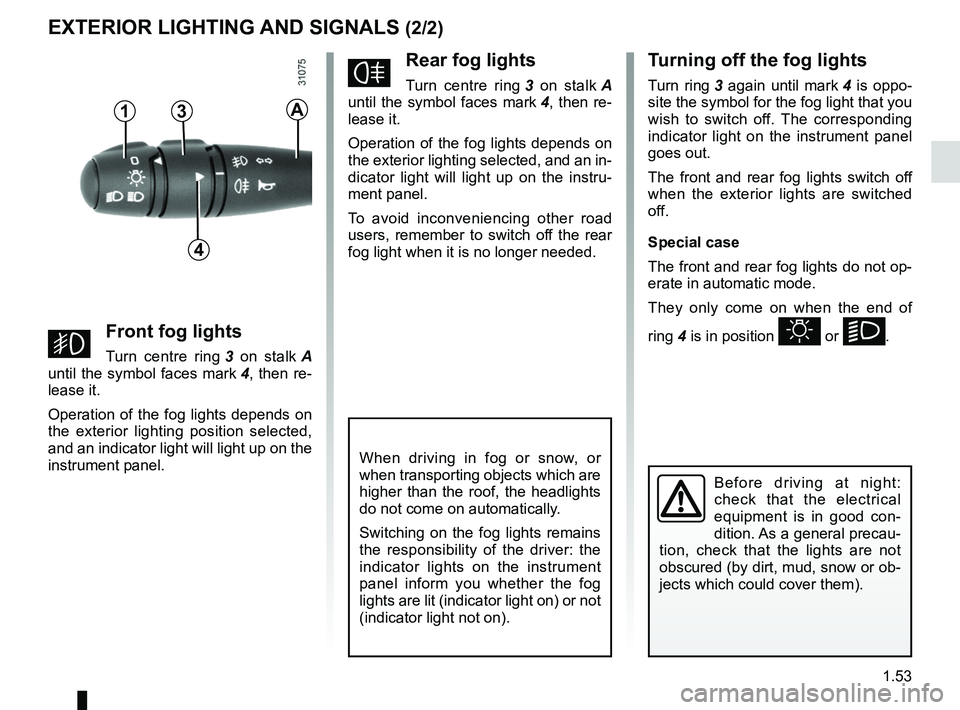
Turning off the fog lights
Turn ring 3 again until mark 4 is oppo -
site the symbol for the fog light that you
wish to switch off. The corresponding
indicator light on the instrument panel
goes out.
The front and rear fog lights switch off
when the exterior lights are switched
off.
Special case
The front and rear fog lights do not op-
erate in automatic mode.
They only come on when the end of
ring 4 is in position
u or k.
EXTERIOR LIGHTING AND SIGNALS (2/2)
gFront fog lights
Turn centre ring 3 on stalk A
until the symbol faces mark 4, then re-
lease it.
Operation of the fog lights depends on
the exterior lighting position selected,
and an indicator light will light up on the
instrument panel.
Before driving at night:
check that the electrical
equipment is in good con -
dition. As a general precau -
tion, check that the lights are not
obscured (by dirt, mud, snow or ob-
jects which could cover them).
1A3
4
fRear fog lights
Turn centre ring 3 on stalk A
until the symbol faces mark 4, then re-
lease it.
Operation of the fog lights depends on
the exterior lighting selected, and an in-
dicator light will light up on the instru -
ment panel.
To avoid inconveniencing other road
users, remember to switch off the rear
fog light when it is no longer needed.
When driving in fog or snow, or
when transporting objects which are
higher than the roof, the headlights
do not come on automatically.
Switching on the fog lights remains
the responsibility of the driver: the
indicator lights on the instrument
panel inform you whether the fog
lights are lit (indicator light on) or not
(indicator light not on).
Page 61 of 185
JauneNoirNoir texte
1.55
ENG_UD25520_2
Essuie-vitre / lave-vitre avant (E33 - X33 - Renault)
ENG_NU_865-6_E33_Renault_1
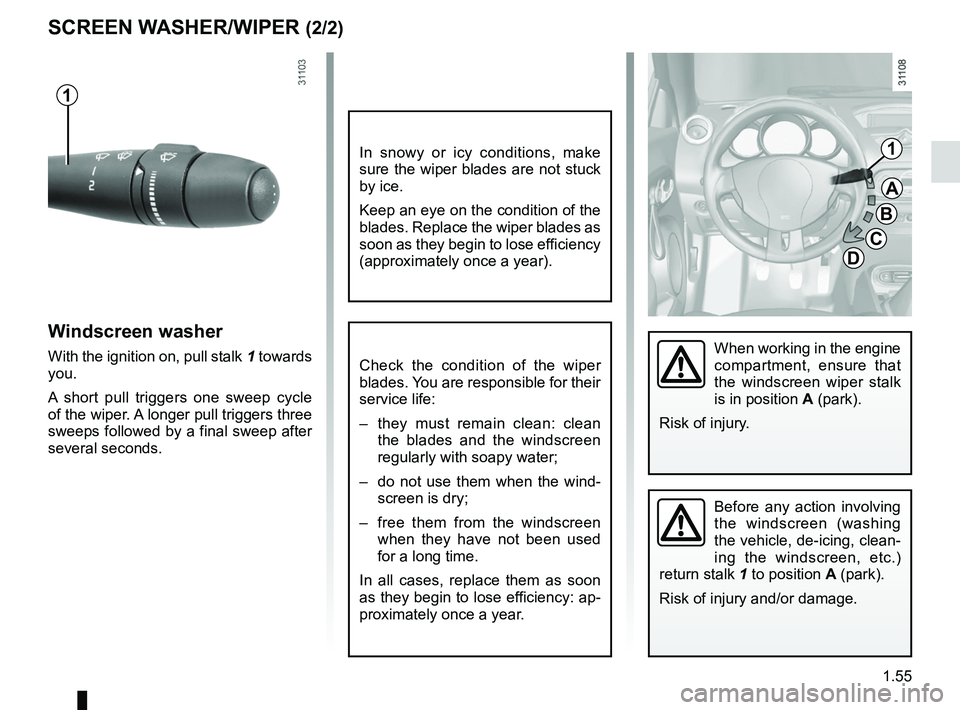
Before any action involving
the windscreen (washing
the vehicle, de-icing, clean -
ing the windscreen, etc.)
return stalk 1 to position A (park).
Risk of injury and/or damage.
SCREEN WASHER/WIpER (2/2)
When working in the engine
compartment, ensure that
the windscreen wiper stalk
is in position A (park).
Risk of injury.Windscreen washer
With the ignition on, pull stalk 1 towards
you.
A short pull triggers one sweep cycle
of the wiper. A longer pull triggers three
sweeps followed by a final sweep after
several seconds.
A
B
C
D
1
Check the condition of the wiper
blades. You are responsible for their
service life:
– they must remain clean: clean
the blades and the windscreen
regularly with soapy water;
– do not use them when the wind-
screen is dry;
– free them from the windscreen
when they have not been used
for a long time.
In all cases, replace them as soon
as they begin to lose efficiency: ap-
proximately once a year.
In snowy or icy conditions, make
sure the wiper blades are not stuck
by ice.
Keep an eye on the condition of the
blades. Replace the wiper blades as
soon as they begin to lose efficiency
(approximately once a year).
1
Page 67 of 185
starting the engine ................................ (up to the end of the DU)
starting the engine ................................ (up to the end of the DU)
2.3
ENG_UD29995_3
Démarrage / Arrêt moteur avec carte RENAULT mains libres (E33 - X33 - Renault)
ENG_NU_865-6_E33_Renault_2
Starting, stopping the engine
St ARtING/StoPPING thE ENGINE
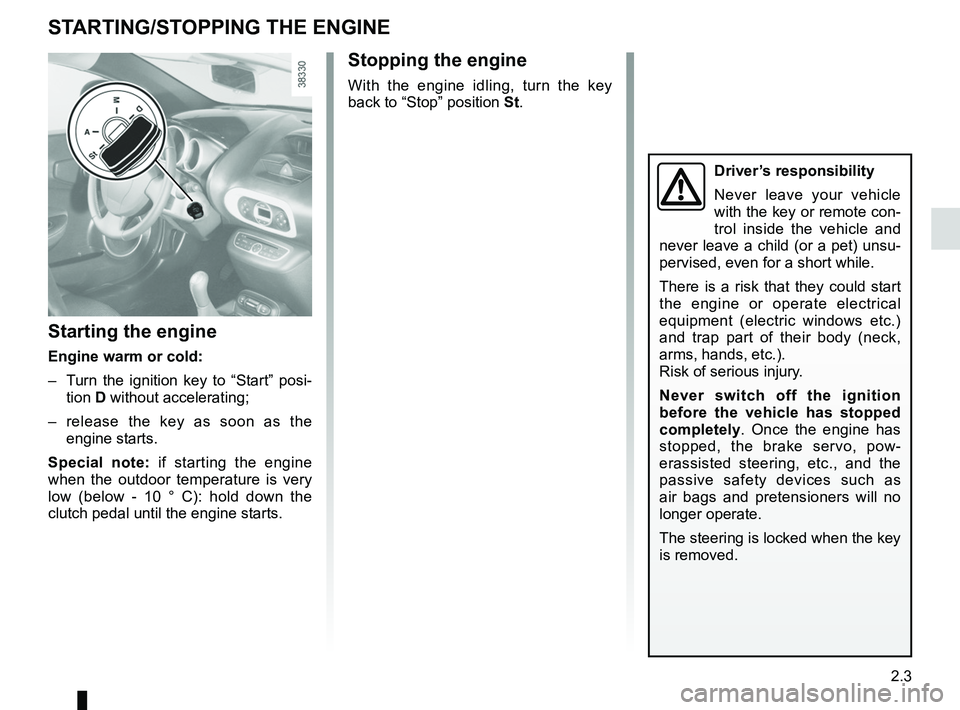
Starting the engine
Engine warm or cold:
– Turn the ignition key to “Start” posi-
tion D without accelerating;
– release the key as soon as the
engine starts.
Special note: if starting the engine
when the outdoor temperature is very
low (below - 10 ° C): hold down the
clutch pedal until the engine starts.
Stopping the engine
With the engine idling, turn the key
back to “Stop” position St.
Driver’s responsibility
Never leave your vehicle
with the key or remote con-
trol inside the vehicle and
never leave a child (or a pet) unsu-
pervised, even for a short while.
There is a risk that they could start
the engine or operate electrical
equipment (electric windows etc.)
and trap part of their body (neck,
arms, hands, etc.).
Risk of serious injury.
Never switch off the ignition
before the vehicle has stopped
completely . Once the engine has
stopped, the brake servo, pow -
erassisted steering, etc., and the
passive safety devices such as
air bags and pretensioners will no
longer operate.
The steering is locked when the key
is removed.
Page 70 of 185
fueladvice on fuel economy .................. (up to the end of the DU)
practical advice ..................................... (up to the end of the DU)
fuel economy ........................................ (up to the end of the DU)
filter air filter ............................................................. (current page)
filter diesel filter ........................................................ (current page)
driving ................................................... (up to the end of the DU)
maintenance .......................................................... (current page)
antipollution advice ............................................. (up to the end of the DU)
2.6
ENG_UD20551_2
CONSEILS : antipollution, économies de carburant, conduite (E33 - X3\
3 - Renault)
ENG_NU_865-6_E33_Renault_2
Jaune NoirNoir texte
Advice on antipollution and fuel economy
ADVIcE: antipollution, fuel economy and driving (1/3)
By virtue of its design, moderate fuel
consumption and initial settings, your
vehicle conforms to current antipol-
lution regulations. The manufacturer
is actively striving to reduce pollutant
exhaust gas emissions and to save
energy. But the fuel consumption of
your vehicle and the level of pollutant
exhaust gas emissions are also your
responsibility. Ensure that it is main -
tained and used correctly.Maintenance
It is important to remember that failure to
respect antipollution regulations could
lead to legal action being taken against
the vehicle owner. In addition, replacing
engine, fuel supply system and exhaust
components with parts other than those
originally recommended by the manu -
facturer may alter your vehicle so that
it no longer complies with antipollution
regulations.
Have your vehicle adjusted and
checked by an approved Dealer, in ac-
cordance with the instructions given in
your maintenance schedule: they will
have all the equipment necessary for
ensuring that your vehicle is maintained
to its original standard.
Engine adjustments
– ignition: this does not require ad -
justment.
– spark plugs: for optimum fuel econ-
omy, efficiency and performance
the specifications laid down by our
Design Department must be strictly
applied.
If the spark plugs have to be
changed, use the make, type and
gap specified for your vehicle’s
engine. Contact an approved dealer
for this.
– idle: this does not require adjust -
ment.
– air filter: a choked element will
reduce efficiency. It must be re -
placed.
Page 73 of 185

2.9
ENG_UD25716_1
Environnement (sans marque) (X44 - X45 - X77 - X81 - X85 - X90 - X91 \
- X83 - X61 - TEST - X95 - J95")
environment .......................................... (up to the end of the DU)
2.9
ENG_UD25716_1
Environnement (sans marque) (X44 - X45 - X77 - X81 - X85 - X90 - X91 \
- X83 - X61 - TEST - X95 - J95 - R95 - F90 Ph2 - X33 - X47 - X43 - X38 - H79 - X62 - X32 -\
X09 -
ENG_NU_865-6_E33_Renault_2
Environment
ENVIRoNMENt
Emissions
Your vehicle has been designed to
emit fewer greenhouse gases (CO2)
while in use, and therefore to consume
less fuel (eg. 140 g/km, equivalent to
5.3 l/100 km for a diesel vehicle).
Our vehicles are also equipped with a
particle filter system including a cata -
lytic converter, an oxygen sensor and
an active carbon filter (the latter pre -
vents vapour from the fuel tank being
released into the open air).
For certain diesel vehicles, this system
also has a particle filter to reduce the
volume of soot particles emitted.
Please make your own
contribution towards
protecting the environment
too
– Worn parts replaced in the course of
routine vehicle maintenance (vehi -
cle battery, oil filter, air filter, batter -
ies, etc.) and oil containers (empty or
filled with used oil) must be disposed
of through specialist organisations. –
At the end of the vehicle’s service
life, it should be sent to approved
centres to ensure that it is recycled.
– In all cases, comply with local legis -
lation.
Recycling
Your vehicle is 85% recyclable and
95% recoverable.
To achieve these objectives, many of
the vehicle components have been de-
signed to enable them to be recycled.
The materials and structures have
been carefully designed to allow these
components to be easily removed and
reprocessed by specialist companies.
In order to preserve raw material re -
sources, this vehicle incorporates nu -
merous parts made from recycled plas-
tics or renewable materials (vegetable
or animal-derived materials such as
cotton or wool).
Your vehicle has been designed with
respect for the
environment in mind for
its entire service life: during production,
use and at the end of its life.
This commitment is illustrated by the of
the manufacturer eco² signature.Manufacture
Your vehicle has been manufactured at
a factory which complies with a policy
to reduce the environmental impact
on the surrounding areas (reduction of
water and energy consumption, visual
and noise pollution, atmospheric emis-
sions and waste water; sorting and re-
using waste).
Page 74 of 185
ABS ...................................................... (up to the end of the DU)
anti-lock braking system: ABS ..............(up to the end of the DU)
ESP: Electronic Stability Program ........ (up to the end of the DU)
ASR (traction control) ........................... (up to the end of the DU)
traction control: ASR .............................(up to the end of the DU)
Electronic Stability Program: ESP ........ (up to the end of the DU)
emergency brake assist ........................(up to the end of the DU)
emergency braking ............................... (up to the end of the DU)
traction control: ASR .............................................. (current page)
driving ................................................... (up to the end of the DU)
2.10
ENG_UD11192_1
Dispositifs de correction de conduite (E33 - X33 - Renault)
ENG_NU_865-6_E33_Renault_2
Jaune NoirNoir texte
Driver correction devices/aids
DRIVER coRREctIoN DEVIcES/AIDS (1/3)
In an emergency, apply firm and
continuous pressure to the brake
pedal. There is no need to pump
it repeatedly. The ABS will modu -
late the force applied in the braking
system.
These functions are an ad-
ditional aid in the event of
critical driving conditions,
enabling the vehicle behav -
iour to be adapted to suit the driving
conditions.
However, the functions do not take
the place of the driver. they do
not increase the vehicle’s limits
and should not encourage you
to drive more quickly. Therefore,
they can under no circumstances
replace the vigilance or responsibil -
ity of the driver when manoeuvring
the vehicle (the driver must always
be ready for sudden incidents which
may occur when driving).
Yo u r b r a k i n g s y s t e m s
are partially operational.
However, it is dangerous
to brake suddenly and
it is essential to stop immediately,
as soon as traffic conditions allow.
Contact an approved dealer.
Depending on the vehicle, this is com-
posed of:
– the (A bS) (anti-lock braking
system);
– the electronic stability program
(ESP) with understeer control and
traction control (ASR);
– emergency brake assist. operating faults:
–
If the
x and © indicator
lights on the instrument panel come
on, braking is still operational but
without AbS;
– If the
x, ®, © and
D indicator lights on the instru -
ment panel come on when driving,
this indicates a fault with the braking
and AbS systems.
In both cases, consult an approved
Dealer.
AbS (anti-lock braking
system)
Under heavy braking, the ABS prevents
the wheels from locking, allowing the
stopping distance to be managed and
keeping control of the vehicle.
Under these circumstances, the vehi -
cle can be steered to avoid an obstacle
whilst braking. In addition, this system
can increase stopping distances, par -
ticularly on roads with low surface grip
(wet ground etc.).
You will feel a pulsation through the
brake pedal each time the system is
activated. The ABS does not in any way
improve the vehicle's physical perform-
ance relating to the road surface and
roadholding. It is still essential to follow
the rules of good driving practice (such
as driving at a safe distance from the
vehicle in front etc.).
Page 75 of 185
JauneNoirNoir texte
2.11
ENG_UD11192_1
Dispositifs de correction de conduite (E33 - X33 - Renault)
ENG_NU_865-6_E33_Renault_2
DRIVER coRREctIoN DEVIcES/AIDS (2/3)
Electronic stability program
(ESP) with understeer control
and traction control (ASR)
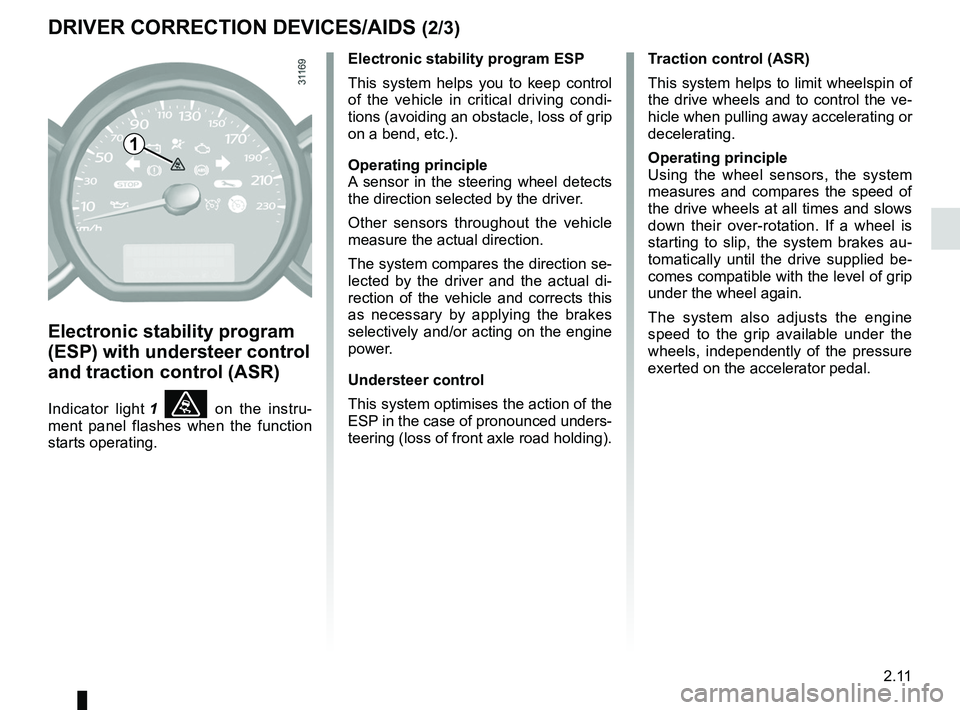
Indicator light 1 ù on the instru -
ment panel flashes when the function
starts operating. Electronic stability program ESP
This system helps you to keep control
of the vehicle in critical driving condi
-
tions (avoiding an obstacle, loss of grip
on a bend, etc.).
operating principle
A sensor in the steering wheel detects
the direction selected by the driver.
Other sensors throughout the vehicle
measure the actual direction.
The system compares the direction se-
lected by the driver and the actual di -
rection of the vehicle and corrects this
as necessary by applying the brakes
selectively and/or acting on the engine
power.
Understeer control
This system optimises the action of the
ESP in the case of pronounced unders -
teering (loss of front axle road holding). t
raction control (ASR)
This system helps to limit wheelspin of
the drive wheels and to control the ve-
hicle when pulling away accelerating or
decelerating.
operating principle
Using the wheel sensors, the system
measures and compares the speed of
the drive wheels at all times and slows
down their over-rotation. If a wheel is
starting to slip, the system brakes au -
tomatically until the drive supplied be -
comes compatible with the level of grip
under the wheel again.
The system also adjusts the engine
speed to the grip available under the
wheels, independently of the pressure
exerted on the accelerator pedal.
1
Page 80 of 185
cruise control ........................................ (up to the end of the DU)
cruise control-speed limiter................... (up to the end of the DU)
driving ................................................... (up to the end of the DU)
2.16
ENG_UD11194_1
Régulateur-limiteur de vitesse : fonction régulateur (E33 - X33 -\
Renault)
ENG_NU_865-6_E33_Renault_2
Jaune NoirNoir texte
Cruise control
cRUISE coNtRoL - SPEED LIMItER: cruise control function (1/4)
The cruise control function
is in no way linked to the
braking system.
This function is an addi -
tional driving aid. However,
the function does not take
the place of the driver.
Therefore, it can under no circum -
stances replace the driver’s respon -
sibility to respect speed limits and to
be vigilant (the driver must always
be ready to brake).
Cruise control must not be used
in heavy traffic, on winding or slip -
pery roads (black ice, aquaplan -
ing, gravel) and during bad weather
(fog, rain, side winds etc.).
There is a risk of accidents.
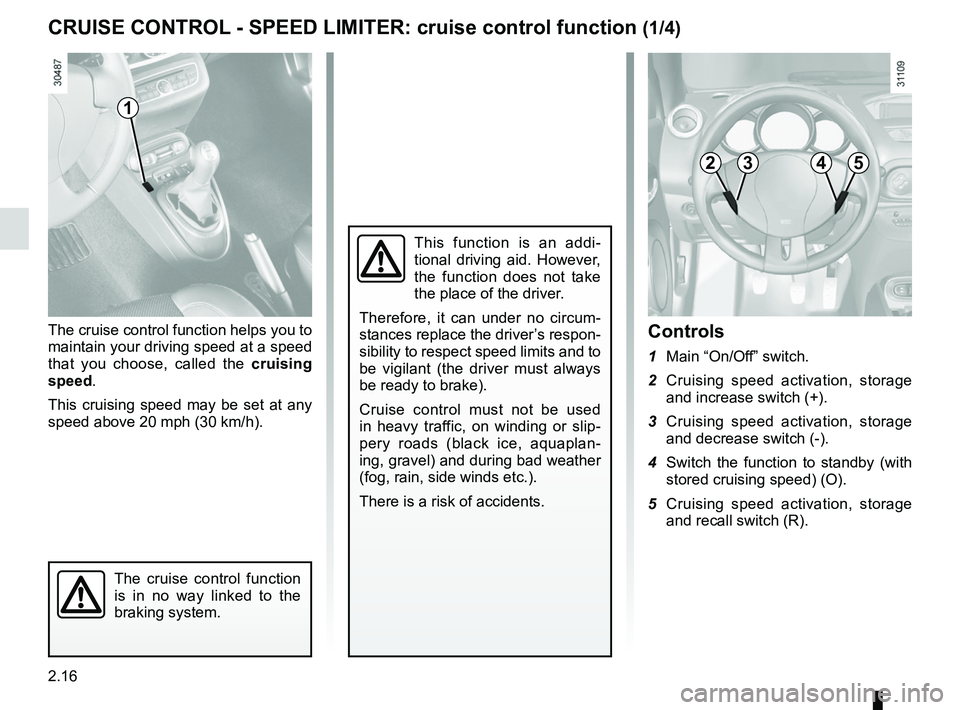
controls
1 Main “On/Off” switch.
2 Cruising speed activation, storage
and increase switch (+).
3 Cruising speed activation, storage
and decrease switch (-).
4 Switch the function to standby (with
stored cruising speed) (O).
5 Cruising speed activation, storage
and recall switch (R).
1
The cruise control function helps you to
maintain your driving speed at a speed
that you choose, called the cruising
speed.
This cruising speed may be set at any
speed above 20 mph (30 km/h).
2345
Page 86 of 185

ENG_NU_865-6_E33_Renault_3
Rotating hard roof
Rotating HaRD RooF: conditions of use
Conditions of use
Imm")
3.2
ENG_UD20475_2
Toit rigide escamotable : condition d’utilisation (E33 - X33 - Renaul\
t)
ENG_NU_865-6_E33_Renault_3
Rotating hard roof
Rotating HaRD RooF: conditions of use
Conditions of use
Immobilise the vehicle on a flat, level
surface (never with the wheel on the
pavement).
Apply the handbrake.
Temperature above -10°C.
Perform the operation with the engine
running if possible (risk of discharging
the battery).
To prevent the system from overheat -
ing, it cuts out automatically. It becomes
operational again after a maximum of
30 minutes.
When opening or clos -
ing the roof, ensure that
nothing interferes with the
moving parts (roof and roof
cover).
Do not drive with the roof unlocked.
Do not open or close the roof if the
wind speed is more than 20 mph
(30 km/h) (risk of damage to the
roof).
Driver’s responsibility
Never leave your vehicle
with the key or remote con-
trol inside and never leave a
child (or a pet) unsupervised, even
for a short while.
He/she may be able to operate the
rotating hard roof and there is a risk
of trapping his/her neck, arm, hand,
etc., which could cause serious in -
juries.
If anything is trapped, reverse the
rotating hard roof’s direction of
travel immediately by pressing the
opposite side of the roof open/close
button.
Never unlock the roof while
driving.
Risk of damage to the roof
and roof cover.
operating the roof
Before opening/closing the roof, check
that there is sufficient space above the
vehicle to allow it to open.
Minimum height required A: 2.05 m.
a