brake RENAULT WIND ROADSTER 2012 User Guide
[x] Cancel search | Manufacturer: RENAULT, Model Year: 2012, Model line: WIND ROADSTER, Model: RENAULT WIND ROADSTER 2012Pages: 185, PDF Size: 5.52 MB
Page 76 of 185
2.12
ENG_UD11192_1
Dispositifs de correction de conduite (E33 - X33 - Renault)
ENG_NU_865-6_E33_Renault_2
DRIVER coRREctIoN DEVIcES/AIDS (3/3)
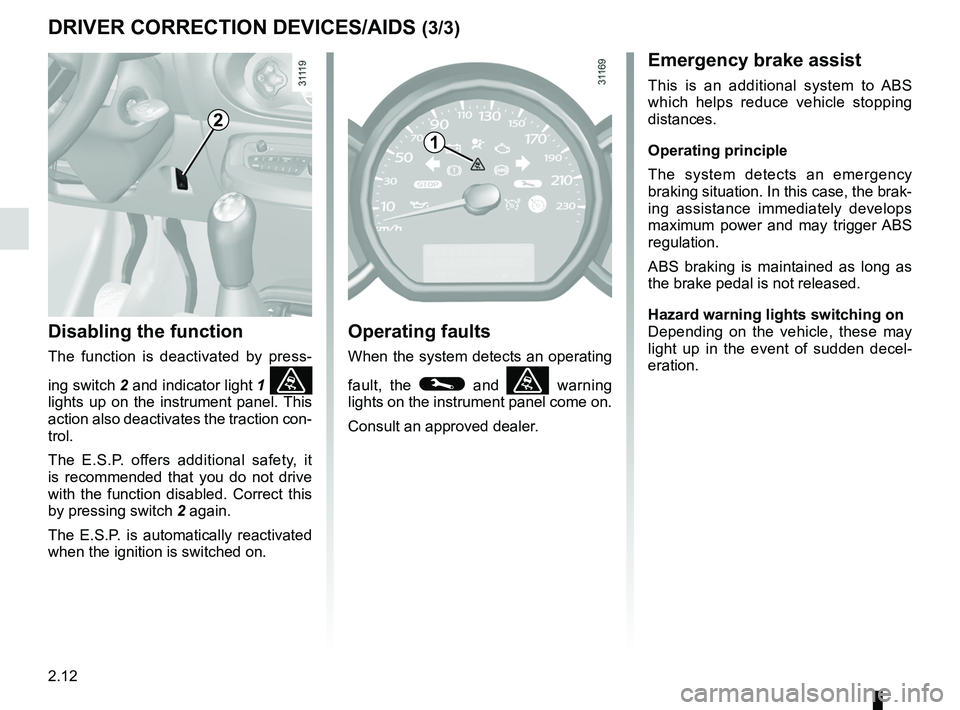
Disabling the function
The function is deactivated by press -
ing switch 2 and indicator light 1
ù
lights up on the instrument panel. This
action also deactivates the traction con-
trol.
The E.S.P. offers additional safety, it
is recommended that you do not drive
with the function disabled. Correct this
by pressing switch 2 again.
The E.S.P. is automatically reactivated
when the ignition is switched on.
operating faults
When the system detects an operating
fault, the
© and ù warning
lights on the instrument panel come on.
Consult an approved dealer.
Emergency brake assist
This is an additional system to ABS
which helps reduce vehicle stopping
distances.
operating principle
The system detects an emergency
braking situation. In this case, the brak-
ing assistance immediately develops
maximum power and may trigger ABS
regulation.
ABS braking is maintained as long as
the brake pedal is not released.
hazard warning lights switching on
Depending on the vehicle, these may
light up in the event of sudden decel -
eration.
2
1
Page 80 of 185
cruise control ........................................ (up to the end of the DU)
cruise control-speed limiter................... (up to the end of the DU)
driving ................................................... (up to the end of the DU)
2.16
ENG_UD11194_1
Régulateur-limiteur de vitesse : fonction régulateur (E33 - X33 -\
Renault)
ENG_NU_865-6_E33_Renault_2
Jaune NoirNoir texte
Cruise control
cRUISE coNtRoL - SPEED LIMItER: cruise control function (1/4)
The cruise control function
is in no way linked to the
braking system.
This function is an addi -
tional driving aid. However,
the function does not take
the place of the driver.
Therefore, it can under no circum -
stances replace the driver’s respon -
sibility to respect speed limits and to
be vigilant (the driver must always
be ready to brake).
Cruise control must not be used
in heavy traffic, on winding or slip -
pery roads (black ice, aquaplan -
ing, gravel) and during bad weather
(fog, rain, side winds etc.).
There is a risk of accidents.
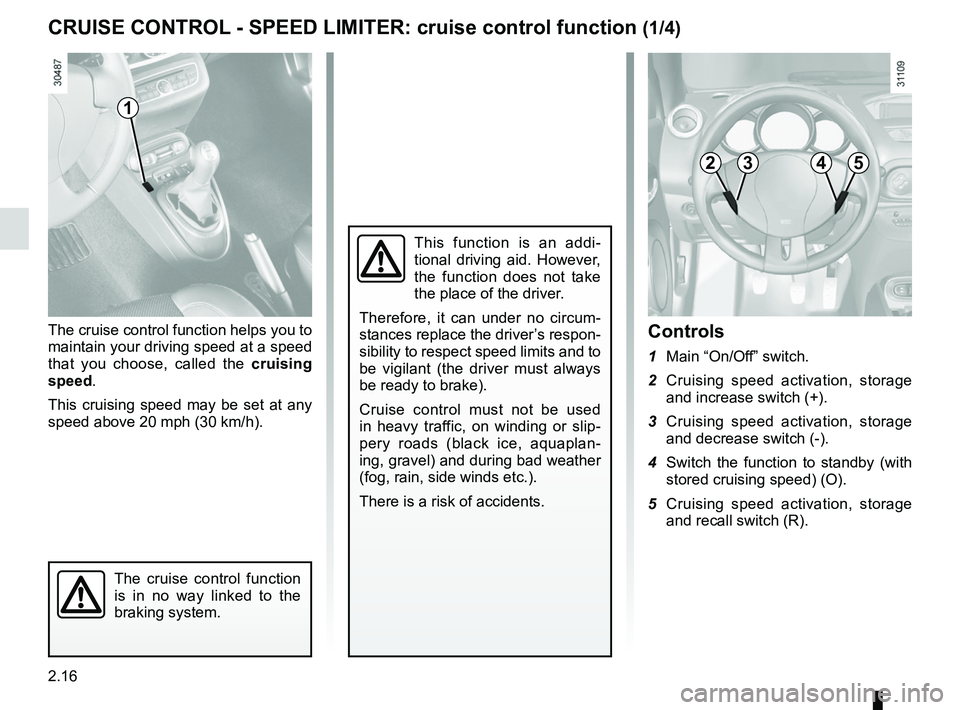
controls
1 Main “On/Off” switch.
2 Cruising speed activation, storage
and increase switch (+).
3 Cruising speed activation, storage
and decrease switch (-).
4 Switch the function to standby (with
stored cruising speed) (O).
5 Cruising speed activation, storage
and recall switch (R).
1
The cruise control function helps you to
maintain your driving speed at a speed
that you choose, called the cruising
speed.
This cruising speed may be set at any
speed above 20 mph (30 km/h).
2345
Page 83 of 185

ENG_NU_865-6_E33_Renault_2
cRUISE coNtRoL - SPEED LIMItER: cruise control functi")
JauneNoirNoir texte
2.19
ENG_UD11194_1
Régulateur-limiteur de vitesse : fonction régulateur (E33 - X33 -\
Renault)
ENG_NU_865-6_E33_Renault_2
cRUISE coNtRoL - SPEED LIMItER: cruise control function (4/4)
1
2345
Switching off the function
The cruise control function is deacti -
vated if you press switch 1: in this case
a speed is no longer memorised.
The
and indicator lights on the
instrument panel go out, confirming that
the function is deactivated.
Recalling the cruising speed
If a speed is stored, it can be recalled,
once you are sure that the road condi -
tions are suitable (traffic, road surface,
weather conditions, etc.).
With a vehicle speed above 20 mph (30
km/h), press switch 5 (R).
Note: if the speed previously stored is
much higher than the current speed,
the vehicle will accelerate more rapidly
to reach this threshold.
When the cruise control is set to
standby, pressing switch 2 (+) re -
activates the cruise control func -
tion without taking into account
the stored speed: it is the speed at
which the vehicle is moving that is
taken into account.Putting the cruise control
on standby or switching it
off does not cause a rapid
reduction in speed: you
must brake by depressing the brake
pedal.
Putting the function on
standby
The function is suspended when you:
– button 4 (O);
– depress the brake pedal;
– the clutch pedal or shift into neutral
if the vehicle has an automatic gear-
box.
In all three cases, the cruising speed
remains memorised and the message
“SPEED MEMORY” appears on the in-
strument panel.
Standby is confirmed when the green
indicator light goes out.
Page 86 of 185

ENG_NU_865-6_E33_Renault_3
Rotating hard roof
Rotating HaRD RooF: conditions of use
Conditions of use
Imm")
3.2
ENG_UD20475_2
Toit rigide escamotable : condition d’utilisation (E33 - X33 - Renaul\
t)
ENG_NU_865-6_E33_Renault_3
Rotating hard roof
Rotating HaRD RooF: conditions of use
Conditions of use
Immobilise the vehicle on a flat, level
surface (never with the wheel on the
pavement).
Apply the handbrake.
Temperature above -10°C.
Perform the operation with the engine
running if possible (risk of discharging
the battery).
To prevent the system from overheat -
ing, it cuts out automatically. It becomes
operational again after a maximum of
30 minutes.
When opening or clos -
ing the roof, ensure that
nothing interferes with the
moving parts (roof and roof
cover).
Do not drive with the roof unlocked.
Do not open or close the roof if the
wind speed is more than 20 mph
(30 km/h) (risk of damage to the
roof).
Driver’s responsibility
Never leave your vehicle
with the key or remote con-
trol inside and never leave a
child (or a pet) unsupervised, even
for a short while.
He/she may be able to operate the
rotating hard roof and there is a risk
of trapping his/her neck, arm, hand,
etc., which could cause serious in -
juries.
If anything is trapped, reverse the
rotating hard roof’s direction of
travel immediately by pressing the
opposite side of the roof open/close
button.
Never unlock the roof while
driving.
Risk of damage to the roof
and roof cover.
operating the roof
Before opening/closing the roof, check
that there is sufficient space above the
vehicle to allow it to open.
Minimum height required A: 2.05 m.
a
Page 109 of 185
transporting objectsin the luggage compartment ........... (up to the end of the DU)
towing rings .......................................... (up to the end of the DU)
towing towing equipment ............................ (up to the end of the DU)
towing equipment fitting ............................................... (up to the end of the DU)
towing a caravan .................................. (up to the end of the DU)
3.25
ENG_UD22203_3
Transport d’objets dans le coffre (E33 - X33 - Renault)
ENG_NU_865-6_E33_Renault_3
Transporting objects in the luggage compartment
tRansPoRting oBjeCts in tHe luggage CoMP aRtMent
Always position the heavi-
est items directly on the
floor. Use the lashing points
on the luggage compart -
ment floor, if these are fitted to the
vehicle. The luggage should be
loaded in such a way that no items
will be thrown forward and strike the
occupants if the driver has to brake
suddenly.
Always position the objects transported
so that the largest surface is against the
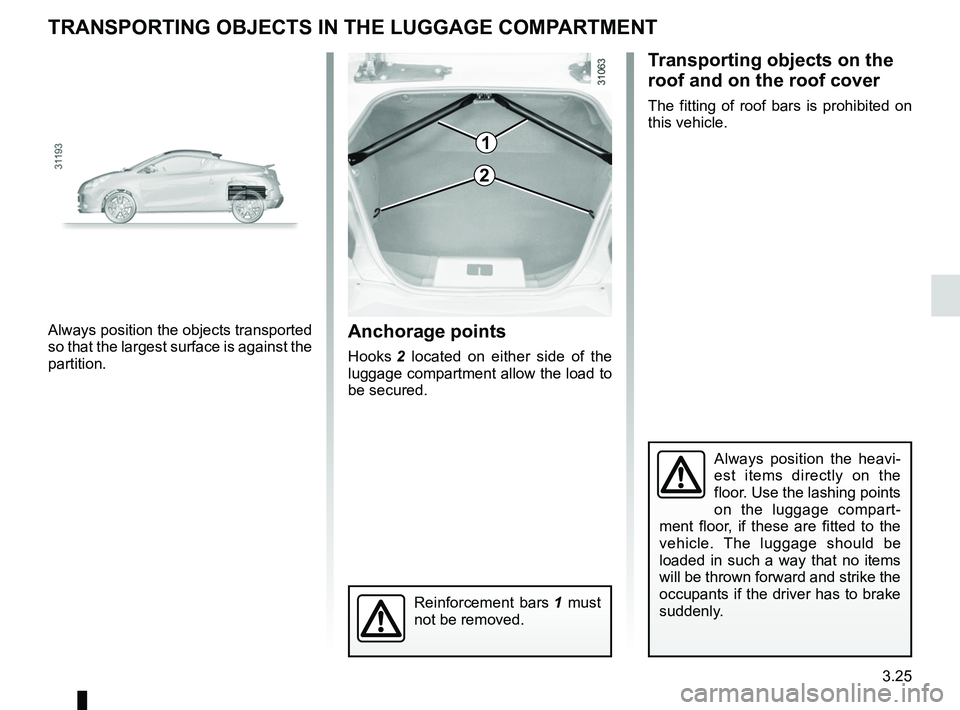
partition.anchorage points
Hooks 2 located on either side of the
luggage compartment allow the load to
be secured.
2
1
Reinforcement bars 1 must
not be removed.
t ransporting objects on the
roof and on the roof cover
The fitting of roof bars is prohibited on
this vehicle.
Page 111 of 185
4.1
ENG_UD29997_7
Sommaire 4 (E33 - X33 - Renault)
ENG_NU_865-6_E33_Renault_4
Section 4: Maintenance
Bonnet . . . . . . . . . . . . . . . . . . . . . . . . . . . . . . . . . . . . . . . . . . . . . . . . . . . . . . . . . . . . . . . . . . . . . . . . 4.2
Engine oil level: . . . . . . . . . . . . . . . . . . . . . . . . . . . . . . . . . . . . . . . . . . . . . . . . . . . . . . . . . . . . . . . . . 4.4
general information . . . . . . . . . . . . . . . . . . . . . . . . . . . . . . . . . . . . . . . . . . . . . . . . . . . . . . . . 4.4
topping up/filling . . . . . . . . . . . . . . . . . . . . . . . . . . . . . . . . . . . . . . . . . . . . . . . . . . . . . . . . . . . 4.5
Engine oil change . . . . . . . . . . . . . . . . . . . . . . . . . . . . . . . . . . . . . . . . . . . . . . . . . . . . . . . . . . . . . . . 4.6
Levels: . . . . . . . . . . . . . . . . . . . . . . . . . . . . . . . . . . . . . . . . . . . . . . . . . . . . . . . . . . . . . . . . . . . . . . . . 4.7
engine coolant . . . . . . . . . . . . . . . . . . . . . . . . . . . . . . . . . . . . . . . . . . . . . . . . . . . . . . . . . . . . 4.7
brake fluid . . . . . . . . . . . . . . . . . . . . . . . . . . . . . . . . . . . . . . . . . . . . . . . . . . . . . . . . . . . . . . . . 4.8
windscreen washer reservoir . . . . . . . . . . . . . . . . . . . . . . . . . . . . . . . . . . . . . . . . . . . . . . . . . 4.9
Filters . . . . . . . . . . . . . . . . . . . . . . . . . . . . . . . . . . . . . . . . . . . . . . . . . . . . . . . . . . . . . . . . . . . . . . . . . 4.9
Tyre pressure. . . . . . . . . . . . . . . . . . . . . . . . . . . . . . . . . . . . \
. . . . . . . . . . . . . . . . . . . . . . . . . . . . . . . 4.10
Battery . . . . . . . . . . . . . . . . . . . . . . . . . . . . . . . . . . . . . . . . . . . . . . . . . . . . . . . . . . . . . . . . . . . . . . . . 4.11
Bodywork maintenance . . . . . . . . . . . . . . . . . . . . . . . . . . . . . . . . . . . . . . . . . . . . . . . . . . . . . . . . . . . 4.12
Interior trim maintenance . . . . . . . . . . . . . . . . . . . . . . . . . . . . . . . . . . . . . . . . . . . . . . . . . . . . . . . . . . 4.14
Page 118 of 185
brake fluid .............................................................. (current page)
levels: brake fluid ........................................................ (current page)
tanks and reservoirs brake fluid ........................................................ (current page)
4.8
ENG_UD20479_2
Niveaux / filtres (E33 - X33 - Renault)
ENG_NU_865-6_E33_Renault_4
Jaune NoirNoir texte
brake fluid
levelS (2/3)
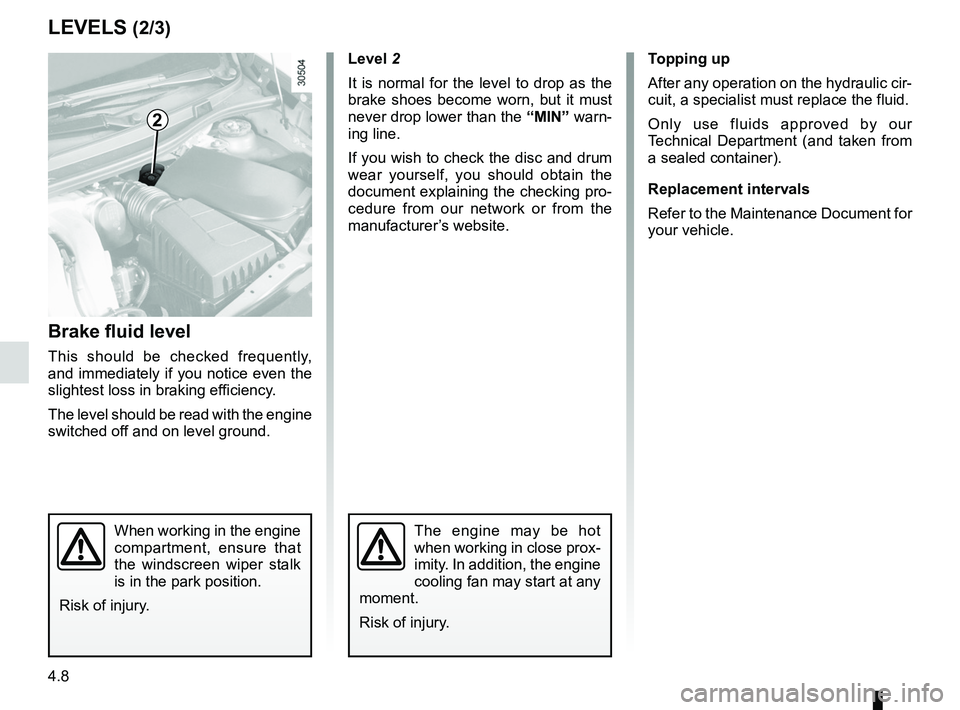
Brake fluid level
This should be checked frequently,
and immediately if you notice even the
slightest loss in braking efficiency.
The level should be read with the engine
switched off and on level ground. level 2
It is normal for the level to drop as the
brake shoes become worn, but it must
never drop lower than the
“Min” warn-
ing line.
If you wish to check the disc and drum
wear yourself, you should obtain the
document explaining the checking pro-
cedure from our network or from the
manufacturer’s website. t
opping up
After any operation on the hydraulic cir-
cuit, a specialist must replace the fluid.
Only use fluids approved by our
Technical Department (and taken from
a sealed container).
Replacement intervals
Refer to the Maintenance Document for
your vehicle.
The engine may be hot
when working in close prox-
imity. In addition, the engine
cooling fan may start at any
moment.
Risk of injury.When working in the engine
compartment, ensure that
the windscreen wiper stalk
is in the park position.
Risk of injury.
2
Page 130 of 185

ENG_NU_865-6_E33_Renault_5
Jaune NoirNoir texte
t")
5.4
ENG_UD28665_3
Kit de gonflage des pneumatiques (X77 - X85 - B85 - C85 - S85 - X77 ph2\
- K85 - X95 - E95 - X67 - X92 - X10 - X98 - X52 - Renault)
ENG_NU_865-6_E33_Renault_5
Jaune NoirNoir texte
tyre Pressure KIt (2/3)
Depending on the vehicle, in the event
of a puncture, use the kit located in the
boot or underneath the luggage com -
partment carpet.
With the engine running and the
parking brake applied,
– unroll the hose from the container;
– connect the compressor hose 3 to
the container’s inlet 8;
– depending on the vehicle, connect
the container 8 to the compressor
from the container recess 7;
– unscrew the valve cap on the rel -
evant wheel and screw on the con -
tainer’s inflation adapter 1;
– adapter 2 must be connected to the
vehicle accessories socket;
– press switch 4 to inflate the tyre to
the recommended pressure (please
refer to the information in the section
on “Tyre pressure”);
45
1
Before using this kit, park
the vehicle at a sufficient
distance from traffic, switch
on the hazard warning
lights, apply the handbrake, ask all
passengers to leave the vehicle and
keep them away from traffic.
8
If the vehicle is parked on
the hard shoulder, you must
warn other road users of
your vehicle’s presence
with a warning triangle or with other
devices as per the legislation apply-
ing to the country you are in.
– after a maximum of 15 minutes, stop
inflating and read the pressure (on
pressure gauge 5).
n ote: while the container is empty -
ing (approximately 30 seconds), the
pressure gauge 5 will briefly indicate
a pressure of up to 6 bar. The pres-
sure will then drop.
– adjust the pressure: to increase
it, continue inflation with the kit; to
reduce it, press button 6.
If a minimum pressure of 1.8 bar is
not reached after 15 minutes, repair
is not possible; do not drive the ve-
hicle but contact an approved dealer.
2
3
7
6
Page 133 of 185
changing a wheel.................................. (up to the end of the DU)
puncture ................................................ (up to the end of the DU)
lifting the vehicle changing a wheel ............................ (up to the end of the DU)
5.7
ENG_UD22214_3
Changement de roue (E33 - X33 - Renault)
ENG_NU_865-6_E33_Renault_5
Changing a wheel
cHangIng a WHeeL (1/2)
Vehicles equipped with
jack, wheelbrace and wheel
wrench
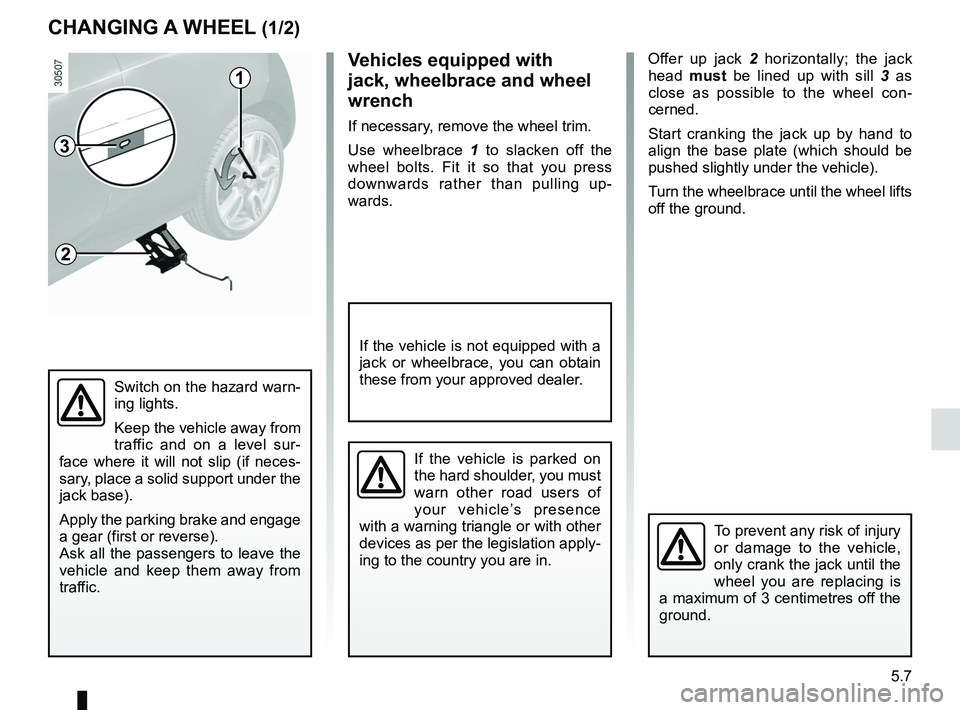
If necessary, remove the wheel trim.
Use wheelbrace 1 to slacken off the
wheel bolts. Fit it so that you press
downwards rather than pulling up -
wards.
Switch on the hazard warn-
ing lights.
Keep the vehicle away from
traffic and on a level sur -
face where it will not slip (if neces -
sary, place a solid support under the
jack base).
Apply the parking brake and engage
a gear (first or reverse).
Ask all the passengers to leave the
vehicle and keep them away from
traffic.
1
2
3
To prevent any risk of injury
or damage to the vehicle,
only crank the jack until the
wheel you are replacing is
a maximum of 3 centimetres off the
ground.
If the vehicle is parked on
the hard shoulder, you must
warn other road users of
your vehicle’s presence
with a warning triangle or with other
devices as per the legislation apply-
ing to the country you are in.
Offer up jack 2 horizontally; the jack
head must be lined up with sill 3 as
close as possible to the wheel con -
cerned.
Start cranking the jack up by hand to
align the base plate (which should be
pushed slightly under the vehicle).
Turn the wheelbrace until the wheel lifts
off the ground.
If the vehicle is not equipped with a
jack or wheelbrace, you can obtain
these from your approved dealer.
Page 140 of 185
bulbschanging ......................................... (up to the end of the DU)
changing a bulb .................................... (up to the end of the DU)
lights: direction indicators ........................................... (current page)
lights: side lights ......................................................... (current page)
lights: brake lights ...................................................... (current page)
lights: reversing lights ................................................. (current page)
lights: fog lights .......................................................... (current page)
indicators: direction indicators ........................................... (current page)
bulbs changing ......................................... (up to the end of the DU)
5.14
ENG_UD11230_1
Feux arrière et latéraux : remplacement des lampes (E33 - X33 - R\
enault)
ENG_NU_865-6_E33_Renault_5
Jaune NoirNoir texte
Rear lights (changing bulbs)
rear LIgHts and sIde LIgHts: changing bulbs (1/3)
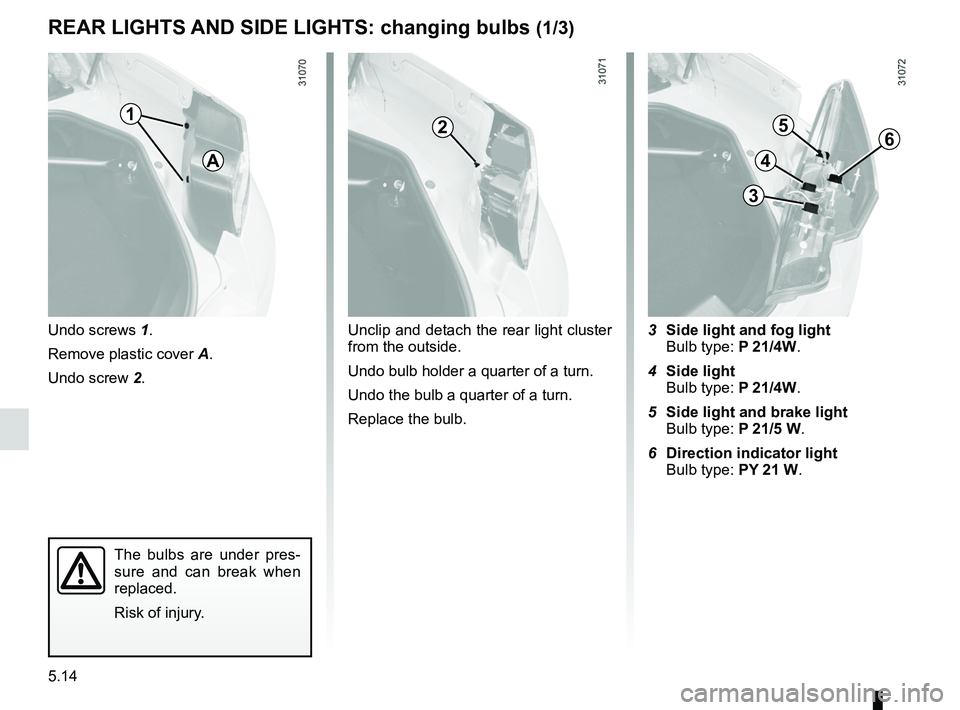
Undo screws 1.
Remove plastic cover A.
Undo screw 2. Unclip and detach the rear light cluster
from the outside.
Undo bulb holder a quarter of a turn.
Undo the bulb a quarter of a turn.
Replace the bulb. 3
side light and fog light
Bulb type: P 21/4W.
4 side light Bulb type: P 21/4W.
5 side light and brake light
Bulb type: P 21/5 W.
6 direction indicator light
Bulb type: Py 21 W.
12
3
4
56
The bulbs are under pres -
sure and can break when
replaced.
Risk of injury.
a