Compartment RENAULT ZOE 2016 1.G Owner's Manual
[x] Cancel search | Manufacturer: RENAULT, Model Year: 2016, Model line: ZOE, Model: RENAULT ZOE 2016 1.GPages: 216, PDF Size: 6.48 MB
Page 141 of 216
3.19
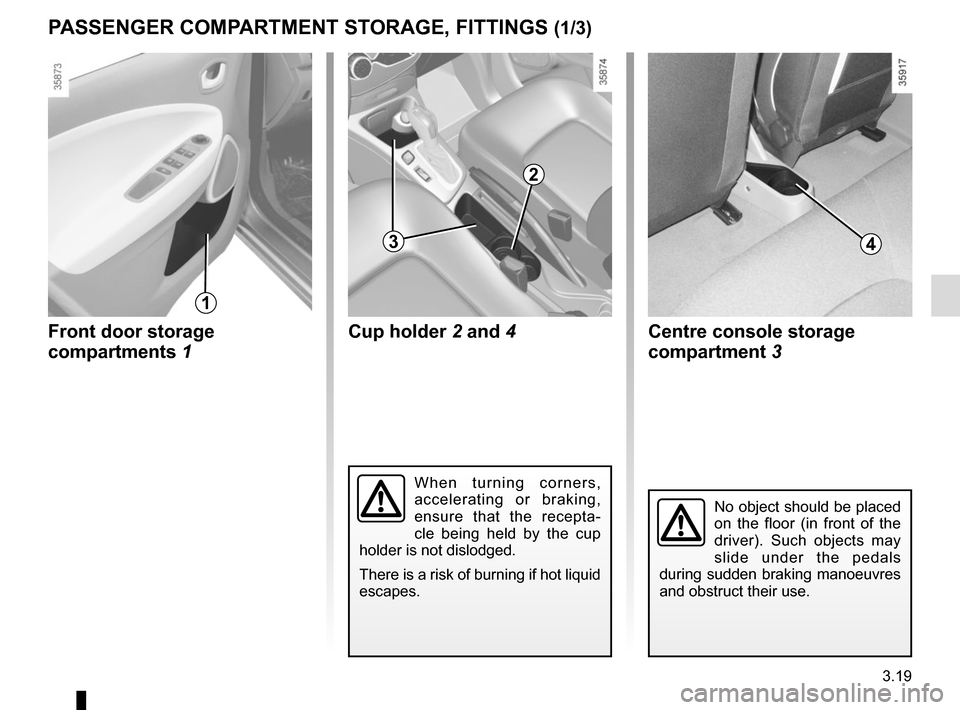
Front door storage
compartments 1
PASSENGER COMPARTMENT STORAGE, FITTINGS (1/3)
1
No object should be placed
on the floor (in front of the
driver). Such objects may
slide under the pedals
during sudden braking manoeuvres
and obstruct their use.
When turning corners,
accelerating or braking,
ensure that the recepta-
cle being held by the cup
holder is not dislodged.
There is a risk of burning if hot liquid
escapes.
2
3
Cup holder 2 and 4 Centre console storage
compartment 3
4
Page 142 of 216

3.20
PASSENGER COMPARTMENT STORAGE, FITTINGS (2/3)
5
Ensure that no hard, heavy
or pointed objects are
placed in the “open” storage
compartments in such a
way that they may fall onto passen-
gers during sudden turning, braking
or in the event of an accident.
Rear door storage
compartment 7
7
Dashboard storage
compartment 5
Glove box
Pull handle 6 to open it.
It can hold A4 size documents, a large
bottle of water, etc.
6
Grab handle 8
This offers support and can be held
when the vehicle is being driven.
Do not use it for getting into or out of
the vehicle.
8
Page 143 of 216
3.21
PASSENGER COMPARTMENT STORAGE, FITTINGS (3/3)
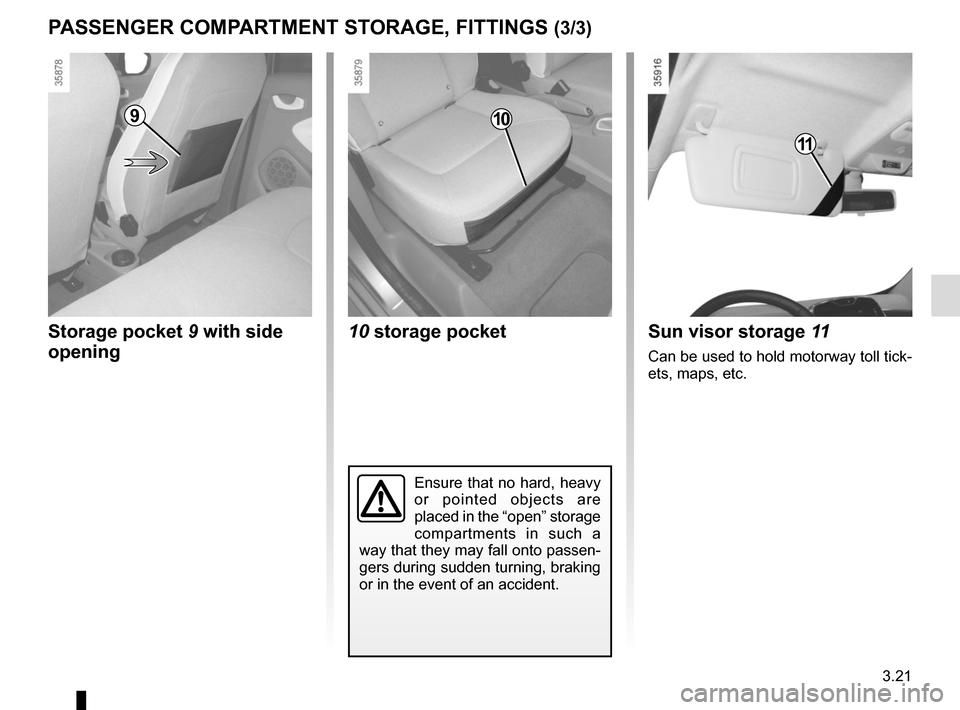
Storage pocket 9 with side opening
910
10 storage pocketSun visor storage 11
Can be used to hold motorway toll tick-
ets, maps, etc.
11
Ensure that no hard, heavy
or pointed objects are
placed in the “open” storage
compartments in such a
way that they may fall onto passen-
gers during sudden turning, braking
or in the event of an accident.
Page 148 of 216
3.26
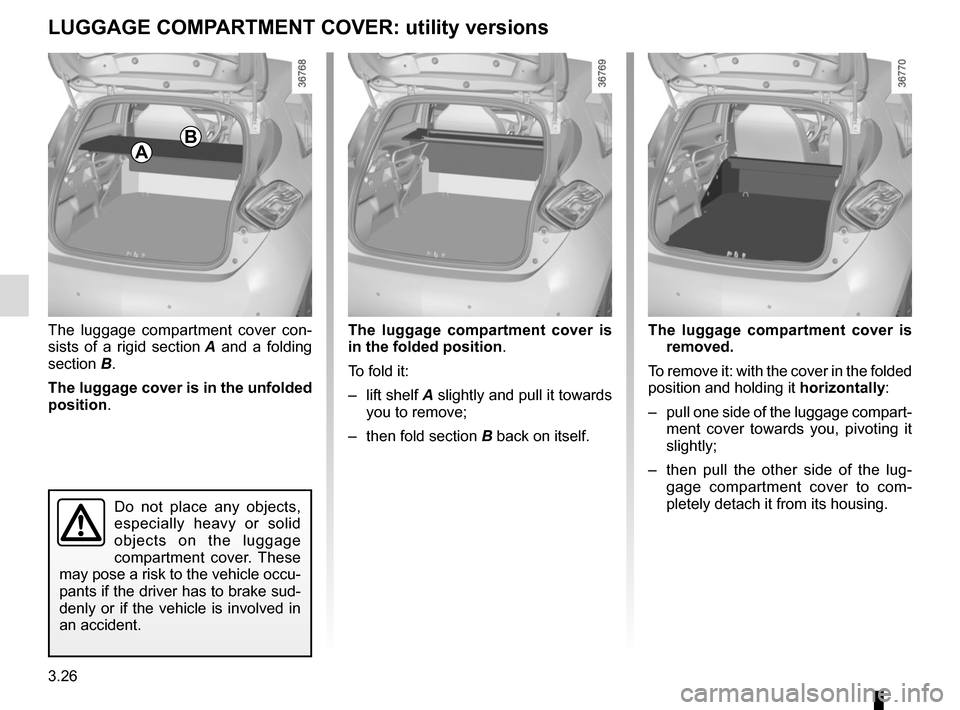
The luggage compartment cover con-
sists of a rigid section A and a folding
section B.
The luggage cover is in the unfolded
position . The luggage compartment cover is
removed.
To remove it: with the cover in the folded
position and holding it horizontally:
– pull one side of the luggage compart- ment cover towards you, pivoting it
slightly;
– then pull the other side of the lug- gage compartment cover to com-
pletely detach it from its housing.
LUGGAGE COMPARTMENT COVER: utility versions
Do not place any objects,
especially heavy or solid
objects on the luggage
compartment cover. These
may pose a risk to the vehicle occu-
pants if the driver has to brake sud-
denly or if the vehicle is involved in
an accident.
The luggage compartment cover is
in the folded position .
To fold it:
– lift shelf A slightly and pull it towards
you to remove;
– then fold section B back on itself.
AB
Page 150 of 216
3.28
TRANSPORTING OBJECTS IN THE LUGGAGE COMPARTMENT
Always position the heavi-
est items directly on the
floor. Use the lashing
points 1 on the boot floor, if
these are fitted to the vehicle. The
luggage should be loaded in such a
way that no items will be thrown for-
ward and strike the occupants if the
driver has to brake suddenly. Fasten
the rear seat belts, even if the seats
are not occupied.
1
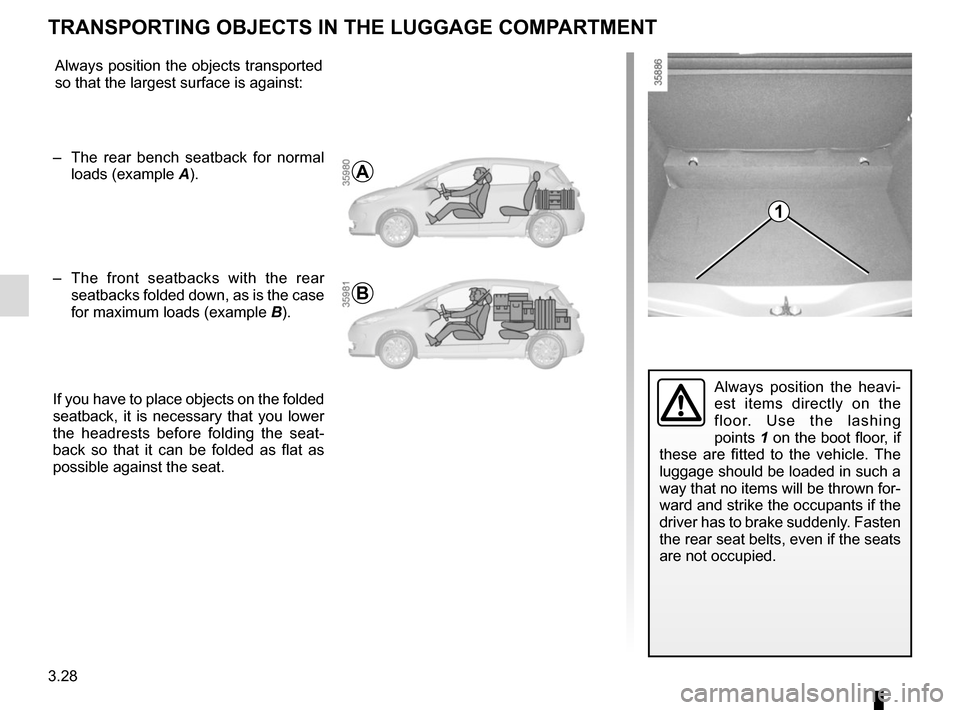
Always position the objects transported
so that the largest surface is against:
– The rear bench seatback for normal loads (example A).
– The front seatbacks with the rear
seatbacks folded down, as is the case
for maximum loads (example B).
If you have to place objects on the folded
seatback, it is necessary that you lower
the headrests before folding the seat-
back so that it can be folded as flat as
possible against the seat.
A
B
Page 154 of 216
4.2
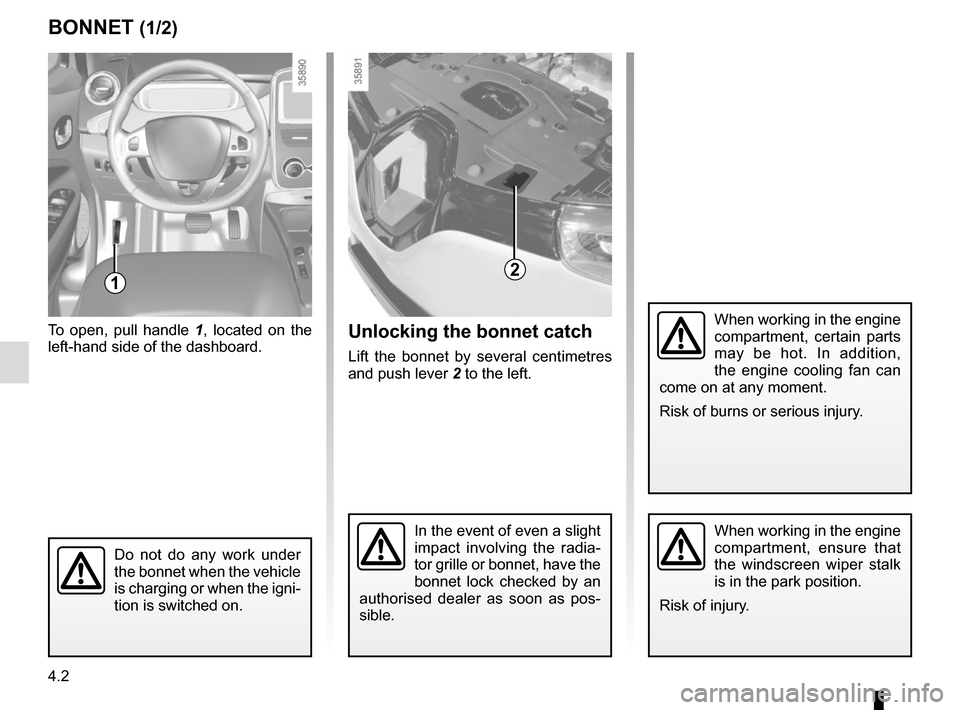
To open, pull handle 1, located on the
left-hand side of the dashboard.
BONNET (1/2)
1
When working in the engine
compartment, certain parts
may be hot. In addition,
the engine cooling fan can
come on at any moment.
Risk of burns or serious injury.
In the event of even a slight
impact involving the radia-
tor grille or bonnet, have the
bonnet lock checked by an
authorised dealer as soon as pos-
sible.
Do not do any work under
the bonnet when the vehicle
is charging or when the igni-
tion is switched on.
Unlocking the bonnet catch
Lift the bonnet by several centimetres
and push lever 2 to the left.
2
When working in the engine
compartment, ensure that
the windscreen wiper stalk
is in the park position.
Risk of injury.
Page 155 of 216
4.3
Opening the bonnet
Lift the bonnet; you will need to guide it
as it is held by a strut.
Ensure that the bonnet is
properly locked.
Ensure that nothing is pre-
venting locking (grit, cloths,
etc.).
After carrying out any work
in the engine compart-
ment, check that nothing
has been left behind (cloth,
tools, etc.).
Otherwise, this may lead to engine
damage.
BONNET (2/2)
Closing the bonnet
Check that nothing has been left in the
engine compartment.
To close the bonnet again, hold the
bonnet in the middle and guide it down,
allowing a 30 cm gap before it is closed,
then release it. It will latch automatically
under its own weight.
Do not press down on the
bonnet: there is a risk that
the bonnet will close inad-
vertently.
Page 156 of 216
4.4
Replacement intervals
Refer to the Maintenance Document for
your vehicle.
LEVELS (1/2)
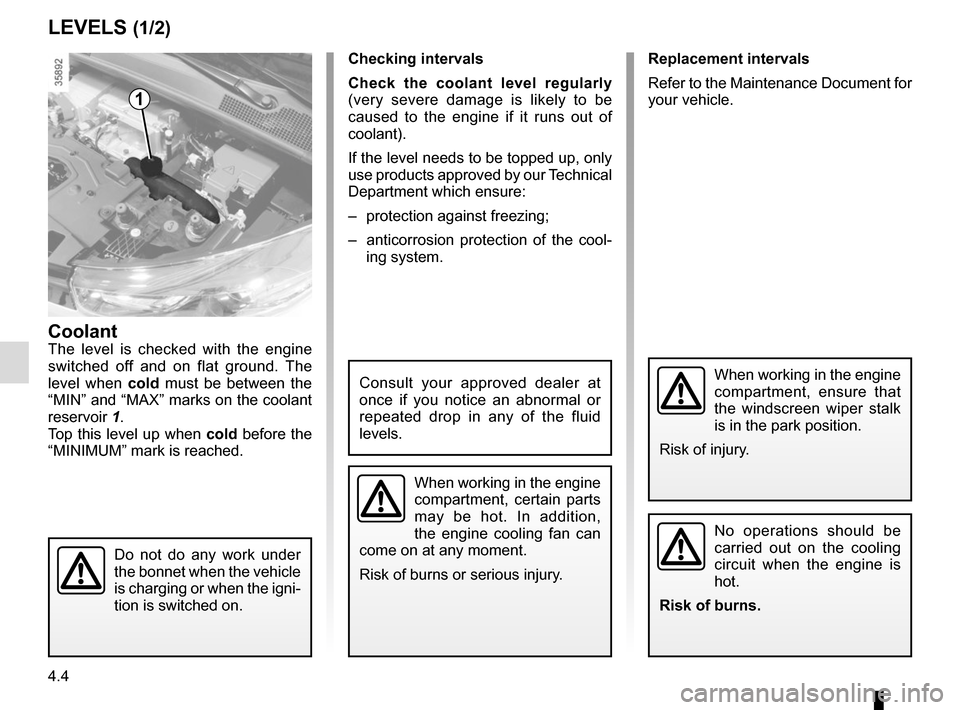
CoolantThe level is checked with the engine
switched off and on flat ground. The
level when cold must be between the
“MIN” and “MAX” marks on the coolant
reservoir 1. Top this level up when cold before the
“MINIMUM” mark is reached. Checking intervals
Check the coolant level regularly
(very severe damage is likely to be
caused to the engine if it runs out of
coolant).
If the level needs to be topped up, only
use products approved by our Technical
Department which ensure:
– protection against freezing;
– anticorrosion protection of the cool-
ing system.
No operations should be
carried out on the cooling
circuit when the engine is
hot.
Risk of burns.
Consult your approved dealer at
once if you notice an abnormal or
repeated drop in any of the fluid
levels.
Do not do any work under
the bonnet when the vehicle
is charging or when the igni-
tion is switched on.
1
When working in the engine
compartment, certain parts
may be hot. In addition,
the engine cooling fan can
come on at any moment.
Risk of burns or serious injury.
When working in the engine
compartment, ensure that
the windscreen wiper stalk
is in the park position.
Risk of injury.
Page 157 of 216
4.5
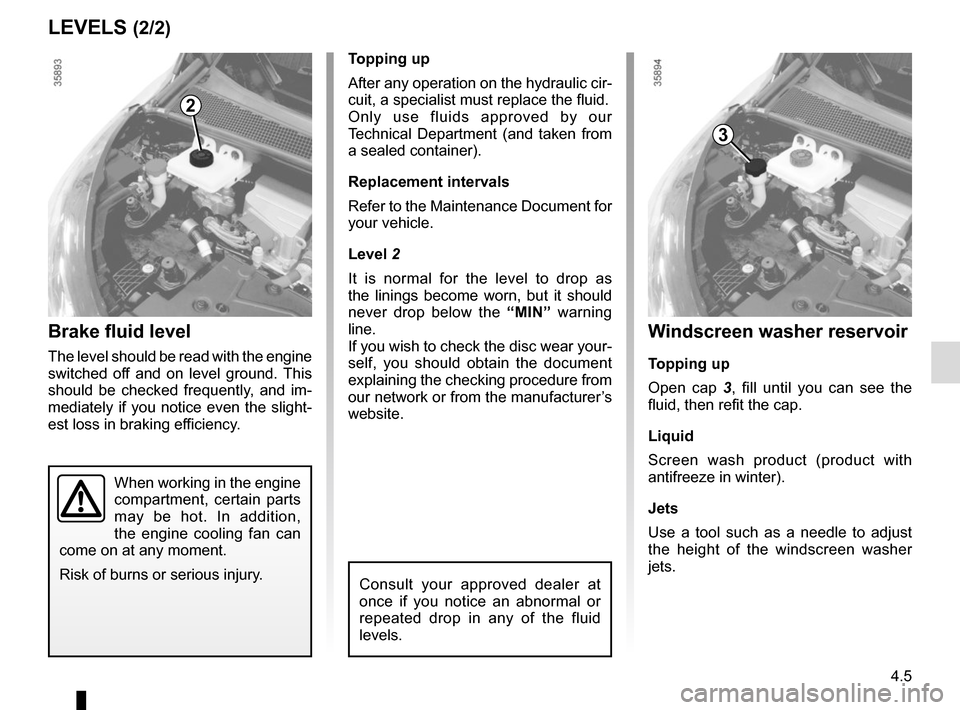
Windscreen washer reservoir
Topping up
Open cap 3, fill until you can see the
fluid, then refit the cap.
Liquid
Screen wash product (product with
antifreeze in winter).
Jets
Use a tool such as a needle to adjust
the height of the windscreen washer
jets.
3
2
Brake fluid level
The level should be read with the engine
switched off and on level ground. This
should be checked frequently, and im-
mediately if you notice even the slight-
est loss in braking efficiency.
Consult your approved dealer at
once if you notice an abnormal or
repeated drop in any of the fluid
levels.
Topping up
After any operation on the hydraulic cir-
cuit, a specialist must replace the fluid.
Only use fluids approved by our
Technical Department (and taken from
a sealed container).
Replacement intervals
Refer to the Maintenance Document for
your vehicle.
Level 2
It is normal for the level to drop as
the linings become worn, but it should
never drop below the “MIN” warning
line.
If you wish to check the disc wear your-
self, you should obtain the document
explaining the checking procedure from
our network or from the manufacturer’s
website.
LEVELS (2/2)
When working in the engine
compartment, certain parts
may be hot. In addition,
the engine cooling fan can
come on at any moment.
Risk of burns or serious injury.
Page 158 of 216
4.6
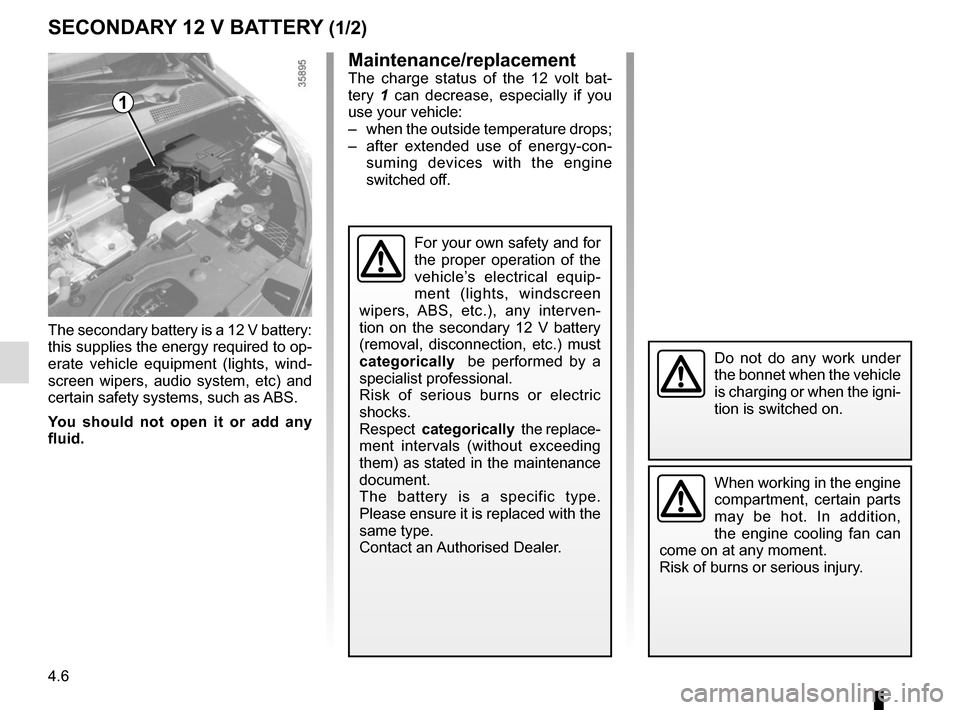
The secondary battery is a 12 V battery:
this supplies the energy required to op-
erate vehicle equipment (lights, wind-
screen wipers, audio system, etc) and
certain safety systems, such as ABS.
You should not open it or add any
fluid.
SECONDARY 12 V BATTERY (1/2)
1
When working in the engine
compartment, certain parts
may be hot. In addition,
the engine cooling fan can
come on at any moment.
Risk of burns or serious injury.
Do not do any work under
the bonnet when the vehicle
is charging or when the igni-
tion is switched on.
For your own safety and for
the proper operation of the
vehicle’s electrical equip-
ment (lights, windscreen
wipers, ABS, etc.), any interven-
tion on the secondary 12 V battery
(removal, disconnection, etc.) must
categorically be performed by a
specialist professional.
Risk of serious burns or electric
shocks.
Respect categorically the replace-
ment intervals (without exceeding
them) as stated in the maintenance
document.
The battery is a specific type.
Please ensure it is replaced with the
same type.
Contact an Authorised Dealer.
Maintenance/replacementThe charge status of the 12 volt bat-
tery 1 can decrease, especially if you
use your vehicle:
– when the outside temperature drops;
– after extended use of energy-con- suming devices with the engine
switched off.