Traction RENAULT ZOE 2017 1.G Owner's Manual
[x] Cancel search | Manufacturer: RENAULT, Model Year: 2017, Model line: ZOE, Model: RENAULT ZOE 2017 1.GPages: 220, PDF Size: 4.07 MB
Page 134 of 220
3.8
AIR CONDITIONING: remote activation
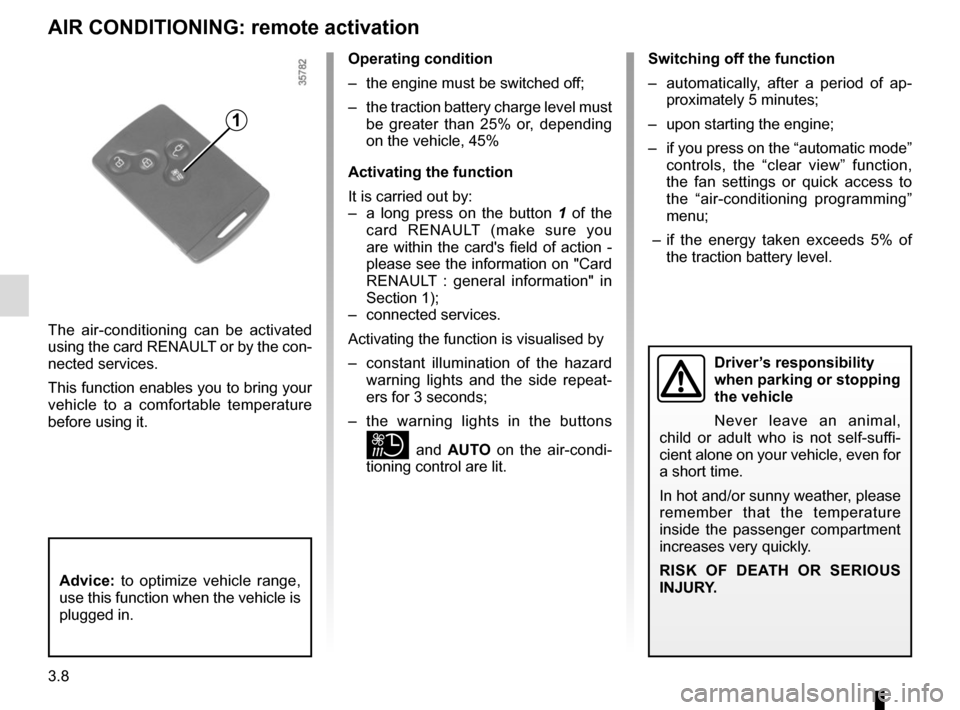
The air-conditioning can be activated
using the card RENAULT or by the con-
nected services.
This function enables you to bring your
vehicle to a comfortable temperature
before using it.
1
Operating condition
– the engine must be switched off;
– the traction battery charge level must be greater than 25% or, depending
on the vehicle, 45%
Activating the function
It is carried out by:
– a long press on the button 1 of the
card RENAULT (make sure you
are within the card's field of action -
please see the information on "Card
RENAULT : general information" in
Section 1);
– connected services.
Activating the function is visualised by
– constant illumination of the hazard warning lights and the side repeat-
ers for 3 seconds;
– the warning lights in the buttons
and AUTO on the air-condi-
tioning control are lit. Switching off the function
– automatically, after a period of ap-
proximately 5 minutes;
– upon starting the engine;
– if you press on the “automatic mode” controls, the “clear view” function,
the fan settings or quick access to
the “air-conditioning programming”
menu;
– if the energy taken exceeds 5% of the traction battery level.
Driver’s responsibility
when parking or stopping
the vehicle
Never leave an animal,
child or adult who is not self-suffi-
cient alone on your vehicle, even for
a short time.
In hot and/or sunny weather, please
remember that the temperature
inside the passenger compartment
increases very quickly.
RISK OF DEATH OR SERIOUS
INJURY.
Advice: to optimize vehicle range,
use this function when the vehicle is
plugged in.
Page 135 of 220
3.9
AIR CONDITIONING: programming (1/4)
Adjusting the programming
With the vehicle connected to a power
source, this function enables:
– a comfortable temperature prior to using the vehicle;
– optimisation of the vehicle range.
The programmable air-conditioning
is triggered the hour before the pro-
grammed hour in order to reach a com-
fortable temperature.
1
Driver’s responsibility
when parking or stopping
the vehicle
Never leave an animal,
child or adult who is not self-suffi-
cient alone on your vehicle, even for
a short time.
In hot and/or sunny weather, please
remember that the temperature
inside the passenger compartment
increases very quickly.
RISK OF DEATH OR SERIOUS
INJURY.
Operating conditions
– the ignition must be switched off;
– the vehicle must be locked;
– the traction battery charge level must be greater than 25% or, depending
on the vehicle, 45% for the function
to be triggered;
– the vehicle has to be plugged into the mains;
– programming should be done at least one hour prior to departure;
and
– air-conditioning programming must be activated.
Depending on the vehicle, the pro- gramming is done from:
– the multimedia display;
or
– the vehicle settings customisation menu.
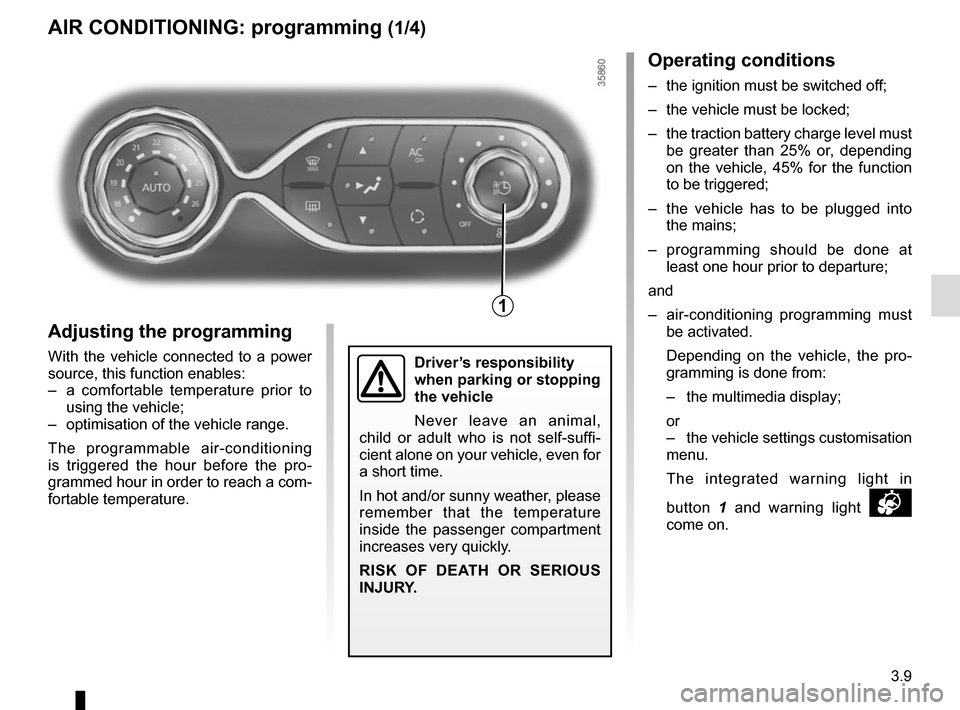
The integrated warning light in
button 1 and warning light
come on.
Page 138 of 220

3.12
Stopping the programmed air
conditioning
The air conditioning stops automati-
cally around ten minutes after the set
end time.
However, the function can be deacti-
vated if:
– the charging socket is disconnected;
– the “Remote Activation” function is activated – please see the informa-
tion on “Air conditioning: remote acti-
vation” in Section 2;
– the traction battery charging level is lower than 15% or, depending on the
vehicle, 30%Driver’s responsibility
when parking or stopping
the vehicle
Never leave an animal,
child or adult who is not self-suffi-
cient alone on your vehicle, even for
a short time.
In hot and/or sunny weather, please
remember that the temperature
inside the passenger compartment
increases very quickly.
RISK OF DEATH OR SERIOUS
INJURY.
AIR CONDITIONING: programming (4/4)
Connected services
The air conditioning can also be acti-
vated using the connected services.
For more information regarding the op-
erating conditions, please contact an
authorised dealer.
“Programme” activation
– With the ignition switched on and the air-conditioning operating (please
refer to the information on “Automatic
air-conditioning” in Section 3);
– press the button 1.
The function is triggered one hour prior
to the programmed time to reach a
comfortable temperature.
The warning lights integrated in the
button 1, the AUTO button 2 and the
warning light
on the instrument
panel are lit up.
12
Page 166 of 220
4.10
Using a roller type car wash
Return the windscreen wiper stalk to
the Park position (refer to the informa-
tion on the “Windscreen washer, wiper”
in Section 1). Check the mounting of
external accessories, additional lights
and mirrors, and ensure that the wiper
blades are secured with adhesive tape.
Remove the radio aerial mast if your
vehicle is fitted with this equipment.
Remember to remove the tape and refit
the antenna after washing.
Observe the vehicle stopping distances
when driving on gravelled surfaces to
prevent paint damage.
Repair, or have repaired quickly, areas
where the paint has been damaged, to
prevent corrosion spreading.
Remember to visit the body shop pe-
riodically in order to maintain your
anti-corrosion warranty. Refer to the
Maintenance Document.
Respect local regulations about wash-
ing vehicles (e.g. do not wash your ve-
hicle on a public highway).
If it is necessary to clean mechani-
cal components, hinges, etc., spray
them with products approved by our
Technical Department to protect them
after they have been cleaned.
BODYWORK MAINTENANCE (2/2)
Cleaning the headlights
As the headlights are made of plastic
“glass”, use a soft cloth or cotton wool
to clean them. If this does not clean
them properly, moisten the cloth with
soapy water, then wipe clean with a soft
damp cloth or cotton wool.
Finally, carefully dry off with a soft dry
cloth.
Cleaning products containing alco-
hol must not be used.
Vehicles with a matte paint
finish
This type of paint requires certain pre-
cautions.
Do not do the following
– use wax-based products (polishing);
– rub too hard;
– wash the vehicle in a roller-type car
wash;
– wash the vehicle using a high-pres-
sure device;
– attach stickers to the paintwork (risk
of leaving marks).
You should do the following
Wash the vehicle by hand using plenty
of water, using a soft cloth or a gentle
sponge.
We have selected special products
to care for your vehicle and you can
obtain these from the manufactur-
er’s accessory outlets.
Washing the vehicle
Never wash the engine
compartment, the charging
connection or the traction
battery with a high-pressure jet.
This risks damaging the electric cir-
cuit.
Never wash the vehicle while it is
charging.
Risk of electric shock and a risk to
life.
Page 187 of 220
5.19
Choice of breakdown service
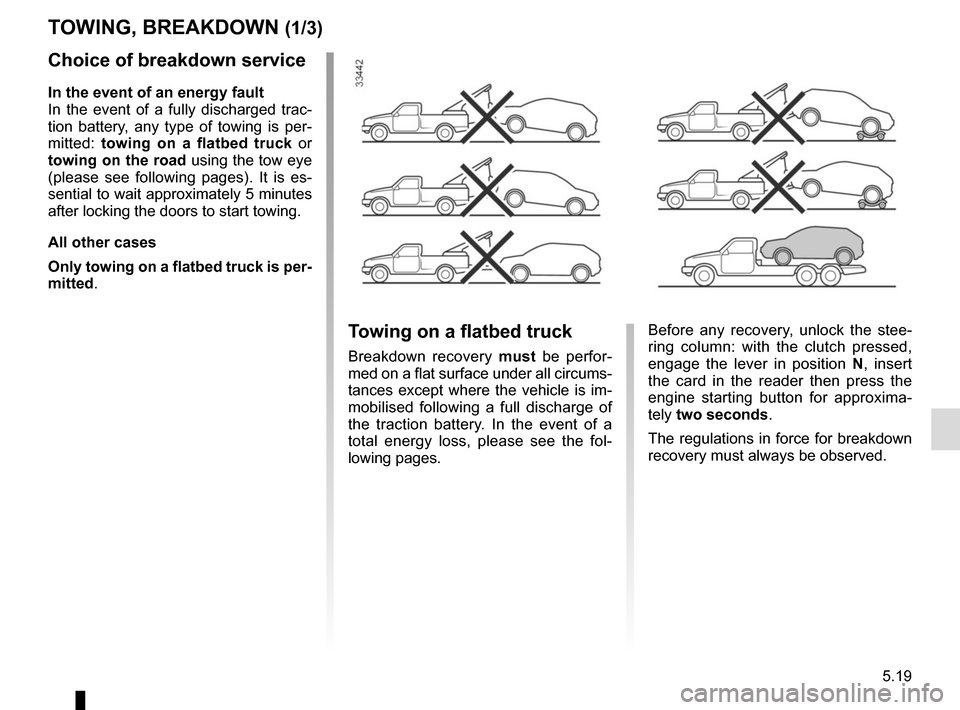
In the event of an energy fault
In the event of a fully discharged trac-
tion battery, any type of towing is per-
mitted: towing on a flatbed truck or
towing on the road using the tow eye
(please see following pages). It is es-
sential to wait approximately 5 minutes
after locking the doors to start towing.
All other cases
Only towing on a flatbed truck is per-
mitted.
TOWING, BREAKDOWN (1/3)
Before any recovery, unlock the stee-
ring column: with the clutch pressed,
engage the lever in position N, insert
the card in the reader then press the
engine starting button for approxima-
tely two seconds.
The regulations in force for breakdown
recovery must always be observed.Towing on a flatbed truck
Breakdown recovery must be perfor-
med on a flat surface under all circums-
tances except where the vehicle is im-
mobilised following a full discharge of
the traction battery. In the event of a
total energy loss, please see the fol-
lowing pages.
Page 190 of 220

The following advice will enable you to carry out quick, temporary repai\
rs. For safety reasons you should always contact
an approved dealer as soon as possible.
FAULTSPO")
5.22
OPERATING FAULTS (1/4)
The following advice will enable you to carry out quick, temporary repai\
rs. For safety reasons you should always contact
an approved dealer as soon as possible.
FAULTSPOSSIBLE CAUSESWHAT TO DO
Impossible to charge the traction bat-
tery.
The charging flap warning light flashes
red. The outdoor temperature is lower
than -26°C.
Recharge your vehicle in a more suitable
environment. If necessary, please refer to
the information on “Towing: breakdown re-
covery” in Section 5.
No electrical current in the wall
socket or poor connection of cable
to domestic socket. Check your installation (circuit breaker, pro-
grammer, etc.).
Check the connections (socket, etc.).
Please refer to the information on “Electric
vehicle: charging” in Section 1.
The cord is defective. Please see an authorised dealer to replace
it.
Impossible to charge the traction bat-
tery.
The charging flap warning light flashes
blue. The charging cord is not correctly
locked to the vehicle. Plug the charging cord correctly to the ve-
hicle. Refer to the information on “Electric
vehicle: charging” in Section 1.
The activation of the air conditioning
using the card RENAULT fails to work. The card RENAULT is outside its
area of action.Step closer to the vehicle.
One of the usage conditions is not
complied with. Please refer to the information on “Air-
conditioning: remote control activation” in
Section 3.
Page 191 of 220
5.23
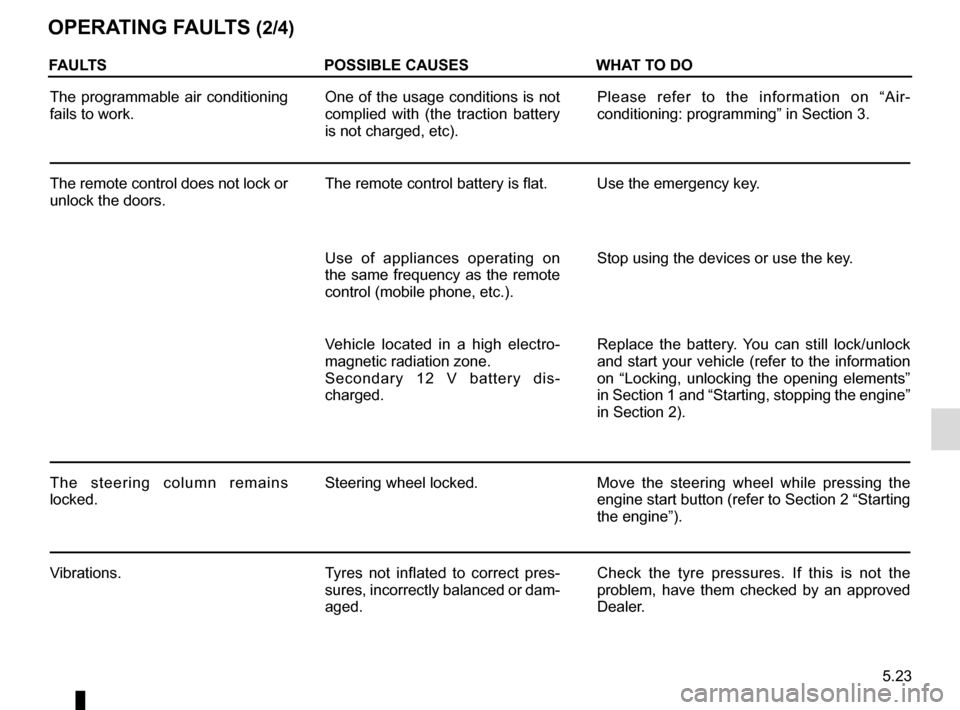
OPERATING FAULTS (2/4)
FAULTSPOSSIBLE CAUSESWHAT TO DO
The programmable air conditioning
fails to work. One of the usage conditions is not
complied with (the traction battery
is not charged, etc).Please refer to the information on “Air-
conditioning: programming” in Section 3.
The remote control does not lock or
unlock the doors. The remote control battery is flat. Use the emergency key.
Use of appliances operating on
the same frequency as the remote
control (mobile phone, etc.).Stop using the devices or use the key.
Vehicle located in a high electro-
magnetic radiation zone.
Secondary 12 V battery dis-
charged. Replace the battery. You can still lock/unlock
and start your vehicle (refer to the information
on “Locking, unlocking the opening elements”
in Section 1 and “Starting, stopping the engine”
in Section 2).
The steering column remains
locked. Steering wheel locked.
Move the steering wheel while pressing the
engine start button (refer to Section 2 “Starting
the engine”).
Vibrations. Tyres not inflated to correct pres-
sures, incorrectly balanced or dam-
aged. Check the tyre pressures. If this is not the
problem, have them checked by an approved
Dealer.
Page 215 of 220
7.3
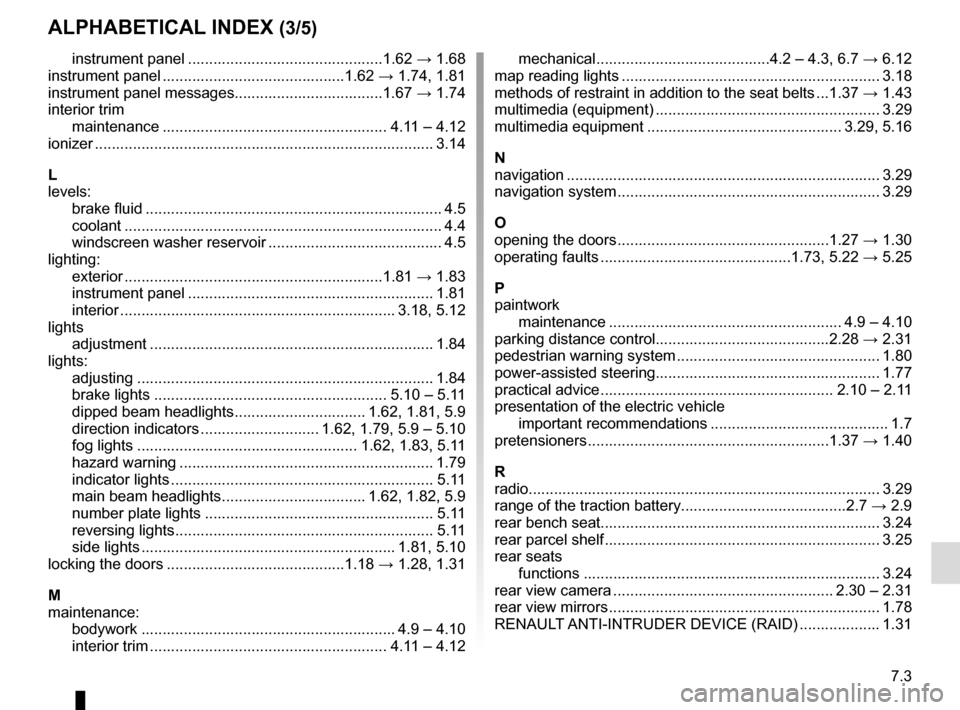
ALPHABETICAL INDEX (3/5)
instrument panel ..............................................1.62 → 1.68
instrument panel ...........................................1.62 → 1.74, 1.81
instrument panel messages...................................1.67 → 1.74
interior trim maintenance ..................................................... 4.11 – 4.12
ionizer ................................................................\
................ 3.14
L
levels: brake fluid ...................................................................... 4.5
coolant ................................................................\
........... 4.4
windscreen washer reservoir ......................................... 4.5
lighting: exterior .............................................................1.81 → 1.83
instrument panel .......................................................... 1.81
interior ...............................................................\
.. 3.18, 5.12
lights adjustment .............................................................\
...... 1.84
lights: adjusting ..............................................................\
........ 1.84
brake lights ....................................................... 5.10 – 5.11
dipped beam headlights ............................... 1.62, 1.81, 5.9
direction indicators ............................ 1.62, 1.79, 5.9 – 5.10
fog lights .................................................... 1.62, 1.83, 5.11
hazard warning ............................................................ 1.79
indicator lights .............................................................. 5.11
main beam headlights .................................. 1.62, 1.82, 5.9
number plate lights ...................................................... 5.11
reversing lights ............................................................. 5.11
side lights ............................................................ 1.81, 5.10
locking the doors ..........................................1.18 → 1.28, 1.31
M
maintenance: bodywork ............................................................ 4.9 – 4.10
interior trim ........................................................ 4.11 – 4.12 mechanical .........................................4.2 – 4.3, 6.7
→ 6.12
map reading lights ............................................................. 3.18
methods of restraint in addition to the seat belts ...1.37 → 1.43
multimedia (equipment) ..................................................... 3.29
multimedia equipment .............................................. 3.29, 5.16
N
navigation .............................................................\
............. 3.29
navigation system .............................................................. 3.29
O
opening the doors ..................................................1.27 → 1.30
operating faults .............................................1.73, 5.22 → 5.25
P
paintwork maintenance ....................................................... 4.9 – 4.10
parking distance control.........................................2.28 → 2.31
pedestrian warning system ................................................ 1.80
power-assisted steering..................................................... 1.77
practical advice ....................................................... 2.10 – 2.11
presentation of the electric vehicle important recommendations .......................................... 1.7
pretensioners .........................................................1.37 → 1.40
R
radio........................................................................\
........... 3.29
range of the traction battery.......................................2.7 → 2.9
rear bench seat.................................................................. 3.24
rear parcel shelf ................................................................. 3.25
rear seats functions ..............................................................\
........ 3.24
rear view camera .................................................... 2.30 – 2.31
rear view mirrors ................................................................ 1.78
RENAULT ANTI-INTRUDER DEVICE (RAID) ................... 1.31
Page 216 of 220

RENAULT cardbattery ................................................................\
.......... 5.15
use ............................................................1.18")
7.4
ALPHABETICAL INDEX (4/5)
RENAULT cardbattery ................................................................\
.......... 5.15
use ............................................................1.18 → 1.26, 3.8
RENAULT card battery ...................................................... 5.15
replacement parts ................................................................ 6.6
reverse gear selecting ................................................................ 2.5 – 2.6
reversing sensor ..................................................... 2.28 – 2.29
S
screen wash/wipe .............................................................. 1.87
seat belt pretensioners ..........................................1.37 → 1.40
front seat belt ...................................................1.37 → 1.40
seat belts ..................................1.33 → 1.40, 1.42 – 1.43, 1.63
see-me-home lighting ............................................... 1.82, 1.84
service sheets..........................................................6.7 → 6.12
side protection devices ...................................................... 1.42
signals and lights ...................................................1.81 → 1.84
speakers location ...............................................................\
......... 5.16
speed control .............................................................. 2.5 – 2.6
speed limiter .................................................1.63, 2.21 → 2.23
spoiler ................................................................\
................ 3.27
starting ...............................................................\
........2.2 → 2.4
starting the engine .....................................................2.2 → 2.4
steering wheel adjustment .............................................................\
...... 1.77
stopping the engine ............................................................. 2.4
storage compartment.............................................3.19 → 3.21
storage compartments ...........................................3.19 → 3.21
sun visor ........................................................................\
.... 3.18
T
tailgate ...............................................................\
................ 3.27
tanks and reservoirs brake fluid ...................................................................... 4.5 coolant ................................................................\
........... 4.4
tanks and reservoirs: windscreen washer ........................................................ 4.5
technical specifications ........................................................ 6.6
telephone ..............................................................\
............. 3.29
temperature regulation ..............................................3.4 → 3.7
tool kit ........................................................................\
.......... 5.2
towing in the event of energy failure ...........................5.19 → 5.21
breakdown .......................................................5.19 → 5.21
towing hitch...................................................... 5.2, 5.20 – 5.21
towing rings ................................................... 1.47 – 1.48, 3.28
traction battery ...........................................................1.2 → 1.6
traction battery charge .............................................1.8 → 1.15
traction control .......................................................2.16 → 2.20
transporting children ..........................1.44 – 1.45, 1.47 → 1.57
transporting objects in the luggage compartment ............................. 3.27 – 3.28
trip computer and warning system.........................1.67 → 1.74
tyre inflation kit...........................................................5.3 → 5.5
tyre pressure............................................2.13 → 2.15, 4.8, 5.7
tyre pressure loss warning.....................................2.13 → 2.15
tyre pressures ...................................................................... 4.8
tyres .............................................. 2.13 → 2.15, 4.8, 5.6 → 5.8
U
unlocking the doors ................................................ 1.29 – 1.30
V
vehicle range ........................................................... 2.7 → 2.11
ventilation ............................................................\
......3.4 → 3.7
W
warning buzzer ..................................... 1.27 – 1.28, 1.79, 1.82
warning lights.....................................1.62 →
1.64, 1.67 – 1.68
washing .................................................................... 4.9 – 4.10