Starting RENAULT ZOE 2018 Owner's Manual
[x] Cancel search | Manufacturer: RENAULT, Model Year: 2018, Model line: ZOE, Model: RENAULT ZOE 2018Pages: 226, PDF Size: 5.51 MB
Page 144 of 226
3.18
AIR CONDITIONING: information and operating instructions (1/2)
Do not open the refriger-
ant fluid circuit. The fluid
may damage eyes or skin.
Advice on use
In some situations, (air conditioning
off, air recirculation activated, ventila-
tion speed at zero or low, etc.) you may
notice that condensation starts to form
on the windows and windscreen.
If there is condensation, use the “Clear
View” function to remove it, then use
the air conditioning in automatic mode
to stop it forming again.
Maintenance
Refer to the Maintenance Document
for your vehicle for the inspection fre-
quency.
Range
It is normal to notice an increase in
energy usage when the air conditioning
is operating. Recommendations to limit energy
consumption and maintain the
range of the vehicle:
Drive with the air vents open and the
windows closed. If the vehicle has been
parked in the sun, open the doors for a
few moments to let the hot air escape
before starting the engine.
Favour:
– before departure, the use of the air-
conditioning programming or remote
activation. Please refer to the infor-
mation on “Air-conditioning: pro-
gramming” and “Air-conditioning:
remote activation” in Section 2);
– during your journeys, using ECO mode. Please see information about
“ECO mode function” in Section 2.
Operating faults
As a general rule, contact your ap-
proved dealer in the event of an oper-
ating fault.
– Reduction in de-icing, demisting
or air conditioning performance.
This may be caused by the passen-
ger compartment filter cartridge be-
coming clogged.
– No hot or cold air is being pro-
duced. Check that the controls are
set correctly and that the fuses are
sound. Otherwise, switch off the
system.
Presence of water under the
vehicle
After prolonged use of the air condi-
tioning system, it is normal for water
to be present under the vehicle. This is
caused by condensation.
Vehicles equipped with
modeECO
Once activated, ECO mode may
reduce air conditioning perform-
ance. Please refer to the informa-
tion on “Driving advice, Eco-driving”
in Section 2.
Use the air conditioning system reg-
ularly, even in cold weather, running
it at least once a month for approxi-
mately 5 minutes.
Page 145 of 226
3.19
AIR CONDITIONING: information and operating instructions (2/2)
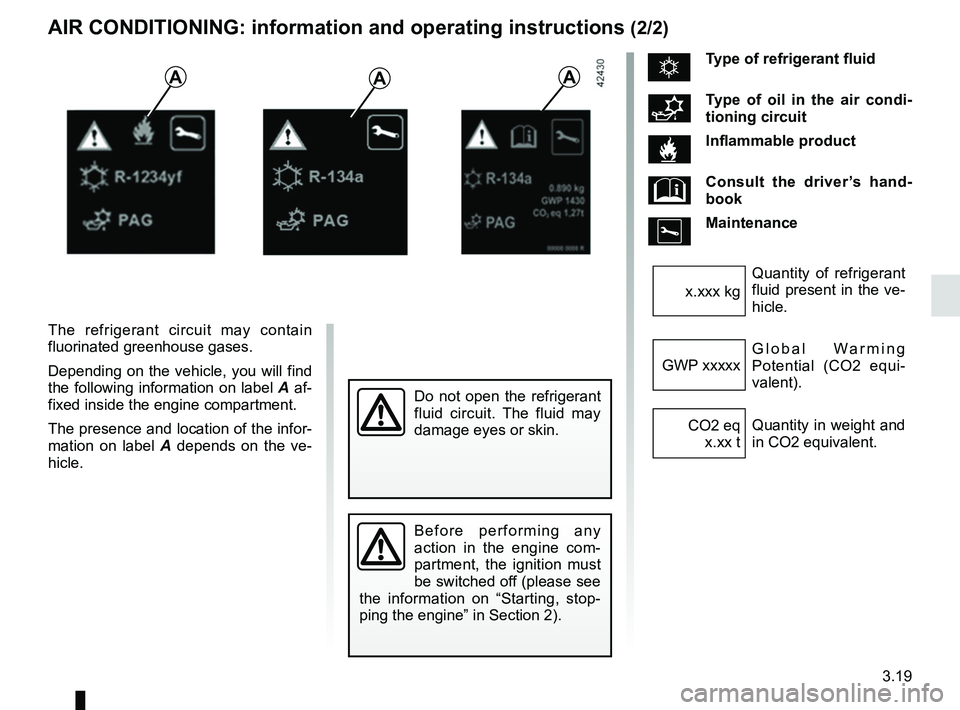
The refrigerant circuit may contain
fluorinated greenhouse gases.
Depending on the vehicle, you will find
the following information on label A af-
fixed inside the engine compartment.
The presence and location of the infor-
mation on label A depends on the ve-
hicle.
AAA
Do not open the refrigerant
fluid circuit. The fluid may
damage eyes or skin.
ÑType of refrigerant fluid
Type of oil in the air condi-
tioning circuit
\bInflammable product
Consult the driver’s hand-
book
Maintenance
Quantity of refrigerant
fluid present in the ve-
hicle.
x.xxx kg
Global Warming
Potential (CO2 equi-
valent).
GWP xxxxx
Quantity in weight and
in CO2 equivalent.
CO2 eq
x.xx t
Before performing any
action in the engine com-
partment, the ignition must
be switched off (please see
the information on “Starting, stop-
ping the engine” in Section 2).
Page 146 of 226
3.20
Safety of rear occupants
The driver can prevent
operation of the rear elec-
tric windows by pressing
switch 4. A confirmation message is
displayed on the instrument panel.
Driver’s responsibility
Never leave your vehicle with the
RENAULT card inside, and never
leave a child, adult who is not self-
sufficient or a pet, even for a short
while. They may pose a risk to
themselves or to others by starting
the engine or activating equipment
(such as the gear lever or electric
windows). If any part of the body be-
comes trapped, reverse the direc-
tion of the window immediately by
pressing the relevant switch.
Risk of serious injury.
ELECTRIC WINDOWS (1/2)
These systems operate with the igni-
tion on or off, until one of the front doors
is opened (limited to about 3 minutes).
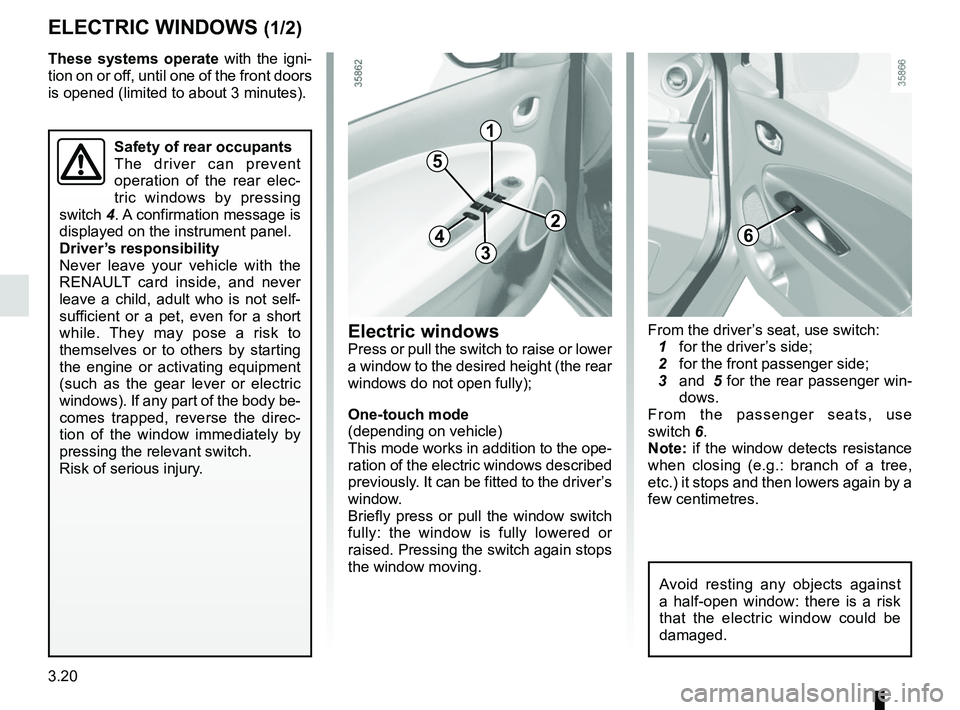
From the driver’s seat, use switch:
1 for the driver’s side;
2 for the front passenger side;
3 and 5 for the rear passenger win-
dows.
From the passenger seats, use
switch 6.
Note: if the window detects resistance
when closing (e.g.: branch of a tree,
etc.) it stops and then lowers again by a
few centimetres.Electric windowsPress or pull the switch to raise or lower
a window to the desired height (the rear
windows do not open fully);
One-touch mode
(depending on vehicle)
This mode works in addition to the ope-
ration of the electric windows described
previously. It can be fitted to the driver’s
window.
Briefly press or pull the window switch
fully: the window is fully lowered or
raised. Pressing the switch again stops
the window moving.
1
2
34
5
6
Avoid resting any objects against
a half-open window: there is a risk
that the electric window could be
damaged.
Page 193 of 226
5.19
Choice of breakdown service
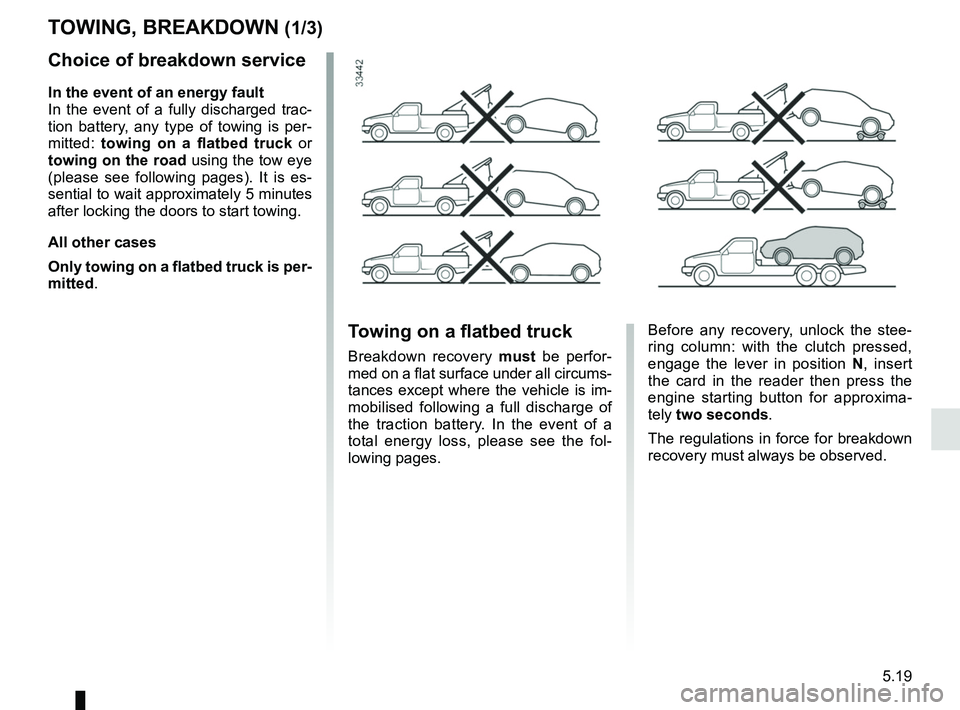
In the event of an energy fault
In the event of a fully discharged trac-
tion battery, any type of towing is per-
mitted: towing on a flatbed truck or
towing on the road using the tow eye
(please see following pages). It is es-
sential to wait approximately 5 minutes
after locking the doors to start towing.
All other cases
Only towing on a flatbed truck is per-
mitted.
TOWING, BREAKDOWN (1/3)
Before any recovery, unlock the stee-
ring column: with the clutch pressed,
engage the lever in position N, insert
the card in the reader then press the
engine starting button for approxima-
tely two seconds.
The regulations in force for breakdown
recovery must always be observed.Towing on a flatbed truck
Breakdown recovery must be perfor-
med on a flat surface under all circums-
tances except where the vehicle is im-
mobilised following a full discharge of
the traction battery. In the event of a
total energy loss, please see the fol-
lowing pages.
Page 194 of 226

5.20
Once you have finished towing, press
the engine start button twice (risk of
running down the 12 V battery).
If the lever is stuck in P, even though
you are depressing the brake pedal, the
lever can be released manually.
To do this, unclip the cover at the base
of the lever.
Simultaneously press at the location 7
and the unlocking button 6 on the lever.
TOWING, BREAKDOWN (2/3)
6
7
In the event of an energy
fault: towing
In the event of a fully discharged trac-
tion battery:
– the warning light 2
Ṏ flashes;
– the indicator 1 shows an empty bat-
tery.
It is possible to recover on a flatbed
truck or tow the vehicle using the tow
eye, following the instructions below.
When the engine is stop-
ped, steering and braking
assistance are not opera-
tional.
Before towing, unlock the steering
column: engage the lever 5 in posi-
tion N, insert the card in the reader 4
then press the engine starting button 3
for approximately two seconds.
The column is unlocked, the accessory
functions are supplied: the vehicle lights
can be used (hazard warning lights,
brake lights etc.). The towed vehicle’s
lights must be switched on at night.
The speed specified by current legisla-
tion for towing must always be obser-
ved.
3
5
4
1
2
Page 197 of 226
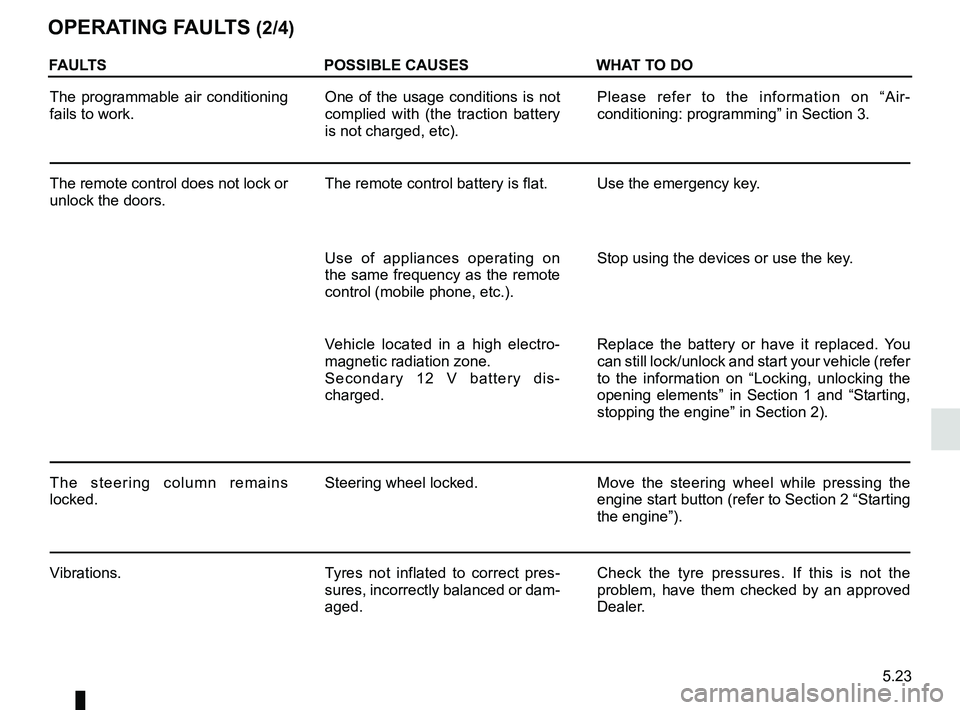
5.23
OPERATING FAULTS (2/4)
FAULTSPOSSIBLE CAUSESWHAT TO DO
The programmable air conditioning
fails to work. One of the usage conditions is not
complied with (the traction battery
is not charged, etc).Please refer to the information on “Air-
conditioning: programming” in Section 3.
The remote control does not lock or
unlock the doors. The remote control battery is flat. Use the emergency key.
Use of appliances operating on
the same frequency as the remote
control (mobile phone, etc.).Stop using the devices or use the key.
Vehicle located in a high electro-
magnetic radiation zone.
Secondary 12 V battery dis-
charged. Replace the battery or have it replaced. You
can still lock/unlock and start your vehicle (refer
to the information on “Locking, unlocking the
opening elements” in Section 1 and “Starting,
stopping the engine” in Section 2).
The steering column remains
locked. Steering wheel locked.
Move the steering wheel while pressing the
engine start button (refer to Section 2 “Starting
the engine”).
Vibrations. Tyres not inflated to correct pres-
sures, incorrectly balanced or dam-
aged. Check the tyre pressures. If this is not the
problem, have them checked by an approved
Dealer.
Page 222 of 226

RENAULT cardbattery ................................................................\
.......... 5.15
use .......................................................... 1.18")
7.4
ALPHABETICAL INDEX (4/5)
RENAULT cardbattery ................................................................\
.......... 5.15
use .......................................................... 1.18 → 1.26, 3.11
RENAULT card battery ...................................................... 5.15
replacement parts ................................................................ 6.6
reverse gear selecting ................................................................ 2.5 – 2.6
reversing sensor ..................................................... 2.28 – 2.29
S
screen wash/wipe .............................................................. 1.87
seat belt pretensioners ..........................................1.37 → 1.40
front seat belt ...................................................1.37 → 1.40
seat belts ..................................1.33 → 1.40, 1.42 – 1.43, 1.63
see-me-home lighting ............................................... 1.82, 1.84
service sheets..........................................................6.7 → 6.12
side protection devices ...................................................... 1.42
signals and lights ...................................................1.81 → 1.84
speakers location ...............................................................\
......... 5.16
speed control .............................................................. 2.5 – 2.6
speed limiter .................................................1.63, 2.21 → 2.23
spoiler ................................................................\
................ 3.31
starting ...............................................................\
........2.2 → 2.4
starting the engine .....................................................2.2 → 2.4
steering wheel adjustment .............................................................\
...... 1.77
stopping the engine ............................................................. 2.4
storage compartment.............................................3.23 → 3.25
storage compartments ...........................................3.23 → 3.25
sun visor ........................................................................\
.... 3.22
T
tailgate ...............................................................\
................ 3.31
tanks and reservoirs brake fluid ...................................................................... 4.5 coolant ................................................................\
........... 4.4
tanks and reservoirs: windscreen washer ........................................................ 4.5
technical specifications ........................................................ 6.6
telephone ..............................................................\
............. 3.33
temperature regulation ............................................3.4 → 3.10
tool kit ........................................................................\
.......... 5.2
towing in the event of energy failure ...........................5.19 → 5.21
breakdown .......................................................5.19 → 5.21
towing hitch...................................................... 5.2, 5.20 – 5.21
towing rings ................................................... 1.47 – 1.48, 3.32
traction battery ...........................................................1.2 → 1.6
traction battery charge .............................................1.8 → 1.15
traction control .......................................................2.16 → 2.20
transporting children ..........................1.44 – 1.45, 1.47 → 1.57
transporting objects in the luggage compartment ............................. 3.31 – 3.32
trip computer and warning system.........................1.67 → 1.74
tyre inflation kit...........................................................5.3 → 5.5
tyre pressure............................................2.13 → 2.15, 4.8, 5.7
tyre pressure loss warning.....................................2.13 → 2.15
tyre pressures ...................................................................... 4.8
tyres .............................................. 2.13 → 2.15, 4.8, 5.6 → 5.8
U
unlocking the doors ................................................ 1.29 – 1.30
V
vehicle range ........................................................... 2.7 → 2.11
ventilation ............................................................\
....3.4 → 3.10
W
warning buzzer ..................................... 1.27 – 1.28, 1.79, 1.82
warning lights.....................................1.62 →
1.64, 1.67 – 1.68
washing ................................................................\
... 4.9 → 4.11