charging RENAULT ZOE 2018 Owner's Guide
[x] Cancel search | Manufacturer: RENAULT, Model Year: 2018, Model line: ZOE, Model: RENAULT ZOE 2018Pages: 226, PDF Size: 5.51 MB
Page 162 of 226

4.2
To open, pull handle 1, located on the
left-hand side of the dashboard.
BONNET (1/2)
1
In the event of even a slight
impact involving the radia-
tor grille or bonnet, have the
bonnet lock checked by an
authorised dealer as soon as pos-
sible.
Do not do any work under
the bonnet when the vehicle
is charging or when the igni-
tion is switched on.
Unlocking the bonnet catch
Lift the bonnet by several centimetres
and push lever 2 to the left.
2
When working in the engine
compartment, ensure that
the windscreen wiper stalk
is in the park position.
Risk of injury.
Please note when work-
ing close to the engine that
it may be hot. The engine
cooling fan may also start
at any moment. The
warning
light in the engine compartment re-
minds you of this.
Risk of injury.
Page 164 of 226
4.4
Replacement intervals
Refer to the Maintenance Document for
your vehicle.
LEVELS (1/2)
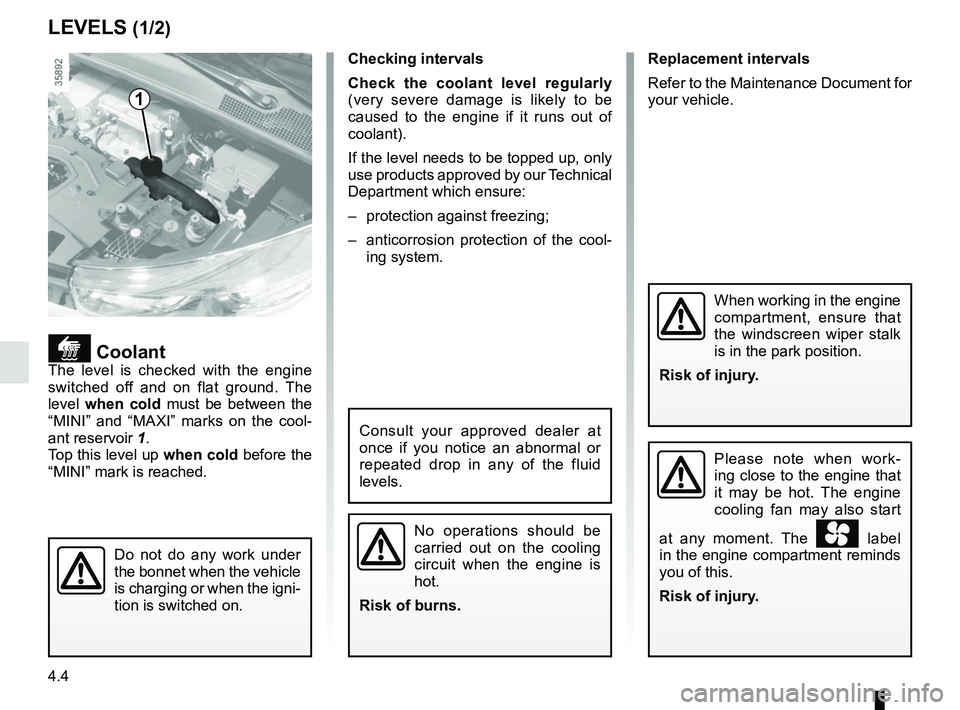
CoolantThe level is checked with the engine
switched off and on flat ground. The
level when cold must be between the
“MINI” and “MAXI” marks on the cool-
ant reservoir 1.
Top this level up when cold before the
“MINI” mark is reached. Checking intervals
Check the coolant level regularly
(very severe damage is likely to be
caused to the engine if it runs out of
coolant).
If the level needs to be topped up, only
use products approved by our Technical
Department which ensure:
– protection against freezing;
– anticorrosion protection of the cool-
ing system.
No operations should be
carried out on the cooling
circuit when the engine is
hot.
Risk of burns.
Consult your approved dealer at
once if you notice an abnormal or
repeated drop in any of the fluid
levels.
Do not do any work under
the bonnet when the vehicle
is charging or when the igni-
tion is switched on.
1
When working in the engine
compartment, ensure that
the windscreen wiper stalk
is in the park position.
Risk of injury.
Please note when work-
ing close to the engine that
it may be hot. The engine
cooling fan may also start
at any moment. The
label
in the engine compartment reminds
you of this.
Risk of injury.
Page 166 of 226
4.6
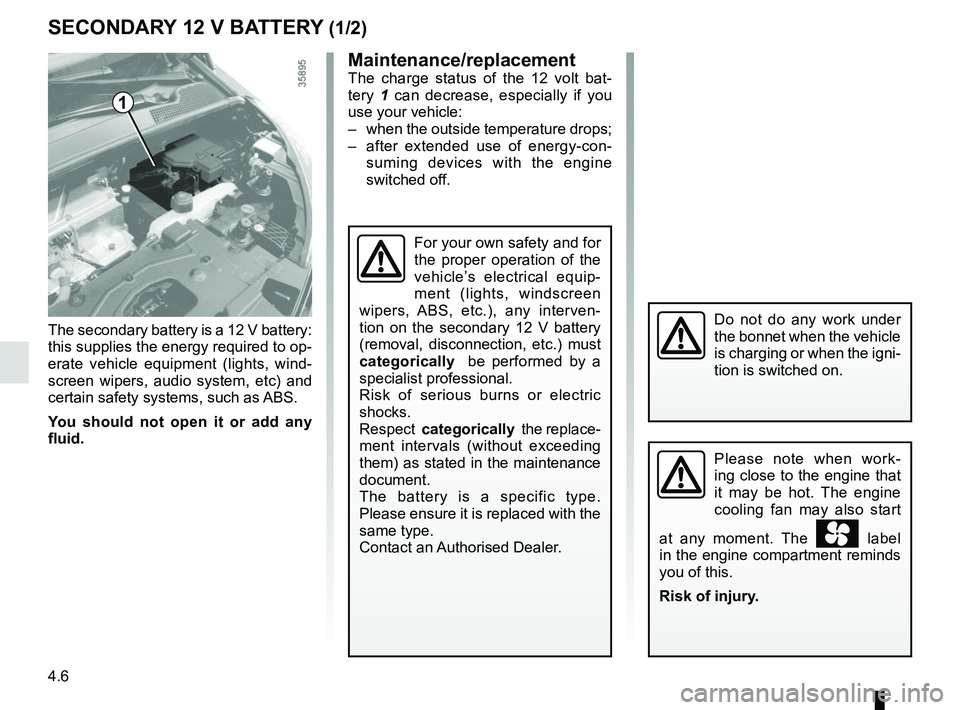
The secondary battery is a 12 V battery:
this supplies the energy required to op-
erate vehicle equipment (lights, wind-
screen wipers, audio system, etc) and
certain safety systems, such as ABS.
You should not open it or add any
fluid.
SECONDARY 12 V BATTERY (1/2)
1
Do not do any work under
the bonnet when the vehicle
is charging or when the igni-
tion is switched on.
For your own safety and for
the proper operation of the
vehicle’s electrical equip-
ment (lights, windscreen
wipers, ABS, etc.), any interven-
tion on the secondary 12 V battery
(removal, disconnection, etc.) must
categorically be performed by a
specialist professional.
Risk of serious burns or electric
shocks.
Respect categorically the replace-
ment intervals (without exceeding
them) as stated in the maintenance
document.
The battery is a specific type.
Please ensure it is replaced with the
same type.
Contact an Authorised Dealer.
Maintenance/replacementThe charge status of the 12 volt bat-
tery 1 can decrease, especially if you
use your vehicle:
– when the outside temperature drops;
– after extended use of energy-con- suming devices with the engine
switched off.
Please note when work-
ing close to the engine that
it may be hot. The engine
cooling fan may also start
at any moment. The
label
in the engine compartment reminds
you of this.
Risk of injury.
Page 171 of 226
4.11
Using a roller type car wash
Return the windscreen wiper stalk to
the Park position (refer to the informa-
tion on the “Windscreen washer, wiper”
in Section 1). Check the mounting of
external accessories, additional lights
and mirrors, and ensure that the wiper
blades are secured with adhesive tape.
Remove the radio aerial mast if your
vehicle is fitted with this equipment.
Remember to remove the tape and refit
the antenna after washing.
BODYWORK MAINTENANCE (3/3)Cleaning the headlights
As the headlights are made of plastic
“glass”, use a soft cloth or cotton wool
to clean them. If this does not clean
them properly, moisten the cloth with
soapy water, then wipe clean with a soft
damp cloth or cotton wool.
Finally, carefully dry off with a soft dry
cloth.
Do not use cleaning products con-
taining alcohol or utensils (e.g.: a
scraper).
Washing the vehicle
Never wash the engine
compartment, the charging
connection or the traction
battery with a high-pressure jet.
This risks damaging the electric cir-
cuit.
Never wash the vehicle while it is
charging.
Risk of electric shock and a risk to
life.
Vehicles with a matte paint
finish
This type of paint requires certain pre-
cautions.
Do not do the following
Use wax-based products (polishing).
Rub too hard.
Wash the vehicle in a roller-type car
wash.
Wash the vehicle using a high-pressure
device.
Attach stickers to the paintwork (risk of
leaving marks).
Wash the vehicle
using a high-pressure
cleaning device.
You should do the following
Wash the vehicle by hand using plenty
of water, using a soft cloth or a gentle
sponge.
Page 183 of 226
5.9
FRONT HEADLIGHTS: changing bulbs
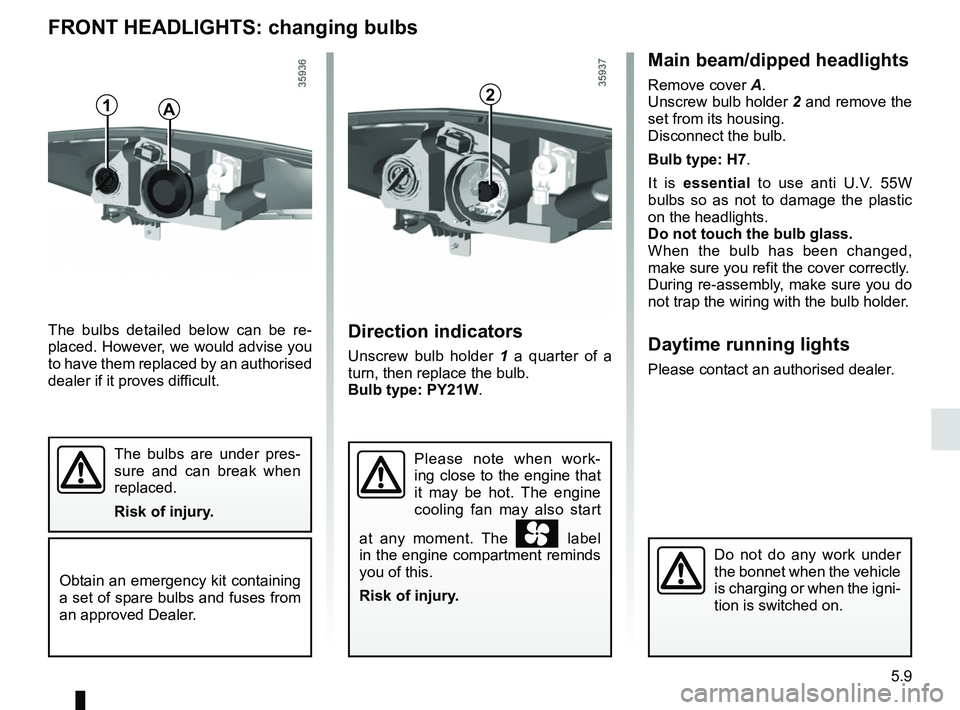
Direction indicators
Unscrew bulb holder 1 a quarter of a
turn, then replace the bulb.
Bulb type: PY21W.
The bulbs detailed below can be re-
placed. However, we would advise you
to have them replaced by an authorised
dealer if it proves difficult.
1A
Obtain an emergency kit containing
a set of spare bulbs and fuses from
an approved Dealer.
Main beam/dipped headlights
Remove cover A.
Unscrew bulb holder 2 and remove the
set from its housing.
Disconnect the bulb.
Bulb type: H7.
It is essential to use anti U.V. 55W
bulbs so as not to damage the plastic
on the headlights.
Do not touch the bulb glass.
When the bulb has been changed,
make sure you refit the cover correctly.
During re-assembly, make sure you do
not trap the wiring with the bulb holder.
Daytime running lights
Please contact an authorised dealer.
The bulbs are under pres-
sure and can break when
replaced.
Risk of injury.
2
Do not do any work under
the bonnet when the vehicle
is charging or when the igni-
tion is switched on.
Please note when work-
ing close to the engine that
it may be hot. The engine
cooling fan may also start
at any moment. The
label
in the engine compartment reminds
you of this.
Risk of injury.
Page 196 of 226

The following advice will enable you to carry out quick, temporary repai\
rs. For safety reasons you should always contact
an approved dealer as soon as possible.
FAULTSPO")
5.22
OPERATING FAULTS (1/4)
The following advice will enable you to carry out quick, temporary repai\
rs. For safety reasons you should always contact
an approved dealer as soon as possible.
FAULTSPOSSIBLE CAUSESWHAT TO DO
Impossible to charge the traction bat-
tery.
The charging flap warning light flashes
red. The outdoor temperature is lower
than -26°C.
Recharge your vehicle in a more suitable
environment. If necessary, please refer to
the information on “Towing: breakdown re-
covery” in Section 5.
No electrical current in the wall
socket or poor connection of cable
to domestic socket. Check your installation (circuit breaker, pro-
grammer, etc.).
Check the connections (socket, etc.).
Please refer to the information on “Electric
vehicle: charging” in Section 1.
The cord is defective. Please see an authorised dealer to replace
it.
Impossible to charge the traction bat-
tery.
The charging flap warning light flashes
blue. The charging cord is not correctly
locked to the vehicle. Plug the charging cord correctly to the ve-
hicle. Refer to the information on “Electric
vehicle: charging” in Section 1.
The activation of the air conditioning
using the card RENAULT fails to work. The card RENAULT is outside its
area of action.Step closer to the vehicle.
One of the usage conditions is not
complied with. Please refer to the information on “Air-
conditioning: remote control activation” in
Section 3.
Page 219 of 226

A
ABS ....................................................................\
...2.16 → 2.20
accessories...................................................................")
7.1
ALPHABETICAL INDEX (1/5)
A
ABS ....................................................................\
...2.16 → 2.20
accessories........................................................................\
5.17
accessories socket ............................................................ 3.26
additional methods of restraint .....................1.37 → 1.40, 1.43
side protection ............................................................. 1.42
to the front seat belts .......................................1.37 → 1.40
to the rear seat belts ........................................1.37 → 1.41
adjusting your driving position ........................................... 1.33
air bag....................................................................1.37 → 1.43
activating the front passenger air bags ........................ 1.57
deactivating the front passenger air bags .................... 1.55
air conditioning ................ 1.20 – 1.21, 3.4 → 3.11, 3.18 – 3.19
air vents ...................................................................... 3.2 – 3.3
anti-corrosion check ..............................................6.13 → 6.17
anti-corrosion protection ...................................................... 4.9
anti-lock braking system: ABS ...............................2.16 → 2.20
armrest: front ..................................................................\
............ 3.24
ashtray ................................................................\
............... 3.26
audible and visual signals.................................................. 1.79
B
battery........................................................................\
........ 1.63
12 volt battery maintenance ......................................................... 4.6 – 4.7
12 volt battery ............................................1.2 → 1.6, 4.6 – 4.7
bonnet........................................................................\
. 4.2 – 4.3
brake fluid ........................................................................\
.... 4.5
bulbs changing ........................................................... 5.10 – 5.11
C
central door locking ......................................1.26, 1.29 → 1.31
changing a bulb ...................................................... 5.10 – 5.11
changing gear ............................................................. 2.5 – 2.6 charge meter .............................................................. 1.66, 2.7
charging cord .......................................1.8
→ 1.15, 1.20 – 1.21
charging flap ............................................................1.8 → 1.15
charging socket ..................................... 1.2 → 1.6, 1.8 → 1.15
child restraint/seat .............................1.44 – 1.45, 1.47 → 1.57
child safety..1.18 – 1.19, 1.24, 1.28, 1.44 – 1.45, 1.47 → 1.57,
3.20 – 3.21
child seats..........................................1.44 – 1.45, 1.47 → 1.54
children ........................... 1.18 – 1.19, 1.27 – 1.28, 1.44 – 1.45
children (safety) ............................................. 1.24, 3.20 – 3.21
cleaning: inside the vehicle .............................................. 4.12 – 4.13
clock ....................................................................... 1.75 – 1.76
closing the doors ...................................................1.27 → 1.30
connected services .............................................................. 1.3
control instruments ................................................1.62 → 1.68
controls ...............................................................\
...1.58 → 1.61
coolant ................................................................\
................. 4.4
courtesy light ............................................................ 3.22, 5.12
courtesy mirrors ................................................................. 3.22
cruise control ................................................1.63, 2.21 → 2.27
cruise control-speed limiter....................................2.21 → 2.27
D
dashboard..............................................................1.58 → 1.61
daytime running lights................................................. 1.81, 5.9
deadlocking the doors ....................................................... 1.26
display .................................................1.58 → 1.66, 2.29, 3.33
doors.............................................................. 1.27 – 1.28, 1.31
doors/tailgate ................................................. 1.26 – 1.28, 1.31
driver’s position .....................................................1.58 → 1.64
driving .............................. 2.2 → 2.6, 2.10 – 2.11, 2.13 → 2.29
driving position settings ............................................................1.33 → 1.36
driving recommendations ........................................ 2.7 → 2.11