steering wheel SAAB 9-3 2000 User Guide
[x] Cancel search | Manufacturer: SAAB, Model Year: 2000, Model line: 9-3, Model: SAAB 9-3 2000Pages: 236, PDF Size: 10.85 MB
Page 111 of 236
111 Interior equipment, trunk
Interior equipment,
trunkSeats ................................. 112
Steering-wheel adjust-
ment ................................ 118
Electrical windows ........... 119
Sunroof (option) ............... 120
Interior lighting................. 121
Cup holder ........................ 122
Ashtrays (accessory)....... 123
Glove compartment ......... 123
Rear-view mirrors ............ 124
Trunk, Coupé and 5-door 125
Tools and spare wheel .... 130
Manually opening the fuel
filler door ........................ 131
IB941
ProCarManuals.com
Page 112 of 236
112 Interior equipment, trunkSeatsThe following seat adjustments can be
made to achieve a comfortable driving
position:
• Height (driver´s seat).
Legroom.
Backrest rake angle.
Lumbar support.
Head-restraint height.
We recommend that adjustments to the
driver’s seat be performed in the following
order:
1 Height.
2 Legroom.
3 Backrest rake angle.
Lastly, adjust the steering wheel (see
page 118). Side airbags (SRS)See page 27.
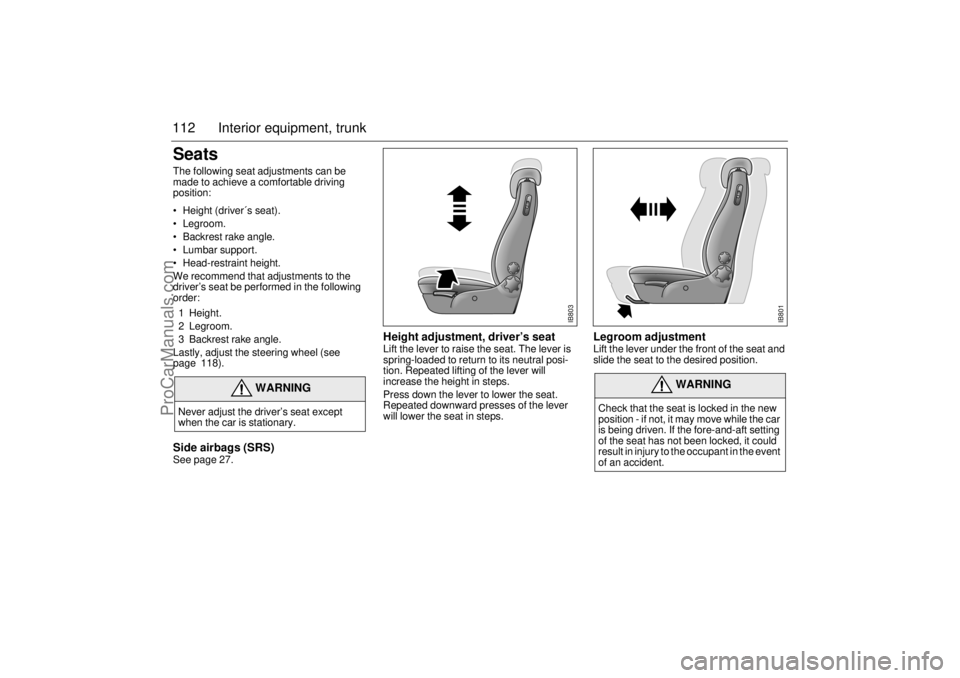
Height adjustment, driver’s seat Lift the lever to raise the seat. The lever is
spring-loaded to return to its neutral posi-
tion. Repeated lifting of the lever will
increase the height in steps.
Press down the lever to lower the seat.
Repeated downward presses of the lever
will lower the seat in steps.
Legroom adjustment Lift the lever under the front of the seat and
slide the seat to the desired position.
WARNING
Never adjust the driver’s seat except
when the car is stationary.
WARNING
Check that the seat is locked in the new
position - if not, it may move while the car
is being driven. If the fore-and-aft setting
of the seat has not been locked, it could
result in injury to the occupant in the event
of an accident.
IB803
IB801
ProCarManuals.com
Page 118 of 236
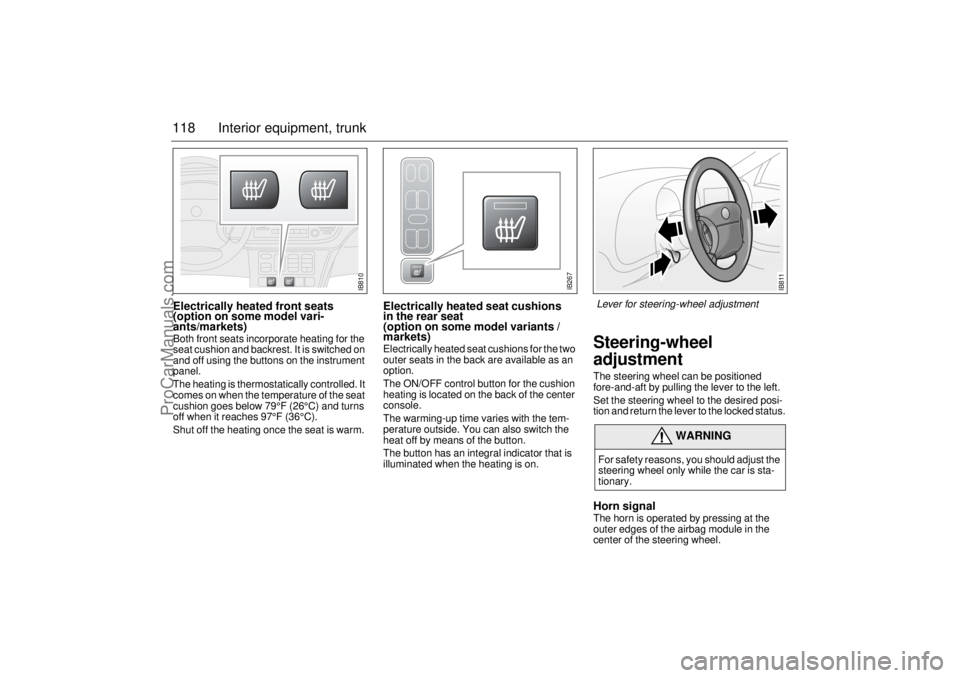
118 Interior equipment, trunkElectrically heated front seats
(option on some model vari-
ants/markets)Both front seats incorporate heating for the
seat cushion and backrest. It is switched on
and off using the buttons on the instrument
panel.
The heating is thermostatically controlled. It
comes on when the temperature of the seat
cushion goes below 79°F (26°C) and turns
off when it reaches 97°F (36°C).
Shut off the heating once the seat is warm.
Electrically heated seat cushions
in the rear seat
(option on some model variants /
markets) Electrically heated seat cushions for the two
outer seats in the back are available as an
option.
The ON/OFF control button for the cushion
heating is located on the back of the center
console.
The warming-up time varies with the tem-
perature outside. You can also switch the
heat off by means of the button.
The button has an integral indicator that is
illuminated when the heating is on.
Steering-wheel
adjustmentThe steering wheel can be positioned
fore-and-aft by pulling the lever to the left.
Set the steering wheel to the desired posi-
tion and return the lever to the locked status. Horn signalThe horn is operated by pressing at the
outer edges of the airbag module in the
center of the steering wheel.
WARNING
For safety reasons, you should adjust the
steering wheel only while the car is sta-
tionary.
IB810
IB267
IB811
Lever for steering-wheel adjustment
ProCarManuals.com
Page 150 of 236
150 Starting and drivingABS brakesABS (Antilock Braking System) modulates
the brake pressure to the respective
wheels. Wheel sensors detect if a wheel is
about to lock, and the control module
reduces the pressure to that wheel and then
increases it once more until the tendency is
detected again.
The brake system is equipped with an Elec-
tronic Brake-force Distribution device
(EBD), which distributes the brake pressure
between the front and rear wheels in such a
way as to achieve optimum braking perfor-
mance regardless of the car’s speed and
load.
The ABS system has a built-in diagnostic
function which will switch on the ABS warn-
ing light if a fault is detected in the system
(see page 56). The ABS system will not reduce the braking
distance on loose gravel or on snow or ice
but, because the wheels cannot lock up,
some steering control is retained.
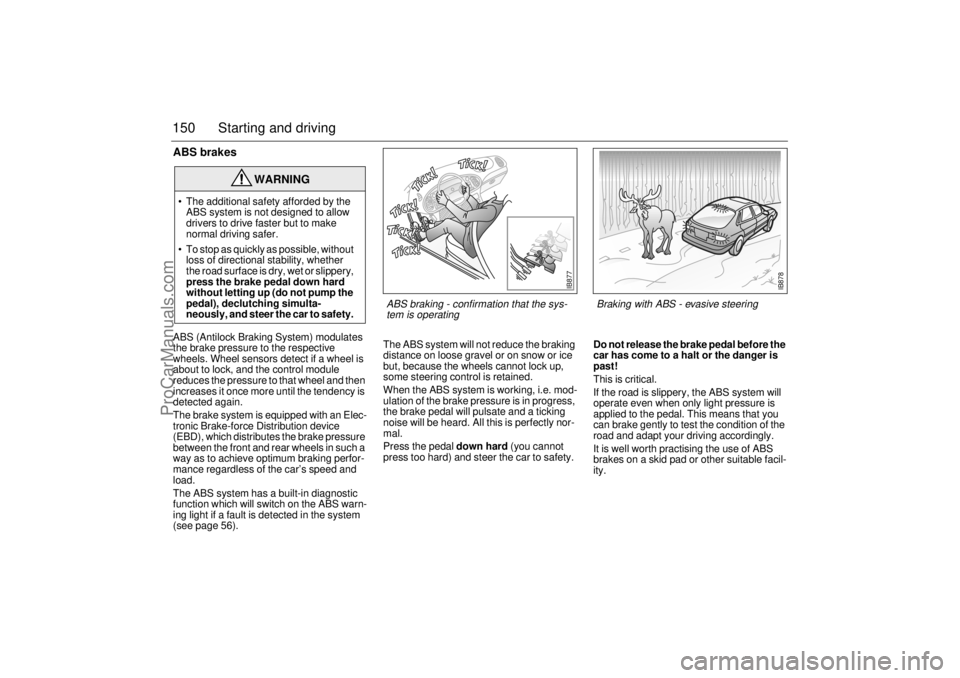
When the ABS system is working, i.e. mod-
ulation of the brake pressure is in progress,
the brake pedal will pulsate and a ticking
noise will be heard. All this is perfectly nor-
mal.
Press the pedal down hard (you cannot
press too hard) and steer the car to safety. Do not release the brake pedal before the
car has come to a halt or the danger is
past!
This is critical.
If the road is slippery, the ABS system will
operate even when only light pressure is
applied to the pedal. This means that you
can brake gently to test the condition of the
road and adapt your driving accordingly.
It is well worth practising the use of ABS
brakes on a skid pad or other suitable facil-
ity.
WARNING
The additional safety afforded by the
ABS system is not designed to allow
drivers to drive faster but to make
normal driving safer.
To stop as quickly as possible, without
loss of directional stability, whether
the road surface is dry, wet or slippery,
press the brake pedal down hard
without letting up (do not pump the
pedal), declutching simulta-
neously, and steer the car to safety.
IB877
ABS braking - confirmation that the sys-
tem is operating
IB878
Braking with ABS - evasive steering
ProCarManuals.com
Page 167 of 236
167 Car care
IB944
Hood release handle ....... 168
Engine .............................. 168
Engine bay ....................... 169
Engine oil ......................... 172
Transmission fluid .......... 173
Coolant ............................. 174
Brake- clutch fluid and
brake pads ..................... 176
Power steering ................ 177
Battery .............................. 177
Drive belt .......................... 179
Wipers and washers ....... 179
Wiper blades .................... 179
Changing bulbs ............... 181
Fuses ................................ 187
Wheels.............................. 192
Safety belts ...................... 199 Upholstery and trim ......... 200
Textile carpeting .............. 200
Engine bay ........................ 201
Washing ............................ 201
Waxing and polishing ...... 202
Touching up the paint ..... 202
Anti-corrosion treatment . 203
Recovery and/or recycling
of automotive materials. 205
Air conditioning (A/C
system) ........................... 207 Car care
ProCarManuals.com
Page 177 of 236
177 Car care
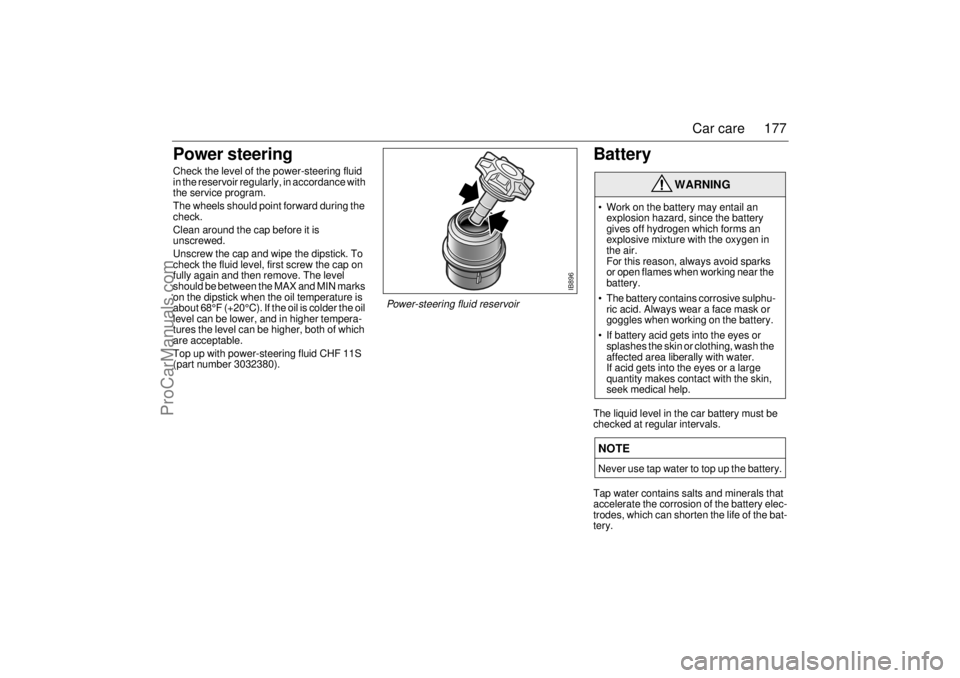
Power steeringCheck the level of the power-steering fluid
in the reservoir regularly, in accordance with
the service program.
The wheels should point forward during the
check.
Clean around the cap before it is
unscrewed.
Unscrew the cap and wipe the dipstick. To
check the fluid level, first screw the cap on
fully again and then remove. The level
should be between the MAX and MIN marks
on the dipstick when the oil temperature is
about 68°F (+20°C). If the oil is colder the oil
level can be lower, and in higher tempera-
tures the level can be higher, both of which
are acceptable.
Top up with power-steering fluid CHF 11S
(part number 3032380).
BatteryThe liquid level in the car battery must be
checked at regular intervals.
Tap water contains salts and minerals that
accelerate the corrosion of the battery elec-
trodes, which can shorten the life of the bat-
tery.
WARNING
Work on the battery may entail an
explosion hazard, since the battery
gives off hydrogen which forms an
explosive mixture with the oxygen in
the air.
For this reason, always avoid sparks
or open flames when working near the
battery.
The battery contains corrosive sulphu-
ric acid. Always wear a face mask or
goggles when working on the battery.
If battery acid gets into the eyes or
splashes the skin or clothing, wash the
affected area liberally with water.
If acid gets into the eyes or a large
quantity makes contact with the skin,
seek medical help. NOTENever use tap water to top up the battery.
IB896
Power-steering fluid reservoir
ProCarManuals.com
Page 190 of 236

190 Car care
Relay holderUnder the instrument panel next to the steering wheel No. Amp Function
21 10 Manual A/C; soft top (Convertible)
22 15 Cruise Control; direction indicators
23 20 Soft top (Convertible); telephone
24 7.5 Radio
25 30 Central locking
26 30 Control module, engine management system; igni-
tion cassette
27 15 High beam flash; ACC
28 10 Engine management system
29 10 Right parking light; number-plate lighting
30 10 Left parking light
31 20 Reversing light; windshield wipers; headlight
beam-length adjustment
32 15 Fuel pump
33 15 Electric heating of rear seat
34 10 SID; control module; automatic transmission
35 15 DICE/TWICE; main instrument panel; interior light-
ing
36 10 Relay, starter
37 – –
38 25 Oxygen sensor (lambda probe)
39 – –Item Function
A Electric heating of rear seat
B Reversing light, cars with automatic transmission
C1 –
C2 Lock motor, trunk lid
D1 Rear wiper
D2 Rear-window washing
E Ignition switch
F–
G Windshield wipers (intermittent)
H Rear-window heating
IFuel pump
J–
KStart relay
L Main relay (injection system)
ProCarManuals.com
Page 192 of 236

192 Car careWheelsAlternative wheels and tiresIf you wish to fit other tires or wheels than
those supplied with the car, consult your
Saab dealer first as to the possibilities avail-
able.
Wheels/tires combinations that are not
approved by Saab can negatively affect the
car´s directional stability, steering and brak-
ing in both wet and dry conditions.
Do not assume that a wheel/tire combina-
tion will function properly just because it will
bolt on.
The wheels and tires have been carefully
matched to the characteristics of the car and
play a key role in its outstanding roadhold-
ing and handling.
Tire pressureTires need to be inflated to suit the load car-
ried and the maximum speed the car will be
driven (see the recommended tire pres-
sures on the back cover). Note that all
values apply to cold tires. For tires with an
aspect ratio less than /60, increase the tire
pressure by 3 psi (20 kPa) for rough roads
with potholes to minimize the risk of rim
damage.
Never reduce the pressure of a hot tire. If the
tires are hot when you check them, only
increase the pressure, if necessary.
Soft tires will cause faster wear than
over-pressurized tires. They also increase
fuel consumption.
If a valve is leaking, simply unscrew it and fit
a new one.
Important! Remember to adjust the tire
pressures if you change the load in the car
or intend to cruise at a substantially higher
or lower speed than normal.
NOTEFor wide wheels and/or low-profile tires,
bear in mind the following:
Tires and wheels can be damaged in
potholes etc.
Springs and shock absorbers can be
overloaded.
The wheels can come into contact with
chassis and body components.
The speed and load limits for the tires
must not be exceeded; see page 193.
Wheels larger than 16” must not be
fitted on the Saab 9-3. For Viggen
models the wheel should not be larger
than 17”. The maximum permissible
offset for the 9-3 is 49 mm and for the
Viggen 42 mm.
When fitting wheels on a 9-3, please
note that a 15” wheel should be used
on 9-3 Coupé and 5-door models, and
nothing smaller than 16” wheel should
be used for Viggen models. Fitting a
smaller size wheel on a Viggen is not
possible due to the size of the brake
discs.
NOTECheck the tire pressures at least once
per month.
Underinflation is the main cause of:
Tires wearing out prematurely.
Damage to the sidewalls.
Damage to the wheels.
ProCarManuals.com
Page 199 of 236
199 Car care
Flat spottingAll tires get hot, especially on long journeys
or when the car is driven hard. After the car
has been parked with hot tires and the tires
have cooled down, a flat spot can form in the
tire, where it is in contact with the ground.
The same can occur if the car has not been
moved for a long time.
Flat spots can cause vibration that can be
felt through the steering wheel, similar to
that experienced when the wheels need bal-
ancing. Flat spots of this type disappear
once the tires get hot again, usually after
10–15 miles (20–25 km) of driving at cruis-
ing speed.
Safety beltsA check should be made periodically to
ensure that the safety belts are working
properly.
Hold the diagonal strap and pull it sharply.
The seat belt should lock and it should not
be possible to withdraw it further.
A sharp tug on the belt should cause the
inertia reel to lock. Check the floor anchor-
age points for corrosion damage. If a belt is
worn or has any fraying edges, it should be
replaced.
Safety belts must not come into contact with
substances such as polishes, oil or chemi-
cals. If the belts get dirty, wash them with
warm water and a detergent or have them
replaced.
WARNING
Safety belts and belt pretensioners that
were in use in a serious collision must be
replaced even if they are not visibly
damaged.
No attempt must be made to repair, or
modify the function of, safety belts.
IB923
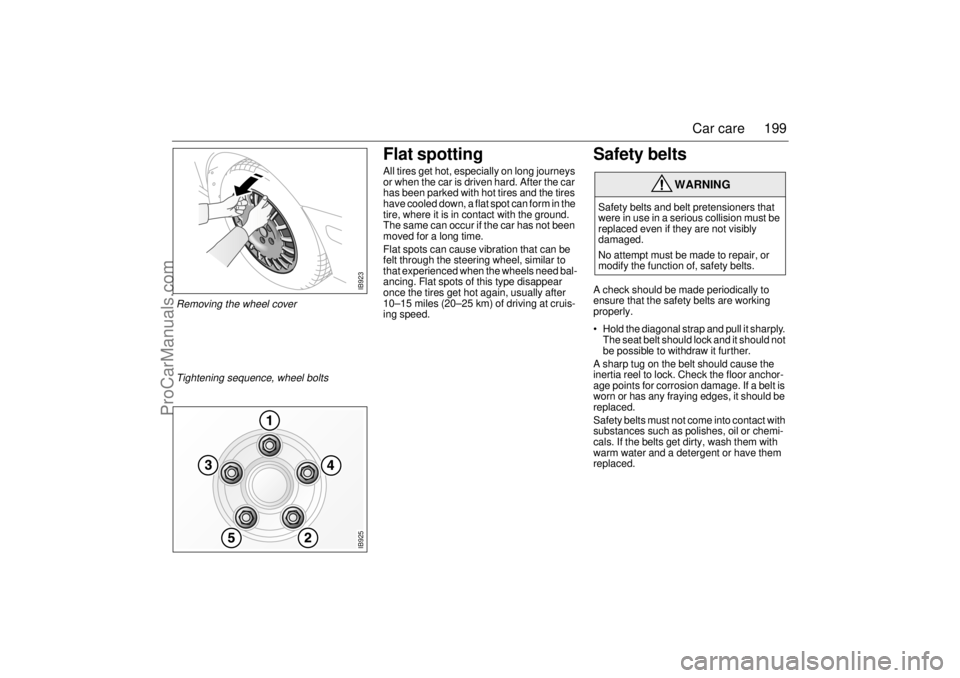
Removing the wheel cover
IB925
Tightening sequence, wheel bolts
ProCarManuals.com
Page 217 of 236

217 Maintenance and owner assistance
(c.) Check wheel alignment if irregular or premature tire wear is apparent.
(d.) Check and clean rear pads and rear calipers in areas with heavy road salt use.
Service Intervals **
Miles = U.S. Cars
Kilometers = Canadian Cars
1,000
(1,600 km)
10,000
(16,000 km)
20,000
(32,000 km)
30,000
(48,000 km)
40,000
(64,000 km)
50,000
(80,000 km)
60,000
(96,000 km)
70,000
(112,000 km)
80,000
(128,000 km)
90,000
(144,000 km)
100,000
(160,000 km)
Service #
1234567891011
Chassis
R Ball joint clearance, outer and inner steering joints and
rubber boots""""""""""
R Front suspension, rear axle mountings; retighten"
R Shock absorbers and bushes; tightness and condition"""
R Tire pressure, tread depth and wear (c.)"""""""""""
R Rotate tires, front to rear""""""""""
R Brake pads and discs; wear and condition (d.)""""""""""
R Brake lines and hoses"""""""""""
R Brake fluid level & renewal (max. 2-year intervals)""" ! "" ! "" ! "
R Check parking brake function"""""""""""
R Power steering fluid level"""""""""""
ProCarManuals.com