audio SAAB 9-3 2000 Owner's Manual
[x] Cancel search | Manufacturer: SAAB, Model Year: 2000, Model line: 9-3, Model: SAAB 9-3 2000Pages: 236, PDF Size: 10.85 MB
Page 105 of 236
105 Saab 9-3 Audio System
Steering-wheel
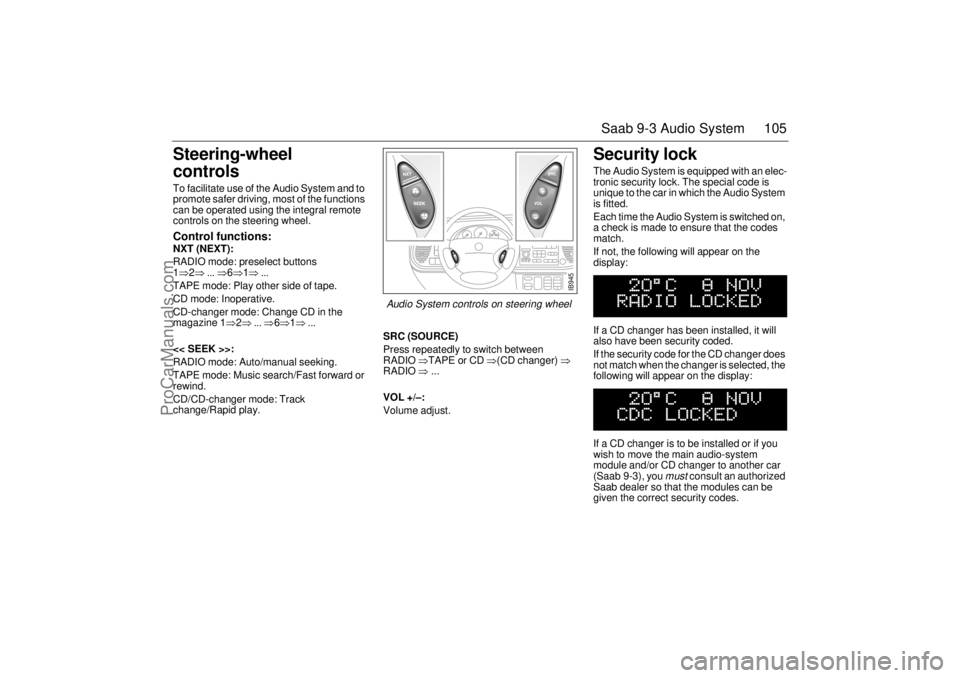
controls To facilitate use of the Audio System and to
promote safer driving, most of the functions
can be operated using the integral remote
controls on the steering wheel. Control functions: NXT (NEXT):
RADIO mode: preselect buttons
1⇒2⇒ ... ⇒6⇒1⇒ ...
TAPE mode: Play other side of tape.
CD mode: Inoperative.
CD-changer mode: Change CD in the
magazine 1⇒2⇒ ... ⇒6⇒1⇒ ...
<< SEEK >>:
RADIO mode: Auto/manual seeking.
TAPE mode: Music search/Fast forward or
rewind.
CD/CD-changer mode: Track
change/Rapid play.SRC (SOURCE)
Press repeatedly to switch between
RADIO ⇒TAPE or CD ⇒(CD changer) ⇒
RADIO ⇒ ...
VOL +/–:
Volume adjust.
Security lock The Audio System is equipped with an elec-
tronic security lock. The special code is
unique to the car in which the Audio System
is fitted.
Each time the Audio System is switched on,
a check is made to ensure that the codes
match.
If not, the following will appear on the
display:
If a CD changer has been installed, it will
also have been security coded.
If the security code for the CD changer does
not match when the changer is selected, the
following will appear on the display:
If a CD changer is to be installed or if you
wish to move the main audio-system
module and/or CD changer to another car
(Saab 9-3), you
must
consult an authorized
Saab dealer so that the modules can be
given the correct security codes.
IB945
Audio System controls on steering wheel
ProCarManuals.com
Page 106 of 236

106 Saab 9-3 Audio SystemTechnical data
These specifications comply with the new IHF Standard
Since the policy at Saab is one of continual improvement, we retain the right to alter
specifications and design without prior notice.
Dolby noise reduction is produced under licence from Dolby Laboratories Licensing
Corporation
”Dolby” and the double-D symbol are trademarks of Dolby Laboratories Licens-
ing Corporation
Changes or modifications not expressly approved by the manufacturer for compliance
could void the user´s authority to operate the equipment.
Tone controls
Bass _________________________ ±12 dB at 40 Hz
Treble ________________________ ±10 dB at 15,000 Hz
Power output __________________4 x 20 W (4 x 12 W at 1%
THD (total harmonic dis-
tortion) and 13.5 V)
Radio module
Radio system __________________ PLL dual-synthesizer
tuner
Number of presets
FM __________________________ 3 x 6
AM __________________________ 2 x 6
Frequency range
FM __________________________ 87.9 MHz – 107.9 MHz
AM __________________________ 530 kHz – 1710 kHz
WB ___________________________ 162.40 – 162.55 MHz
Scanning steps
Automatic seek tuning: ___________ VHF (FM) 200 kHz
AM 10 kHz
WB 50 kHz
Manual seek tuning: _____________ VHF (FM) 200 kHz
AM 10 kHz Cassette player
Fast forward/rewind ______________ < 110 s (C-60)
Frequency range ________________ 50 Hz - 12500 Hz ±3 dB
WOW _________________________ 0.1% WRMS
Signal-to-noise ratio______________ 45 dB
Dolby NR effect _________________ 10 dB
CD player and CD changer
1-bit system and 8 x oversampling
Frequency range ________________ 5-20000 Hz
±0.5 dB
Stereo separation _______________ 45 dB
Distortion _____________________ < 0.008%
Dynamics _____________________ > 95 dB (1 kHz)
CD-changer capacity: 6 discs
Amplifier (cars with extra speakers in
front doors)
Power output ___________________ 2 x 40 W (2 x 30 W at 1%
THD 50 Hz)
Crossover frequency _____________ 110 Hz (-3 dB)
ProCarManuals.com
Page 107 of 236
107 Saab 9-3 Audio System
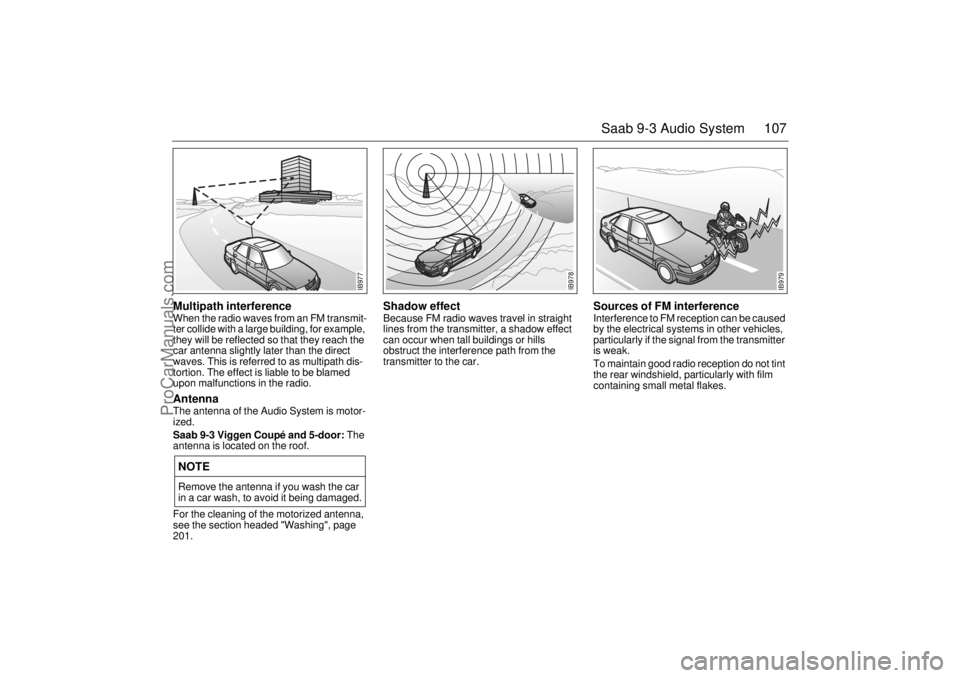
Multipath interference When the radio waves from an FM transmit-
ter collide with a large building, for example,
they will be reflected so that they reach the
car antenna slightly later than the direct
waves. This is referred to as multipath dis-
tortion. The effect is liable to be blamed
upon malfunctions in the radio. Antenna The antenna of the Audio System is motor-
ized.
Saab 9-3 Viggen Coupé and 5-door: The
antenna is located on the roof.
For the cleaning of the motorized antenna,
see the section headed "Washing", page
201.
Shadow effect Because FM radio waves travel in straight
lines from the transmitter, a shadow effect
can occur when tall buildings or hills
obstruct the interference path from the
transmitter to the car.
Sources of FM interference Interference to FM reception can be caused
by the electrical systems in other vehicles,
particularly if the signal from the transmitter
is weak.
To maintain good radio reception do not tint
the rear windshield, particularly with film
containing small metal flakes.
NOTERemove the antenna if you wash the car
in a car wash, to avoid it being damaged.
IB977
IB978
IB979
ProCarManuals.com
Page 108 of 236
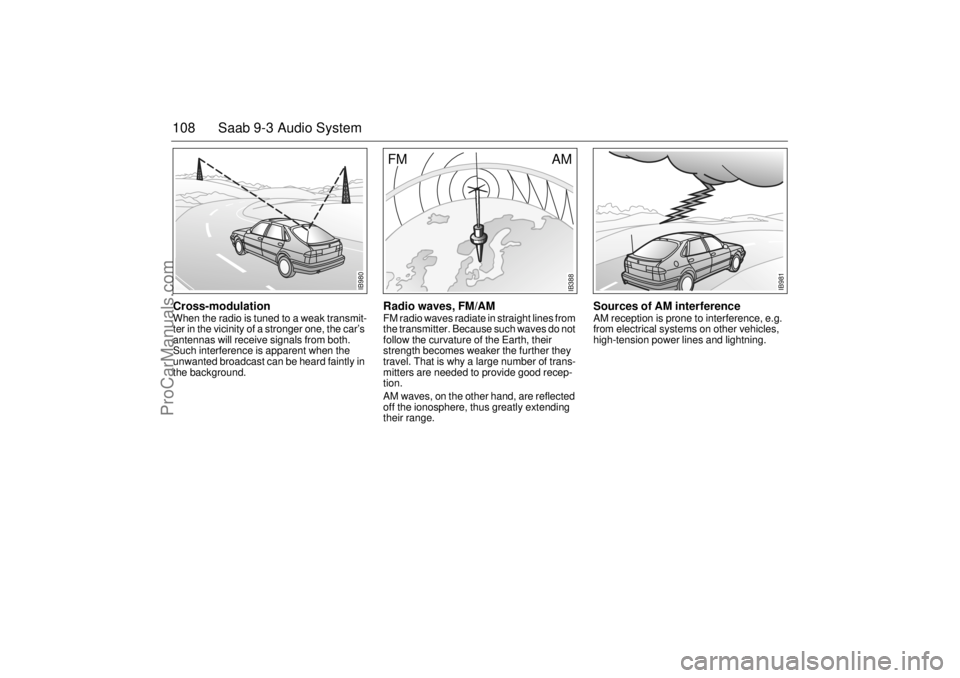
108 Saab 9-3 Audio SystemCross-modulation When the radio is tuned to a weak transmit-
ter in the vicinity of a stronger one, the car’s
antennas will receive signals from both.
Such interference is apparent when the
unwanted broadcast can be heard faintly in
the background.
Radio waves, FM/AM FM radio waves radiate in straight lines from
the transmitter. Because such waves do not
follow the curvature of the Earth, their
strength becomes weaker the further they
travel. That is why a large number of trans-
mitters are needed to provide good recep-
tion.
AM waves, on the other hand, are reflected
off the ionosphere, thus greatly extending
their range.
Sources of AM interference AM reception is prone to interference, e.g.
from electrical systems on other vehicles,
high-tension power lines and lightning.
IB980
IB388
AM
FM
IB981
ProCarManuals.com
Page 109 of 236
109 Saab 9-3 Audio System
Installation of car phone
(option)
Provision has been made on certain vari-
ants of the Saab 9-3 for the installation of a
hands-free car phone.
Installation must be done by an authorized
Saab dealer.
A car-phone cradle is available as an acces-
sory.
Your Saab dealer has details of which
phones are suitable for the installation.
Provision for hands-free phone (Con-
vertible, only if Saab 9-3 Audio System is
fitted)
Car phone connects to car’s circuitry.
Coaxial cable for external antenna is pre-
run.
Microphone for hands-free phone use
incorporated in overhead panel at front
(not Convertible).
Audio System mute functions when
phone activated.
Phone conversation amplified through
Audio System speakers. "TELEPHONE" appears on the SID when
phone is in use.
Volume level for ongoing conversation
can be adjusted by volume controls on
steering wheel or on audio-system mod-
ule. See also ”Volume-preset mode”,
page 104.
If the sound is a bit fuzzy, adjust by means
of the volume control on the
phone set
.
Phone battery is charging when ignition is
ON and phone in its cradle.
Please refer to the instructions supplied with
the phone for details of how to make and
receive calls.
OnStar System (US Only Option)
Your car may be equipped with OnStar, a
vehicle telematics system for communica-
tion and navigation. Please consult the sep-
arate owner’s manual for OnStar provided
in your document organizer.
WARNING
To prevent crashes while using a cell
phone:
Do not use the cell phone in distracting
traffic situations. Turn it off if traffic is
heavy.
Dial sensibly, at a stoplight or safely off
the road.
Consider installing hands-free or
speaker phone.
Avoid stressful and intense phone
conversations.NOTEThe A-pillar area (area beside the wind-
shield) and the headlining of your Saab
contain padding designed to reduce head
injuries. No modifications to these areas
should be made unless done by your
authorized Saab dealer.
ProCarManuals.com
Page 110 of 236
110 Saab 9-3 Audio SystemMobile phones and
communications radios Mobile phones and communications radios
that do not have a separate external
antenna radiate an electromagnetic field
inside the car.
Saab therefore recommends that a car
phone/radio transmitter should always be
connected to an external antenna.
An external antenna also provides
improved transmission/reception and a
greater range.
Mobile phones and communications radios
that are not supplied as standard equipment
by Saab can interfere with the car’s electri-
cal system and cause misleading fault
codes to be generated.
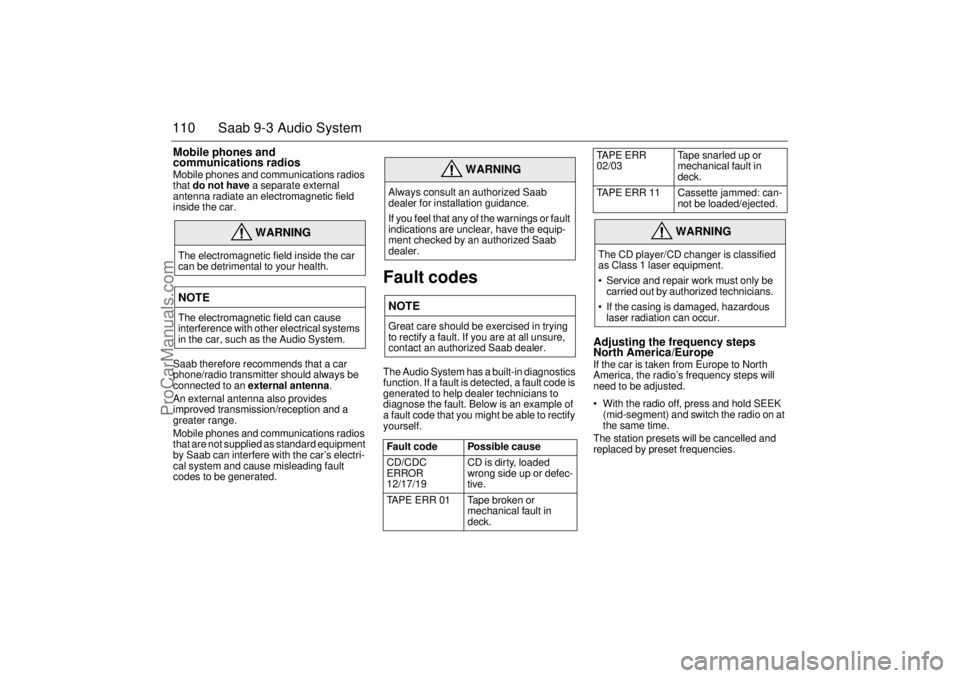
Fault codesThe Audio System has a built-in diagnostics
function. If a fault is detected, a fault code is
generated to help dealer technicians to
diagnose the fault. Below is an example of
a fault code that you might be able to rectify
yourself.
Adjusting the frequency steps
North America/Europe If the car is taken from Europe to North
America, the radio’s frequency steps will
need to be adjusted.
With the radio off, press and hold SEEK
(mid-segment) and switch the radio on at
the same time.
The station presets will be cancelled and
replaced by preset frequencies.
WARNING
The electromagnetic field inside the car
can be detrimental to your health. NOTEThe electromagnetic field can cause
interference with other electrical systems
in the car, such as the Audio System.
WARNING
Always consult an authorized Saab
dealer for installation guidance.
If you feel that any of the warnings or fault
indications are unclear, have the equip-
ment checked by an authorized Saab
dealer. NOTEGreat care should be exercised in trying
to rectify a fault. If you are at all unsure,
contact an authorized Saab dealer.
Fault code Possible cause
CD/CDC
ERROR
12/17/19 CD is dirty, loaded
wrong side up or defec-
tive.
TAPE ERR 01 Tape broken or
mechanical fault in
deck.
TAPE ERR
02/03Tape snarled up or
mechanical fault in
deck.
TAPE ERR 11 Cassette jammed: can-
not be loaded/ejected.
WARNING
The CD player/CD changer is classified
as Class 1 laser equipment.
Service and repair work must only be
carried out by authorized technicians.
If the casing is damaged, hazardous
laser radiation can occur.
ProCarManuals.com
Page 232 of 236

232 Technical dataFollowing adjustments can be done
by the driver:Automatic Climate Control (ACC):
To alter the preprogrammed “AUTO“ start
up mode with your own preferences you can
manually select the desired settings for:
Temperature.
Fan speed.
Air distribution.
See “Programming I” on page 86 and “Pro-
gramming II” on page 87.Saab 9-3 Audio System:
The following functions can be adjusted by
the driver (see page 104):
Maximum starting volume (when the
radio is switched on).
Telephone volume (if the car is equipped
with a phone connected to the audio sys-
tem).
Speed dependent volume (volume
increases or decreases with vehicle
speed).
Loudness.Alarm System:
The glass breakage sensor can be tempo-
rarily disabled, see page 36.
Daytime Running Lights:
To disable, turn off the ignition and pull out
fuse 15, see page 189.
ProCarManuals.com
Page 233 of 236

233 Index
Index
AA/C system, fault diagnosis
_______ 207
A/C system, maintenance
_________ 207
ACC
__________________________ 80
ACC, useful tips
_________________ 88
Adjustment, steering wheel
________ 118
Air conditioning (A/C),
fault diagnosis and maintenance
__ 207
Airbag
_________________________ 22
Alarm _________________________ 35
Alarm functions
__________________ 38
Alarm signals
___________________ 38
Anticorrosion treatment
___________ 203
Anti-theft safety, alarm ____________ 35
Ashtray
_______________________ 123
Audio System
___________________ 90
Automatic climate control (ACC)
_____ 80
Automatic transmission
___________ 141
BBattery
_______________________ 177
Boost starting from donor battery
___ 162
Brake fluid, check
_______________ 176
Brake fluid, grade _______________ 227
Brake pad wear indicators
________ 176
Brakes
________________________ 149Braking
_______________________ 149
Bulb table _____________________ 186
CCD changer
____________________ 101
CD player
______________________ 99
CHECK messages
____________ 63
, 68
CHECKING
__________________ 63
, 68
Cabin lighting
__________________ 121
Calibration, ACC _________________ 86
Car alarm
______________________ 35
Car phone, installation
___________ 109
Cassette player
__________________ 96
Center console compartment
______ 123
Central locking
__________________ 30
Change of address notification
_____ 214
Changing a wheel
_______________ 196
Changing bulbs
_________________ 181
Changing the coolant
____________ 175
Changing the engine oil __________ 173
Changing wiper blades
___________ 179
Chassis number
________________ 229
Child car seats
__________________ 18
Child safety
_____________________ 18
Child safety locks, rear doors
_______ 33
Child seats
_____________________ 18
Cigar lighter ____________________ 123
Cleaning the soft top
______________ 51
Climate-control system, manual
_____ 76
Clock
__________________________ 69Condensation water, A/C
__________ 78
Condensation water, ACC __________ 81
Convertible
_____________________ 42
Coolant
_______________________ 174
Courtesy Headlight Feature
________ 72
Cruise Control
__________________ 148
Cup holder
_____________________ 122
DDICE/TWICE
___________________ 188
Date code, tires _________________ 195
Dim low beam
___________________ 71
Dimmer
________________________ 74
Direction indicators
_______________ 72
Direction-indicator stalk
____________ 72
Dome lighting
__________________ 121
Door mirrors
___________________ 124
Drive belt
______________________ 179
Driving in deep water
_____________ 166
Driving in hot weather ____________ 156
Driving technique
________________ 153
Driving with a compact spare wheel
_ 165
Driving with a roof load
___________ 158
Driving with the trunk lid open
______ 166
EEconomical motoring
_____________ 153
Electrical system, technical data
____ 225
ProCarManuals.com
Page 234 of 236

234 IndexElectrical window
_______________ 119
Electrically adjustable seats
_______ 116
Electrically heated front seats ______ 118
Electrically heated rear seat
_______ 118
Electrically heated rear window _____ 79
Electronic starting interlock
_________ 31
Emergency opening, fuel filler door
_ 131
Emergency operation of the soft top,
Convertible
____________________ 46
Emergency operation of the sunroof
_ 120
Emission control systems
_________ 170
Engine bay, cleaning
____________ 201
Engine bay, gasoline engine
_______ 169
Engine break-in period
_______ 140
, 153
Engine number
_________________ 229
Engine oil, change ______________ 173
Engine oil, checking _____________ 172
Engine oil, grade
________________ 223
Engine oil, volume ______________ 223
Engine variants
_________________ 225
Engine, description ______________ 168
Engine, technical data ___________ 223
FFault codes, Audio System
________ 110
Flat spot
______________________ 199
Folding the soft top
_______________ 43
Fuel filler door, emergency opening
_ 131
Fuel gauge
_____________________ 61
Fuel grade _____________________ 224Fueling
_______________________ 138
Fuse table _____________________ 189
Fuses
________________________ 187
GGearbox number
________________ 229
Gearbox oil, checking and changing
_173
Gearbox oil, grade
______________ 226
General safety instructions,
Convertible
____________________ 42
Glove compartment
______________ 123
HHazard warning lights
_____________ 72
Head restraint
__________________ 114
Headlight flasher _________________ 71
Hood
_________________________ 168
Horn signal
____________________ 118
IIf the car does not start
___________ 135
Ignition switch
__________________ 134
Immobilizer
_____________________ 31
Important considerations concerning
cars with catalytic converters
_____ 137Important considerations for driving,
turbo models
__________________ 136
Instrument lighting
________________ 74
Integrated child car seat
___________ 20
Interior lighting
__________________ 121
Interior lighting, Convertible
_________ 52
Interior rearview mirror
___________ 124
KKey
___________________________ 30
Key, removing
__________________ 134
LLabels and plates
_______________ 229
Leather upholstery, care of
________ 200
Load eyes
_____________________ 129
Locks
__________________________ 30
Lowering rear seat
_______________ 125
Luggage compartment
___________ 125
Luggage compartment, Convertible
__ 50
Luggage-compartment lighting
_____ 129
MMain beam
______________________ 71
Main instrument panel
_____________ 54
Maintenance schedule ___________ 212
ProCarManuals.com