wheel SAAB 9-3 2000 Owner's Manual
[x] Cancel search | Manufacturer: SAAB, Model Year: 2000, Model line: 9-3, Model: SAAB 9-3 2000Pages: 236, PDF Size: 10.85 MB
Page 118 of 236
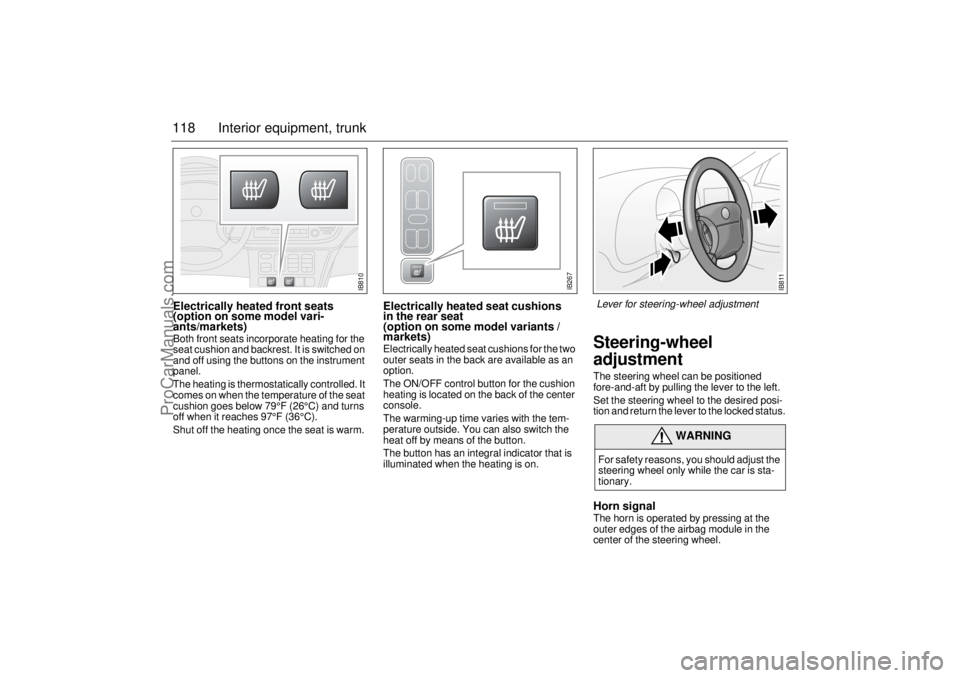
118 Interior equipment, trunkElectrically heated front seats
(option on some model vari-
ants/markets)Both front seats incorporate heating for the
seat cushion and backrest. It is switched on
and off using the buttons on the instrument
panel.
The heating is thermostatically controlled. It
comes on when the temperature of the seat
cushion goes below 79°F (26°C) and turns
off when it reaches 97°F (36°C).
Shut off the heating once the seat is warm.
Electrically heated seat cushions
in the rear seat
(option on some model variants /
markets) Electrically heated seat cushions for the two
outer seats in the back are available as an
option.
The ON/OFF control button for the cushion
heating is located on the back of the center
console.
The warming-up time varies with the tem-
perature outside. You can also switch the
heat off by means of the button.
The button has an integral indicator that is
illuminated when the heating is on.
Steering-wheel
adjustmentThe steering wheel can be positioned
fore-and-aft by pulling the lever to the left.
Set the steering wheel to the desired posi-
tion and return the lever to the locked status. Horn signalThe horn is operated by pressing at the
outer edges of the airbag module in the
center of the steering wheel.
WARNING
For safety reasons, you should adjust the
steering wheel only while the car is sta-
tionary.
IB810
IB267
IB811
Lever for steering-wheel adjustment
ProCarManuals.com
Page 130 of 236
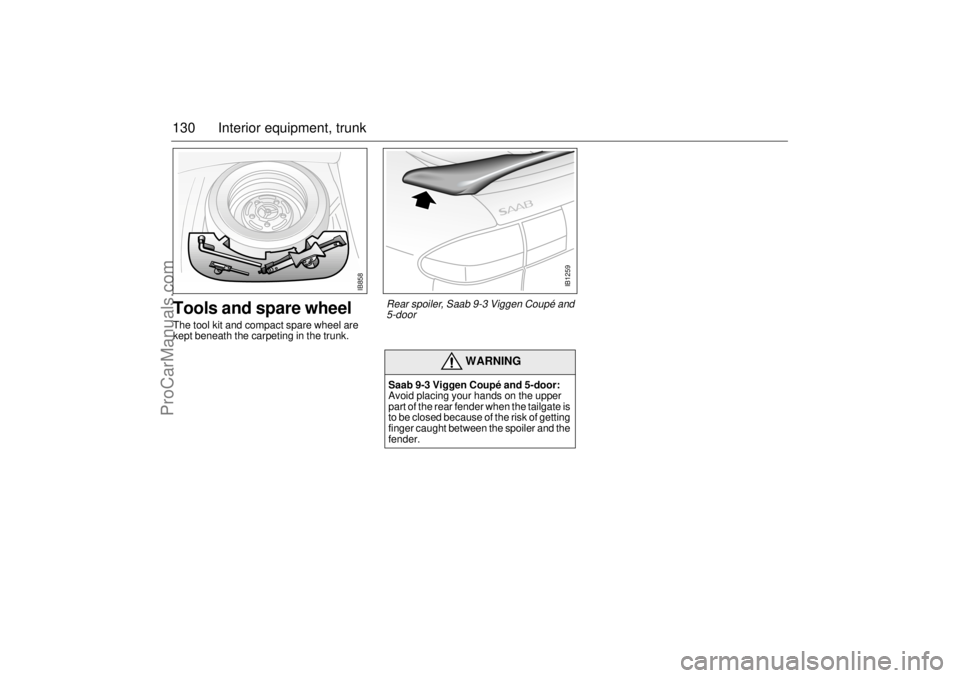
130 Interior equipment, trunkTools and spare wheelThe tool kit and compact spare wheel are
kept beneath the carpeting in the trunk.
WARNING
Saab 9-3 Viggen Coupé and 5-door:
Avoid placing your hands on the upper
part of the rear fender when the tailgate is
to be closed because of the risk of getting
finger caught between the spoiler and the
fender.
IB858
IB1259
Rear spoiler, Saab 9-3 Viggen Coupé and
5-door
ProCarManuals.com
Page 133 of 236
133 Starting and driving
IB943Starting and drivingIgnition switch ................. 134
Starting the engine .......... 135
Important considerations
for driving....................... 136
Engine Break-in Period... 140
Gear changing ................. 141
Manual transmission ...... 141
Automatic transmission . 141
Cruise Control ................. 148
Braking ............................. 149
Parking ............................. 151
Economical motoring ..... 153 Driving in cold weather ... 154
Driving in hot weather ..... 156
Towing a trailer ................ 156
Driving with a roof rack
load .................................. 158
Towing the car.................. 160
Jump starting ................... 162
Driving considerations
with compact spare
wheel/tire fitted............... 165
For long trips .................... 165
Driving with the trunk lid
open ................................ 166
Driving in deep water....... 166
ProCarManuals.com
Page 137 of 236
137 Starting and driving
Saab 9-3 Viggen: The Saab 9-3 Viggen has
a high-performance engine which means
that a certain amount of care should be
exercised, in particular when accelerating in
the lower gears. This is especially important
when the road surface is slippery to avoid
the driving wheels losing their grip
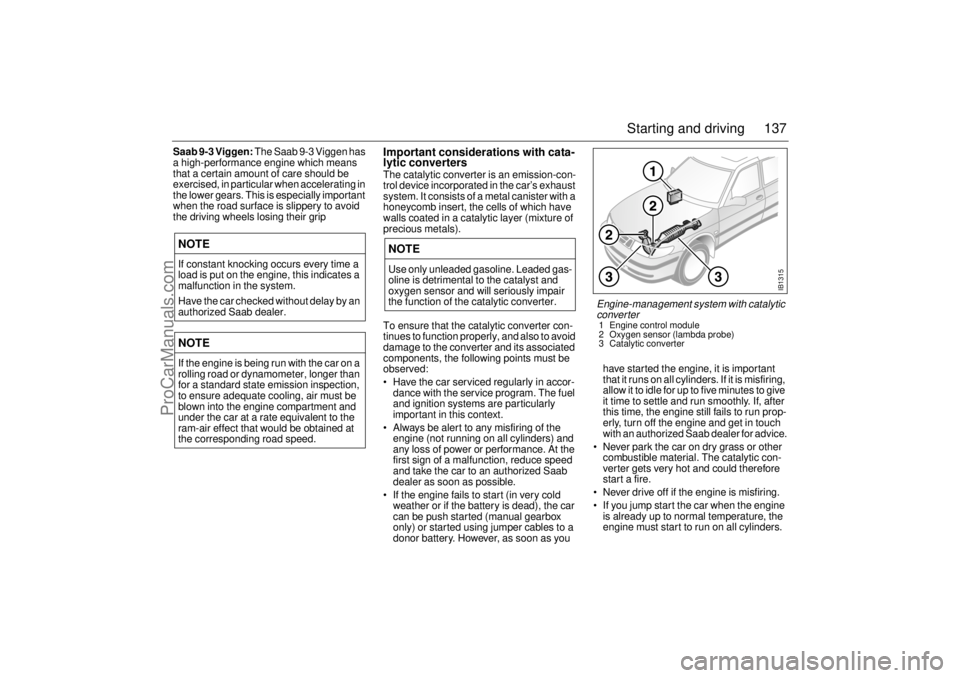
Important considerations with cata-
lytic convertersThe catalytic converter is an emission-con-
trol device incorporated in the car’s exhaust
system. It consists of a metal canister with a
honeycomb insert, the cells of which have
walls coated in a catalytic layer (mixture of
precious metals).
To ensure that the catalytic converter con-
tinues to function properly, and also to avoid
damage to the converter and its associated
components, the following points must be
observed:
Have the car serviced regularly in accor-
dance with the service program. The fuel
and ignition systems are particularly
important in this context.
Always be alert to any misfiring of the
engine (not running on all cylinders) and
any loss of power or performance. At the
first sign of a malfunction, reduce speed
and take the car to an authorized Saab
dealer as soon as possible.
If the engine fails to start (in very cold
weather or if the battery is dead), the car
can be push started (manual gearbox
only) or started using jumper cables to a
donor battery. However, as soon as you have started the engine, it is important
that it runs on all cylinders. If it is misfiring,
allow it to idle for up to five minutes to give
it time to settle and run smoothly. If, after
this time, the engine still fails to run prop-
erly, turn off the engine and get in touch
with an authorized Saab dealer for advice.
Never park the car on dry grass or other
combustible material. The catalytic con-
verter gets very hot and could therefore
start a fire.
Never drive off if the engine is misfiring.
If you jump start the car when the engine
is already up to normal temperature, the
engine must start to run on all cylinders.
NOTEIf constant knocking occurs every time a
load is put on the engine, this indicates a
malfunction in the system.
Have the car checked without delay by an
authorized Saab dealer. NOTEIf the engine is being run with the car on a
rolling road or dynamometer, longer than
for a standard state emission inspection,
to ensure adequate cooling, air must be
blown into the engine compartment and
under the car at a rate equivalent to the
ram-air effect that would be obtained at
the corresponding road speed.
NOTEUse only unleaded gasoline. Leaded gas-
oline is detrimental to the catalyst and
oxygen sensor and will seriously impair
the function of the catalytic converter.
IB1315
Engine-management system with catalytic
converter 1 Engine control module
2 Oxygen sensor (lambda probe)
3 Catalytic converter
ProCarManuals.com
Page 140 of 236

140 Starting and drivingommended blend percentages and service
station operators should know if their gaso-
lines contain detergents and oxygenates,
and have been reformulated to reduce vehi-
cle emissions. Nevertheless, if you begin to
notice a problem with the way your car starts
or runs shortly after it has been refueled, try
a different brand of gasoline.
Engine Break-in PeriodPistons, cylinder bores and bearings need
time to obtain uniform, wear-resistant sur-
faces.
If a new engine is driven too hard, this grad-
ual process of bedding-in will not be possi-
ble and the life of the engine will be short-
ened.
During the first 1,200 miles (2,000 km), do
not exceed 5,000 rpm.
In addition, refrain from driving the car at full
throttle, other than for brief instances,
during the first 1,800 miles (3,000 km).Wearing in new brake padsNew brake pads take time to bed in, about
90 miles (150 km) if the car is driven largely
under stop-and-go conditions or about
300 miles (500 km) of highway driving.
To extend the useful life of the pads, avoid
hard braking as much as possible.Wear indicatorsThe outer brake pads on the front wheels
have acoustic wear indicators, When 3 mm
remain on the pads, a scraping or shrieking
noise is heard on braking. When this occurs,
the pads should be changed as soon as
possible.
Changing brake pads should only be
carried out by an authorized Saab dealer.
NOTEHigher concentrations of methanol than
listed above, or the use of methanol-
blended gasoline without suitable
co-solvents and corrosion inhibitors,
can damage your car’s fuel system,
leading to the need for repairs which are
not covered by Saab’s product warranty.
NOTEThe engine control module (ECM) mon-
itoring the engine parameters also
stores fault codes.
Under certain circumstances, this may
cause constant illumination of the
Engine malfunction (CHECK ENGINE)
lamp , thus indicating a fault that
must be checked by your Saab dealer,
see page 57.
NOTE: always observe the following two
measures:
Make sure that the fuel filler cap is
screwed on correctly before the
engine is started. Screw on the fuel
filler cap until you hear three distinct
clicks.
Avoid driving with the fuel low level
indicator illuminated. The symbol
illuminates when less than approxi-
mately 2.5 gallons (10 litres) of fuel
remains in the tank.
ProCarManuals.com
Page 146 of 236

146 Starting and drivingIf the gear selector lever is moved from position D to 1, a
change-down to 3rd gear will occur at about 110 mph (180 km/h).
A change-down to 2nd gear will occur at about 75 mph (120 km/h)
and to 1st gear at about 40 mph (65 km/h).
When position 1 is selected, all the other gears will be locked out.
Manual gear-changing is not recommended on slippery roads.
2.0 Turbo 185 hp and 205 hp: If one of the drive wheels spins
excessively, the engine torque will be reduced to avoid damaging
the transmissionKick-downWhen the accelerator is pressed down hard, a downshift to the next
lower gear will occur to provide maximum acceleration, e.g. for over-
taking.
The change-up to the next gear again will take place either when the
accelerator is released or when maximum engine speed for that
gear is reached.
Adaptive gear-change patternsAdaptive gear-change patterns are selected automatically depend-
ing on the engine load. This function applies in the Normal and Sport
modes.
The change occurs at a higher rotation speed and the gear remains
engaged for a longer period, if the control module senses that the
load does not drop. These change patterns avoid unnecessary gear
changes when, for example, driving on long inclines with a trailer,
and to prevent overheating of the transmission oil. This function cuts
in automatically if the oil becomes too hot, to protect the transmis-
sion from serious damage, and lower the oil temperature.
The adaptive change pattern function is not activated at speeds over
93 mph (150 km/h). If a pattern is in operation when this speed is
exceeded, it will be maintained until the control module senses that
a more suitable one can be activated.
The adaptive gear-change pattern function is deselected when:
Winter mode is selected.
The engine is switched off.
The load is reduced by so much that this function is no longer
required.
“Automatic transmission fault indicator” appears on the
main instrument panel, see page 144. 1
Position 1 should be used when maximum
engine-braking is required on steep downhill
slopes and to avoid frequent gear-changing on
steep climbs.
Do not move the selector to position 1 at speeds
in excess of 30 mph (50 km/h).
ProCarManuals.com
Page 147 of 236
147 Starting and driving
The SPORT and WINTER modes
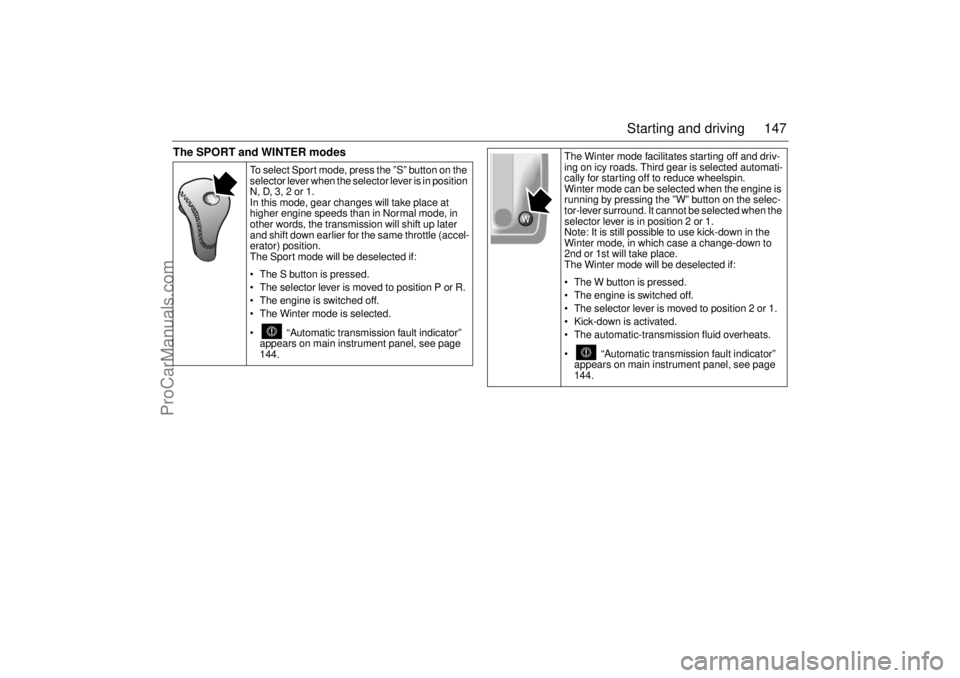
To select Sport mode, press the ”S” button on the
selector lever when the selector lever is in position
N, D, 3, 2 or 1.
In this mode, gear changes will take place at
higher engine speeds than in Normal mode, in
other words, the transmission will shift up later
and shift down earlier for the same throttle (accel-
erator) position.
The Sport mode will be deselected if:
The S button is pressed.
The selector lever is moved to position P or R.
The engine is switched off.
The Winter mode is selected.
“Automatic transmission fault indicator”
appears on main instrument panel, see page
144.
The Winter mode facilitates starting off and driv-
ing on icy roads. Third gear is selected automati-
cally for starting off to reduce wheelspin.
Winter mode can be selected when the engine is
running by pressing the ”W” button on the selec-
tor-lever surround. It cannot be selected when the
selector lever is in position 2 or 1.
Note: It is still possible to use kick-down in the
Winter mode, in which case a change-down to
2nd or 1st will take place.
The Winter mode will be deselected if:
The W button is pressed.
The engine is switched off.
The selector lever is moved to position 2 or 1.
Kick-down is activated.
The automatic-transmission fluid overheats.
“Automatic transmission fault indicator”
appears on main instrument panel, see page
144.
ProCarManuals.com
Page 149 of 236

149 Starting and driving
Disengaging the system The system will be disengaged:
When the brake or clutch pedal is
depressed.
When the switch is moved to CANCEL.
When the switch is moved to OFF.
When the engine is switched off.
When the selector lever is moved to posi-
tion N (cars with automatic transmission).
BrakingTo avoid overheating the brakes, (e.g. when
negotiating long descents with a drop of
several hundred feet), select a low gear to
use the braking effect of the engine. If the
car has automatic transmission, move the
selector lever to position 1 or 2.
When driving fast, you can help to prolong
the life of the brakes by thinking ahead and
braking harder for short periods, rather than
braking more moderately over long
stretches. Brake pad wear indicatorsThe outboard brake pads on the front
wheels incorporate pad-wear indicators.
When the lining is down to 3 mm, the pad
will produce a screeching, squealing or
scraping noise when the brakes are applied.
New pads should be installed without delay.
Brake pads should only be replaced by
an authorized Saab dealer.
To ensure optimum brake performance,
it is recommended that you use only
Saab original brake pads.
WARNING
It is prudent to try your brakes from
time to time, especially when driving in
heavy rain, on roads with a lot of sur-
face water, or in snow or slush. In such
conditions, the brakes may take
longer than normal to take effect. To
rectify this, touch the brake pedal peri-
odically to dry the brakes out.
The same applies after the car has
been washed or when the weather is
very humid.
The brakes are power assisted and it
should be kept in mind that the servo
unit only provides the power assis-
tance when the engine is running.
The brake pressure required when the
engine is off,( e.g. when the car is
being towed) is roughly four times the
normal pedal force required. The
pedal also feels hard and unrespon-
sive.
ProCarManuals.com
Page 150 of 236
150 Starting and drivingABS brakesABS (Antilock Braking System) modulates
the brake pressure to the respective
wheels. Wheel sensors detect if a wheel is
about to lock, and the control module
reduces the pressure to that wheel and then
increases it once more until the tendency is
detected again.
The brake system is equipped with an Elec-
tronic Brake-force Distribution device
(EBD), which distributes the brake pressure
between the front and rear wheels in such a
way as to achieve optimum braking perfor-
mance regardless of the car’s speed and
load.
The ABS system has a built-in diagnostic
function which will switch on the ABS warn-
ing light if a fault is detected in the system
(see page 56). The ABS system will not reduce the braking
distance on loose gravel or on snow or ice
but, because the wheels cannot lock up,
some steering control is retained.
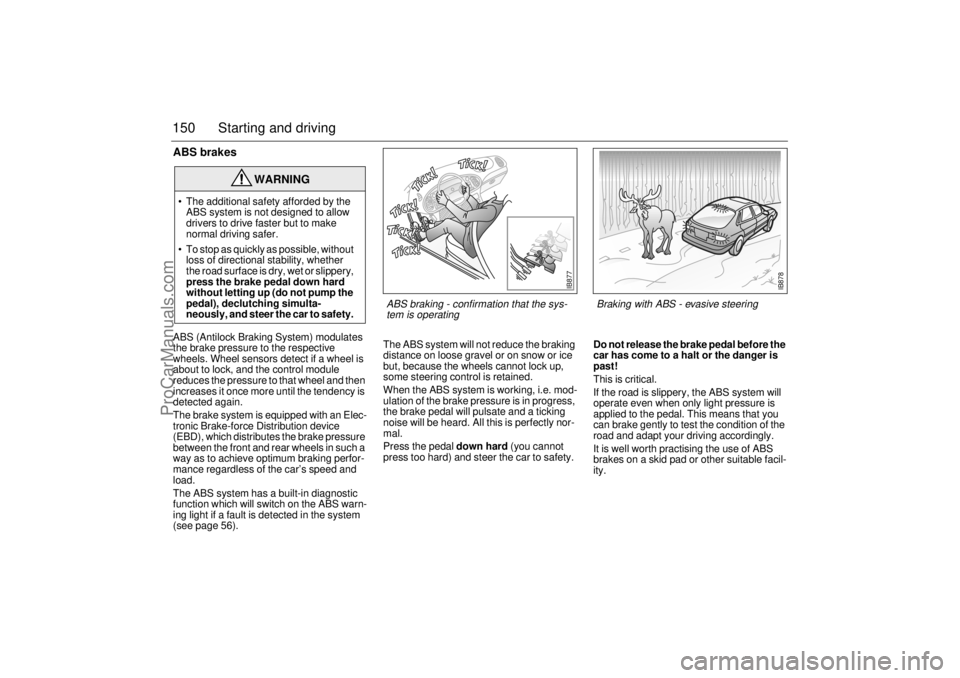
When the ABS system is working, i.e. mod-
ulation of the brake pressure is in progress,
the brake pedal will pulsate and a ticking
noise will be heard. All this is perfectly nor-
mal.
Press the pedal down hard (you cannot
press too hard) and steer the car to safety. Do not release the brake pedal before the
car has come to a halt or the danger is
past!
This is critical.
If the road is slippery, the ABS system will
operate even when only light pressure is
applied to the pedal. This means that you
can brake gently to test the condition of the
road and adapt your driving accordingly.
It is well worth practising the use of ABS
brakes on a skid pad or other suitable facil-
ity.
WARNING
The additional safety afforded by the
ABS system is not designed to allow
drivers to drive faster but to make
normal driving safer.
To stop as quickly as possible, without
loss of directional stability, whether
the road surface is dry, wet or slippery,
press the brake pedal down hard
without letting up (do not pump the
pedal), declutching simulta-
neously, and steer the car to safety.
IB877
ABS braking - confirmation that the sys-
tem is operating
IB878
Braking with ABS - evasive steering
ProCarManuals.com
Page 151 of 236
151 Starting and driving
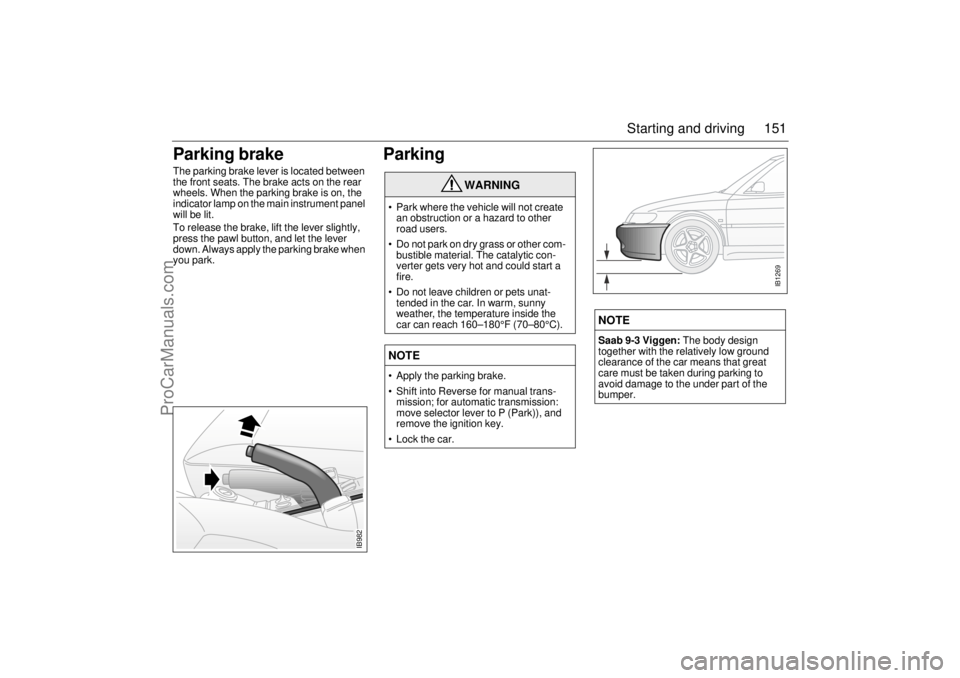
Parking brakeThe parking brake lever is located between
the front seats. The brake acts on the rear
wheels. When the parking brake is on, the
indicator lamp on the main instrument panel
will be lit.
To release the brake, lift the lever slightly,
press the pawl button, and let the lever
down. Always apply the parking brake when
you park.
Parking
WARNING
Park where the vehicle will not create
an obstruction or a hazard to other
road users.
Do not park on dry grass or other com-
bustible material. The catalytic con-
verter gets very hot and could start a
fire.
Do not leave children or pets unat-
tended in the car. In warm, sunny
weather, the temperature inside the
car can reach 160–180°F (70–80°C). NOTE Apply the parking brake.
Shift into Reverse for manual trans-
mission; for automatic transmission:
move selector lever to P (Park)), and
remove the ignition key.
Lock the car.
NOTESaab 9-3 Viggen: The body design
together with the relatively low ground
clearance of the car means that great
care must be taken during parking to
avoid damage to the under part of the
bumper.
IB1269
IB982
ProCarManuals.com