lock SAAB 9-3 2000 Workshop Manual
[x] Cancel search | Manufacturer: SAAB, Model Year: 2000, Model line: 9-3, Model: SAAB 9-3 2000Pages: 236, PDF Size: 10.85 MB
Page 127 of 236
127 Interior equipment, trunk
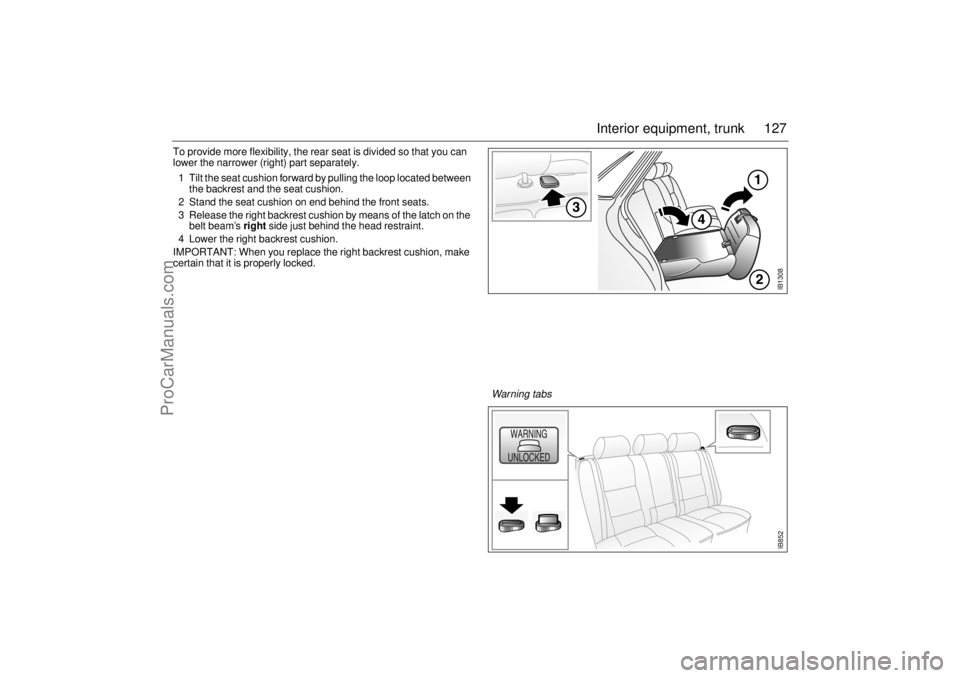
To provide more flexibility, the rear seat is divided so that you can
lower the narrower (right) part separately.
1 Tilt the seat cushion forward by pulling the loop located between
the backrest and the seat cushion.
2 Stand the seat cushion on end behind the front seats.
3 Release the right backrest cushion by means of the latch on the
belt beam’s right side just behind the head restraint.
4 Lower the right backrest cushion.
IMPORTANT: When you replace the right backrest cushion, make
certain that it is properly locked.
IB1308IB852
Warning tabs
ProCarManuals.com
Page 128 of 236
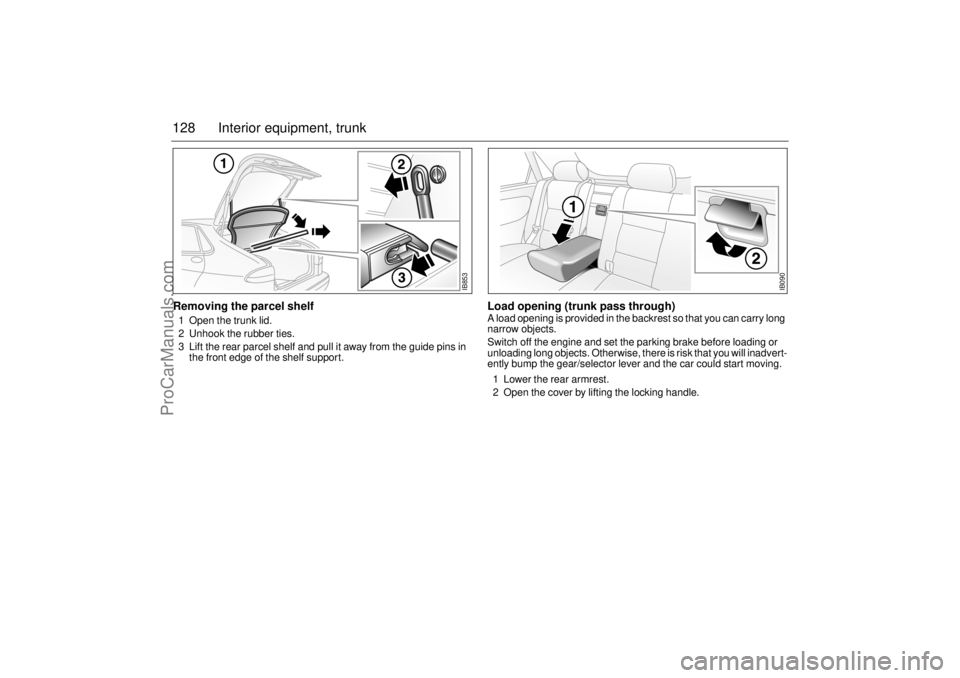
128 Interior equipment, trunkRemoving the parcel shelf1 Open the trunk lid.
2 Unhook the rubber ties.
3 Lift the rear parcel shelf and pull it away from the guide pins in
the front edge of the shelf support.
Load opening (trunk pass through) A load opening is provided in the backrest so that you can carry long
narrow objects.
Switch off the engine and set the parking brake before loading or
unloading long objects. Otherwise, there is risk that you will inadvert-
ently bump the gear/selector lever and the car could start moving.
1 Lower the rear armrest.
2 Open the cover by lifting the locking handle.
IB853
IB090
ProCarManuals.com
Page 131 of 236
131 Interior equipment, trunk
Manually opening the
fuel filler door Coupé and 5-door models If the fuel filler door (which is controlled by
the central locking system) does not unlock,
proceed as follows.
Check fuse 20. If it is blown or its replace-
ment blows, you can release the lock motor
from the door as follows:
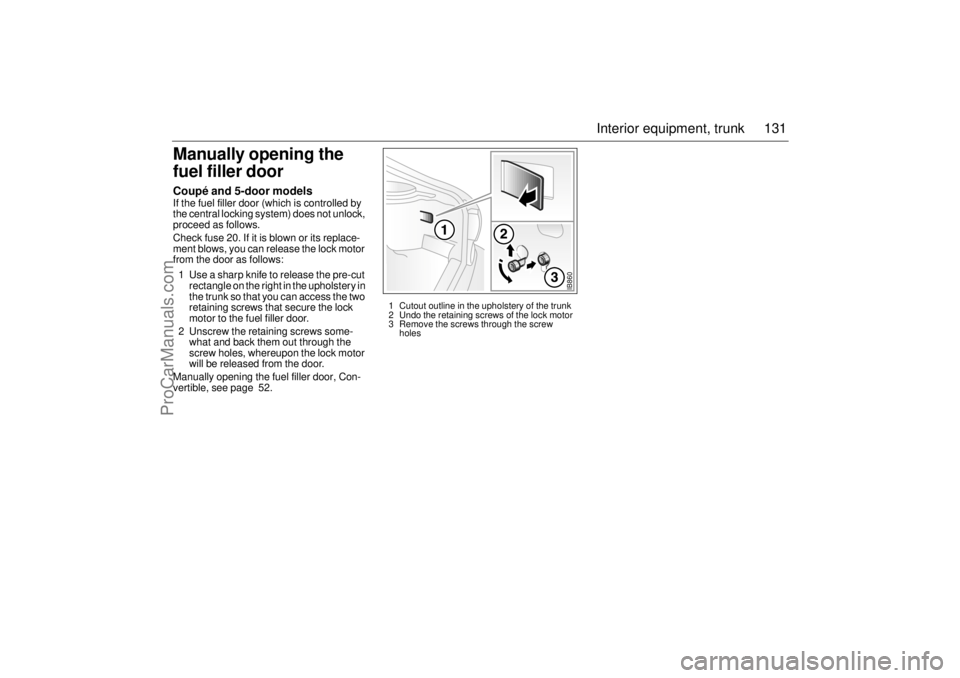
1 Use a sharp knife to release the pre-cut
rectangle on the right in the upholstery in
the trunk so that you can access the two
retaining screws that secure the lock
motor to the fuel filler door.
2 Unscrew the retaining screws some-
what and back them out through the
screw holes, whereupon the lock motor
will be released from the door.
Manually opening the fuel filler door, Con-
vertible, see page 52.
IB860
1 Cutout outline in the upholstery of the trunk
2 Undo the retaining screws of the lock motor
3 Remove the screws through the screw
holes
ProCarManuals.com
Page 134 of 236
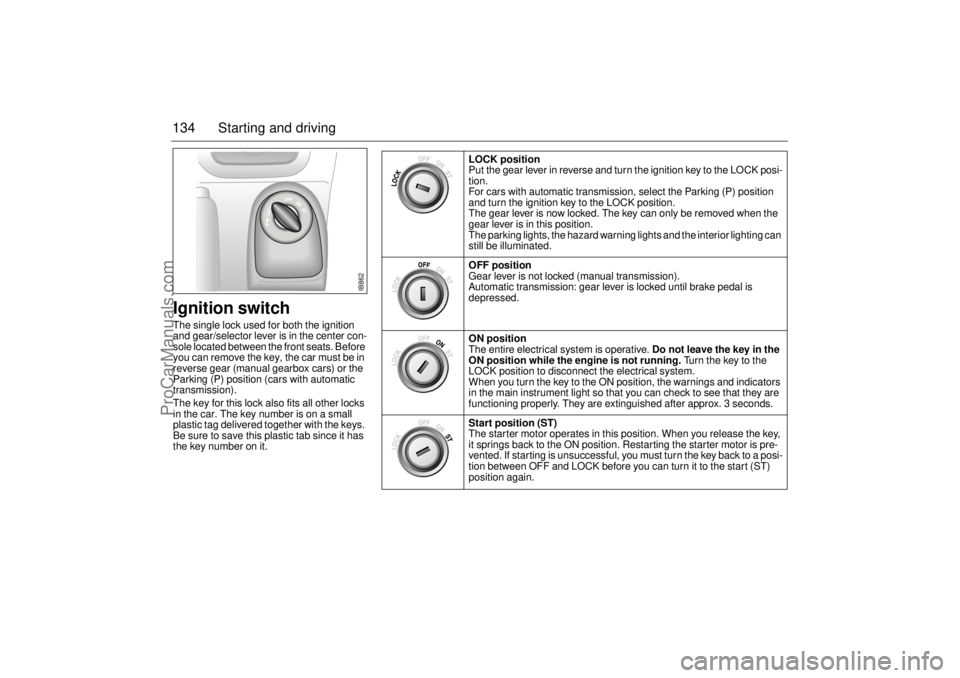
134 Starting and drivingIgnition switchThe single lock used for both the ignition
and gear/selector lever is in the center con-
sole located between the front seats. Before
you can remove the key, the car must be in
reverse gear (manual gearbox cars) or the
Parking (P) position (cars with automatic
transmission).
The key for this lock also fits all other locks
in the car. The key number is on a small
plastic tag delivered together with the keys.
Be sure to save this plastic tab since it has
the key number on it.
IB862
LOCK position
Put the gear lever in reverse and turn the ignition key to the LOCK posi-
tion.
For cars with automatic transmission, select the Parking (P) position
and turn the ignition key to the LOCK position.
The gear lever is now locked. The key can only be removed when the
gear lever is in this position.
The parking lights, the hazard warning lights and the interior lighting can
still be illuminated.
OFF position
Gear lever is not locked (manual transmission).
Automatic transmission: gear lever is locked until brake pedal is
depressed.
ON position
The entire electrical system is operative. Do not leave the key in the
ON position while the engine is not running. Turn the key to the
LOCK position to disconnect the electrical system.
When you turn the key to the ON position, the warnings and indicators
in the main instrument light so that you can check to see that they are
functioning properly. They are extinguished after approx. 3 seconds.
Start position (ST)
The starter motor operates in this position. When you release the key,
it springs back to the ON position. Restarting the starter motor is pre-
vented. If starting is unsuccessful, you must turn the key back to a posi-
tion between OFF and LOCK before you can turn it to the start (ST)
position again.
ProCarManuals.com
Page 135 of 236
135 Starting and driving
If the car does not startIf the text "KEY NOT ACCEPTED" appears
on the SID when the engine refuses to start,
the trouble may be a fault in the transponder
of the key or in the receiver of the ignition
switch. Proceed as follows:
• Turn the key back to the LOCK position.
Turn the key to the ON position.
Press one of the buttons on the remote
control (the LED on top of the dash stops
flashing).
Start the engine.
Try the other key. If it works, the trouble is in
the first key.
Call on an authorized Saab dealer for
inspection and correction.
Starting the engineDo not run the starter motor for more than
25 seconds at a time. Wait 20-30 seconds
before running the starter again, to give the
battery time to recover.
Avoid racing the engine or putting a heavy
load on it before it has warmed up. Let the
engine idle for at least 10 seconds and then
drive away as long as the engine oil warning
light has gone out to enable the engine to
attain its normal temperature as quickly as
possible.
It is possible for air to enter the lubricating
system in conjunction with an oil or oil-filter
change, or if the car has been stored for
some time. This air can cause the hydraulic
cam followers to emit a ticking noise, which
can persist for up to 15 minutes after start-
ing. Although this is quite normal and does
not indicate any malfunction, it is advisable
not to exceed 3,000 rpm before the noise
has disappeared. The hydraulic cam lifters are completely
service free; the valve clearance is set up at
the factory and will not need any subse-
quent adjustment.
Starting the engine The engine has an automatic choke and
should be started as follows:
Cars with manual gearbox
To start the engine the clutch pedal must
be fully depressed.
1 Depress the clutch pedal but do not
touch the accelerator.
2 Start the engine. Let the ignition key
spring back as soon as the engine has
started and is running smoothly – at very
low temperatures, you may need to run
the starter for up to 50 seconds.
Let the engine idle for about 10 seconds. Do
not open the throttle wide for at least
2-3 minutes after starting.
Cars with automatic transmission
The selector lever must be in the P or N
position.
1 Keep your foot on the brake pedal.
2 Start the engine. Let the ignition key
spring back as soon as the engine has
started and is running smoothly – at very
low temperatures, you may need to run
the starter for up to 50 seconds.
Let the engine idle for about 10 seconds. Do
not open the throttle wide for at least
2–3 minutes after starting.
WARNING
Always remove the key before leaving
the car.
Always apply the parking brake before
removing the ignition key.NOTETake care not to spill drinks or to drop
crumbs over the ignition switch. If dirt or
liquid gets into it, the switch may not
operate properly.
WARNING
Carbon monoxide (CO) is a colorless,
odorless, poisonous gas. Be alert to
the danger of CO – always open the
garage doors before starting the
engine in the garage.
There is also a danger of CO poison-
ing if the exhaust system is leaking.
ProCarManuals.com
Page 141 of 236
141 Starting and driving
Gear changingManual transmissionTo start the engine the clutch pedal must
be fully depressed.
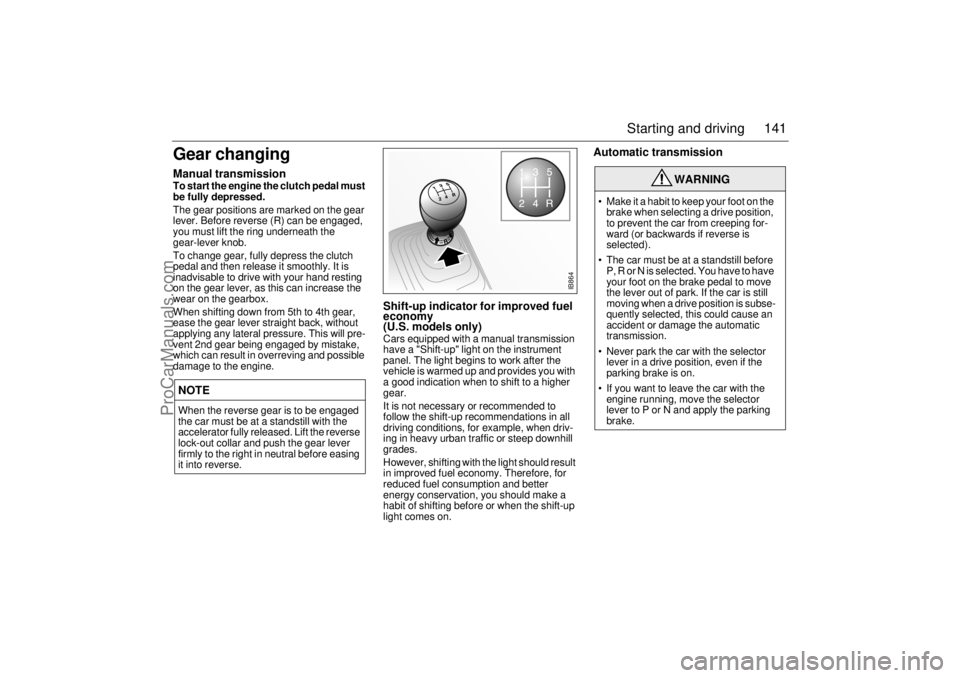
The gear positions are marked on the gear
lever. Before reverse (R) can be engaged,
you must lift the ring underneath the
gear-lever knob.
To change gear, fully depress the clutch
pedal and then release it smoothly. It is
inadvisable to drive with your hand resting
on the gear lever, as this can increase the
wear on the gearbox.
When shifting down from 5th to 4th gear,
ease the gear lever straight back, without
applying any lateral pressure. This will pre-
vent 2nd gear being engaged by mistake,
which can result in overreving and possible
damage to the engine.
Shift-up indicator for improved fuel
economy
(U.S. models only)Cars equipped with a manual transmission
have a "Shift-up" light on the instrument
panel. The light begins to work after the
vehicle is warmed up and provides you with
a good indication when to shift to a higher
gear.
It is not necessary or recommended to
follow the shift-up recommendations in all
driving conditions, for example, when driv-
ing in heavy urban traffic or steep downhill
grades.
However, shifting with the light should result
in improved fuel economy. Therefore, for
reduced fuel consumption and better
energy conservation, you should make a
habit of shifting before or when the shift-up
light comes on.
Automatic transmission
NOTEWhen the reverse gear is to be engaged
the car must be at a standstill with the
accelerator fully released. Lift the reverse
lock-out collar and push the gear lever
firmly to the right in neutral before easing
it into reverse.
WARNING
Make it a habit to keep your foot on the
brake when selecting a drive position,
to prevent the car from creeping for-
ward (or backwards if reverse is
selected).
The car must be at a standstill before
P, R or N is selected. You have to have
your foot on the brake pedal to move
the lever out of park. If the car is still
moving when a drive position is subse-
quently selected, this could cause an
accident or damage the automatic
transmission.
Never park the car with the selector
lever in a drive position, even if the
parking brake is on.
If you want to leave the car with the
engine running, move the selector
lever to P or N and apply the parking
brake.
IB864
ProCarManuals.com
Page 143 of 236
143 Starting and driving
provide better grip, and the WINTER indica-
tor appears on the main instrument panel.
When the ignition is turned to OFF, the auto-
matic transmission will automatically revert
to Normal mode (see page 147).
Adaptive gear change pattern is a func-
tion of the Normal and Sport modes. It
allows gear changing to be suited to the pre-
vailing driving conditions. The transmission
control module senses the engine load and
temperature of the transmission and selects
one of the four available gear change pat-
terns. Unnecessary gear changes and
undesired temperature increases in the
transmission are avoided.
The automatic transmission has a special
shift pattern during the first minute after a
cold engine is started so that the catalytic
converter will reach its correct working tem-
perature more rapidlyLock-up functionThe automatic transmission has a lock-up
function, which renders the torque con-
verter inoperative in 2nd, 3rd and 4th gears.
The result is reduction in the engine speed
and, hence, fuel consumption.
When the lock-up function comes into oper-
ation, it may give the impression of an over-
drive being engaged.
Shift Lock override1 Apply the parking brake.
2 Make sure the key is in the ON position.
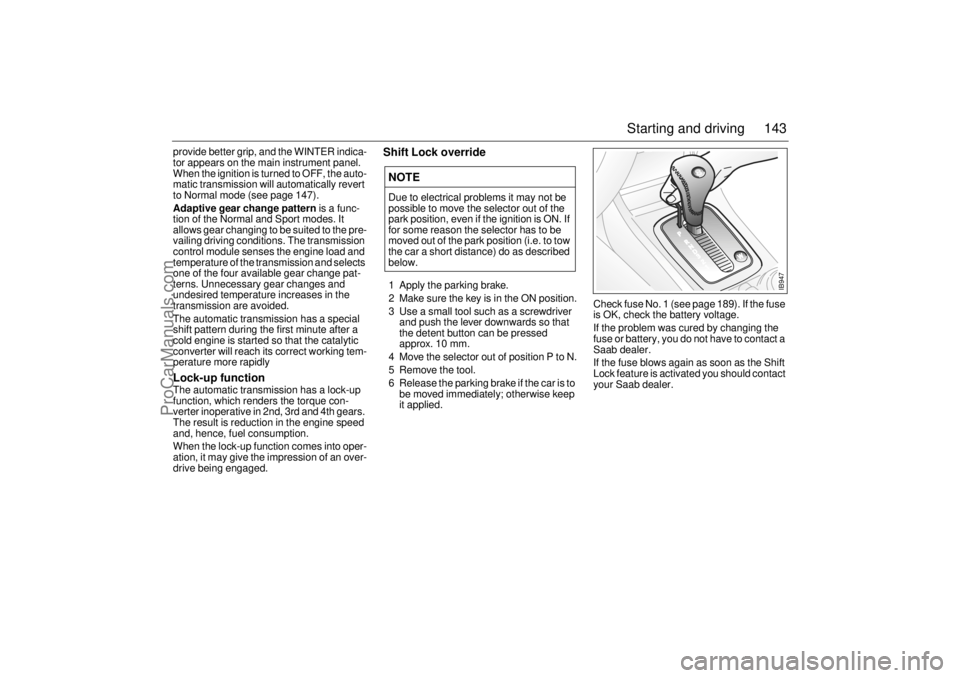
3 Use a small tool such as a screwdriver
and push the lever downwards so that
the detent button can be pressed
approx. 10 mm.
4 Move the selector out of position P to N.
5 Remove the tool.
6 Release the parking brake if the car is to
be moved immediately; otherwise keep
it applied.Check fuse No. 1 (see page 189). If the fuse
is OK, check the battery voltage.
If the problem was cured by changing the
fuse or battery, you do not have to contact a
Saab dealer.
If the fuse blows again as soon as the Shift
Lock feature is activated you should contact
your Saab dealer.NOTEDue to electrical problems it may not be
possible to move the selector out of the
park position, even if the ignition is ON. If
for some reason the selector has to be
moved out of the park position (i.e. to tow
the car a short distance) do as described
below.
IB947
ProCarManuals.com
Page 144 of 236
144 Starting and driving
Automatic transmission
fault indicator
If the symbol appears on the main instru-
ment panel, the system has detected a fault
in the automatic transmission or its control
module (see page 58).
This also means that the Limp-home mode
has been selected, to guard against further
damage being done to the transmission. In
this mode, the automatic transmission
starts in 4th gear, and gear changes (if nec-
essary) will have to be made manually.
It is not possible to select the SPORT or
WINTER mode when the Limp-home mode
is active.
You should have the automatic transmis-
sion checked as soon as possible by an
authorized Saab dealer.
The following gears will be engaged in the
respective selector positions when the auto-
matic transmission is in the Limp-home
mode:
Overheated transmission oilIf the transmission oil becomes overheated
while driving, the following message
appears on the SID: TRANSMISSION
OVERHEATING. In this event, stop the car
in a suitable place, switch off the engine,
open the hood and wait until the message
goes out. When driving subsequent to the
transmission oil overheating, select a
locked gear position in which the engine
speed is about 3,000 rpm.
The transmission oil can become very hot
when the car is driven with a heavy load; for
example, driving with a trailer on hilly roads
when the wrong gear has been selected,
resulting in many extra gear changes.
Select one of the positions 1, 2 or 3. A high
outside temperature or a defective oil cooler
can also cause the oil temperature to
increase. Contact an authorized Saab work-
shop, see also page 156.
Driving in hilly country with a heavy
loadOverheating of the automatic-transmission
fluid can occur when the car is towing a
heavy load, such as a trailer in hilly country,
with the wrong gear selected, resulting in
abnormally frequent gear changing. Try
selecting position 1, 2 or 3. High ambient
temperatures can also increase the temper-
ature of the transmission fluid or the oil
cooler may be faulty. As the transmission
fluid temperature increases, its useful ser-
vice life is reduced. Contact an authorized
Saab dealer (see also page 156).TowingTowing a car with automatic transmission,
see page 162. Position R D 3 2 1
Gear Reverse 4th 4th 3rd 3rd
NOTEIf the control module has actuated the
Limp-home function for the automatic
transmission, the car will remain in 4th
gear when D is selected, making it very
sluggish. To overcome this, move the
selector lever to position 2.
WARNING
Remember to use engine-braking (selec-
tor position 1, 2, or 3) to spare the brakes
when you are driving on a long or steep
downhill slope. Select the same gear as
you would on the corresponding uphill
slope.
Brake failure can result from overheated
brakes!
ProCarManuals.com
Page 145 of 236
145 Starting and driving
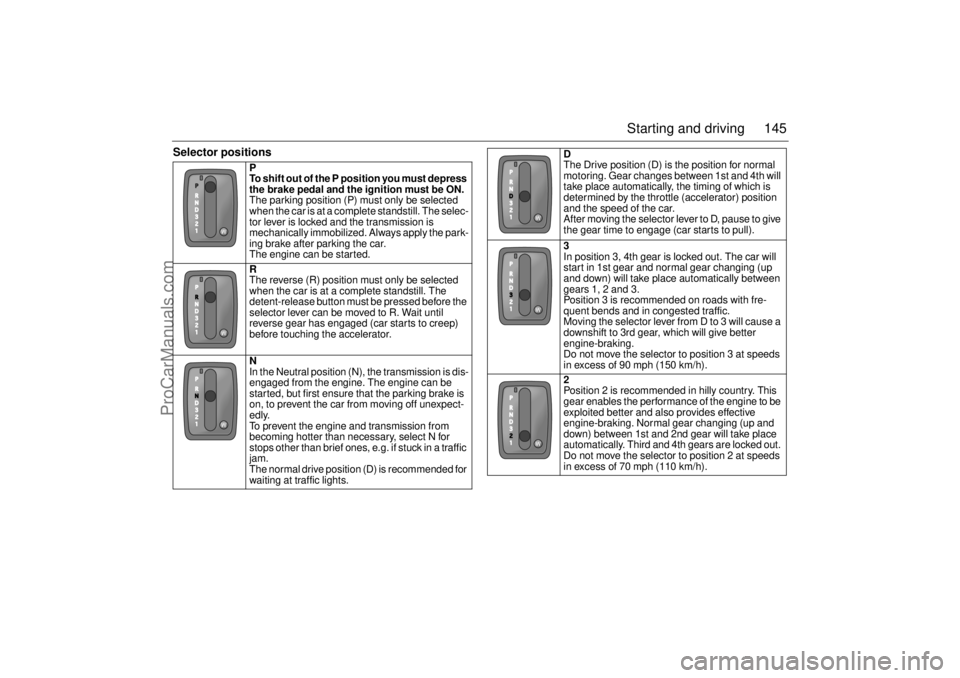
Selector positions
P
To shift out of the P position you must depress
the brake pedal and the ignition must be ON.
The parking position (P) must only be selected
when the car is at a complete standstill. The selec-
tor lever is locked and the transmission is
mechanically immobilized. Always apply the park-
ing brake after parking the car.
The engine can be started.
R
The reverse (R) position must only be selected
when the car is at a complete standstill. The
detent-release button must be pressed before the
selector lever can be moved to R. Wait until
reverse gear has engaged (car starts to creep)
before touching the accelerator.
N
In the Neutral position (N), the transmission is dis-
engaged from the engine. The engine can be
started, but first ensure that the parking brake is
on, to prevent the car from moving off unexpect-
edly.
To prevent the engine and transmission from
becoming hotter than necessary, select N for
stops other than brief ones, e.g. if stuck in a traffic
jam.
The normal drive position (D) is recommended for
waiting at traffic lights.
D
The Drive position (D) is the position for normal
motoring. Gear changes between 1st and 4th will
take place automatically, the timing of which is
determined by the throttle (accelerator) position
and the speed of the car.
After moving the selector lever to D, pause to give
the gear time to engage (car starts to pull).
3
In position 3, 4th gear is locked out. The car will
start in 1st gear and normal gear changing (up
and down) will take place automatically between
gears 1, 2 and 3.
Position 3 is recommended on roads with fre-
quent bends and in congested traffic.
Moving the selector lever from D to 3 will cause a
downshift to 3rd gear, which will give better
engine-braking.
Do not move the selector to position 3 at speeds
in excess of 90 mph (150 km/h).
2
Position 2 is recommended in hilly country. This
gear enables the performance of the engine to be
exploited better and also provides effective
engine-braking. Normal gear changing (up and
down) between 1st and 2nd gear will take place
automatically. Third and 4th gears are locked out.
Do not move the selector to position 2 at speeds
in excess of 70 mph (110 km/h).
ProCarManuals.com
Page 146 of 236

146 Starting and drivingIf the gear selector lever is moved from position D to 1, a
change-down to 3rd gear will occur at about 110 mph (180 km/h).
A change-down to 2nd gear will occur at about 75 mph (120 km/h)
and to 1st gear at about 40 mph (65 km/h).
When position 1 is selected, all the other gears will be locked out.
Manual gear-changing is not recommended on slippery roads.
2.0 Turbo 185 hp and 205 hp: If one of the drive wheels spins
excessively, the engine torque will be reduced to avoid damaging
the transmissionKick-downWhen the accelerator is pressed down hard, a downshift to the next
lower gear will occur to provide maximum acceleration, e.g. for over-
taking.
The change-up to the next gear again will take place either when the
accelerator is released or when maximum engine speed for that
gear is reached.
Adaptive gear-change patternsAdaptive gear-change patterns are selected automatically depend-
ing on the engine load. This function applies in the Normal and Sport
modes.
The change occurs at a higher rotation speed and the gear remains
engaged for a longer period, if the control module senses that the
load does not drop. These change patterns avoid unnecessary gear
changes when, for example, driving on long inclines with a trailer,
and to prevent overheating of the transmission oil. This function cuts
in automatically if the oil becomes too hot, to protect the transmis-
sion from serious damage, and lower the oil temperature.
The adaptive change pattern function is not activated at speeds over
93 mph (150 km/h). If a pattern is in operation when this speed is
exceeded, it will be maintained until the control module senses that
a more suitable one can be activated.
The adaptive gear-change pattern function is deselected when:
Winter mode is selected.
The engine is switched off.
The load is reduced by so much that this function is no longer
required.
“Automatic transmission fault indicator” appears on the
main instrument panel, see page 144. 1
Position 1 should be used when maximum
engine-braking is required on steep downhill
slopes and to avoid frequent gear-changing on
steep climbs.
Do not move the selector to position 1 at speeds
in excess of 30 mph (50 km/h).
ProCarManuals.com