warning SAAB 9-3 2000 Repair Manual
[x] Cancel search | Manufacturer: SAAB, Model Year: 2000, Model line: 9-3, Model: SAAB 9-3 2000Pages: 236, PDF Size: 10.85 MB
Page 129 of 236
129 Interior equipment, trunk
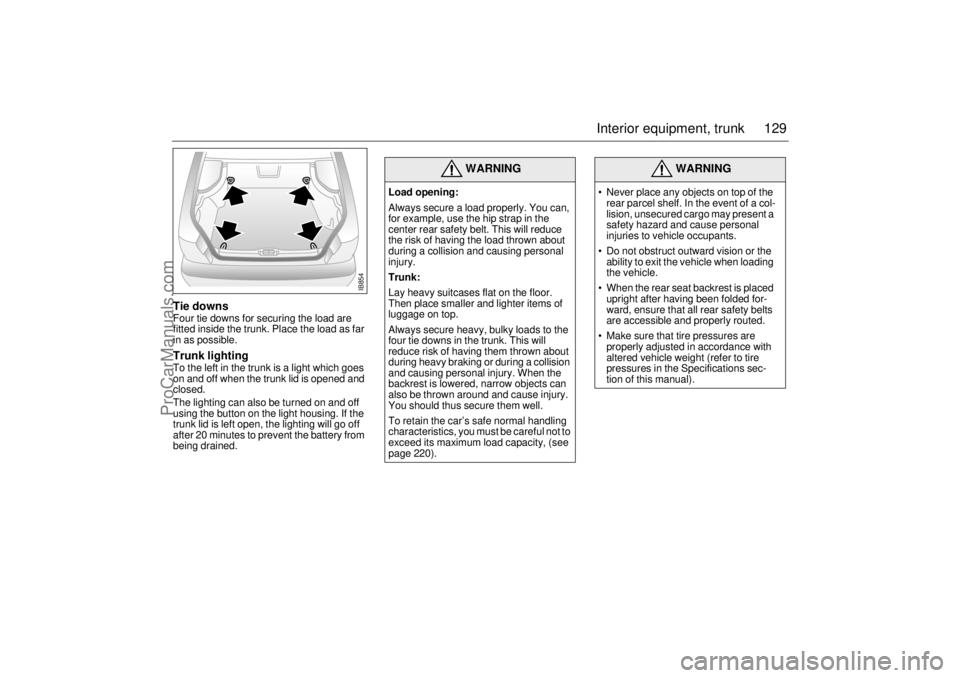
Tie downsFour tie downs for securing the load are
fitted inside the trunk. Place the load as far
in as possible.Trunk lightingTo the left in the trunk is a light which goes
on and off when the trunk lid is opened and
closed.
The lighting can also be turned on and off
using the button on the light housing. If the
trunk lid is left open, the lighting will go off
after 20 minutes to prevent the battery from
being drained.
WARNING
Load opening:
Always secure a load properly. You can,
for example, use the hip strap in the
center rear safety belt. This will reduce
the risk of having the load thrown about
during a collision and causing personal
injury.
Trunk:
Lay heavy suitcases flat on the floor.
Then place smaller and lighter items of
luggage on top.
Always secure heavy, bulky loads to the
four tie downs in the trunk. This will
reduce risk of having them thrown about
during heavy braking or during a collision
and causing personal injury. When the
backrest is lowered, narrow objects can
also be thrown around and cause injury.
You should thus secure them well.
To retain the car’s safe normal handling
characteristics, you must be careful not to
exceed its maximum load capacity, (see
page 220).
WARNING
Never place any objects on top of the
rear parcel shelf. In the event of a col-
lision, unsecured cargo may present a
safety hazard and cause personal
injuries to vehicle occupants.
Do not obstruct outward vision or the
ability to exit the vehicle when loading
the vehicle.
When the rear seat backrest is placed
upright after having been folded for-
ward, ensure that all rear safety belts
are accessible and properly routed.
Make sure that tire pressures are
properly adjusted in accordance with
altered vehicle weight (refer to tire
pressures in the Specifications sec-
tion of this manual).
IB854
ProCarManuals.com
Page 130 of 236
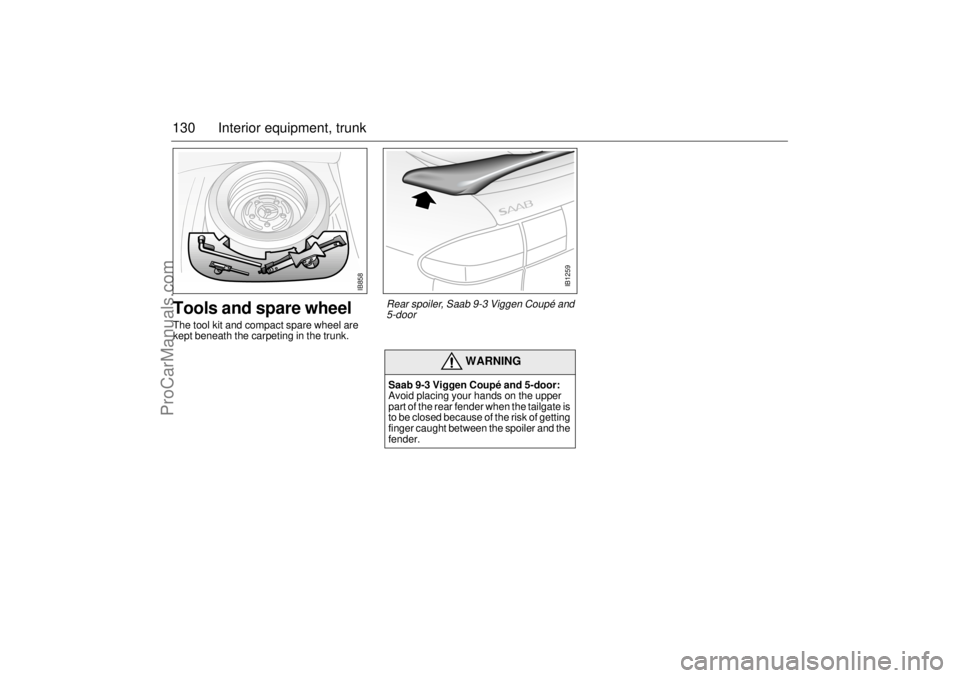
130 Interior equipment, trunkTools and spare wheelThe tool kit and compact spare wheel are
kept beneath the carpeting in the trunk.
WARNING
Saab 9-3 Viggen Coupé and 5-door:
Avoid placing your hands on the upper
part of the rear fender when the tailgate is
to be closed because of the risk of getting
finger caught between the spoiler and the
fender.
IB858
IB1259
Rear spoiler, Saab 9-3 Viggen Coupé and
5-door
ProCarManuals.com
Page 134 of 236
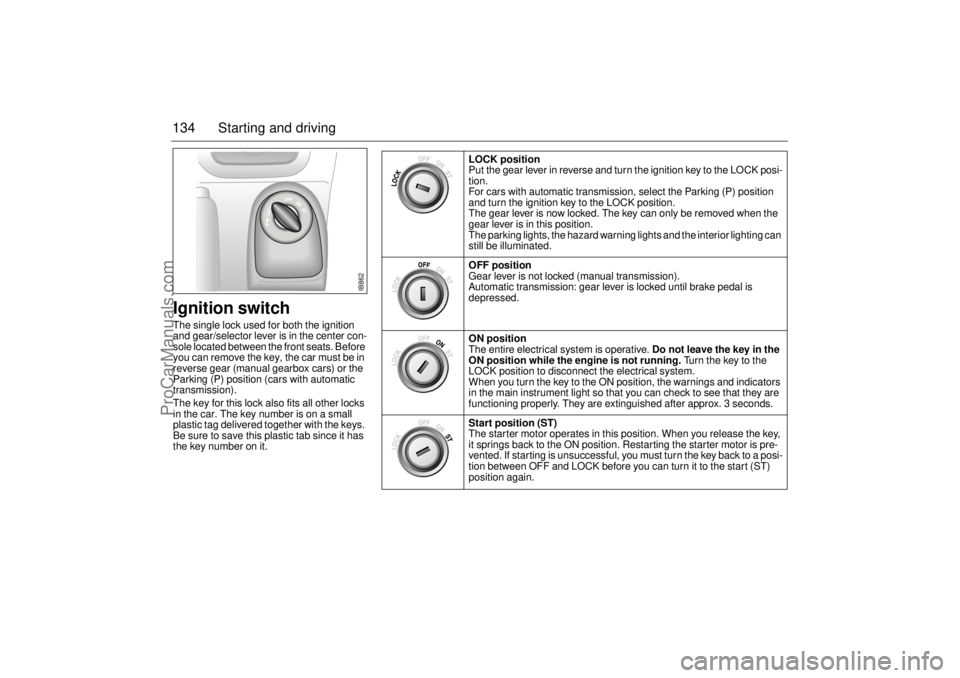
134 Starting and drivingIgnition switchThe single lock used for both the ignition
and gear/selector lever is in the center con-
sole located between the front seats. Before
you can remove the key, the car must be in
reverse gear (manual gearbox cars) or the
Parking (P) position (cars with automatic
transmission).
The key for this lock also fits all other locks
in the car. The key number is on a small
plastic tag delivered together with the keys.
Be sure to save this plastic tab since it has
the key number on it.
IB862
LOCK position
Put the gear lever in reverse and turn the ignition key to the LOCK posi-
tion.
For cars with automatic transmission, select the Parking (P) position
and turn the ignition key to the LOCK position.
The gear lever is now locked. The key can only be removed when the
gear lever is in this position.
The parking lights, the hazard warning lights and the interior lighting can
still be illuminated.
OFF position
Gear lever is not locked (manual transmission).
Automatic transmission: gear lever is locked until brake pedal is
depressed.
ON position
The entire electrical system is operative. Do not leave the key in the
ON position while the engine is not running. Turn the key to the
LOCK position to disconnect the electrical system.
When you turn the key to the ON position, the warnings and indicators
in the main instrument light so that you can check to see that they are
functioning properly. They are extinguished after approx. 3 seconds.
Start position (ST)
The starter motor operates in this position. When you release the key,
it springs back to the ON position. Restarting the starter motor is pre-
vented. If starting is unsuccessful, you must turn the key back to a posi-
tion between OFF and LOCK before you can turn it to the start (ST)
position again.
ProCarManuals.com
Page 135 of 236
135 Starting and driving
If the car does not startIf the text "KEY NOT ACCEPTED" appears
on the SID when the engine refuses to start,
the trouble may be a fault in the transponder
of the key or in the receiver of the ignition
switch. Proceed as follows:
• Turn the key back to the LOCK position.
Turn the key to the ON position.
Press one of the buttons on the remote
control (the LED on top of the dash stops
flashing).
Start the engine.
Try the other key. If it works, the trouble is in
the first key.
Call on an authorized Saab dealer for
inspection and correction.
Starting the engineDo not run the starter motor for more than
25 seconds at a time. Wait 20-30 seconds
before running the starter again, to give the
battery time to recover.
Avoid racing the engine or putting a heavy
load on it before it has warmed up. Let the
engine idle for at least 10 seconds and then
drive away as long as the engine oil warning
light has gone out to enable the engine to
attain its normal temperature as quickly as
possible.
It is possible for air to enter the lubricating
system in conjunction with an oil or oil-filter
change, or if the car has been stored for
some time. This air can cause the hydraulic
cam followers to emit a ticking noise, which
can persist for up to 15 minutes after start-
ing. Although this is quite normal and does
not indicate any malfunction, it is advisable
not to exceed 3,000 rpm before the noise
has disappeared. The hydraulic cam lifters are completely
service free; the valve clearance is set up at
the factory and will not need any subse-
quent adjustment.
Starting the engine The engine has an automatic choke and
should be started as follows:
Cars with manual gearbox
To start the engine the clutch pedal must
be fully depressed.
1 Depress the clutch pedal but do not
touch the accelerator.
2 Start the engine. Let the ignition key
spring back as soon as the engine has
started and is running smoothly – at very
low temperatures, you may need to run
the starter for up to 50 seconds.
Let the engine idle for about 10 seconds. Do
not open the throttle wide for at least
2-3 minutes after starting.
Cars with automatic transmission
The selector lever must be in the P or N
position.
1 Keep your foot on the brake pedal.
2 Start the engine. Let the ignition key
spring back as soon as the engine has
started and is running smoothly – at very
low temperatures, you may need to run
the starter for up to 50 seconds.
Let the engine idle for about 10 seconds. Do
not open the throttle wide for at least
2–3 minutes after starting.
WARNING
Always remove the key before leaving
the car.
Always apply the parking brake before
removing the ignition key.NOTETake care not to spill drinks or to drop
crumbs over the ignition switch. If dirt or
liquid gets into it, the switch may not
operate properly.
WARNING
Carbon monoxide (CO) is a colorless,
odorless, poisonous gas. Be alert to
the danger of CO – always open the
garage doors before starting the
engine in the garage.
There is also a danger of CO poison-
ing if the exhaust system is leaking.
ProCarManuals.com
Page 138 of 236
138 Starting and drivingStop jump-starting if the engine fails to
start immediately.
Failure to follow these directions could
result in the catalytic converter and asso-
ciated components being damaged, and
could represent a breach of the warranty
conditions.
RefuelingEnsure that you are using the correct grade
of fuel, unleaded AON 87-93. For optimum
performance we recommend:
AO N 90 for 2.0 Turbo 185 hp.
AO N 93 for 2.0 Turbo 205 hp and
2.3 Turbo Viggen.
If fuel containing a mixture of alcohol is
used, the following restrictions apply:
Methanol: max. 5% by volume.
Ethanol: max. 10% by volume.
MTBE: max. 15% by volume.
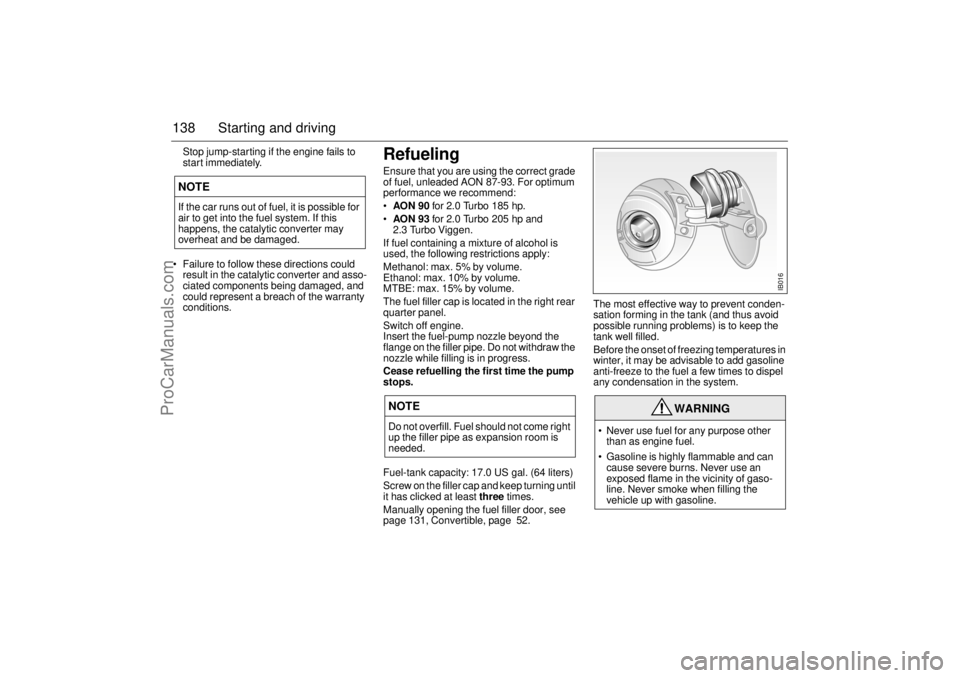
The fuel filler cap is located in the right rear
quarter panel.
Switch off engine.
Insert the fuel-pump nozzle beyond the
flange on the filler pipe. Do not withdraw the
nozzle while filling is in progress.
Cease refuelling the first time the pump
stops.
Fuel-tank capacity: 17.0 US gal. (64 liters)
Screw on the filler cap and keep turning until
it has clicked at least three times.
Manually opening the fuel filler door, see
page 131, Convertible, page 52.The most effective way to prevent conden-
sation forming in the tank (and thus avoid
possible running problems) is to keep the
tank well filled.
Before the onset of freezing temperatures in
winter, it may be advisable to add gasoline
anti-freeze to the fuel a few times to dispel
any condensation in the system.
NOTEIf the car runs out of fuel, it is possible for
air to get into the fuel system. If this
happens, the catalytic converter may
overheat and be damaged.
NOTEDo not overfill. Fuel should not come right
up the filler pipe as expansion room is
needed.
WARNING
Never use fuel for any purpose other
than as engine fuel.
Gasoline is highly flammable and can
cause severe burns. Never use an
exposed flame in the vicinity of gaso-
line. Never smoke when filling the
vehicle up with gasoline.
IB016
ProCarManuals.com
Page 141 of 236
141 Starting and driving
Gear changingManual transmissionTo start the engine the clutch pedal must
be fully depressed.
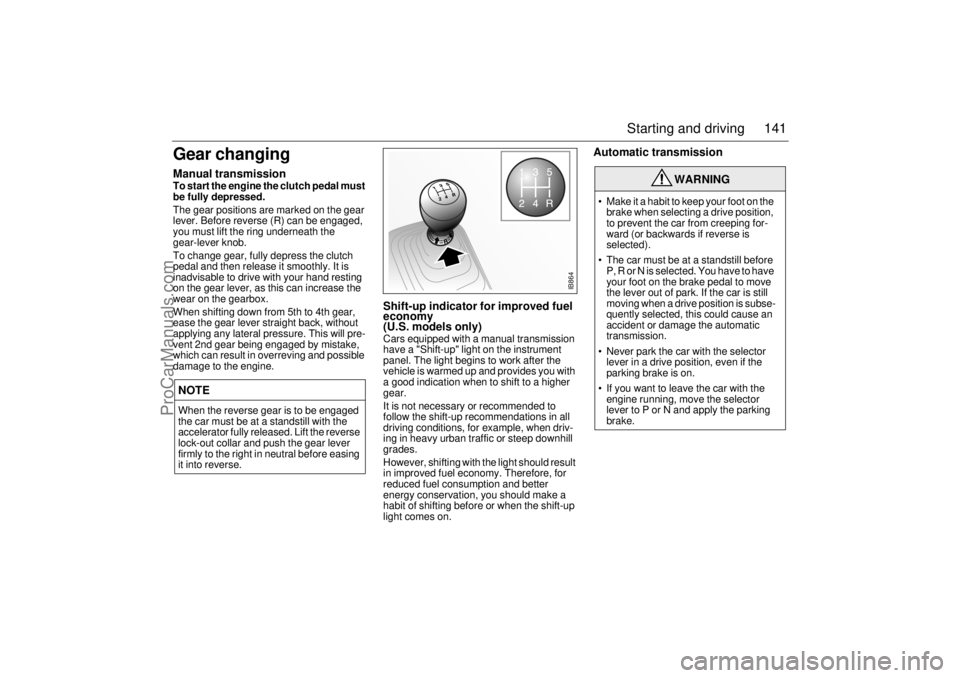
The gear positions are marked on the gear
lever. Before reverse (R) can be engaged,
you must lift the ring underneath the
gear-lever knob.
To change gear, fully depress the clutch
pedal and then release it smoothly. It is
inadvisable to drive with your hand resting
on the gear lever, as this can increase the
wear on the gearbox.
When shifting down from 5th to 4th gear,
ease the gear lever straight back, without
applying any lateral pressure. This will pre-
vent 2nd gear being engaged by mistake,
which can result in overreving and possible
damage to the engine.
Shift-up indicator for improved fuel
economy
(U.S. models only)Cars equipped with a manual transmission
have a "Shift-up" light on the instrument
panel. The light begins to work after the
vehicle is warmed up and provides you with
a good indication when to shift to a higher
gear.
It is not necessary or recommended to
follow the shift-up recommendations in all
driving conditions, for example, when driv-
ing in heavy urban traffic or steep downhill
grades.
However, shifting with the light should result
in improved fuel economy. Therefore, for
reduced fuel consumption and better
energy conservation, you should make a
habit of shifting before or when the shift-up
light comes on.
Automatic transmission
NOTEWhen the reverse gear is to be engaged
the car must be at a standstill with the
accelerator fully released. Lift the reverse
lock-out collar and push the gear lever
firmly to the right in neutral before easing
it into reverse.
WARNING
Make it a habit to keep your foot on the
brake when selecting a drive position,
to prevent the car from creeping for-
ward (or backwards if reverse is
selected).
The car must be at a standstill before
P, R or N is selected. You have to have
your foot on the brake pedal to move
the lever out of park. If the car is still
moving when a drive position is subse-
quently selected, this could cause an
accident or damage the automatic
transmission.
Never park the car with the selector
lever in a drive position, even if the
parking brake is on.
If you want to leave the car with the
engine running, move the selector
lever to P or N and apply the parking
brake.
IB864
ProCarManuals.com
Page 144 of 236
144 Starting and driving
Automatic transmission
fault indicator
If the symbol appears on the main instru-
ment panel, the system has detected a fault
in the automatic transmission or its control
module (see page 58).
This also means that the Limp-home mode
has been selected, to guard against further
damage being done to the transmission. In
this mode, the automatic transmission
starts in 4th gear, and gear changes (if nec-
essary) will have to be made manually.
It is not possible to select the SPORT or
WINTER mode when the Limp-home mode
is active.
You should have the automatic transmis-
sion checked as soon as possible by an
authorized Saab dealer.
The following gears will be engaged in the
respective selector positions when the auto-
matic transmission is in the Limp-home
mode:
Overheated transmission oilIf the transmission oil becomes overheated
while driving, the following message
appears on the SID: TRANSMISSION
OVERHEATING. In this event, stop the car
in a suitable place, switch off the engine,
open the hood and wait until the message
goes out. When driving subsequent to the
transmission oil overheating, select a
locked gear position in which the engine
speed is about 3,000 rpm.
The transmission oil can become very hot
when the car is driven with a heavy load; for
example, driving with a trailer on hilly roads
when the wrong gear has been selected,
resulting in many extra gear changes.
Select one of the positions 1, 2 or 3. A high
outside temperature or a defective oil cooler
can also cause the oil temperature to
increase. Contact an authorized Saab work-
shop, see also page 156.
Driving in hilly country with a heavy
loadOverheating of the automatic-transmission
fluid can occur when the car is towing a
heavy load, such as a trailer in hilly country,
with the wrong gear selected, resulting in
abnormally frequent gear changing. Try
selecting position 1, 2 or 3. High ambient
temperatures can also increase the temper-
ature of the transmission fluid or the oil
cooler may be faulty. As the transmission
fluid temperature increases, its useful ser-
vice life is reduced. Contact an authorized
Saab dealer (see also page 156).TowingTowing a car with automatic transmission,
see page 162. Position R D 3 2 1
Gear Reverse 4th 4th 3rd 3rd
NOTEIf the control module has actuated the
Limp-home function for the automatic
transmission, the car will remain in 4th
gear when D is selected, making it very
sluggish. To overcome this, move the
selector lever to position 2.
WARNING
Remember to use engine-braking (selec-
tor position 1, 2, or 3) to spare the brakes
when you are driving on a long or steep
downhill slope. Select the same gear as
you would on the corresponding uphill
slope.
Brake failure can result from overheated
brakes!
ProCarManuals.com
Page 148 of 236
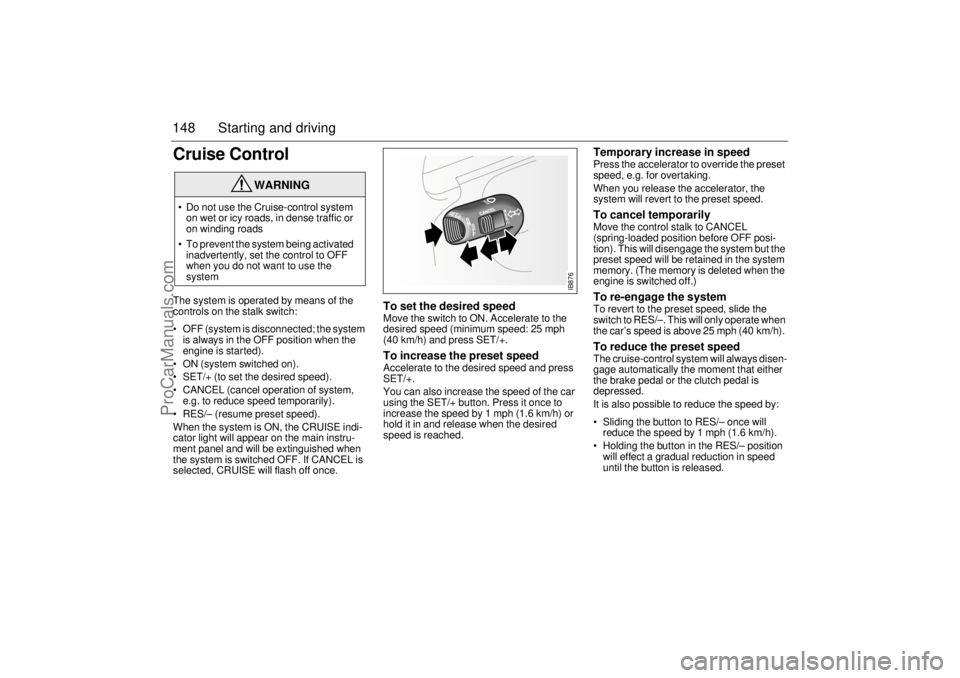
148 Starting and drivingCruise ControlThe system is operated by means of the
controls on the stalk switch:
OFF (system is disconnected; the system
is always in the OFF position when the
engine is started).
ON (system switched on).
SET/+ (to set the desired speed).
CANCEL (cancel operation of system,
e.g. to reduce speed temporarily).
RES/– (resume preset speed).
When the system is ON, the CRUISE indi-
cator light will appear on the main instru-
ment panel and will be extinguished when
the system is switched OFF. If CANCEL is
selected, CRUISE will flash off once.
To set the desired speed Move the switch to ON. Accelerate to the
desired speed (minimum speed: 25 mph
(40 km/h) and press SET/+. To increase the preset speed Accelerate to the desired speed and press
SET/+.
You can also increase the speed of the car
using the SET/+ button. Press it once to
increase the speed by 1 mph (1.6 km/h) or
hold it in and release when the desired
speed is reached.
Temporary increase in speed Press the accelerator to override the preset
speed, e.g. for overtaking.
When you release the accelerator, the
system will revert to the preset speed. To cancel temporarily Move the control stalk to CANCEL
(spring-loaded position before OFF posi-
tion). This will disengage the system but the
preset speed will be retained in the system
memory. (The memory is deleted when the
engine is switched off.) To re-engage the system To revert to the preset speed, slide the
switch to RES/–. This will only operate when
the car’s speed is above 25 mph (40 km/h). To reduce the preset speedThe cruise-control system will always disen-
gage automatically the moment that either
the brake pedal or the clutch pedal is
depressed.
It is also possible to reduce the speed by:
Sliding the button to RES/– once will
reduce the speed by 1 mph (1.6 km/h).
Holding the button in the RES/– position
will effect a gradual reduction in speed
until the button is released.
WARNING
Do not use the Cruise-control system
on wet or icy roads, in dense traffic or
on winding roads
To prevent the system being activated
inadvertently, set the control to OFF
when you do not want to use the
system
IB876
ProCarManuals.com
Page 149 of 236

149 Starting and driving
Disengaging the system The system will be disengaged:
When the brake or clutch pedal is
depressed.
When the switch is moved to CANCEL.
When the switch is moved to OFF.
When the engine is switched off.
When the selector lever is moved to posi-
tion N (cars with automatic transmission).
BrakingTo avoid overheating the brakes, (e.g. when
negotiating long descents with a drop of
several hundred feet), select a low gear to
use the braking effect of the engine. If the
car has automatic transmission, move the
selector lever to position 1 or 2.
When driving fast, you can help to prolong
the life of the brakes by thinking ahead and
braking harder for short periods, rather than
braking more moderately over long
stretches. Brake pad wear indicatorsThe outboard brake pads on the front
wheels incorporate pad-wear indicators.
When the lining is down to 3 mm, the pad
will produce a screeching, squealing or
scraping noise when the brakes are applied.
New pads should be installed without delay.
Brake pads should only be replaced by
an authorized Saab dealer.
To ensure optimum brake performance,
it is recommended that you use only
Saab original brake pads.
WARNING
It is prudent to try your brakes from
time to time, especially when driving in
heavy rain, on roads with a lot of sur-
face water, or in snow or slush. In such
conditions, the brakes may take
longer than normal to take effect. To
rectify this, touch the brake pedal peri-
odically to dry the brakes out.
The same applies after the car has
been washed or when the weather is
very humid.
The brakes are power assisted and it
should be kept in mind that the servo
unit only provides the power assis-
tance when the engine is running.
The brake pressure required when the
engine is off,( e.g. when the car is
being towed) is roughly four times the
normal pedal force required. The
pedal also feels hard and unrespon-
sive.
ProCarManuals.com
Page 150 of 236
150 Starting and drivingABS brakesABS (Antilock Braking System) modulates
the brake pressure to the respective
wheels. Wheel sensors detect if a wheel is
about to lock, and the control module
reduces the pressure to that wheel and then
increases it once more until the tendency is
detected again.
The brake system is equipped with an Elec-
tronic Brake-force Distribution device
(EBD), which distributes the brake pressure
between the front and rear wheels in such a
way as to achieve optimum braking perfor-
mance regardless of the car’s speed and
load.
The ABS system has a built-in diagnostic
function which will switch on the ABS warn-
ing light if a fault is detected in the system
(see page 56). The ABS system will not reduce the braking
distance on loose gravel or on snow or ice
but, because the wheels cannot lock up,
some steering control is retained.
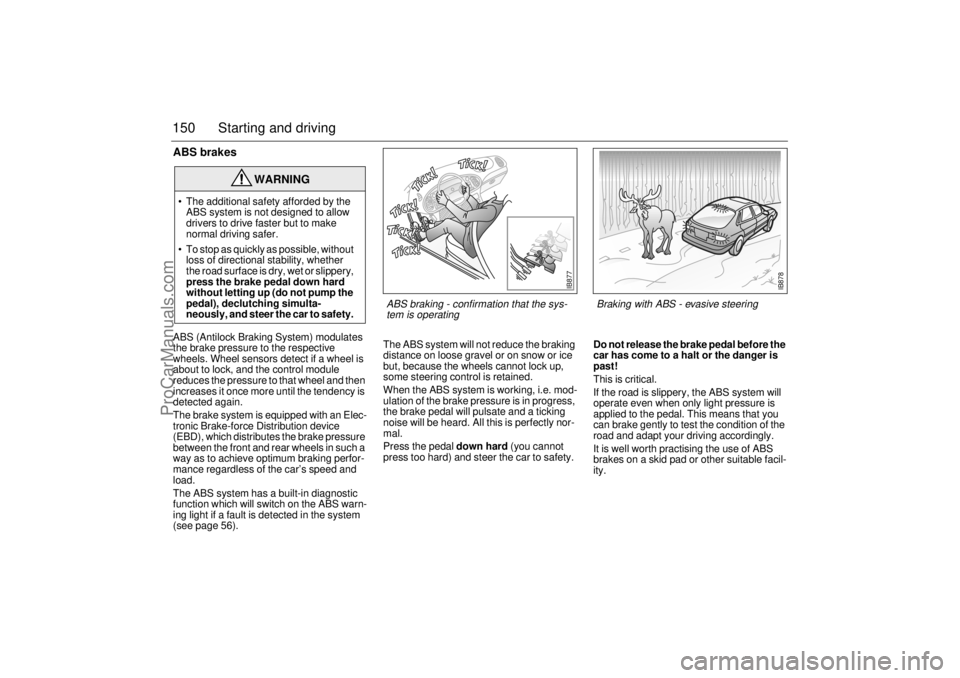
When the ABS system is working, i.e. mod-
ulation of the brake pressure is in progress,
the brake pedal will pulsate and a ticking
noise will be heard. All this is perfectly nor-
mal.
Press the pedal down hard (you cannot
press too hard) and steer the car to safety. Do not release the brake pedal before the
car has come to a halt or the danger is
past!
This is critical.
If the road is slippery, the ABS system will
operate even when only light pressure is
applied to the pedal. This means that you
can brake gently to test the condition of the
road and adapt your driving accordingly.
It is well worth practising the use of ABS
brakes on a skid pad or other suitable facil-
ity.
WARNING
The additional safety afforded by the
ABS system is not designed to allow
drivers to drive faster but to make
normal driving safer.
To stop as quickly as possible, without
loss of directional stability, whether
the road surface is dry, wet or slippery,
press the brake pedal down hard
without letting up (do not pump the
pedal), declutching simulta-
neously, and steer the car to safety.
IB877
ABS braking - confirmation that the sys-
tem is operating
IB878
Braking with ABS - evasive steering
ProCarManuals.com