spare wheel SAAB 9-3 2000 Owners Manual
[x] Cancel search | Manufacturer: SAAB, Model Year: 2000, Model line: 9-3, Model: SAAB 9-3 2000Pages: 236, PDF Size: 10.85 MB
Page 4 of 236
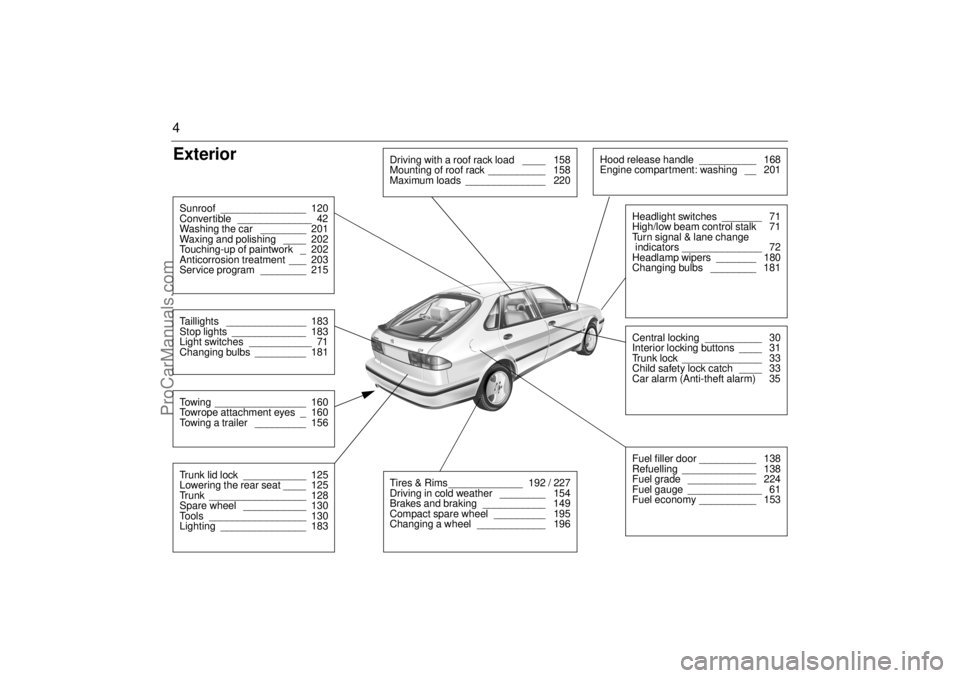
4Exterior Sunroof _______________ 120
Convertible _____________ 42
Washing the car ________ 201
Waxing and polishing ____ 202
Touching-up of paintwork _ 202
Anticorrosion treatment ___ 203
Service program ________ 215Taillights ______________ 183
Stop lights _____________ 183
Light switches ___________ 71
Changing bulbs _________ 181Towing ________________ 160
Towrope attachment eyes _ 160
Towing a trailer _________ 156Trunk lid lock ___________ 125
Lowering the rear seat ____ 125
Trunk _________________ 128
Spare wheel ___________ 130
Tools _________________ 130
Lighting _______________ 183
Driving with a roof rack load ____ 158
Mounting of roof rack __________ 158
Maximum loads ______________ 220
Hood release handle __________ 168
Engine compartment: washing __ 201
Central locking __________ 30
Interior locking buttons ____ 31
Trunk lock ______________ 33
Child safety lock catch ____ 33
Car alarm (Anti-theft alarm) 35Headlight switches _______ 71
High/low beam control stalk 71
Turn signal & lane change
indicators ______________ 72
Headlamp wipers _______ 180
Changing bulbs ________ 181Fuel filler door __________ 138
Refuelling _____________ 138
Fuel grade ____________ 224
Fuel gauge _____________ 61
Fuel economy __________ 153
Tires & Rims _____________ 192 / 227
Driving in cold weather ________ 154
Brakes and braking ___________ 149
Compact spare wheel _________ 195
Changing a wheel ____________ 196
ProCarManuals.com
Page 9 of 236
9
WL16
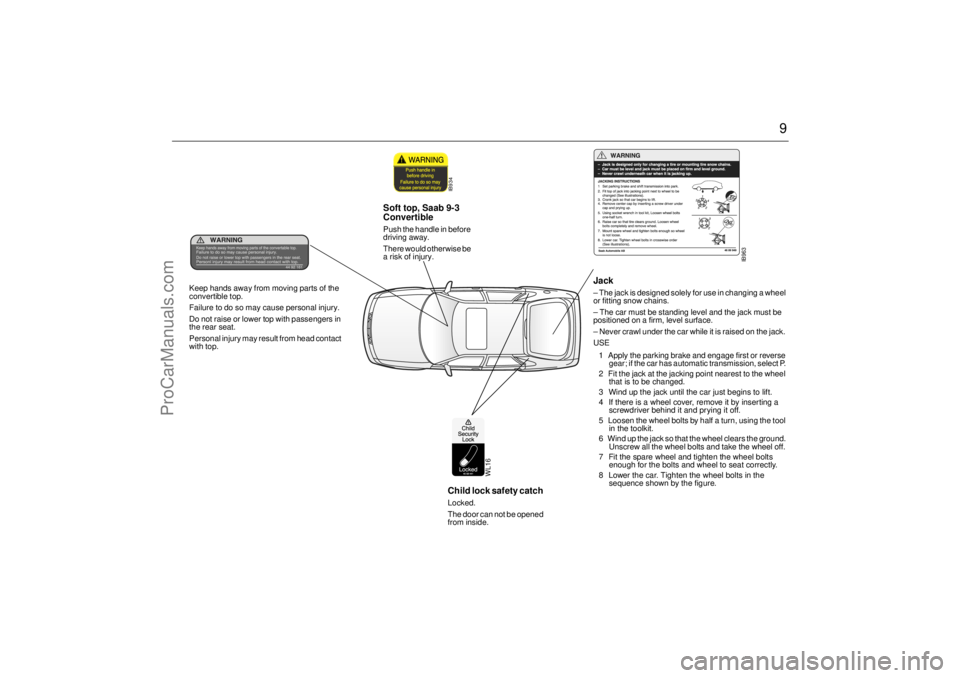
Child lock safety catch Locked.
The door can not be opened
from inside.
IB963
Jack – The jack is designed solely for use in changing a wheel
or fitting snow chains.
– The car must be standing level and the jack must be
positioned on a firm, level surface.
– Never crawl under the car while it is raised on the jack.
USE
1 Apply the parking brake and engage first or reverse
gear; if the car has automatic transmission, select P.
2 Fit the jack at the jacking point nearest to the wheel
that is to be changed.
3 Wind up the jack until the car just begins to lift.
4 If there is a wheel cover, remove it by inserting a
screwdriver behind it and prying it off.
5 Loosen the wheel bolts by half a turn, using the tool
in the toolkit.
6 Wind up the jack so that the wheel clears the ground.
Unscrew all the wheel bolts and take the wheel off.
7 Fit the spare wheel and tighten the wheel bolts
enough for the bolts and wheel to seat correctly.
8 Lower the car. Tighten the wheel bolts in the
sequence shown by the figure.
IB934
Soft top, Saab 9-3
Convertible Push the handle in before
driving away.
There would otherwise be
a risk of injury.
Keep hands away from moving parts of the
convertible top.
Failure to do so may cause personal injury.
Do not raise or lower top with passengers in
the rear seat.
Personal injury may result from head contact
with top.
ProCarManuals.com
Page 111 of 236
111 Interior equipment, trunk
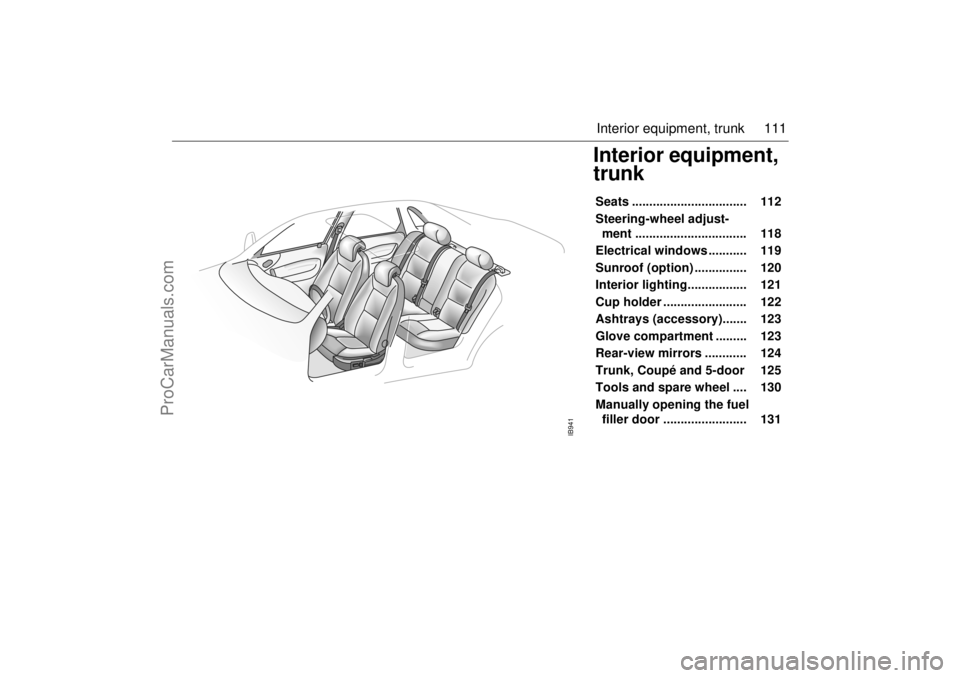
Interior equipment,
trunkSeats ................................. 112
Steering-wheel adjust-
ment ................................ 118
Electrical windows ........... 119
Sunroof (option) ............... 120
Interior lighting................. 121
Cup holder ........................ 122
Ashtrays (accessory)....... 123
Glove compartment ......... 123
Rear-view mirrors ............ 124
Trunk, Coupé and 5-door 125
Tools and spare wheel .... 130
Manually opening the fuel
filler door ........................ 131
IB941
ProCarManuals.com
Page 130 of 236
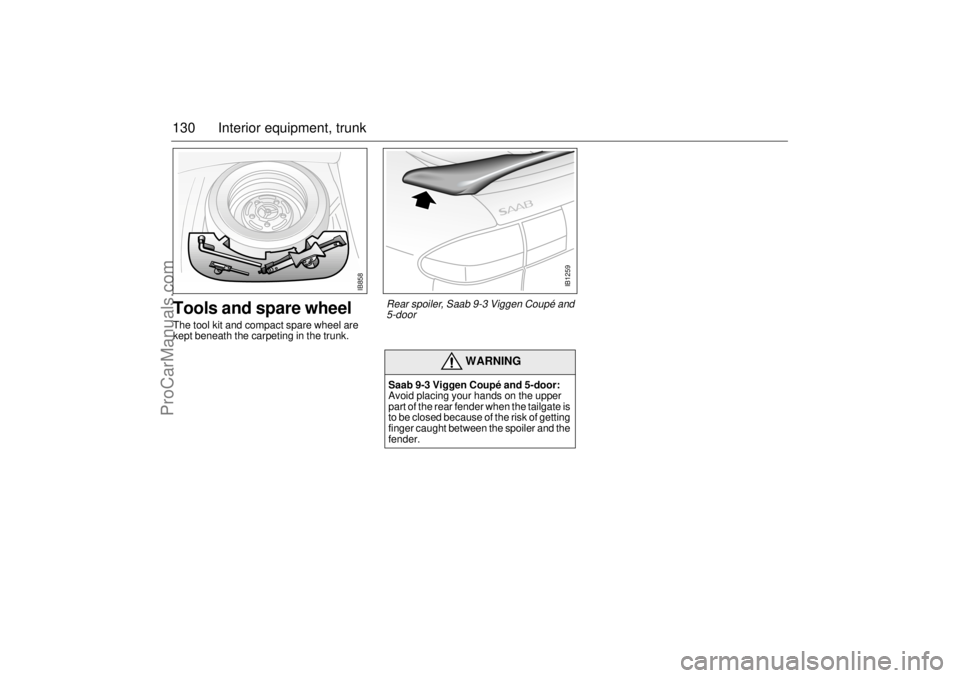
130 Interior equipment, trunkTools and spare wheelThe tool kit and compact spare wheel are
kept beneath the carpeting in the trunk.
WARNING
Saab 9-3 Viggen Coupé and 5-door:
Avoid placing your hands on the upper
part of the rear fender when the tailgate is
to be closed because of the risk of getting
finger caught between the spoiler and the
fender.
IB858
IB1259
Rear spoiler, Saab 9-3 Viggen Coupé and
5-door
ProCarManuals.com
Page 133 of 236
133 Starting and driving
IB943Starting and drivingIgnition switch ................. 134
Starting the engine .......... 135
Important considerations
for driving....................... 136
Engine Break-in Period... 140
Gear changing ................. 141
Manual transmission ...... 141
Automatic transmission . 141
Cruise Control ................. 148
Braking ............................. 149
Parking ............................. 151
Economical motoring ..... 153 Driving in cold weather ... 154
Driving in hot weather ..... 156
Towing a trailer ................ 156
Driving with a roof rack
load .................................. 158
Towing the car.................. 160
Jump starting ................... 162
Driving considerations
with compact spare
wheel/tire fitted............... 165
For long trips .................... 165
Driving with the trunk lid
open ................................ 166
Driving in deep water....... 166
ProCarManuals.com
Page 161 of 236
161 Starting and driving
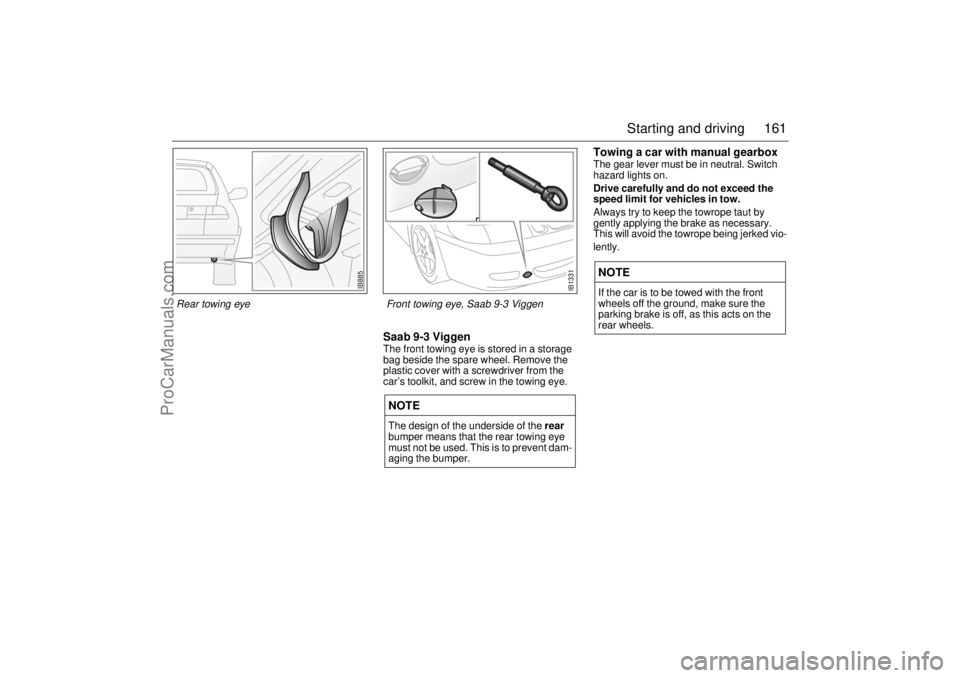
Saab 9-3 ViggenThe front towing eye is stored in a storage
bag beside the spare wheel. Remove the
plastic cover with a screwdriver from the
car’s toolkit, and screw in the towing eye.
Towing a car with manual gearboxThe gear lever must be in neutral. Switch
hazard lights on.
Drive carefully and do not exceed the
speed limit for vehicles in tow.
Always try to keep the towrope taut by
gently applying the brake as necessary.
This will avoid the towrope being jerked vio-
lently.
NOTEThe design of the underside of the rear
bumper means that the rear towing eye
must not be used. This is to prevent dam-
aging the bumper.
NOTEIf the car is to be towed with the front
wheels off the ground, make sure the
parking brake is off, as this acts on the
rear wheels.
IB885
Rear towing eye
IB1331
Front towing eye, Saab 9-3 Viggen
ProCarManuals.com
Page 165 of 236

165 Starting and driving
Driving considerations
with compact spare
wheel/tire fitted The following should be observed when the
compact spare wheel (T115/70 R16) is
installed:
The compact spare is light and easy to
handle when changing the wheel. Do not
drive farther than necessary with the com-
pact spare fitted – the maximum life of the
wheel is only just over 2000 miles
(3,500 km). Have the standard wheel
repaired and reinstalled as soon as possi-
ble.
The car’s ground clearance is reduced with
the compact spare fitted. Note that only one
compact spare wheel may be used at any
time. Take care not to hit the curb and do not
fit snow chains. Leave the wheel cover off,
so that the warning text is readily visible.
For long tripsBefore starting off on a long journey, it is
advisable to have your car inspected over
by your Saab dealer.
Obtain a few important items to take along
on your journey such as spare bulbs, wiper
blades, fuses, a Poly-Vee-belt and the like.
You can check some points yourself before-
hand:
Make sure that the engine is in good con-
dition.
Check that no oil or fuel leaks out of the
engine or gearbox/transmission.
Inspect the Poly-Vee-belt and replace it if
it shows any signs of wear.
Check the battery charge.
Check the tires for tread pattern and air
pressure, including the compact spare
wheel.
Take an extra car key/remote control and
keep it separate, see also page 30.
Check the brakes.
Check all bulbs.
Check for the presence of the tool kit and
the jack in the car.
WARNING
Do not exceed 50 mph (80 km/h) as the
tire can overheat and adversely affect the
handling of the car.
The tire should be inflated to 60 psi
(420 kPa).
NOTETo avoid damaging a punctured alloy
wheel this can be placed outside up in the
spare-wheel well but only while driving to
the closest workshop.
A general rule is that all heavy loads must
be well secured in the luggage compart-
ment, see page 129.
ProCarManuals.com
Page 176 of 236
176 Car careBrake- clutch fluid and
brake pads
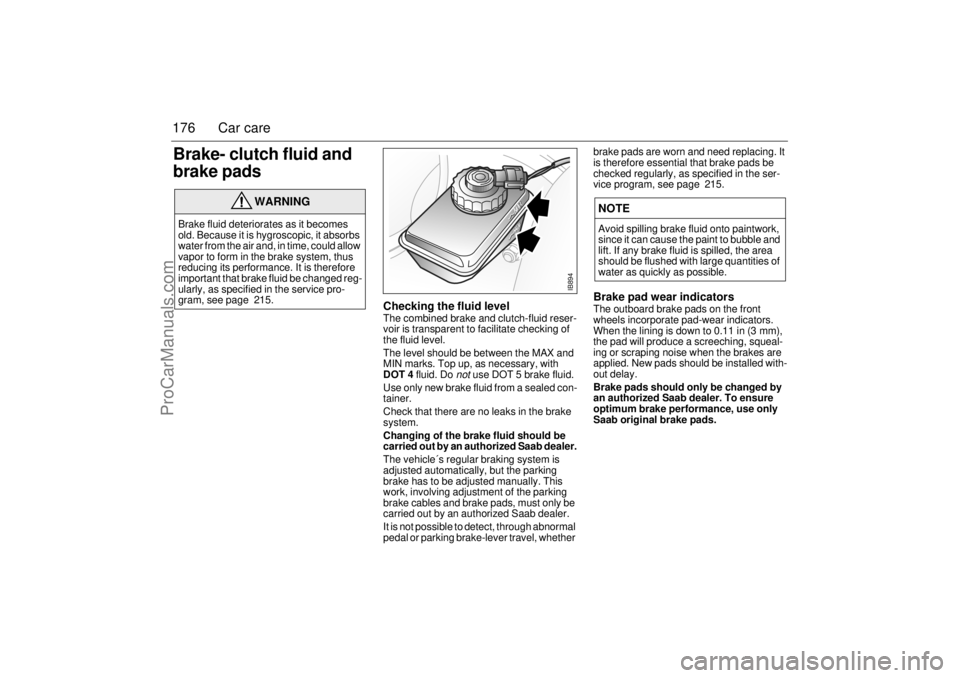
Checking the fluid level The combined brake and clutch-fluid reser-
voir is transparent to facilitate checking of
the fluid level.
The level should be between the MAX and
MIN marks. Top up, as necessary, with
DOT 4 fluid. Do
not
use DOT 5 brake fluid.
Use only new brake fluid from a sealed con-
tainer.
Check that there are no leaks in the brake
system.
Changing of the brake fluid should be
carried out by an authorized Saab dealer.
The vehicle´s regular braking system is
adjusted automatically, but the parking
brake has to be adjusted manually. This
work, involving adjustment of the parking
brake cables and brake pads, must only be
carried out by an authorized Saab dealer.
It is not possible to detect, through abnormal
pedal or parking brake-lever travel, whether brake pads are worn and need replacing. It
is therefore essential that brake pads be
checked regularly, as specified in the ser-
vice program, see page 215.
Brake pad wear indicators The outboard brake pads on the front
wheels incorporate pad-wear indicators.
When the lining is down to 0.11 in (3 mm),
the pad will produce a screeching, squeal-
ing or scraping noise when the brakes are
applied. New pads should be installed with-
out delay.
Brake pads should only be changed by
an authorized Saab dealer. To ensure
optimum brake performance, use only
Saab original brake pads.
WARNING
Brake fluid deteriorates as it becomes
old. Because it is hygroscopic, it absorbs
water from the air and, in time, could allow
vapor to form in the brake system, thus
reducing its performance. It is therefore
important that brake fluid be changed reg-
ularly, as specified in the service pro-
gram, see page 215.
NOTEAvoid spilling brake fluid onto paintwork,
since it can cause the paint to bubble and
lift. If any brake fluid is spilled, the area
should be flushed with large quantities of
water as quickly as possible.
IB894
ProCarManuals.com
Page 193 of 236

193 Car care
Changing the wheels round Because of front wheel drive, the front tires
tend to wear faster than the rear ones. New
tires should always be fitted in pairs, so that
tires on the same axle have the same
amount of tread.
If swapping the complete set, e.g. winter
tires for summer tires, mark the tires
removed to ensure that they go back in the
same position (e.g. FL for front left, RL rear
left, etc.).
Store wheels lying flat or hanging – never
standing upright.
Tire markingsAn example of the meaning of the different
markings in a tire size is given below for a
tire size of 195/60 R15 88V:
Winter tiresWinter (snow) tires are recommended for
winter climates where the majority of your
driving will be done on snow and ice. Winter
tires should be fitted to all four wheels to
maintain a proper balance. Your Saab
dealer can advise you of to the correct size
tire for your car (if different from the original
size) and also supply Saab approved winter
tires pre-mounted on steel or alloy rims.Tire quality grading (cars sold in
U.S.)New tires must be graded and labeled in
accordance with new Federal regulations.
Standard tests are conducted to measure
performance in the areas of traction and
temperature resistance. Refer to the tire
sidewall for the specific quality grades of the
tires provided on your new Saab. Compact
spare tires are exempt.
DOT QUALITY GRADES
Treadwear.
Traction AA, A, B, C.
Temperature A, B, C.
All passenger car tires must conform to Fed-
eral safety requirements in addition to these
grades.
WARNING
When fitting just one new pair of tires,
these should be fitted to the rear wheels,
as these are more critical to the direc-
tional stability of the car (e.g. on braking
or in a skid). The existing rear tires should
therefore be moved to the front. Always
move left rear to left front and right rear to
right front, so that the direction of rotation
remains the same.
195 Tire section width, mm
60 Aspect ratio, i.e. the section height
is 60 % of the section width
R Radial ply
15 Wheel rim diameter 15 in. at bead
seats
88 Tire load code
V Speed marking
Speed ratingsS Tire approved for speeds up to
112 mph (180 km/h)
T Tire approved for speeds up to
118 mph (190 km/h)
H Tire approved for speeds up to
130 mph (210 km/h)
V Tire approved for speeds up to
150 mph (240 km/h)
W Tire approved for speeds up to
167 mph (270 km/h)
Y Tire approved for speeds up to
186 mph (300 km/h)
ProCarManuals.com
Page 195 of 236
195 Car care
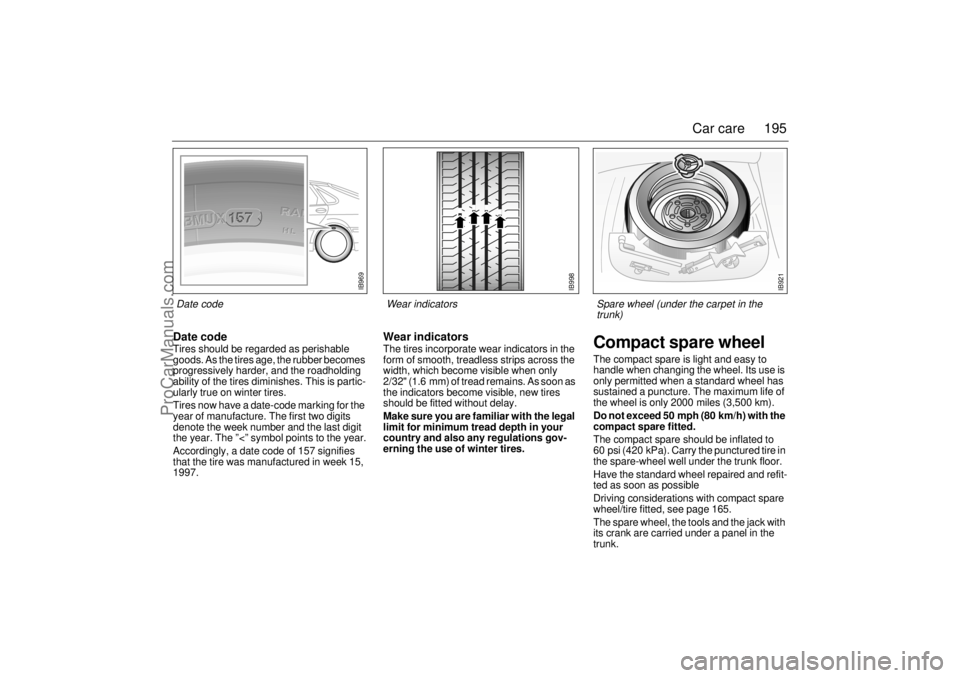
Date codeTires should be regarded as perishable
goods. As the tires age, the rubber becomes
progressively harder, and the roadholding
ability of the tires diminishes. This is partic-
ularly true on winter tires.
Tires now have a date-code marking for the
year of manufacture. The first two digits
denote the week number and the last digit
the year. The ”<” symbol points to the year.
Accordingly, a date code of 157 signifies
that the tire was manufactured in week 15,
1997.
Wear indicatorsThe tires incorporate wear indicators in the
form of smooth, treadless strips across the
width, which become visible when only
2/32" (1.6 mm) of tread remains. As soon as
the indicators become visible, new tires
should be fitted without delay.
Make sure you are familiar with the legal
limit for minimum tread depth in your
country and also any regulations gov-
erning the use of winter tires.
Compact spare wheelThe compact spare is light and easy to
handle when changing the wheel. Its use is
only permitted when a standard wheel has
sustained a puncture. The maximum life of
the wheel is only 2000 miles (3,500 km).
Do not exceed 50 mph (80 km/h) with the
compact spare fitted.
The compact spare should be inflated to
60 psi (420 kPa). Carry the punctured tire in
the spare-wheel well under the trunk floor.
Have the standard wheel repaired and refit-
ted as soon as possible
Driving considerations with compact spare
wheel/tire fitted, see page 165.
The spare wheel, the tools and the jack with
its crank are carried under a panel in the
trunk.
IB969
Date code
IB998
Wear indicators
IB921
Spare wheel (under the carpet in the
trunk)
ProCarManuals.com