ECO mode SAAB 9-3 2001 Owner's Manual
[x] Cancel search | Manufacturer: SAAB, Model Year: 2001, Model line: 9-3, Model: SAAB 9-3 2001Pages: 260, PDF Size: 12.01 MB
Page 161 of 260
161 Starting and driving
Engine Break-in PeriodPistons, cylinder bores and bearings need
time to obtain uniform, wear-resistant sur-
faces.
If a new engine is driven too hard, this grad-
ual process of bedding-in will not be possi-
ble and the life of the engine will be short-
ened.
During the first 1,200 miles (2,000 km), do
not exceed 5,000 rpm.
In addition, refrain from driving the car at full
throttle, other than for brief instances,
during the first 1,800 miles (3,000 km).Wearing in new brake padsNew brake pads take time to bed in, about
90 miles (150 km) if the car is driven largely
under stop-and-go conditions or about
300 miles (500 km) of highway driving.
To extend the useful life of the pads, avoid
hard braking as much as possible.
Manual transmissionTo start the engine the clutch pedal must
be fully depressed.
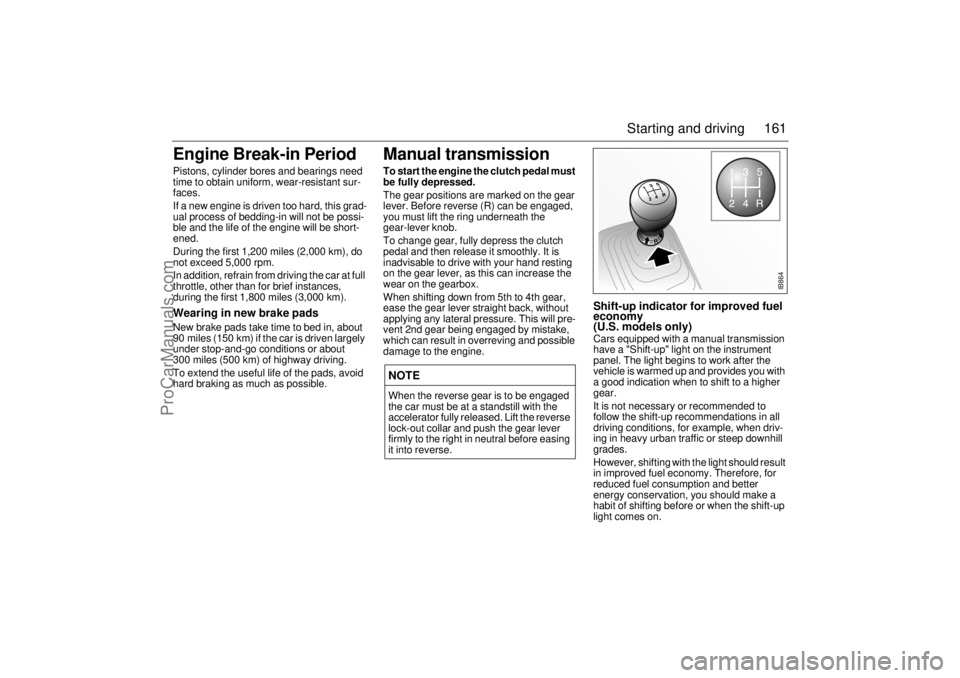
The gear positions are marked on the gear
lever. Before reverse (R) can be engaged,
you must lift the ring underneath the
gear-lever knob.
To change gear, fully depress the clutch
pedal and then release it smoothly. It is
inadvisable to drive with your hand resting
on the gear lever, as this can increase the
wear on the gearbox.
When shifting down from 5th to 4th gear,
ease the gear lever straight back, without
applying any lateral pressure. This will pre-
vent 2nd gear being engaged by mistake,
which can result in overreving and possible
damage to the engine.
Shift-up indicator for improved fuel
economy
(U.S. models only)Cars equipped with a manual transmission
have a "Shift-up" light on the instrument
panel. The light begins to work after the
vehicle is warmed up and provides you with
a good indication when to shift to a higher
gear.
It is not necessary or recommended to
follow the shift-up recommendations in all
driving conditions, for example, when driv-
ing in heavy urban traffic or steep downhill
grades.
However, shifting with the light should result
in improved fuel economy. Therefore, for
reduced fuel consumption and better
energy conservation, you should make a
habit of shifting before or when the shift-up
light comes on.
NOTEWhen the reverse gear is to be engaged
the car must be at a standstill with the
accelerator fully released. Lift the reverse
lock-out collar and push the gear lever
firmly to the right in neutral before easing
it into reverse.
IB864
ProCarManuals.com
Page 163 of 260
163 Starting and driving
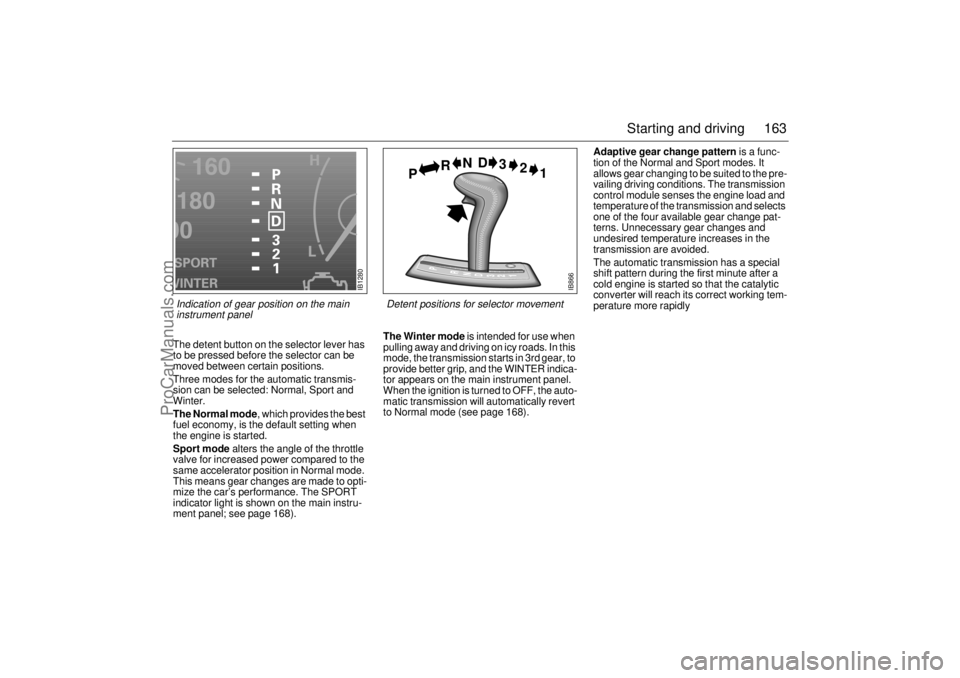
The detent button on the selector lever has
to be pressed before the selector can be
moved between certain positions.
Three modes for the automatic transmis-
sion can be selected: Normal, Sport and
Winter.
The Normal mode, which provides the best
fuel economy, is the default setting when
the engine is started.
Sport mode alters the angle of the throttle
valve for increased power compared to the
same accelerator position in Normal mode.
This means gear changes are made to opti-
mize the car’s performance. The SPORT
indicator light is shown on the main instru-
ment panel; see page 168). The Winter mode is intended for use when
pulling away and driving on icy roads. In this
mode, the transmission starts in 3rd gear, to
provide better grip, and the WINTER indica-
tor appears on the main instrument panel.
When the ignition is turned to OFF, the auto-
matic transmission will automatically revert
to Normal mode (see page 168).Adaptive gear change pattern is a func-
tion of the Normal and Sport modes. It
allows gear changing to be suited to the pre-
vailing driving conditions. The transmission
control module senses the engine load and
temperature of the transmission and selects
one of the four available gear change pat-
terns. Unnecessary gear changes and
undesired temperature increases in the
transmission are avoided.
The automatic transmission has a special
shift pattern during the first minute after a
cold engine is started so that the catalytic
converter will reach its correct working tem-
perature more rapidly
IB1280
Indication of gear position on the main
instrument panel
PRND
3
2
1
IB866
Detent positions for selector movement
ProCarManuals.com
Page 165 of 260
165 Starting and driving
Automatic transmission
fault indicator
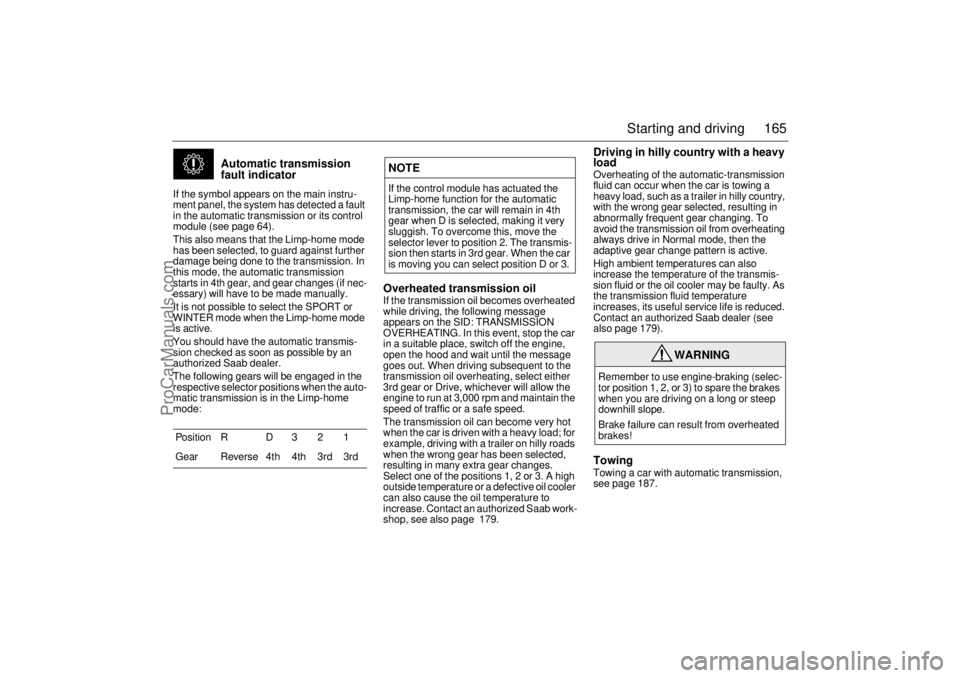
If the symbol appears on the main instru-
ment panel, the system has detected a fault
in the automatic transmission or its control
module (see page 64).
This also means that the Limp-home mode
has been selected, to guard against further
damage being done to the transmission. In
this mode, the automatic transmission
starts in 4th gear, and gear changes (if nec-
essary) will have to be made manually.
It is not possible to select the SPORT or
WINTER mode when the Limp-home mode
is active.
You should have the automatic transmis-
sion checked as soon as possible by an
authorized Saab dealer.
The following gears will be engaged in the
respective selector positions when the auto-
matic transmission is in the Limp-home
mode:
Overheated transmission oilIf the transmission oil becomes overheated
while driving, the following message
appears on the SID: TRANSMISSION
OVERHEATING. In this event, stop the car
in a suitable place, switch off the engine,
open the hood and wait until the message
goes out. When driving subsequent to the
transmission oil overheating, select either
3rd gear or Drive, whichever will allow the
engine to run at 3,000 rpm and maintain the
speed of traffic or a safe speed.
The transmission oil can become very hot
when the car is driven with a heavy load; for
example, driving with a trailer on hilly roads
when the wrong gear has been selected,
resulting in many extra gear changes.
Select one of the positions 1, 2 or 3. A high
outside temperature or a defective oil cooler
can also cause the oil temperature to
increase. Contact an authorized Saab work-
shop, see also page 179.
Driving in hilly country with a heavy
loadOverheating of the automatic-transmission
fluid can occur when the car is towing a
heavy load, such as a trailer in hilly country,
with the wrong gear selected, resulting in
abnormally frequent gear changing. To
avoid the transmission oil from overheating
always drive in Normal mode, then the
adaptive gear change pattern is active.
High ambient temperatures can also
increase the temperature of the transmis-
sion fluid or the oil cooler may be faulty. As
the transmission fluid temperature
increases, its useful service life is reduced.
Contact an authorized Saab dealer (see
also page 179).TowingTowing a car with automatic transmission,
see page 187. Position R D 3 2 1
Gear Reverse 4th 4th 3rd 3rd
NOTEIf the control module has actuated the
Limp-home function for the automatic
transmission, the car will remain in 4th
gear when D is selected, making it very
sluggish. To overcome this, move the
selector lever to position 2. The transmis-
sion then starts in 3rd gear. When the car
is moving you can select position D or 3.
WARNING
Remember to use engine-braking (selec-
tor position 1, 2, or 3) to spare the brakes
when you are driving on a long or steep
downhill slope.
Brake failure can result from overheated
brakes!
ProCarManuals.com
Page 167 of 260

167 Starting and driving
If the gear selector lever is moved from position D to 1, a
change-down to 3rd gear will occur at about 110 mph (180 km/h).
A change-down to 2nd gear will occur at about 75 mph (120 km/h)
and to 1st gear at about 40 mph (65 km/h).
When position 1 is selected, all the other gears will be locked out.
Manual gear-changing is not recommended on slippery roads.
If one of the drive wheels spins excessively, the engine torque will
be reduced to avoid damaging the transmission
Adaptive gear-change patternsAdaptive gear-change patterns are selected automatically depend-
ing on the engine load. This function applies in the Normal and Sport
modes.
The change occurs at a higher rotation speed and the gear remains
engaged for a longer period, if the control module senses that the
load does not drop. These change patterns avoid unnecessary gear
changes when, for example, driving on long inclines with a trailer,
and to prevent overheating of the transmission oil. This function cuts
in automatically if the oil becomes too hot, to protect the transmis-
sion from damage, and lowers the oil temperature.
The adaptive change pattern function is not activated at speeds over
93 mph (150 km/h). If a pattern is in operation when this speed is
exceeded, it will be maintained until the control module senses that
a more suitable one can be activated.
The adaptive gear-change pattern function is deselected when:
Winter mode is selected.
The engine is switched off.
The load is reduced by so much that this function is no longer
required.
“Automatic transmission fault indicator” appears on the
main instrument panel, see page 165.
ProCarManuals.com
Page 170 of 260

170 Starting and drivingDisengaging the system The system will be disengaged:
When the brake or clutch pedal is
depressed.
When the switch is moved to CANCEL.
When the switch is moved to OFF.
When the engine is switched off.
When the selector lever is moved to posi-
tion N (cars with automatic transmission).
BrakingTo avoid overheating the brakes, (e.g. when
negotiating long descents with a drop of
several hundred feet), select a low gear to
use the braking effect of the engine. If the
car has automatic transmission, move the
selector lever to position 1 or 2.
When driving fast, you can help to prolong
the life of the brakes by thinking ahead and
braking harder for short periods, rather than
braking more moderately over long
stretches. Brake pad wear indicatorsThe outboard brake pads on the front
wheels incorporate pad-wear indicators.
When the lining is down to 3 mm, the pad
will produce a screeching, squealing or
scraping noise when the brakes are applied.
New pads should be installed without delay.
Brake pads should only be replaced by
an authorized Saab dealer.
To ensure optimum brake performance,
it is recommended that you use only
Saab original brake pads.
WARNING
It is prudent to try your brakes from
time to time, especially when driving in
heavy rain, through water collected on
the road, in snow, on a wet road sur-
face or in salty slush. In such condi-
tions, the brakes may take longer than
normal to take effect. To rectify this,
touch the brake pedal periodically to
dry the brakes out.
The same applies after the car has
been washed or when the weather is
very humid.
Avoid parking the car with wet brakes.
Before parking, and if the traffic condi-
tions allow, brake quite heavily so that
the brake discs and pads warm up and
dry.
The brakes are power assisted and it
should be kept in mind that the servo
unit only provides the power assis-
tance when the engine is running.
The brake pressure required when the
engine is off,( e.g. when the car is
being towed) is roughly four times the
normal pedal force required. The
pedal also feels hard and unrespon-
sive.
ProCarManuals.com
Page 181 of 260
181 Starting and driving
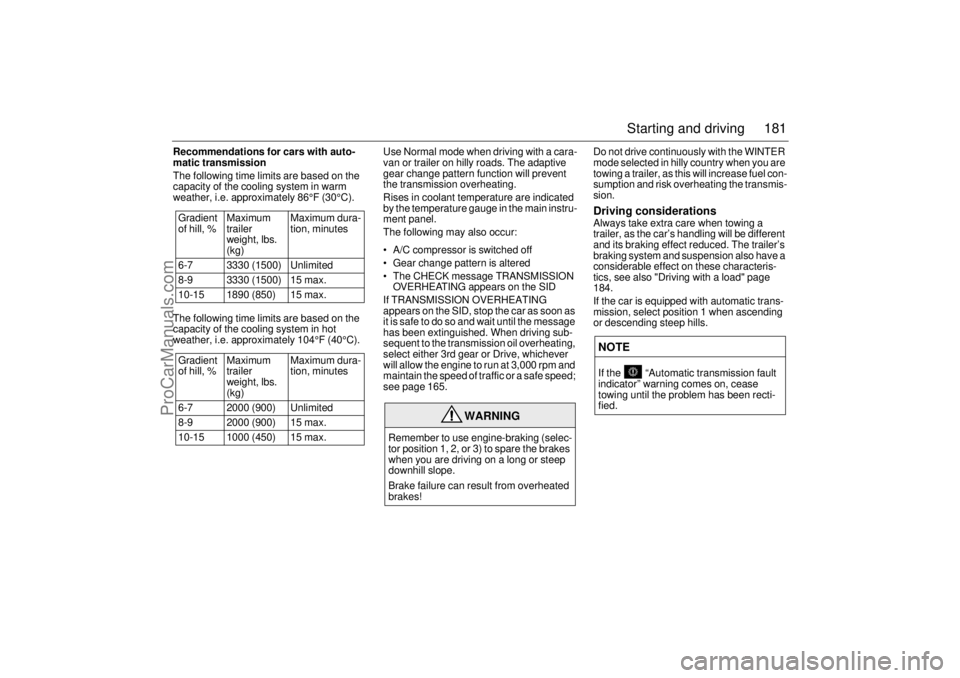
Recommendations for cars with auto-
matic transmission
The following time limits are based on the
capacity of the cooling system in warm
weather, i.e. approximately 86°F (30°C).
The following time limits are based on the
capacity of the cooling system in hot
weather, i.e. approximately 104°F (40°C).Use Normal mode when driving with a cara-
van or trailer on hilly roads. The adaptive
gear change pattern function will prevent
the transmission overheating.
Rises in coolant temperature are indicated
by the temperature gauge in the main instru-
ment panel.
The following may also occur:
A/C compressor is switched off
Gear change pattern is altered
The CHECK message TRANSMISSION
OVERHEATING appears on the SID
If TRANSMISSION OVERHEATING
appears on the SID, stop the car as soon as
it is safe to do so and wait until the message
has been extinguished. When driving sub-
sequent to the transmission oil overheating,
select either 3rd gear or Drive, whichever
will allow the engine to run at 3,000 rpm and
maintain the speed of traffic or a safe speed;
see page 165.Do not drive continuously with the WINTER
mode selected in hilly country when you are
towing a trailer, as this will increase fuel con-
sumption and risk overheating the transmis-
sion.
Driving considerationsAlways take extra care when towing a
trailer, as the car’s handling will be different
and its braking effect reduced. The trailer’s
braking system and suspension also have a
considerable effect on these characteris-
tics, see also "Driving with a load" page
184.
If the car is equipped with automatic trans-
mission, select position 1 when ascending
or descending steep hills. Gradient
of hill, % Maximum
trailer
weight, lbs.
(kg)Maximum dura-
tion, minutes
6-7 3330 (1500) Unlimited
8-9 3330 (1500) 15 max.
10-15 1890 (850) 15 max.
Gradient
of hill, % Maximum
trailer
weight, lbs.
(kg)Maximum dura-
tion, minutes
6-7 2000 (900) Unlimited
8-9 2000 (900) 15 max.
10-15 1000 (450) 15 max.
WARNING
Remember to use engine-braking (selec-
tor position 1, 2, or 3) to spare the brakes
when you are driving on a long or steep
downhill slope.
Brake failure can result from overheated
brakes!
NOTEIf the “Automatic transmission fault
indicator” warning comes on, cease
towing until the problem has been recti-
fied.
ProCarManuals.com
Page 182 of 260
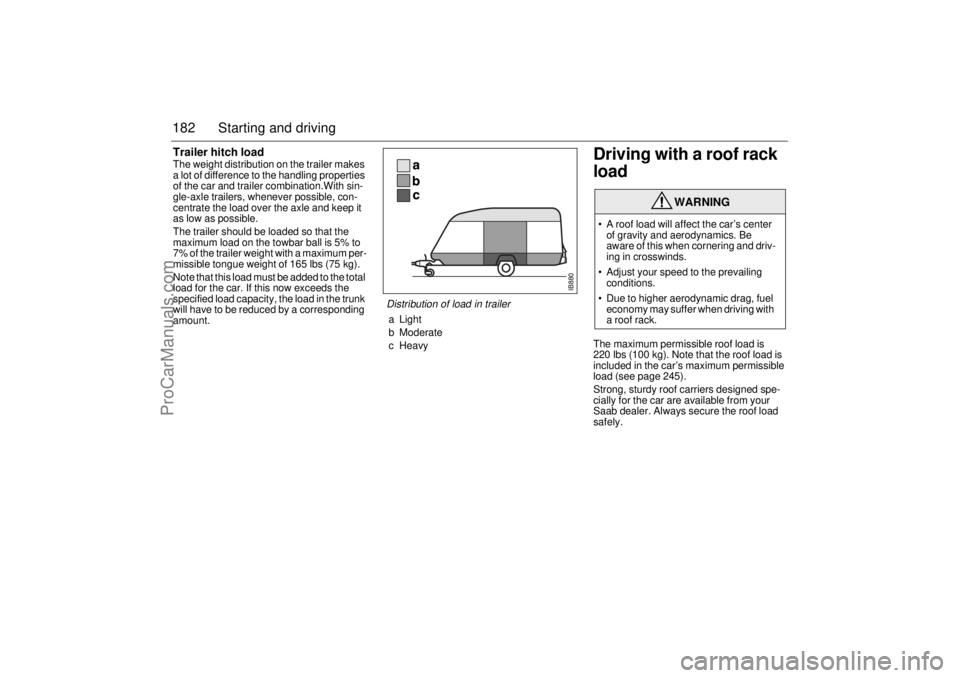
182 Starting and drivingTrailer hitch loadThe weight distribution on the trailer makes
a lot of difference to the handling properties
of the car and trailer combination.With sin-
gle-axle trailers, whenever possible, con-
centrate the load over the axle and keep it
as low as possible.
The trailer should be loaded so that the
maximum load on the towbar ball is 5% to
7% of the trailer weight with a maximum per-
missible tongue weight of 165 lbs (75 kg).
Note that this load must be added to the total
load for the car. If this now exceeds the
specified load capacity, the load in the trunk
will have to be reduced by a corresponding
amount.
Driving with a roof rack
loadThe maximum permissible roof load is
220 lbs (100 kg). Note that the roof load is
included in the car’s maximum permissible
load (see page 245).
Strong, sturdy roof carriers designed spe-
cially for the car are available from your
Saab dealer. Always secure the roof load
safely.
WARNING
A roof load will affect the car’s center
of gravity and aerodynamics. Be
aware of this when cornering and driv-
ing in crosswinds.
Adjust your speed to the prevailing
conditions.
Due to higher aerodynamic drag, fuel
economy may suffer when driving with
a roof rack.
IB880
Distribution of load in trailer aLight
b Moderate
cHeavy
ProCarManuals.com
Page 217 of 260

217 Car care
WheelsAlternative wheels and tiresIf you wish to fit other tires or wheels than
those supplied with the car, consult your
Saab dealer first as to the possibilities avail-
able.
Wheels/tires combinations that are not
approved by Saab can negatively affect the
car´s directional stability, steering and brak-
ing in both wet and dry conditions.
Do not assume that a wheel/tire combina-
tion will function properly just because it will
bolt on.
The wheels and tires have been carefully
matched to the characteristics of the car and
play a key role in its outstanding roadhold-
ing and handling.
Tire pressureTires need to be inflated to suit the load car-
ried and the maximum speed the car will be
driven (see the recommended tire pres-
sures on the back cover). Tire pressure
label, see page 253.
Note that all values apply to cold tires. For
tires with an aspect ratio less than /60,
increase the tire pressure by 3 psi (20 kPa)
for rough roads with potholes to minimize
the risk of rim damage.
Never reduce the pressure of a hot tire. If the
tires are hot when you check them, only
increase the pressure, if necessary.
Soft tires will cause faster wear than
over-pressurized tires. They also increase
fuel consumption.
If a valve is leaking, simply unscrew it and fit
a new one.
Important! Remember to adjust the tire
pressures if you change the load in the car
or intend to cruise at a substantially higher
or lower speed than normal.
NOTEFor wide wheels and/or low-profile tires,
bear in mind the following:
Tires and wheels can be damaged in
potholes etc.
Springs, shock absorbers and wheel
bearings can be overloaded.
The wheels can come into contact with
chassis and body components.
The speed and load limits for the tires
must not be exceeded; see page 218.
Wheels larger than 17” must not be
fitted on the Saab 9-3. For Viggen
models the wheel should not be larger
than 17”. The maximum permissible
offset for the 9-3 is 49 mm and for the
Viggen 42 mm.
Wheels smaller than 16” must not be
fitted on Viggen models. Fitting a
smaller size wheel on a Viggen is not
possible due to the size of the brake
discs.
NOTECheck the tire pressures at least once
per month.
Underinflation is the main cause of:
Tires wearing out prematurely.
Damage to the sidewalls.
Damage to the wheels.
ProCarManuals.com
Page 238 of 260

238 Maintenance and owner assistanceChange of Address Notification
(U.S. and Canada)Two change of address cards are provided
at the end of the Warranties and Service
Record Booklet. Knowing your current
address allows Saab to contact you in the
event of a recall or service campaign.
Please help us keep our records up to date
for your own peace of mind.Service informationFactory Service Manuals for the Saab 9-3
and 9-5 car lines can be ordered through the
dealer. These are comprehensive manuals
on CD rom, geared to use by professional
technicians.
Consult your Saab dealer for prices and for
a listing for your model.
Reporting Safety
Defects (U.S.A.)If you believe that your vehicle has a defect
which could cause a crash or could cause
injury or death, you should immediately
inform the National Highway Traffic Safety
Administration (NHTSA) in addition to noti-
fying Saab Cars USA, Inc.
If NHTSA receives similar complaints, it
may open an investigation, and if it finds that
a safety defect exists in a group of vehicles,
it may order a recall and remedy campaign.
However, NHTSA cannot become involved
in individual problems between you, your
dealer, or Saab Cars USA, Inc.
To contact NHTSA, you may either call the
Auto Safety Hotline toll-free at 1-800-424-
9393 (or 202/366-0123 in Washington D.C.
area) or write to: NHTSA, U.S. Department
of Transportation, Washington, D.C. 20590.
You can also obtain other information about
motor vehicle safety from the Hotline.
Reporting Safety
Defects to the Canadian
governmentIf you live in Canada, and believe that your
vehicle has a safety defect, you should
immediately notify Transport Canada, in
addition to notifying General Motors of
Canada Limited.
You may write to Transport Canada at Box
8880, Ottawa, Ontario, K1G 3J2.
In addition to notifying Transport Canada in
a situation like this, we certainly hope you
will notify us. In Canada, please call our
Saab Customer Assistance Centre at
1-800-263- 1999.
Or write:
General Motors of Canada Limited
Customer Assistance Centre,
1908 Colonel Sam Drive,
Oshawa, Ontario, L1H 8P7.
ProCarManuals.com
Page 239 of 260

239 Maintenance and owner assistance
Saab Original Service Program M2001 USA, Canada, (9-3 Models)* These are the minimum required Emission Control System maintenance steps. Saab urges that all recommended maintenance procedures be performed
according to this program.
(a.) Engine oil and filter should be changed at least once a year. Intermediate oil and filter changes (halfway between indicated intervals) suggested for
cars primarily used for driving in dense city traffic or for repeated short trip operation without sufficient warm up.
** Service intervals:
Refer to the Warranties & Service Record Book for service intervals beyond 100,000 miles (160,000 km).Service Intervals **
Miles = U.S. Cars
Kilometers = Canadian Cars
30 day
10,000
(16,000 km)
20,000
(32,000 km)
30,000
(48,000 km)
40,000
(64,000 km)
50,000
(80,000 km)
60,000
(96,000 km)
70,000
(112,000 km)
80,000
(128,000 km)
90,000
(144,000 km)
100,000
(160,000 km)
Service #
1234567891011
Engine and engine compartment
E Engine oil and filter (a.)!!!!!!!!!!
R Engine coolant freezing point and level""" """ ""
R Engine coolant flush and replace (max. 3-year intervals)!!
R Engine cooling system, hoses and cap""""""""""
R Drive belt; condition""""" ! """"
E Spark plugs!
*
!*
!*
E Crankcase ventilation and vacuum lines""
Application/type of service (col. 1) Service Procedure
E = emission service"= Check - top up, adjust or replace if necessary
R = regular maintenance!= Replace
#= Lubricate
ProCarManuals.com