oil SAAB 9-3 2001 Owner's Guide
[x] Cancel search | Manufacturer: SAAB, Model Year: 2001, Model line: 9-3, Model: SAAB 9-3 2001Pages: 260, PDF Size: 12.01 MB
Page 231 of 260
231 Car care
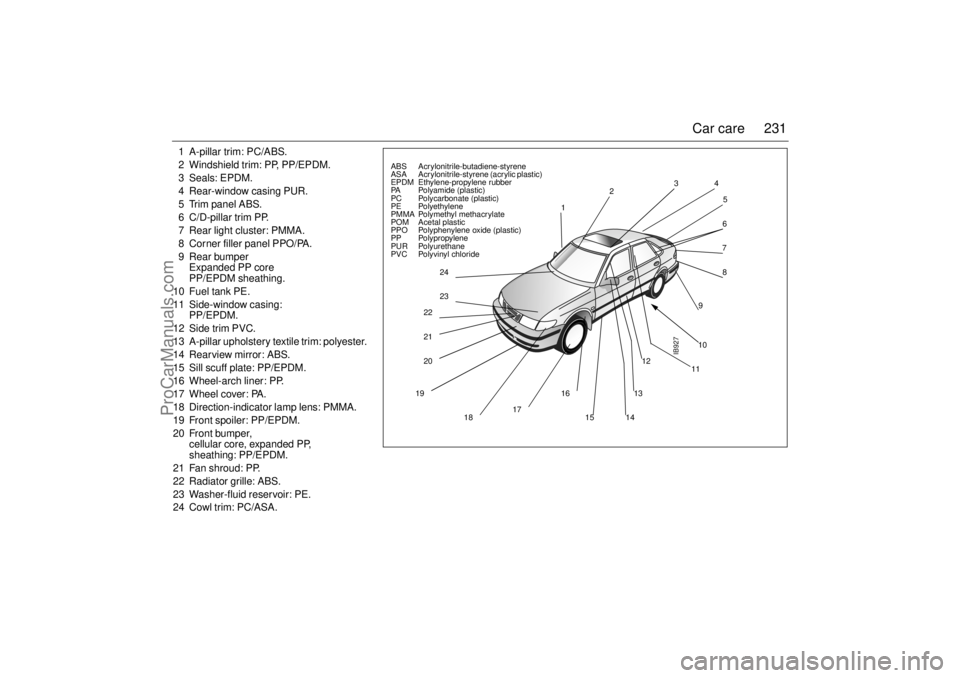
1 A-pillar trim: PC/ABS.
2 Windshield trim: PP, PP/EPDM.
3 Seals: EPDM.
4 Rear-window casing PUR.
5 Trim panel ABS.
6 C/D-pillar trim PP.
7 Rear light cluster: PMMA.
8 Corner filler panel PPO/PA.
9 Rear bumper
Expanded PP core
PP/EPDM sheathing.
10 Fuel tank PE.
11 Side-window casing:
PP/EPDM.
12 Side trim PVC.
13 A-pillar upholstery textile trim: polyester.
14 Rearview mirror: ABS.
15 Sill scuff plate: PP/EPDM.
16 Wheel-arch liner: PP.
17 Wheel cover: PA.
18 Direction-indicator lamp lens: PMMA.
19 Front spoiler: PP/EPDM.
20 Front bumper,
cellular core, expanded PP,
sheathing: PP/EPDM.
21 Fan shroud: PP.
22 Radiator grille: ABS.
23 Washer-fluid reservoir: PE.
24 Cowl trim: PC/ASA.
IB927
19 20 21 22 23 24 1 2 3 4
18 1716
15 14 13 12
11 7
10 98 6 5 ABS Acr ylonitrile-butadiene-styrene
ASA Acrylonitrile-styrene (acrylic plastic)
EPDM Ethylene-propylene rubber
PA Polyamide (plastic)
PC Polycarbonate (plastic)
PE Polyethylene
PMMA Polymethyl methacrylate
POM Acetal plastic
PPO Polyphenylene oxide (plastic)
PP Polypropylene
PUR Polyurethane
PVC Polyvinyl chloride
ProCarManuals.com
Page 236 of 260

236 Maintenance and owner assistanceMaintenance scheduleThe Maintenance Schedule prescribes a
service program to the purchaser/operator
of a Saab that is reasonable and necessary
to ensure the proper emission control sys-
tems function, safety and reliability of the
Saab automobile in normal use. Additional
maintenance is recommended for specific
components when the car is operated under
certain severe conditions. Proper mainte-
nance is always a good practice!
Authorized Saab dealers are equipped and
trained to meet your Saab’s service needs.
They regularly receive up-to-date Saab ser-
vice manuals and parts and technical ser-
vice bulletins from Saab and are able,
through their franchise agreement, to attend
Saab service schools, obtain Saab special
tools and technical assistance and pur-
chase original equipment service and
replacement parts.
Today’s complex automobiles should only
be entrusted to the most knowledgeable
service professionals. A Saab dealer is your
best choice.
Service intervalsThe maintenance schedule is comprised of
a Check -up 30 days after retail delivery, fol-
lowed by services at every 10,000 miles
(16,000 km) thereafter (10,000, 20,000,
30,000 miles/16,000 32,000, 48,000 km
etc.).
Engine oil and filter changesChanging the engine oil and filter is required
at every service point. Use only a Saab
approved long-life oil filter and engine oils
meeting the SAE viscosity ratings and API
service classifications stated in the “Techni-
cal data” section of this Owner’s Manual.
The use of extra additives in the oil is not
necessary and is not recommended, and
may be harmful to turbochargers.
More frequent oil changes are recom-
mended if your vehicle is operated under
any of the following conditions:
Most trips are less than 5-10 miles (8-16
km). This is particularly important when
outside temperatures are below freezing.
Most trips include extensive idling (fre-
quent stop-and-go traffic).
Most trips are through dusty areas (such
as construction zones).
If the vehicle is used for delivery service,
police, taxi or other commercial applica-
tions.
If your driving habits match this description,
have the engine oil and filter changed in-
between normal services at 5,000 mile
(8,000 km) intervals. These conditions
cause the engine oil to break down faster.
The Warranties and Service Record Book-
let has provisions to record extra oil
changes.
NOTEThe Check-up will be done by your Saab
dealer at no charge and should be done
as close as possible to the scheduled 30
days.
ProCarManuals.com
Page 237 of 260

237 Maintenance and owner assistance
Service record retentionService instruction coupons and record
stubs are provided in the Saab Warranties
and Service Record Booklet which accom-
panies this Owner’s Manual. The coupons
are arranged in the order that normal ser-
vice should be performed. The edge of each
coupon is shaded to correspond to the type
of service point:
Striped - "Check-up".
Blue - Oil change/inspection service.
Black - Major service.
Note that in Canada a combined service
and warranty book is used, but not service
coupons.
When scheduled services are performed,
your dealer will tear out the applicable
coupon and use it to check off the opera-
tions performed and enter it into the service
file at the dealership. The servicing dealer’s
stamp, along with the date and mileage at
which the service was done, should be
entered on the corresponding stub which
remains in your booklet. The booklet is your
permanent record of the services per-
formed. It also includes a log sheet for
unscheduled repairs.
It is advisable to retain receipts and, if pos-
sible, copies of shop work orders for all ser-
vice and repair work, wherever performed.
Service costsDealer pricing practices and labor for ser-
vice work vary. Saab’s recommended ser-
vice times for each service point do not
include the labor required to replace wear
items, such as wiper blades, brake pads or
tires. Nor is labor to perform other service or
repairs found to be necessary as a result of
the inspections included in these times.
Additional labor and parts will be charged
for such work when necessary, except as
covered under an applicable Saab warranty
or any optional extended service contract.
Transmission fluid changes or suspension
alignment, when necessary, are also addi-
tional.
Dealer charges for general shop material,
regulated hazardous waste removal, recy-
cling expenses or other operation costs may
also be applied to service and repair
invoices and are apt to vary by dealer and
location.
Owner assistanceWarranties and service problem
assistanceFor complete information about all applica-
ble warranties, including the New Car War-
ranty, Perforation Warranty, Vehicle Emis-
sion Warranty and Emission Perforation
Warranty, consult the Warranties and Ser-
vice Record Booklet which accompanies
this Owner’s Manual. It also contains owner
assistance information including Saab
Roadside Assistance. If the booklet is lost or
misplaced, a new one may be ordered
through a Saab dealer or by contacting
Saab.
In the U.S. there is a national Customer
Assistance Center at Saab Cars USA, Inc.
The toll-free number to call from all 50 states
is 1-800-955-9007.
In Canada, please call the Saab Customer
Assistance Centre at 1-800-263-1999.
A list of authorized Saab sales and service
dealers is available for those planning to
travel in the United States and Canada.
Canadian or U.S. travelers may call the
Customer Assistance Center in the country
in which they are traveling.
ProCarManuals.com
Page 239 of 260

239 Maintenance and owner assistance
Saab Original Service Program M2001 USA, Canada, (9-3 Models)* These are the minimum required Emission Control System maintenance steps. Saab urges that all recommended maintenance procedures be performed
according to this program.
(a.) Engine oil and filter should be changed at least once a year. Intermediate oil and filter changes (halfway between indicated intervals) suggested for
cars primarily used for driving in dense city traffic or for repeated short trip operation without sufficient warm up.
** Service intervals:
Refer to the Warranties & Service Record Book for service intervals beyond 100,000 miles (160,000 km).Service Intervals **
Miles = U.S. Cars
Kilometers = Canadian Cars
30 day
10,000
(16,000 km)
20,000
(32,000 km)
30,000
(48,000 km)
40,000
(64,000 km)
50,000
(80,000 km)
60,000
(96,000 km)
70,000
(112,000 km)
80,000
(128,000 km)
90,000
(144,000 km)
100,000
(160,000 km)
Service #
1234567891011
Engine and engine compartment
E Engine oil and filter (a.)!!!!!!!!!!
R Engine coolant freezing point and level""" """ ""
R Engine coolant flush and replace (max. 3-year intervals)!!
R Engine cooling system, hoses and cap""""""""""
R Drive belt; condition""""" ! """"
E Spark plugs!
*
!*
!*
E Crankcase ventilation and vacuum lines""
Application/type of service (col. 1) Service Procedure
E = emission service"= Check - top up, adjust or replace if necessary
R = regular maintenance!= Replace
#= Lubricate
ProCarManuals.com
Page 240 of 260

240 Maintenance and owner assistance* These are the minimum required Emission Control System maintenance steps. Saab urges that all recommended maintenance procedures be performed
according to this program.
(b.) Change automatic transmission fluid at more frequent intervals (30,000; 90,000 miles, etc.) if car is driven in dense city traffic where the outside tem-
perature regularly reaches 90°F or higher, if car is used in a mountainous/high altitude area or for trailer towing.
Service Intervals **
Miles = U.S. Cars
Kilometers = Canadian Cars
30 day
10,000
(16,000 km)
20,000
(32,000 km)
30,000
(48,000 km)
40,000
(64,000 km)
50,000
(80,000 km)
60,000
(96,000 km)
70,000
(112,000 km)
80,000
(128,000 km)
90,000
(144,000 km)
100,000
(160,000 km)
Service #
1234567891011
Engine and engine compartment (cont.)
E Evaporative emission system including filler cap, vapor
lines, EVAP canister and canister purge valve""
R Fuel system; leaks and damages""""""""""
E Fuel filter!
E Engine air cleaner element!
*
!*
!*
R Exhaust system and mountings; leaks and condition""""""""""
Electrical
R Battery; state of charge and electrolyte level; clean termi-
nals if necessary"""""""""""
R Headlamp and fog lamp alignment"""""
R Head, fog, brake, tail, turn signal, warning lights instru-
ment panel, backup and marker lamps"""""""""""
Transmission
R Automatic transmission change fluid (b.)!
R Automatic transmission; oil level and condition"""""" """"
R Manual transmission; oil level""
R Outer and inner driver joint boots""""""""""
ProCarManuals.com
Page 243 of 260
243 Technical data
Technical dataGeneral particulars .......... 244
Engine ............................... 247
Engine oil .......................... 247
Fuel.................................... 249
Engine variants ................ 249
Electrical system.............. 250
Drive belts......................... 250
Manual transmission ....... 250
Automatic transmission .. 250
Suspension....................... 251
Steering............................. 251
Brake system.................... 251
Rims and tires .................. 252
Plates and labels .............. 253
IB993
ProCarManuals.com
Page 247 of 260

247 Technical data
Engine Engine oilType _____________________________ 4 cyl, 2 overhead
camshafts,
16 valves and 2 bal-
ancer shafts
Cylinder bores ______________________ 3.54" (90 mm)
Stroke:
2.0 Turbo _________________________ 3.071" (78 mm)
Viggen __________________________ 3.543” (90 mm)
Swept volume:
2.0 Turbo _________________________ 121 cu.in.
(1,985 dm
3)
Viggen __________________________ 140 cu.in.
(2.290 dm3)
Idling speed _______________________ 900 rpm
Antifreeze _________________________ Saab-approved
antifreeze
Coolant volume, cooling system ________ 8.7 qts. (8.5 l)
Oil grade: We recommend the use of oils that are available from your
Saab dealer, for the regular oil changes.
These oils fulfill the most stringent requirements set by API and
ACEA classifications.
Oil for gasoline engines is classified by the API standards
(American Petroleum Institute) into the grade classes SH (since
1993) and SJ (since 1996). The SJ class fulfils more stringent
requirements and has a lower phosphorous level.
These grade classes are most often combined with the corre-
sponding classes for diesel engines. The class designations for
diesel engines begin with the letter “C“ (Commercial). For ex-
ample a grade combination suitable for both types of engine
could be API SH/CD or SJ/CF.
Basic recommendations for Saab engines:
• SAE 5W-30 or 5W-40.
The oil should be semi or fully synthetic and fulfil the grade
requirements for ACEA A3/B3 or API SJ.
Oils which are less viscous, such as 0W/-40/50 are becoming
more common and may be used. However, the oil must be
fully-synthetic, of a well known brand, and fulfil ACEA grade re-
quirements A3/B3.
This viscosity makes starting in cold weather easier.
Oil capacity inc. filter (on changing) _____ 4.0 l
ProCarManuals.com
Page 248 of 260

248 Technical dataUnder ACEA nomenclature, oils are divided into Class A for
gasoline engines and Class B for diesel-engined passenger
cars. There is a further class for heavy diesel engines. Each
class is divided into three grades: 1, 2 and 3, where grades 2
and 3 normally encompass semi and fully-synthetic oils. The
diesel class B also has a fourth grade, B4, which encompasses
tests and regulations aimed at improving the performance of
direct injection engines.
In the same way as in the API system, gasoline and diesel
engine specifications are combined for products that can be
used in both types of engine. For example, a grade designation
could be ACEA A2/B2 or ACEA A3/B3/B4.
To afford Saab engines the best protection, with regard to lubri-
cation, the ability to dissolve residues and the neutralization of
combustion products, we recommend the following oil grades:
API SH/CD/CF or SJ/CD/CF.
ACEA A3/B3/B4.
These oils contain the additives required for the engine to
function well. We advise against the use of further addi-
tives.
Viscosity: The viscosity of oil is classified according to the SAE standard.
Nowadays, multigrade oils are always used in cars. The proper-
ties of these oils facilitate starting the car in cold weather but
mean that the oil is also viscous enough to coat all moving parts
under high pressures and with high outside air temperatures.
Multigrade oils are graded with two viscosities, e.g. 10W-30,
where the 10W meets certain viscosity requirements at -4°F
(-20°C), while the 30 fulfills requirements at a temperature of
212°F (100°C).
ProCarManuals.com
Page 250 of 260
250 Technical dataElectrical system
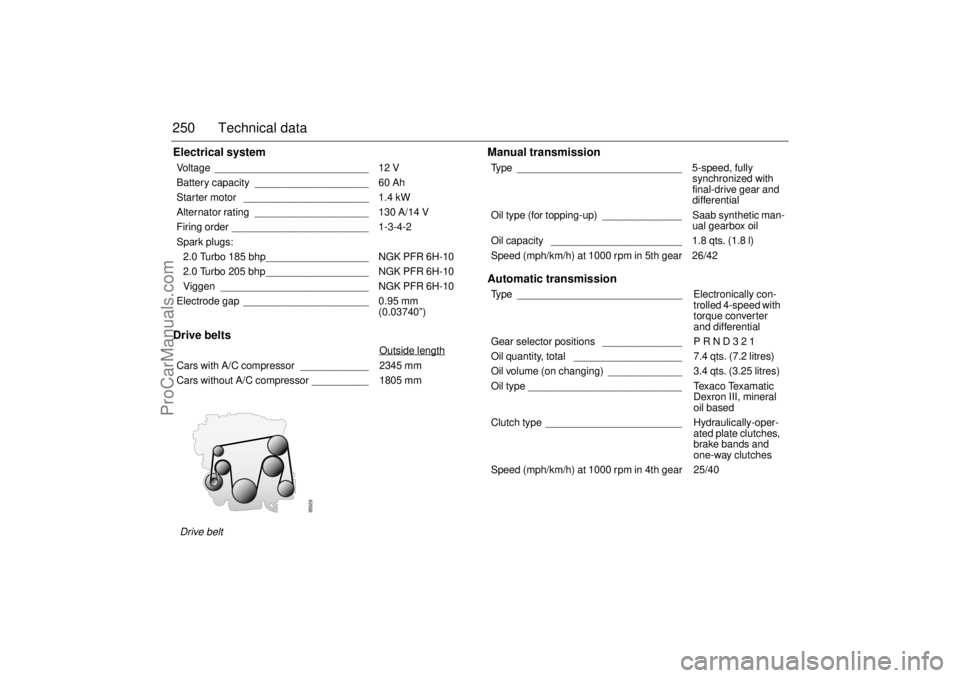
Drive belts
Manual transmission
Automatic transmission
Voltage ___________________________ 12 V
Battery capacity ____________________ 60 Ah
Starter motor ______________________ 1.4 kW
Alternator rating ____________________ 130 A/14 V
Firing order ________________________ 1-3-4-2
Spark plugs:
2.0 Turbo 185 bhp__________________ NGK PFR 6H-10
2.0 Turbo 205 bhp __________________ NGK PFR 6H-10
Viggen __________________________ NGK PFR 6H-10
Electrode gap ______________________ 0.95 mm
(0.03740”)
Outside lengthCars with A/C compressor ____________ 2345 mm
Cars without A/C compressor __________ 1805 mmDrive belt
IB929
Type _____________________________ 5-speed, fully
synchronized with
final-drive gear and
differential
Oil type (for topping-up) ______________ Saab synthetic man-
ual gearbox oil
Oil capacity _______________________ 1.8 qts. (1.8 l)
Speed (mph/km/h) at 1000 rpm in 5th gear 26/42
Type _____________________________ Electronically con-
trolled 4-speed with
torque converter
and differential
Gear selector positions ______________ P R N D 3 2 1
Oil quantity, total ___________________ 7.4 qts. (7.2 litres)
Oil volume (on changing) _____________ 3.4 qts. (3.25 litres)
Oil type ___________________________ Texaco Texamatic
Dexron III, mineral
oil based
Clutch type ________________________ Hydraulically-oper-
ated plate clutches,
brake bands and
one-way clutches
Speed (mph/km/h) at 1000 rpm in 4th gear 25/40
ProCarManuals.com
Page 251 of 260

251 Technical data
Suspension
SteeringBrake systemSpring type, front and rear ____________ Coil springs
Maximum deflection of springs:
front, Coupé/5-door/Convertible _______ 6.4" (163 mm)
front, Viggen ______________________ 6.5” (165 mm)
rear, Coupé/5-door/Convertible _______ 8.3" (212 mm)
rear, Viggen ______________________ 7.9” (200 mm)
Dampers, front and rear ______________ Gas-filled tele-
scopic shock
absorbers
Steering __________________________ Power-assisted
steering gear of
rack-and-pinion
type with tele-
scopic, universal
joint steering- col-
umn shaft
Number of turns, lock to lock __________ 3.0
Oil type ___________________________ Power Steering
Fluid CHF 11S Footbrake (ABS) ___________________ Hydraulic disc
brakes with vacuum
servo, diagonally
split circuits
Parking brake ______________________ Acts on rear wheels
Brake fluid ________________________ DOT 4
Do not use DOT 5
Disc diameter:
front, Coupé/5-door/Convertible _______ 11.4" (288 mm)
front, Viggen ______________________ 12.0” (306 mm)
rear ____________________________ 11.3" (286 mm)
Total friction area of brake pads:
front, Coupé/5-door/Convertible _______ 34.4 in² (224 cm²)
front, Viggen ______________________ 35.9 in² (234 cm²)
rear ____________________________ 14.2 in² (92 cm²)
ProCarManuals.com