wheel SAAB 9-3 2001 Service Manual
[x] Cancel search | Manufacturer: SAAB, Model Year: 2001, Model line: 9-3, Model: SAAB 9-3 2001Pages: 260, PDF Size: 12.01 MB
Page 186 of 260
186 Starting and driving
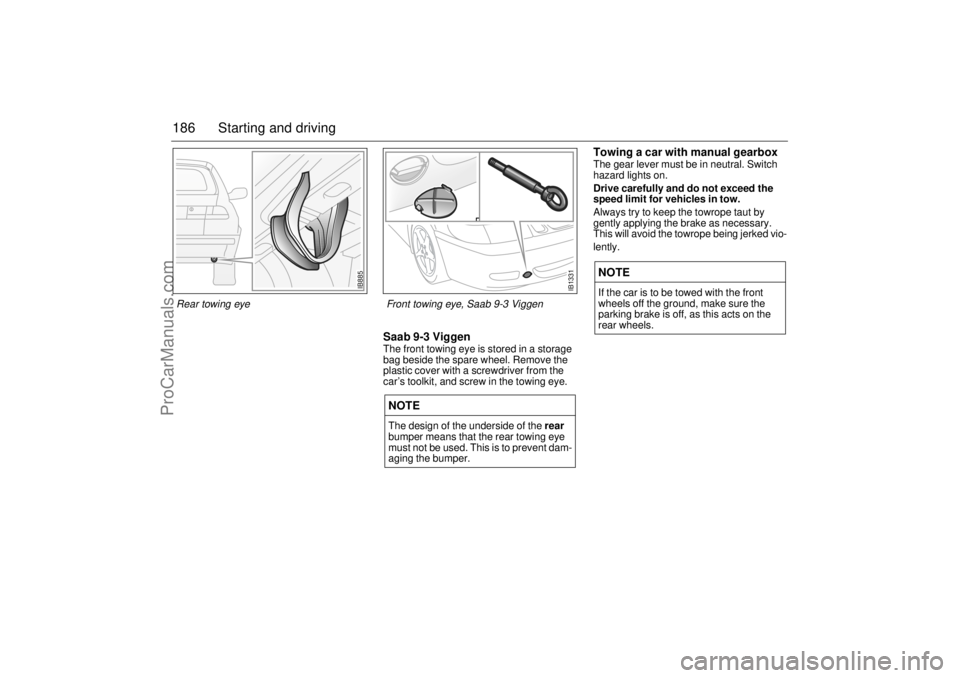
Saab 9-3 ViggenThe front towing eye is stored in a storage
bag beside the spare wheel. Remove the
plastic cover with a screwdriver from the
car’s toolkit, and screw in the towing eye.
Towing a car with manual gearboxThe gear lever must be in neutral. Switch
hazard lights on.
Drive carefully and do not exceed the
speed limit for vehicles in tow.
Always try to keep the towrope taut by
gently applying the brake as necessary.
This will avoid the towrope being jerked vio-
lently.
NOTEThe design of the underside of the rear
bumper means that the rear towing eye
must not be used. This is to prevent dam-
aging the bumper.
NOTEIf the car is to be towed with the front
wheels off the ground, make sure the
parking brake is off, as this acts on the
rear wheels.
IB885
Rear towing eye
IB1331
Front towing eye, Saab 9-3 Viggen
ProCarManuals.com
Page 187 of 260

187 Starting and driving
Towing a car with automatic
transmission The following rules must be observed if a
car with automatic transmission is to be
towed.
The gear selector must be in the N position.
Switch hazard lights on.
Drive carefully and do not exceed the
speed limit for vehicles in tow.
Always try to keep the towrope taut by
gently applying the brake as necessary.
This will avoid the towrope being jerked vio-
lently.1 Selector lever in position N.
2 Raise the oil level in the gearbox above
normal by 2 extra quarts. Use oil of type
Texaco Texamatic Dexron III.
3 The local regulations on towing speeds
must be followed.
The highest permissible towing speed is
30 mph (50 km/h), unless the legal limit
is lower. The longest permissible towing
distance is 25-30 miles (40-50 km). If the
car has to be transported farther than
that, summon a tow truck. A flat bed tow
truck is the preferred method to tow.
4 When the car is being returned to ser-
vice, check the gearbox oil, and reduce
it to the prescribed amount if necessary.
The engine cannot be started by towing or
pushing the car. In emergency, the engine
can be started as described in the section
”Jump starting”.
Jump startingIf your battery has run down, you may want
to use another vehicle and some jumper
cables to start your Saab. Follow the steps
below to do it safely.
NOTEThe car must be towed front first.
If the car is to be towed with the front
wheels off the ground, make sure the
parking brake is off, as this acts on the
rear wheels.
WARNING
Batteries can cause injury. They can be
dangerous because:
They contain acid that can burn you.
They contain gas that can explode or
ignite.
They contain enough electricity to
injure you.
If you do not follow these steps exactly,
some or all of these things can hurt you.
ProCarManuals.com
Page 190 of 260
190 Starting and drivingDriving considerations
with compact spare
wheel/tire fitted The following should be observed when the
compact spare wheel (T115/70 R16) is
installed:
The compact spare is light and easy to
handle when changing the wheel. Do not
drive farther than necessary with the com-
pact spare fitted – the maximum life of the
wheel is only just over 2000 miles
(3,500 km). Have the standard wheel
repaired and reinstalled as soon as possi-
ble.Points to bear in mind when driving with a
compact spare wheel:
The car’s ground clearance is reduced
with the compact spare fitted.
Only one compact spare wheel may be
used at any time.
Take care not to hit the curb.
Do not fit snow chains.
Leave the wheel cover off, so that the
warning text is readily visible.
For long tripsBefore starting off on a long journey, it is
advisable to have your car inspected by
your Saab dealer.
Obtain a few important items to take along
on your journey such as spare bulbs, wiper
blades, fuses, a Poly-Vee-belt and the like.
You can check some points yourself before-
hand:
Make sure that the engine is in good con-
dition.
Check that no oil or fuel leaks out of the
engine or gearbox/transmission.
Check the coolant and power steering
fluid levels. Check also for leaks.
Inspect the Poly-Vee-belt and replace it if
it shows any signs of wear.
Check the battery charge.
Check the tires for tread pattern and air
pressure, including the compact spare
wheel.
Take an extra car key/remote control and
keep it separate, see also page 36.
Check the brakes.
Check all bulbs.
Check for the presence of the tool kit and
the jack in the car.
WARNING
Do not exceed 50 mph (80 km/h) as the
tire can overheat and adversely affect the
handling of the car.
The tire should be inflated to 60 psi
(420 kPa).
NOTETo avoid damaging a punctured alloy
wheel this can be placed outside up in the
spare-wheel well but only while driving to
the closest dealer.
A general rule is that all heavy loads must
be well secured in the luggage compart-
ment, see page 148.
ProCarManuals.com
Page 191 of 260
191 Car care
IB944
Hood release handle ....... 192
Engine .............................. 194
Engine bay ....................... 193
Engine oil ......................... 196
Transmission fluid .......... 197
Coolant ............................. 198
Brake- clutch fluid and
brake pads ..................... 200
Power steering ................ 201
Battery .............................. 201
Drive belt .......................... 203
Wipers and washers ....... 204
Wiper blades .................... 204
Changing bulbs ............... 206
Fuses ................................ 212
Wheels.............................. 217
Safety belts ...................... 224 Upholstery and trim ......... 225
Textile carpeting .............. 225
Engine bay ........................ 226
Washing ............................ 226
Waxing and polishing ...... 227
Touching up the paint ..... 227
Anti-corrosion treatment . 228
Recovery and/or recy-
cling of automotive mate-
rials .................................. 230
Air conditioning (A/C
system) ........................... 232 Car care
ProCarManuals.com
Page 200 of 260
200 Car careBrake- clutch fluid and
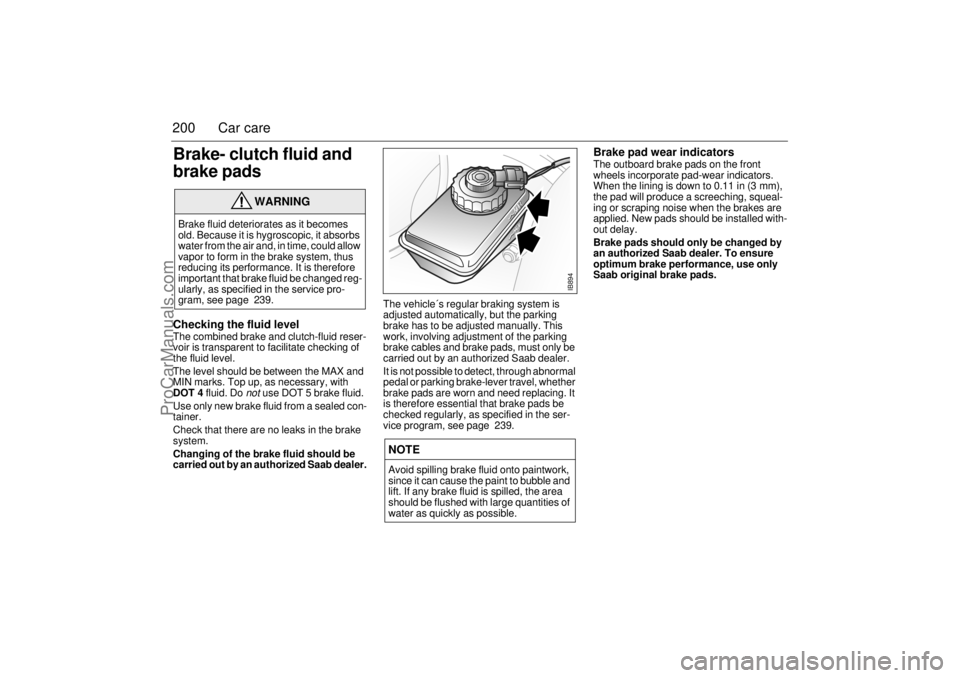
brake padsChecking the fluid level The combined brake and clutch-fluid reser-
voir is transparent to facilitate checking of
the fluid level.
The level should be between the MAX and
MIN marks. Top up, as necessary, with
DOT 4 fluid. Do
not
use DOT 5 brake fluid.
Use only new brake fluid from a sealed con-
tainer.
Check that there are no leaks in the brake
system.
Changing of the brake fluid should be
carried out by an authorized Saab dealer.The vehicle´s regular braking system is
adjusted automatically, but the parking
brake has to be adjusted manually. This
work, involving adjustment of the parking
brake cables and brake pads, must only be
carried out by an authorized Saab dealer.
It is not possible to detect, through abnormal
pedal or parking brake-lever travel, whether
brake pads are worn and need replacing. It
is therefore essential that brake pads be
checked regularly, as specified in the ser-
vice program, see page 239.
Brake pad wear indicators The outboard brake pads on the front
wheels incorporate pad-wear indicators.
When the lining is down to 0.11 in (3 mm),
the pad will produce a screeching, squeal-
ing or scraping noise when the brakes are
applied. New pads should be installed with-
out delay.
Brake pads should only be changed by
an authorized Saab dealer. To ensure
optimum brake performance, use only
Saab original brake pads.
WARNING
Brake fluid deteriorates as it becomes
old. Because it is hygroscopic, it absorbs
water from the air and, in time, could allow
vapor to form in the brake system, thus
reducing its performance. It is therefore
important that brake fluid be changed reg-
ularly, as specified in the service pro-
gram, see page 239.
NOTEAvoid spilling brake fluid onto paintwork,
since it can cause the paint to bubble and
lift. If any brake fluid is spilled, the area
should be flushed with large quantities of
water as quickly as possible.
IB894
ProCarManuals.com
Page 201 of 260
201 Car care
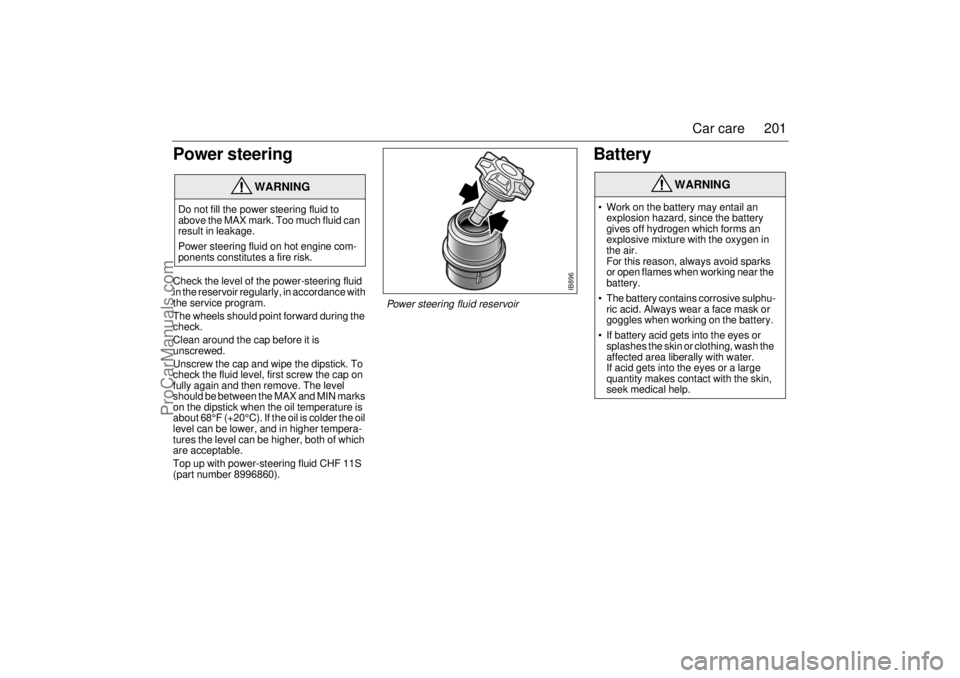
Power steeringCheck the level of the power-steering fluid
in the reservoir regularly, in accordance with
the service program.
The wheels should point forward during the
check.
Clean around the cap before it is
unscrewed.
Unscrew the cap and wipe the dipstick. To
check the fluid level, first screw the cap on
fully again and then remove. The level
should be between the MAX and MIN marks
on the dipstick when the oil temperature is
about 68°F (+20°C). If the oil is colder the oil
level can be lower, and in higher tempera-
tures the level can be higher, both of which
are acceptable.
Top up with power-steering fluid CHF 11S
(part number 8996860).
Battery
WARNING
Do not fill the power steering fluid to
above the MAX mark. Too much fluid can
result in leakage.
Power steering fluid on hot engine com-
ponents constitutes a fire risk.
WARNING
Work on the battery may entail an
explosion hazard, since the battery
gives off hydrogen which forms an
explosive mixture with the oxygen in
the air.
For this reason, always avoid sparks
or open flames when working near the
battery.
The battery contains corrosive sulphu-
ric acid. Always wear a face mask or
goggles when working on the battery.
If battery acid gets into the eyes or
splashes the skin or clothing, wash the
affected area liberally with water.
If acid gets into the eyes or a large
quantity makes contact with the skin,
seek medical help.
IB896
Power steering fluid reservoir
ProCarManuals.com
Page 215 of 260

215 Car care
Relay holderUnder the instrument panel next to the steering wheel No. Amp Function
21 10 Switch, manual A/C; soft top (Convertible)
22 15 Direction indicators
23 20 Soft top (Convertible); telephone
24 7.5 Radio
25 30 Central locking; amplifier
26 30 Control module, engine management system
27 15 High beam flash; ACC
28 10 Control module, engine management system
29 10 Right parking light; number-plate lighting
30 10 Left parking light
31 20 Reversing light; windshield wipers; headlight
beam-length adjustment
32 15 Fuel pump
33 15 Electric heating of rear seat
34 10 SID; control module; automatic transmission
35 15 DICE/TWICE; main instrument panel; interior light-
ing
36 10 Relay, starter
37 15 Limp-home
38 25 Oxygen sensor (lambda probe)
39 – –
S–SpareItem Function
A Electric heating of rear seat
B Reversing light, cars with automatic transmission
C1 –
C2 Lock motor, trunk lid
D1 Rear wiper
D2 Rear-window washing
E Ignition switch
F–
G Windshield wipers (intermittent)
H Rear-window heating
IFuel pump
J–
KStart relay
L Main relay (injection system)
ProCarManuals.com
Page 217 of 260

217 Car care
WheelsAlternative wheels and tiresIf you wish to fit other tires or wheels than
those supplied with the car, consult your
Saab dealer first as to the possibilities avail-
able.
Wheels/tires combinations that are not
approved by Saab can negatively affect the
car´s directional stability, steering and brak-
ing in both wet and dry conditions.
Do not assume that a wheel/tire combina-
tion will function properly just because it will
bolt on.
The wheels and tires have been carefully
matched to the characteristics of the car and
play a key role in its outstanding roadhold-
ing and handling.
Tire pressureTires need to be inflated to suit the load car-
ried and the maximum speed the car will be
driven (see the recommended tire pres-
sures on the back cover). Tire pressure
label, see page 253.
Note that all values apply to cold tires. For
tires with an aspect ratio less than /60,
increase the tire pressure by 3 psi (20 kPa)
for rough roads with potholes to minimize
the risk of rim damage.
Never reduce the pressure of a hot tire. If the
tires are hot when you check them, only
increase the pressure, if necessary.
Soft tires will cause faster wear than
over-pressurized tires. They also increase
fuel consumption.
If a valve is leaking, simply unscrew it and fit
a new one.
Important! Remember to adjust the tire
pressures if you change the load in the car
or intend to cruise at a substantially higher
or lower speed than normal.
NOTEFor wide wheels and/or low-profile tires,
bear in mind the following:
Tires and wheels can be damaged in
potholes etc.
Springs, shock absorbers and wheel
bearings can be overloaded.
The wheels can come into contact with
chassis and body components.
The speed and load limits for the tires
must not be exceeded; see page 218.
Wheels larger than 17” must not be
fitted on the Saab 9-3. For Viggen
models the wheel should not be larger
than 17”. The maximum permissible
offset for the 9-3 is 49 mm and for the
Viggen 42 mm.
Wheels smaller than 16” must not be
fitted on Viggen models. Fitting a
smaller size wheel on a Viggen is not
possible due to the size of the brake
discs.
NOTECheck the tire pressures at least once
per month.
Underinflation is the main cause of:
Tires wearing out prematurely.
Damage to the sidewalls.
Damage to the wheels.
ProCarManuals.com
Page 218 of 260

218 Car careRotating the tires Because of front wheel drive, the front tires
tend to wear faster than the rear ones. New
tires should always be fitted in pairs, so that
tires on the same axle have the same
amount of tread.
If swapping the complete set, e.g. winter
tires for summer tires, mark the tires
removed to ensure that they go back in the
same position (e.g. FL for front left, RL rear
left, etc.).
Store wheels lying flat or hanging – never
standing upright.
Tire markingsAn example of the meaning of the different
markings in a tire size is given below for a
tire size of 195/60 R15 88V:
Winter tiresWinter (snow) tires are recommended for
winter climates where the majority of your
driving will be done on snow and ice. Winter
tires should be fitted to all four wheels to
maintain a proper balance. Your Saab
dealer can advise you of to the correct size
tire for your car (if different from the original
size) and also supply Saab approved winter
tires pre-mounted on steel or alloy rims.Tire quality grading (cars sold in
U.S.)New tires must be graded and labeled in
accordance with new Federal regulations.
Standard tests are conducted to measure
performance in the areas of traction and
temperature resistance. Refer to the tire
sidewall for the specific quality grades of the
tires provided on your new Saab. Compact
spare tires are exempt.
DOT QUALITY GRADES
Treadwear.
Traction AA, A, B, C.
Temperature A, B, C.
All passenger car tires must conform to Fed-
eral safety requirements in addition to these
grades.
WARNING
When fitting just one new pair of tires,
these should be fitted to the rear wheels,
as these are more critical to the direc-
tional stability of the car (e.g. on braking
or in a skid). The existing rear tires should
therefore be moved to the front. Always
move left rear to left front and right rear to
right front, so that the direction of rotation
remains the same.
195 Tire section width, mm
60 Aspect ratio, i.e. the section height
is 60 % of the section width
R Radial ply
15 Wheel rim diameter 15 in. at bead
seats
88 Tire load code
V Speed marking
Speed ratingsS Tire approved for speeds up to
112 mph (180 km/h)
T Tire approved for speeds up to
118 mph (190 km/h)
H Tire approved for speeds up to
130 mph (210 km/h)
V Tire approved for speeds up to
150 mph (240 km/h)
W Tire approved for speeds up to
167 mph (270 km/h)
Y Tire approved for speeds up to
186 mph (300 km/h)
ProCarManuals.com
Page 219 of 260
219 Car care
Uniform Tire Quality Grading (US)Quality grades can be found where applica-
ble on the tire sidewall between tread shoul-
der and maximum section width. For exam-
ple:
Treadwear 200 Traction AA
Temperature ATreadwearThe treadwear grade is a comparative
rating based on the wear rate of the tire
when tested under controlled conditions on
a specified government test course. For
example, a tire graded 150 would wear one
and one half (1 1/2) times as well on the gov-
ernment course as a tire graded 100. The
relative performance of tires depends upon
the actual conditions of their use, however,
and may depart significantly from the norm
due to variations in driving habits, service
practices and differences in road character-
istics and climate.
TractionThe traction grades, from highest to lowest,
are AA, A, B and C. These grades represent
the tire’s ability to stop on wet pavement as
measured under controlled conditions on
specified government test surfaces of
asphalt and concrete. A tire marked C may
have poor traction performance.
TemperatureThe temperature grades are A (the highest),
B, and C, representing the tire’s resistance
to the generation of heat and its ability to dis-
sipate heat when tested under controlled
conditions on a specified indoor laboratory
test wheel. Sustained high temperature can
cause the material of the tire to degenerate
and reduce tire life. Excessive temperature
can lead to sudden tire failure. The grade C
corresponds to a level of performance
which all passenger car tires must meet
under the Federal Motor Vehicle Safety
Standard No. 109.
Grades B and A represent higher levels of
performance on the laboratory test wheel
than the minimum required by law.
WARNING
The traction grade assigned to a tire is
based on straight-ahead braking, traction
test and does not include acceleration,
cornering, hydroplaning or peak traction
characteristics.
WARNING
The temperature grade for a tire is estab-
lished for a tire that is properly inflated
and not overloaded. Excessive speed,
underinflation, or excessive loading,
either separately or in combination, can
cause heat buildup and possible tire fail-
ure.
ProCarManuals.com