air condition SAAB 9-3 2002 User Guide
[x] Cancel search | Manufacturer: SAAB, Model Year: 2002, Model line: 9-3, Model: SAAB 9-3 2002Pages: 256, PDF Size: 11.55 MB
Page 154 of 256

154 Starting and drivingFuel (Gasoline Engine)Use regular unleaded gasoline rated at 87
octane or higher. It is recommended that the
gasoline meet specifications which were
developed by the American Automobile
Manufacturers Association (AAMA) and
endorsed by the Canadian Motor Vehicle
Manufacturers Association for better vehi-
cle performance and engine protection.
Gasolines meeting the AAMA specification
could provide improved driveability and
emission control system performance com-
pared to other gasolines.Canada Only
Be sure the posted octane is at least 87. If
the octane is less than 87, you may get a
heavy knocking noise when you drive. If it’s
bad enough, it can damage your engine. If
you’re using fuel rated at 87 octane or
higher and you hear heavy knocking, your
engine needs service. But don’t worry if you
hear a little pinging noise when you’re accel-
erating or driving up a hill. That’s normal,
and you don’t have to buy a higher octane
fuel to get rid of pinging. It’s the heavy, con-
stant knock that means you have a problem.
If your vehicle is certified to meet California
Emission Standards (indicated on the
underhood emission control label), it is
designed to operate on fuels that meet Cal-
ifornia specifications. If such fuels are not
available in states adopting California emis-
sions standards, your vehicle will operate
satisfactorily on fuels meeting federal spec-
ifications, but emission control system per-
formance may be affected. The malfunction
indicator lamp on your instrument panel
may turn on and/or your vehicle may fail a
smog-check test. See "Malfunction Indica-
tor Lamp" in the Index. If this occurs, return
to your authorized Saab dealer for diagno-
sis to determine the cause of failure. In the
event it is determined that the cause of the
condition is the type of fuels used, repairs
may not be covered by your warranty. Some gasolines that are not reformulated
for low emissions may contain an
octane-enhancing additive called methylcy-
clopentadienyl manganese tricarbonyl
(MMT); ask your service station operator
whether or not the fuel contains MMT. Saab
does not recommend the use of such gaso-
lines. If fuels containing MMT are used,
spark plug life may be reduced and your
emission control system performance may
be affected. The Engine malfunction
(CHECK ENGINE) light on your instrument
panel may turn on. If this occurs, return to
your authorized Saab dealer for service.
In Canada, look for the
"Auto Makers’ Choice" label
on the fuel pump.
ProCarManuals.com
Page 171 of 256

171 Starting and driving
Driving in a low gear results in higher fuel
consumption than in a high gear because
of the lower engine speed for a given road
speed. Always change up to a higher gear
as soon as traffic conditions allow and use
the highest gear as much as possible.
Check the air pressure in the tires once a
month. Incorrect pressures increase tire
wear. It is better to have slightly higher
pressure than lower.
Check fuel consumption regularly.
Increased consumption can indicate that
something is wrong and that the car
needs to be checked by an authorized
Saab dealer.
Practical tests on the roads have demon-
strated that substantial savings in fuel con-
sumption can be made if the above advice
is heeded.Road conditions Wet roads increase fuel consumption, as do
unpaved roads and driving in hilly country
(the amount of fuel saved driving downhill is
less than the additional amount required to
climb the hill).
Engine block heater (standard
equipment in Canada, accessory in
U.S.)The following are just some of the benefits
to the car and the environment of using an
engine block heater:
Lower fuel consumption.
Reduced wear on the engine.
Inside of car warms up faster.
Exhaust emissions substantially reduced
over short runs.
The engine block heater is effective with
outside temperatures up to +60 – +70°F
(+15 – +20°C). The warmer it is outside, the
shorter the time the heater need be con-
nected. Longer than 1.5 hours is unneces-
sary.
If the car is equipped with a removable elec-
trical cabin heater that is not in use, this
should be stored in the luggage compart-
ment.
Driving in cold weatherBefore starting a journey in cold weather
you should check the following:
That the wiper blades have not become
frozen to the windshield/glass.
Brush any snow away from the air intake
for the heater system (opening between
hood and windshield).
It may be advisable to lubricate the
door-lock cylinder (use molybdenum
disulphide, MoS
2) to prevent its freezing.
If the lock has frozen, take care not to
break the key (or use the remote control)
– heat it first or spray it with de-icer.
Periodically during the winter, add gaso-
line anti-freeze to the fuel to dispel any
condensation in the fuel tank which could
freeze and cause problems in the system.
Keep the tank well filled to reduce the risk
of condensation forming.
If the car is parked outside in freezing
weather, fuel additives (gasoline
anti-freeze) will not do any good as it
cannot remove water that has already fro-
zen. Park the car in a warm place so that
any ice that may have built up melts, then
add gasoline anti-freeze when filling up
the tank. Condensation is caused by
changes in the outdoor temperature or by
the car being parked alternately in a
garage and outside.
It is particularly important when the roads
are slippery that the brakes and tires be in
good condition.
ProCarManuals.com
Page 185 of 256
185 Car care
IB944
Hood release handle ....... 186
Engine .............................. 188
Engine bay ....................... 187
Engine oil ......................... 190
Transmission fluid .......... 191
Coolant ............................. 192
Air filter ............................ 193
Brake- clutch fluid and
brake pads ..................... 194
Power steering ................ 195
Battery .............................. 195
Drive belt .......................... 197
Wipers and washers ....... 198
Wiper blades .................... 198
Changing bulbs ............... 200
Fuses ................................ 206
Wheels.............................. 211 Safety belts ....................... 218
Upholstery and trim ......... 219
Textile carpeting .............. 219
Engine bay ........................ 220
Washing ............................ 220
Waxing and polishing ...... 221
Touching up the paint ..... 221
Anti-corrosion treatment . 222
Recovery and/or recy-
cling of automotive mate-
rials .................................. 224
Air conditioning (A/C
system) ........................... 226 Car care
ProCarManuals.com
Page 212 of 256

212 Car careRotating the tires Because of front wheel drive, the front tires
tend to wear faster than the rear ones. New
tires should always be fitted in pairs, so that
tires on the same axle have the same
amount of tread.
The wheels should be marked, L (left) and
R (right), when changing between summer
and winter (snow) tires. This ensures that
the direction of rotation of the wheels is the
same when they are refitted. Fit the tires in
best condition to the rear wheels.
Store wheels lying flat or hanging – never
standing upright.
Tire markingsAn example of the meaning of the different
markings in a tire size is given below for a
tire size of 205/55 R16 91V:
Winter tiresWinter (snow) tires are recommended for
winter climates where the majority of your
driving will be done on snow and ice. Winter
tires should be fitted to all four wheels to
maintain a proper balance. Your Saab
dealer can advise you of to the correct size
tire for your car (if different from the original
size) and also supply Saab approved winter
tires pre-mounted on steel or alloy rims.Tire quality grading (cars sold in
U.S.)New tires must be graded and labeled in
accordance with new Federal regulations.
Standard tests are conducted to measure
performance in the areas of traction and
temperature resistance. Refer to the tire
sidewall for the specific quality grades of the
tires provided on your new Saab. Compact
spare tires are exempt.
DOT QUALITY GRADES
Treadwear.
Traction AA, A, B, C.
Temperature A, B, C.
All passenger car tires must conform to Fed-
eral safety requirements in addition to these
grades.
WARNING
When fitting just one new pair of tires,
these should be fitted to the rear wheels,
as these are more critical to the direc-
tional stability of the car (e.g. on braking
or in a skid). The existing rear tires should
therefore be moved to the front. Always
move left rear to left front and right rear to
right front, so that the direction of rotation
remains the same.
205 Tire section width, mm
55 Aspect ratio, i.e. the section height
is 60 % of the section width
R Radial ply
16 Wheel rim diameter 16 in. at bead
seats
91 Tire load code
V Speed marking
Speed ratingsS Tire approved for speeds up to
112 mph (180 km/h)
T Tire approved for speeds up to
118 mph (190 km/h)
H Tire approved for speeds up to
130 mph (210 km/h)
V Tire approved for speeds up to
150 mph (240 km/h)
W Tire approved for speeds up to
167 mph (270 km/h)
Y Tire approved for speeds up to
186 mph (300 km/h)
ProCarManuals.com
Page 219 of 256

219 Car care
Upholstery and trimTo remove fluff or hairs from the seat uphol-
stery or headlining, use a moist, lint-free
cloth or a special lint remover (brush or
roller). Remove any dirty marks using a
cloth moistened with lukewarm soapy
water.
When using a stain remover, always work
from the outside towards the center to avoid
leaving a ring. If a soiled ring or spot should
remain, it can usually be removed using
lukewarm soapy water or water alone.
Wet patches left by spilled soft drinks or thin
oil must be wiped off immediately using an
absorbent material, such as paper toweling,
and treated with stain remover.
Isopropyl alcohol is recommended for
removing grease or oil stains, and a
semi-stiff brush may also be used.
Cleaning and caring for leather
upholsteryThe principal reason for treating leather
upholstery is to maintain its elegant appear-
ance and to provide it with a protective film.
Discoloration caused by dust and wear
mainly affects the lighter shades, although
this is not detrimental to the leather –
indeed, the patina resulting from use is often
considered desirable in leather. But if the
leather is allowed to become too grubby, it
can start to look shabby.
The leather upholstery should be cleaned
and reconditioned twice a year in conjunc-
tion with spring and autumn inspections. In
very warm, dry climates the leather may
need more regular reconditioning. Recom-
mended conditioner - Saab Leather Care
Lotion.
Do not use unknown harsh polishing
agents, cleaning agents, sprays, coarse
soap or hot water.
The leather will be clean and attractive for
many years.
Textile carpetingVacuum clean the carpeting regularly. Car-
pets can also be cleaned using a brush, or
carpet shampoo applied with a sponge. Do
not use vacuum cleaners outdoors unless
they are properly grounded.
ProCarManuals.com
Page 223 of 256
223 Car care
What causes rust?Steel body panels of automobiles are sub-
ject to rusting whenever air and moisture
manage to penetrate the protective finish.
Body panels may rust through if the process
is unchecked. Rusting can occur wherever
water is trapped or where the car’s panels
are continuously damp.
Damage to paint and undercoating by
stones, gravel and minor crashes immedi-
ately exposes metal to air and moisture.
Road salts used for de-icing will collect on
the bottom of the car and promote rusting.
Areas of the country with high humidity have
a greater potential for rust problems, espe-
cially where salt is used on roads or there is
moist sea air. Industrial pollution (fallout)
may also damage paint and promote rust-
ing.
Preventive maintenanceThe following procedures are necessary to
help protect against rusting. Refer also to
the terms and conditions of the Performa-
tion Limited Warranty described in the war-
ranty booklet.
1Wash the car frequently, and wax at
least twice a year. Under adverse con-
ditions, where there is a rapid buildup of
dirt, sand or road salt, wash your car at
least once a week. After extreme expo-
sure to salted snow or slush, evidenced
by a white film on the car, wash the car
immediately. Frequent washing will pre-
vent paint damage from acid rain and
other airborne contaminants such as
tree sap and bird droppings. If any of
these contaminants are noticed on the
car the finish should be washed immedi-
ately.
Begin washing by rinsing the entire car
with water to loosen and flush off heavy
concentrations of dirt (include the
underbody).
Sponge the car with a solution of either
a good quality car soap or mild general
purpose (dish washing) detergent and
water.
Rinse car thoroughly with clean water.
After washing, check and clear all
drains in doors and body panels.
Wipe the car dry, preferably using a
chamois.2Clean the underside of the car during
the winter. Use high pressure water to
clean the car’s underside (floor panels,
wheel wells) at least at mid-winter and in
the spring.
3Inspect the car frequently for leaks or
damage, and arrange for needed
repairs promptly. After washing or
after heavy rain, check for leaks. When
washing the car inspect body surfaces
for paint damage. While checking for
leaks, lift the floor mats and check
underneath them. Water can collect in
these areas and remain for prolonged
periods. Dry any wet areas including the
floor mats. Have leaks repaired as soon
as possible.
Use touch-up paint to repair small
scratches or minor finish damage. Areas
where metal is exposed will rust quickly
and MUST be repaired immediately by
touch-up or professional repainting.
Rust must be removed, the bare metal
primed and painted. Major body
damage should be repaired immediately
and new panels or exposed areas
should be undercoated with anti- corro-
sion material.
Repairs of this type are the owner’s
responsibility and are not covered under
warranty.
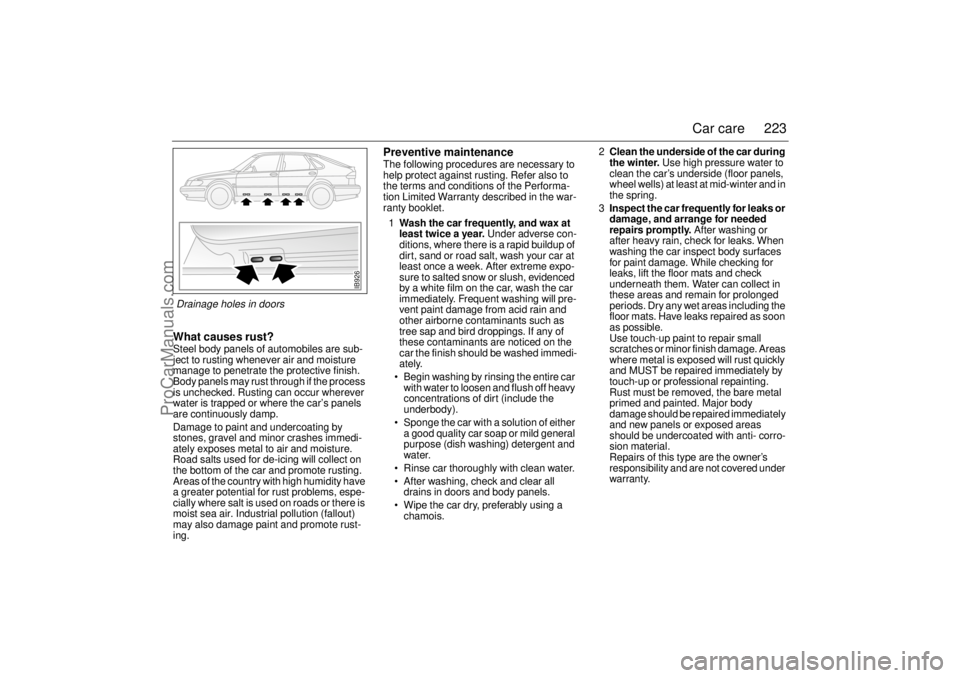
IB926
Drainage holes in doors
ProCarManuals.com
Page 226 of 256
226 Car careAir conditioning
(A/C system)
Fault diagnosis If a fault occurs in the A/C system, there are
a number of checks you can perform your-
self. If the fault persists, however, have the
system checked by an authorized Saab
dealer.Important!
When the A/C system is in operation, mois-
ture from the air will condense on the evap-
orator. When the car is then parked, this
condensation will drip off the evaporator
and form a small pool of water on the
ground. This is normal. The warmer the
ambient air and the higher the humidity, the
greater the amount of condensation formed.Inadequate cooling:
a Make sure that the temperature and
air-distribution controls are in the
appropriate settings, see page 81.
b Check that the condenser (forward of
the radiator) has not become clogged
with dirt and insects.
c Make sure that the drive belt for the com-
pressor is not slipping, see page 197.
d Check the fuses for the ventilation fans
and compressor, see page 208.
NOTE The A/C system is designed for use
with R134a refrigerant.
Refrigerant handling requires special
equipment and special procedures for
charging and draining the system.
All repairs and adjustments on the A/C
system must be carried out by a Saab
dealer authorized for this kind of work.
Never mix R134a and R12 refriger-
ants.
WARNING
The A/C system is pressurized. Do not
break any connections or undo A/C
system components.
Escaping refrigerant gas can cause
visual impairment or other injury.
ProCarManuals.com
Page 247 of 256

247 Index
IndexAA/C system, fault diagnosis
________ 226
A/C system, maintenance _________ 226
ACC
__________________________ 84
ACC, useful tips
_________________ 92
Adjustment, steering wheel
________ 131
Air conditioning (A/C), fault diagnosis
and maintenance
______________ 226
Airbag
_________________________ 28
Alarm __________________________ 41
Alarm functions
__________________ 44
Alarm signals
___________________ 44
Anti-corrosion treatment
__________ 222
Anti-theft system
_________________ 41
Ashtray
_______________________ 135
Audio System
___________________ 93
Automatic climate control (ACC)
_____ 84
Automatic transmission
___________ 156
BBattery
________________________ 195
Boost starting from donor battery
___ 181
Brake fluid, check
_______________ 194
Brake fluid, grade _______________ 241
Brake pad wear indicators
___ 164
, 194
Brakes
________________________ 164Braking
_______________________164
Bulb table _____________________205
CCD changer
____________________102
CD player
_____________________100
CHECK messages
_______________72
CHECKING
_____________________72
Cabin lighting __________________133
Calibration, ACC _________________90
Car alarm
______________________41
Care of safety belts
______________218
Central locking
__________________36
Change of address notification
_____232
Changing a wheel
_______________215
Changing bulbs
_________________200
Changing the engine oil
__________190
Changing the key battery __________39
Changing the wheels round _______212
Changing wiper blades
___________198
Chassis number
________________243
Child car seats
__________________19
Child safety
_____________________19
Child safety locks, rear doors
_______39
Child seats
_____________________19
Cigar lighter ____________________135
Cleaning the soft top, Convertible
____57
Climate-control system, manual
_____80
Compact spare wheel
____________214
Condensation water, A/C __________82Condensation water, ACC
_________ 85
Convertible
____________________ 47
Coolant
______________________ 192
Courtesy Headlight Feature
_______ 76
Cruise Control
_________________ 163
Cup holder
____________________ 134
DDICE/TWICE
__________________ 207
Date code, tires ________________ 214
Dim low beam
__________________ 75
Dimmer
_______________________ 78
Direction indicators
______________ 76
Direction-indicator stalk
___________ 76
Dome lighting
_________________ 133
Door mirrors
__________________ 137
Drive belt
_____________________ 197
Driving in deep water
____________ 179
Driving in hot weather ___________ 173
Driving technique
_______________ 170
Driving with a compact spare wheel
184
Driving with a load
______________ 178
Driving with a roof load
__________ 176
Driving with the trunk lid open
_____ 179
EEconomical motoring
____________ 170
Electrical system, technical data
___ 240
Electrical window
_______________ 130
ProCarManuals.com