air condition SAAB 9-3 2002 Owners Manual
[x] Cancel search | Manufacturer: SAAB, Model Year: 2002, Model line: 9-3, Model: SAAB 9-3 2002Pages: 256, PDF Size: 11.55 MB
Page 31 of 256
31 Safety
Side airbags are housed inside the back-
rests of the front seats and are designed to
protect the driver and front passenger in the
event of a side impact.
In a side impact, only the airbag on that side
will be activated, and only then if certain pre-
determined conditions are met such as the
force and angle of the impact, the speed of
the car on impact, and at which point on the
car’s side the impact occurs.
The sensors, which are fitted in the front
doors, sense the rise in pressure caused by
the door panel being pressed in during an
impact condition. The side airbag trigger will
be commanded based on the characteris-
tics of this pressure rise. The sensors for the side airbags are
fitted in the front doors.
We advise against doing any work on
the doors that could affect the mois-
ture barrier in the door or the airbag
sensors. It is essential that the mois-
ture barrier (thick plastic film) in the
front door is not damaged in any way.
Improvement of the anticorrosion
treatment of the doors should only be
carried out by an authorized Saab
dealer. Otherwise there is a risk that
the side impact sensor and the mois-
ture barrier in the door could be dam-
aged.
The side airbags will inflate only in the
event of a side impact; not in the event
of a front or rear-end crash or of the
car’s rolling over.
Wear and damage to the seat cover,
or the seat seam, in the area of the
side airbag must immediately be
repaired by an authorized Saab
dealer.
Do not modify the speaker installation
in the front doors or install speakers
other than those specifically approved
by Saab.
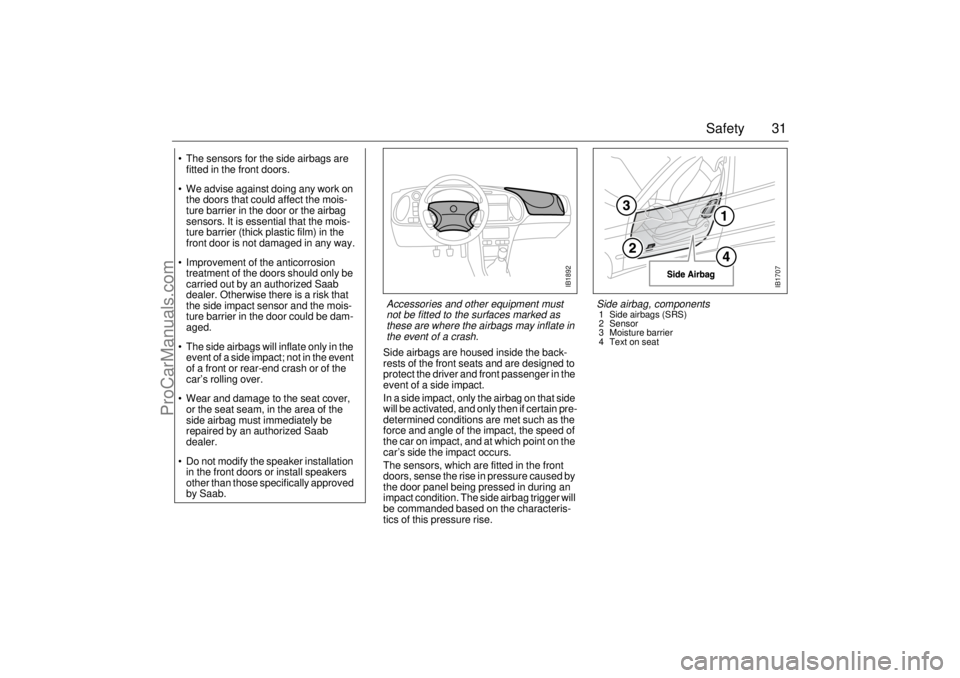
IB1707
Side airbag, components 1 Side airbags (SRS)
2 Sensor
3 Moisture barrier
4 Text on seat
IB1892
Accessories and other equipment must
not be fitted to the surfaces marked as
these are where the airbags may inflate in
the event of a crash.
ProCarManuals.com
Page 33 of 256

33 Safety
Frequently asked questions on func-
tion of the airbagDo you still need to wear a safety belt if air-
bags are fitted? Yes, always! The airbag merely supple-
ments the car’s normal safety system.
Moreover, the airbag will only be actuated in
a moderate to severe frontal, or near-frontal
crash, which means, of course, that it pro-
vides no protection in minor frontal crashes,
major rear-end or side-on crashes or if the
car rolls over.
The safety belts help to prevent passengers
from being thrown against each other and
being injured.
But they also ensure that, if a crash occurs
in which the airbags are inflated, the airbag
will make the optimum contact with the
occupant, i.e. square on from the front. If the
occupant meets the airbag in an offset posi-
tion, the protection afforded will be reduced.
In addition, airbags provide no protection
against a secondary impact occurring in the
same incident. So there is no doubt about
the benefit of wearing safety belts at all
times.
Do not sit too close to the airbag: it needs
room to inflate.
The airbag inflates very quickly and power-
fully in order to protect an adult person,
before they are thrown forward, in a serious
frontal crash.
How do I position the seat to leave room for
the airbag to inflate?Don’t have your seat too far forward.
Recline the seat back to increase the dis-
tance between you and the airbag. For short
drivers, special accessory pedal extensions
are available through your Saab dealer.
Airbags inflate extremely rapidly and with
great force - to be fast enough to protect an
adult in the seat. When do the airbags in the steering wheel
and passenger side of the dash board
inflate? The airbag will only be inflated under certain
predetermined conditions in a moderate to
severe frontal, or near-frontal crash,
depending on such factors as the force and
angle of the impact, the speed of the car on
impact, and the resistance to deformation of
the impacting object.
The airbag can only be activated once in the
same incident.
Do not attempt to drive the car after an
airbag has been inflated, even if it is possi-
ble.
What won’t trigger the airbag? The airbag will not be activated in all
front-end crashes. For instance, if the car
has hit something relatively soft and yielding
(e.g. a snow drift or a hedge) or a solid
object at a low impact speed, the airbag will
not necessarily be triggered. How loud is the inflation? The noise of the inflation is certainly loud,
but it is very short-lived and will not damage
your hearing. For a short time afterwards
you could experience a buzzing noise in
your ears.
Most people who have experienced it
cannot remember the noise of the inflation
at all - all they remember is the noise of the
crash. Can you still use a child seat in the front if a
passenger airbag is installed? Definitely not!
Children 12 and under can be injured or
killed by the airbag.
The BACK SEAT is the SAFEST place for
children.
NEVER put a child seat in the front.
ProCarManuals.com
Page 62 of 256
62 Instruments and controls
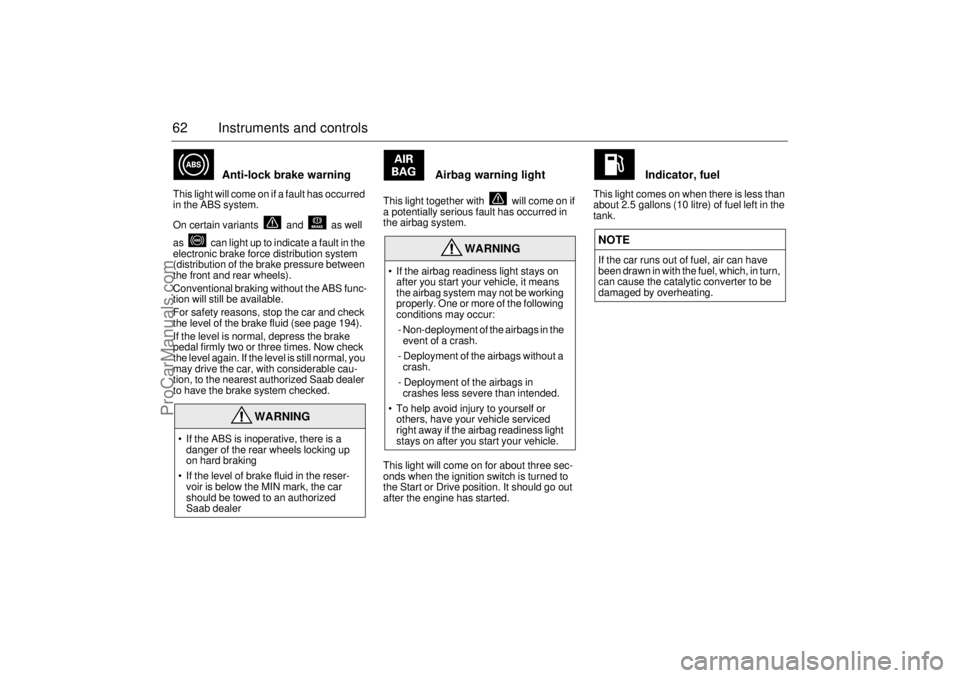
Anti-lock brake warning
This light will come on if a fault has occurred
in the ABS system.
On certain variants and as well
as can light up to indicate a fault in the
electronic brake force distribution system
(distribution of the brake pressure between
the front and rear wheels).
Conventional braking without the ABS func-
tion will still be available.
For safety reasons, stop the car and check
the level of the brake fluid (see page 194).
If the level is normal, depress the brake
pedal firmly two or three times. Now check
the level again. If the level is still normal, you
may drive the car, with considerable cau-
tion, to the nearest authorized Saab dealer
to have the brake system checked.
Airbag warning light
This light together with will come on if
a potentially serious fault has occurred in
the airbag system.
This light will come on for about three sec-
onds when the ignition switch is turned to
the Start or Drive position. It should go out
after the engine has started.
Indicator, fuel
This light comes on when there is less than
about 2.5 gallons (10 litre) of fuel left in the
tank.
WARNING
If the ABS is inoperative, there is a
danger of the rear wheels locking up
on hard braking
If the level of brake fluid in the reser-
voir is below the MIN mark, the car
should be towed to an authorized
Saab dealer
WARNING
If the airbag readiness light stays on
after you start your vehicle, it means
the airbag system may not be working
properly. One or more of the following
conditions may occur:
- Non-deployment of the airbags in the
event of a crash.
- Deployment of the airbags without a
crash.
- Deployment of the airbags in
crashes less severe than intended.
To help avoid injury to yourself or
others, have your vehicle serviced
right away if the airbag readiness light
stays on after you start your vehicle.
NOTEIf the car runs out of fuel, air can have
been drawn in with the fuel, which, in turn,
can cause the catalytic converter to be
damaged by overheating.
ProCarManuals.com
Page 63 of 256
63 Instruments and controls
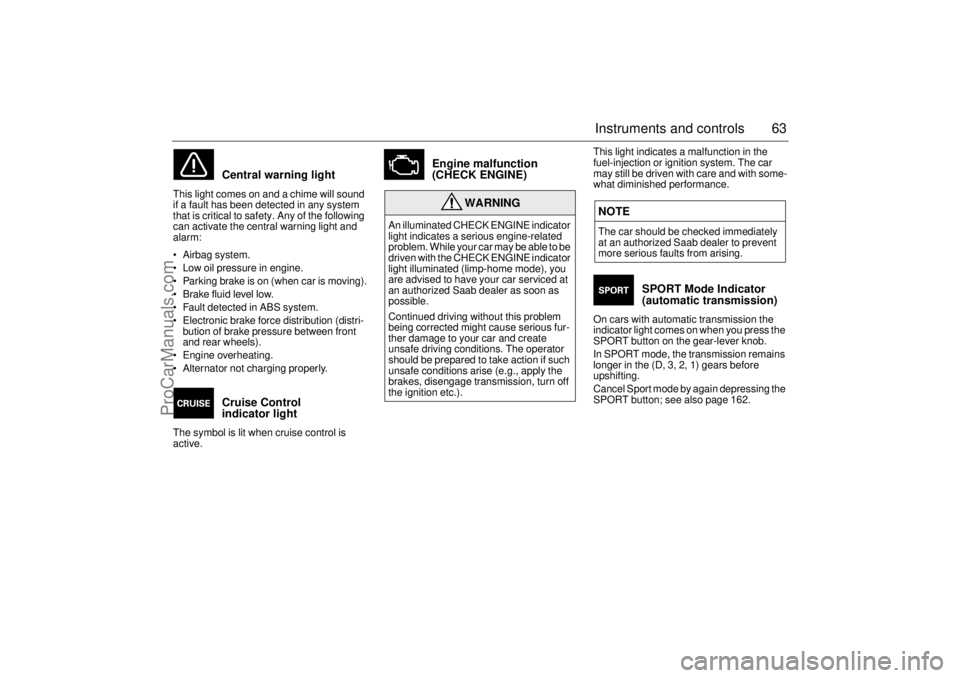
Central warning light
This light comes on and a chime will sound
if a fault has been detected in any system
that is critical to safety. Any of the following
can activate the central warning light and
alarm:
Airbag system.
Low oil pressure in engine.
Parking brake is on (when car is moving).
Brake fluid level low.
Fault detected in ABS system.
Electronic brake force distribution (distri-
bution of brake pressure between front
and rear wheels).
Engine overheating.
Alternator not charging properly.
Cruise Control
indicator light
The symbol is lit when cruise control is
active.
Engine malfunction
(CHECK ENGINE)
This light indicates a malfunction in the
fuel-injection or ignition system. The car
may still be driven with care and with some-
what diminished performance.
SPORT Mode Indicator
(automatic transmission)
On cars with automatic transmission the
indicator light comes on when you press the
SPORT button on the gear-lever knob.
In SPORT mode, the transmission remains
longer in the (D, 3, 2, 1) gears before
upshifting.
Cancel Sport mode by again depressing the
SPORT button; see also page 162.
WARNING
An illuminated CHECK ENGINE indicator
light indicates a serious engine-related
problem. While your car may be able to be
driven with the CHECK ENGINE indicator
light illuminated (limp-home mode), you
are advised to have your car serviced at
an authorized Saab dealer as soon as
possible.
Continued driving without this problem
being corrected might cause serious fur-
ther damage to your car and create
unsafe driving conditions. The operator
should be prepared to take action if such
unsafe conditions arise (e.g., apply the
brakes, disengage transmission, turn off
the ignition etc.).
NOTEThe car should be checked immediately
at an authorized Saab dealer to prevent
more serious faults from arising.
ProCarManuals.com
Page 80 of 256
80 Instruments and controlsManual climate-control
systemThe air is drawn in through an intake at the
bottom edge of the windshield. It passes
through an efficient filter before being
routed through the climate-control system
and into the cabin. The cabin discharge vent
is located on the right behind the rear
bumper. The air discharge vents should be
kept free of snow and ice in the winter.
The rate of air flow inside the car is con-
trolled by means of the fan switch. Temperature control The temperature of the incoming air can
be steplessly varied using the temperature
control.
Air distribution The air distribution control is used to direct
the flow of air to the defroster, dash and floor
vents.
The control permits settings intermediately
between the three main settings so that the
available air can be apportioned between
the floor and the windshield (defroster) or
between the floor and the panel.
To counter cold drafts from the front side
windows when the control has been set to
defroster or floor, a small flow of air issues
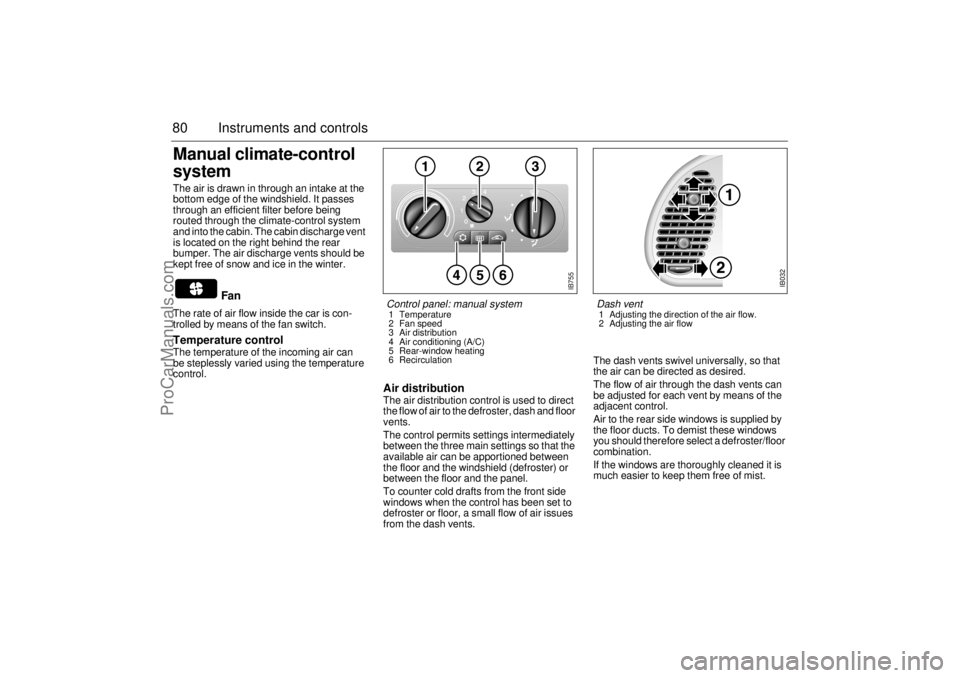
from the dash vents. The dash vents swivel universally, so that
the air can be directed as desired.
The flow of air through the dash vents can
be adjusted for each vent by means of the
adjacent control.
Air to the rear side windows is supplied by
the floor ducts. To demist these windows
you should therefore select a defroster/floor
combination.
If the windows are thoroughly cleaned it is
much easier to keep them free of mist.
Fan
IB755
Control panel: manual system 1 Temperature
2 Fan speed
3 Air distribution
4 Air conditioning (A/C)
5 Rear-window heating
6 Recirculation
IB032
Dash vent 1 Adjusting the direction of the air flow.
2 Adjusting the air flow
ProCarManuals.com
Page 82 of 256
82 Instruments and controls
The air conditioning is combined with the
conventional climate-control system and is
switched on by pressing the button,
provided that the fan control is in
position 1-4.
The incoming air is treated in three stages:
first it passes through a filter; it is then dehu-
midified and cooled and, finally, if required,
heated.
The air conditioning can be used at outdoor
temperatures down to 32°F (0°C). Condensation water When the A/C compressor is on, the incom-
ing air is dehumidified. The resulting con-
densation water is drained away through an
outlet under the car.
It is therefore perfectly normal for water to
be seen dripping from this outlet when the
car is parked. The warmer the ambient air
and the higher the humidity, the more con-
densation will form. When the button is depressed the
regular air intake will be closed. In this posi-
tion, the air inside the cabin is recirculated.
Use recirculation when you want rapid cool-
ing, at extremely high air temperatures.
Switch the air conditioning (A/C) on first.
Recirculation can be useful to activate man-
ually to prevent unpleasant smells being
drawn into the car from outside.
Note that recirculation should not be
used when the outside temperature is
lower than 50°F (+10°C) except briefly,
e.g. to avoid unpleasant air from enter-
ing the car. Prolonged use of recircula-
tion could cause the windows to mist or
ice up.
Air conditioning (A/C)
Recirculation
IB794
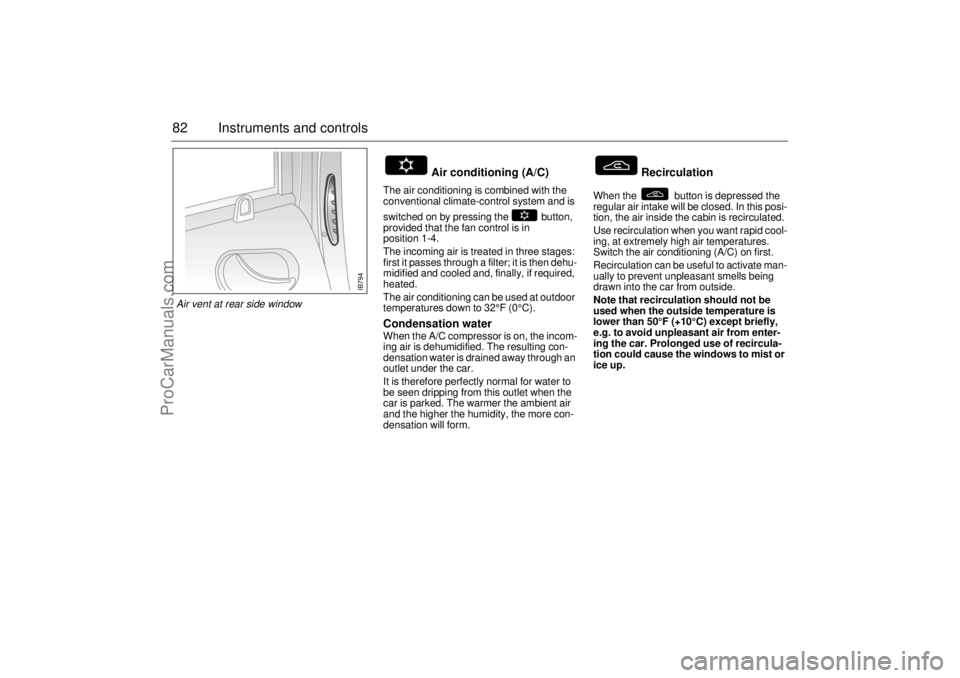
Air vent at rear side window
ProCarManuals.com
Page 86 of 256
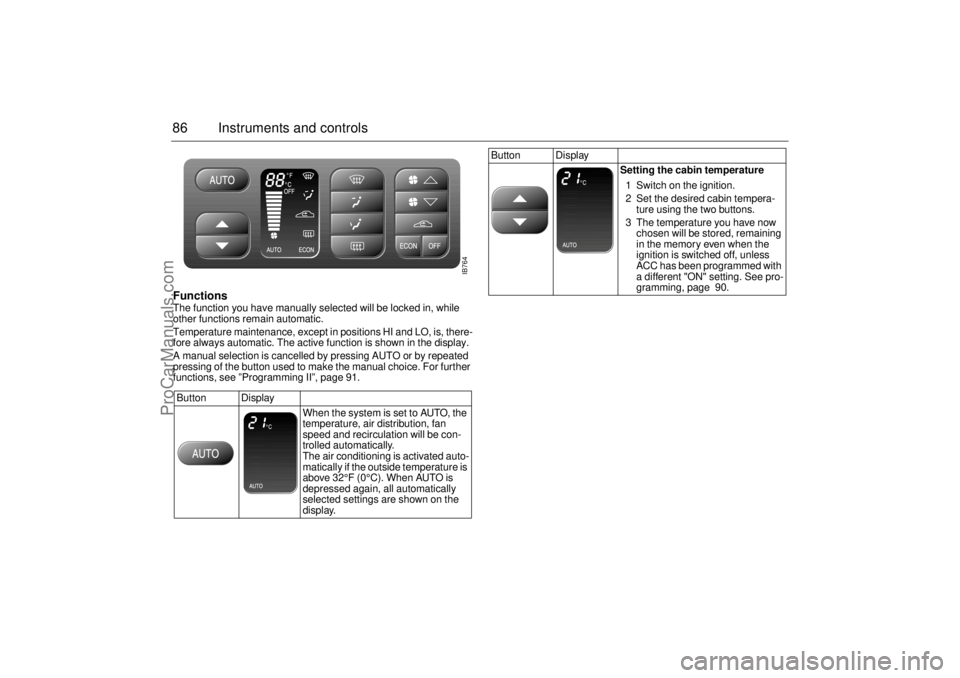
86 Instruments and controlsFunctions The function you have manually selected will be locked in, while
other functions remain automatic.
Temperature maintenance, except in positions HI and LO, is, there-
fore always automatic. The active function is shown in the display.
A manual selection is cancelled by pressing AUTO or by repeated
pressing of the button used to make the manual choice. For further
functions, see ”Programming II”, page 91.
Button Display
When the system is set to AUTO, the
temperature, air distribution, fan
speed and recirculation will be con-
trolled automatically.
The air conditioning is activated auto-
matically if the outside temperature is
above 32°F (0°C). When AUTO is
depressed again, all automatically
selected settings are shown on the
display.
Button Display
Setting the cabin temperature
1 Switch on the ignition.
2 Set the desired cabin tempera-
ture using the two buttons.
3 The temperature you have now
chosen will be stored, remaining
in the memory even when the
ignition is switched off, unless
ACC has been programmed with
a different "ON" setting. See pro-
gramming, page 90.
IB764
ProCarManuals.com
Page 115 of 256

115 OnStar - Telematics
Roadside assistance**There’s nothing worse than being stranded
on the road with car trouble. No matter what
the problem is (flat tire, out of gas, or engine
trouble), just call OnStar. They will contact
the help you need to get you quickly back on
the road.Stolen vehicle trackingOnStar doesn’t just protect you, it protects
your Saab, too. If your vehicle is ever stolen,
just contact OnStar by calling
1-888-4-ONSTAR. They will put you in
touch with the authorities and aid them in
locating your Saab. Ask your insurance car-
rier about possible premium discounts.Accident Assist™Accident Assist™ provides step-by-step
guidance about what to do in case of a
crash. Working with leading insurance com-
panies On Star has developed a ”best prac-
tices” list to assist you through most acci-
dent situations. OnStar Accident Assist™
can make the process of completing a
police report and/or insurance claim less
stressful.
OnStar Med-Net***OnStar MED-NET securely stores your per-
sonal medical information (e.g., physician’s
name, emergency contacts, medications,
chronic conditions) and, in an emergency,
can quickly send it to a medical facility. This
important information can help assist with
diagnosis and treatment. ******There will be no charge for Roadside Assistance as
long as your vehicle is under warranty.
***Requires activation and additional fee.
****Availability in Canada was undetermined at time of
pulbication. Please contact your local dealer in Canada.Hands-free communicationTalking to an OnStar advisor is easy and
hands-free. Simply press the OnStar but-
ton, and a small microphone picks up your
voice while the OnStar advisor talks to you
through your stereo speakers. Note: Audio
system must be switched on. You can even
adjust the volume to your liking with the
steering wheel controls or the radio volume
knob. Your hands remain on the steering
wheel, while your eyes remain on the road.Being safe on the road is important, but
there’s more to life than security. There’s liv-
ing. That’s why we have created the OnStar
Premium Services Plan. It gives you not
only the important protections of the Safety
and Security Plan, but also a whole range of
services which truly change driving from a
chore to a luxury. All new Saab models
come with one full year of the OnStar Pre-
mium Services Plan.* * New retail deliveries only.
The OnStar Premium
Services Plan *Route supportWith OnStar Route Support, an advisor can
help you find your way, no matter how far off
course you are. You can get exact street
directions, or guidance to nearby gas sta-
tions, restaurants, hotels or ATMs.Ride AssistIf you need a lift, anytime of the day or night,
just call OnStar. They’ll contact transporta-
tion and send it right to you.Information and Convenience ser-
vicesOnStar advisors have access to over five
million service listings including hotels, res-
taurants, gas stations, dealerships, hospi-
tals, ATMs and airports — more than 250
service categories in all. OnStar advisors
can even assist you with hotel and restau-
rant reservations.*All Saab models come with one full year of Premium
Service. New retail deliveries only.
ProCarManuals.com
Page 148 of 256

148 Starting and drivingStarting the engine The engine has an automatic choke and
should be started as follows:
Cars with manual gearbox
To start the engine the clutch pedal must
be fully depressed.
1 Depress the clutch pedal but do not
touch the accelerator.
2 Start the engine. Let the ignition key
spring back as soon as the engine has
started and is running smoothly – at very
low temperatures, you may need to run
the starter for up to 50 seconds.
Let the engine idle for about 10 seconds. Do
not open the throttle wide for at least
2-3 minutes after starting.
Cars with automatic transmission
The selector lever must be in the P or N
position.
1 Keep your foot on the brake pedal.
2 Start the engine. Let the ignition key
spring back as soon as the engine has
started and is running smoothly – at very
low temperatures, you may need to run
the starter for up to 50 seconds.
Let the engine idle for about 10 seconds. Do
not open the throttle wide for at least
2–3 minutes after starting.
Useful tips on cold climate startingIf the engine has failed to start after several
attempts in very cold weather, press and
hold the accelerator down to the floor and
run the starter for 5–10 seconds. This will
prevent the engine being flooded (exces-
sively rich fuel-air mixture).
Now start the engine in the normal way – do
not touch the accelerator.
If the engine stalls immediately after starting
(e.g. if the clutch was released too quickly),
do not touch the accelerator when restarting
the engine.
Every time the engine is switched off the
spark plugs are automatically cleaned. If
your attempt to start nevertheless fails, let
go of the ignition key and allow it to spring
back. This initiates more vigorous cleaning
of the sparking plugs which goes on for
about 5 seconds. Then start in the ordinary
way. Do not touch the accelerator; if the
accelerator is pressed to the floor the fuel
supply is shut off.
Important
considerations for
drivingThe engine-management system in the
Saab 9-3 is called Saab Trionic T7. The
system manages the ignition, fuel injection
and turbo boost pressure.
The Trionic T7 system developed by Saab
is an intelligent engine-management
system designed to achieve optimum drive-
ability under differing driving conditions.
The system makes adjustments automati-
cally, for instance, if the car is being driven
at altitude (oxygen-deficient air), for differ-
ent grades of fuel (AON 87–93) and for dif-
ferent load conditions.
1 Starting and driving
Refrain from using full throttle before
the engine has warmed up (before
needle is in the mid-range on tempera-
ture gauge) to avoid unnecessary
wear. If the needle of the pressure
gauge repeatedly enters the red zone
the engine may suddenly lose power,
owing to the intervention of a monitor-
ing system which curtails the charging
pressure. Get in touch with an autho-
rized Saab dealer at once.
A safety function prevents the engine
from reving faster than 6,200 rpm by
temporarily shutting of the fuel injec-
tors.
ProCarManuals.com
Page 151 of 256

151 Starting and driving
Never park the car on dry grass or other
combustible material. The catalytic con-
verter gets very hot and could therefore
start a fire.
Never drive off if the engine is misfiring.
If you jump start the car when the engine
is already up to normal temperature, the
engine must start to run on all cylinders.
Stop jump-starting if the engine fails to
start immediately.
Failure to follow these directions could
result in the catalytic converter and asso-
ciated components being damaged, and
could represent a breach of the warranty
conditions.
RefuelingOnly fuel from well-known oil companies
should be used.
All Saab gasoline engines can be driven on
fuel of grade AON 87-93.
For optimum performance we recommend:
AO N 90 for 2.0 Turbo 185 hp.
AO N 93 for 2.0 Turbo 205 hp and
2.3 Turbo Viggen.
If fuel containing a mixture of alcohol is
used, the following restrictions apply:
Methanol: max. 5% by volume.
Ethanol: max. 10% by volume.
MTBE: max. 15% by volume.The fuel filler cap is located in the right rear
quarter panel.
Switch off engine.
Insert the fuel-pump nozzle beyond the
flange on the filler pipe. Do not withdraw the
nozzle while filling is in progress.
Cease refueling the first time the pump
stops.
Fuel-tank capacity: 17.0 US gal. (64 liters)
Screw on the filler cap and keep turning until
it has clicked at least three times to prevent
illumination of the CHECK ENGINE light
and a TIGHTEN FUEL FILLER CAP mes-
sage to appear on SID.
Manually opening the fuel filler door, see
page 144, Convertible, page 58.
The most effective way to prevent conden-
sation forming in the tank (and thus avoid
possible running problems) is to keep the
tank full.
Before the onset of freezing temperatures in
winter, it may be advisable to add gasoline
anti-freeze to the fuel a few times to dispel
any condensation in the system.
NOTEIf the car runs out of fuel, it is possible for
air to get into the fuel system. If this
happens, the catalytic converter may
overheat and be damaged.
WARNING
Never use fuel for any purpose other
than as engine fuel.
Gasoline is highly flammable and can
cause severe burns. Never use an
exposed flame in the vicinity of gaso-
line. Never smoke when filling the
vehicle up with gasoline.
Do not use the phone when refueling
with gasoline. Gasoline fuels are
highly explosive.
NOTEDo not overfill. Fuel should not come right
up the filler pipe as expansion room is
needed.
ProCarManuals.com