brakes SAAB 9-3 2002 User Guide
[x] Cancel search | Manufacturer: SAAB, Model Year: 2002, Model line: 9-3, Model: SAAB 9-3 2002Pages: 256, PDF Size: 11.55 MB
Page 171 of 256

171 Starting and driving
Driving in a low gear results in higher fuel
consumption than in a high gear because
of the lower engine speed for a given road
speed. Always change up to a higher gear
as soon as traffic conditions allow and use
the highest gear as much as possible.
Check the air pressure in the tires once a
month. Incorrect pressures increase tire
wear. It is better to have slightly higher
pressure than lower.
Check fuel consumption regularly.
Increased consumption can indicate that
something is wrong and that the car
needs to be checked by an authorized
Saab dealer.
Practical tests on the roads have demon-
strated that substantial savings in fuel con-
sumption can be made if the above advice
is heeded.Road conditions Wet roads increase fuel consumption, as do
unpaved roads and driving in hilly country
(the amount of fuel saved driving downhill is
less than the additional amount required to
climb the hill).
Engine block heater (standard
equipment in Canada, accessory in
U.S.)The following are just some of the benefits
to the car and the environment of using an
engine block heater:
Lower fuel consumption.
Reduced wear on the engine.
Inside of car warms up faster.
Exhaust emissions substantially reduced
over short runs.
The engine block heater is effective with
outside temperatures up to +60 – +70°F
(+15 – +20°C). The warmer it is outside, the
shorter the time the heater need be con-
nected. Longer than 1.5 hours is unneces-
sary.
If the car is equipped with a removable elec-
trical cabin heater that is not in use, this
should be stored in the luggage compart-
ment.
Driving in cold weatherBefore starting a journey in cold weather
you should check the following:
That the wiper blades have not become
frozen to the windshield/glass.
Brush any snow away from the air intake
for the heater system (opening between
hood and windshield).
It may be advisable to lubricate the
door-lock cylinder (use molybdenum
disulphide, MoS
2) to prevent its freezing.
If the lock has frozen, take care not to
break the key (or use the remote control)
– heat it first or spray it with de-icer.
Periodically during the winter, add gaso-
line anti-freeze to the fuel to dispel any
condensation in the fuel tank which could
freeze and cause problems in the system.
Keep the tank well filled to reduce the risk
of condensation forming.
If the car is parked outside in freezing
weather, fuel additives (gasoline
anti-freeze) will not do any good as it
cannot remove water that has already fro-
zen. Park the car in a warm place so that
any ice that may have built up melts, then
add gasoline anti-freeze when filling up
the tank. Condensation is caused by
changes in the outdoor temperature or by
the car being parked alternately in a
garage and outside.
It is particularly important when the roads
are slippery that the brakes and tires be in
good condition.
ProCarManuals.com
Page 173 of 256
173 Starting and driving
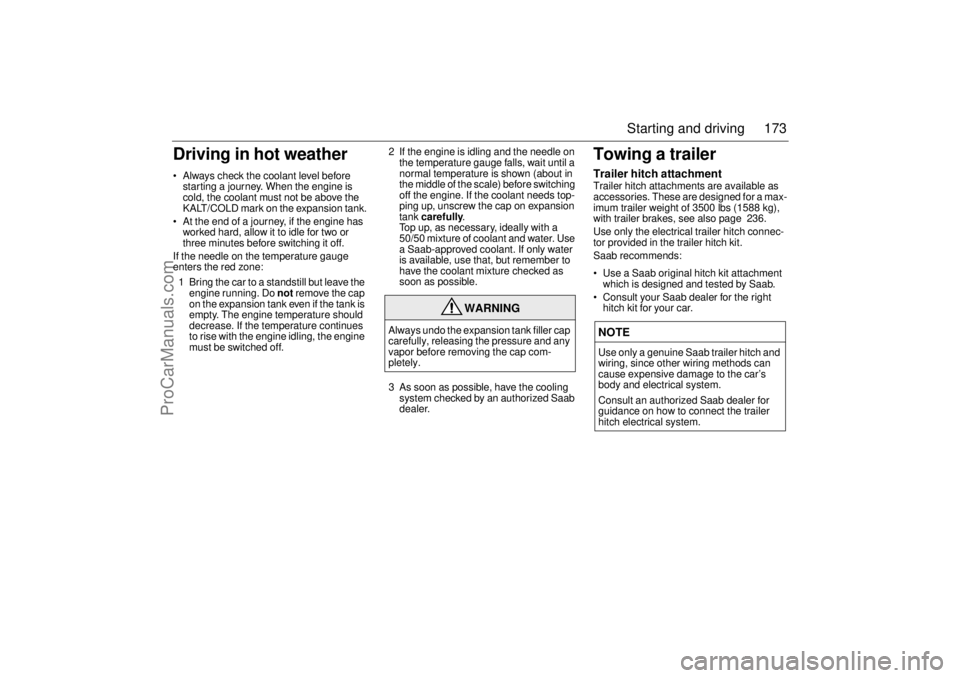
Driving in hot weather Always check the coolant level before
starting a journey. When the engine is
cold, the coolant must not be above the
KALT/COLD mark on the expansion tank.
At the end of a journey, if the engine has
worked hard, allow it to idle for two or
three minutes before switching it off.
If the needle on the temperature gauge
enters the red zone:
1 Bring the car to a standstill but leave the
engine running. Do not remove the cap
on the expansion tank even if the tank is
empty. The engine temperature should
decrease. If the temperature continues
to rise with the engine idling, the engine
must be switched off. 2 If the engine is idling and the needle on
the temperature gauge falls, wait until a
normal temperature is shown (about in
the middle of the scale) before switching
off the engine. If the coolant needs top-
ping up, unscrew the cap on expansion
tank carefully.
Top up, as necessary, ideally with a
50/50 mixture of coolant and water. Use
a Saab-approved coolant. If only water
is available, use that, but remember to
have the coolant mixture checked as
soon as possible.
3 As soon as possible, have the cooling
system checked by an authorized Saab
dealer.
Towing a trailerTrailer hitch attachment Trailer hitch attachments are available as
accessories. These are designed for a max-
imum trailer weight of 3500 lbs (1588 kg),
with trailer brakes, see also page 236.
Use only the electrical trailer hitch connec-
tor provided in the trailer hitch kit.
Saab recommends:
Use a Saab original hitch kit attachment
which is designed and tested by Saab.
Consult your Saab dealer for the right
hitch kit for your car.
WARNING
Always undo the expansion tank filler cap
carefully, releasing the pressure and any
vapor before removing the cap com-
pletely.
NOTEUse only a genuine Saab trailer hitch and
wiring, since other wiring methods can
cause expensive damage to the car’s
body and electrical system.
Consult an authorized Saab dealer for
guidance on how to connect the trailer
hitch electrical system.
ProCarManuals.com
Page 175 of 256
175 Starting and driving
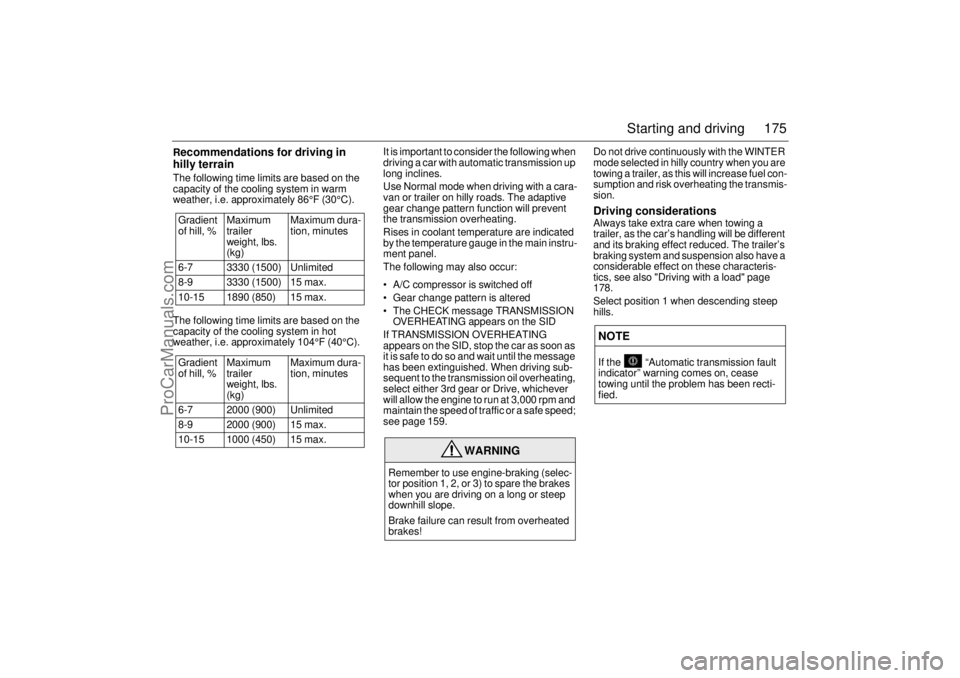
Recommendations for driving in
hilly terrainThe following time limits are based on the
capacity of the cooling system in warm
weather, i.e. approximately 86°F (30°C).
The following time limits are based on the
capacity of the cooling system in hot
weather, i.e. approximately 104°F (40°C).It is important to consider the following when
driving a car with automatic transmission up
long inclines.
Use Normal mode when driving with a cara-
van or trailer on hilly roads. The adaptive
gear change pattern function will prevent
the transmission overheating.
Rises in coolant temperature are indicated
by the temperature gauge in the main instru-
ment panel.
The following may also occur:
A/C compressor is switched off
Gear change pattern is altered
The CHECK message TRANSMISSION
OVERHEATING appears on the SID
If TRANSMISSION OVERHEATING
appears on the SID, stop the car as soon as
it is safe to do so and wait until the message
has been extinguished. When driving sub-
sequent to the transmission oil overheating,
select either 3rd gear or Drive, whichever
will allow the engine to run at 3,000 rpm and
maintain the speed of traffic or a safe speed;
see page 159.Do not drive continuously with the WINTER
mode selected in hilly country when you are
towing a trailer, as this will increase fuel con-
sumption and risk overheating the transmis-
sion.
Driving considerationsAlways take extra care when towing a
trailer, as the car’s handling will be different
and its braking effect reduced. The trailer’s
braking system and suspension also have a
considerable effect on these characteris-
tics, see also "Driving with a load" page
178.
Select position 1 when descending steep
hills. Gradient
of hill, % Maximum
trailer
weight, lbs.
(kg)Maximum dura-
tion, minutes
6-7 3330 (1500) Unlimited
8-9 3330 (1500) 15 max.
10-15 1890 (850) 15 max.
Gradient
of hill, % Maximum
trailer
weight, lbs.
(kg)Maximum dura-
tion, minutes
6-7 2000 (900) Unlimited
8-9 2000 (900) 15 max.
10-15 1000 (450) 15 max.
WARNING
Remember to use engine-braking (selec-
tor position 1, 2, or 3) to spare the brakes
when you are driving on a long or steep
downhill slope.
Brake failure can result from overheated
brakes!
NOTEIf the “Automatic transmission fault
indicator” warning comes on, cease
towing until the problem has been recti-
fied.
ProCarManuals.com
Page 184 of 256

184 Starting and drivingDriving considerations
with compact spare
wheel/tire fitted The following should be observed when the
compact spare wheel (T115/70 R16) is
installed:
The compact spare is light and easy to
handle when changing the wheel. Do not
drive farther than necessary with the com-
pact spare fitted – the maximum life of the
wheel is only just over 2000 miles
(3,500 km). Have the standard wheel
repaired and reinstalled as soon as possi-
ble.Points to bear in mind when driving with a
compact spare wheel:
The car’s ground clearance is reduced
with the compact spare fitted.
Only one compact spare wheel may be
used at any time.
Take care not to hit the curb.
Do not fit snow chains.
Leave the wheel cover off, so that the
warning text is readily visible.
For long tripsBefore starting off on a long journey, it is
advisable to have your car inspected by
your Saab dealer.
Obtain a few important items to take along
on your journey such as spare bulbs, wiper
blades, fuses, a Poly-V belt and the like.
You can check some points yourself before-
hand:
Make sure that the engine is in good con-
dition.
Check that no oil or fuel leaks out of the
engine or gearbox/transmission.
Check the coolant and power steering
fluid levels. Check also for leaks.
Inspect the Poly-V belt and replace it if it
shows any signs of wear.
Check the battery charge.
Check the tires for tread pattern and air
pressure, including the compact spare
wheel.
Take an extra car key/remote control and
keep it separate, see also page 36.
Check the brakes.
Check all bulbs.
Check for the presence of the tool kit and
the jack in the car.
WARNING
Do not exceed 50 mph (80 km/h) as the
tire can overheat and adversely affect the
handling of the car.
The tire should be inflated to 60 psi
(420 kPa).
NOTETo avoid damaging a punctured alloy
wheel this can be placed outside up in the
spare-wheel well but only while driving to
the closest dealer.
A general rule is that all heavy loads must
be well secured in the luggage compart-
ment, see page 142.
ProCarManuals.com
Page 194 of 256
194 Car careBrake- clutch fluid and
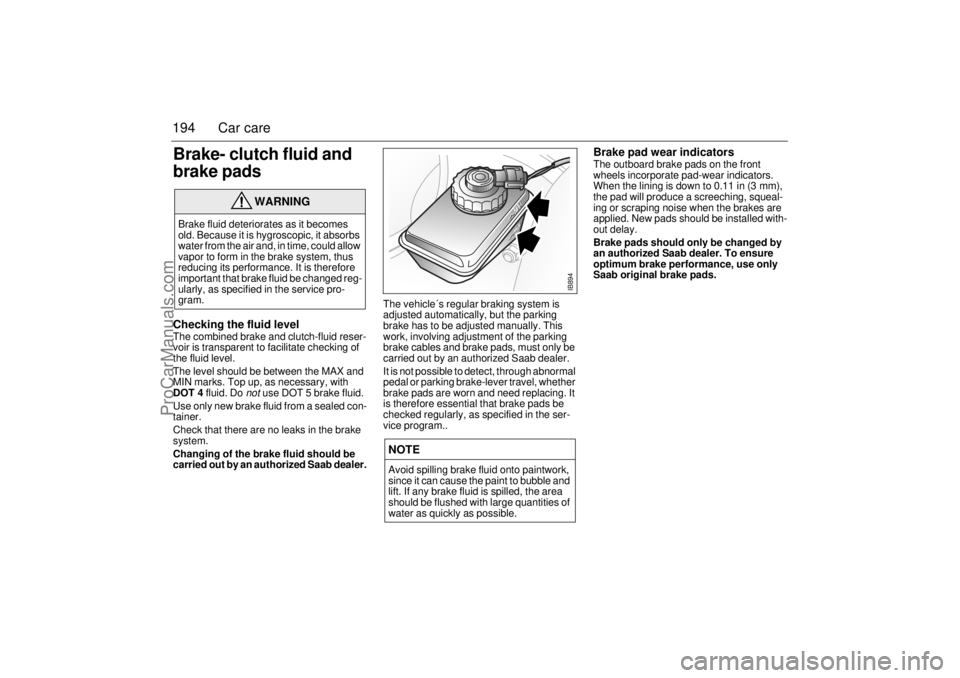
brake padsChecking the fluid level The combined brake and clutch-fluid reser-
voir is transparent to facilitate checking of
the fluid level.
The level should be between the MAX and
MIN marks. Top up, as necessary, with
DOT 4 fluid. Do
not
use DOT 5 brake fluid.
Use only new brake fluid from a sealed con-
tainer.
Check that there are no leaks in the brake
system.
Changing of the brake fluid should be
carried out by an authorized Saab dealer.The vehicle´s regular braking system is
adjusted automatically, but the parking
brake has to be adjusted manually. This
work, involving adjustment of the parking
brake cables and brake pads, must only be
carried out by an authorized Saab dealer.
It is not possible to detect, through abnormal
pedal or parking brake-lever travel, whether
brake pads are worn and need replacing. It
is therefore essential that brake pads be
checked regularly, as specified in the ser-
vice program..
Brake pad wear indicators The outboard brake pads on the front
wheels incorporate pad-wear indicators.
When the lining is down to 0.11 in (3 mm),
the pad will produce a screeching, squeal-
ing or scraping noise when the brakes are
applied. New pads should be installed with-
out delay.
Brake pads should only be changed by
an authorized Saab dealer. To ensure
optimum brake performance, use only
Saab original brake pads.
WARNING
Brake fluid deteriorates as it becomes
old. Because it is hygroscopic, it absorbs
water from the air and, in time, could allow
vapor to form in the brake system, thus
reducing its performance. It is therefore
important that brake fluid be changed reg-
ularly, as specified in the service pro-
gram.
NOTEAvoid spilling brake fluid onto paintwork,
since it can cause the paint to bubble and
lift. If any brake fluid is spilled, the area
should be flushed with large quantities of
water as quickly as possible.
IB894
ProCarManuals.com
Page 221 of 256
221 Car care
Waxing and polishingDo not wax a new car during the first three
or four months. In fact, there is no need to
polish the car before the paintwork has
started to go dull through oxidation. Other
than in exceptional cases, do not use abra-
sive polishes containing a cutting agent on
a new car. Always wash the car thoroughly
before waxing or polishing.
Touching up the paintDamaged paintwork should be treated as
soon as it is discovered: the longer it is left,
the greater the risk of corrosion. The
anti-perforation warranty does not cover
corrosion resulting from untreated defects.
Paintwork damage sustained in a crash is
usually extensive and can only be properly
restored by professionals.
However, you can repair small scratches
and stone-chip damage yourself. The nec-
essary tools and materials, such as primer,
touch-up paint and brushes, are available
from your Saab dealer.
In the case of minor flaws in the paintwork,
where the metal has not been exposed and
an undamaged layer of paint remains,
touch-up paint can usually be applied
directly, after any dirt has been scraped
away using a pointed knife.
If corrosion has already set in, e.g. as a
result of stone-chip damage, use a pointed
knife to scrape off all surface rust. If possi-
ble, the damaged area should be taken
back to the bare metal. The metal should
then be primed with two thin coats of primer
applied by brush.
After the primer has dried, apply several thin
layers of topcoat enamel until the surface of
the repaired area is flush with the surround-
ing paintwork.
Stir both primer and touch-up enamel thor-
oughly before use and allow each coat to
dry before applying the next.
NOTE Try your brakes on leaving a car wash.
Wet brake discs reduce the braking
effect.
Turn off the radio before entering an
automatic car wash so the power
antenna mast does not get damaged.
Clean the rod of the electrically pow-
ered antenna about once a month with
a clean, dry rag.
IMPORTANT! Use no oil, nor any sili-
cone-based cleaning product.
Fixed antennas must be removed
when going through an automatic car
wash.
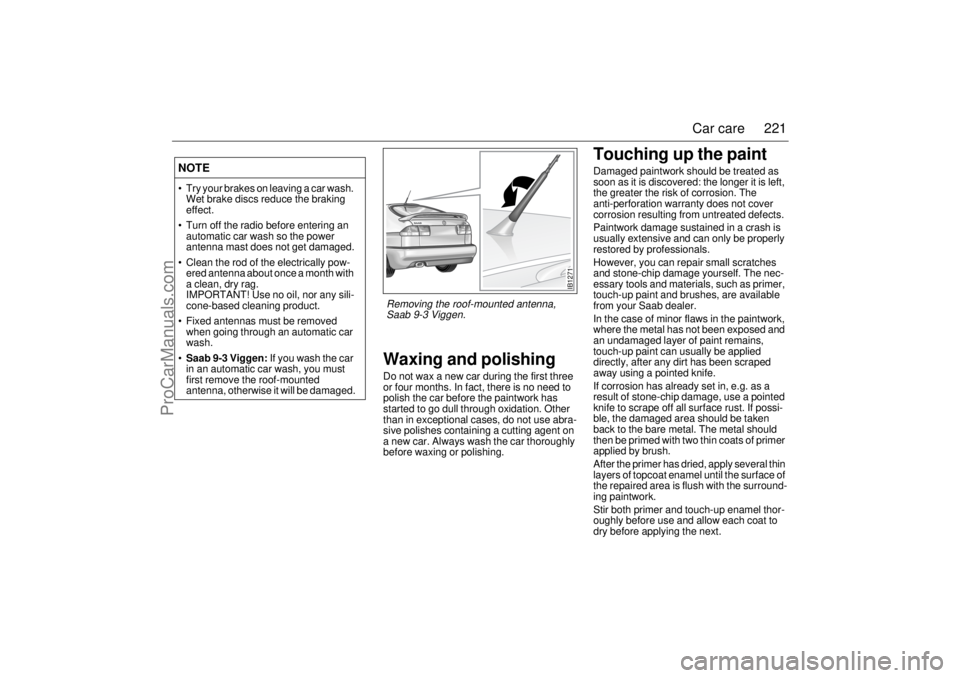
Saab 9-3 Viggen: If you wash the car
in an automatic car wash, you must
first remove the roof-mounted
antenna, otherwise it will be damaged.
IB1271
Removing the roof-mounted antenna,
Saab 9-3 Viggen.
ProCarManuals.com
Page 236 of 256
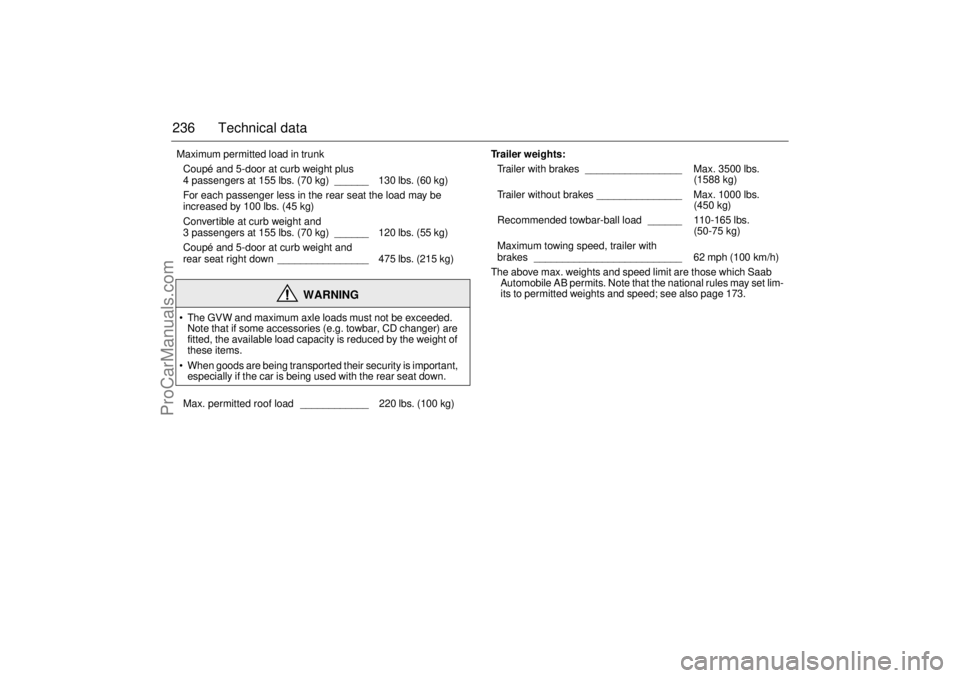
236 Technical data Maximum permitted load in trunk
Coupé and 5-door at curb weight plus
4 passengers at 155 lbs. (70 kg) ______ 130 lbs. (60 kg)
For each passenger less in the rear seat the load may be
increased by 100 lbs. (45 kg)
Convertible at curb weight and
3 passengers at 155 lbs. (70 kg) ______ 120 lbs. (55 kg)
Coupé and 5-door at curb weight and
rear seat right down ________________ 475 lbs. (215 kg)
WARNING
The GVW and maximum axle loads must not be exceeded.
Note that if some accessories (e.g. towbar, CD changer) are
fitted, the available load capacity is reduced by the weight of
these items.
When goods are being transported their security is important,
especially if the car is being used with the rear seat down.
Max. permitted roof load ____________ 220 lbs. (100 kg)
Trailer weights:
Trailer with brakes _________________ Max. 3500 lbs.
(1588 kg)
Trailer without brakes _______________ Max. 1000 lbs.
(450 kg)
Recommended towbar-ball load ______ 110-165 lbs.
(50-75 kg)
Maximum towing speed, trailer with
brakes __________________________ 62 mph (100 km/h)
The above max. weights and speed limit are those which Saab
Automobile AB permits. Note that the national rules may set lim-
its to permitted weights and speed; see also page 173.
ProCarManuals.com
Page 241 of 256

241 Technical data
Suspension
SteeringBrake systemSpring type, front and rear ____________ Coil springs
Maximum deflection of springs:
front, Coupé/5-door/Convertible _______ 6.4" (163 mm)
front, Viggen ______________________ 6.5” (165 mm)
rear, Coupé/5-door/Convertible _______ 8.3" (212 mm)
rear, Viggen ______________________ 7.9” (200 mm)
Dampers, front and rear ______________ Gas-filled tele-
scopic shock
absorbers
Steering __________________________ Power-assisted
steering gear of
rack-and-pinion
type with tele-
scopic, universal
joint steering- col-
umn shaft
Number of turns, lock to lock __________ 3.0
Oil type ___________________________ Power Steering
Fluid CHF 11S Footbrake (ABS) ___________________ Hydraulic disc
brakes with vacuum
servo, diagonally
split circuits
Parking brake ______________________ Acts on rear wheels
Brake fluid ________________________ DOT 4
Do not use DOT 5
Disc diameter:
front, Coupé/5-door/Convertible _______ 11.4" (288 mm)
front, Viggen ______________________ 12.0” (306 mm)
rear ____________________________ 11.3" (286 mm)
Total friction area of brake pads:
front, Coupé/5-door/Convertible _______ 34.4 in² (224 cm²)
front, Viggen ______________________ 35.9 in² (234 cm²)
rear ____________________________ 14.2 in² (92 cm²)
ProCarManuals.com
Page 247 of 256

247 Index
IndexAA/C system, fault diagnosis
________ 226
A/C system, maintenance _________ 226
ACC
__________________________ 84
ACC, useful tips
_________________ 92
Adjustment, steering wheel
________ 131
Air conditioning (A/C), fault diagnosis
and maintenance
______________ 226
Airbag
_________________________ 28
Alarm __________________________ 41
Alarm functions
__________________ 44
Alarm signals
___________________ 44
Anti-corrosion treatment
__________ 222
Anti-theft system
_________________ 41
Ashtray
_______________________ 135
Audio System
___________________ 93
Automatic climate control (ACC)
_____ 84
Automatic transmission
___________ 156
BBattery
________________________ 195
Boost starting from donor battery
___ 181
Brake fluid, check
_______________ 194
Brake fluid, grade _______________ 241
Brake pad wear indicators
___ 164
, 194
Brakes
________________________ 164Braking
_______________________164
Bulb table _____________________205
CCD changer
____________________102
CD player
_____________________100
CHECK messages
_______________72
CHECKING
_____________________72
Cabin lighting __________________133
Calibration, ACC _________________90
Car alarm
______________________41
Care of safety belts
______________218
Central locking
__________________36
Change of address notification
_____232
Changing a wheel
_______________215
Changing bulbs
_________________200
Changing the engine oil
__________190
Changing the key battery __________39
Changing the wheels round _______212
Changing wiper blades
___________198
Chassis number
________________243
Child car seats
__________________19
Child safety
_____________________19
Child safety locks, rear doors
_______39
Child seats
_____________________19
Cigar lighter ____________________135
Cleaning the soft top, Convertible
____57
Climate-control system, manual
_____80
Compact spare wheel
____________214
Condensation water, A/C __________82Condensation water, ACC
_________ 85
Convertible
____________________ 47
Coolant
______________________ 192
Courtesy Headlight Feature
_______ 76
Cruise Control
_________________ 163
Cup holder
____________________ 134
DDICE/TWICE
__________________ 207
Date code, tires ________________ 214
Dim low beam
__________________ 75
Dimmer
_______________________ 78
Direction indicators
______________ 76
Direction-indicator stalk
___________ 76
Dome lighting
_________________ 133
Door mirrors
__________________ 137
Drive belt
_____________________ 197
Driving in deep water
____________ 179
Driving in hot weather ___________ 173
Driving technique
_______________ 170
Driving with a compact spare wheel
184
Driving with a load
______________ 178
Driving with a roof load
__________ 176
Driving with the trunk lid open
_____ 179
EEconomical motoring
____________ 170
Electrical system, technical data
___ 240
Electrical window
_______________ 130
ProCarManuals.com