check oil SAAB 9-3 2002 User Guide
[x] Cancel search | Manufacturer: SAAB, Model Year: 2002, Model line: 9-3, Model: SAAB 9-3 2002Pages: 256, PDF Size: 11.55 MB
Page 191 of 256
191 Car care
Transmission fluidManual transmissionCheck and top up the fluid in accordance
with the service program.
If original fluid cannot be obtained for top-
ping up, Dextron III (synthetic fluid) auto-
matic transmission fluid can be used. If so,
the car should be taken to an authorized
Saab dealer as soon as possible to have the
reason for low fluid level corrected and orig-
inal fluid installed.Automatic transmissionCheck the fluid level as follows:
1 Park the car on level ground and apply
the parking brake. The automatic trans-
mission fluid must be at normal running
temperature, approximately 175°F
NOTEChange of engine oil and oil filter may be
required more frequently (5000-mile
intervals (8,000 km)) if any one of the fol-
lowing conditions apply to the car:
Most trips are less than 5 to 10 miles (8
to 16 km). This is particularly important
when outside temperatures are below
freezing.
Most trips include extensive idling
(such as frequent stop-and-go driving).
Most trips are through dusty areas.
You frequenty tow a trailer or use a car-
rier on top of your vehicle.
If the vehicle is used for delivery ser-
vice, police, taxi or other commerical
applications.
WARNING
Prolonged and repeated exposure of
the skin to engine oil can cause seri-
ous skin disorders.
Avoid prolonged skin contact when-
ever possible. Wash the affected area
thoroughly with soap and water after
any contact.
Keep oil out of reach of children.
Do not touch the turbocharger or
manifold. These get very hot when the
engine has been running.
Do not spill oil on hot parts of the
engine as this could cause a fire. Used
engine oil is particularly flammable.
Protect the environment. Do not dis-
pose of oil in the ground or down a
drain. Dispose of all used oil and oil fil-
ters at an appropriate disposal facility.
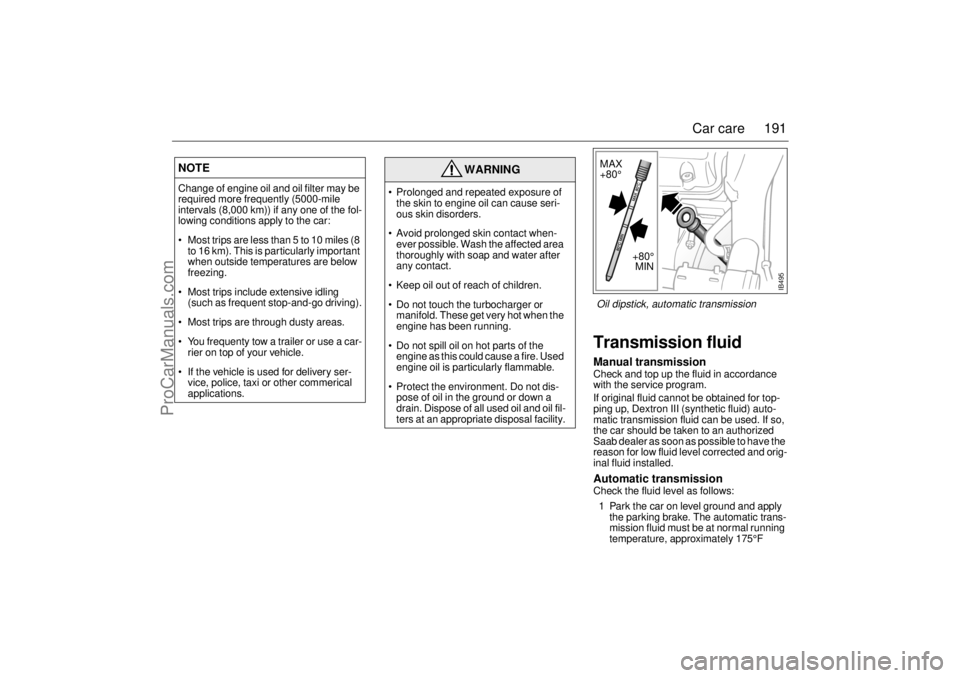
+80°
MIN MAX
+80°
IB495
Oil dipstick, automatic transmission
ProCarManuals.com
Page 192 of 256
192 Car care
(80°C). This can be achieved by driving
the car for about 30 min on the open
road.
2 With the engine idling, move the selector
lever to D and wait for at least
15 seconds. Next, move the selector
lever to R and wait for 15 seconds again.
Finally, move the selector lever to P. Let
the engine idle.
3 Wipe the dipstick clean with a lint-free
cloth and put it back.
4 With the fluid at normal temperature, the
level should be between the MAX and
MIN marks on the dipstick. Top up, as
necessary, with Texaco Texamatic Dex-
tron III automatic-transmission fluid,
adding it through the dipstick pipe. The
distance between the MIN and MAX
marks on the dipstick corresponds to a
volume of approximately 0.4 qts
(0.4 litre).
If the outside temperature is below 50°F
(10°C), the fluid will not reach the specified
temperature of 175°F (80°C). In this case,
the correct fluid level may be 0.8 in (20 mm)
below the MAX mark.
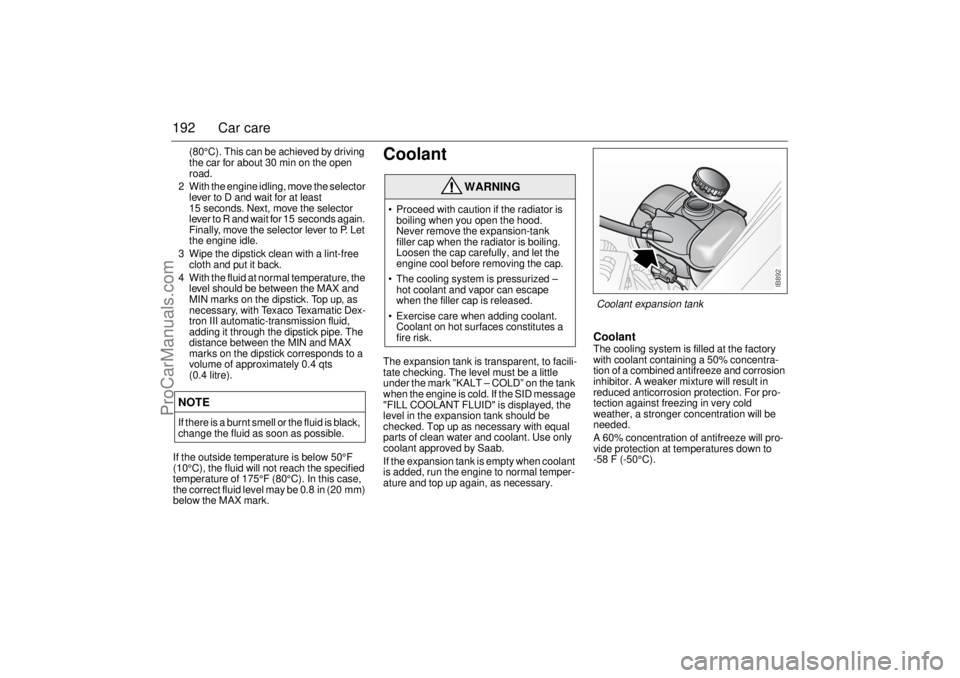
CoolantThe expansion tank is transparent, to facili-
tate checking. The level must be a little
under the mark ”KALT – COLD” on the tank
when the engine is cold. If the SID message
"FILL COOLANT FLUID" is displayed, the
level in the expansion tank should be
checked. Top up as necessary with equal
parts of clean water and coolant. Use only
coolant approved by Saab.
If the expansion tank is empty when coolant
is added, run the engine to normal temper-
ature and top up again, as necessary.
Coolant The cooling system is filled at the factory
with coolant containing a 50% concentra-
tion of a combined antifreeze and corrosion
inhibitor. A weaker mixture will result in
reduced anticorrosion protection. For pro-
tection against freezing in very cold
weather, a stronger concentration will be
needed.
A 60% concentration of antifreeze will pro-
vide protection at temperatures down to
-58 F (-50°C).
NOTEIf there is a burnt smell or the fluid is black,
change the fluid as soon as possible.
WARNING
Proceed with caution if the radiator is
boiling when you open the hood.
Never remove the expansion-tank
filler cap when the radiator is boiling.
Loosen the cap carefully, and let the
engine cool before removing the cap.
The cooling system is pressurized –
hot coolant and vapor can escape
when the filler cap is released.
Exercise care when adding coolant.
Coolant on hot surfaces constitutes a
fire risk.
IB892
Coolant expansion tank
ProCarManuals.com
Page 195 of 256
195 Car care
Power steeringCheck the level of the power-steering fluid
in the reservoir regularly, in accordance with
the service program.
The wheels should point forward during the
check.
Clean around the cap before it is
unscrewed.
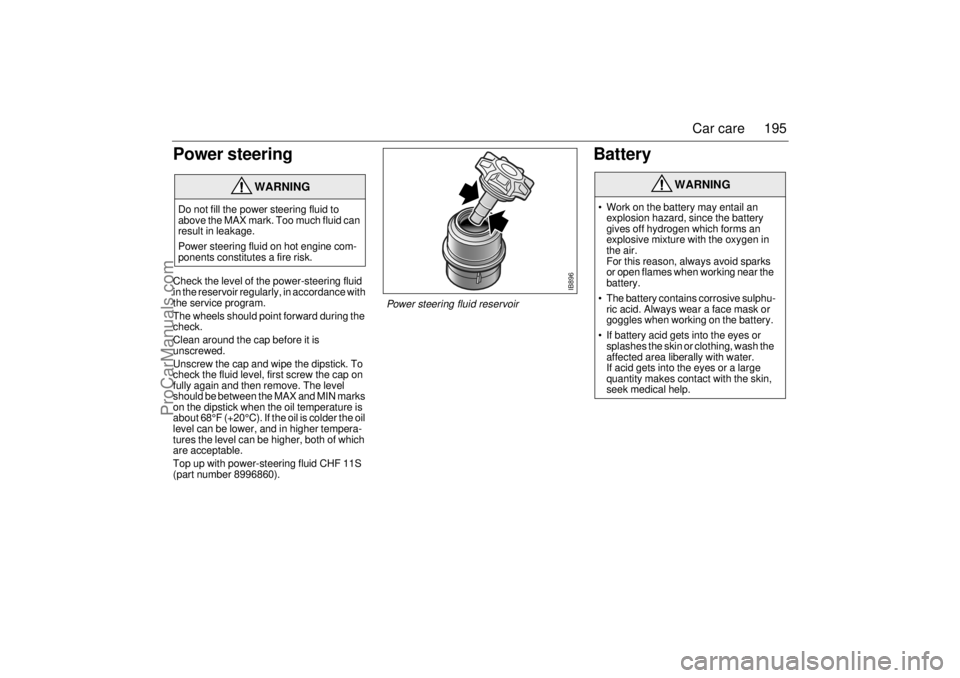
Unscrew the cap and wipe the dipstick. To
check the fluid level, first screw the cap on
fully again and then remove. The level
should be between the MAX and MIN marks
on the dipstick when the oil temperature is
about 68°F (+20°C). If the oil is colder the oil
level can be lower, and in higher tempera-
tures the level can be higher, both of which
are acceptable.
Top up with power-steering fluid CHF 11S
(part number 8996860).
Battery
WARNING
Do not fill the power steering fluid to
above the MAX mark. Too much fluid can
result in leakage.
Power steering fluid on hot engine com-
ponents constitutes a fire risk.
WARNING
Work on the battery may entail an
explosion hazard, since the battery
gives off hydrogen which forms an
explosive mixture with the oxygen in
the air.
For this reason, always avoid sparks
or open flames when working near the
battery.
The battery contains corrosive sulphu-
ric acid. Always wear a face mask or
goggles when working on the battery.
If battery acid gets into the eyes or
splashes the skin or clothing, wash the
affected area liberally with water.
If acid gets into the eyes or a large
quantity makes contact with the skin,
seek medical help.
IB896
Power steering fluid reservoir
ProCarManuals.com
Page 196 of 256
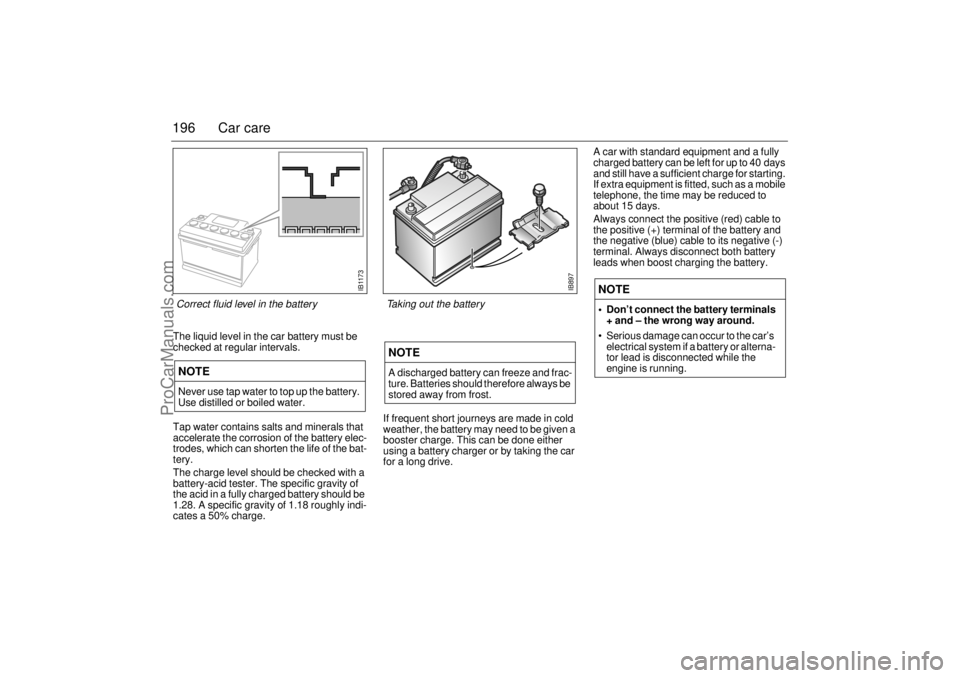
196 Car careThe liquid level in the car battery must be
checked at regular intervals.
Tap water contains salts and minerals that
accelerate the corrosion of the battery elec-
trodes, which can shorten the life of the bat-
tery.
The charge level should be checked with a
battery-acid tester. The specific gravity of
the acid in a fully charged battery should be
1.28. A specific gravity of 1.18 roughly indi-
cates a 50% charge.If frequent short journeys are made in cold
weather, the battery may need to be given a
booster charge. This can be done either
using a battery charger or by taking the car
for a long drive. A car with standard equipment and a fully
charged battery can be left for up to 40 days
and still have a sufficient charge for starting.
If extra equipment is fitted, such as a mobile
telephone, the time may be reduced to
about 15 days.
Always connect the positive (red) cable to
the positive (+) terminal of the battery and
the negative (blue) cable to its negative (-)
terminal. Always disconnect both battery
leads when boost charging the battery.NOTENever use tap water to top up the battery.
Use distilled or boiled water.
NOTEA discharged battery can freeze and frac-
ture. Batteries should therefore always be
stored away from frost.
NOTE• Don’t connect the battery terminals
+ and – the wrong way around.
Serious damage can occur to the car’s
electrical system if a battery or alterna-
tor lead is disconnected while the
engine is running.
IB897
Taking out the battery
IB1173
Correct fluid level in the battery
ProCarManuals.com
Page 218 of 256
218 Car care
Flat spottingAll tires get hot, especially on long journeys
or when the car is driven hard. After the car
has been parked with hot tires and the tires
have cooled down, a flat spot can form in the
tire, where it is in contact with the ground.
The same can occur if the car has not been
moved for a long time.
Flat spots can cause vibration that can be
felt through the steering wheel, similar to
that experienced when the wheels need bal-
ancing. Flat spots of this type disappear
once the tires get hot again, usually after
10–15 miles (20–25 km) of driving at cruis-
ing speed.
Safety beltsA check should be made periodically to
ensure that the safety belts are working
properly.
Hold the diagonal strap and pull it sharply.
The safety belt should lock and it should
not be possible to withdraw it further.
A sharp tug on the belt should cause the
inertia reel to lock. Check the floor anchor-
age points for corrosion damage. If a belt is
worn or has any fraying edges, it should be
replaced.
Safety belts must not come into contact with
substances such as polishes, oil or chemi-
cals. If the belts get dirty, wash them with
warm water and a detergent or have them
replaced.
WARNING
Safety belts and belt pretensioners that
were in use in a serious crash must be
replaced even if they are not visibly
damaged.
No attempt must be made to repair, or
modify the function of, safety belts.
IB923
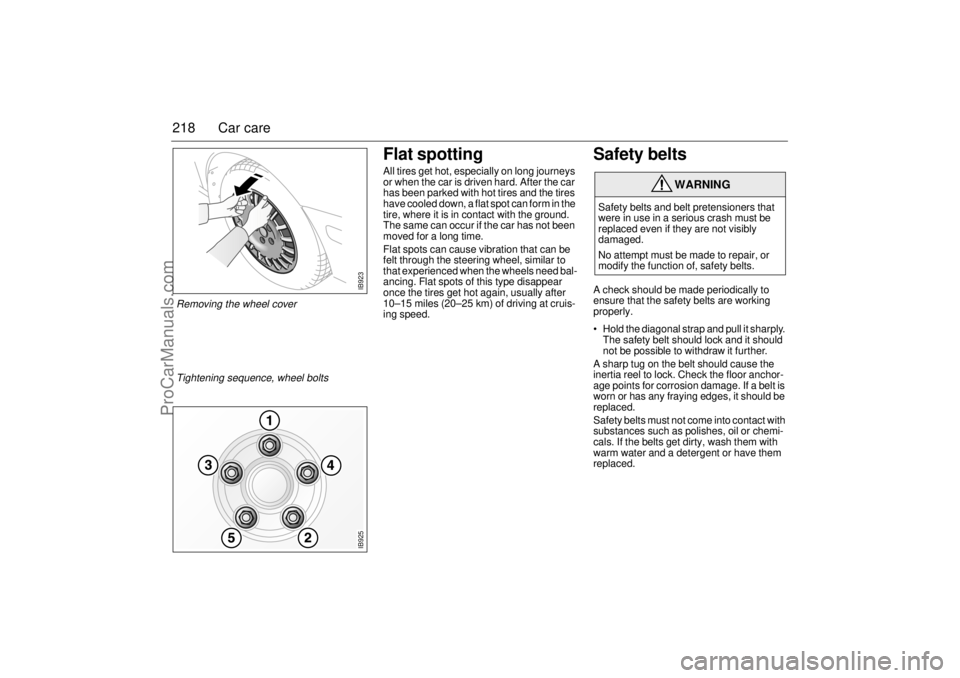
Removing the wheel cover
IB925
Tightening sequence, wheel bolts
ProCarManuals.com
Page 230 of 256

230 Maintenance and owner assistanceMaintenance scheduleThe Maintenance Schedule prescribes a
service program to the purchaser/operator
of a Saab that is reasonable and necessary
to ensure the proper emission control sys-
tems function, safety and reliability of the
Saab automobile in normal use. Additional
maintenance is recommended for specific
components when the car is operated under
certain severe conditions. Proper mainte-
nance is always a good practice!
Authorized Saab dealers are equipped and
trained to meet your Saab’s service needs.
They regularly receive up-to-date Saab ser-
vice manuals and parts and technical ser-
vice bulletins from Saab and are able,
through their franchise agreement, to attend
Saab service schools, obtain Saab special
tools and technical assistance and pur-
chase original equipment service and
replacement parts.
Today’s complex automobiles should only
be entrusted to the most knowledgeable
service professionals. A Saab dealer is your
best choice.
Service intervalsThe maintenance schedule is comprised of
a Check -up 30 days after retail delivery, fol-
lowed by services at every 10,000 miles
(16,000 km) thereafter (10,000, 20,000,
30,000 miles/16,000 32,000, 48,000 km
etc.).
Engine oil and filter changesChanging the engine oil and filter is required
at every service point. Use only a Saab
approved long-life oil filter and engine oils
meeting the SAE viscosity ratings and API
service classifications stated in the “Techni-
cal data” section of this Owner’s Manual.
The use of extra additives in the oil is not
necessary and is not recommended, and
may be harmful to turbochargers.
More frequent oil changes are recom-
mended if your vehicle is operated under
any of the following conditions:
Most trips are less than 5-10 miles (8-16
km). This is particularly important when
outside temperatures are below freezing.
Most trips include extensive idling (fre-
quent stop-and-go traffic).
Most trips are through dusty areas (such
as construction zones).
If the vehicle is used for delivery service,
police, taxi or other commercial applica-
tions.
If your driving habits match this description,
have the engine oil and filter changed in-
between normal services at 5,000 mile
(8,000 km) intervals. These conditions
cause the engine oil to break down faster.
The Warranties and Service Record Book-
let has provisions to record extra oil
changes.
NOTEThe Check-up will be done by your Saab
dealer at no charge and should be done
as close as possible to the scheduled 30
days.
ProCarManuals.com
Page 231 of 256

231 Maintenance and owner assistance
Service record retentionService instruction coupons and record
stubs are provided in the Saab Warranties
and Service Record Booklet which accom-
panies this Owner’s Manual. The coupons
are arranged in the order that normal ser-
vice should be performed. The edge of each
coupon is shaded to correspond to the type
of service point:
Striped - "Check-up".
Blue - Oil change/inspection service.
Black - Major service.
Note that in Canada a combined service
and warranty book is used, but not service
coupons.
When scheduled services are performed,
your dealer will tear out the applicable
coupon and use it to check off the opera-
tions performed and enter it into the service
file at the dealership. The servicing dealer’s
stamp, along with the date and mileage at
which the service was done, should be
entered on the corresponding stub which
remains in your booklet. The booklet is your
permanent record of the services per-
formed. It also includes a log sheet for
unscheduled repairs.
It is advisable to retain receipts and, if pos-
sible, copies of shop work orders for all ser-
vice and repair work, wherever performed.
Service costsDealer pricing practices and labor for ser-
vice work vary. Saab’s recommended ser-
vice times for each service point do not
include the labor required to replace wear
items, such as wiper blades, brake pads or
tires. Nor is labor to perform other service or
repairs found to be necessary as a result of
the inspections included in these times.
Additional labor and parts will be charged
for such work when necessary, except as
covered under an applicable Saab warranty
or any optional extended service contract.
Transmission fluid changes or suspension
alignment, when necessary, are also addi-
tional.
Dealer charges for general shop material,
regulated hazardous waste removal, recy-
cling expenses or other operation costs may
also be applied to service and repair
invoices and are apt to vary by dealer and
location.
Owner assistanceWarranties and service problem
assistanceFor complete information about all applica-
ble warranties, including the New Car War-
ranty, Perforation Warranty, Vehicle Emis-
sion Warranty and Emission Perforation
Warranty, consult the Warranties and Ser-
vice Record Booklet which accompanies
this Owner’s Manual. It also contains owner
assistance information including Saab
Roadside Assistance. If the booklet is lost or
misplaced, a new one may be ordered
through a Saab dealer or by contacting
Saab.
In the U.S. there is a national Customer
Assistance Center at Saab Cars USA, Inc.
The toll-free number to call from all 50 states
is 1-800-955-9007.
In Canada, please call the Saab Customer
Assistance Centre at 1-800-263-1999.
A list of authorized Saab sales and service
dealers is available for those planning to
travel in the United States and Canada.
Canadian or U.S. travelers may call the
Customer Assistance Center in the country
in which they are traveling.
ProCarManuals.com
Page 247 of 256

247 Index
IndexAA/C system, fault diagnosis
________ 226
A/C system, maintenance _________ 226
ACC
__________________________ 84
ACC, useful tips
_________________ 92
Adjustment, steering wheel
________ 131
Air conditioning (A/C), fault diagnosis
and maintenance
______________ 226
Airbag
_________________________ 28
Alarm __________________________ 41
Alarm functions
__________________ 44
Alarm signals
___________________ 44
Anti-corrosion treatment
__________ 222
Anti-theft system
_________________ 41
Ashtray
_______________________ 135
Audio System
___________________ 93
Automatic climate control (ACC)
_____ 84
Automatic transmission
___________ 156
BBattery
________________________ 195
Boost starting from donor battery
___ 181
Brake fluid, check
_______________ 194
Brake fluid, grade _______________ 241
Brake pad wear indicators
___ 164
, 194
Brakes
________________________ 164Braking
_______________________164
Bulb table _____________________205
CCD changer
____________________102
CD player
_____________________100
CHECK messages
_______________72
CHECKING
_____________________72
Cabin lighting __________________133
Calibration, ACC _________________90
Car alarm
______________________41
Care of safety belts
______________218
Central locking
__________________36
Change of address notification
_____232
Changing a wheel
_______________215
Changing bulbs
_________________200
Changing the engine oil
__________190
Changing the key battery __________39
Changing the wheels round _______212
Changing wiper blades
___________198
Chassis number
________________243
Child car seats
__________________19
Child safety
_____________________19
Child safety locks, rear doors
_______39
Child seats
_____________________19
Cigar lighter ____________________135
Cleaning the soft top, Convertible
____57
Climate-control system, manual
_____80
Compact spare wheel
____________214
Condensation water, A/C __________82Condensation water, ACC
_________ 85
Convertible
____________________ 47
Coolant
______________________ 192
Courtesy Headlight Feature
_______ 76
Cruise Control
_________________ 163
Cup holder
____________________ 134
DDICE/TWICE
__________________ 207
Date code, tires ________________ 214
Dim low beam
__________________ 75
Dimmer
_______________________ 78
Direction indicators
______________ 76
Direction-indicator stalk
___________ 76
Dome lighting
_________________ 133
Door mirrors
__________________ 137
Drive belt
_____________________ 197
Driving in deep water
____________ 179
Driving in hot weather ___________ 173
Driving technique
_______________ 170
Driving with a compact spare wheel
184
Driving with a load
______________ 178
Driving with a roof load
__________ 176
Driving with the trunk lid open
_____ 179
EEconomical motoring
____________ 170
Electrical system, technical data
___ 240
Electrical window
_______________ 130
ProCarManuals.com
Page 248 of 256

248 IndexElectrically adjustable seats
_______ 127
Electrically heated front seats ______ 129
Electrically heated rear window _____ 83
Electronic starting interlock
_________ 37
Emergency opening, fuel filler door
_144
Emergency operation of the soft top,
Convertible
____________________ 52
Emergency operation of the sunroof
_132
Emission control systems
_________ 188
Engine bay
____________________ 187
Engine bay, cleaning
_____________ 220
Engine break-in period ______ 155
, 170
Engine number
_________________ 243
Engine oil, changing
_____________ 190
Engine oil, checking _____________ 190
Engine oil, grade
________________ 237
Engine oil, volume _______________ 238
Engine variants
_________________ 239
Engine, description ______________ 188
Engine, technical data ____________ 237
FFault codes, Audio System
________ 109
Flat spot
______________________ 218
Folding the soft top, Convertible
_____ 49
For long trips
___________________ 184
Front fog lights __________________ 77
Fuel filler door, emergency opening
_144
Fuel gauge
_____________________ 68
Fuel grade _____________________ 239Fueling
_______________________151
Fuel-tank capacity
_______________239
Fuse table
_____________________208
Fuses
________________________206
GGearbox number
________________243
Gearbox oil, checking
____________191
Gearbox oil, grade
_______________240
General particulars ______________234
General safety instructions, Convertible
48
Glove compartment
______________135
HHandbrake
_____________________168
Hazard warning lights
_____________76
Head restraint
___________________18
Headlight flasher _________________75
Hood
_________________________186
Horn signal
____________________131
IIf the car does not start
___________147
Ignition switch
__________________146
Immobilizer
_____________________37
Important considerations concerning
cars with catalytic converters
_____150Important considerations for driving
148
Indicator lights
__________________ 60
Instrument lighting
_______________ 78
Integrated booster seat
___________ 26
Interior equipment
______________ 123
Interior lighting
_________________ 133
Interior lighting, Convertible
________ 58
Interior rearview mirror
__________ 137
JJack
_________________________ 215
Jump starting
__________________ 181
KKey
__________________________ 36
Key, removing
_________________ 146
LLATCH (child safety)
_____________ 21
Labels and plates
______________ 243
Leather upholstery, care of
_______ 219
Load eyes
____________________ 142
Locks
_________________________ 36
Lowering rear seat
______________ 138
Luggage compartment
__________ 138
Luggage compartment, Convertible
_56
Luggage-compartment lighting
____ 142
ProCarManuals.com
Page 249 of 256

249 Index
MMain beam
_____________________ 75
Main instrument panel
_____________ 60
Maintenance schedule ___________ 230
Manual climate-control system
______ 80
Manual raising of the soft top,
Convertible
____________________ 52
Manual transmission
_____________ 155
Manually opening the fuel filler door,
Convertible
____________________ 58
Manually opening the fuel filler door,
Coupé and 5-door
______________ 144
Maxi fuses
_____________________ 207
Memory, driver’s seat
____________ 128
Motoring abroad
________________ 184
NNight Panel
_____________________ 73
OORVR
________________________ 189
Odometer ______________________ 66
Oil specification
_________________ 237
OnStar
________________________ 111
Opening handle
__________________ 36
Owner assistance _______________ 231
PPaint touch-up
__________________221
Parcel shelf
____________________141
Park Brake Shift Lock
____________158
Parking brake
__________________168
Parking lights ____________________75
Plates and labels
________________243
Power steering fluid, check
________195
Power steering oil, grade
_________241
Pressure gauge
__________________67
Programmable driver’s seat
_______128
Programming, ACC
_______________90
RRadio
__________________________98
Raising the soft top, Convertible
_____51
Rear fog light
____________________77
Rear seat
______________________138
Rear seat, tipping
_______________138
Rearview mirrors ________________137
Rear-window wiper _______________79
Recirculation
____________________82
Recycling
______________________224
Refuelling _____________________151
Relay table ____________________209
Release handle, hood
____________186
Remote control
__________________36
Remote control battery, changing
____39
Removing the key
_______________146
Reporting safety defects
__________232Rev counter
____________________ 66
Reversing lights
_________________ 77
Roof rack
_____________________ 176
Rotating the tires
_______________ 212
Running-in
____________________ 155
SSAHR, head restraint
____________ 18
SID (Side Instrument Display)
______ 69
SRS (airbag)
___________________ 28
Saab Audio System
______________ 93
Saab Trionic engine management
system
______________________ 189
Safety belts ____________________ 12
Safety belts, care of
_____________ 218
Seat belts
_____________________ 12
Seat-belt pretensioners
___________ 13
Seats
________________________ 124
Service costs
__________________ 231
Service information
_____________ 232
Service intervals
_______________ 230
Service record retention
_________ 231
Side airbags
___________________ 30
Ski hatch
_____________________ 141
Snow tires ____________________ 242
Soft top storage, Convertible
_______ 56
Spare wheel
__________________ 143
Speedometer ___________________ 66
Starting the engine
_____________ 147
Steering-wheel adjustment
_______ 131
ProCarManuals.com