roof SAAB 9-3 2002 User Guide
[x] Cancel search | Manufacturer: SAAB, Model Year: 2002, Model line: 9-3, Model: SAAB 9-3 2002Pages: 256, PDF Size: 11.55 MB
Page 108 of 256
108 Saab 9-3 Audio SystemAntennaThe antenna of the Audio System is motor-
ized.
Saab 9-3 Viggen Coupé and 5-door: The
antenna is located on the roof.
For the cleaning of the motorized antenna,
see the section headed "Washing", page
220.
The car has a factory-fitted roof antenna for
a car phone. Roof loads may negatively
affect telecommunication.
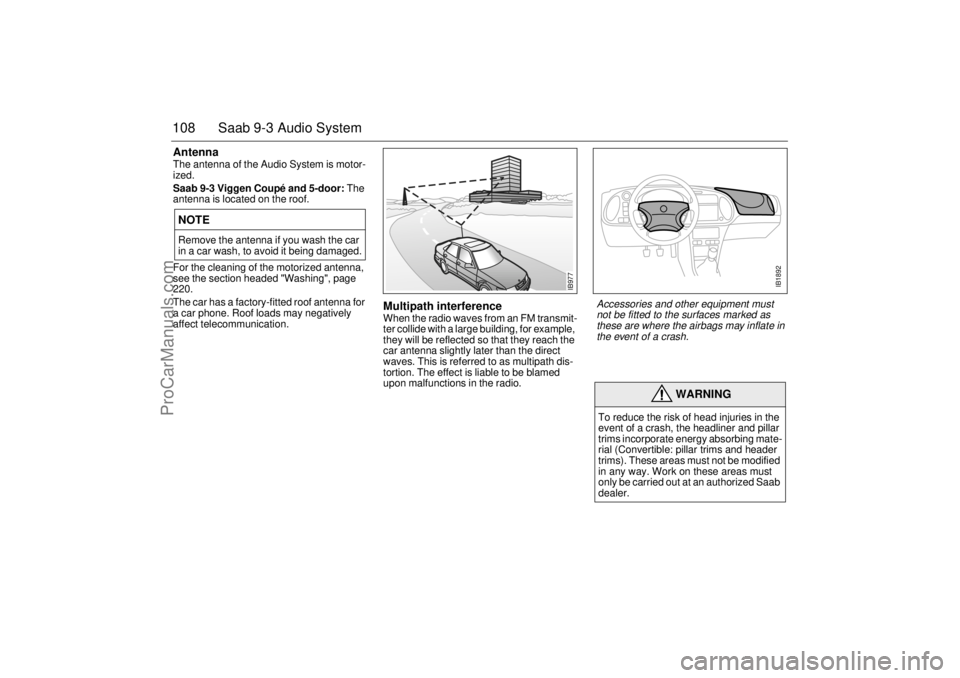
Multipath interference When the radio waves from an FM transmit-
ter collide with a large building, for example,
they will be reflected so that they reach the
car antenna slightly later than the direct
waves. This is referred to as multipath dis-
tortion. The effect is liable to be blamed
upon malfunctions in the radio.
NOTERemove the antenna if you wash the car
in a car wash, to avoid it being damaged.
WARNING
To reduce the risk of head injuries in the
event of a crash, the headliner and pillar
trims incorporate energy absorbing mate-
rial (Convertible: pillar trims and header
trims). These areas must not be modified
in any way. Work on these areas must
only be carried out at an authorized Saab
dealer.
IB977
IB1892
Accessories and other equipment must
not be fitted to the surfaces marked as
these are where the airbags may inflate in
the event of a crash.
ProCarManuals.com
Page 123 of 256
123 Interior equipment, trunk
Interior equipment,
trunkSeats ................................. 124
Steering-wheel adjust-
ment ................................ 131
Electrical windows ........... 130
Sunroof ............................. 132
Interior lighting................. 133
Cup holder ........................ 134
Ashtrays (accessory)....... 135
Glove compartment ......... 135
Rearview mirrors.............. 137
Trunk, Coupé and 5-door 138
Tools and spare wheel .... 143
Manually opening the fuel
filler door ........................ 144
IB941
ProCarManuals.com
Page 130 of 256
130 Interior equipment, trunkElectrical windows The electric window motors are equipped
with overload protection. If this protection
should trip, wait several seconds before
operating the electric windows again.To open Press the window symbol on the button.
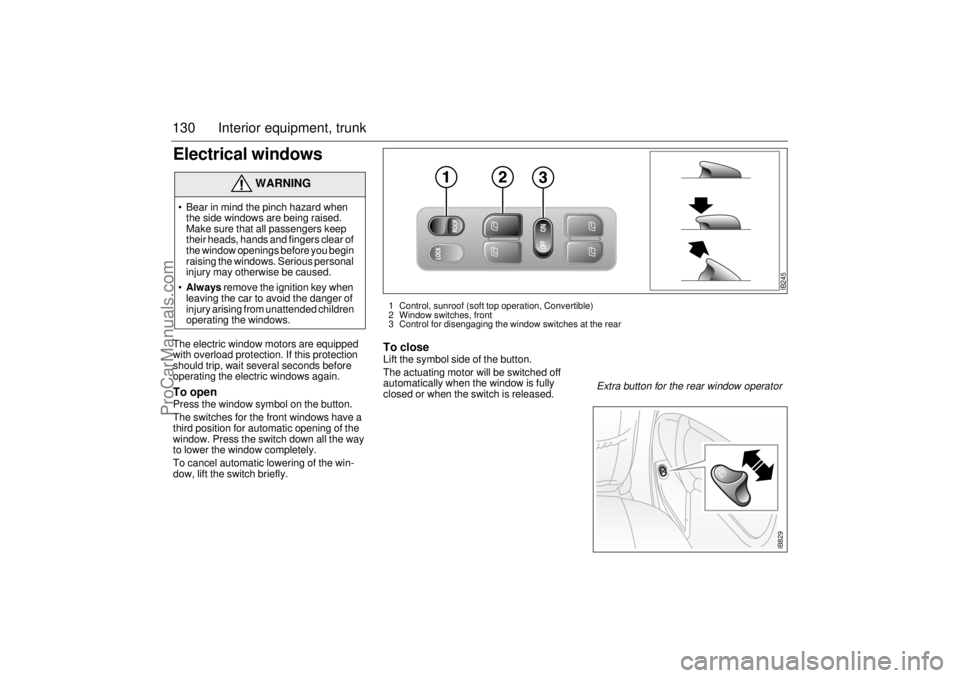
The switches for the front windows have a
third position for automatic opening of the
window. Press the switch down all the way
to lower the window completely.
To cancel automatic lowering of the win-
dow, lift the switch briefly.
To close Lift the symbol side of the button.
The actuating motor will be switched off
automatically when the window is fully
closed or when the switch is released.
WARNING
Bear in mind the pinch hazard when
the side windows are being raised.
Make sure that all passengers keep
their heads, hands and fingers clear of
the window openings before you begin
raising the windows. Serious personal
injury may otherwise be caused.
Always remove the ignition key when
leaving the car to avoid the danger of
injury arising from unattended children
operating the windows.
IB245
1 Control, sunroof (soft top operation, Convertible)
2 Window switches, front
3 Control for disengaging the window switches at the rear
IB829
Extra button for the rear window operator
ProCarManuals.com
Page 132 of 256
132 Interior equipment, trunkSunroof
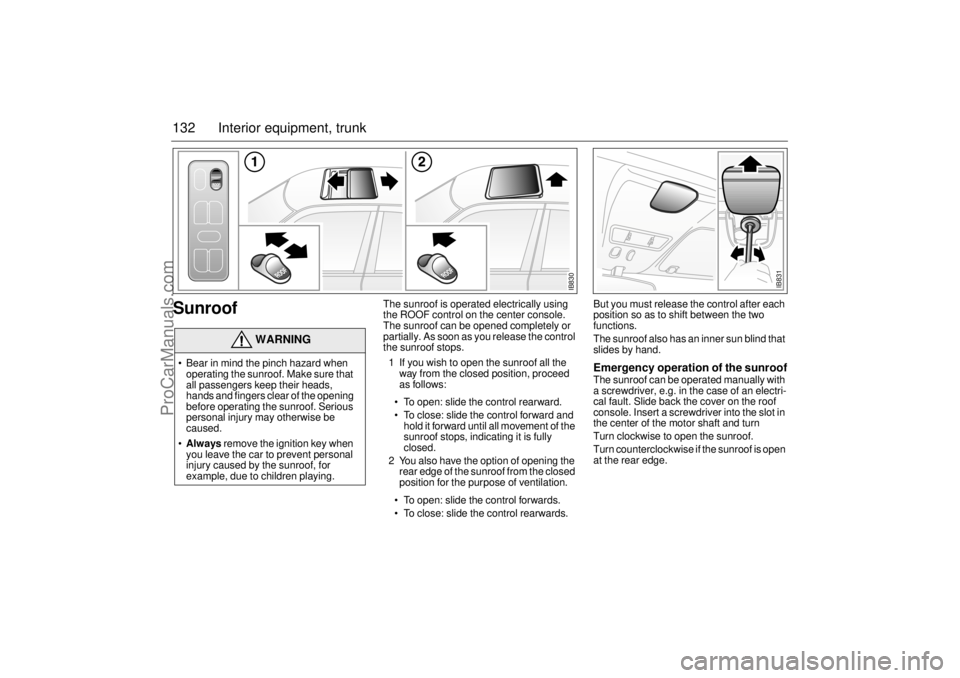
The sunroof is operated electrically using
the ROOF control on the center console.
The sunroof can be opened completely or
partially. As soon as you release the control
the sunroof stops.
1 If you wish to open the sunroof all the
way from the closed position, proceed
as follows:
To open: slide the control rearward.
To close: slide the control forward and
hold it forward until all movement of the
sunroof stops, indicating it is fully
closed.
2 You also have the option of opening the
rear edge of the sunroof from the closed
position for the purpose of ventilation.
To open: slide the control forwards.
To close: slide the control rearwards. But you must release the control after each
position so as to shift between the two
functions.
The sunroof also has an inner sun blind that
slides by hand.
Emergency operation of the sunroofThe sunroof can be operated manually with
a screwdriver, e.g. in the case of an electri-
cal fault. Slide back the cover on the roof
console. Insert a screwdriver into the slot in
the center of the motor shaft and turn
Turn clockwise to open the sunroof.
Turn counterclockwise if the sunroof is open
at the rear edge.
WARNING
Bear in mind the pinch hazard when
operating the sunroof. Make sure that
all passengers keep their heads,
hands and fingers clear of the opening
before operating the sunroof. Serious
personal injury may otherwise be
caused.
Always remove the ignition key when
you leave the car to prevent personal
injury caused by the sunroof, for
example, due to children playing.
IB830
IB831
ProCarManuals.com
Page 145 of 256
145 Starting and driving
IB943
Starting and driving
Ignition switch ................. 146
Starting the engine .......... 147
Important considerations
for driving....................... 148
Refueling .......................... 151
Engine Break-in Period... 155
Manual transmission ...... 155
Automatic transmission . 156
Cruise Control ................. 163
Braking ............................. 164
Traction Control System 166
Parking ............................. 168
Economical motoring ..... 170 Driving in cold weather ... 171
Driving in hot weather ..... 173
Towing a trailer ................ 173
Driving with a roof rack
load .................................. 176
Driving with the trunk lid
open ................................ 179
Driving in deep water....... 179
Towing the car.................. 179
Jump starting ................... 181
Driving considerations
with compact spare
wheel/tire fitted............... 184
For long trips .................... 184
ProCarManuals.com
Page 170 of 256
170 Starting and drivingEconomical motoringFactors affecting fuel consumption Fuel consumption is greatly affected by the
general driving conditions, the way in which
the car is driven and at what speeds, the
weather, the state of the road, the condition
of the car, etc. Breaking-in Fuel consumption may be somewhat higher
during the break-in period (the first 3,000–
4,000 miles (5,000–7,000 km). Weather conditionsFuel consumption can be as much as 10 %
lower in summer than in winter. The higher
consumption in cold weather is explained by
the longer time it takes for the engine to
reach normal operating temperature, and
for the transmission and wheel bearings to
warm up. Fuel economy is also affected by
the distance driven: short journeys of
3-5 miles (5-8 km) do not give the engine
enough time to reach normal temperature.
Strong winds can also affect fuel consump-
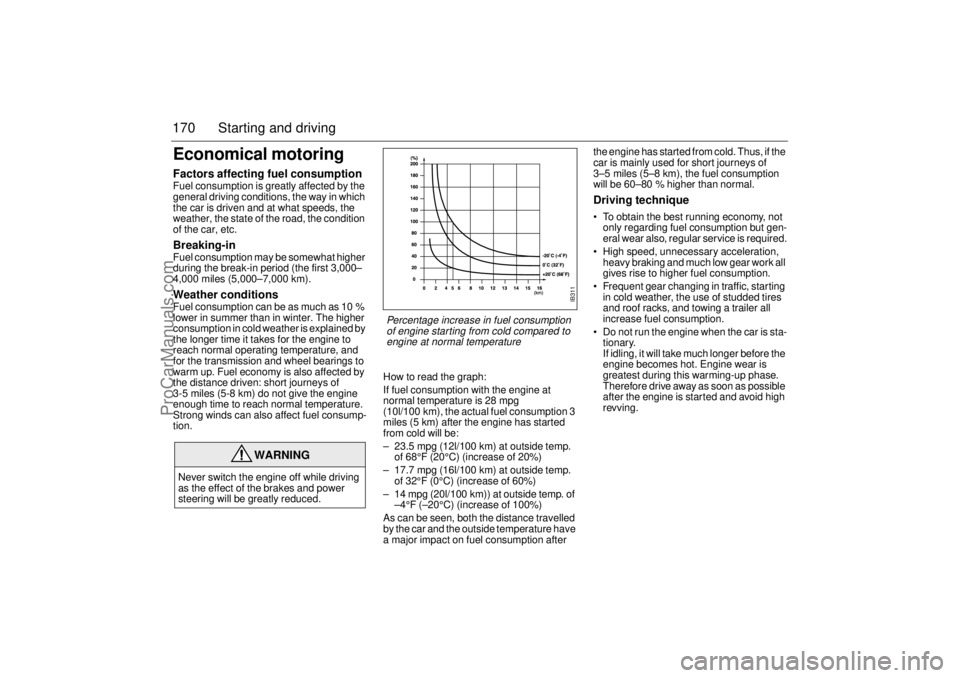
tion. How to read the graph:
If fuel consumption with the engine at
normal temperature is 28 mpg
(10l/100 km), the actual fuel consumption 3
miles (5 km) after the engine has started
from cold will be:
– 23.5 mpg (12l/100 km) at outside temp.
of 68°F (20°C) (increase of 20%)
– 17.7 mpg (16l/100 km) at outside temp.
of 32°F (0°C) (increase of 60%)
– 14 mpg (20l/100 km)) at outside temp. of
–4°F (–20°C) (increase of 100%)
As can be seen, both the distance travelled
by the car and the outside temperature have
a major impact on fuel consumption after the engine has started from cold. Thus, if the
car is mainly used for short journeys of
3–5 miles (5–8 km), the fuel consumption
will be 60–80 % higher than normal.
Driving technique To obtain the best running economy, not
only regarding fuel consumption but gen-
eral wear also, regular service is required.
High speed, unnecessary acceleration,
heavy braking and much low gear work all
gives rise to higher fuel consumption.
Frequent gear changing in traffic, starting
in cold weather, the use of studded tires
and roof racks, and towing a trailer all
increase fuel consumption.
Do not run the engine when the car is sta-
tionary.
If idling, it will take much longer before the
engine becomes hot. Engine wear is
greatest during this warming-up phase.
Therefore drive away as soon as possible
after the engine is started and avoid high
revving.
WARNING
Never switch the engine off while driving
as the effect of the brakes and power
steering will be greatly reduced.
IB311
Percentage increase in fuel consumption
of engine starting from cold compared to
engine at normal temperature
ProCarManuals.com
Page 176 of 256
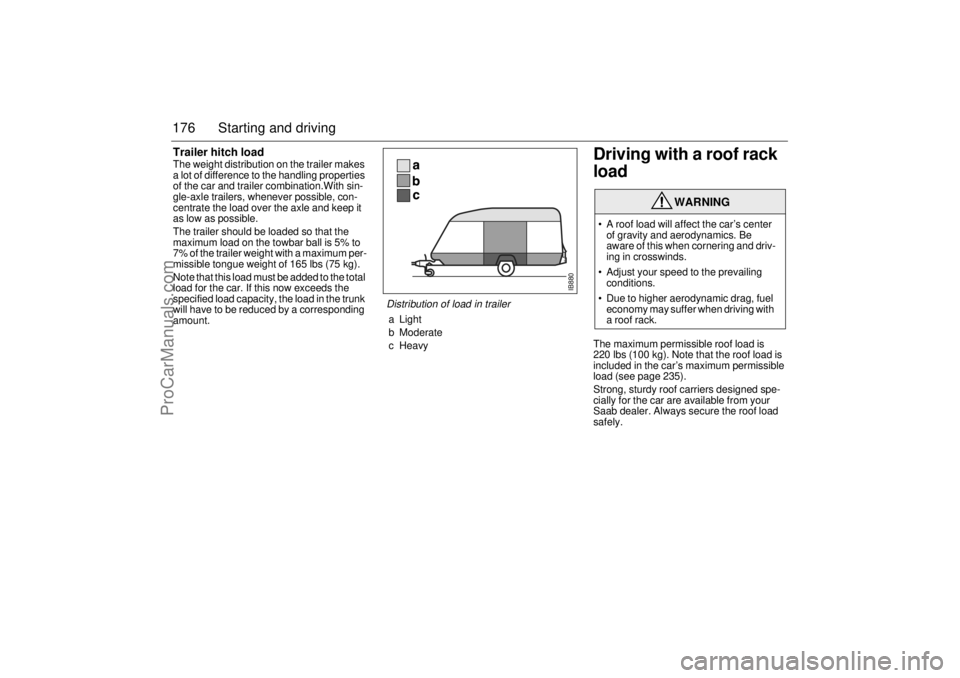
176 Starting and drivingTrailer hitch loadThe weight distribution on the trailer makes
a lot of difference to the handling properties
of the car and trailer combination.With sin-
gle-axle trailers, whenever possible, con-
centrate the load over the axle and keep it
as low as possible.
The trailer should be loaded so that the
maximum load on the towbar ball is 5% to
7% of the trailer weight with a maximum per-
missible tongue weight of 165 lbs (75 kg).
Note that this load must be added to the total
load for the car. If this now exceeds the
specified load capacity, the load in the trunk
will have to be reduced by a corresponding
amount.
Driving with a roof rack
loadThe maximum permissible roof load is
220 lbs (100 kg). Note that the roof load is
included in the car’s maximum permissible
load (see page 235).
Strong, sturdy roof carriers designed spe-
cially for the car are available from your
Saab dealer. Always secure the roof load
safely.
WARNING
A roof load will affect the car’s center
of gravity and aerodynamics. Be
aware of this when cornering and driv-
ing in crosswinds.
Adjust your speed to the prevailing
conditions.
Due to higher aerodynamic drag, fuel
economy may suffer when driving with
a roof rack.
IB880
Distribution of load in trailer aLight
b Moderate
cHeavy
ProCarManuals.com
Page 177 of 256
177 Starting and driving
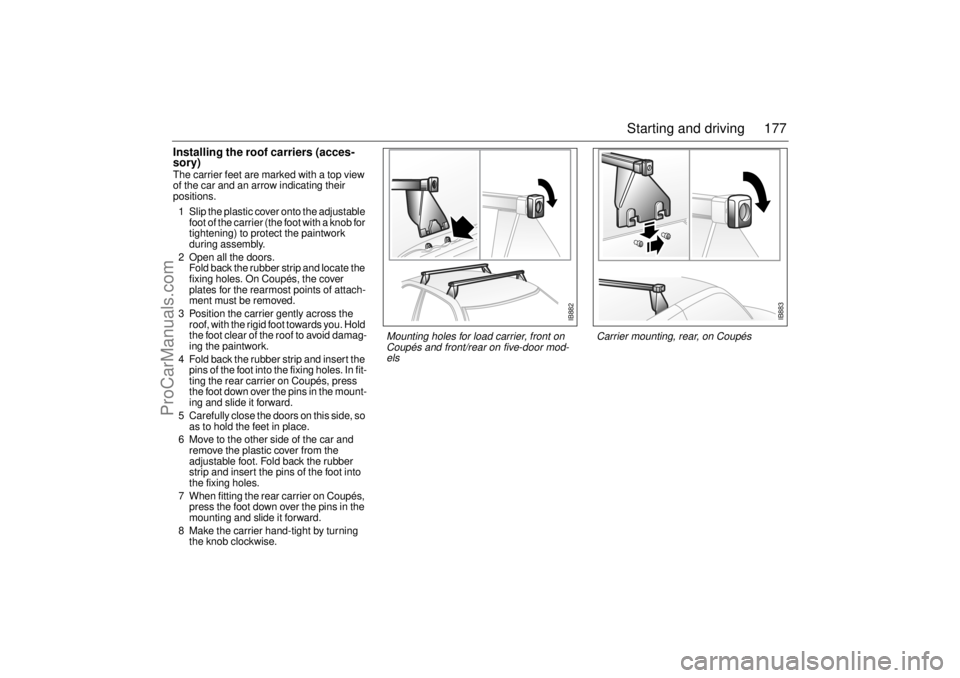
Installing the roof carriers (acces-
sory) The carrier feet are marked with a top view
of the car and an arrow indicating their
positions.
1 Slip the plastic cover onto the adjustable
foot of the carrier (the foot with a knob for
tightening) to protect the paintwork
during assembly.
2 Open all the doors.
Fold back the rubber strip and locate the
fixing holes. On Coupés, the cover
plates for the rearmost points of attach-
ment must be removed.
3 Position the carrier gently across the
roof, with the rigid foot towards you. Hold
the foot clear of the roof to avoid damag-
ing the paintwork.
4 Fold back the rubber strip and insert the
pins of the foot into the fixing holes. In fit-
ting the rear carrier on Coupés, press
the foot down over the pins in the mount-
ing and slide it forward.
5 Carefully close the doors on this side, so
as to hold the feet in place.
6 Move to the other side of the car and
remove the plastic cover from the
adjustable foot. Fold back the rubber
strip and insert the pins of the foot into
the fixing holes.
7 When fitting the rear carrier on Coupés,
press the foot down over the pins in the
mounting and slide it forward.
8 Make the carrier hand-tight by turning
the knob clockwise.
IB882
IB883
Mounting holes for load carrier, front on
Coupés and front/rear on five-door mod-
els Carrier mounting, rear, on Coupés
ProCarManuals.com
Page 178 of 256

178 Starting and drivingDriving with a loadThe driving characteristics of the car are
affected by the way it is loaded.
Place heavy loads as far forward and as
low as possible in the trunk.
Secure the load to the tie downs, see
page 142.
The load should be such that the car´s
total weight or axle weight are not
exceeded, see page 235.
Heavy loads mean that the car’s center of
gravity is further back. As a result, the car
will sway more during evasive steering.
Never exceed the permissible load in the
roof box, even if there is room for more.
Ensure that the tire pressure is correct –
slight overinflation is preferable to under-
inflation.
The braking distance of a loaded car is
always greater. Keep your distance from
the vehicle in front.
Tire pressure, see page 211 and back
cover.
TiresThe tire pressure should match the current
load and speed of the car; see the back
cover or the tire pressure label on
page 243.
The tire pressures given apply to cold tires,
that is tires that are the same temperature
as the outside air temperature.
The tire pressure increases as the tires
become warm (e.g. during highway driving)
with approximately 0.3 bar (4 psi). When
the temperature of the tires changes by 50°
(10°C), the tire pressure will change 0.1 bar
(2 psi).Never reduce the pressure of a hot tire. If the
tires are hot when you check them, only
increase the pressure, if necessary.
Underinflated tires wear more quickly than
slightly overinflated tires.
If a valve is leaking, simply unscrew it and fit
a new one.
Important! Remember to adjust the tire
pressures if you change the load in the car
or intend to drive at substantially lower or
higher speeds than normal.NOTECheck the tire pressure at least once a
month. Underinflation is the main cause
of:
Damage to the wheels.
Premature tire wear.
Damage to the sidewalls.
ProCarManuals.com
Page 179 of 256
179 Starting and driving
Driving with the trunk lid
openAvoid driving with the trunk lid partly or fully
open, since exhaust fumes can be drawn
into the cabin.
If you must drive with the trunk lid open, all
windows and the sunroof (if fitted) must be
closed and the cabin fan on at its highest
speed setting.Driving in deep waterTowing the car
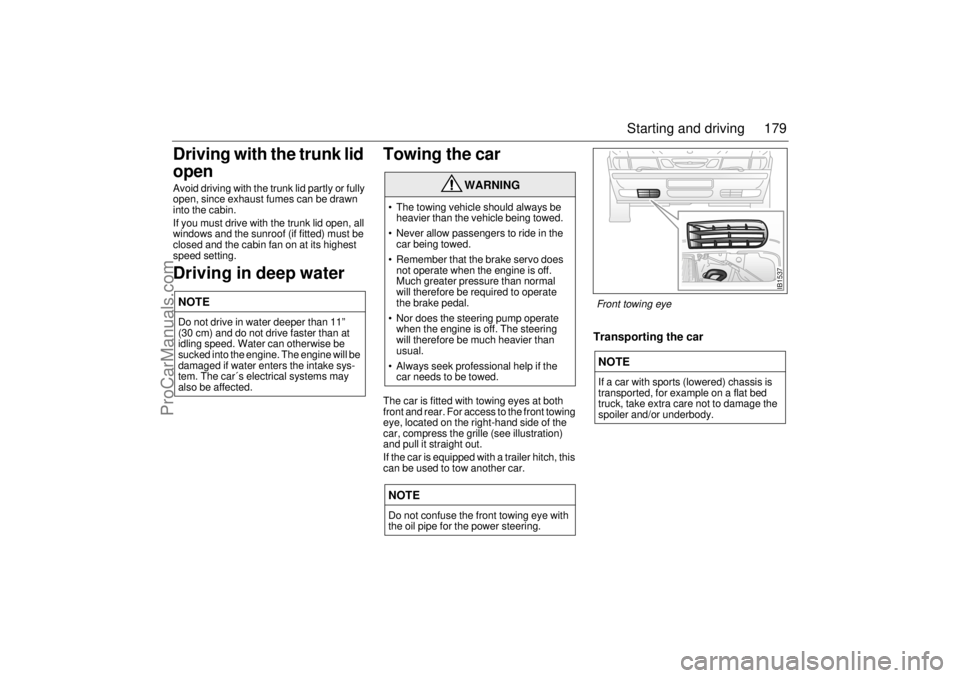
The car is fitted with towing eyes at both
front and rear. For access to the front towing
eye, located on the right-hand side of the
car, compress the grille (see illustration)
and pull it straight out.
If the car is equipped with a trailer hitch, this
can be used to tow another car.
Transporting the car NOTE
Do not drive in water deeper than 11”
(30 cm) and do not drive faster than at
idling speed. Water can otherwise be
sucked into the engine. The engine will be
damaged if water enters the intake sys-
tem. The car´s electrical systems may
also be affected.
WARNING
The towing vehicle should always be
heavier than the vehicle being towed.
Never allow passengers to ride in the
car being towed.
Remember that the brake servo does
not operate when the engine is off.
Much greater pressure than normal
will therefore be required to operate
the brake pedal.
Nor does the steering pump operate
when the engine is off. The steering
will therefore be much heavier than
usual.
Always seek professional help if the
car needs to be towed. NOTEDo not confuse the front towing eye with
the oil pipe for the power steering.
NOTEIf a car with sports (lowered) chassis is
transported, for example on a flat bed
truck, take extra care not to damage the
spoiler and/or underbody.
IB1537
Front towing eye
ProCarManuals.com