tow SAAB 9-3 2002 User Guide
[x] Cancel search | Manufacturer: SAAB, Model Year: 2002, Model line: 9-3, Model: SAAB 9-3 2002Pages: 256, PDF Size: 11.55 MB
Page 89 of 256
89 Instruments and controls
Starting in cold weather: The automatic
climate control system selects the defroster
position, max. heating and low fan speed to
begin with.
As the engine temperature rises, the fan
speed is increased and air is routed towards
the floor.
As the temperature inside the car nears the
selected value, both the fan speed and the
heat will be decreased to a level determined
by the system.
Starting in hot weather: The automatic cli-
mate control system selects air to the panel
vents and high fan speed. Recirculation is
switched on about 30 seconds after starting
if the selected cabin temperature is mark-
edly lower than the actual temperature.
Unless the ECON button has been
depressed, the A/C compressor is always
switched on at outside temperatures above
32°F (0°C) in order to cool and dehumidify
the incoming air, unless the ECON button
has been depressed.
As the temperature inside the car nears the
selected value, the fan speed will be
decreased to a value determined by the
system.
Action to be taken in special types of
weather Normally, misting and icing problems on the
windows do not occur other than in extreme
situations, e.g. when you are driving in
heavy rain or severe cold in combination
with high air humidity or when those travel-
ling in the car are sweaty and wet. If you
have trouble with misting or icing in such
cases we suggest the following counter-
measures:
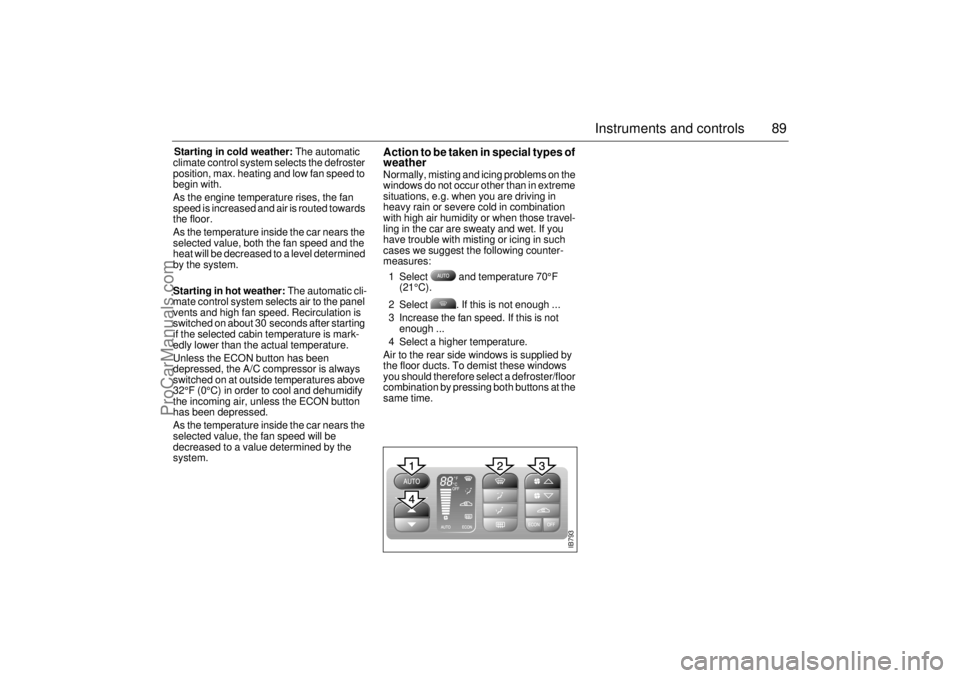
1 Select and temperature 70°F
(21°C).
2 Select . If this is not enough ...
3 Increase the fan speed. If this is not
enough ...
4 Select a higher temperature.
Air to the rear side windows is supplied by
the floor ducts. To demist these windows
you should therefore select a defroster/floor
combination by pressing both buttons at the
same time.
IB793
ProCarManuals.com
Page 137 of 256
137 Interior equipment, trunk
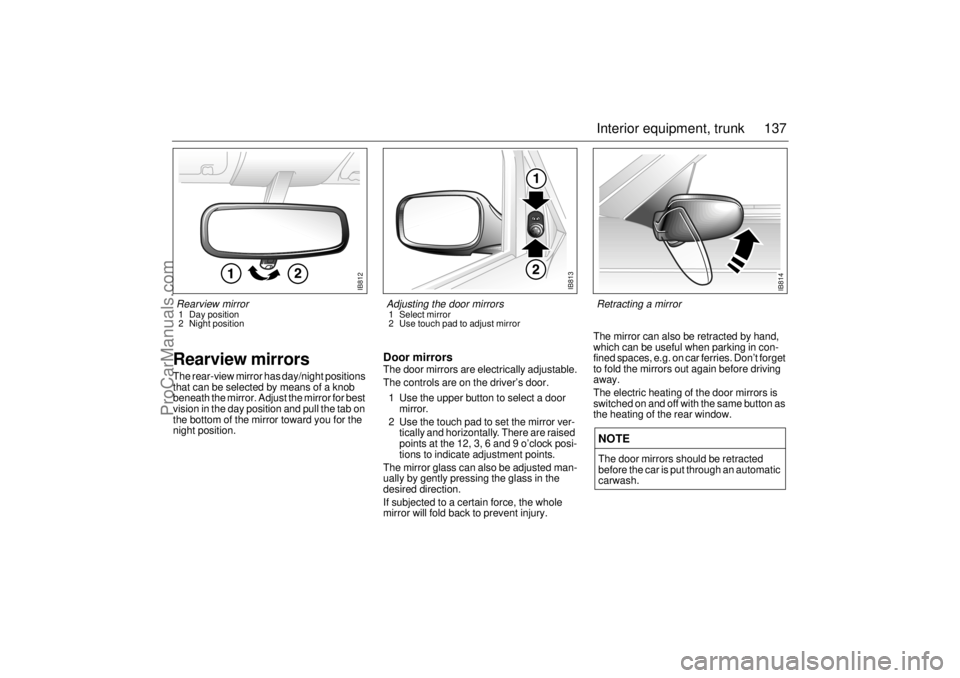
Rearview mirrorsThe rear-view mirror has day/night positions
that can be selected by means of a knob
beneath the mirror. Adjust the mirror for best
vision in the day position and pull the tab on
the bottom of the mirror toward you for the
night position.
Door mirrorsThe door mirrors are electrically adjustable.
The controls are on the driver’s door.
1 Use the upper button to select a door
mirror.
2 Use the touch pad to set the mirror ver-
tically and horizontally. There are raised
points at the 12, 3, 6 and 9 o’clock posi-
tions to indicate adjustment points.
The mirror glass can also be adjusted man-
ually by gently pressing the glass in the
desired direction.
If subjected to a certain force, the whole
mirror will fold back to prevent injury. The mirror can also be retracted by hand,
which can be useful when parking in con-
fined spaces, e.g. on car ferries. Don’t forget
to fold the mirrors out again before driving
away.
The electric heating of the door mirrors is
switched on and off with the same button as
the heating of the rear window.
NOTEThe door mirrors should be retracted
before the car is put through an automatic
carwash.
IB813
Adjusting the door mirrors 1 Select mirror
2 Use touch pad to adjust mirror
IB814
Retracting a mirror
IB812
Rearview mirror1 Day position
2 Night position
ProCarManuals.com
Page 145 of 256
145 Starting and driving
IB943
Starting and driving
Ignition switch ................. 146
Starting the engine .......... 147
Important considerations
for driving....................... 148
Refueling .......................... 151
Engine Break-in Period... 155
Manual transmission ...... 155
Automatic transmission . 156
Cruise Control ................. 163
Braking ............................. 164
Traction Control System 166
Parking ............................. 168
Economical motoring ..... 170 Driving in cold weather ... 171
Driving in hot weather ..... 173
Towing a trailer ................ 173
Driving with a roof rack
load .................................. 176
Driving with the trunk lid
open ................................ 179
Driving in deep water....... 179
Towing the car.................. 179
Jump starting ................... 181
Driving considerations
with compact spare
wheel/tire fitted............... 184
For long trips .................... 184
ProCarManuals.com
Page 150 of 256
150 Starting and driving
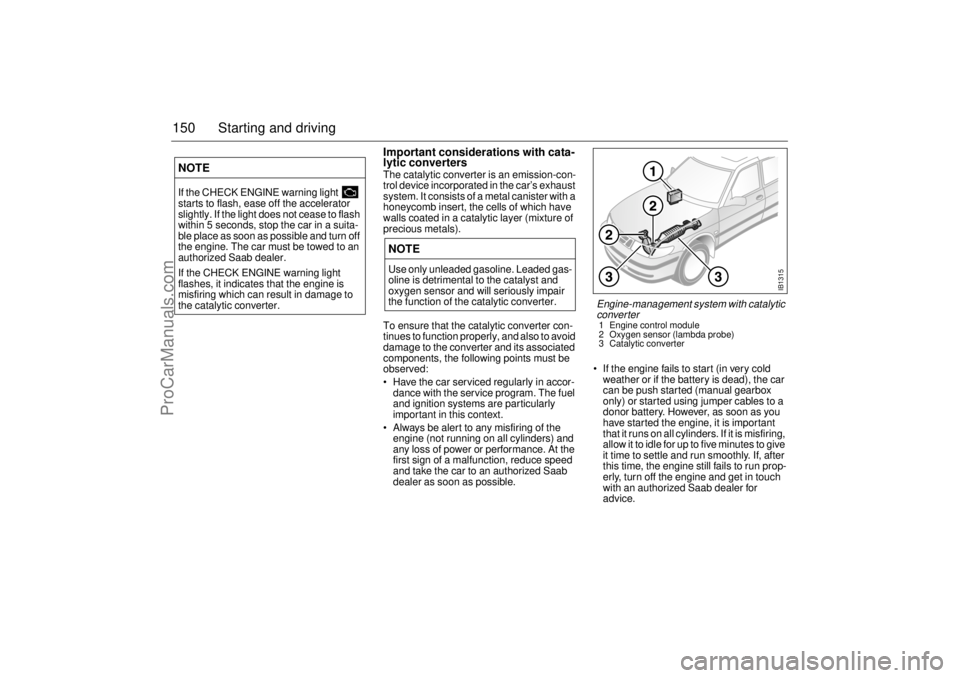
Important considerations with cata-
lytic convertersThe catalytic converter is an emission-con-
trol device incorporated in the car’s exhaust
system. It consists of a metal canister with a
honeycomb insert, the cells of which have
walls coated in a catalytic layer (mixture of
precious metals).
To ensure that the catalytic converter con-
tinues to function properly, and also to avoid
damage to the converter and its associated
components, the following points must be
observed:
Have the car serviced regularly in accor-
dance with the service program. The fuel
and ignition systems are particularly
important in this context.
Always be alert to any misfiring of the
engine (not running on all cylinders) and
any loss of power or performance. At the
first sign of a malfunction, reduce speed
and take the car to an authorized Saab
dealer as soon as possible. If the engine fails to start (in very cold
weather or if the battery is dead), the car
can be push started (manual gearbox
only) or started using jumper cables to a
donor battery. However, as soon as you
have started the engine, it is important
that it runs on all cylinders. If it is misfiring,
allow it to idle for up to five minutes to give
it time to settle and run smoothly. If, after
this time, the engine still fails to run prop-
erly, turn off the engine and get in touch
with an authorized Saab dealer for
advice.
NOTEIf the CHECK ENGINE warning light
starts to flash, ease off the accelerator
slightly. If the light does not cease to flash
within 5 seconds, stop the car in a suita-
ble place as soon as possible and turn off
the engine. The car must be towed to an
authorized Saab dealer.
If the CHECK ENGINE warning light
flashes, it indicates that the engine is
misfiring which can result in damage to
the catalytic converter.
NOTEUse only unleaded gasoline. Leaded gas-
oline is detrimental to the catalyst and
oxygen sensor and will seriously impair
the function of the catalytic converter.
IB1315
Engine-management system with catalytic
converter 1 Engine control module
2 Oxygen sensor (lambda probe)
3 Catalytic converter
ProCarManuals.com
Page 158 of 256
158 Starting and drivingLock-up functionThe automatic transmission has a lock-up
function, which renders the torque con-
verter inoperative in 3rd and 4th gears. The
result is reduction in the engine speed and,
hence, fuel consumption.
When the lock-up function comes into oper-
ation, it may give the impression of an over-
drive being engaged.Kick-downWhen the accelerator is pressed down hard,
a downshift to the next lower gear will occur
to provide maximum acceleration, e.g. for
overtaking.
The change-up to the next gear again will
take place either when the accelerator is
released or when maximum engine speed
for that gear is reached.
Park Brake Shift LockThe transmission has a safety function
called Park Brake Shift Lock. For the selec-
tor lever to be moved out of the P position,
the brake pedal must be depressed at the
same time as the detent button is lifted.
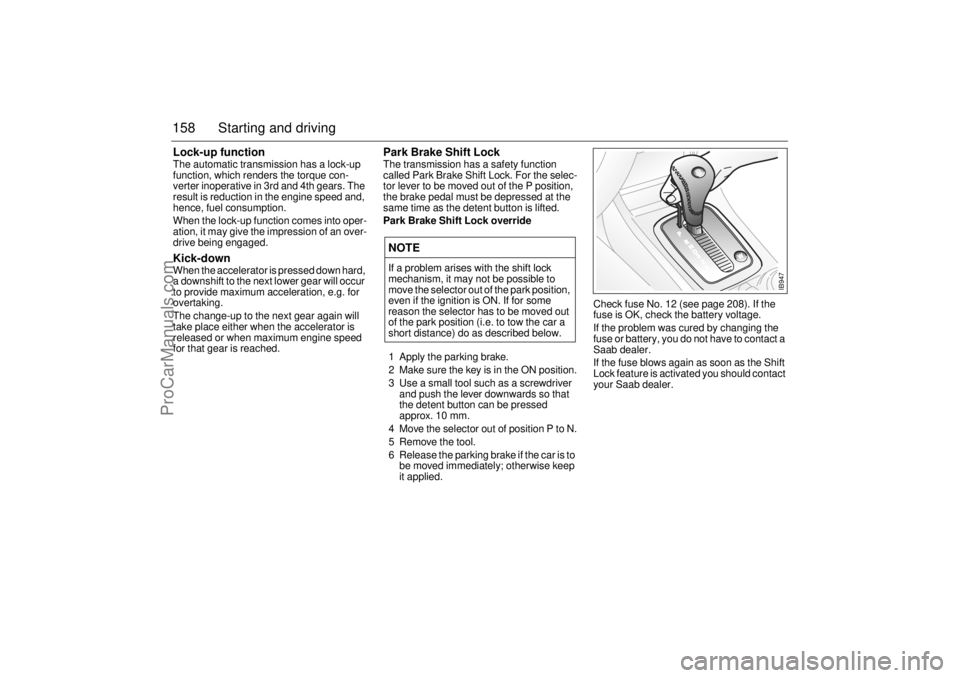
Park Brake Shift Lock override
1 Apply the parking brake.
2 Make sure the key is in the ON position.
3 Use a small tool such as a screwdriver
and push the lever downwards so that
the detent button can be pressed
approx. 10 mm.
4 Move the selector out of position P to N.
5 Remove the tool.
6 Release the parking brake if the car is to
be moved immediately; otherwise keep
it applied.Check fuse No. 12 (see page 208). If the
fuse is OK, check the battery voltage.
If the problem was cured by changing the
fuse or battery, you do not have to contact a
Saab dealer.
If the fuse blows again as soon as the Shift
Lock feature is activated you should contact
your Saab dealer.NOTEIf a problem arises with the shift lock
mechanism, it may not be possible to
move the selector out of the park position,
even if the ignition is ON. If for some
reason the selector has to be moved out
of the park position (i.e. to tow the car a
short distance) do as described below.
IB947
ProCarManuals.com
Page 159 of 256
159 Starting and driving
Automatic transmission
fault indicator
If the symbol appears on the main instru-
ment panel, the system has detected a fault
in the automatic transmission or its control
module (see page 64).
This also means that the Limp-home mode
has been selected, to guard against further
damage being done to the transmission. In
this mode, the automatic transmission
starts in 4th gear, and gear changes (if nec-
essary) will have to be made manually.
It is not possible to select the SPORT or
WINTER mode when the Limp-home mode
is active.
You should have the automatic transmis-
sion checked as soon as possible by an
authorized Saab dealer.
The following gears will be engaged in the
respective selector positions when the auto-
matic transmission is in the Limp-home
mode:
Overheated transmission oilIf the transmission oil becomes overheated
while driving, the following message
appears on the SID: TRANSMISSION
OVERHEATING. In this event, stop the car
in a suitable place, switch off the engine,
open the hood and wait until the message
goes out. When driving subsequent to the
transmission oil overheating, select either
3rd gear or Drive, whichever will allow the
engine to run at 3,000 rpm and maintain the
speed of traffic or a safe speed.
The transmission oil can become very hot
when the car is driven with a heavy load; for
example, driving with a trailer on hilly roads
when the wrong gear has been selected,
resulting in many extra gear changes.
Select one of the positions 1, 2 or 3. A high
outside temperature or a defective oil cooler
can also cause the oil temperature to
increase. Contact an authorized Saab
dealer, see also page 173.
Driving in hilly country with a heavy
loadOverheating of the automatic-transmission
fluid can occur when the car is towing a
heavy load, such as a trailer in hilly country,
with the wrong gear selected, resulting in
abnormally frequent gear changing. To
avoid the transmission oil from overheating
always drive in Normal mode, then the
adaptive gear change pattern is active.
High ambient temperatures can also
increase the temperature of the transmis-
sion fluid or the oil cooler may be faulty. As
the transmission fluid temperature
increases, its useful service life is reduced.
Contact an authorized Saab dealer (see
also page 173).TowingTowing a car with automatic transmission,
see page 181. Position R D 3 2 1
Gear Reverse 4th 4th 3rd 3rd
NOTEIf the control module has actuated the
Limp-home function for the automatic
transmission, the car will remain in 4th
gear when D and 3 are selected, making
it very sluggish. To overcome this, move
the selector lever to position 1. The trans-
mission then starts in 3rd gear. When the
car is moving you can select position D
or 3.
WARNING
Remember to use engine-braking (selec-
tor position 1, 2, or 3) to spare the brakes
when you are driving on a long or steep
downhill slope.
Brake failure can result from overheated
brakes!
ProCarManuals.com
Page 164 of 256

164 Starting and drivingDisengaging the system The system will be disengaged:
When the brake or clutch pedal is
depressed.
When the switch is moved to CANCEL.
When the switch is moved to OFF.
When the engine is switched off.
When the selector lever is moved to posi-
tion N (cars with automatic transmission).
BrakingTo avoid overheating the brakes, (e.g. when
negotiating long descents with a drop of
several hundred feet), select a low gear to
use the braking effect of the engine. If the
car has automatic transmission, move the
selector lever to position 1 or 2.
When driving fast, you can help to prolong
the life of the brakes by thinking ahead and
braking harder for short periods, rather than
braking more moderately over long
stretches. Brake pad wear indicatorsThe outboard brake pads on the front
wheels incorporate pad-wear indicators.
When the lining is down to 3 mm, the pad
will produce a screeching, squealing or
scraping noise when the brakes are applied.
New pads should be installed without delay.
Brake pads should only be replaced by
an authorized Saab dealer.
To ensure optimum brake performance,
it is recommended that you use only
Saab original brake pads.
WARNING
It is prudent to try your brakes from
time to time, especially when driving in
heavy rain, through water collected on
the road, in snow, on a wet road sur-
face or in salty slush. In such condi-
tions, the brakes may take longer than
normal to take effect. To rectify this,
touch the brake pedal periodically to
dry the brakes out.
The same applies after the car has
been washed or when the weather is
very humid.
Avoid parking the car with wet brakes.
Before parking, and if the traffic condi-
tions allow, brake quite heavily so that
the brake discs and pads warm up and
dry.
The brakes are power assisted and it
should be kept in mind that the servo
unit only provides the power assis-
tance when the engine is running.
The brake pressure required when the
engine is off,( e.g. when the car is
being towed) is roughly four times the
normal pedal force required. The
pedal also feels hard and unrespon-
sive.
ProCarManuals.com
Page 169 of 256
169 Starting and driving
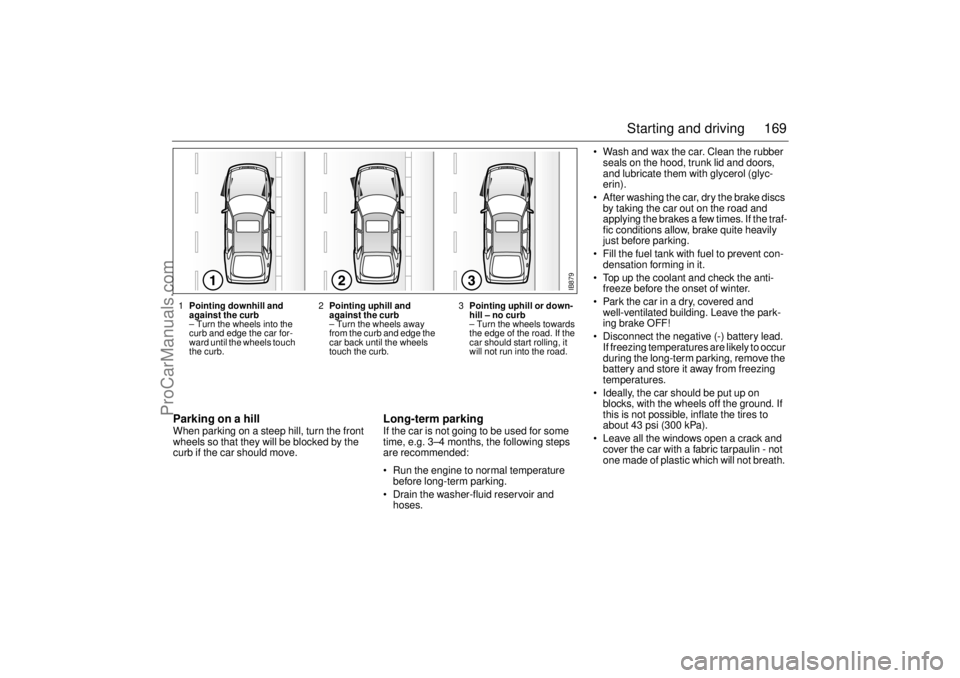
Parking on a hillWhen parking on a steep hill, turn the front
wheels so that they will be blocked by the
curb if the car should move.
Long-term parkingIf the car is not going to be used for some
time, e.g. 3–4 months, the following steps
are recommended:
Run the engine to normal temperature
before long-term parking.
Drain the washer-fluid reservoir and
hoses. Wash and wax the car. Clean the rubber
seals on the hood, trunk lid and doors,
and lubricate them with glycerol (glyc-
erin).
After washing the car, dry the brake discs
by taking the car out on the road and
applying the brakes a few times. If the traf-
fic conditions allow, brake quite heavily
just before parking.
Fill the fuel tank with fuel to prevent con-
densation forming in it.
Top up the coolant and check the anti-
freeze before the onset of winter.
Park the car in a dry, covered and
well-ventilated building. Leave the park-
ing brake OFF!
Disconnect the negative (-) battery lead.
If freezing temperatures are likely to occur
during the long-term parking, remove the
battery and store it away from freezing
temperatures.
Ideally, the car should be put up on
blocks, with the wheels off the ground. If
this is not possible, inflate the tires to
about 43 psi (300 kPa).
Leave all the windows open a crack and
cover the car with a fabric tarpaulin - not
one made of plastic which will not breath.
IB879
1Pointing downhill and
against the curb
– Turn the wheels into the
curb and edge the car for-
ward until the wheels touch
the curb. 2Pointing uphill and
against the curb
– Turn the wheels away
from the curb and edge the
car back until the wheels
touch the curb. 3Pointing uphill or down-
hill – no curb
– Turn the wheels towards
the edge of the road. If the
car should start rolling, it
will not run into the road.
ProCarManuals.com
Page 170 of 256
170 Starting and drivingEconomical motoringFactors affecting fuel consumption Fuel consumption is greatly affected by the
general driving conditions, the way in which
the car is driven and at what speeds, the
weather, the state of the road, the condition
of the car, etc. Breaking-in Fuel consumption may be somewhat higher
during the break-in period (the first 3,000–
4,000 miles (5,000–7,000 km). Weather conditionsFuel consumption can be as much as 10 %
lower in summer than in winter. The higher
consumption in cold weather is explained by
the longer time it takes for the engine to
reach normal operating temperature, and
for the transmission and wheel bearings to
warm up. Fuel economy is also affected by
the distance driven: short journeys of
3-5 miles (5-8 km) do not give the engine
enough time to reach normal temperature.
Strong winds can also affect fuel consump-
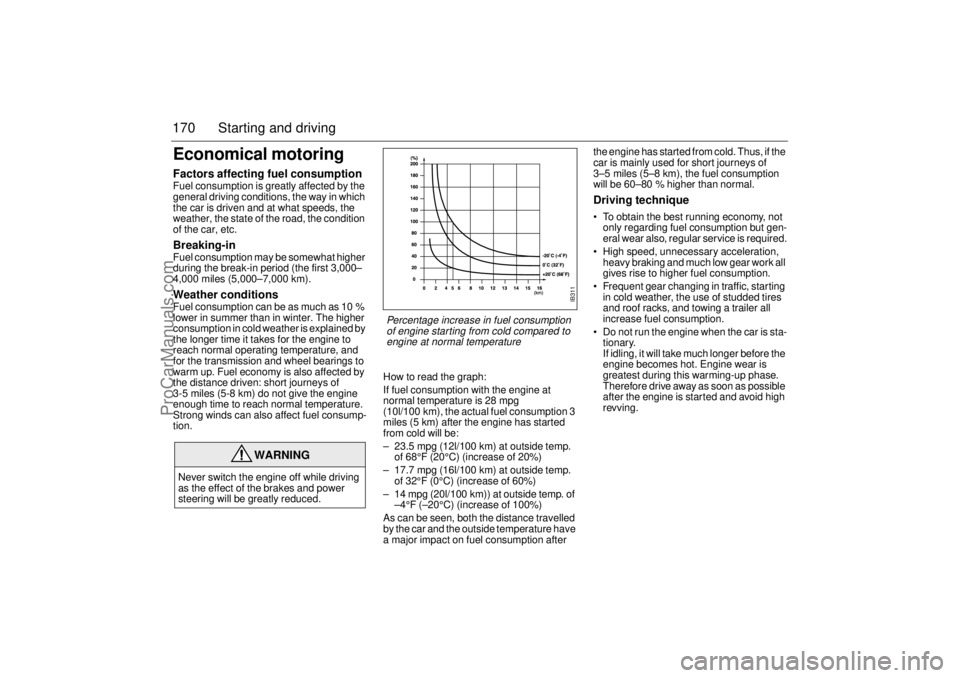
tion. How to read the graph:
If fuel consumption with the engine at
normal temperature is 28 mpg
(10l/100 km), the actual fuel consumption 3
miles (5 km) after the engine has started
from cold will be:
– 23.5 mpg (12l/100 km) at outside temp.
of 68°F (20°C) (increase of 20%)
– 17.7 mpg (16l/100 km) at outside temp.
of 32°F (0°C) (increase of 60%)
– 14 mpg (20l/100 km)) at outside temp. of
–4°F (–20°C) (increase of 100%)
As can be seen, both the distance travelled
by the car and the outside temperature have
a major impact on fuel consumption after the engine has started from cold. Thus, if the
car is mainly used for short journeys of
3–5 miles (5–8 km), the fuel consumption
will be 60–80 % higher than normal.
Driving technique To obtain the best running economy, not
only regarding fuel consumption but gen-
eral wear also, regular service is required.
High speed, unnecessary acceleration,
heavy braking and much low gear work all
gives rise to higher fuel consumption.
Frequent gear changing in traffic, starting
in cold weather, the use of studded tires
and roof racks, and towing a trailer all
increase fuel consumption.
Do not run the engine when the car is sta-
tionary.
If idling, it will take much longer before the
engine becomes hot. Engine wear is
greatest during this warming-up phase.
Therefore drive away as soon as possible
after the engine is started and avoid high
revving.
WARNING
Never switch the engine off while driving
as the effect of the brakes and power
steering will be greatly reduced.
IB311
Percentage increase in fuel consumption
of engine starting from cold compared to
engine at normal temperature
ProCarManuals.com
Page 173 of 256
173 Starting and driving
Driving in hot weather Always check the coolant level before
starting a journey. When the engine is
cold, the coolant must not be above the
KALT/COLD mark on the expansion tank.
At the end of a journey, if the engine has
worked hard, allow it to idle for two or
three minutes before switching it off.
If the needle on the temperature gauge
enters the red zone:
1 Bring the car to a standstill but leave the
engine running. Do not remove the cap
on the expansion tank even if the tank is
empty. The engine temperature should
decrease. If the temperature continues
to rise with the engine idling, the engine
must be switched off. 2 If the engine is idling and the needle on
the temperature gauge falls, wait until a
normal temperature is shown (about in
the middle of the scale) before switching
off the engine. If the coolant needs top-
ping up, unscrew the cap on expansion
tank carefully.
Top up, as necessary, ideally with a
50/50 mixture of coolant and water. Use
a Saab-approved coolant. If only water
is available, use that, but remember to
have the coolant mixture checked as
soon as possible.
3 As soon as possible, have the cooling
system checked by an authorized Saab
dealer.
Towing a trailerTrailer hitch attachment Trailer hitch attachments are available as
accessories. These are designed for a max-
imum trailer weight of 3500 lbs (1588 kg),
with trailer brakes, see also page 236.
Use only the electrical trailer hitch connec-
tor provided in the trailer hitch kit.
Saab recommends:
Use a Saab original hitch kit attachment
which is designed and tested by Saab.
Consult your Saab dealer for the right
hitch kit for your car.
WARNING
Always undo the expansion tank filler cap
carefully, releasing the pressure and any
vapor before removing the cap com-
pletely.
NOTEUse only a genuine Saab trailer hitch and
wiring, since other wiring methods can
cause expensive damage to the car’s
body and electrical system.
Consult an authorized Saab dealer for
guidance on how to connect the trailer
hitch electrical system.
ProCarManuals.com